223
A quantitative modeling approach to estimate the risks posed by the smuggled animal products contaminated
with Foot-and-Mouth Disease (FMD) virus
Ki-Ok Hong, Gil-Hong Lee, Son-Il Pak
1*
National Veterinary Research and Quarantine Services, Ministry of Agriculture and Forestry, Anyang 430-824, Korea
1
Department of Veterinary Medicine, Kangwon National University, Chunchon 200-701, Korea
(Accepted: May 23, 2005)
Abstract : A quantitative risk assessment tool was used to provide estimates of the probability that foot- and-mouth (FMD) virus-contaminated, smuggled animal products are fed to susceptible swine in Korea.
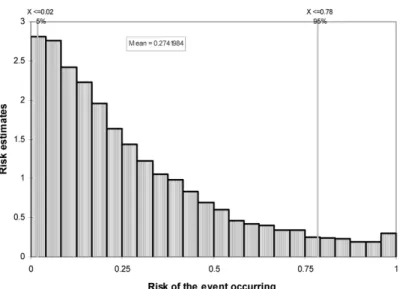
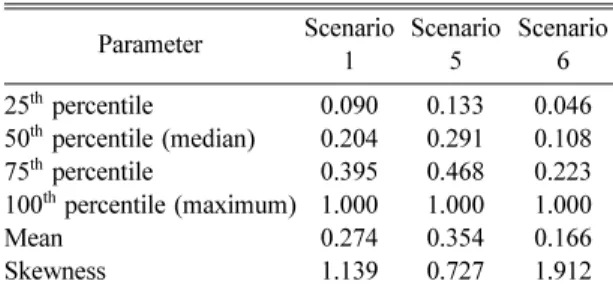
Sensitivity analyses were conducted to attempt to distinguish between parameter uncertainty and variability, using different assumptions on the effect of cooking at home, the effect of the fresh meat, and the effect of heat treatment at garbage processing facility. The median risk estimate was about 20.1% with a mean value of 27.4%. In a scenario regarding all beef and pork were considered as fresh meat the estimated median risk was 3.4%. The risk was greatly dependent on the survival parameters of the FMD virus during the cooking or heat treatment at garbage processing facility. Uncertainty about the proportion of garbage that is likely contaminated with FMD had a major positive influence on the risk, whereas conversion rate representing the size of a load had a major negative effect. This model was very useful in assessing the risk explored. However, the model also requires enhancements, such as the availability of more accurate data to verify the various assumptions considered such as FMD prevalence in a specific country, proportion of garbage which is recycled as feed, proportion of food discarded as garbage. Other factors including the effect of selection of animals for slaughter, ante- and post-mortem inspection, the domestic distribution of the smuggled products, and susceptible animals other than pigs, are need to be taken into account in the future model development.
Key words : risk assessment, foot-and-mouth disease, simulation, animal product, garbage
Introduction
Foot-and-mouth disease (FMD) is a highly contagious viral disease that primarily affects cloven-footed animals.
The disease is characterized by the formation of vesicles on the skin. The nostrils, lips, oral mucosa, coronary bands and interdigital space of the feet typically are affected [15]. Affected animals often drool and may be lame [9]. The importance of FMD lies not so much in its killing power, for mortality usually is not great, but in morbidity losses of milk and long periods in which affected animals are not productive [8]. The most significant effect of an outbreak of FMD in developed countries is the widespread restriction on trade in susceptible animals and animal products imposed by FMD-free trading partners [2, 5, 7]. For this reason,
FMD is regarded as one of the most important non- zoonotic animal disease and categorized as listed disease by Office International des Epizooties (OIE).
There are several animal diseases which could be introduced into a country by means of smuggled animal products. In 1995, Centers for Epidemiology and Animal Health (CEAH) of the United States Department of Agriculture (USDA) [3] performed a risk assessment on swill feed practice for FMD, classical swine fever (CSF), African swine fever (ASF) and swine vesicular disease (SVD). Canada also has its own primary disease lists which should be considered first in risk assessment related with animal and/or their products and those lists include FMD and bovine spongiform encephalopathy for bovine meat and edible offal and FMD, SVD, ASF and CSF for swine meat and edible offal [1].
*Corresponding author: Son-Il Pak
Department of Veterinary Medicine, Kangwon National University, Chunchon 200-701, Korea
[Tel: +82-33-250-8672, Fax: +82-33-244-2367, E-mail: [email protected]]
Under the Agreement on Sanitary and Phytosanitary Measures (SPS) member countries can employ measures to protect human, animal or plant health provided that these measures are based on scientific evidence [12].
With regard to the importation of a commodity, the main aim of the SPS is to provide importing countries with an objective and defensible method of assessing the disease risks associated with the importation of animals and animal products, and can be achieved by use of import risk analysis [14].
With this background the authors performed a risk assessment to answer the question: what is the probability that at least one load of garbage which is contaminated with FMD virus (FMDV) and smuggled into Korea from foreign country, will be insufficiently treated and ultimately fed to Korean swine in a year? To the author’s knowledge the answers are of value to the government authorities as they continue to develop quarantine policy to reduce the disease risks associated with illegal imports, emphasizing the need to maintain high standards of biosecurity in Korea.
Materials and Methods
Scenario and Monte Carlo simulation
The scenario considered in the present study was basically originated from a model conducted by CEAH, USDA [3]. Overall, the scenario consisted of 5 steps of conditional probabilities. Briefly, the initiating event is the selection of meat or meat products to be smuggled into Korea. Branch point 1 is the probability (F1) that the animal which was selected for slaughter and the meat or meat product to smuggle into Korea is infected with FMDV. The probability of F1 is associated with the prevalence of FMD in the country of origin. Branch point 2 is the probability (F2) that the items carry FMDV, given that the animal from which the item was made is infected with the virus in specific country. The probabilities, F1 and F2 correspond to release assessment that assesses the probability that the FMDV can be released into Korea by those items. Branch point 3 is the probability (F3) that the item contains FMDV even after heat treatment in households or cooking facilities.
Branch point 4 is the probability (F4) that the item is discarded with FMDV as garbage and collected by garbage collector to use as recycled feed and holds the virus after heat treatment in the collectors’ facility.
Finally, branch point 5 is the probability (F5) that the
item is likely fed to susceptible swine in Korea, given that it holds the FMDV. The probabilities, F3, F4 and F5 correspond to exposure assessment which assesses the probability that FMDV can be exposed to swine in Korea. Overall probability gives us the estimate for total probability that smuggled animal products con- taminated with FMDV is fed to Korean swine.
The formulas and probability distributions used in the model are described in Table 1. The model was written in Microsoft Excel (Microsoft, Seattle, WA) and run using @Risk (Palisade, Newfield, NY) Monte Carlo simulation software with 10,000 iterations with Latin hypercube sampling.
Modeling methods (1) Input parameters
①
F1 (FMD prevalence)
The prevalence of FMD in the country of origin was estimated by Annual Animal Health Information using Handistatus of the OIE. In this assessment, the prevalence of the country in which there was no outbreak of the disease in 1998-2002, was assigned as ‘negligible’ and in which there was only one year when it had outbreaks of the disease, as ‘low’. The countries of origin which had had 2 or 3 years when it had outbreaks of the disease was categorized into ‘medium’ prevalence, and the countries which had had 4 or 5 years when it had had outbreaks, into ‘high’ prevalence. To incorporate the uncertainty of the prevalence, the probability distributions were estimated for each level of prevalence using triangular distribution. FMD prevalence in negligible risk group was designated as F1n, in low risk group as F1l, in moderate risk group as F1m and in high risk group as F1h.
②
CAM (amount of animal products smuggled) CAM is the amount of animal products which are smuggled into Korea from other countries without detection. This was inferred from the amount of animal products which were detected by National Veterinary Research and Quarantine Services (NVRQS) upon entry into Korea [13]. In 2003, NVRQS detected about 36,000 kg upon entry which was decided as inappropriate to pass and all of them were dealt mainly by burning.
Assuming that between 50-90% of contraband food of
animal origin in passenger baggage at airports escapes
interception [3], estimated minimum CAM was 36,000
kg and maximum 180,000 kg.
③
PCAM(proportion of intercepted animal products) The proportion of intercepted animal products from specific countries group was calculated directly from the NVRQS report [13]. After the amount of animal products from each group was divided by total amount, the resulting proportion for negligible risk group was designated as PCn, for low risk group as PCl, for medium risk group as PCm and for high risk group as PCh.
④
F2 (proportion of each product)
The period of FMDV persistence is strongly affected
by the type of animal products and by processing that may occur. To incorporate this, animal products was divided into beef, pork, ham, sausage, bacon, poultry and other meats. The proportions of the amount of each product type per specific group of countries were calculated by the amount of each product type divided by sub-total amount per specific group. Poultry and other meats (type A) were considered not to have potency to carry FMDV. Beef and pork (type B) was considered to have equal potency to carry FMDV. Ham, sausage and bacon (type C) were cooked by different method and considered to have less potency. The proportion of Table 1. Description of model inputs and outputs
Description of variables Notation Formula used with @Risk (the notations of MS Excel are being used) Input parameters
FMD prevalence in specific country group F1 Negligible = 0
Low = RiskTriang (0,0.0005,0.001) Medium = RiskTriang (0.001,0.03,0.05) High = RiskTriang (0.05,0.1,0.2) The amount of animal products smuggled CAM RiskUniform (36000, 180000) Proportion of intercepted animal products PCAM Negligible = 0.3138
Low = 0.1289 Medium = 0.3792
‘ High = 0.1781
Proportion of each product F2 F2bb: beef (low=0.33; med=0.38; high=0.264) F2bp: pork (low=0.1; med=0.17; high=0.11)
F2c: ham. Sausage, bacon (low=0.5; med=0.35; high=0.59) F2ao: other meat (low=0.028; med=0.057; high=0.01) F2ap: poultry (low=0.042; med=0.043; high=0.026) Proportion of FMDV contaminated SAP PCA RiskOutput(((F2bbl+F2bpl+F2lc*(1-F3))*F1l*PCl
+(F2bbm+F2bpm+F2mc*(1-F3))*F1m*PCm +(F2bbh+F2bph+F2hc*(1-F3))*F1h*PCh)) The amount of FMDV contaminated SAP CA RiskOutput (CAM*PCA)
Effect of home cooking F3 0.85
Effect of heat treatment at garbage facility F4 0.5
Total food consumed in households in Korea TF 26,018,900 ton Total garbage in Korea per year TG 4,101,505 ton Proportion of garbage which is recycled as feed PG 0.3
Proportion of food discarded as garbage DR TG/TF The amount of likely FMDV-contaminated garbage AP CA*F3*F4*DR
Proportion of garbage that is contaminated with FMDV TP RiskOutput (RiskUniform(0, AP/TG))
Loads of garbage fed to swine F TG/CR
Conversion rate CR RiskTriang (0.06, 3.58, 26)
Output parameters P 1-(1-TP)
FAbbreviation: SAP, smuggled animal products.
Refer to texts for detailed description for each notation.
type A-related animal products in low risk group was designated as F2la, that of type B as F2lb and that of type C as F2lc. The proportion of each product type for other group of countries was designated as same pattern.
⑤
PCA (proportion of FMDV-contaminated, smuggled animal products upon entry) and CA (amount of FMDV- contaminated, smuggled animal products)
PCA is affected by processing techniques that are often aimed at preserving the meat, including canning, freezing, chilling, smoking, salting, drying, or any combination of these. Considering Type A was thought not to carry FMDV the prevalence for type A was set to zero. For type B and C which could carry the virus, the survivability of the FMDV in that product was evaluated relative to the assumed transit time of 14 days, which means the time interval from the point that the meat or products had been prepared such as slaughter to the point that the garbage which had been derived from the meat or products were fed to swine in Korea [3, 4]. The effect of frozen or chilling was compared in scenario 2. There could be heating below the standards required or contamination with strains from more heat-resistant sub-population, and thus 85%
of type C was estimated free from FMD prevalence.
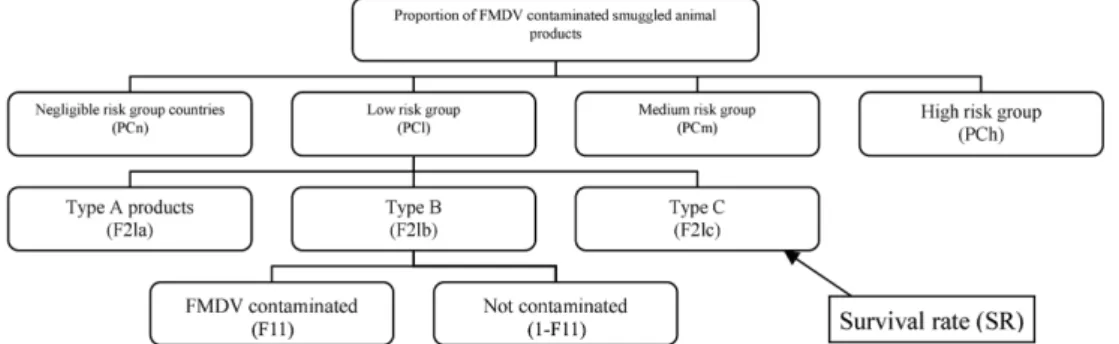
The PCA was calculated using the nested probability.
In Fig. 1, because the sum of each row should be one, and thus the following equations are valid: PCn+PCl +PCm+PCh = 1; F2la+F2lb+F2lc = 1 and F1l+(1-F1l)
= 1. To calculate the PCA for low risk group of countries, following equation is used: (0×F2la)+(F1l×F2lb)+(F1l
×F2lc×SR) = PCAl. Total PCA is calculated from the following equation: PCAn+PCAl+PCAm+PCAh = PCA.
CA represents the amount of FMDV-contaminated, smuggled animal products from foreign countries and was calculated from the equation: PCA×CAM.
⑥
F3 (effect of home cooking) and F4 (effect of heat treatment at garbage processing facility)
F3 is the value to incorporate the effect of home cooking into this assessment. Based on the literatures [16] who reported 15% of incidence of food handling malpractices at home cooking, it was assumed that 85%
of FMDV contaminated smuggled animal products could be FMDV-free after home cooking. This value may not appropriate for the situation in Korea. F4 represents how much proportion of the garbage would be FMDV- free after heat treatment at garbage facility. Since credible data was not available at the time of performing this assessment, we assumed roughly 50%.
⑦
TF (total food consumed in households in Korea) TF is the amount of food which is consumed in Korean household in a year. Based on the annual report on food supply by Korean Rural Economic Institute (KREI) [10], the data for the year of 2002 was used as 26,018,900,000 kg. The authors consider that if the real food consumption is less than the above-mentioned figure, this change may contribute risk-reducing effect.
⑧
TG (total garbage in Korea per year), PG (proportion of garbage which is recycled as feed) and DR (discard rate)
TG is the amount of garbage in Korea per year and PG is the proportion of garbage which is recycled as livestock feed. Municipal waste management division of the Korean Ministry of Environment [11] reported
Fig. 1. Schematic diagram of estimating the proportion of FMDV-contaminated, smuggled animal products upon entry in
each level of risk.
the total garbage occurred in 2001 was about 4,101,500 kg, recycling rate of garbage is 56.8% and the proportion of feeding in recycling is 53.3%. Based on this information, TG was estimated as 4,101,500 kg and PG is 56.8%×53.3% = 30.3%. DR, the proportion of food discarded as garbage, was calculated TG divided by TF.
⑨
AP (amount of likely FMDV-contaminated garbage) and TP (proportion of Korean garbage that is likely contaminated with FMDV)
AP is the amount of garbage which is likely FMDV- contaminated garbage from foreign country and TP is the proportion of AP in total garbage per year. AP was calculated from following equation: AP = CA×(1-F3)
×F4×DR. It was assumed that smuggled animal products are discarded at a rate equal to or less than domestic food products [3]. TG was modeled as a uniform distribution using minimum of 0 (DR for smuggled products = 0) to a maximum of AP/TG (DR for smuggled products = DR for domestic food products).
⑩