경남지역 단감 재배 토양의 화학성 변화 평가
이영한†·최성태†·이성태·홍광표·송원두·이진호1·조주식2* 경상남도농업기술원, 1전북대학교 농업생명과학대학, 2순천대학교 생명환경과학부
Seasonal Change in the Soil Chemical Properties from Sweet Persimmon Orchard in Gyeongnam Province
Young-Han Lee†, Seong-Tae Choi†, Seong-Tae Lee, Kang-Pyo Hong, Won-Doo Song, Jin-Ho Lee1, and Ju-Sik Cho2*
Gyeongsangnam-do Agricultural Research and Extension Services, Jinju 660-370, Korea.
1Department of Bioenvironmental Chemistry, College of Agricultural and Life Sciences, Chonbuk National University, Jeonju 561-756, Korea.
2Division of Applied Life and Environmental Sciences, Sunchon National University, Sunchon, 540‐742, Korea
Field monitoring was performed to evaluate the soil chemical properties of 31 sweet persimmon orchard soil samples every two months from April to October in 2008 at Gyeongnam Province. Soil chemical properties such as pH, organic matter, available phosphate, exchangeable potassium, exchangeable calcium, exchangeable magnesium, exchangeable sodium, ammonium nitrogen, and nitrate nitrogen were analyzed.
The soil chemical properties of both top soil, and subsoil showed that soil pH was significantly increased whereas ammonium nitrogen, and nitrate nitrogen were significantly decreased. The insufficient levels of nutrients in top soil, and subsoil were higher in 69.4%, and 84.7% for pH, 63.7%, and 84.7% for organic matter compared to optimum range. Meanwhile, the excessive levels of available phosphate showed 70.2% in top soil, and 46.8% in subsoil compared to optimum range. The experimental results showed that the optimum fertilization based on soil testing was the most important thing in soil nutrients management for sweet persimmon.
Key words: Sweet persimmon, Soil monitoring, Chemical property, Seasonal Change
접수 : 2010. 8. 30 수리 : 2010. 9. 30
*연락저자 : Phone: +82617503297 E-mail: [email protected]
† 공동 제 1저자
서 언
경남지역 단감은 재배면적이 2009년 기준으로 전국 재배면적 14,785 ha의 55% (8,132 ha)를 차지하고 있 으며 생산량은 109 천톤으로 전국 생산량의 56%를 차지 하고 있어 경남의 대표적인 과수이다 (KOSIS, 2010).
단감은 내한성이 약한 온대성 과수로서 남부지역에 국한 되어 재배되고 있으며 토양조건에 대한 적응은 다른 과 수보다 넓은 것으로 보고되고 있다 (Ha et al., 1982).
그러나 남부지역 단감 과원의 79%가 15% 이상 경사지 에 분포되어 있으며 75%는 구릉지 및 산악지 등에 분포 되어 있어 (Jung et al., 1993) 토양 침식이나 양분 유 실이 매우 심하여 단감과원 토양 양분관리가 매우 어려
운 실정이다 (Jung et al., 2007; Lee et al., 2006).
Jung et al. (2005)은 수치 정밀토양도를 이용하여 전 국 토양 유실량을 평가한 결과 경남지역이 강우인자와 경사도가 크게 나타나 단위면적당 연간 토양 유실량이 가장 높았다고 하였다. 특히, 다년생 작물인 단감의 생 육은 주로 시비에 의해 크게 지배된다고 할 수 있으며 합리적인 토양관리를 위해서는 토양분석 결과를 토대로 시비량의 조절이 필수적이다 (Lee et al., 1993). 그러 나 경남지역의 단감 재배지 토양에 대한 분석은 Ha et al. (1982)이 보고한 이후 전무한 실정이며 시기별로 토 양 화학성의 변화를 검토한 결과는 거의 없다. 따라서 본 연구는 경남지역 단감 재배지 토양 31개소를 대상으 로 단감의 생육기간인 4월부터 10월까지 2개월 단위로 토양 화학성분 변화를 분석하고 주요 변동요인을 해석하 여 효율적인 토양 양분관리를 위한 기초 자료를 제공하 는데 목적이 있다.
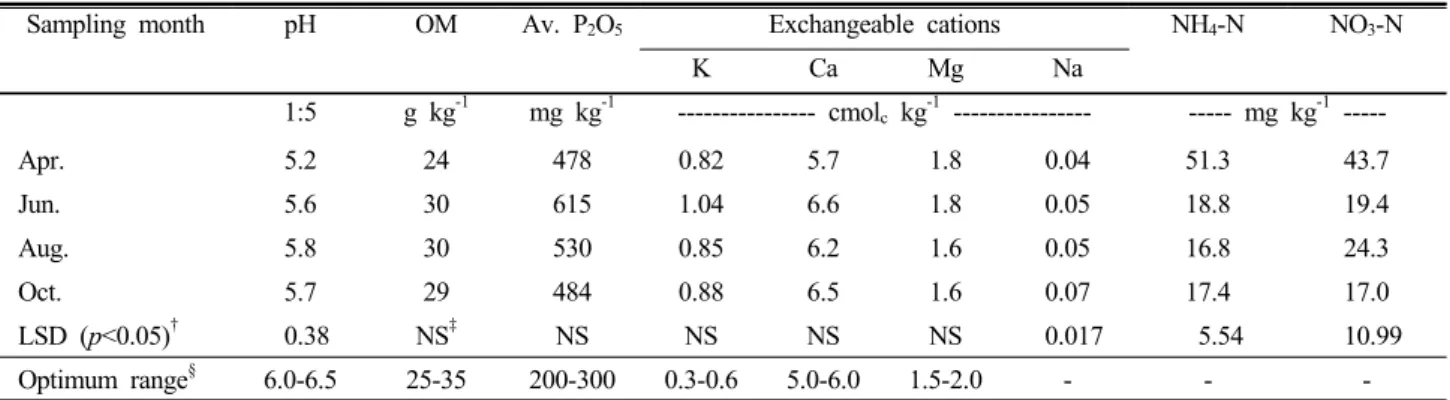
Table 1. Chemical properties of top soil for sweet persimmon cultivation.
Sampling month pH OM Av. P2O5 Exchangeable cations NH4-N NO3-N
K Ca Mg Na
1:5 g kg-1 mg kg-1 --- cmolc kg-1 --- --- mg kg-1 ---
Apr. 5.2 24 478 0.82 5.7 1.8 0.04 51.3 43.7
Jun. 5.6 30 615 1.04 6.6 1.8 0.05 18.8 19.4
Aug. 5.8 30 530 0.85 6.2 1.6 0.05 16.8 24.3
Oct. 5.7 29 484 0.88 6.5 1.6 0.07 17.4 17.0
LSD (p<0.05)† 0.38 NS‡ NS NS NS NS 0.017 5.54 10.99 Optimum range§ 6.0-6.5 25-35 200-300 0.3-0.6 5.0-6.0 1.5-2.0 - - -
† Values within a column followed by the same letter are not significantly different at 5% level by LSD (Least significant difference); ‡ NS: Not significant; §Fertilizer recommendation for crops (NIAST, 2006).
재료 및 방법
단감 토양 지점 선정 및 시료채취 방법 경남지역 단감 산학연 협력단 참여 농가의 토양 화학성분 변동을 시기적으로 파악하기 위하여 2008년에 토양 유형, 지형 및 토성 (RDA, 1983)과 지역별 분포면적 비율을 기준으로 창 원 7, 마산 1, 진주 6, 사천 3, 김해 5, 밀양 2, 함안 2, 창 녕 1, 하동 3, 산청 1 등 31개 지점을 선정하였고 4월부터 10월까지 2개월 단위로 4회 조사하였다. 분석에 사용된 토양 시료는 표토 (0-20 cm)와 심토 (20-40 cm)로 구분 하여 500 g 정도를 3반복으로 채취하였다.
토양 시료조제 및 화학성분 분석방법 채취한 토 양은 실험실에서 7일간 풍건하여 2 mm 체를 통과된 것 을 화학성분 분석에 사용하였다. 화학성분 분석은 농촌 진흥청 농업과학기술원 토양 및 식물체 분석법 (NIAST, 2000)을 적용하여 pH는 토양과 증류수의 비율을 1:5로 하여 초자전극법 (Orion 520A pH meter, Orion Research Inc., Boston, USA)으로 측정하였고, 유기물은 Tyurin 법으로 적정하였으며, 유효인산은 Lancaster법으로 비 색계 (UV-1650PC, Shimadzu Co., Kyoto, Japan)를 사용하였다. 치환성 양이온인 칼륨, 칼슘, 마그네슘, 나 트륨 등은 1M NH4OAc로 추출하여 원자흡광분광광도계 (AAnalyst 300, Perkin-Elmer, Norwalk, USA)로 분석하였고 암모니아태 질소와 질산태 질소는 킬달분석 법으로 측정하였다.
다변량 주성분 분석 및 통계분석 분석된 토양 화 학성은 SAS 프로그램 9.1.3 버젼 (2006)을 사용하였다.
시기별 토양 화학성분은 5% 수준에서 LSD 검정을 하였 으며 화학성분 간의 상관관계를 분석하였다. 또한 토양 화학성분의 주성분 분석을 통하여 시기별 화학성분의 변 화를 비교 검토하였다.
결과 및 고찰
단감 재배지 토양 화학성 변화 경남지역 단감 재 배지 표토의 시기별 화학성분 평균 함량 변화는 Table 1 과 같다. 토양 pH 값은 4월에 5.2에서 6월, 8월, 10월 에 각각 5.6, 5.8, 5.7의 값으로 유의적인 증가를 나타 냈으나 적정수준인 6.0-6.5 (NIAST, 2006) 보다 낮았다.
토양 pH의 증가는 토양개량제로 사용한 석회 성분의 용 출과 질산태 질소 함량의 감소와 관련이 있는 것으로 판 단되었다. 표토의 유기물 함량은 24-30 g kg-1, 유효인산 은 478-615 mg kg-1, 치환성 칼륨은 0.82-1.04 cmolc kg-1, 치환성 칼슘은 5.7-6.6 cmolc kg-1, 치환성 마그네슘은 1.6-1.8 cmolc kg-1으로 생육시기에 따른 유의적인 차 이가 없었다. 농촌진흥청에서 2002년 전국 97개소 (NIAST, 2003)와 2006년 전국 103개소 (NIAST, 2007)의 단감 재 배지 표토를 분석한 결과 pH는 5.9, 유기물 함량은 25-28 g kg-1, 유효인산은 661-882 mg kg-1, 치환성 칼륨은 0.92- 1.16 cmolc kg-1, 치환성 칼슘은 5.7-7.3 cmolc kg-1, 치 환성 마그네슘은 1.7-2.0 cmolc kg-1이라고 보고한 바와 유사한 경향이었다. 표토의 암모니아태 질소 함량과 질산 태 질소 함량은 4월에 각각 51.3 mg kg-1과 43.7 mg kg-1 으로 가장 높았으나 6월이후 유의적인 감소를 나타냈다.
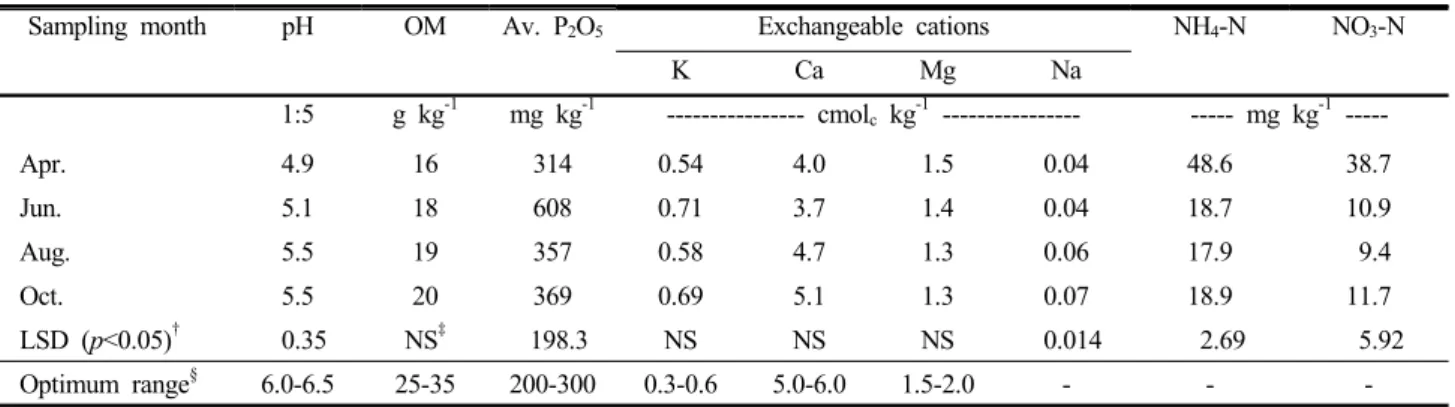
Clark and Smith (1990)는 부유 단감 과실의 ha당 양 분 흡수량은 질소 17.7 kg, 칼륨 49.8 kg, 인산 4.8 kg, 황 2.9 kg, 칼슘 3.6 kg, 마그네슘 1.7 kg, 나트륨 0.8 kg 이었으며, 질소는 생육초기에 흡수량이 많은 것으로 보 고한 바와 같이 생육기간이 경과함에 따라 토양의 질소 함량이 감소되는 것으로 판단되었다. 경남지역 단감 재 배지 심토의 시기별 화학성분 평균 함량 변화는 Table 2 와 같다. 심토의 pH는 4월에 4.9에서 생육시기가 경과함 에 따라 유의적인 증가를 나타냈다. 심토의 유기물 함량은 16-20 g kg-1, 치환성 칼륨은 0.54-0.71 cmolc kg-1, 치 환성 칼슘은 3.7-5.1 cmolc kg-1, 치환성 마그네슘은 1.3-
Table 2. Chemical properties of subsoil for sweet persimmon cultivation.
Sampling month pH OM Av. P2O5 Exchangeable cations NH4-N NO3-N
K Ca Mg Na
1:5 g kg-1 mg kg-1 --- cmolc kg-1 --- --- mg kg-1 ---
Apr. 4.9 16 314 0.54 4.0 1.5 0.04 48.6 38.7
Jun. 5.1 18 608 0.71 3.7 1.4 0.04 18.7 10.9
Aug. 5.5 19 357 0.58 4.7 1.3 0.06 17.9 9.4
Oct. 5.5 20 369 0.69 5.1 1.3 0.07 18.9 11.7
LSD (p<0.05)† 0.35 NS‡ 198.3 NS NS NS 0.014 2.69 5.92 Optimum range§ 6.0-6.5 25-35 200-300 0.3-0.6 5.0-6.0 1.5-2.0 - - -
†Values within a column followed by the same letter are not significantly different at 5% level by LSD (Least significant difference); ‡NS: Not significant; §Fertilizer recommendation for crops (NIAST, 2006).
Fig. 1. Frequency distribution of chemical properties from top soil (T) and subsoil (S) for sweet persimmon cultivation (n=124).
1.5 cmolc kg-1으로 생육시기에 따른 유의적인 차이가 없 었다. 농촌진흥청에서 2002년 전국 97개소 (NIAST, 2003) 와 2006년 전국 103개소 (NIAST, 2007)의 단감 재배지 심 토를 분석한 결과 pH는 5.6-5.7, 유기물 함량은 17-20 g kg-1, 유효인산은 491-740 mg kg-1, 치환성 칼륨은 0.67- 0.95 cmolc kg-1, 치환성 칼슘은 4.6-6.0 cmolc kg-1, 치 환성 마그네슘은 1.4-1.7 cmolc kg-1이라고 보고한 바와 유사한 경향이었다. 심토의 토양 화학성은 표토에 비해 낮 은 경향을 보였으며 (Lee et al., 2000; NIAST, 2003;
NIAST, 2007) 단감은 심근성 작물로서 뿌리가 심토에 많 이 분포되어 있기 때문에 심토의 부족한 유효양분 함량을 높이기 위해 심층시비가 필요하다. 또한, 질소 등의 유실 이 빠른 양분은 추비로 엽면시비 등을 통한 양분관리도 필 요할 것이다 (Hossain and Ryu, 2009; Kim et al., 2005;
Moon et al., 2002; Park et al., 2009).
토양 화학성 과부족 분포비율 단감 재배지 토양 의 화학성분의 과부족 분포 비율은 Fig. 1과 같다. 토양 pH 적정수준인 6.0-6.5 범위의 분포비율은 표토 17.7%
및 심토 6.5%로 매우 낮았다. 특히, 표토와 심토의 부 족한 비율이 각각 69.4%와 84.7%로 매우 높게 나타났다.
또한, 토양 유기물 함량도 적정수준인 25-35 g kg-1분
포비율은 표토 13.7%, 심토 4.0%로 매우 낮았으며 부족 한 비율이 각각 63.7% 및 84.7%로 매우 높았다. 따라서 단감 재배지 토양 양분관리를 위해서는 적절한 유기물 공 급이 필수적인 것으로 판단되었다. 치환성 칼슘의 적정수 준인 5.0-6.0 cmolc kg-1보다 부족한 비율은 표토 45.2%, 심토 68.5%였으며 치환성 마그네슘의 적정수준인 1.5- 2.0 cmolc kg-1 보다 부족한 비율도 표토 47.6%, 심토 57.3%로 높게 나타났으며 이러한 토양은 석회고토 등의 토양개량제를 시용함으로써 개선할 수 있을 것으로 기대 된다. 토양의 pH, 유기물, 치환성 칼슘 및 치환성 마그네 슘의 부족한 비율이 높은 반면 유효인산 및 치환성 칼륨 함량은 초과된 비율이 많았다. 즉, 유효인산 함량은 적정 수준인 200-300 mg kg-1보다 초과된 비율은 표토 70.2%, 심토 46.8% 였으며 치환성 칼륨 함량은 적정수준인 0.3- 0.6 cmolc kg-1보다 초과된 비율이 표토 63.7% 및 심 토 40.3%로 나타났다. 따라서 이러한 양분 불균형을 해 소하기 위해서는 토양검정에 의한 적정 시비가 매우 중 요한 것으로 판단되었으며 인산과 칼륨 함량이 다소 많 은 가축분 퇴비보다 신선 유기물을 공급하는 것이 유익 할 것으로 생각된다.
토양 화학성분 상관관계 및 주성분 분석 단감 재배 표토의 토양 화학성분의 상관관계는 Table 3과 같다.
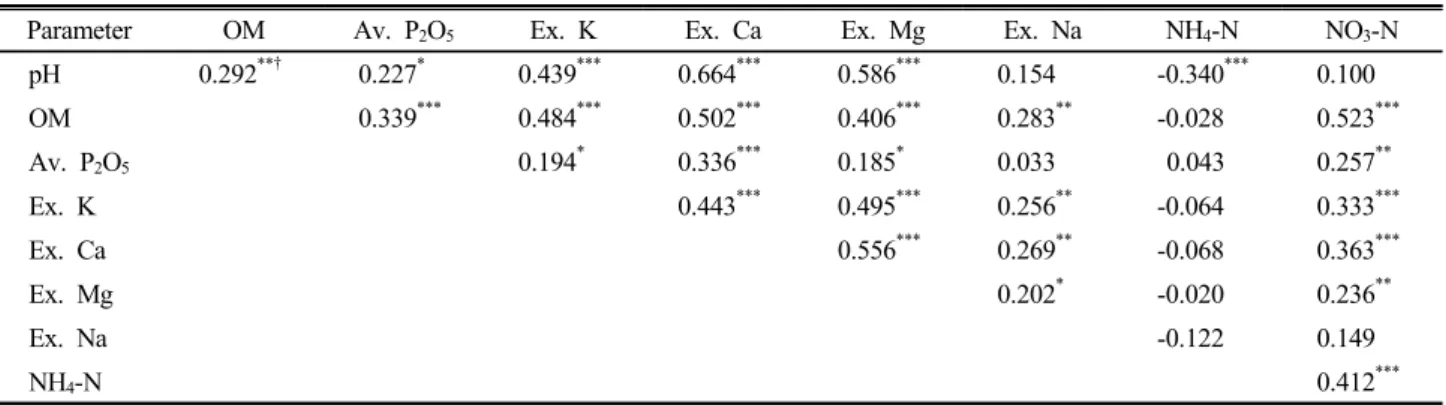
토양 pH는 치환성 칼륨 (r=0.439, p≤0.001), 치환성 칼 슘 (r=0.664, p≤0.001) 및 치환성 마그네슘 (r=0.586, p≤ 0.001)과 고도의 유의적인 정의상관을 나타냈다. 유효인 산 함량은 토양 유기물 함량 (r=0.339, p≤0.001) 및 치환성 칼슘 (r=0.336, p≤0.001)과 고도의 유의적인 정의상관을 보였는데 이러한 결과는 가축분 퇴비의 시용 에 의한 유기물 함량과 유효인산의 증가로 해석되었으며 또한, 산성토양에서 석회 시용으로 토양의 칼슘 함량의 증가와 pH 교정에 의한 불용성 인산을 가용화 시킨 것 으로 판단되었다. 유기물 시용으로 토양의 유효인산 함
Fig. 2. Principal components analyses of chemical pro- perties from top soils for sweet persimmon cultivation.
The variance explained by the each principal component (PC) axis is shown in parentheses. Bars present standard error (n=31).
Fig. 3. Principal components analyses of chemical pro- perties from subsoils for sweet persimmon cultivation.
The variance explained by the each principal component (PC) axis is shown in parentheses. Bars present standard error (n=31).
Table 3. A correlation coefficient among chemical contents in top soil for sweet persimmon cultivation (n=124).
Parameter OM Av. P2O5 Ex. K Ex. Ca Ex. Mg Ex. Na NH4-N NO3-N pH 0.292**† 0.227* 0.439*** 0.664*** 0.586*** 0.154 -0.340*** 0.100 OM 0.339*** 0.484*** 0.502*** 0.406*** 0.283** -0.028 0.523***
Av. P2O5 0.194* 0.336*** 0.185* 0.033 0.043 0.257**
Ex. K 0.443*** 0.495*** 0.256** -0.064 0.333***
Ex. Ca 0.556*** 0.269** -0.068 0.363***
Ex. Mg 0.202* -0.020 0.236**
Ex. Na -0.122 0.149
NH4-N 0.412***
†A significant values reported as **p≤0.001, **p≤0.01, and *p≤0.05.
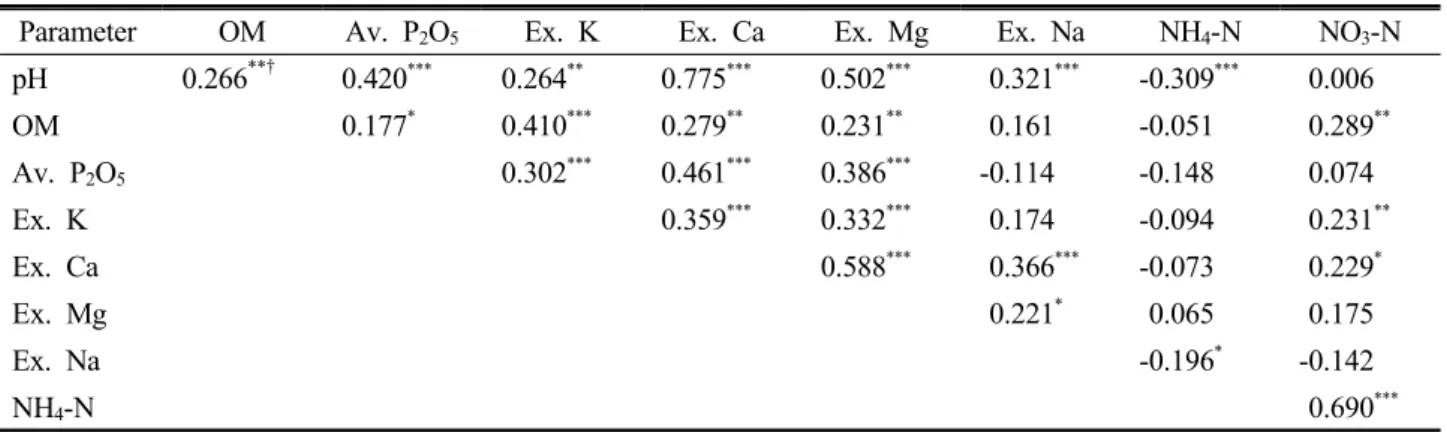
량 증가 뿐만 아니라 치환성 칼륨 (r=0.484, p≤0.001), 치환성 칼슘 (r=0.502, p≤0.001), 치환성 마그네슘 (r=0.406, p≤0.001), 치환성 나트륨 (r=0.283, p≤0.01) 및 질산태 질소 함량 (r=0.523, p≤0.001)의 증가를 가 져왔다. 심토의 화학성분 상관관계는 Table 4와 같이 표 토와 비슷한 경향을 나타냈다. 그러나 토양 유기물 함량과 다른 화학성분과의 상관계수는 표토에 비해 낮은 값을 나타냈다. 이러한 경향은 농가에서 대부분 퇴비 등의 유 기물을 공급할 경우 노동력 절감을 위해 표면시비에 의존 하기 때문인 것으로 해석되었다. 토양의 화학적인 성분에 기초한 토양의 질을 표현하기 위해 최근에는 여러 가지 요인을 몇 가지의 성분으로 추출하여 설명하고 예측할 수 있는 주성분 분석방법을 이용하고 있다 (Cho et al., 2005;
Choi et al., 2010; Koo et al., 2005; Lee et al., 2010a;
Lee et al., 2010b). 단감 재배 표토 화학성분의 주성분 분석결과 고유값이 1.0 이상인 주성분은 2개였고 제 1주 성분 (PC1)에 속하는 토양 화학성은 치환성 칼슘 (0.444), 치환성 마그네슘 (0.399), 토양 유기물 (0.397), 치환성 칼
륨 (0.387), pH (0.384) 등 5개 였고 제 2 주성분 (PC2) 에 속하는 토양 화학성은 암모니아태 질소 (0.675) 및 질 산태 질소 (0.555) 등 2개 였다. 단감 재배 표토 화학성 분의 특성은 제 1주성분이 38.5%, 제 2주성분이 17.3%
로서 전체 55.8%의 자료를 설명할 수 있는 것으로 나타 났다.
단감 재배 심토 화학성분의 주성분 분석결과 고유값이 1.0 이상인 주성분은 4개였고 제 1주성분 (PC1)에 속하 는 토양 화학성은 치환성 칼슘 (0.491), pH (0.457), 치 환성 마그네슘 (0.410) 등 3개 였고 제 2 주성분 (PC2)에 속하는 토양 화학성은 질산태 질소 (0.662) 및 암모니아 태 질소 (0.646) 등 2개 였다. 단감 재배 표토 화학성분 의 특성은 제 1주성분이 35.3%, 제 2주성분이 20.6%로 서 전체 55.9%의 자료를 설명할 수 있는 것으로 나타났다.
특히, PC2에서 4월은 정의 값을 나타낸 반면 6월, 8월, 10월은 부의 값을 나타내어 토양 양분의 변화는 질산태 질소와 암모니아태 질소 함량의 변화가 큰 것으로 나타 났다.
Table 4. A correlation coefficient among chemical contents in subsoil for sweet persimmon cultivation (n=124).
Parameter OM Av. P2O5 Ex. K Ex. Ca Ex. Mg Ex. Na NH4-N NO3-N pH 0.266**† 0.420*** 0.264** 0.775*** 0.502*** 0.321*** -0.309*** 0.006 OM 0.177* 0.410*** 0.279** 0.231** 0.161 -0.051 0.289**
Av. P2O5 0.302*** 0.461*** 0.386*** -0.114 -0.148 0.074
Ex. K 0.359*** 0.332*** 0.174 -0.094 0.231**
Ex. Ca 0.588*** 0.366*** -0.073 0.229*
Ex. Mg 0.221* 0.065 0.175
Ex. Na -0.196* -0.142
NH4-N 0.690***
†A significant values reported as **p≤0.001, **p≤0.01, and *p≤0.05.
요 약
경남지역 단감 재배 토양의 양분관리를 위한 기초 자 료를 제공하고자 창원 7, 마산 1, 진주 6, 사천 3, 김해 5, 밀양 2, 함안 2, 창녕 1, 하동 3, 산청 1 등 31개 지점을 선정하였고 4월부터 10월까지 2개월 단위로 4회 조사하 였다.
표토와 심토의 pH 값은 4월에 비해6월 이후 유의적인 증가를 나타냈으며 적정수준인 6.0-6.5 보다 낮았다. 반 면, 암모니아태 질소 함량과 질산태 질소 함량은 4월 보다 6월 이후 유의적인 감소를 나타냈다. 표토와 심토의 pH 는 적정수준인 6.0-6.5 보다 부족한 비율이 각각 69.4%
와 84.7%로 매우 높게 나타나 경남지역 단감 재배 토양 의 pH 교정을 위해 토양개량제 공급이 시급한 것으로 판 단되었다. 토양 유기물 함량도 적정수준인 25-35 g kg-1 분포비율은 표토 13.7%, 심토 4.0%로 매우 낮았으며 부 족한 비율이 각각 63.7% 및 84.7%로 매우 높아 적절한 유기물 공급이 필수적인 것으로 나타났다. 유효인산 함량 은 적정수준인 200-300 mg kg-1보다 초과된 비율은 표 토 70.2%, 심토 46.8% 였으며 토양 유기물 함량 (r=0.339, p≤0.001)과 고도의 유의적인 정의상관을 보여 가축분 퇴비 과다 시용에 대한 주의가 필요한 것으로 나타났다.
사 사
본 연구는 농촌진흥청 공동연구사업 (과제번호: PJ005 416201003)의 지원에 의해 이루어진 것임.
인용문헌
Cho, I.H., Y.S. Kim, and K.D. Zoh. 2005. A case study on the comparison and assessment between environ- mental impact assessment and post-environmental investigation
using principal component analysis. Kor. J. Env. Hlth.
31:134-146.
Choi, M.T., J.I. Lee, Y.U. Yun, J.E. Lee, B.C. Lee, E.S.
Yang, and Y.H. Lee. 2010. Characteristics of fertility on strawberry cultivated soil of plastic film house in Chungnam Province in Korea. Korean J. Soil Sci. Fert.
43:160-165.
Clark, C.J. and G.S. Smith. 1990. Seasonal changed in the composition, distribution and accumulation of mineral nutrients in persimmon fruit. Sci. Hortic. 42:99-111.
Ha, H.S., D.B. Park, and J.S. Heo. 1982. Studies on the nutritional diagnosis of the soil and the plant leaves in sweet persimmon cultivation area of Jinyoung. J. Korean Soc. Soil Sci. Fert. 15:258-269.
Hossain, M.B. and K.S. Ryu. 2009. Effect of foliar applied phosphatic fertilizer on absorption pathways, yield and quality of sweet persimmon. Sci. Hortic. 122:626-632.
Jung, K.H., Y.K. Sonn, S.Y. Hong, S.O. Hur, and S.K.
Ha. 2005. Assessment of national soil loss and potential erosion area using the digital detailed soil maps. Korean J. Soil Sci. Fert. 38:59-65.
Jung, K.H., S.O. Hur, S.G. Ha, C.W. Park, and H.H. Lee.
2007. Runoff pattern in upland soils with various soil texture and slope at torrential rainfall events. Korean J.
Soil Sci. Fert. 40:208-213.
Jung, Y.T., E.S. Yun, J.K. Kim, I.S. Son, J.D. So, and Y.K. Jo. 1993. Establishment of soil suitability classification system for sweet persimmon in Yeongnam area. RDA J. Agric Sci. Soil Fert. 35:245-251.
Kim, I.Y., T.H. Chang, and Y.S. Lee. 2005. Effects of foliar spray of calcium chloride on calcium concent- rations in leaf and fruit tissues of ‘Nishimurawase’ and
‘Fuyu’ persimmon trees and fruits storability. Kor. J.
Hort. Sci. Technol. 23:293-300.
Koo, J.Y., M.J. Yu, S.G. Kim, M.H. Shim, and A.
Koizumi. 2005. Estimation of long-term water demand by principal component and cluster analysis and practical application. J. KSEE 27:870-876.
KOSIS (Korean Statistical Information Service). 2010.
Agriculture statistical database.
Lee, C.S., J.Y. Lee, Y.J. Lee, J.S. Shin, K.H. Han, and D.S. Kim. 1993. Fertility and rate of fertilizer application for orchard soils of apple and pear. J. Korean Soc. Soil Sci. Fert. 26:103-110.
Lee, H.H., S.K. Ha, S.O. Hur, K.H. Jung, W.T. Kim, and K.H. Kim. 2006. Characteristics of runoff and percolation on sloping land with different soil textures. Korean J.
Soil Sci. Fert. 39:268-273.
Lee, J.Y., J.H. Jung, S.C. Kim, S.W. Hwang, and C.S.
Lee. 2000. Chemical properties of Korean orchard soils in main apple, pear and peach producing area. Korean J. Soil Sci. Fert. 33:79-84.
Lee, Y.H., S.T. Lee, J.Y. Heo, M.G. Kim, K.P. Hong, E.S.
Kim, W.D. Song, C.W. Rho, J.H. Lee, W.T. Jeon, B.G.
Ko, K.A. Roh, and S.K. Ha. 2010a. Monitoring of heavy metal contents from paddy soil in Gyeongnam Province.
Korean J. Soil Sci. Fert. 43:289-295.
Lee, Y.H., S.T. Lee, J.Y. Heo, M.G. Kim, K.P. Hong, W.D. Song, C.W. Rho, J.H. Lee, W.T. Jeon, B.G. Ko, K.A. Roh, and S.K. Ha. 2010b. Monitoring of chemical properties from paddy soil in Gyeongnam Province.
Korean J. Soil Sci. Fert. 43:140-146.
Moon, B.W., I.K. Kang, Y.C. Lee, K.W. Nam, and J.S.
Choi. 2002. Effects of tree-spray of liquid calcium
compound on the changes in cell wall components, cell wall hydrolases, and cell wall structure during cold storage of non-astringent persimmon fruits. J. Kor. Soc.
Hort. Sci. 43:443-446.
NIAST (National Institute of Agricultural Science and Technology). 2000. Analytical methods of soil and plant.
NIAST, Suwon, Korea.
NIAST (National Institute of Agricultural Science and Technology). 2003. Annual report of the monitoring project on agro-environmental quality in 2002. NIAST, RDA, Suwon, Korea.
NIAST (National Institute of Agricultural Science and Technology). 2006. Fertilizer recommendation for crops.
NIAST, RDA, Suwon, Korea.
NIAST (National Institute of Agricultural Science and Technology). 2007. Annual report of the monitoring project on agro-environmental quality in 2006. NIAST, RDA, Suwon, Korea.
Park, D.S., S.T. Choi, and S.M. Kang. 2009. Effect of soil and foliar applications of supplemental nitrogen on tree growth and yield of ‘Fuyu’ persimmon. Kor. J. Hort.
Sci. Technol. 27:365-370.
RDA (Rural development administration). 1983. Soil in Korea. RDA, Suwon, Korea.
SAS Institute. 2006. SAS Version 9.1.3. SAS Inst., Cary, NC.