조사료원에 따른 한국 재래산양의 채식습성에 관한 연구
강병호
1ㆍ이인덕
1ㆍ이수기
1ㆍ이형석
2*
1충남대학교 동물바이오시스템과학과, 2우송정보대학
A study on the food habits of Korean native goats fed with roughage sources
Byung-Ho Gang
1, In-Duk Lee
1, Soo-Kee Lee
1, Hyung-Suk Lee
2*
1
Department of Animal Biosystem Science, Chungnam National University, Daejeon 305-764, Korea
2
Woosong College, Daejeon, 300-715, Korea
Received on 5 September 2011, revised on 16 September 2011, accepted on 19 September 2011
Abstract : The object of this experiment was to investigate the food habits of Korean native goats fed with various roughage sources. The experimental trials were conducted at Unbong Animal Genetic Resources Station in 2008. The experimental roughages include five sources and 25 species in all; grasses and legumes: 5 species (mixed grasses, orchardgrass, tall fescue, alfalfa, white clover), native grasses and weeds: 5 species (mixed native grasses, Miscanthus sinensis Anderss, Arundinella hirta (Thunb.) Tanaka, Barnyard grass, short awn, forage crops and straw: 5 species (barley + hairy vetch, wheat + hairy vetch, rye silage, barley silage, baled rice straw), browse and fallen leaves: 5 species (Mixed browse, Oriental white oak, Quercus serrta Thunb., Oriental cherry fallen leaves, Japanese chestnut fallen leaves), and imported hay and straw: 5 species(timothy hay, tall fescue straw, annual ryegrass straw, klinegrass hay, alfalfa hay). Ten Korean native goats were selected which had nearly the same body weight (average 24±2.8 kg). The chemical composition and dry matter digestibility of each roughage source and species were significantly different at the sampling area, plant species, growth stages and cutting period (p<0.05). Among all the 25 species of roughages, the favorite intake species order by Korean native goat was observed like this: Quercus aliena, Querancas serrta Thunb and Mixed browse, which was a lower intake compared to other domestic herbivores. The Korean native goats ate more roughages which had low fibrous contents, but high dry matter digestibility. The Korean native goats ate more roughages which had low fibrous contents, but high dry matter digestibility. On the other hand, compared to each roughage source, total intake amount by Korean native goats was showed as browse and fallen leaves (33.1%) among trials roughage sources. Based on these results, the food habit of Korean native goats seems to be closer to the browser.
Key words : Food habits, Korean native goats, Intake ranking, Browser, Roughage sources
*Corresponding author: Tel: +82-42-629-6175 E-mail address: [email protected]
I. 서 론
초식동물은 소화기 구조나 서식지, 주변 환경에 따라서 채식습성이 다르다고 할 수 있다. 가축의 생산성을 높이기 위해서는 사초를 급여하였을 때 우선적으로 섭취량이 많아 야하고 또한 섭취한 사초의 소화율이 높아야 한다. 그 중에 서 섭취량을 높이기 위해서는 초식동물에 맞는 초류를 급 여하는 것이 중요하다고 하겠다. 기호성은 선택채식과 연
관성이 크며, 선택채식은 곧 가축의 채식습성을 결정짓는
요인이기도 하다. 재래산양의 채식습성을 Hofmann(1983)
은 concentrate selectors와 grass-roughage eaters의
중간형인 intermediate로 분류하였고, Holecheck(1989)
는 browsers와 grazers의 중간형인 intermediate feeders
로 분류하였으며, Belanger(1986)는 browsers로 분류한
바 있다. 그러나 Lee와 Lee(2008)는 재래산양의 채식습성
을 browsers에 더 가까운 것으로 보고한바 있다. 본시험에
서는 국내산 및 수입 조사료원을 재래산양에 급여했을 때
조사료 종류 및 조사료원에 따른 채식습성을 비교 평가하
기 위해 실시하였다.
II. 재료 및 방법
본 연구는 2008년 1월부터 12월까지 수행하였으며, 공 시시료로는 국내산 화본과와 두과목초(grasses and legumes) 류는 혼합목초(mixed grasses), 오챠드그라스(orchardgrass), 톨 페스큐(tall fescue), 알팔파(alfalfa) 및 화이트클로버 (white clover)의 5종 , 야초와 잡초(native grasses and weeds)류는 혼합야초(mixed Native grasses), 억새( Mis- canthus sinensis Anderss) , 새( Arundinella hirta (Thunb.) Tanaka) , 바랭이(barnyard grass) 및 둑새풀(short awn) 의 5종 , 사료작물(forage crops; hay, silages and straw) 류는 청보리+헤어리벳치 건초(barley+hairy vetch hay), 청밀+헤어리벳치 건초(wheat+hairy vetch hay), 호밀 사 일리지(rye silage), 청보리 사일리지(barley silage) 및 곤 포볏짚(baled rice straw)의 5 종, 수엽과 낙엽(browse and fallen leaves)류는 혼합수엽(mixed browse), 갈참나 무 수엽(Oriental white oak browse) , 졸참나무 수엽 ( Queracus serrata Thunb. browse) , 벚나무 낙엽(Oriental cherry fallen leaves) 및 밤나무 낙엽(Japanese chestnut fallen leaves)의 5 종 및 수입건초(imported hay and straws)류는 티머시 건초(timothy hay), 톨 페스큐 짚(tall fescue straw), 애뉴얼 라이그라스 짚(annual ryegrass straw), 클라인그라스 건초(klinegrass hay) 및 알팔파 건 초(alfalfa hay)의 5 종 등 총 25종을 공시하였다. 혼합목초 의 경우는 orchardgrass + tall fescue + Kentucky bluegrass 등(66%)과 white clover(34%)가 혼생한 혼파초 지에서 orchardgrass의 출수기를 기준으로 수확한 1번초 (5월 8일)를 양건 후 공시하였고, orchardgrass와 tall fescue는 1번초를 수잉기(5월 2일)에 각각 예취하였으며, alfalfa, white clover는 1번초를 개화초기(5월 13일)에 수 확하여 양건 후 공시하였다. 혼합야초는 망초+쑥+토끼풀 +개밀+억새+새 등이 혼생되어 있는 야산지에서 2008년 5월 26일 수확하였고, 기타 야초는 2008년 5월 29일 수확 후 양건하여 공시하였다. Barley+hairy vetch와 wheat+
hairy vetch는 각각 혼파 후 수확하였는데 (건물비율 보리, 밀 66 : hairy vetch 34%) 수확시기는 보리와 밀을 기준으 로 황숙기(5월 29일)에 수확하여 양건하였다. Rye silage 는 TMR공장(충남 논산)에서 2007년도에 제조한 시료를,
barley silage와 baled rice straw는 충남 논산군 연산면 소재 젖소농장에서 공급받은 원료를 양건 후 이용하였다.
혼합수엽은 5월 23일 채취한 갈참(70%)+졸참(20%)+상수 리(10%)나무 잎을 건물기준으로 혼합하여 공시하였다. 벚 나무와 밤나무 낙엽은 2007년 11월 24일에 수집한 것을 공 시하였다. 수입 건초는 2007년 미국에서 수입한 것을 공급 받아 공시하였다. 건초를 제외한 모든 시료는 시멘트포장 운동장에서 5~6일간 양건시킨 후 2 cm 내외로 세절한 뒤 비닐주머니에 담아 냉장 보관하여 사용하였다. 급여량은 건물기준으로 시료 당 500 g 씩을 급여하였다. 분석용 시료 는 동일한 방법으로 얻어진 시료를 분쇄하여 사용하였다 (Willey mill, 1mm screen). 공시 축은 재래산양(♀, 평균 체중 24±2.8 kg) 10두를 공시하였다. 시험은 2008년 6월 23일 전북 남원시 운봉읍 소재 가축유전자원시험장 축사 내에서 수행하였고 물은 자유 채식시켰다. 시료는 20kg 용 량의 4각 고무 통에 담아 자유채식방법으로 수행하였다.
25종 시료의 배치는 시료의 특성을 고려하고 놓는 위치에 따른 채식영향을 줄이기 위해 화본과 및 두과 목초 → 야초 및 잡초 → 사료작물 → 수엽 및 낙엽 → 수입건초의 순으로 1초종씩을 교대로 시계방향으로 1번에서 25번까지 배치하 였다. 유 산양의 채식량 조사는 각각 10시, 12시, 14시, 16 시, 18시 및 20시에 6회 실시하였다. 채식량은 급여량에서 잔량을 빼어 기록하였다. Crude protein (CP)은 AOAC(1999) 방법으로, neutral detergent fiber(NDF), acid detergent fiber(ADF) 및 lignin은 Goering과 Van Soest(1970) 방법 으로, cellulose는 Crampton과 Maynard(1938) 방법으로 분석하였다. Hemicellulose는 NDF와 ADF의 차이로, in vitro 건물소화율(IVDMD)은 Tilley와 Terry(1963) 방법으 로 분석하였다. 통계처리는 SAS(Institute Inc. Cary. NC.
2002)로 유의성을 검정하였으며, 처리간의 차이는 최소유 의차(LSD)값으로 구하였다.
III. 결과 및 고찰
1. 화학적 성분 및 건물소화율
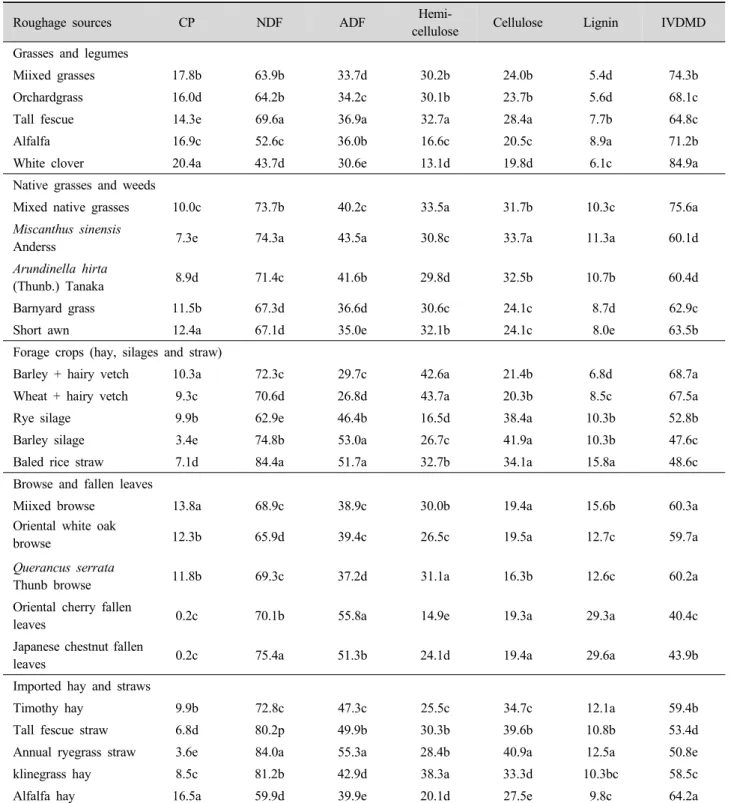
조사료원별로 화학적 성분과 건물소화율( in vitro dry
matter digestibility, IVDMD)을 조사한 결과는 Table 1에
서 보는 바와 같다. 대체적으로 crude protein(CP)함량은
화본과 목초와 두과목초에서 높았던 반면에 수엽과 잡초는
중간이었으며 사일리지, 곤포볏짚, 야초 및 낙엽은 낮은 결 과를 보여서 채취장소, 초종, 생육단계 및 채취시기에 따라 조단백질(crude protein, CP)함량이 차이를 보였다(p
<0.05). 한편, NDF, ADF, hemicellulose, cellulose, lignin 함량 및 IVDMD도 역시 CP함량의 변화와 마찬가지 로 조사료원별로 차이를 보였다(p<0.05). Osoro와 Cebrian (1989)는 초종에 따라서, Givens 등(1993)은 계절에 따라 서 화학적 성분과 건물소화율이 달라지고 있음을 보고한 바 있으며, Lee 등(1990)은 수엽의 종류, 계절 및 채취시기 에 따라서, Wood와 Tanner(1985)도 시료의 채취장소와 시 기에 따른 사초의 화학적 성분과 건물소화율의 차이를 보 고하고 있어 본 시험결과를 뒷받침하였다. 화본과 및 두과 목초(grasses and legumes)류의 화학적 성분 및 건물소화 율은 초종 간에 뚜렷한 차이를 보였는데, white clover는 CP함량과 IVDMD가 가장 높았고(p<0.05), 반대로 NDF 와 ADF함량은 가장 낮은 결과를 보였으며(p<0.05), 반면 에 tall fescue는 CP 함량과 IVDMD가 가장 낮았고(p
<0.05), 반대로 NDF와 ADF함량은 가장 높은 결과를 가져 왔다(p<0.05). 대체적으로 white clover 및 alfalfa가 orchardgrass나 tall fescue에 비하여 CP함량과 IVDMD 가 가장 높은 편이었고 반대로 NDF와 ADF함량은 낮은 결 과를 보였으나, 혼합목초는 중간정도로 나타났다.
야초 및 잡초(Native grasses and weeds)류 역시 초종 간에 뚜렷한 차이를 나타내어, 둑새풀(Short awn)의 CP함 량이 가장 높았고, NDF와 ADF, cellulose 및 lignin함량은 낮은 결과를 나타내었다(p<0.05). 그러나 억새( Miscanthus sinensis Anderss)는 CP 함량과 IVDMD가 가장 낮은 반면 에 NDF, ADF, cellulose 및 lignin함량은 높은 양상을 보 여 대조를 보였다(p<0.05). 혼합야초는 IVDMD는 높은 편 이었으나(p<0.05), CP함량과 섬유소물질의 함량은 중간 정도이었다.
사료작물(forage crops; hay, silages and straw)류의 경우 청보리+헤어리 벳치(Barley+hairy vetch)가 CP함량 과 IVDMD가 가장 높았고, 반대로 NDF와 ADF함량은 상대 적으로 낮은 결과를 보였으며(p<0.05), cellulose 및 lignin함량도 대체적으로 낮은 결과를 나타내었다. 청보리 사일리지(Barley silage)는 CP 함량과 IVDMD가 가장 낮 았던 반면에 NDF와 ADF함량은 가장 높은 결과를 보였으 며(p<0.05), cellulose 및 lignin함량도 비교적 높은 양상 을 나타내었다. 그러나 곤포볏짚(baled rice straw)은 청보
리 사일리지보다는 품질이 다소 높은 편이지만, 호밀 사일 리지와 함께 품질은 상당히 낮은 것으로 조사되었는데, 청 보리와 호밀 사일리지는 2007년도에 제조된 것을 사용하 였기 때문에 저장기간 및 상태가 좋지 않았던 것으로 판단 된다.
수엽 및 낙엽(browse and fallen leaves)류의 화학적 성 분 및 건물소화율은 역시 수엽과 낙엽의 종류에 따라 차이 를 나타내었는데, 특히 수엽과 낙엽 간에는 이들 성분의 차이가 뚜렷하였다. 수엽 중에서는 혼합수엽(Mixed browse) 이 CP함량과 IVDMD가 가장 높았으며(p<0.05), NDF, ADF, cellulose 및 lignin함량도 상대적으로 다소 낮은 결과를 보였다(p<0.05). 그러나 낙엽은 모두 CP 함량과 IVDMD 가 현저히 낮았을 뿐 아니라 NDF와 ADF, cellulose 및 lignin함량은 가장 높은 결과를 나타내었다(p<0.05).
수입건초(imported hay and straws)류의 화학적 성분 및 건물소화율은 역시 초종 간에 뚜렷한 차이를 나타내었 으며, 특히 건초와 짚 간에 따라 현저한 차이를 보였다(p
<0.05). 알팔파 건초(alfalfa hay)는 CP함량과 IVDMD가 가장 높았고, 반대로 NDF와 ADF함량은 가장 낮은 결과를 보였다(p<0.05). 그러나 애뉴얼 라이그라스(annual ryegrass) 와 톨 페스큐(tall fescue)와 같은 짚(straw)류는 상대적으 로 CP 함량과 IVDMD가 현저히 낮은 반면에 NDF, ADF, cellulose 및 lignin함량은 상당히 높은 결과를 보여 대조 를 이루었다(p<0.05).
이상에서 얻어진 본 시험결과는 공시된 조사료 종류 및 조사료원에 따라 다소의 차이는 있겠으나, 대체적으로 Lee 와 Lee(2008)가 재래산양을 공시하여 얻어진 조사료원별 결과와 부합되는 것이라 하겠다.
2. 채식량, 채식비율 및 채식순위
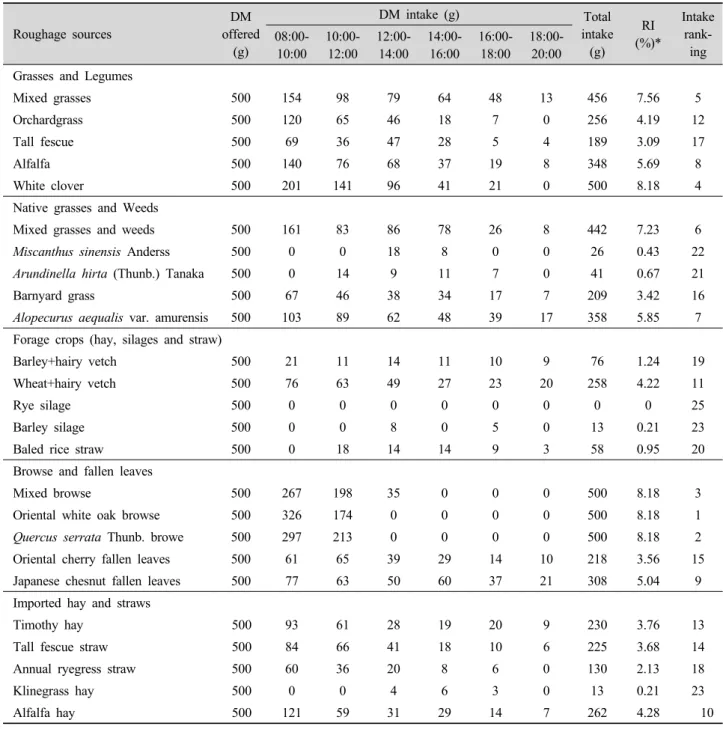
재래산양의 채식량, 채식비율 및 채식순위를 조사한 결
과는 Table 2에서 보는 바와 같다. 채식량이 가장 높았던
것은 갈참나무 수엽(oriental white oak browse)으로 급여
후 6시간 내에 전량을 채식하여 채식비율과 채식순위가 가
장 높았고, 졸참나무 수엽( Queracus serrta Thunb. browse)
도 역시 급여 후 6시간 내에 전량을 채식하여 채식비율과
채식순위가 2번째로 높았다. 혼합 수엽(mixed browse)은
급여 후 8시간 후에 완전히 채식하였고, 화이트 크로버
(white clover)는 12시간 후에 완전히 채식 하여 채식비율
Table 1. Chemical composition and in vitro dry matter digestibility (IVDMD) of roughages (%, DM) fed to Korean native goats.
Roughage sources CP NDF ADF Hemi-
cellulose Cellulose Lignin IVDMD Grasses and legumes
Miixed grasses 17.8b 63.9b 33.7d 30.2b 24.0b 5.4d 74.3b
Orchardgrass 16.0d 64.2b 34.2c 30.1b 23.7b 5.6d 68.1c
Tall fescue 14.3e 69.6a 36.9a 32.7a 28.4a 7.7b 64.8c
Alfalfa 16.9c 52.6c 36.0b 16.6c 20.5c 8.9a 71.2b
White clover 20.4a 43.7d 30.6e 13.1d 19.8d 6.1c 84.9a
Native grasses and weeds
Mixed native grasses 10.0c 73.7b 40.2c 33.5a 31.7b 10.3c 75.6a
Miscanthus sinensis
Anderss 7.3e 74.3a 43.5a 30.8c 33.7a 11.3a 60.1d
Arundinella hirta
(Thunb.) Tanaka 8.9d 71.4c 41.6b 29.8d 32.5b 10.7b 60.4d
Barnyard grass 11.5b 67.3d 36.6d 30.6c 24.1c 8.7d 62.9c
Short awn 12.4a 67.1d 35.0e 32.1b 24.1c 8.0e 63.5b
Forage crops (hay, silages and straw)
Barley + hairy vetch 10.3a 72.3c 29.7c 42.6a 21.4b 6.8d 68.7a
Wheat + hairy vetch 9.3c 70.6d 26.8d 43.7a 20.3b 8.5c 67.5a
Rye silage 9.9b 62.9e 46.4b 16.5d 38.4a 10.3b 52.8b
Barley silage 3.4e 74.8b 53.0a 26.7c 41.9a 10.3b 47.6c
Baled rice straw 7.1d 84.4a 51.7a 32.7b 34.1a 15.8a 48.6c
Browse and fallen leaves
Miixed browse 13.8a 68.9c 38.9c 30.0b 19.4a 15.6b 60.3a
Oriental white oak
browse 12.3b 65.9d 39.4c 26.5c 19.5a 12.7c 59.7a
Querancus serrata
Thunb browse 11.8b 69.3c 37.2d 31.1a 16.3b 12.6c 60.2a
Oriental cherry fallen
leaves 0.2c 70.1b 55.8a 14.9e 19.3a 29.3a 40.4c
Japanese chestnut fallen
leaves 0.2c 75.4a 51.3b 24.1d 19.4a 29.6a 43.9b
Imported hay and straws
Timothy hay 9.9b 72.8c 47.3c 25.5c 34.7c 12.1a 59.4b
Tall fescue straw 6.8d 80.2p 49.9b 30.3b 39.6b 10.8b 53.4d
Annual ryegrass straw 3.6e 84.0a 55.3a 28.4b 40.9a 12.5a 50.8e
klinegrass hay 8.5c 81.2b 42.9d 38.3a 33.3d 10.3bc 58.5c
Alfalfa hay 16.5a 59.9d 39.9e 20.1d 27.5e 9.8c 64.2a
CP; Crude protein, NDF; Neutral detergent fiber, ADF; Acid detergent fiber
a,b,c,d,e
Means in the same column with different letters were significantly different (p<0.05).
과 채식순위가 높았다. 혼합목초(mixed grass, 456 g)와 혼합야초(native grasses and weeds, 442 g)도 채식순위 가 비교적 높은 조사료원으로 판단되었다. 그러나 호밀 사 일리지(rye silage, 0 g)와 보리 사일리지(barley silage,
13 g)는 채식량이 적어서 재래산양이 사일리지를 즐겨 채식
하지 않는 것으로 판단되었다. 한편, 클라인 건초(kline
hay, 13 g), 억새( Miscanthus sinensis Anderss, 26 g)
및 새( Arundinella hirta Thunb., 41 g)등도 채식량이 적
Table 2. Dry matter intake, relative intake percentage and intake ranking of Korean native goats fed with various roughage sources.
Roughage sources
DM offered
(g)
DM intake (g) Total
intake (g)
RI (%)*
Intake rank-
ing 08:00-
10:00
10:00- 12:00
12:00- 14:00
14:00- 16:00
16:00- 18:00
18:00- 20:00 Grasses and Legumes
Mixed grasses 500 154 98 79 64 48 13 456 7.56 5
Orchardgrass 500 120 65 46 18 7 0 256 4.19 12
Tall fescue 500 69 36 47 28 5 4 189 3.09 17
Alfalfa 500 140 76 68 37 19 8 348 5.69 8
White clover 500 201 141 96 41 21 0 500 8.18 4
Native grasses and Weeds
Mixed grasses and weeds 500 161 83 86 78 26 8 442 7.23 6
Miscanthus sinensis Anderss 500 0 0 18 8 0 0 26 0.43 22
Arundinella hirta (Thunb.) Tanaka 500 0 14 9 11 7 0 41 0.67 21
Barnyard grass 500 67 46 38 34 17 7 209 3.42 16
Alopecurus aequalis var. amurensis 500 103 89 62 48 39 17 358 5.85 7
Forage crops (hay, silages and straw)
Barley+hairy vetch 500 21 11 14 11 10 9 76 1.24 19
Wheat+hairy vetch 500 76 63 49 27 23 20 258 4.22 11
Rye silage 500 0 0 0 0 0 0 0 0 25
Barley silage 500 0 0 8 0 5 0 13 0.21 23
Baled rice straw 500 0 18 14 14 9 3 58 0.95 20
Browse and fallen leaves
Mixed browse 500 267 198 35 0 0 0 500 8.18 3
Oriental white oak browse 500 326 174 0 0 0 0 500 8.18 1
Quercus serrata Thunb. browe 500 297 213 0 0 0 0 500 8.18 2
Oriental cherry fallen leaves 500 61 65 39 29 14 10 218 3.56 15
Japanese chesnut fallen leaves 500 77 63 50 60 37 21 308 5.04 9
Imported hay and straws
Timothy hay 500 93 61 28 19 20 9 230 3.76 13
Tall fescue straw 500 84 66 41 18 10 6 225 3.68 14
Annual ryegress straw 500 60 36 20 8 6 0 130 2.13 18
Klinegrass hay 500 0 0 4 6 3 0 13 0.21 23
Alfalfa hay 500 121 59 31 29 14 7 262 4.28 10
어 채식순위가 낮은 조사료원으로 조사되었다. Holecheck 와 Vavra(1982) 및 Kirby와 Stuth(1982)에 의하면 대체적 으로 채식량이 높은 조사료원은 NDF, ADF와 같은 섬유소 물질의 함량이 낮은 반면에, IVDMD가 높았다고 보고하고 있으나, Table 1에서 보는 바 같이 white clover와 alfalfa 를 제외하고는 수엽(browse)류인 mixed browse, oriental white oak browse , Quercus serrta Thunb. browse 등은 상대적으로 NDF와 ADF 함량이 높고, 건물소화율은 낮았 는데도 불구하고 재래산양에 의한 채식량이 높아서 채식순
위가 높았던 것은 Gall(1981), Luttmann(1986) 및 Belanger (1986) 등의 보고와 같이 수엽채식형(browsers)이기 때문 에 수엽류를 선택채식 하였기 때문에 얻어진 결과라 하겠다.
3. 조사료원별 채식량 및 채식비율
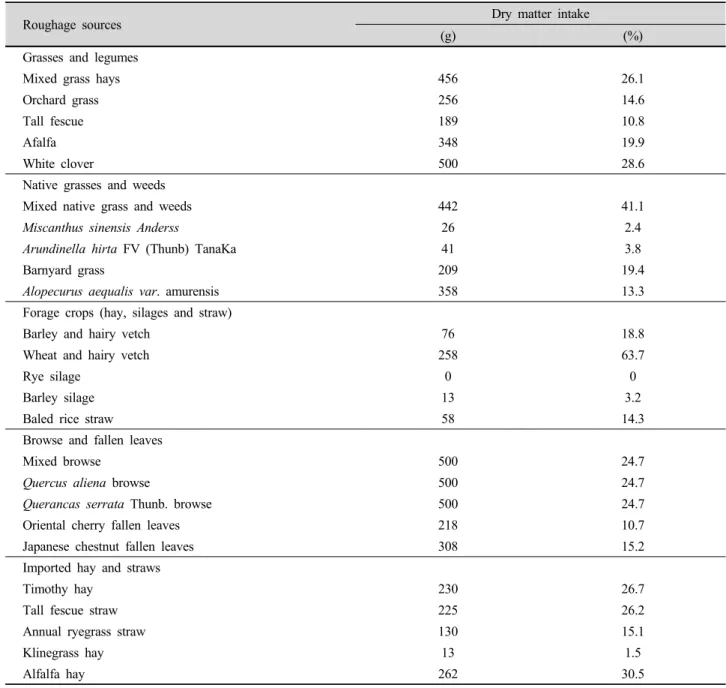
재래산양을 공시하여 조사료원별로 섭취량과 채식비율
을 조사한 시험결과는 Table 3에서 보는 바와 같다. 조사료
원 내에서도 5종간의 채식량과 채식비율은 초종 및 수종에
Table 3. Dry matter intake, relative intake percentage of diets in Korean native goats fed with various roughage sources.
Roughage sources Dry matter intake
(g) (%)
Grasses and legumes
Mixed grass hays 456 26.1
Orchard grass 256 14.6
Tall fescue 189 10.8
Afalfa 348 19.9
White clover 500 28.6
Native grasses and weeds
Mixed native grass and weeds 442 41.1
Miscanthus sinensis Anderss 26 2.4
Arundinella hirta FV (Thunb) TanaKa 41 3.8
Barnyard grass 209 19.4
Alopecurus aequalis var. amurensis 358 13.3
Forage crops (hay, silages and straw)
Barley and hairy vetch 76 18.8
Wheat and hairy vetch 258 63.7
Rye silage 0 0
Barley silage 13 3.2
Baled rice straw 58 14.3
Browse and fallen leaves
Mixed browse 500 24.7
Quercus aliena browse 500 24.7
Querancas serrata Thunb. browse 500 24.7
Oriental cherry fallen leaves 218 10.7
Japanese chestnut fallen leaves 308 15.2
Imported hay and straws
Timothy hay 230 26.7
Tall fescue straw 225 26.2
Annual ryegrass straw 130 15.1
Klinegrass hay 13 1.5
Alfalfa hay 262 30.5
따라 차이를 보였다. 즉, 채식량과 채식비율은 화본과와 두 과목초(grasses and legumes)류는 화이트 클로버(white clover)의 채식량과 채식비율이 가장 높았던 반면에 tall fescue는 가장 낮은 결과를 보였고, 산야초와 잡초(native grasses and weeds)류는 혼합야초(mixed native grasses and weeds)가 가장 높았던 반면에 억새( Miscanthus sinensis Anderss)가 가장 낮았으며, 수엽과 낙엽(browse and fallen leaves)류는 갈참나무 수엽( Quercus aliena browse)이 높 았던 반면에 벚나무 낙엽(Oriental cherry fallen leaves) 이 가장 낮았으며, 사료작물(forage crops; hay, silages and straw)류는 청밀+헤어리 벳치(wheat+hairy vetch)
가 높았던 반면에 호밀 사일리지(rye silage)가 가장 낮았 으며, 수입건초(imported hay and straws)류는 알팔파 건 초(Alfalfa hay)가 높은 반면에 클라인 건초(kline hay)가 가장 낮은 결과를 보였다. 이러한 결과는 Lee와 Lee(2008) 가 보고한 바와 같이 재래산양은 나뭇잎과 잔가지를 즐겨 채식하는 browser로서의 선택채식습성이 더 강하게 작용 하였기 때문에 얻어진 결과라 하겠다.
4. 채식습성
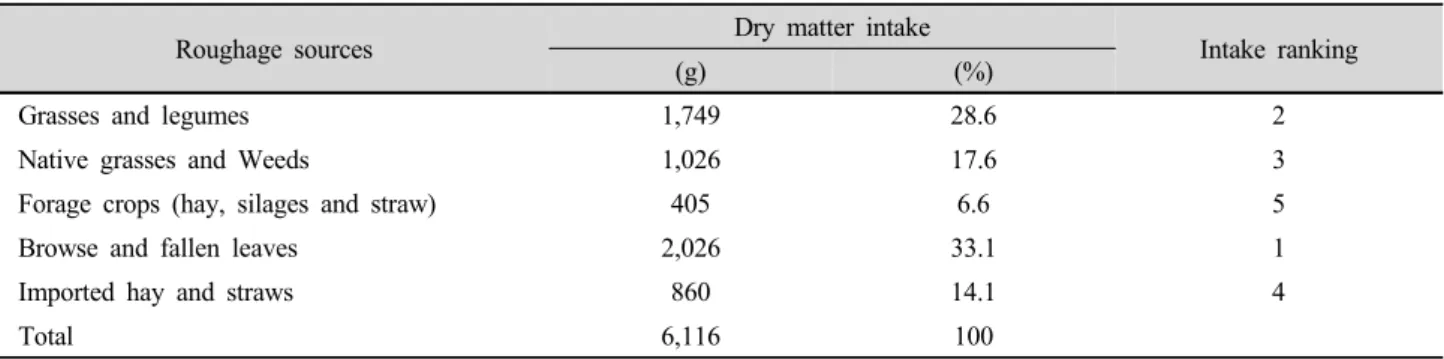
조사료원별로 채식량과 채식비율을 조사한 결과는
Table 4. Food habits of korean native goats fed with various roughage sources.
Roughage sources Dry matter intake
Intake ranking
(g) (%)
Grasses and legumes 1,749 28.6 2
Native grasses and Weeds 1,026 17.6 3
Forage crops (hay, silages and straw) 405 6.6 5
Browse and fallen leaves 2,026 33.1 1
Imported hay and straws 860 14.1 4
Total 6,116 100
Fig. 1. Food habits of Korean native goats fed with various roughages sources.
Table 4에서보는 바와 같다. 재래산양은 수엽과 낙엽(browse and fallen leaves)류를 33.1%를 채식하였고, 화본과와 두 과목초(grasses and legumes)류를 28.6% 채식하였으며, 산야초와 잡초(native grasses and weeds)류를 17.6% 채 식하였다. 수입건초(imported hay and straws)류는 14.1%
를, 사료작물(forage crops; hay, silages and straw)류 는 6.6%를 채식하는 습성을 보였다.
이러한 결과는 Fig. 1에서와 같이, 재래산양은 수엽과 낙엽 뿐 만아니라 초본류인 화본과와 두과목초도 즐겨 채 식하는 습성을 보이고 있으나 역시 수엽과 낙엽을 가장 많 이 채식하였던 것으로 보아 Luttmann(1986) 및 Belanger (1986) 등이 밝힌 바와 같이 나뭇잎과 야초를 즐겨 채식하 는 browsers(Holecheck와 Herbel, 1989)에 더 가까운 것 으로 판단된다. 따라서 본 시험에서 얻어진 이러한 결과는 Lee와 Lee(2008)의 연구결과와 부합되는 것이어서 재래산 양의 채식습성은 수엽과 낙엽(33.1%)를 가장 즐겨 채식하 는 수엽채식형(browsers)에 가까운 것을 확인할 수 있었다.
VI. 결 론
본 연구는 2008년 1월부터 12월까지 수행하였으며, 공 시시료는 목초류(grasses and legumes)는 mixed grasses , orchardgrass, tall fescue, alfalfa 및 white clover의 5 종, 야초와 잡초류(native grasses 및 weeds)는 mixed native grasses , Miscanthus sinensis Anderss, , Arundinella hirta (Thunb.) Tanaka , Barnyard grass 및 Short awn의 5종 , 사료작물류(forage crop; hay, silages and straw) 는 barley + hairy vetch, wheat + hairy vetch, rye silage, barley silage 및 baled rice straw의 5종, 수엽과 낙엽류 (browse and fallen leaves)는 mixed browse, oriental white oak browse , Queracus serrata Thunb , Oriental cherry fallen leaves 및 Japanese chestnut fallen leaves 의 5종, 그리고 수입건초류(imported hay and straws)는 timothy, tall fescue hay, Annual ryegrass straw, Klinegrass hay 및 Alfalfa hay의 5종 등 총 25종을 공시 하였다. 공시 축은 재래산양(♀, 평균체중 24±2.8 kg)10두 를 공시하였고, 시험은 2008년 6월 23일 전북 남원시 운봉 읍 소재 가축유전자원시험장 축사 내에서 수행하였다. 얻 어진 결과는 다음과 같다.
조단백질(crude protein, CP), NDF, ADF, hemicellulose,
cellulose, lignin 함량 및 IVDMD는 채취장소, 초종, 생육
단계 및 예취시기에 따라 조사료원별로 차이를 나타내었다
(p<0.05). 재래산양은 화이트 크로버(white clover), 혼
합목초(mixed grasses) 및 혼합야초(native grasses and
weeds)도 즐겨 채식하였으나, 갈참나무 수엽( Quercus
aliena browse), 졸참나무 수엽( Quercus serrta Thunb,
browse) 및 혼합 수엽(Mixed browse)등을 더 즐겨 선택하
여 채식하였다. 또한 재래산양은 조사료원 중에서 대체적
으로 NDF나 ADF와 같은 섬유소물질의 함량이 낮았던 반 면에 IVDMD이 높은 사초를 주로 선택하여 채식하는 습성 을 보였다. 재래산양은 수엽과 낙엽(browse and fallen leaves)을 33.1%채식하였던 것으로 보아 수엽채식형 (browsers)에 더 가깝다고 할 수 있다.
참 고 문 헌