• 검색 결과가 없습니다.

Effects of Job Satisfaction, Organizational Support and Risk Perception on Safety Consciousness in Confined Space Workers

N/A
N/A
Protected

Academic year: 2021

Share "Effects of Job Satisfaction, Organizational Support and Risk Perception on Safety Consciousness in Confined Space Workers"

Copied!
10
0
0

로드 중.... (전체 텍스트 보기)

전체 글

(1)

JESK http://jesk.or.kr eISSN:2093-8462

Effects of Job Satisfaction, Organizational Support and Risk Perception on Safety Consciousness in Confined Space Workers

Yang Rae Kim

1

, Byung Yong Jeong

2

, Myoung Hwan Park

2

1

Startup Business Platform, Catholic Kwandong University, Gangwon, 25601

2

Department of Industrial and Management Engineering, Hansung University, Seoul, 02876

Corresponding Author Myoung Hwan Park Department of Industrial and Management Engineering, Hansung University, Seoul, 02876

Mobile : +82-10-9027-1576 Email : [email protected]

Received : May 02, 2017 Revised : May 04, 2017 Accepted : May 29, 2017

Objective: This study aims to investigate the effects of organizational support, risk perception and job satisfaction on safety consciousness in confined space works.

Background: Confined space works are rated as hazardous works with high injury frequency and fatalities. But there were few researches for the occupational injury of the confined space workers.

Method: Questionnaire survey targeting 236 workers working in confined spaces were carried out to construct the structural equation model on safety consciousness.

The participants were all male workers, and they install and maintain or clean facilities mainly in the confined spaces.

Results: A structural equation model for safety consciousness was proposed, and validated based on perceived organizational support, risk perception and job satisfaction factors. Perceived 'organizational support' contributed significantly to 'worker's safety consciousness' both directly and indirectly. Also, perceived 'worker's safety consciousness' was also affected by perceived 'job satisfaction' and 'risk perception'. In terms of magnitude of relationships, the direct effect of perceived 'job satisfaction' on 'worker's safety consciousness' was the greatest among the interrelationships among latent factors.

Conclusion: Workers' safety consciousness can function as a leading indicator for safety and hazard prevention of workers.

Application: The results can be used in developing safety prevention programs for confined space workers.

Keywords: Confined space; Safety consciousness; Structural equation model; Job satisfaction; Risk perception

Copyright@2017 by Ergonomics Society of Korea. All right reserved.

cc

This is an open-access article distributed under the terms of the Creative Commons Attribution Non-Commercial License (http://

creativecommons.org/licenses/by-nc/3.0/), which permits unrestricted non-commercial use, distribution, and reproduction in any medium, provided the original work is properly cited.

1. Introduction

Confined space means any place, including any chamber, tank, vat, silo, pit, trench,

pipe, sewer, flue, well or other similar space in which, by virtue of its enclosed nature

(HSE, 1997). Confined space works are rated as hazardous works with high injury

frequency and fatalities because confined spaces may contain toxic, oxygen-deficient,

and/or explosive atmospheres and may contain particular physical hazards, such as

contents that can engulf or collapse on a worker, piping and fittings under high

(2)

pressure and temperature, unguarded machinery, and exposed electrical hazards (Kim et al., 2016; Pettit et al., 1996; Wilson et al., 2012). Workers are killed or seriously injured in confined spaces each year in the Republic of Korea. Those killed include people working in the confined space and those who try to rescue them without proper training and equipment (HSE, 2014). For accident prevention in confined space work, facility inspection, protective gear wearing, worker's training and management and supervision should be systematically conducted before entering the working space. That is, employers must carry out a suitable and sufficient assessment of the risks for all work activities to decide what measures are necessary for safety (HSE, 1997).

Measures to prevent occupational accidents can be divided into two approaches. One is based on lagging indicators revealing the characteristics of industrial accidents, and the other is based on leading indicators, such as safety audit or safety consciousness.

Safety environment can be continuously managed by identifying the weaknesses of a system and taking an action using the leading indicators (Flin et al., 2000). Thus, worker's safety awareness for working conditions and organizational support as well as characteristics of industrial accidents can be used in developing safety prevention programs.

Previous studies showed that organizational support, worker's risk perception, job satisfaction, and safety consciousness factors are regarded as the factors that can affect industrial accidents. Jeong et al. (2015) investigate the correlation between office environment satisfaction levels and workers' subjective symptoms. Safety consciousness is defined as a positive attitude and awareness toward acting safely. Westaby and Lee (2003) reported that safety consciousness is one of the variables mediating exogenous variable effect, such as safety activity, self-esteem and organizational support, in relation with hazard occurrence. McLain (1995) emphasized the risk perception can directly affect worker's attitudes and behaviors, such as job satisfaction, stress and distraction from work tasks. Job satisfaction is defined as degree to which a worker experiences positive affection towards his or her job, and it can affect safety consciousness (Gyekye, 2005; Locke, 1969). Both safety training and procedures, on-site job hazards, and engineering and administrative controls are also associated with reduced workplace injuries (Kinn et al., 2000). Various services including education, training, consulting and technology support can be included in the organizational support. Safety training provides employees the knowledge and skills necessary to perform the job safely and high-quality jobs have direct and indirect effects on occupational injuries (Barling et al., 2002). Also, in a workplace where a safety program was successfully implemented with manager's solid commitment to safety, accidents sharply decreased if workers receive proper education and training.

Therefore, there is a need to check how organizational support including safety training can affect job satisfaction, risk perception and safety consciousness. Also, it is necessary to find the relationships among organizational, working condition, and worker's consciousness and satisfaction factors. Structural equation model is valuable for finding the causal relationships between the factors. Choe et al. (2001) identified casual relationships between user satisfaction of Internet website and performance measures using the structural equation model.

This study investigate the effects of organizational support, risk perception and job satisfaction on safety consciousness using a structural equation model, and identify any causal relationships or interrelationships among latent factors.

2. Methods

2.1 Research model and variables

Structural equation modelling is a statistical methodology that takes a confirmatory approach to the analysis of a structural

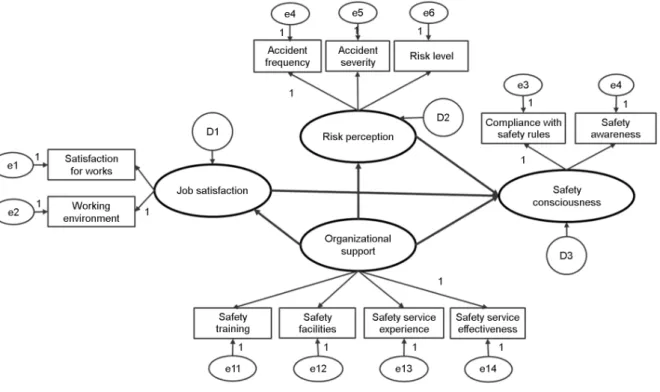
theory bearing on some phenomenon. Figure 1 shows structural equation research model and variables. In Figure 1, factors

(latent variables) are represented as ellipse in shape, such as job satisfaction, risk perception, organizational support, and safety

consciousness. Observed variables are represented as squares, and these observation variables in the model are rated on a 1-5

(5=best) scale.

(3)

Job satisfaction factor is measured by satisfaction level on works and working environment. Risk perception factor is measured by perception level on accident frequency, severity, and risk. Organizational support factor is measured by perception level on safety training, safety facilities, safety service experience, and service effectiveness. Worker's safety consciousness factor is measured by worker's safety awareness and compliance with safety rules.

This study sets up the following hypotheses based on the conceptual model

• Hypothesis 1: Worker's risk perception has a positive impact on safety consciousness.

• Hypothesis 2: Worker's job satisfaction has a positive impact on safety consciousness.

• Hypothesis 3: Organizational support has a positive impact on safety consciousness.

• Hypothesis 4: Organizational support has a positive impact on worker's job satisfaction.

• Hypothesis 5: Organizational support has a positive impact on worker's risk perception.

2.2 Subjects and data analyses

Questionnaire survey targeting 236 workers working in confined spaces were carried out. The participants were all male workers, and they install and maintain or clean facilities mainly in the confined spaces, such as a septic tank, water storage tank, manhole for communications, waterworks and sewage and storage tank.

Analysis of the structural equation model comprises validating the measurement model and fitting the structural model. The measurement model is evaluated by reliability analysis, convergent validity analysis and discriminant validity analysis. The effects of job satisfaction, organizational support and risk perception on safety consciousness using structural model analysis are analyzed based on the interrelationships between the constructs. AMOS 18 and SPSS 21 are used for the analysis.

Figure 1. Proposed structural equation model

(4)

3. Results

3.1 Construct validation by convergent validity and discriminant validity

The confirmatory factor analysis is useful for construct validation because it can measure standardized regression weight between measurement variables and latent variables, and evaluate model's fit. This study conducts verification through convergent validity and discriminant validity.

Standardized regression weight generally ranges between 0.5 and 0.95 for convergent validity (Bagozzi and Yi, 1988). Additionally, it is checked if critical ratio is greater than 1.965 and p <0.05. Fornell and Larcker (1981) proposed the equation for calculating AVE, and convergent validity is regarded as existing if AVE is over 0.5., convergent validity is acceptable if construct reliability value is greater than 0.7. Table 1 shows the results of confirmatory factor analysis. The standardized regression weight, critical ratio, AVE and construct reliability are judged to be adequate for the thresholds.

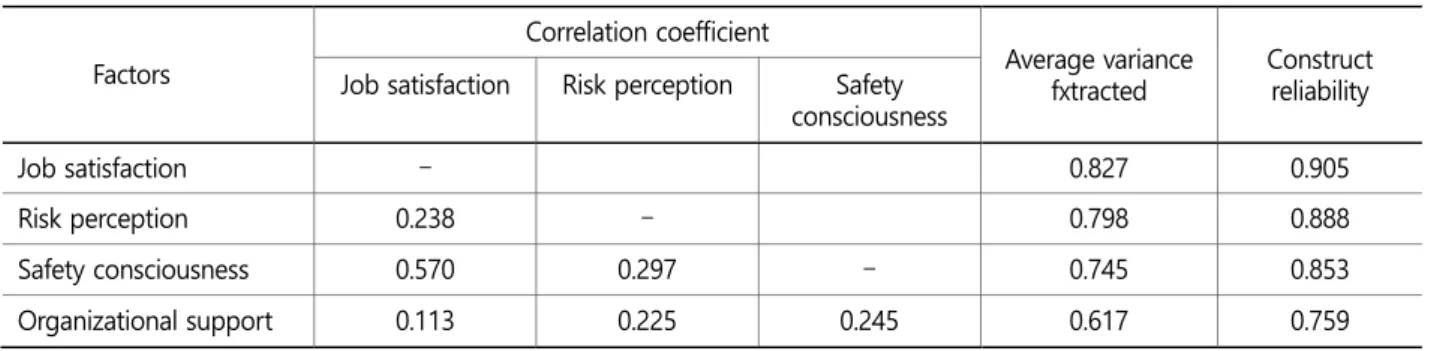
Discriminant validity means the degree that each latent variable is discriminated. That is, if correlation coefficient among latent variables is low, discrimination validity exists. Table 2 shows the review results of discriminant validity. There are several methods to verify discriminant validity. First, for each latent variable, it is checked whether the AVE value exceeds the square value of correlation coefficient among constructs (∅

2

) (Fornell and Larcker, 1981). The maximum correlation coefficient among latent variables is 0.570. There exists discriminant validity, because the AVE values of the job satisfaction and safety consciousness are 0.827 and Table 1. Results of confirmatory factor analysis and convergent validity analysis

Confirmatory factor Standardized regression

weight

Standard

error Critical

ratio p -value Average

variance extracted

Construct reliability

(> 0.5)* (> 1.965) (< 0.05) (> 0.5) (> 0.7) Accident frequency <-

Risk perception 0.904 0.106 8.445 *** 0.798 0.888

Accident severity <-

Risk perception 0.934

Satisfaction for works <-

Job Satisfaction 0.891 0.098 10.112 *** 0.827 0.905

Working environment <-

Job satisfaction 0.851

Compliance with rules <-

Safety consciousness 0.889 0.745 0.853

Safety awareness <-

Safety consciousness 0.732 0.094 8.367 ***

Service effectiveness <-

Organizational support 0.717 0.042 15.747 *** 0.617 0.759

Service experience <-

Organizational support 0.999

Note: ( )*: validity criterion

(5)

0.798, and are larger than the square of the coefficient (0.570)

2

= 0.325.

Second, it is tested if the correlation coefficient between the constructs is '1'. This means that there is no difference between the constructs. Namely, discriminant validity is regarded as existing, if 95% (∅±2×Standard error) confidence interval does not include '1.0' (Anderson and Gerbing, 1988). Therefore, there exists discriminant validity.

Next, it is checked if χ

2

-difference, which is calculated between the constrained model and the unconstrained model, is over 3.84 (Anderson and Gerbing, 1988; Fornell and Larcker, 1981; Steenkamp and Van Trijp, 1991). The unconstrained model indicates there is no constraint in the factor analysis, and the constrained model indicates the model in which correlation coefficient is fixed to 1 among the latent variables with high correlation coefficient. The unconstrained model gives χ

2

=105.6 and df=16. The constrained model gives χ

2

=39.074 and df=15. The χ

2

difference of the unconstrained and constrained models is 66.526, and is larger than 3.84. Therefore, there can be discriminant validity.

3.2 Results of structural equation model analysis 3.2.1 Verification of structural equation model

If model fit is not adequate, there is no meaning despite good path result in a model. So, the indices of model fit are as important as hypothesis test. Goodness of fit index values of .90 or greater indicate well-fitting models (Hooper et al., 2008). Comparative fit index and incremental fit index values close to .95 or greater are recognized as a good model-fit (Hu and Bentler, 1999). Root Table 2. Correlation coefficients, average variance extracted, and construct reliability

Factors

Correlation coefficient

Average variance

fxtracted Construct reliability Job satisfaction Risk perception Safety

consciousness

Job satisfaction - 0.827 0.905

Risk perception 0.238 - 0.798 0.888

Safety consciousness 0.570 0.297 - 0.745 0.853

Organizational support 0.113 0.225 0.245 0.617 0.759

Table 3. Model fit criteria and results

Model fit indices Criteria Statistics Judgement results

Chi-square p > 0.05 p =0.032 insufficient

Root mean-squared residual < 0.05 0.068 insufficient

Goodness of fit index > 0.9 0.973 sufficient

Root mean squared error of approximation < 0.08 0.056 sufficient

Incremental fit index > 0.9 0.987 sufficient

Comparative fit index > 0.95 0.986 sufficient

(6)

mean squared error of approximation values less than 0.08 suggest an adequate model-fit.

Table 3 shows model's fit indices. Research model gives model fit indices slightly insufficient for the criteria, especially for χ

2

and root mean‐squared residual. The modification index gave no relationship that can reduce χ

2

value and the research model is concluded to be suitable for the data.

3.2.2 Hypothesis verification

Figure 2 is the final model including standardized path coefficient. Hypothesis is accepted when p -value is less than 0.05, and critical ratio value is bigger than 1.965. Table 4 shows the result of hypothesis testing, and all the hypotheses are accepted.

Table 4. Hypothesis verification results

Hypothesis Path Standardized path

coefficients Critical ratio p Result

1 Risk perception

-> Safety consciousness 0.150 2.431 0.015 Accept

2 Job satisfaction

-> Safety consciousness 0.488 6.866 *** Accept

3 Organizational support

-> Safety consciousness 0.233 3.545 *** Accept

Figure 2. Final structural equation model

(7)

In Hypothesis 1 testing, perceived risk perception contributed significantly to worker's safety consciousness (standardized path coefficient = 0.150). That is, as a worker perceives the risk of accident frequency and severity more seriously, the higher level of safety consciousness is shown.

In Hypothesis 2 testing, job satisfaction has a positive impact on worker's safety consciousness (standardized path coefficient = 0.488). As a worker has higher job satisfaction level on works and working environment, worker's job satisfaction level is helpful to safety consciousness level on safety awareness and compliance with safety rules.

In Hypothesis 3 testing, organizational support has a positive impact on worker's safety consciousness (standardized path coefficient

= 0.233). That is, perceived organizational support contributed significantly to worker's safety consciousness both directly and indirectly.

In Hypothesis 4 testing, organizational support has a positively impact on job satisfaction (standardized path coefficient = 0.233).

The higher perceived organizational support, the higher level of job satisfaction.

In Hypothesis 5 testing, organizational support has a positively impact on risk perception (standardized path coefficient = 0.216).

As a worker has more experience receiving the safety service, it can be helpful to worker's risk perception more sensitively.

3.2.3 Analysis of construct effect

Figure 2 show that 'risk perception', 'job satisfaction' and 'organizational support' have a direct effect on 'safety consciousness', respectively, and that a mediating effect by job satisfaction and risk perception exits between organizational support and safety consciousness level. The effects of the individual factors on safety consciousness can be analyzed along with the test of significance for the direct and indirect effects.

The standardized path coefficient as shown in Table 4 is the direct effect, and p -value shows the significance. To test the significance of indirect effect, a bootstrapping method is applied. The total effect of organizational support on the worker's safety consciousness is, 0.379, the sum of the direct effect (0.233) and mediating effects (0.146) through job satisfaction (0.233*0.488) and risk perception (0.216*0.15).

4. Discussion and Conclusion

This study identified the factors affecting worker's safety consciousness, examined the relationships of those factors, and also analyzed their direct and indirect effects on safety consciousness. In the study, the collected data were verified as having reliability and validity, and the structural equation model of worker's safety consciousness consisting of four factors was verified as suitable, Table 4. Hypothesis verification results (Continued)

Hypothesis Path Standardized path

coefficients Critical ratio p Result

4 Organizational support

-> Job satisfaction 0.233 3.263 0.001 Accept

5 Organizational support

-> Risk perception 0.216 3.305 *** Accept

(8)

and all paths were significant. The proposed three factors (risk perception, job satisfaction and organizational support) had a direct impact on worker's safety consciousness. Regarding organizational support, it was proved that there was an indirect effect on the safety consciousness by the mediating effect of job satisfaction and risk perception. The direct effect of job satisfaction was 0.488, which was relatively higher than 0.379, the total effect of organizational support, and 0.15 of risk perception.

First, this study confirmed that worker's risk perception has a direct effect on worker's safety consciousness. This confirmed that subjective perception on risk affects worker's attitudes and behaviors (McLain, 1995), and that such attitudes and behaviors affect safety climate and worker's safety consciousness (Mearns and Flin, 1995).

Second, this study confirmed that worker's job satisfaction has a direct effect on worker's safety consciousness. Job satisfaction is close to an aggregate indicator on working condition (Neal et al., 2000), and is affected by the support level of organizational safety and welfare. This study confirmed the research that if workers perceive their organization regard safety and welfare important, and that they are satisfied with the current system, the workers positively perceive the current safety climate, which affects organizational behaviours (Gyekye, 2005).

Third, this study confirmed that organizational support has a direct effect on worker's safety consciousness. This confirmed the preceding researches that the management's commitment and safety training was pointed out as the difference between the companies with high hazard rate and those with low hazard rate and that management's commitment or safety training can affect organizational safety climate and worker's safety consciousness (Zohar, 1980).

Fourth, this study confirmed that organizational support has a direct effect on job satisfaction. This means that there is a mediating effect on worker's safety consciousness because job satisfaction affects worker's safety consciousness.

As examined above, worker's safety consciousness reflects risk perception that how seriously workers perceive accident frequency and severity, and also reflects worker's perception on working condition, namely overall perception on the safety and welfare offered by a company. Not only management's participation in safety activity, but organizational support including safety training, can encourage worker's safety consciousness.

Worker's safety consciousness can function as a leading indicator for safety and hazard prevention of workers like safety audit or safety climate. Especially, in the occupation such as confined space workers, of which working place and work details are changing, worker's safety consciousness is important in hazard prevention and safety activity. Because the work environment cannot be controlled, hazards can be prevented in advance by providing safe work environment through establishing and managing worker's safety consciousness, workplace' safety climate and organizational safety culture.

Acknowledgements

This research was financially supported by Hansung University.

References

Anderson, J.C. and Gerbing, D.W., Structural equation modelling in practice: A review and recommended two‐step approach, Psychological Bulletin , 103, 411-423, 1988.

Bagozzi, R.P. and Yi, Y., On the evaluation of structural equation models, Journal of the Academy of Marketing Science , 16, 74‐94,

1988.

(9)

Barling, J., Loughlin, C. and Kelloway, E.K., Development and Test of a Model Linking Safety-Specific Transformational Leadership and Occupational Safety, Journal of Applied Psychology , 87, 488-496, 2002.

Choe, J.H., Baek, I.G., Jeon, Y.H. and Sin, J.T., A Study on Causal Relations between Website User Satisfaction and Performance Measures. Journal of the Ergonomics Society of Korea , 20(3), 47-60, 2001.

Flin, R., Mearns, K., O'Connor, P. and Bryden, R., Measuring safety climate: identifying the common features, Safety Science , 34, 177‐192, 2000.

Fornell, C. and Larcker, D.F., Evaluating structural equation models with unobservable variables and measurement error, Journal of Marketing Research , 18, 39‐50, 1981.

Gyekye, S.A., Workers' perceptions of workplace safety and job satisfaction, International Journal of Occupational Safety and Ergonomics , 11, 291‐302, 2005.

Hooper, D., Coughlan, J. and Mullen, M.R., Structural equation modeling: Guidelines for determining model fit,. The Electronic Journal of Business Research Methods , 6, 53-60, 2008.

HSE., Safe work in confined spaces: Confined Spaces Regulations 1997, http://www.hse.gov.uk/pubns/priced/l101.pdf (retrieved Nov 21, 2016).

HSE., Confined spaces: A brief guide to working safely 2014, http://www.hse.gov.uk/pubns/indg258.pdf (retrieved Nov 21, 2016).

Hu, L.T. and Bentler, P.M., Cutoff criteria for fit indexes in covariance structure analysis: Conventional criteria versus new alternatives, Structural Equation Modelling , 6, 1-55, 1999.

Jeong, B.Y., Shin, D.S. and Park, M.H., A Study on Office Environment Satisfaction and Worker's Subjective Symptoms. Journal of the Ergonomics Society of Korea , 34(3), 223-234, 2015.

Kim, Y.R., Park, M.H. and Jeong, B.Y., Hazardous Factors and Accident Severity of Cabling Work in Telecommunications Industry.

Journal of the Ergonomics Society of Korea , 35(3), 155-163, 2016.

Kinn, S., Khuder, S.A., Bisesi, M.S. and Woolley, S., Evaluation of Safety Orientation and Training Programs for Reducing Injuries in the Plumbing and Pipefitting Industry, Journal of Occupational & Environmental Medicine , 42, 1142-1147, 2000.

Locke, E.A., What is job satisfaction?, Organizational Behaviour and Human Performance , 4, 309‐336, 1969.

McLain, D.L., Responses to health and safety risk in the work environment, Academy of Management Journal , 38, 1726‐1743, 1995.

Mearns, K. and Flin, R., Risk perception and attitudes to safety by personnel in the offshore oil and gas industry: a review, Journal of Loss Prevention in the Process Industries , 8, 299‐305, 1995.

Neal, A., Griffin, M.A. and Hart, P.M., The impact of organizational climate on safety climate and individual behaviour, Safety Science ,

34, 99‐109, 2000.

(10)

Pettit, T.A., Braddee, R.W., Suruda, A.J., Castillo, D.N. and Helmkamp, J.C., Worker deaths in confined spaces, Professional Safety , 41, 22-24, 1996.

Steenkamp, J.E.M. and Van Trijp, H.C.M., The use of LISREL in validating marketing constructs, International Journal of Research in Marketing , 8, 283-299, 1991.

Westaby, J.D. and Lee, B.C., Antecedents of injury among youth in agricultural settings: A longitudinal examination of safety consciousness, dangerous risk taking, and safety knowledge, Journal of Safety Research , 34, 227‐240, 2003.

Wilson, M.P., Madison, H.N. and Healy, S.B., Confined Space Emergency Response: Assessing Employer and Fire Department Practices, Journal of Occupational and Environmental Hygiene , 9, 120-128, 2012.

Zohar, D., Safety climate in industrial organizations: theoretical and applied implications, Journal of Applied Psychology , 65, 96- 102, 1980.

Author listings

Yang Rae Kim: [email protected]

Highest degree: PhD, Department of Industrial and Management Engineering, Hansung University Position title: Senior Mentor, Startup Business Platform, Catholic Kwandong University

Areas of interest: Ergonomics, System Simulation

Byung Yong Jeong: [email protected]

Highest degree: PhD, Department of Industrial Engineering, KAIST

Position title: Professor, Department of Industrial and Management Engineering, Hansung University Areas of interest: Ergonomics, Safety and Health Management

Myoung Hwan Park: [email protected]

Highest degree: PhD, Department of Industrial Engineering, KAIST

Position title: Professor, Department of Industrial and Management Engineering, Hansung University

Areas of interest: Management Science, Innovation Engineering

수치

Figure 1. Proposed structural equation model
Table 3. Model fit criteria and results
Table 3 shows model's fit indices. Research model gives model fit indices slightly insufficient for the criteria, especially for χ 2  and  root mean‐squared residual
Figure 2 show that 'risk perception', 'job satisfaction' and 'organizational support' have a direct effect on 'safety consciousness',  respectively, and that a mediating effect by job satisfaction and risk perception exits between organizational support an

참조

관련 문서

Purpose: The study was to investigate the organizational culture of middle and small sized hospital workers on organizational effectiveness and controlling effect of

The purpose of this study is to investigate the effect of the “problem solving and programming” area of ​​information subject on perception and

In this regard, this study analyzes the effect of the job characteristics and work environment of workers with physical disabilities on job satisfaction

The purpose of this study was to analyze the relations between the leader-member exchange relationship, job satisfaction, and organizational citizenship behavior of sports

In addition, we more checked the direct effect of job calling and perceived organizational politics moderate between job calling and work engagement.. Also

Third, the relationship analysis of organizational effectiveness and organizational performance according to the perception levels of transactional

The purpose of this study is to analyze the effects of sports marketing strategy fit on organizational attitude and organizational citizenship behavior

In addition, cross-level analysis is used to empirically verify the effects of learning organization and organizational ambidexterity on organizational