48(2) : 141∼ 147 (2017)
141
삼채 잎의 예쁜꼬마선충 내의 항산화 효과
기별희1·이은별2·김준형3·양재헌4·김대근3*·김영수1*
1전북대학교 식품공학과, 2농촌진흥청 국립농업과학원 기능성식품과,
3우석대학교 약학대학, 4전북대학교 헬스케어기술개발사업단
Anti-oxidative Effects of Allium hookeri Leaves in Caenorhabditis elegans
Byeolhui Ki1, Eun Byeol Lee2, Jun Hyeong Kim3, Jae Heon Yang4, Dae Keun Kim3* and Young-Soo Kim1*
1Department of Food Science and Technology, Chonbuk National University, Jeonju 54896, Korea
2Functional Food & Nutrition Division, Department of Agro-food Resources, Rural Development Administration, Wanju 55365, Korea
3College of Pharmacy, Woosuk University, Jeonju 55338, Korea
4Center for Healthcare Technology Development, Chonbuk National University, Jeonju 54896, Korea
Abstract − As an ongoing study about Allium hookeri (Liliaceae), this study was performed to evaluate the anti-oxidative effect of the leaves of this plant. Ethanol extract of A. hookeri leaves was successively partitioned as methylene chloride, ethyl acetate, n-butanol and H2O soluble fractions. The ethyl acetate soluble fraction showed the most potent DPPH radical scavenging and superoxide quenching activities among those fractions. To prove antioxidant activity of ethyl acetate fraction of A. hookeri leaves, we checked the activities of superoxide dismutase (SOD) and catalase, and intracellular ROS level and oxidative stress tolerance in Caenorhabditis elegans. In addition, to verify if increased stress tolerance of C. elegans by treating of ethyl acetate fraction was due to regulation of stress-response gene, we checked SOD-3 expression using transgenic strain. As a consequence, the ethyl acetate fraction increased SOD and catalase activity of C. elegans, and reduced intracellular ROS accumulation in a dose–dependent manner. Besides, the ethyl acetate fraction-treated CF1553 worms showed higher SOD-3::GFP intensity.
Keywords − Allium hookeri leaves, Caenorhabditis elegans, Antioxidative effect, SOD, ROS
인체 내의 미토콘드리아에서 행해지는 호기성 대사를 통 해 에너지의 형태인 ATP를 생산하는 과정에서 활성 산소종 (reactive oxygen species, ROS)이 발생하고 잉여의 활성 산 소종은 주변 세포에 많은 악영향을 끼치는 것으로 알려져 있다. 이러한 활성 산소종에는 hydroxyl radical(·OH), superoxide radical(·O2-), singlet oxygen(1O2)과 hydrogen peroxide(H2O2) 등이 알려져 있으며, hydroxyl radical이 가 장 강한 활성을 가지고 있는 것으로 알려져 있다.1-3) 인체 내에서는 이러한 활성 산소종의 생성을 억제하거나 생성된 활성 산소종이 파괴적인 반응을 하기 전에 제거하기 위한 superoxide dismutase, catalase 등의 효소와 glutathione, vitamin C, E와 uric acid 등과 같은 항산화 방어기전을 가 지고 있다.4,5) 이러한 인체의 방어기전은 인체를 산화적 스
트레스로부터 보호하는데 중요한 역할을 하나 위와 같은 요 소들만으로는 불완전하여 건강을 유지하기 위해서는 외부 에서 공급되는 vitamin C, E 등을 비롯하여 carotenoid나 polyphenol 물질 같은 항산화제의 공급이 필요하다.1,6) 최근 몇 종의 합성 항산화제들이 경제성을 이유로 사용되어 오 고 있으나 부작용이 적을 것을 판단되는 천연물 유래의 항 산화제의 개발이 요구되는 있는 실정이다.7,8)
본 연구에서는 저자 등이 삼채(Allium hookeri, Liliaceae) 뿌리 추출물의 항산화 효능을 확인한 전보에9,10)이어 삼채 뿌리를 채취한 후에 버려지는 삼채 잎의 항산화와 관련된 자원으로서의 개발 가능성을 확인해 보고자 실험을 실시하 였다. 삼채 잎의 에탄올 추출물을 제조하고 이 추출물의 용 매 분획물을 DPPH free radical 및 superoxide 소거능을 측 정하여 가장 강한 항산화능을 나타낸 ethyl acetate 가용 분 획을 예쁜꼬마선충(Caenorhabditis elegans)을 이용하여 선 충 내의 항산화 효소인 superoxide dismutase(SOD)와
*교신저자(E-mail):[email protected], [email protected] (Tel): +82-63-270-2569, +82-63-290-1574
oxidative stress에 대한 저항능력을 확인하고 이와 관련하여 선충 내의 oxidative stress 저항 단백질의 증가여부를 확인 하기 위하여 SOD-3을 포함한 형질 전환 선충 CF1553을 이 용하여 SOD 발현 증가 여부를 확인하여 몇 가지 지견을 얻 었기에 이를 보고하고자 한다.
재료 및 방법
실험재료 − 실험에 사용한 삼채 잎은 2015년에 순창군에 서 재배한 것을 제공받아 김대근교수가 검증한 후에 60oC 에서 12시간 동안 건조한 후에 실험에 사용하였으며, 표준 품은 전북대학교 식품공학과 표본실에 보관하고 있다 (JBFE1503).
추출 및 분획 − 건조한 삼채 잎 1 kg을 분쇄하여 에탄올 5 L로 가끔 진탕하면서 50oC에서 5시간씩 2회 추출하였다.
그 추출액을 수욕상에서 감압농축하여 ethanol엑스 약 59 g 을 얻었으며, 이 ethanol엑스를 증류수로 현탁시키고 상법에 따라 동량의 methylene chloride(0.6 g), ethyl acetate(1.3 g) 및 n-butanol(6.9 g)의 순으로 용매 분획하여 각각의 분획물 을 확보하였다.
DPPH Free Radical 소거활성 측정11)− 96 well plate에 시료를 ethanol로 각 분획 별로 조제한 용액에 13 µM의 1,1- diphenyl-2-picrylhydrazyl(DPPH)을 일정량씩 가하였다. 10 초간 진탕한 후 25oC에서 30분간 방치한 후 microplate reader를 이용하여 520 nm에서 흡광도를 측정하였다. 대조 약물은 L-ascorbic acid를 사용하였다. 항산화 효과는 시료 를 첨가하지 않은 대조군의 흡광도와 비교하였다. 각 시료 에 대한 DPPH radical 소거작용을 3회 반복하여 측정하였다.
Superoxide 억제 활성12)− Xanthine/xanthine oxidase에 의해 생성된 superoxide radical은 Thuong 등의 방법에 따 라 측정하였다. Nitro blue tetrazolium(NBT, 100 µM), xanthine(250µM)을 포함하는 phosphate buffer(pH 7.8, 20 mM)와 시료를 함께 혼합한다. 5분 후 xanthine oxidase (0.05 U/mL) 100µL를 넣고, 37oC에서 30분간 배양 시킨 후 570 nm에서 흡광도를 측정하였다. Superoxide radical 소거 활성은 시료와 대조군의 NBT의 환원 정도를 비교하여 나 타내었다.
예쁜꼬마선충의 배양13)− 예쁜꼬마선충(Caenorhabditis elegans, wild type)과 Escherichia coli OP50은 차동석교수 (우석대학교 한약학과)로부터 제공받은 것을 사용하였으며, Escherichia coli OP50을 도말한 Nematode Growth Medium (NGM) agar plate에서 배양하였다(20oC). EDZ은 DMSO를 용매로 한 stock solution 상태로 멸균된 NGM plate(50oC) 에 첨가되었으며, 최종 DMSO농도는 모든 상태에서 0.1%(v/
− 성장 단계가 동일한 N2 선충을 각각의 농도별 plate에서 배양하였다(EDZ 250, 500 µg/mL). 성체가 된 후 4일째에 선충을 모아 M9 buffer로 3회 세척 후 분쇄하여 효소활성 측정에 사용하였다(homogenization buffer: 10 mM Tris- HCl, 150 mM NaCl, 0.1 mM EDTA, pH 7.5). SOD 활성은 Ibrahim등의 방법을 응용하여 측정하였다. 먼저 10 mM phosphate buffer(pH 8.0)를 용매로 반응혼합물(1.6 mM xanthine과 0.48 mM NBT) 0.49 mL를 만든 뒤 sample 10 µL 와 37oC에서 5분간 pre-incubation시켰다. 그 후 xanthine oxidase 1 mL(0.05 U/mL)을 첨가하고 37oC에서 20분 동안 incubation시킨 다음 69 mM SDS로 반응을 멈추고 570 nm 에서 흡광도를 측정하였다. Catalase activity는 Aebi의 방법 을 응용하여 25 mM H2O2에 시료 50 µL(EDZ 250, 500 µg/
mL)를 3분 동안 반응시키고 240 nm에서 흡광도를 측정하 였다.
선충 세포 내 활성 산소종(ROS) 분석16)− 세포 내 활성 산소종은 2',7'-dichlorodihydro fluorescein diacetate(H2DCF- DA)를 사용하여 측정하였다. 성장 단계가 동일한 N2 선충 을 각각 농도별로 plate에서 배양하였다. 성체가 된 후 4일 째 50 µM juglone을 함유한 M9 buffer에 넣고 2시간 노출 시킨 뒤 96 well plate에 담긴 50 µL M9 buffer에 5마리씩 옮겼다. 마지막으로 25 µM H2DCF-DA 50µL를 첨가한 뒤 여기 485 nm, 방출 535 nm에서 흡광도를 각각 측정하였다.
Oxidative Stress 저항성 평가17)− 성장 단계가 동일한 선충을 각각의 농도별 plate에서 배양하였다(EDZ 250, 500µg/mL). Oxidative stress에 의한 내성은 기존 방법을 약 간 변형하여 평가하였으며, 성체가 된 후 7일째에 일시적으 로 선충을 1 mM juglone이 함유된 M9 buffer가 담긴 96 well plate의 well에 옮기고 시간 별로 생존율을 확인하였다.
형질전환 선충 내 SOD-3::GFP 형광 측정 − 형질 전환 된 선충으로 SOD-3::GFP를 포함한 CF1553을 농도별로 투 여된 배지에 배양하였다. 성체가 된 후 4일째에 사용하였으 며, 선충은 sodium azide(2%)로 마취시켰고 GFP 발현은 형 광 실체 현미경(Olympus, Japan)으로 관찰하였다. 발현강도 를 정량, 분석하기 위해 현미경을 이용한 사진 촬영과 ImageJ 소프트웨어를 사용하여 분석하였다. 모든 실험은 3회 반복 하였다.
통계 분석 − 통계 자료의 값은 평균값±표준오차(mean±
S.E.M.)로 표시하였다. 그룹 간의 통계적 유의성 검정은 Student’s t-test를 통해서 분석하였고 선충의 연속적인 생존 도는 Log-rank test분석 방법을 이용하였다. p값은 *p<0.05,
**p<0.01, ***p<0.001일 때 유의성이 있는 것으로 간주하 였다.
결 과
DPPH Radical 소거능 − 삼채 잎 분획 중에서 DPPH radical 소거 효과는 Fig. 1에 나타난 바와 같이 분획들 중 ethyl acetate분획(IC50; 193.3µg/mL)이 대조군인 비타민 C(IC50; 6.6µg/mL)보다는 낮았으나 분획물 중 가장 높은 DPPH free radical 소거 효과를 나타냈다(Fig. 1).
Superoxide 소거 활성 − Xanthin 유래 superoxide quenching 활성에서는 대조군 비타민 C가 IC50값이 2.8 µg/
mL으로 superoxide quenching 활성을 보였으며, 삼채 잎 분 획 중 ethyl acetate분획은 IC50값이 18.6 µg/mL으로 나타나 대조군보다 높은 superoxide 소거 활성을 보여 주었다(Fig.
2).
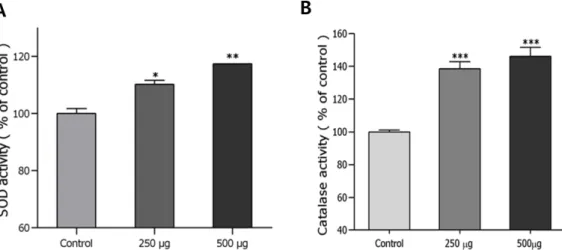
항산화 효소 SOD 및 Catalase 활성증가 효능 – Xanthine 을 기질로 xanthine oxidase의 효소반응 과정 중에 생성되는 superoxide anion을 활용하여 SOD의 활성을 측정한 결과 Fig. 3A에서 나타난 바와 같이 예쁜꼬마선충의 삼채 잎의 ethyl acetate 투여군은 SOD의 활성을 농도의존적으로 증가 시켰으며, ethyl acetate분획 500 µg/mL 투여군은 대조군과 비교하여 SOD 활성을 약 17.3% 정도 증가시켰다(**p<0.01).
강력한 반응성을 가진 활성 산소종인 hydrogen peroxide를 체내에서 대사시키는 catalase의 활성은 Fig. 3B에서 나타난 바와 같이 ethyl acetate분획 500 µg/mL 투여군이 대조군에 비해 catalase활성을 약 46.1% 정도 증가시켰다(***p<0.001) (Fig. 3).
Fig. 1. DPPH radical scavenging effects of the ethanol extract, and its fractions of the leaves of A. hookeri.
Fig. 3. Effects of ethyl acetate fraction of the leaves of A. hookeri on the antioxidant enzyme activity of wildtype N2 nematodes.
(A) The enzymatic reaction of xanthine with xanthine oxidase was used to generate ·O2- and the SOD activity was estimated spec- trophotometrically through formazan formation by NBT reduction. SOD activity was expressed as a percentage of the scavenged amount per control. (B) Catalase activity was calculated from the concentration of residual H2O2, as determined by a spectropho- tometric method. Catalase activity was expressed in U/mg protein. Data are expressed as the mean±S.E.M. of three independent experiments (N=3). Differences compared to the control were considered significant at *p<0.05 and ***p<0.001 by one-way ANOVA.
Fig. 2. Xanthine-originated superoxide quenching activities of ethanol extract, and its fractions of the leaves of A. hookeri.
활성 산소종(ROS) 감소 효능 − 삼채 잎 ethyl acetate 분 획의 농도별 세포 내 활성 산소종의 감소 효능을 알아보기 위해 H2DCF-DA와 선충 내부의 활성 산소종을 반응시켜 형광을 관찰하였다. 활성 산소종 형광의 감소 폭은 대조군 과 비교하여 ethyl acetate층 500 µg/mL 투여군에서 평균 약 28.3%(**p<0.01) 활성 산소종을 감소시키는 것으로 확인되 었다(Fig. 4).
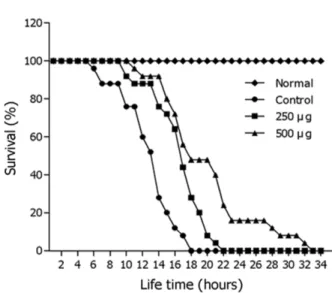
Oxidative Stress 저항성 증가 효능 − 삼채 잎 ethyl acetate 분획이 선충의 stress 저항성에 미치는 영향은 oxidative stress 조건에서 선충을 배양하여 생존율을 확인하 였다. 선충에 oxidative stress를 유도하기 위해서 juglone이 함유된 plate에서 배양한 대조군 선충의 최고 생존시간은 18 시간 이었으나, ethyl acetate분획 500 µg/mL 농도에서는 생 존시간을 33시간으로 증가시켰다. 대조군의 평균 생존시간
이 12.9±0.6시간었으나 500 µg/mL 농도 처리군은 평균 생존 시간을 20.1±0.1시간으로 56.0%를 향상시켰다(***p<0.001) (Fig. 5, Table I).
형질 전환 선충 내 SOD-3의 발현 증가 효능 − 선충 내 에서 oxidative stress에 저항하기 위한 단백질의 증가여부를 확인하기 위해서 SOD 발현 유전자의 증가 여부를 확인하 였다. SOD-3을 포함한 형질 전환 선충 CF1553을 사용하여 실험한 결과 CF1553 형질전환 선충에 삼채 잎 ethyl acetate 분획 500 µg/mL 처리군이 처리되지 않은 선충에 비해 높 은 SOD-3::GFP 발현율(14.3%, ***p<0.001)을 보여주었다 (Fig. 6A, 6B).
고 찰
본 실험은 수확 후에 폐기되는 삼채 잎의 항산화와 관련 된 자원으로서의 효용성을 확인해 보기 위해 실행되었다.
Table I. Effect of ethyl acetate fraction of the leaves of A. hookeri on the oxidative stress tolerance of C. elegans Stress
condition Concentration Mean lifespan (h)
Maximum lifespan (h)
Change in mean lifespan (%)
Log-rank test 1 mM
Juglone
Control 250µg/mL 500µg/mL
12.9±0.6 16.7±0.6 20.1±0.1
18 22 33
- 29.4 56.0
-
***p<0.001
***p<0.001
Mean lifespan presented as mean±S.E.M data. Change in mean lifespan compared with control group (%). Statistical significance of the difference between survival curves was determined by log-rank test using the Kaplan-Meier survival analysis. Differences compared to the control were considered significant at ***p<0.001.
Fig. 4. Effect of ethyl acetate fraction of the leaves of A.
hookeri on the intracellular ROS accumulation of wild-type N2 nematodes. The worms were incubated with 50µM juglone for 2 h, and subsequently treated with the fluorescent probe H2-DCF-DA. Intracellular ROS accumulation was quan- tified spectrometrically at excitation 485 nm and emission 535 nm. Plates were read 30 min for 90 min. Data are expressed as the mean±S.E.M. of three independent experi- ments (N=3). Differences compared to the control were con- sidered significant at *p<0.05, **p<0.01 and ***p<0.001 by one-way ANOVA.
Fig. 5. Effect of ethyl acetate fraction of the leaves of A.
hookeri on the stress tolerance of wild-type N2 nematodes.
For the oxidative stress assays, worms were transferred to 96- well plate containing 1 mM of juglone liquid culture, and then their viability was scored. Statistical difference between the curves was analyzed by log-rank test. All experiments were done in triplicates.
실험에서 삼채 잎의 ethyl actate분획물은 DPPH radical과, superoxide 소거활성시험에서 가장 강한 활성을 보여 주었 다. 이러한 결과는 삼채 뿌리를 대상으로 실험한 연구결과 에서도 ethyl acetate분획에서 가장 높은 DPPH radical과 superoxide 소거 효과를 나타낸 결과와 유사하며,9) 이러한 DPPH radical과 superoxide 소거 효과는 기존에 보고된 삼 채의 항염증, 항산화 효과와 부합되는 결과로 사료된다.18-20) 예쁜꼬마선충 세포의 양을 정량한 후 선충 내의 항산화 효 소인 SOD 및 catalase의 활성을 확인해 본 결과 삼채 잎 ethyl acetate 분획은 농도 의존적으로 SOD 및 catalase의 활 성을 높이는 것으로 확인되어 활성 산소종에 의해 야기되 는 산화적 스트레스로부터 방어하는 기전에 도움이 될 것 으로 판단된다.21,22) 또한 선충에 삼채 잎 ethyl acetate분획 을 처리하고 juglone을 투여한 후 선충 세포 내 활성 산소 종 수치의 변화를 확인한 결과 상당한 활성 산소종의 축적 이 농도 의존적으로 억제되는 활성을 보여 주었다. 이와 관 련하여 juglone을 이용하여 oxidative stress를 발생시키고 선 충의 oxidative stress에 대한 저항능력을 확인한 결과 삼채 잎 ethyl acetate분획 처리군이 stress 조건하에서 대조군과 비교하여 생존율이 농도 의존적으로 크게 증가하는 것이 확 인되었다. 또한, 이를 확인할 수 있는 기전 중의 하나인, GFP-fused transgenic strain CL2070을 이용하여 juglone으 로 처리한 oxidative stress 저항성 확인실험에서 저항성을 나타내는 SOD-3::GFP 형광 발현율이 상당히 증가됨이 확 인되어 oxidative stress에 저항하는 단백질의 발현이 상당히
증가되었음을 확인하였다. 인체 내의 활성 산소종은 주로 미토콘드리아에서 생성되지만 그 외에 자외선, 스트레스 및 세포 손상 등에 의해 생성되어 체내의 항산화제를 고갈시 키고 이로 인해 oxidative stress를 야기하여 노화, 암, 염증 및 피부주름 생성 등에 상당한 관련성이 있다고 보고되어
있다.23,24) 따라서 삼채 잎의 ethyl acetate분획이 체내의 SOD
나 catalase 등의 항산화 효소의 활성을 증가시키고, 활성 산 소종의 축적을 억제하며 oxidative stress에 대한 저항력을 높여 주는 효능은 노화나 수명연장 및 암이나 염증성 질환 등의 예방 및 치료 등에 긍정적인 영향을 줄 수 있을 것으 로 추측된다. 삼채에 대한 연구 중에 삼채 뿌리의 함유 성 분에 대해서 저자 등이 보고한 phenol 화합물 1종과10) 총페 놀성 성분 및 총플라보노이드 성분에 대한 내용25) 외에는 구체적으로 보고된 것은 없으며, 삼채 잎의 성분에 대해서 는 구체적으로 단일 물질로 분리하여 보고된 성분이 현재 없는 것으로 확인되었다. 앞으로 활성물질에 대한 물질의 분리와 구조확인 및 단일 물질 수준에서의 항산화 활성 확 인이 필요할 것으로 사료된다.
결 론
삼채 잎의 ethyl acetate분획은 DPPH radical과, superoxide 소거활성 시험에서 강한 항산화력을 보여 주었으며, 예쁜꼬 마선충 내의 항산화 효소인 SOD 및 catalase의 활성이 ethyl acetate분획 투여에 의해 농도 의존적으로 높아졌다. 또한 선 Fig. 6. Effect of ethyl acetate fraction of the leaves of A. hookeri on the expression of SOD-3 was determined using transgenic nematodes. Mean GFP intensity of CF1553 mutant was represented as mean ± S.E.M. of values from 19 to 25 animals per each experiment. The GFP intensity was quantified using Image software by determining average pixel intensity. Images of SOD-3::GFP expression of CF1553 worm in the presence or absence of ethyl acetate fraction. Data are expressed as the mean±standard deviation of three independent experiments (N=3). Differences compared to the control were considered significant at *p<0.05 and
***p<0.001 by one-way ANOVA.
juglone을 이용하여 oxidative stress를 측정한 결과 생존율 이 농도 의존적으로 증가하는 것을 확인하였다. 이와 관련 하여 예쁜꼬마선충의 mutant인 GFP-fused transgenic strain CL2070을 이용하여 oxidative stress 저항성을 확인한 결과 oxidative stress에 저항성이 있는 단백질의 발현이 증가되었 음을 형광발현 정도를 측정하여 확인하였다. 이러한 결과로 볼 때 삼채 잎 및 그 ethyl acetate분획은 항산화 및 이와 관 련된 질병의 예방 및 치료를 위한 자원으로서의 가치가 충 분히 있을 것으로 사료된다.
인용문헌
1. den Endea, W. V., Pesheva, D. and Garab, L. D. (2011) Dis- ease prevention by natural antioxidants and prebiotics acting as ROS scavengers in the gastrointestinal tract. Trends in Food Sci. Technol. 22: 689-697.
2. Su, S. and Wink, M. (2015) Natural lignans from Arctium lappa as antiaging agents in Caenorhabditis elegans. Phy- tochemistry 117: 340-350.
3. Feng, S., Cheng, H., Xu, Z., Shen, S., Yuan, M., Liu, J. and Ding, C. (2015) Thermal stress resistance and aging effects of Panax notoginseng polysaccharides on Caenorhabditis ele- gans. Int. J. Biol. Macromol. 81: 188-194.
4. Sohal, R. S., Agarwal, A., Agarwal, S. and Orr, W. C. (1995) Simultaneous overexpression of copper- and zinc-containing superoxide dismutase and catalase retards age-related oxi- dative damage and increases metabolic potential in Dro- sophila melanogaster. J. Biol. Chem. 270: 15671-15674.
5. Wei, Y. H. and Lee, H. C. (2002) Oxidative stress, mito- chondrial DNA mutation, and impairment of antioxidant enzymes in aging. Exp. Biol. Med. (Maywood) 227: 671-682.
6. Bouayed, J. and Bohn, T. (2010) Exogenous antioxidants- Double-edged swords in cellular redox state: Health bene- ficial effects at physiologic doses versus deleterious effects at high doses. Oxid. Med. Cell Longev. 3: 228-237.
7. Branen, A. L. (1975) Toxicological and biochemistry of butylated hydroxyanisole and butylated hydroxytoluene. J.
Am. Oil Chem. Soc. 52: 59-63.
8. Shin, T. S., Kang, H. S., Kim, S. K., Lee, K. W. and Cho, B.
W. (1999) Effect of natural and synthetic antioxidants on pH, POV, fatty acids composition and overall acceptability of cooked ground pork. J. Agri. Tech. & Dev. Inst. 3: 1-9.
9. Lee, E. B., Kim, J. H., Yang, J. H., Kim, Y.-S., Jun, H.-I., Ki, B., Lee, S.-H., Kim, Y.-S., Han, S. and Kim, D. K. (2015) Antioxidant and longevity properties of the root of Allium hookeri in Caenorhabditis elegans. Kor. J. Pharmacogn. 46:
234-242.
10. Jun, H.-I., Jang, H., Ahn, D., Kim, D. K., Yang, J. H., Yun,
use as antioxidant in foods. Food Sci. Biotechnol. 24: 2031- 2034.
11. Yoshida, T., Mori, K., Hatano, T., Okumura, T., Uehara, I., Komagoe, K., Fujita, Y. and Okuda, T. (1989) Studies on inhibition mechanism of autooxidation by tannins and fla- vonoids. V: Radical scavenging effects of tannins and related polyphenols on 1,1-diphenyl-2-picrylhydrazyl radical. Chem.
Pharm. Bull. 37: 1919-1921.
12. Thuong, P. T, Kang, H. J., Na, M., Jin, W., Youn, U. J., Seong, Y. H., Song, K. S., Min, B. S. and Bae, K. (2007) Anti-oxidant constituents from Sedum takesimense. Phyto- chemistry 68: 2432-2438.
13. Brenner, S. (1974) The genetics of Caenorhabditis elegans.
Genetics 77: 71-94.
14. Mekheimer, R. A., Sayed, A. A. and Ahmed, E. A. (2012) Novel 1,2,4-triazolo[1,5-a]pyridines and their fused ring sys- tems attenuate oxidative stress and prolong lifespan of Caenorhabiditis elegans. J. Med. Chem. 55: 4169-4177.
15. Aebi, H. (1984) Catalase in vitro. Method. Enzymol. 105:
121-126.
16. Kim, H. N., Seo, H. W., Kim, B. S., Lim H. J., Lee, H, N., Park, J. S., Yoon, Y. J., Oh, J. W., Oh, M. J., Kwon, J., Oh, C. H., Cha, D. S. and Jeon, H. (2015) Lindera obtusiloba extends lifespan of Caenorhabditis elegans. Nat. Prod. Sci.
21: 128-133.
17. Lee, E. Y., Shim, Y. H., Chitwood, D. J., Hwang, S. B., Lee, J. and Paik, Y. K. (2005) Cholesterol-producing transgenic Caenorhabditis elegans lives longer due to newly acquired enhanced stress resistance. Biochem. Biophys. Res. Commun.
328: 929-936.
18. Bae, D. Y. and Bae, G. C. (2012) The anti-inflammatory effects of ethanol extract of Allium hookeri cultivated in South Korea. Kor. J. Herbology 27: 55-61.
19. Kim, N. S., Choi, B. K., Lee, S. H., Jang, H. H., Kim, J. B., Kim, H. R., Kim, D. K., Kim, Y. S., Yang, J. H., Kim, H. J.
and Lee, S. H. (2015) Effect of Allium hookeri on glucose metabolism in type II diabetic mice. Kor. J. Pharmacogn. 46:
78-83.
20. Won, J. Y., Yoo, Y. C., Kang, E. J., Yang, H., Kim, G. H., Seong, B. J., Kim, S. I., Han, S. I., Han, S. H., Lee, S. S. and Lee, K. S. (2013) Chemical components, DPPH radical scav- enging activity and inhibitory effects on nitric oxide pro- duction in Allium hookeri cultivated under open field and greenhouse conditions. J. Korean Soc. Food Sci. Nutr. 42:
1351-1356.
21. Saran, M. and Bors, W. (1990) Radical reaction in vivo – an overview. Radiat. Environ. Biophys. 29: 249-262.
22. Sun, Y. (1990) Free radicals, antioxidant enzymes, and car- cinogenesis. Free Radic. Biol. Med. 8: 583-599.
23. Bokov, A., Chaudhuri, A. and Richardson, A. (2004) The role
of oxidative damage and stress in aging. Mech. Ageing Dev.
125: 811-826.
24. Kim, J. W., Seo, S. J., Hong, C. K. and Ro, B. I. (1994) Study on superoxide dismutase activity in psoriatic skin. Kor. J.
Dermatol. 32: 860-865.
25. Hwang, J.-S., Lee, B. H., An, X., Jenog, H. r., Kim, Y.-E.,
Lee, I., Lee, H. and Kim, D.-O (2015) Total phenolics , total flavonoids, and antioxidant capacity in the leaves, bulbs, and roots Allium hookeri. Korean J. Food Sci. Technol. 47: 261- 266.
(2017. 6. 10 접수; 2017. 6. 15 심사; 2017. 6. 16 게재확정)