Modulatory Effects of Korean Red Ginseng Extract (Panax ginseng C.A. Meyer) on Cytochrome P450 after Oral Administration to Mice for 14 Days
Heeyeon Kim1, Woongshik Nam1, Seong Hee Kim1, Hye Ryang Jang1, Mi Kyoung Lee1, Tae Wan Kim2 and Sangkyu Lee1*
1College of Pharmacy, Kyungpook National University, Daegu 702-701, Korea
2Department of Physiology, College of Veterinary Medicine, Kyungpook National University, Daegu 702-701, Korea Received May 25, 2012 /Revised July 31, 2012 /Accepted August 1, 2012
Ginseng is one of the most commonly used herbal medicines and health foods. Korean red ginseng (KRG;Panax ginseng C.A. Meyer) extract is known to have potential therapeutic activities, such as an- ti-viral effects, the amelioration of food allergies, anti-oxidant effects, and obesity reduction.
Nevertheless, no reports have been issued the modulatory effects of KRG extract on the activity of cytochrome P450 (CYP). In the present study, we investigated the modulatory effect of KRG extract in vitro and in vivo by using pooled human liver microsomes and male ICR mice. When human liver microsomes were incubated with KRG extract at 0.01-10 mg/ml, CYP1A2, 2B6, 2C19, 2D6, and 3A were not significantly inhibited by KRG extract, although CYP2B6 was slightly inhibited. Mice were orally administered KRG extract at 50, 250, or 500 mg/kg daily for 3, 7, or 14 days. However, the activities of CYPs in mouse livers were not significantly different from those of vehicle-treated controls. In conclusion, no significant ginseng-drug interaction was observed. KRG extract did not sig- nificantly modulate the activities of CYPs in vitro or in vivo.
Key words : Cytochrome P450, korean red ginseng extract, herb-drug interaction
*Corresponding author
*Tel:+82-53-950-8571, Fax:+82-53-950-8557
*E-mail : [email protected]
Introduction
Ginseng is one of the most popular used herbal medicines worldwide. Generally, ginseng itself or natural medicines containing ginseng components are believed to have various therapeutic effects, such as, tonic, immune system enhance- ment, and physical stamina and appetite stimulating effects.
Korean red ginseng (KRG) extract are prepared by steaming and drying fresh ginseng. During this process, the chemical constituents may be transformed, and this is of pharmaco- logic importance. Recently KRG extract have been reported to have various pharmacological effects, such as, anti-viral, food allergy preventing, anti-oxidant, and anti-obesitic ef- fects [7,9,15,16]. Furthermore, KRG extract has been reported to be an effective remedy for influenza-like illnesses and atopic dermatitis [3,14].
Although the co-administration of drugs with KRG ex- tract may give rise to ginseng-drug interactions, gin- seng-drug interactions have not been tested. In herbal medi- cine, herb-drug interactions are an important research consideration. Of the many reasons for herb-drug inter-
actions, the most important is herb-drug interactions origi- nating from cytochrome P450s (CYPs). The inhibition or in- duction of the activities of CYPs can lead to pharmacokinetic drug interactions. Representatively, bergamottin in grape- fruit juice strongly inhibits CYP3A activity in intestine and liver [13] and hyperforin in St. John’s wort extract sig- nificantly induces CYP3A in liver [12].
In previous reports, the modulatory effects of ginseng ex- tract or components on CYP activities were investigatedin vitro. For example, it has been reported that ginsenoside Rd weakly inhibits activities of CYP3A and 2D6 in cDNA ex- pressed CYP enzyme and that standardized ginseng extract reduce the effects of CYP1 family on the activities of human recombinant CYP1A1, 1A2, and 1B1 [2,6]. In one study, eight ginsenosides and their aglycones were found to potently in- duce CYP1A1 expression, and furthermore, ginsenoside Rf showed a weak effect on CYP3A promoter activation in HepG2 cells [5,10].
Although the regulatory effects of ginseng extract or ac- tive components on the activities of CYPsin vitro have been reported, no investigation has been conducted on the modu- latory effects of KRG extractin vitro and in vivo. Moreover, the modulatory effects of KRG extract on metabolic enzymes after orally administration to animals or man have not been
studied. In the present study, we investigated the modu- latory effect of KRG extractin vitro and in vivo using pooled human liver microsomes (HLMs) and male ICR mice in or- der to study the potential herb-drug interaction. Using cock- tail probes for CYP1A, 2B, 2C, 2D, 2E and 3A, the activities of the six major CYPs involved in drug metabolism in hu- man were evaluated after incubating pooled HLMs with KRG extract and in microsomal protein from mice treated with KRG extract orally.
Materials and Methods Reagents and Samples
KRG extract was purchased from the Korea Ginseng Corporation (Daejeon, Korea). Pooled HLMs were purchased from BD Gentest (Woburn, MA). Glucose 6-phosphate, β -NADP+and glucose 6-phosphate dehydrogenase were ob- tained from Sigma Chemical Co. (St. Louis, MO). All other chemicals used were of analytical grade and used as received.
Animal treatment and preparation of liver S9 fractions
Specific pathogen-free male ICR mice were obtained from Orient Bio Inc., (Seongnam, Korea). Animals were received at 4 weeks old and acclimated for at least 2 weeks. Animal quarters were strictly maintained at 23±3oC and 40-60% rela- tive humidity. A 12 hr light/dark cycle was used at an in- tensity of 150-300 Lux. KRG extract in distilled water at 50, 250, or 500 mg/kg was treated to mice orally for 3, 7, or 14 consecutive days. Twenty-four hours after last dosing, all animals were subjected to necropsy. Livers were removed and homogenized with four volumes of ice-cold 0.1 M potas- sium phosphate buffer (pH 7.4). The liver S9 fractions iso- lated by differential centrifugation at 9,000 g were stored at -80°C until required. Protein contents were determined using bovine serum albumin as a standard, as previously described [11]. All animal care and procedures were con- ducted according to the Guiding Principles in the Use of Animals in Toxicology, as adopted by the Society of Toxicology (Reston, VA) in 1989.
Enzyme inhibition experiments in pooled human liver microsomes
To determine liver microsomal activities, the probe re- actions used were: phenacetinO-deethylation for CYP1A2,
bupropion 1’-hydroxylation for CYP2B6, omeprazole 5-hy- droxylation for CYP2C19, dextromethorphanO-demethyla- tion for CYP2D6, chlorzoxazone 6-hydroxylation for CYP2E1, and midazolam 1’-hydroxylation for CYP3A. The cocktail probes consisted with 80 μM phenacetin for CYP1A2, 50 μM bupropion for CYP2B6, 20 μM omeprazole for CYP2C19, 5 μM dextromethorphan for CYP2D6, and 2.5 μM midazolam for CYP3A. Probe substrates were incubated with 0.2 mg of HLM in a final incubation volume of 0.2 ml contained 0.1 M potassium phosphate buffer (pH 7.4), KRG extract, and a NADPH-generating system (NGS) con- taining 0.1 M glucose 6-phosphate, 10 mg/ml β-NADP+, and 1.0 U/ml glucose-6-phosphate dehydrogenase. The mixture was incubated for 60 min at 37°C after a 5 min-preincubation without the substrate mixture. For identification of inhibition patterns of CYP by KRG extract, the mixture including pooled HLM, NGS and KRG extract was incubated without pre-incubation for 5 min. After incubation, the reaction was stopped by adding 100 μl acetonitrile containing on 0.1%
formic acid with internal standard solution (10 μg/ml terfe- nadine in methanol). Samples were mixed and centrifuged at 16,000 g for 5 min, and 10 μl aliquots were analyzed by LC/MS/MS.
Monooxygenase activities in mice treated with KRG extract
Liver S9 fractions were incubated with cocktail probes with 6 types of CYP substrates, and NGS in 0.1 M potassium phosphate buffer (pH 7.4). After incubation for 60 min at 37°C, the reaction was stopped by adding 100 μl acetonitrile with 0.1% formic acid containing an internal standard sol- ution (10 μg/ml terfenadine in methanol). Sample were mixed and centrifuged at 16,000 g for 5 min, and 10 μl ali- quots were analyzed by LC/MS/MS.
Hepatotoxicity Parameters
Liver homogenate protein levels were determined as described by Lowry et al. (1951) [11], using bovine serum albumin as a standard. Lipid peroxides were determined by thiobarbituric acid reaction, as previously described [13], and liver GSH levels were determined using Ellman’s method [1].
Instrumentation
The activities of CYP in incubated samples were de- termined using an AccelaTM LC system coupled to a TSQ
Table 1. IC50 values for the inhibition of CYP family members in pooled human liver microsomes by KRG extract
CYP isoforms Substrate reaction probes IC50 (mg/ml)
Without preincubation With preincubation
CYP1A2 Phenacetin O-deethylation 17.7 > 50
CYP2B6 Bupropion 1’-hydroxylation 13.7 8.1
CYP2C19 Omeprazole 5-hydroxylation > 50 34.2
CYP2D6 Dextromethorphan O-demethylation > 50 > 50
CYP2E1 Chlorzoxazone 6-hydroxylation > 50 > 50
CYP3A Midazolam 1’-hydroxylation > 50 > 50
To determine the presence of inactivation by KRG extract, pooled HLMs (0.2 mg) were pre-incubated with KRG extract at 0.01 to 10 mg/ml in 0.1 M potassium phosphate buffer (pH 7.4) for 15 min in the presence of NGS. CYP substrates were then added and incubated for 60 min at 37oC.
(A) CYP1A2
Korean Red Ginseng Extract (mg/ml)
0.01 0.1 1 10
% of Control Activity
0 20 40 60 80 100
without preincubation with preincubation
(B) CYP2B6
Korean Red Ginseng Extract (mg/ml)
0.01 0.1 1 10
% of Control Activity
0 20 40 60 80 100
without preincubation with preincubation
(D) CYP2D6
Korean Red Ginseng Extract (mg/ml)
0.01 0.1 1 10
% of Control Activity
0 20 40 60 80 100
Without preincubation With preincubation
(E) CYP2E1
Korean Red Ginseng Extract (mg/ml)
0.01 0.1 1 10
% of Control Activity
0 20 40 60 80 100
Without preincubation With preincubation
(F) CYP3A4
Korean Red Ginseng Extract (mg/ml)
0.01 0.1 1 10
% of Control Activity
0 20 40 60 80 100
without preincubation with preincubation
(C) CYP2C19
Korean Red Ginseng Extract (mg/ml)
0.01 0.1 1 10
% of Control Activity
0 20 40 60 80 100
Without preincubation With preincubation
Fig. 1. Inhibition of CYP family members by KRG extract at 0 to 10 mg/ml in pooled human liver microsomes. To determine the inhibition effect of KRG extract on the activities of CYPs, the probe reaction used were: phenacetinO-deethylation for CYP1A2, bupropion 1’-hydroxylation for CYP2B6, omeprazole 5-hydroxylation for CYP2C19, dextromethorphanO-demethyla- tion for CYP2D6, chlorzoxazone 6-hydroxylation for CYP2E1 and midazolam 1’-hydroxylation for CYP3A. Values are the means of two determinations and are expressed as percentages of control activity.
Table 2. Effects of KRG extract on liver weights in vehicle and experimental male ICR mice
Dose (mg/kg) Weight ratio (Liver/Body)
3 days 7 days 14 days
VH 0.060±0.001 0.059±0.001 0.051±0.001
50 0.061±0.002 0.061±0.001 0.053±0.001
250 0.069±0.004 0.059±0.002 0.054±0.001
500 0.072±0.003* 0.063±0.002 0.054±0.001
Male ICR were treated orally with 50, 250, or 500 mg/kg of KRG extract daily for 3, 7, or 14 days. Animals were subjected to necropsy 24 hour after last treatments. Values are the means±SEs of five animals. The asterisks indicate values significantly different from the vehicle control. VH, vehicle treated animals.
Vantage triple quadrupole mass spectrometer (Thermo Fisher Scientific Inc., USA) equipped with a HESI-II Spray source. Samples (20 μl) were injected into a chromatographic system and separated on an Inertsil® ODS-3 column, 5 μm (2.1×150 mm, GL science) with a guard column C18 (4 mm, 3.0 mm i.d., Phenomenex, USA). The mobile phase consisted of 0.1% formic acid (A) and acetonitrile (B). The initial com- position was increased to 90% solvent (B) over 11 min. A gradient program was used for HPLC separation at a flow rate of 230 μl/min. Electrospray ionization was performed at a spray voltage of 4,000 kV in positive mode. Vaporizer and capillary temperature were at 150 and 300°C, respectively. Nitrogen was used as the sheath and as the auxiliary gas, with the optimum values at 45 and 15 (arbitrary units), respectively.
Statistics
Mean values±standard errors (SEs) were determined for each treatment group in given experiments. Dunnett’s t-test was used to determine statistical significance. Statistical sig- nificance was accepted for p values of <0.05, which are in- dicated in the text as asterisks. Calculation of IC50 values (the concentration of the inhibitor causing 50% inhibition of the original enzyme activity) was based on the curves of mean enzyme activity versus inhibitor concentration using SigmaPlot (version 10.0, Systat Software, Inc.)
Results
Inhibitory effects of KRG extract on monooxygenase activities in pooled human liver microsomes
To study the potential inhibitory effects of KRG extract on individual CYP enzymes, probe reaction assays were con- ducted using cocktail for CYP1A2, 2B6, 2C19, 2D6, 2E1 and 3A, which are the major CYP family members involved in human drug metabolism (Fig. 1). As shown in Table 1, IC50
Korean red ginseng extract (mg/kg)
VH 50 250 500
Malondialdehyde (nmoles per g liver)
0 1 2 3
A
Korean red ginseng extract (mg/kg)
VH 50 250 500
Glutathion (nmole per mg protein)
0 25 50 75
B
Fig. 2. Effect of KRG extract on malondialdehyde (A) and GSH (B) contents in mouse liver after oral administration. Five male ICR mice were treated orally with 50, 250, or 500 mg/kg daily for 14 days. Animals were subjected to nec- ropsy 24 hours after last treatments. Values are the means±SEs of five animals.
values were determined for each CYP, and these were used to estimate inhibitory potencies. Although incubation with 0.01-10 mg/ml of extract for 60 min slightly inhibited CYP2B6-catalyzed bupropion 1’-hydroxylation with an IC50
at 13.7 mg/ml, other CYPs were not significantly inhibited
Table 3. Effects of KRG extract on CYP activities after oral administration to mice for 3 days Activity
(pmol/min/mg protein) Dose (mg/kg)
VH 50 250 500
CYP1A Phenacetin
O-deethylation 204.4±21.7 206.1±19.3 241.3±19.0 173.6±9.9
CYP2B Bupropion 1’-
hydroxylation 110.6±14.2 110.7±18.0 127.7±16.7 146.7±16.1
CYP2C Omeprazole 5-
hydroxylation 158.2±32.4 171.3±33.4 192.5±19.5 175.5±12.2
CYP2D Dextromethorphan
O-demethylation 19.2±1.2 21.7±1.2 21.1±1.3 28.2±8.6
CYP2E Chlorzoxazone
6-hydroxylation 1066.9±92.4 1219.7±68.2 1230.8±93.8 1036.2±40.3
CYP3A
Midazolam
1’-hydroxylation 5.6±0.8 6.4±0.9 6.4±0.3 6.1±0.8
Erythromycin
N-demethylation 63.9±2.9 70.1±4.3 67.6±3.6 63.1±4.6
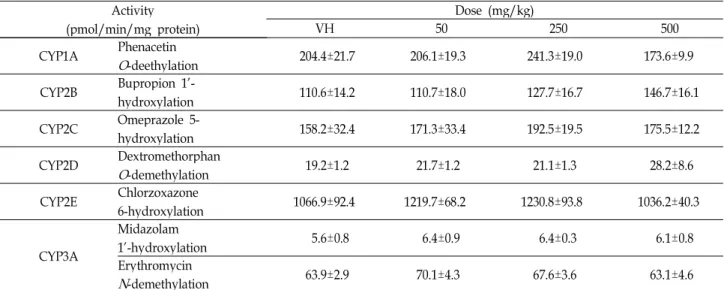
Male ICR were treated orally with 50, 250, or 500 mg/kg of KRG extract daily for 3 days, respectively. Animals were subjected to necropsy 24 hours after last treatments. Values are means±SEs for five animals. VH, vehicle treated animals.
Table 4. Effects of KRG extract on CYP activities after oral administration to mice for 7 days Activity
(pmol/min/mg protein)
Dose (mg/kg)
VH 50 250 500
CYP1A Phenacetin
O-deethylation 139.4±28.2 108.7±10.7 146.5±17.5 126.9±13.7
CYP2B Bupropion 1’-
hydroxylation 71.1±15.8 53.0±7.3 45.9±7.8 47.7±4.9
CYP2C Omeprazole 5-
hydroxylation 198.4±10.4 207.9±29.2 176.8±13.9 213.4±14.0
CYP2D Dextromethorphan
O-demethylation 31.6±5.3 23.7±5.3 25.8±4.5 24.8±2.6
CYP2E Chlorzoxazone
6-hydroxylation 969.1±118.7 765.2±88.3 807.5±93.4 809.6±63.4
CYP3A
Midazolam
1’-hydroxylation 9.8±0.5 8.6±1.8 7.4±0.6 10.0±1.1
Erythromycin
N-demethylation 70.7±1.4 67.5±2.0 48.9±3.8* 63.8±8.2
Male ICR were treated orally with 50, 250, or 500 mg/kg of KRG extract daily for 7 days. Animals were subjected to necropsy 24 hours after last treatments. Values are means±SEs of five animals. The asterisks indicate values significantly different from the vehicle control. VH, vehicle treated animals.
by KRG extract.
Hepatotoxicity of KRG extract
To investigate the toxic effects of KRG extract, changes in liver weights and GSH and malondialdehyde contents were determined after daily treatment for 3, 7, or 14 days with 0, 50, 250 or 500 mg/kg of extract daily. As shown in Table 2, the liver weights were not changed, and GSH and malondialdehyde contents were not decreased by treat-
ment for 14 days daily dose (Fig. 2). Additionally, we de- termined the activities of serum ALT and AST in animals orally treated with extract for 3, 7, or 14 days. No significant hepatotoxicity was observed versus vehicle treated controls (data not shown).
Modulatory effects of KRG extract on mono- oxygenase activities in mouse liver
To investigate ginseng-drug interactions in vivo, mice
Table 5. Effects of KRG extract on CYP activities after oral administration to mice for 14 days Activity
(pmol/min/mg protein)
Dose (mg/kg)
VH 50 250 500
CYP1A Phenacetin
O-deethylation 146.7±33.9 145.9±15.0 143.1±21.0 125.0±11.6
CYP2B Bupropion 1’-
hydroxylation 43.5±13.3 47.5±4.8 58.9±8.3 29.5±3.1
CYP2C Omeprazole 5-
hydroxylation 147.1±40.6 167.6±12.3 134.7±14.1 138.3±11.3
CYP2D Dextromethorphan
O-demethylation 27.3±5.3 26.3±1.4 30.3±2.0 22.5±2.3
CYP2E Chlorzoxazone
6-hydroxylation 721.2±167.3 738.7±62.7 713.3±48.6 652.8±27.2
CYP3A
Midazolam
1’-hydroxylation 7.7±1.8 7.6±0.3 8.1±0.6 7.0±0.6
Erythromycin
N-demethylation 41.5±5.3 52.8±8.1 42.0±3.8 46.7±2.7
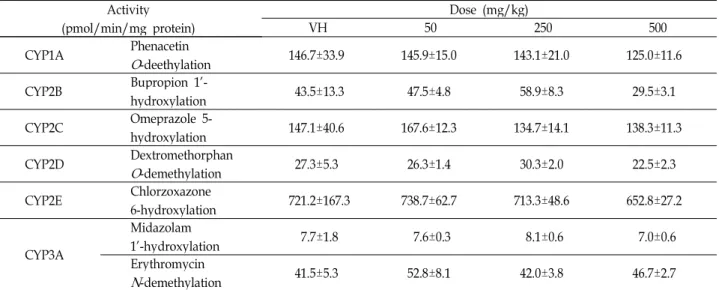
Male ICR were treated orally with 50, 250, or 500 mg/kg of KRG extract daily for 14 days. Animals were subjected to necropsy 24 hours after last treatments. Values are means±SEs of five animals. VH, vehicle treated animals.
were treated orally with extract in distilled water at 50, 250, or 500 mg/kg for 3, 7, or 14 consecutive days. The daily recommended dosage of extract in man is 50 mg/kg. Using microsomal fractionation, the modulatory effects of KRG ex- tract on monooxygenase activities were determined by in- cubation with cocktail probe substrates, namely, phenacetin for CYP1A2, bupropion for CYP2B6, omeprazole for CYP2C19, dextromethorphan for CYP2D6, chlorzoxazone for CYP2E1, and midazolam and erythromycin for CYP3A (Tables 3-5). KRG extract were not found to have any effect on CYP activities.
Discussion
Herb-drug interactions are considerable interest to scien- tists developing natural medicines, prescribing doctors, and to patients. Ginseng is taken as a health supplement either as extract or as a component of a supplement. However, if people take herbal medicines or health foods over the long term, drug interactions may occur due to modulations of the activities of metabolic enzymes.
To evaluate the modulatory effects of KRG extract, we tested their inhibitory effects on 6 types of CYP using HLMs in vitro. In previous studies, the ginsenosides Rb1, Rb2, Rc, Rd, Re, Rf and Rg1were found to inhibit the catalytic activ- ities of CYP1A1, CYP1A2 and CYP1B1 at a concentration of 50 μg/ml in human recombinant CYPs [2], but the modu- latory effects of KRG extract on CYP activities were not in-
vestigated in HLMs. In the present study, we tested the modulatory effects of KRG extract instead of single KRG components in HLMs, because it was difficult to real re- actions between ginsenoside components and specific CYPs under biologic conditions.
For thein vivo study, we orally administrated KRG extract to mice daily for 3, 7, or 14 days at dosages of 50, 250, or 500 mg/kg; the daily recommended dose in man is 50 mg/kg. In the present study, we orally treated mice at 10 times these recommended dosages. Nevertheless, CYP activ- ities in mouse liver showed no notable changes.
The major pharmacological components of ginseng are ginsenosides and their aglycones, which are known to have modulatory effects on the activities of CYPs. Thus, the quan- tities of these principals in extract and their bioavailabilities are likely to influence ginseng-drug interactions [2,6]. The 14 ginsenosides (Rg1, Re, Rf, Rh1, Rg2, Rb1, Rc, Rb2, Rb3, Rd, Rg3, Rk1, Rg5, and Rh2) in KRG extract were present at 66 to 76 mg/g of extract [8]. Furthermore, ginsenosides have very low oral bioavailabilities. For example, the bioavail- ability of the major ginsenoside Rb1 P.O. is only 4.35% when Panax notoginsengs saponins (PNS) are administered at 600 mg/kg to rats [18], and the bioavailability of Rg1 is only 3.29% at a dose of 1,500 mg/kg P.O. of PNS in rat [4].
Moreover, the absolute bioavailability of Rd in dogs is only 0.26%, though Rd has an inhibitory effect on CYP3A and 2D6in vitro [17]. Therefore, although ginsenosides and gin- seng extract modulate CYP activityin vitro, no modulatory
effects was observed in vivo due to the low oral bio- availabilities of ginsenosides.
In conclusion, KRG extract were not found to modulate the activities of CYPs, which suggests that KRG extract ex- hibit no significant pharmacokinetic herb-drug interactions with prescribed drugs metabolized by the six major CYP families. However, further human pharmacokinetics studies should be conducted to confirm the safety of KRG extract in those that take it regularly for long periods of time.
Acknowledgement
This research was supported by the Kyungpook National University Research Fund, 2011.
References
1. Boyne, A. F. and Ellman, G. L. 1972. A methodology for analysis of tissue sulfhydryl components.Anal. Biochem.46, 639-653.
2. Chang, T. K., Chen, J. and Benetton, S. A. 2002.In vitroeffect of standardized ginseng extracts and individual ginseno- sides on the catalytic activity of human CYP1A1, CYP1A2, and CYP1B1. Drug Metab. Dispos.30, 378-384.
3. Ha, K. C., Kim, M. G., Oh, M. R., Choi, E. K., Back, H.
I., Kim, S. Y., Park, E. O., Kwon, D. Y., Yang, H. J., Kim, M. J., Kang, H. J., Lee, J. H., Choi, K. M., Chae, S. W. and Lee, C. S. 2012. A placebo-controlled trial of Korean red gin- seng extracts for preventing Influenza-like illness in healthy adults. BMC Complement Altern. Med. 12, 10.
4. Han, M. and Fang, X. L. 2006. Difference in oral absorption of ginsenoside Rg1 betweenin vitroandin vivomodels.Acta Pharmacol. Sin. 27, 499-505.
5. Hao, M., Ba, Q., Yin, J., Li, J., Zhao, Y. and Wang, H. 2011.
Deglycosylated ginsenosides are more potent inducers of CYP1A1, CYP1A2 and CYP3A expression in HepG2 cells than glycosylated ginsenosides.Drug. Metab. Pharmacokinet.
26, 201-205.
6. Henderson, G. L., Harkey, M. R., Gershwin, M. E., Hackman, R. M., Stern, J. S. and Stresser, D. M. 1999. Effects of ginseng components on c-DNA-expressed cytochrome P450 enzyme catalytic activity. Life Sci. 65, 209-214.
7. Kim, H., Lee, S. G., Chae, I. G., Kim, M. J., Im, N. K., Yu, M. H., Lee, E. J. and Lee, I. S. 2011. Antioxidant effects of fermented red ginseng extracts in streptozotocin-induced
diabetic rats. Ginseng35, 129-137.
8. Kim, S. N., Ha, Y. W., Shin, H., Son, S. H., Wu, S. J. and Kim, Y. S. 2007. Simultaneous quantification of 14 ginseno- sides inPanax ginsengC.A. Meyer (Korean red ginseng) by HPLC-ELSD and its application to quality control.J. Pharm.
Biomed. Anal. 45, 164-170.
9. Lee, M. H., Lee, B. H., Jung, J. Y., Cheon, D. S., Kim, K.
T. and Choi, C. 2011. Antiviral effect of Korean red ginseng extracts and ginsenosides on murine norovirus and feline calicivirus as surrogates for human norovirus.Ginseng35, 429-435.
10. Liu, Y., Wang, Q., Yao, X. and Li, Y. 2010. Induction of CYP3A and MDR1 gene expression by baicalin, baicalein, chlorogenic acid, and ginsenoside Rf through constitutive androstane receptor- and pregnane X receptor-mediated pathways. Eur. J. Pharmacol. 640, 46-54.
11. Lowry, O. H., Rosebrough, N. J., Farr, A. L. and Randall, R. J. 1951. Protein measurement with the Folin phenol reagent. J. Biol. Chem. 193, 265-275.
12. Markowitz, J. S., Donovan, J. L., DeVane, C. L., Taylor, R.
M., Ruan, Y., Wang, J. S. and Chavin, K. D. 2003. Effect of St John's wort on drug metabolism by induction of cyto- chrome P450 3A4 enzyme. JAMA290, 1500-1504.
13. Ohkawa, H., Ohishi, N. and Yagi, K. 1979. Assay for lipid peroxides in animal tissues by thiobarbituric acid reaction.
Anal. Biochem. 95, 351-358.
14. Sohn, E. H, Jang, S. A., Lee, C. H., Jang, K. H., Kang, S.
C., Park, H. J. and Pyo, S. 2011. Effects of Korean red gin- seng extracts for the treatment of atopic dermatitis-like skin lesions in mice. Ginseng35, 479-486.
15. Song, Y. B., An, Y. R., Kim, S. J., Park, H. W., Jung, J. W., Kyung, J. S., Hwang, S. Y. and Kim, Y. S. 2012 Lipid meta- bolic effect of Korean red ginseng extracts in mice fed on a high-fat diet. J. Sci. Food. Agric. 92, 388-396.
16. Sumiyoshi, M., Sakanaka, M. and Kimura, Y. 2010. Effects of Red Ginseng extracts on allergic reactions to food in Balb/cmice. J. Ethnopharmacol. 132, 206-212.
17. Wang, W., Wang, G. J., Xie, H. T., Sun, J. G., Zhao, S., Jiang, X. L., Li, H., Lv, H., Xu, M. J. and Wang, R. 2007.
Determination of ginsenoside Rd in dog plasma by liquid chromatography-mass spectrometry after solid-phase ex- tractsion and its application in dog pharmacokinetics studies.J. Chromatogr. B Analyt. Technol. Biomed. Life Sci.852, 8-14.
18. Xu, Q. F., Fang, X. L. and Chen, D. F. 2003. Pharmacokinetics and bioavailability of ginsenoside Rb1 and Rg1 fromPanax notoginseng in rats. J. Ethnopharmacol. 84, 187-192.
초록:마우스에 홍삼추출물의 14일간 경구 투여에 따른 약물대사효소 조절능 평가 김희연1․남웅식1․김성희1․장혜량1․이미경1․김태완2․이상규1*
(1경북대학교 약학대학, 2경북대학교 수의과대학)
인삼 및 인삼 유래 물질들은 가장 대표적인 건강기능식품이며, 홍삼추출물(Panax ginseng C.A. Meyer)의 경우 항바이러스, 알레르기 감소, 항산화, 비만억제 등의 효과를 나타낸다고 알려져 있다. 대표적 건강기능식품임에도 불구하고 약물상호작용을 일으키는 대사효소(Cytochrome P450, CYP)에 대한 홍삼추출물의 영향은 보고되지 않 았다. 본 연구에서는 사람의 간 마이크로좀 분획과 마우스 모델을 기반으로 홍삼엑기스의 약물대사 조절능을 평 가하였다. 사람의 간 마이크로좀에서는 CYP2B6에 대한 미약한 억제 효과를 나타내었을 뿐, 타 대사효소 CYP1A2, 2B6, 2C19, 2D6와 3A에 대한 억제효과는 검출되지 않았다. 홍삼엑기스를 마우스에 50, 250, or 500 mg/kg의 농도로 3, 7, 14일간 하루 1회 경구 투여 후 간을 적출하여 대사효소의 활성 변화를 측정하였지만, 유의 적인 변화는 관찰되지 않았다. 결과적으로 홍삼엑기스의 유의적인 약물대사효소에 대한 활성 조절능이 없는 것 으로 판단되고, 홍삼엑기스 복용에 따른 홍삼-약물상호작용의 가능성은 없을 것으로 추정된다.