Antifreeze Activity of Dimerized Type I Antifreeze Protein Fragments
Hak Jun Kim*
Department of Chemistry, Pukyong National University, Busan 48513, Korea Received March 7, 2017 /Revised April 5, 2017 /Accepted April 10, 2017
Antifreeze proteins (AFPs) bind to ice crystals and inhibit their growth. AFPs are essential for the sur- vival of organisms living in subzero environments. Type I AFP (AFP37) isolated from winter flounder is an α-helical peptide of 37 residues long. In this study, we attempted to develop short AFP frag- ments with higher activity and solubility. We designed and synthesized N-terminal 15 and 21 resi- due-long AFPs, designated AFP15 and 21. Also dimerized AFP15 and 21, designated dAFP15N and dAFP21N, respectively, were generated through disulfide bonds between peptides containing CGG residues added to the N-terminus of AFP15 and AFP21 (designated AFP15N and 21N). Their helical contents and antifreeze activities were assessed using circular dichroism (CD) spectroscopy and a nanoliter osmometer, respectively. The helical content of AFP15 AFP21, AFP15N, AFP21N, dAFP15N and dAFP21N was 47, 48, 23.8, 28, 49.1, and 52%, respectively compared to that of wild type AFP37;
the antifreeze activity was 8.4, 9.3, 0.05, 5.6, 12.1, 11.2% respectively, compared to that of wild type AFP37. Contrary to our anticipation, the dimerized peptides showed almost the same antifreeze activ- ity as their monomeric counterparts. These results indicate that the dimerized peptides behave as monomeric peptides due to the high rotational freedom of disulfide bonds connecting two monomeric peptides. The star-shaped ice crystals generated by the peptides also demonstrated weak interaction between ice and peptides.
Key words : Antifreeze protein, circular dichroism, dimerization, thermal hysteresis, winter flounder
*Corresponding author
*Tel : +82-51-629-5587, Fax : +82-51-629-5583
*E-mail : [email protected]
This is an Open-Access article distributed under the terms of the Creative Commons Attribution Non-Commercial License (http://creativecommons.org/licenses/by-nc/3.0) which permits unrestricted non-commercial use, distribution, and reproduction in any medium, provided the original work is properly cited.
Journal of Life Science 2017 Vol. 27. No. 5. 584~590 DOI : https://doi.org/10.5352/JLS.2017.27.5.584
서 론
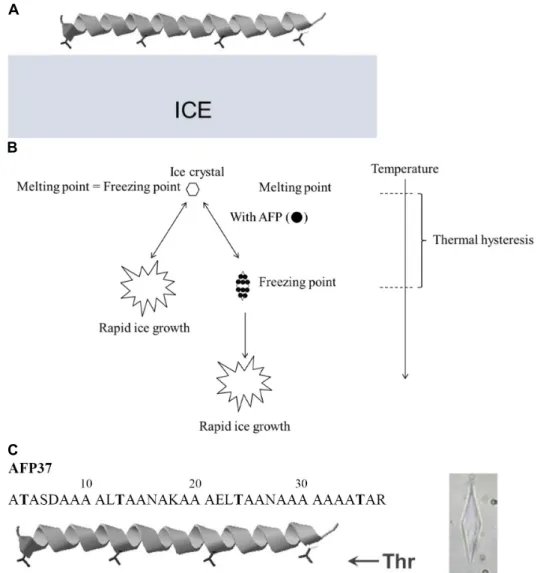
결빙방지 단백질(Antifreeze protein, AFP) 또는 부동 단백 질은 생물유래 부동 물질로 극지서식 어류에서 처음 발견되었 다[6-8]. 이 단백질은 극지어류가 -1.9℃의 바닷물 속에서도 생 존하는데 필수적인 단백질이다. 결빙방지 단백질은 극지어류 의 혈액 내로 분비되어 문자 그대로 어류의 혈액이 -1.9℃에서 도 얼지 않도록 작용한다. 결빙방지 단백질의 결빙방지 기능 은 이 단백질이 얼음에 흡착하기 때문에 가능하다(Fig. 1A) [27]. 결빙방지 단백질은 얼음결정 핵이 생성되면 얼음결정에 흡착하여 얼음 결정의 성장을 억제하게 된다[16]. 결과적으로 결빙방지 단백질이 포함된 용액의 어는점과 녹는점 사이에 차이가 생기게 된다(Fig. 1B). 이러한 온도 차이를 온도 이력 또는 열적 이력(Thermal hysteresis) 이라고 한다[16]. 일반적 으로 용액의 어는점과 녹는점은 같지만, 결빙방지 단백질을 포함한 용액은 녹는점과 어는점 사이에 차이가 생기게 된다.
또한, 결빙방지 단백질은 얼음 재결정화를 억제한다[15]. 얼음
재결정화 과정이란 작은 얼음 결정들이 모여 커다란 얼음 결 정으로 성장하는 현상을 말한다. 이 현상은 열적 변동에 따라 일어나며 열역학적으로 유리한 과정이기 때문에 빈번한 열적 변동이 동반된 혹한의 환경에 노출된 생명체의 경우 체내 커 다란 얼음의 성장으로 인해 치명적인 동결손상을 입을 수 있 다[14]. 따라서 결빙방지 단백질의 이러한 기능은 혹한의 환경 에서 서식하는 생물의 생존에 필수적이다. 현재, 결빙방지 단 백질은 극지나 알파인, 툰드라 등 혹한 지역에 서식하는 미생 물, 미세조류, 식물, 곤충, 어류 등에서 널리 발견되고 있다[9, 10, 12, 13, 18, 28]. 지금까지 결빙방지 단백질의 이런 독특한 특성을 생물물리학적, 생화학적으로 이해하고자 얼음과 단백 질간의 상호작용 연구가 활발히 수행되어 왔으며, 한편으로 천연 동결보호제로서 결빙방지 단백질을 생물소재 및 자원의 동결보존에 활용하려는 연구 또한 점점 증가하고 있다[1-3, 14, 19, 20].
어류 유래 결빙방지 단백질은 4종으로 결빙방지 당단백질 (Antifreeze glycoproteins, AFGPs)과 Type I, II, III AFP가 있 다[11]. 이중 가장 연구가 많이 된 것은 type I AFP이다[5].
겨울넙치(winter flounder)유래의 type I AFP HPLC6 (AFP37)
은 37개의 잔기로 이루어진 α-나선 구조의 펩타이드로 11개의
아미노산 반복단위로 이루어져 있으며 alanine의 비율이 매우
높은 것이 특징이다(Fig. 1C) [4, 29, 30, 32]. 이 펩타이드와
얼음간 결합은 Thr잔기의 수산화기와 얼음 결정의 산소간 수
소 결합, Thr잔기의 메틸그룹에 의한 소수성 상호작용으로 설
- Note -
A
B
C
Fig. 1. (A) Illustration of binding of antifreeze protein (AFP) to ice crystal plane. α-helix represents type I AFP (AFP37); (B) Thermal hysteresis (TH) phenomenon. In general as shown in the left panel, the ice grows rapidly as temperature drops below melting point. However, in the presence of AFP, ice growth is halted until the temperature reaches freezing point. The temperature gap created by AFP is called TH; (C) The primary sequence of AFP37. Threonine resiudes important for ice-binding are highlighted in bold. Shown in the right panel is a typical bipyramidal ice crystal shaped by AFP37, which was measured by a nanoliter osmometer; (D) The setup of a nanoliter osmometer. The cold-stage connected to temperature controller is place on the stage of light microscope.
명된다[29, 32, 33] . AFP37의 네 개의 Thr 잔기 중 13과 24번 Thr이 얼음 결합에 중요한 역할을 한다고 보고된 바 있다[29, 32]. 겨울 넙치의 혈액 내 극미량 존재하여 최근에야 분리된 hyperactive type I AFP는 195개의 잔기를 가진 비교적 큰 단 백질로 AFP37에 비해 온도 이력 활성이 매우 높다[21, 22].
결빙방지 단백질 분자의 크기가 증가하면 온도 이력활성이 증가하는데 이는 단백질이 얼음 표면과 결합할 수 있는 면적 이 증가 때문인 것으로 보인다. 유전자 재조합으로 만들어진 type III AFP의 이, 삼, 사량체의 경우 그 크기가 증가함에 따라 활성도 증가한다고 보고된 바가 있다[23, 24]. 고활성 hyper- active type I AFP의 x-선 결정구조를 보면 네 개의 나선구조 묶음의 이량체(dimeric four-helix bundle)의 구조를 취하고
있다[31].
AFP37의 N-과 C-말단 모두에서 하나 또는 두 개의 잔기를 순차적으로 절단한 실험에서 얼음 결합 활성을 나타내기 위해 최소한 28개의 잔기가 필요하다는 것을 규명하였다[25]. 하지 만 예상한 대로 펩타이드의 잔기의 수가 줄어듦에 따라 활성 또한 비례적으로 감소하였다. 한편 Kun과 Mastai는 AFP 37의 fragment 중 N-말단 12-mer에 해당하는 DTASDAAAAAAL 서열(AFP12) 이 야생형 AFP 37 온도이력활성의 60% 를 나타 낸다고 보고하였다[17].
본 연구에서는 첫 12개 잔기를 포함한 15번 잔기와 21번
잔기까지 연장한 두 펩타이드를 제조, 이들의 이량체화를 시
도하여 나선구조 함량과 온도 이력 활성을 측정하였다. 화학
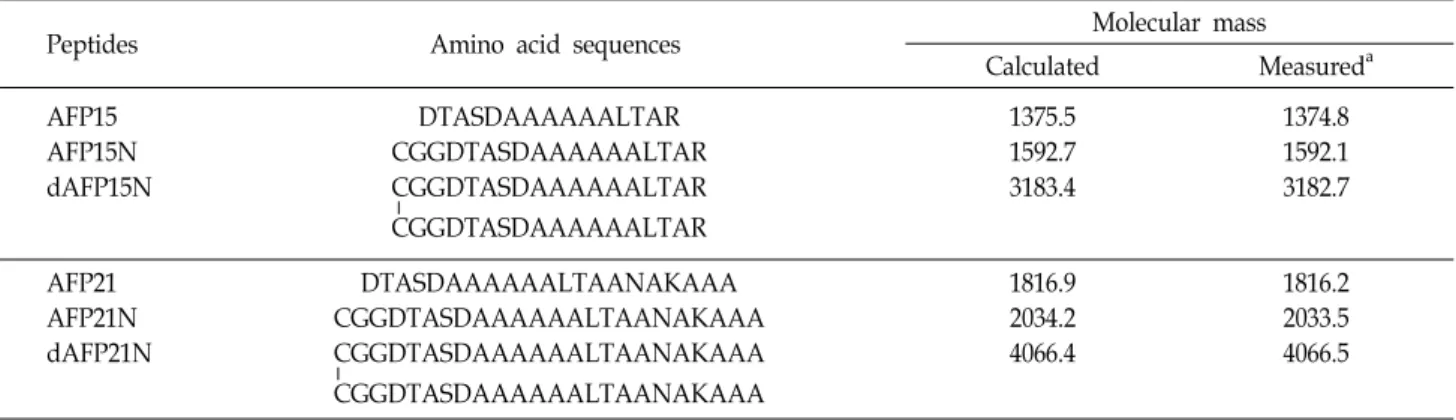
Table 1. Amino acid sequences and calculated and observed molecular masses of antifreeze peptides used in this study
Peptides Amino acid sequences Molecular mass
Calculated Measureda
AFP15 AFP15N dAFP15N
DTASDAAAAAALTAR CGGDTASDAAAAAALTAR CGGDTASDAAAAAALTAR
CGGDTASDAAAAAALTAR
1375.5 1592.7 3183.4
1374.8 1592.1 3182.7
AFP21 AFP21N dAFP21N
DTASDAAAAAALTAANAKAAA CGGDTASDAAAAAALTAANAKAAA CGGDTASDAAAAAALTAANAKAAA
CGGDTASDAAAAAALTAANAKAAA
1816.9 2034.2 4066.4
1816.2 2033.5 4066.5
a Molecular masses were determined by MALDI-TOF MS.
적으로 합성이 용이하며 상대적으로 높은 활성을 가진 작은 크기의 결빙방지 펩타이드(AFP12)를 이량체화 한다면 기존의 AFP37보다 활성이 높은 결빙방지 펩타이드를 개발할 수 있을 것이라는 가설 하에 실험을 수행하였다. 특히 이량체화를 시 도한 이유는 결빙방지 펩타이드의 분자 크기가 클수록 결빙방 지 펩타이드와 얼음간의 결합 면적이 증가함으로써 결빙방지 활성이 증가한다는 보고가 있기 때문이다[23, 24].
재료 및 방법
펩타이드 합성
합성 결빙방지 펩타이드를 제조하기 위하여 사용한 아미노 산 서열은 Table 1에 나타내었다. 단량체 펩타이드인 AFP15, AFP15N, AFP21, AFP21N은 Fmoc-기반의 고상합성법(solid phase peptide synthesis (SPPS))으로 수행하였다. DCC (dicyclohexylcarbodiimide)와 HOBt (Nhydroxybenzotriazole) 를 coupling agent로 사용하였으며, 매회의 Fmoc-L-amino acids의 coupling에는 10당량의 Fmoc-L-amino acids를 사용 하였다. Fmoc-보호기는 20% piperidine/N-methylpyrolidone (NMP) 용액으로 제거하였다. 합성된 펩타이드는 cleavage re- agent [trifluoroacetic acid/water/thioanisole/phenol/etha- nedithiol/triisopropylsilane (81.5/5/5/5/2.5 /1, v/v)]와 실 온에서 2시간 반응 시켜 보호기를 제거하고 resin에서 회수 하였다. Crude peptide는 0.05% trifluoroacetic acid (TFA)을 포함하는 water-acetonitrile gradient (0-80%)을 이동상으로 C18 Vydac column (15 mm, 20 mm × 250 mm)에서 역상 크로마토그래피 (reverse-phase high-performance liquid chromatography: RP-HPLC)로 정제하였다. 정제가 완료된 펩 타이드는 분석용 C18 Vydac column (4.5 mm, 20 mm × 250 mm)으로 펩타이드의 순도를 확인하였다. 이량체 펩타이드인 dAFP15N과 dAFP21N은 앞서 합성한 단량체 펩타이드를 10% DMSO/ acetic acid에서 48시간 반응시켜서 합성하였다.
이황화 결합된 이량체 펩타이드를 RP-HPLC를 이용하여 정제
하였다. 정제가 완료된 펩타이드는 matrix-assisted laser de- sorption/ionization time-of-flight mass spectrometry (MALDI-TOF MS) (Shimadzu, Japan)로 펩타이드의 분자량 을 확인하였다. 대조구로 AFP37을 사용하였다.
Circular Dichroism (CD) Spectroscopy
결빙방지 펩타이드의 2차 구조 분석은 Jsaco사의 J-715 CD spectrophotometer (Toky, Japan)를 이용하여 수행하였다. 펩 타이드 시료는 0.1 M ammonium bicarbonate 완충용액(pH 8.5)에 100 μg/ml이 되도록 녹인 후 사용하였다. 준비한 시료 는 quartz cuvette (1-mm path length)에 넣고 25℃에서, 190-250 nm 범위의 far-UV에서 circular dichroism spectra를 측정하였다. 펩타이드의 CD spectra는 molar ellipticity [θ]
vs 파장의 그래프로 나타냈다. Mean residue molar ellipticity, [θ]는 deg ·cm
2·dmol
-1로 나타내며, 다음 공식을 사용하여 계 산하였다.
[θ]= [θ]
측정(MRW/10 ×l×c)
여기에서 [θ]
측정는 측정한 ellipticity이며 단위는 milli- degrees로 나타내며, MRW는 peptide의 mean residue molec- ular weight, c는 시료의 농도로 mg/ml로, l은 cuvette cell의 광학 경로 길이로 cm로 나타낸다.
각 펩타이드의 α-나선 구조 백분율은 다음 공식을 이용하여 구하였다.
% α-helix content = (θ- θ
RC)/(θ
H- θ
RC) ×100 여기에서 θ는 측정한 ellipticity며, θ
RC와 θ
H는 각각 완전 random coil과 완전 나선구조에 대한 제한 값으로 본 연구에 서는 222nm에서 θ
RC=-1.5×10
3deg ·cm
2·dmol
-1와 θ
H
=-33.4×10
3deg ·cm
2· dmol
-1값을 사용하였다.
온도 이력 활성
결빙방지 펩타이드의 온도 이력 활성과 얼음결정 형태 측정
은 나노리터 삼투압계(nanoliter osmometer, Otago os-
mometers, New Zealand)를 사용하여 측정하였다. 나노리터
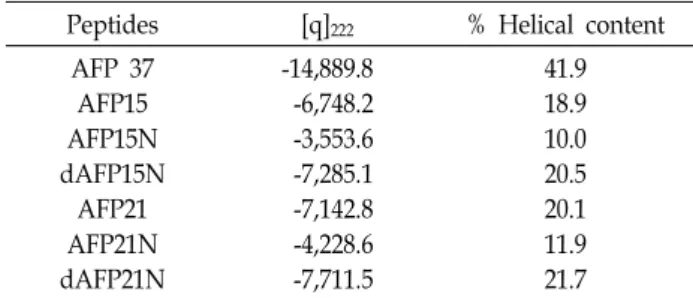
Table 2. Helical content of the antifreeze peptides
Peptides [q]222 % Helical content
AFP 37 AFP15 AFP15N dAFP15N
AFP21 AFP21N dAFP21N
-14,889.8 -6,748.2 -3,553.6 -7,285.1 -7,142.8 -4,228.6 -7,711.5
41.9 18.9 10.0 20.5 20.1 11.9 21.7
Fig. 2. The circular dichroism (CD) spectra of AFP peptides in 0.1 M NH4HCO3 (pH 8.5).
삼투압계에 연결된 cold-well stage는 광학현미경으로 관찰하 였으며 현미경에 탑재된 디지털 카메라로 얼음결정의 형태 변화를 기록하였다. 사용한 시료는 0.1 M NH
4HCO
3, pH 8.5에 녹인 후 사용하였다. 수 μl 부피의 시료 well에 immersion oil 을 채운 후 측정 대상 시료 약 1.5 μl를 주입하였다. 이 well을 cold-well stage에 올려놓고 -20℃로 급속 냉동시킨 후 약 10여 분간 온도를 유지하였다. 천천히 온도를 상승시키면서 얼음을 관찰하였다. 단일 얼음결정의 얼음이 거의 다 녹을 때까지 온 도를 올린다. 이 때의 온도가 해당 용액의 녹는점이 된다. 다시 온도를 0.05℃/min로 천천히 내리면서 단일 얼음결정의 형태 변화를 관찰하였다. 결빙방지 단백질이 포함된 경우 온도가 하강해도 얼음 결정이 커지지 않고 일정한 온도까지 유지되다 가 어는점에 도달하면 급격히 결정이 성장하는 하게 된다. 이 때의 온도가 어는점이 된다. 어는점과 녹는점의 차이가 온도 이력 값이다. 또한 온도 이력 구간 내에서 얼음 결정의 형태는 결빙방지 분자와 얼음의 상호작용 특성을 나타낸다.
결과 및 고찰
결빙방지 펩타이드 제조 및 이차구조 분석
본 연구에서는 AFP 37의 N-말단 12잔기와 C-말단 3 잔기인 TAR을 연결한 AFP15과 N-말단 18잔기와 C-말단 3 잔기인 TAR을 연결한 AFP21 를 합성하였다(Table 1). AFP15는 야생 형 AFP37과 유사하게 나선구조의 N-말단과 C-말단에 cap- ping을 가질 것으로 예상할 수 있다[29]. 야생형AFP37의 경우 C-말단이 amidation화 되어 있으나 본 연구에서 합성한 AFP 15의 경우 그렇지 못하므로 펩타이드의 나선구조 안정화가 약할 것이라고 추측할 수 있다. 이황화 결합을 통한 AFP15 이량체를 제조하기 위하여 CGG서열을 N-말단에 도입하여 AFP15N을 합성하였다. 이황화 결합의 형성을 높이기 위하여 flexibility가 높은 Gly잔기를 N-말단에 2 개 도입하였다. 마찬 가지 방법으로 AFP21N 을 제조하였다.
제조한 펩타이드의 2차 구조를 circular dichroism (CD) spectrophotomer로 분석하였다(Fig. 2). 펩타이드 α-나선 구조 는 주로 208과 222 nm의 파장에서 음의 값을 가진 CD 스펙트 럼을 보여준다. 각 펩타이드의CD 스펙트럼은 측정한 elliptic- ity를 mean residue molar ellipticity 로 변환하여 Fig. 2에 나
타내었다. CD 결과를 바탕으로 한 나선구조 함량은 Table 2에 정리하였다. Fig. 2에 나타낸 바와 같이 AFP37은 전형적인 나 선 구조의 CD 스펙트럼을 보이는 반면, 본 연구에서 제작한 펩타이드는 다소 나선 구조 함량이 적은 CD 스펙트럼을 보였 다. 특히 N-말단에 CGG를 도입한 두 펩타이드 AFP15N과 AFP21N의 나선 구조 함량이 가장 낮은 것으로 나타났다.
AFP21은 AFP15보다 나선 구조 함량이 다소 높게 나타났다.
AFP15와 AFP21의 경우 C-말단의 Arg 잔기가 AFP37과 달리 amidation 되지 않아 전체적으로 펩타이드의 유연성이 증가 하였을 가능성이 높다. N-말단에 CGG 잔기가 도입된 AFP15N 과 AFP21N의 경우 모두 나선 구조 함량이 각각 AFP15와 AFP21에 비해 더 떨어진 것으로 나타났다. 이는 N-말단에 도 입된 잔기가 펩타이드의 유연성을 증가시킴과 동시에 N-말단 의 capping 잔기로서 역할을 하지 못하기 때문인 것을 여겨진 다. 이량체인 dAFP15N과 dAFP21N는 나선 구조 함량이 다소 증가한 것을 알 수 있다. 펩타이드 간의 이황화 결합으로 두 펩타이드의 자유도가 낮아져서 나선 구조 함량이 증가한 것으 로 보인다. 특히 dAFP15N의 경우, N-말단 CGG로 인해 유연 했던 나선 구조가 이량체화를 통해 나선 구조 함량이 AFP15수 준으로 증가하였고, 같은 이유로 dAFP21N도 이황화 결합을 통해 나선 구조 함량이 더 증가한 것으로 판단된다.
결빙방지 펩타이드의 온도 이력 활성
AFP37의 Thr잔기는 2, 13, 24, 35번 위치에 존재하며 얼음과 결합에 중요한 역할을 한다고 알려져 있다(Fig. 1C) [29, 32].
특히13과 24번 Thr잔기는 얼음 결합에 매우 필수적인 것으로
알려져 있다. 이중 2와 13번 Thr잔기만을 포함한 AFP12는
12 mg/ml의 농도에서 AFP37의 60%에 해당하는 온도 이력
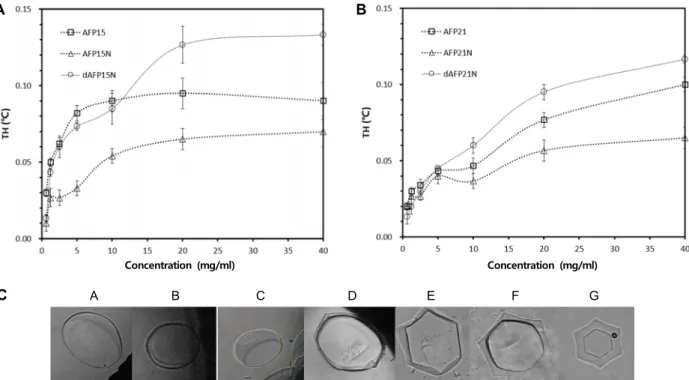
활성을 보인다고 보고된 바 있다[17]. 하지만 본 연구에서 제작
된 AFP15는 AFP37의 약 10% 정도의 활성만을 가진 것으로
나타났다(Fig. 3A). 이전 연구와 본 연구에서 활성의 차이를
보이는 이유는 C-말단의 amidation 차이일 가능성이 있다. 이
A B
Concentration (mg/ml) Concentration (mg/ml)
C
A B C D E F GFig. 3. Thermal hysteresis activity of (A) AFP15, AFP15N, and dAFP15N and (B) AFP21, AFP21N, and dAFP21N as a function of peptide concentration; (C) Ice morphologies generated by (a) 0.1 M NH4HCO3 (pH 8.5) buffer, (b) AFP15, (c) AFP15N, (d) dAFP15N, (e) AFP21, (f) AFP21N, and (g) dAFP21N at 40 mg/ml peptide concentration.
전 연구의 AFP12는 C-말단을 amidation화 함으로써 펩타이 드의 나선 구조가 안정화되었을 가능성이 있으나, 본 연구에 서는 amidation화하지 않았기 때문에 전체적으로 나선 구조 의 유연성이 높아져 활성이 낮아졌을 것으로 생각된다. 이를 지지할 만한 근거로 AFP37의 마지막 잔기에 amidation화하지 않은 AFP37-nonamidated는 야생형의 약 65% 활성을 보인다 는 보고가 있었다[26]. AFP15N과 AFP21N의 경우, 추가적으 로 도입된 N-말단의 CGG로 인해 N-말단 capping이 형성되지 못하여 펩타이드의 유연성이 증가하여 활성이 더 낮아졌다고 생각된다(Fig. 3A과 B). 이량체화된 dAFP15N은 AFP15보다 상대적으로 높은 활성을 보였다. 이는 이황화 결합으로 인한 펩타이드의 자유도가 낮아짐으로써 나선 구조 함량이 증가했 기 때문으로 추론할 수 있다. AFP21의 경우 AFP15와 유사한 활성을 보였다(Fig. 3B). AFP21N의 활성은 AFP15N의 경우와 유사한 이유로 더 낮아진 것으로 보인다. 반면 이량체화된 dAFP21N은 dAFP15N과 비슷한 이유로 활성이 증가한 것으 로 보인다. 이량체화된 두 펩타이드의 경우, 나선구조 함량의 증가로 온도 이력 활성이 다소 상승하였으나 산술적인 증가, 즉 두 배의 증가로 이어지지 못했다. 이는 야생형 AFP37와 달리, 이량체 펩타이드의 얼음결합 잔기들이 일정한 방향으로 정렬되지 못했기 때문일 가능성이 높다(Fig. 1A). 즉 이량체 펩타이드가 하나의 30-mer 또는 42-mer로 작용하기 보다 두 개의 15-mer와 21-mer로 작용하며 이들의 얼음 결합 잔기들이 같은 배향을 하지 않은 것으로 볼 수 있다. 온도 이력 활성 결과
를 볼 때, 하나의 이량체에 두 개의 개별적인 얼음 결합 펩타이 드가 동시에 얼음과 결합하지 못하는 것으로 판단된다. 따라 서 향후 결빙방지 펩타이드 이량체 설계시 이러한 점을 고려 하여야 할 것이다.
결빙방지 펩타이드와 얼음이 결합하면 앞서 Fig. 1C에 제시 한 바와 같이 특이한 얼음 결정 모양이 나타난다. 얼음 결정은 육방정계 구조를 하고 있는데, 정육각형을 밑면으로 하는 프 리즘 형태이다. AFP37과 얼음이 결합하면, 얼음 결정은 쌍피 라미드 형태로 성장하게 된다(Fig. 1D) [11]. 본 연구에서 설계 한 펩타이드의 경우 CD 스펙트럼과 온도 이력 활성을 통해 볼 때 얼음과 강한 결합을 하지 못할 것으로 예상되는데, Fig.
3C에 제시한 바와 같이 각 펩타이드는 얼음과 결합에 의한 얼음 결정의 모양은 육각기둥 형태 또는 별 모양이었다. 야생 형 AFP37와 같은 쌍피라미드 형태의 얼음 결정은 다소 강한 얼음-펩타이드 결합을 나타내지만 육각기둥 또는 별 모양은 약한 얼음-펩타이드 결합을 나타낸다.
결론적으로, 본 연구에서는 합성이 용이한 AFP37 펩타이드
의 N-말단 조각을 합성하고 이량체화 함으로써 활성이 높은
결빙방지 펩타이드를 설계하고자 하였지만 높은 활성을 얻지
는 못하였다. 하지만 본 연구를 통해 결빙방지 펩타이드 설계
및 다량체화시 연결된 펩타이드의 얼음 결합 잔기들의 배향을
우선적으로 고려하여야 함을 보여주었다. 향후 결빙방지 펩타
이드와 그 유도체 등의 개발시 기초 자료로 활용될 것으로
사료된다.
감사의 글
본 연구에 사용된 펩타이드를 합성해 주신 조선대 신송엽 교수님께 감사 드립니다. 이 논문은 부경대학교 연구비를 지 원받아 수행된 연구입니다(과제번호 CD20131339).
References
1. Ahn, M., Murugan, N. R., Kim, E., Lee, J. H., Cheong, C., Kang, S. W., Park, H. J., Shin, S. Y., Kim, H. J. and Bang, J. K. 2012. Studies on the effect of number of sugar moiety in the antifreeze activity of homodimeric AFGPs. Bull. Kor.
Chem. Soc. 33, 2411-2414.
2. Ahn, M., Murugan, R. N., Shin, S. Y., Kim, H. J. and Bang, J. K. 2012. Peptoid-based Positional Scanning Derivatives:
Revealing the Optimum Residue Required for Ice Recrystal- lization Inhibition Activity for Every Position in the AFGPs.
Bull. Kor. Chem. Soc. 33, 3931-3932.
3. Bang, J. K., Lee, J. H., Murugan, R. N., Lee, S. G., Do, H., Koh, H.Y., Shim, H. E., Kim, H. C. and Kim, H. J. 2013.
Antifreeze peptides and glycopeptides, and their de- rivatives: potential uses in biotechnology. Mar. Drugs 11, 2013-2041.
4. Chakrabartty, A., Ananthanarayanan, V. S. and Hew, C. L.
1989. Structure-function relationships in a winter flounder antifreeze polypeptide. I. Stabilization of an alpha-helical antifreeze polypeptide by charged-group and hydrophobic interactions. J. Biol. Chem. 264, 11307-11312.
5. Davies, P. L. and Hew, C. L. 1990. Biochemistry of fish anti- freeze proteins. Faseb J. 4, 2460-2468.
6. DeVries, A. L. 1969. Freezing resistance in fishes of the Antarctic penninsula. Antarct. J. US. 4, 104-105.
7. DeVries, A. L., Komatsu, S. K. and Feeney, R. E. 1970.
Chemical and physical properties of freezing point-depress- ing glycoproteins from Antarctic fishes. J. Biol. Chem. 245, 2901-2908.
8. DeVries, A. L. and Wohlschlag, D. E. 1969. Freezing resist- ance in some Antarctic fishes. Science 163, 1073-1075.
9. Do, H., Kim, S. J., Kim, H. J. and Lee, J. H. 2014. Structure- based characterization and antifreeze properties of a hyper- active ice-binding protein from the Antarctic bacterium Flavobacterium frigoris PS1. Acta Crystallogr. D Biol. Crystallogr.
70, 1061-1073.
10. Duman, J. G., Bennett, V., Sformo, T., Hochstrasser, R. and Barnes, B. M. 2004. Antifreeze proteins in Alaskan insects and spiders. J. Insect Physiol. 50, 259-266.
11. Fletcher, G. L., Hew, C. L. and Davies, P. L. 2001. Antifreeze proteins of teleost fishes. Annu. Rev. Physiol. 63, 359-390.
12. Hon, W. C., Griffith, M., Chong, P. and Yang, D. 1994.
Extraction and isolation of antifreeze proteins from winter rye (Secale cereale L.) leaves. Plant Physiol. 104, 971-980.
13. Janech, M., Krell, A., Mock, T., Kang, J. S. and Raymond, J. 2006. Ice-binding proteins from sea ice diatoms (bacillario- phyceae). J. Phycol. 42, 410-416.
14. Kim, H. J., Lee, H. J., Hur, B. Y., Lee, W. C., Park, S. H.
and Koo, B. W. 2017. Marine Antifreeze Proteins, Structure, Function, and Application to Cryopreservation as a Poten- tial Cryoprotectant. Mar. Drugs 15, 27.
15. Knight, C. A., DeVries, A. L. and Oolman, L. D. 1984. Fish antifreeze protein and the freezing and recrystallization of ice. Nature 308, 295-296.
16. Kristiansen, E. and Zachariassen, K. E. 2005. The mechanism by which fish antifreeze proteins cause thermal hysteresis.
Cryobiology 51, 262-280.
17. Kun, H. and Mastai, Y. 2007. Activity of short segments of Type I antifreeze protein. Biopolymers 88, 807-814.
18. Lee, J. K., Park, K. S., Park, S., Park, H., Song, Y. H., Kang S. H. and Kim, H. J. 2010. An extracellular ice-binding glyco- protein from an Arctic psychrophilic yeast. Cryobiology 60, 222-228.
19. Lee, S. G., Koh, H. Y., Lee, J. H., Kang, S. H. and Kim, H. J. 2012. Cryopreservative effects of the recombinant ice-binding protein from the arctic yeast Leucosporidium sp.
on red blood cells. Appl. Biochem. Biotechnol. 167, 824-834.
20. Lee, S. G., Lee, J. H., Kang, S. and Kim, H. J. 2013. Marine Antifreeze Proteins, Types, Functions and Applications, pp.
667-694. In: Kim, S. K. (ed), Marine Proteins and Peptides:
Biological Activities and Applicantion.. John Wiley & Sons, Ltd: Chichester, UK.
21. Marshall, C. B., Chakrabartty, A. and Davies, P. L. 2005.
Hyperactive antifreeze protein from winter flounder is a very long rod-like dimer of alpha-helices. J. Biol. Chem. 280, 17920-17929.
22. Marshall, C. B., Fletcher, G. L. and Davies, P. L. 2004.
Hyperactive antifreeze protein in a fish. Nature 429, 153.
23. Miura, K., Ohgiya, S., Hoshino, T., Nemoto, N., Suetake, T., Miura A., Spyracopoulos, L. and Tsuda, S. 2001. NMR analysis of type III antifreeze protein intramolecular dimer.
Structural basis for enhanced activity. J. Biol. Chem. 276, 1304-1310.
24. Nishimiya, Y., Ohgiya, S. and Tsuda, S. 2003. Artificial mul- timers of the type III antifreeze protein. Effects on thermal hysteresis and ice crystal morphology. J. Biol. Chem. 278, 32307-32312.
25. Park, K. S., Jung, W. S., Kim, H. J. and Shin, S. Y. 2010.
Determination of the minimal sequence required for anti- freeze activity of type I antifreeze protein (AFP37). Bull. Kor.
Chem. Soc. 31, 3791-3793.
26. Patel, S. N. and Graether, S. P. 2010. Increased flexibility decreases antifreeze protein activity. Protein Sci. 19, 2356- 2365.
27. Raymond, J. A. and DeVries, A. L. 1977. Adsorption in- hibition as a mechanism of freezing resistance in polar fishes. Proc. Natl. Acad. Sci. USA 74, 2589-2593.
28. Raymond, J. A., Fritsen, C. and Shen, K. 2007. An ice-bind- ing protein from an Antarctic sea ice bacterium. FEMS Microbiol. Ecol. 61, 214-221.
29. Sicheri, F. and Yang, D. S. 1995. Ice-binding structure and mechanism of an antifreeze protein from winter flounder.
Nature 375, 427-431.
초록:Type I 결빙방지 단백질 조각 이량체의 결빙방지 활성
김학준*
(부경대학교 화학과)
결빙방지 단백질(Antifreeze protein, AFP)은 얼음 결정에 결합하여 결정의 성장을 억제한다. AFP는 영하의 환 경에서 서식하는 생물체의 생존에 필수적이다. 겨울 넙치에서 분리된 type I AFP (AFP37)는 37 개의 잔기를 가진 α-나선 구조의 펩타이드이다. 본 연구에서는 활성과 수용성이 높은 짧은 AFP 조각을 개발하고자 시도하였다. 아 미노-말단 15, 21 잔기의 AFP15와 21를 설계 및 합성하였다. 이들 펩타이드의 아미노-말단에 CGG를 도입한 AFP15N and 21N을 합성하고 이황화 결합을 유도함으로써 이량체 펩타이드인dAFP15N과dAFP21N을 합성하였 다. 이들의 나선 함량과 결빙방지 활성을 circular dichroism (CD) 분광법과 나노리터 삼투압계로 각각 측정하였다.
합성된 펩타이드 AFP15 AFP21, AFP15N, AFP21N, dAFP15N, dAFP21N의 나선 구조 함량은 대조구인 AFP37의 49, 41, 23.8, 28, 47.9, 51.7% 수준을 보였다. 이들의 결빙방지 활성은 AFP37의 13, 7, 0.05, 5.6, 13, 11%로 나타났다.
예상과는 달리 이량체화된 펩타이드는 단량체와 비슷한 결빙방지 활성을 보였다. 이는 이량체 펩타이드가 하나의 펩타이드로 얼음과 결합하기 보다 두 개의 개별적 펩타이드로 작용함으로써 단량체와 같은 활성을 보인 것으로 생각된다. 또한 펩타이드들에 의한 별 모양의 얼음 결정 형성은 펩타이드와 얼음의 약한 결합을 시사한다.
30. Sönnichsen, F. D., Davies, P. L. and Sykes, B. D. 1998. NMR structural studies on antifreeze proteins. Biochem. Cell Biol.
76, 284-293.
31. Sun, T., Lin, F. H., Campbell, R. L., Allingham, J. S. and Davies, P. L. 2014. An antifreeze protein folds with an in- terior network of more than 400 semi-clathrate waters.
Science 343, 795-798.
32. Yang, D. S., Sax, M., Chakrabartty, A. and Hew, C. L. 1988.
Crystal structure of an antifreeze polypeptide and its mech- anistic implications. Nature 333, 232-237.
33. Zhang, W. and Laursen, R. A. 1998. Structure-function rela- tionships in a type I antifreeze polypeptide. The role of threonine methyl and hydroxyl groups in antifreeze activity.
J. Biol. Chem. 273, 34806-34812.