다중 경로 T-DMB 환경에서의 신호검출 성능 분석 연구
김승종*, 박영식*, 김진영*
Performance of Signal Detection for T-DMB System in Multipath Environments
Seung Jong Kim*, Young Sik Park* and Jin Young Kim*
요 약
본 논문에서 다중 경로 T-DMB 환경에서 신호검출 알고리즘을 적용하여 성능을 분석하였다. 가우시안, Rayleigh, COST 207 채널을 각각 적용하여 다중 환경에서 다양한 파라미터를 변화시켜 연구하였다. 최종 실험결과는 주파수 유무에 따라 비트화로 정의하여 비교 분석하였으며, 검출하기 위한 신호는 T-DMB 표준을 참고하여 생성하였다. 실험에 있어서 적용된 신호검출 기법은 에너지 검출 기법을 적용하였으며, 생성 신호의 길이에 따라 실험을 하였다. 실험결과로써는 다중 환경에 따른 다양한 결과값을 얻을 수 있었으며, 뿐만 아니라 신호 길이에 따른 성능 분석을 할 수 있었다. 신호의 길이가 증가할수록 검출시간이 길어져 성능과 비례함을 확인할 수 있었다. 우리는 이번 신호검출 실험을 실제 T-DMB 환경에서 적용할 수 있도록 연구를 하였다.
Key Words : COST 207, energy detection, multipath, spectrum sensing, T-DMB.
ABSTRACT
In this paper, we analyzed performance of signal detection for terrestrial digital multimedia broadcasting (T-DMB) system in various channel environments that applied gaussian, Rayleigh and COST 207 environments that estimate response of real channel state. In order to detect the signal, a signal detection scheme based on energy detection is employed. We generated T-DMB signals so that estimate properly simulation result. For evaluating the signal detection performance, detection probability is derived. We consider two kinds of detection segment, which are three segments and five segments. And we compare the system performances in accordance with the detection segment. From simulation results, it is confirmed that the performance of signal detection is raised as increase the number of segments. The result of this paper can be applied to implement signal detection of broadcasting system.
“본 연구는 2013년 광운대학교 교내연구비 지원에 의한 연구결과임”
*광운대학교 전자융합공학과 유비쿼터스 통신 연구실 ([email protected], [email protected], [email protected]) 접수일자 : 2014년 1월 20일, 수정완료일자 : 2014년 3월 11일, 최종게재확정일자 : 2014년 3월 12일
Ⅰ. Introduction
Future broadcasting systems go digital and ubiquitous.
In case of fixed broadcast networks, there are North American advanced television systems committee (ATSC), European terrestrial digital video broadcasting (DVB-T) and Japanese terrestrial integrated services digital broadcasting (ISDB-T) standards. Otherwise, in case of mobile broadcast networks, a variety of systems has been developed such as terrestrial digital multimedia broadcasting (T-DMB), DVB-H. The latest trend of broadcasting systems are not fixed broadcasting and low
definition but high mobility and high definition multimedia information reception. Furthermore, full duplex transmission location positioning and relay station for high frequency efficiency are at issue because of broadcasting and telecommunication convergence technology [1].
In T-DMB system, we applied that one of the cognitive radio (CR) scheme is signal detection based on signal energy to improve an efficiency of spectrum resource utilization in radio spectrum currently allocated to the T-DMB systems. In this paper, we propose and implement the signal detection based on energy detection method for T-DMB signals. System performance is evaluated in term
of a detection probability. Also, we consider three channel environments which are Gaussian, Rayleigh, COST 207, respectively.
The rest of this paper is organized as follows. In Section II, we briefly described T-DMB technique. The COST 207 channel considered in this paper is illustrated in Section III. In Section IV, the signal detection method based on energy detection is presented. In Section V, we analyze the system performance. Finally, concluding remarks are given in Section VI.
Ⅱ. T-DMB Technique
T-DMB is made for transmission on very high frequency (VHF: 174~216MHz) for analog television broadcasting. It is upgrades of the old DAB system with multimedia data service. Thus T-DMB provides high quality audio and video, data service and DAB service as well. In Korea, anybody with T-DMB mobile phone can use T-DMB service as well as DAB audio and video service. Both T-DMB and EUREKA-147 DAB have incorporated the transmission frame. Fig. 1 shows the format of the T-DMB frame. The frame is formed by the time juxtaposition of Synchronization channel, fast information channel (FIC) and main service channel (MSC). Each channel receives the data from the several sources and the transmission frames of each channel are formed by the data. The format and length of transmission frame are varied by transmission modes.
Fig. 1. Frame structure of T-DMB.
Fast information block (FIB) and common interleaved frame (CIF) are to provide independent data transmission mode for FIC and MSC. The general property of transmission frame is that CIF is a set of four groups, and each groups consists 12 FIB. For example, the first CIF consist the first three FIBs and the second CIF consists the next three FIBs. Each transmission frame is divided into a sequence of orthogonal frequency division
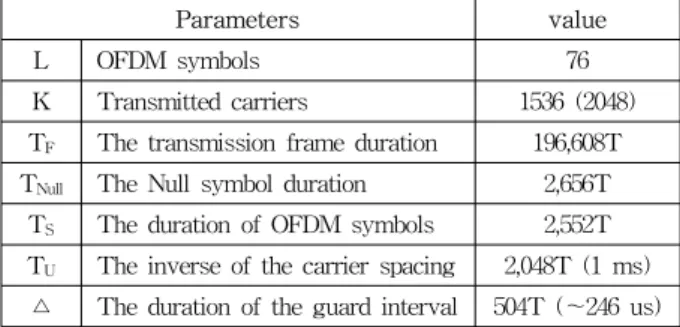
multiplexing (OFDM) symbols. The number of OFDM symbols in a frame is varied by transmission modes. In case of T-DMB, synchronization channel has one symbol, fast information channel has 3 symbols and main service channel has 72 symbols respectively. Table 1 shows the parameters for T-DMB system.
Table 1. Definition of the parameters for T-DMB
Parameters value
L OFDM symbols 76
K Transmitted carriers 1536 (2048) TF The transmission frame duration 196,608T TNull The Null symbol duration 2,656T
TS The duration of OFDM symbols 2,552T TU The inverse of the carrier spacing 2,048T (1 ms)
△ The duration of the guard interval 504T (~246 us)
The first OFDM symbol of the transmission frame shall be the null symbol of duration . The rest of the frame consist OFDM symbols with the length of . Each of OFDM symbols consist of a set of equally spaced carriers, with a carrier spacing equal to . The main signal is given by [2].
.
, , 2 , 1 ) / (
0 ) 0
(
) 1 ( (
Re ) (
/ ) ( , 2
0
, 2 /
2 /
, 2 ,
Δ +
=
⎩⎨
⎧
=
⋅
= =
⎪⎭
⎪⎬
⎫
⎪⎩
⎪⎨
⎧ ⋅ − − − −
=
Δ
− +∞
−∞
= = =−
∑ ∑ ∑
U S
T S t k l j k
m L l
s Null F l k K
K k
k l t m
f j
T T
L l for T t rect e
l t for
g
T l T mT t g Z e
t s
U c
π L π
(1)
From function (1) and Table 1, the length of main signal of T-DMB per frame can be evaluated as function (2).
The length of transmission frame (2)
=76symbols ×(2,048+504(GI))=193,952 bit/frame
This signals pass through the transmit block as shown Fig. 2. In T-DMB transmitter, Audio and video signal are coded by using MPEG-4 type with outstanding compression efficiency. They are transmitted through Orthogonal Frequency Division Multiplexing (OFDM).
Eureka-147 Baseband Process Audio
T-DMB Multimedia
Data
Encoder IFFT DAC
Video
RF Tuner
Fig. 2. Block diagram of T-DMB system.
Advanced T-DMB receiver is represented by function (3).
(3)
where is n-th OFDM symbol, is k-th sub-carrier,
IS estimated channel, is receiver signal, is estimated transmitted signal and is weighting factor. To increase the accuracy of channel estimated value in Advanced T-DMB, we use different weighting values for HP and LP symbol decision, time/frequency domain averaging and channel estimation weighting value for soft decision viterbi decoder input signal. The frequency domain average is given by
(4)
where is windoe size of moving average filter. The time domain average is given by
(5)
where is forgetting factor. And the soft decision viterbi decoder input is given by
(6)
Ⅲ. COST 207 TU6 Channel
The technical specification for COST 207 [3] presents the equipment and techniques used to measure the channel characteristics over typical bandwidth of 10 MHz to 20 MHz at near 900 MHz. Adaptation of the COST 207 profiles to mobile DVB-T reception was done by the Motivate project [4]. Especially, we dealt with a typical urban reception case. The feature of typical urban (TU6) is made of 6 paths having wide dispersion in delay relatively strong power. This TU6 profile parameters are given in Table 2.
Table 2. Typical urban (TU6) profile constitution.
Tap Number Delay (us) Power
(dB) Doppler
1 0.0 -3 Rayleigh
2 0.2 0 Rayleigh
3 0.5 -2 Rayleigh
4 1.6 -6 Rayleigh
5 2.3 -8 Rayleigh
6 5.0 -10 Rayleigh
Until a given Doppler limit, the receivers are able to perform sufficient channel equalization to demodulate the signal. Then, when the Doppler further increases, the recovery performance decreases until a point where no demodulation remains possible [5].
Ⅳ. Signal detection method
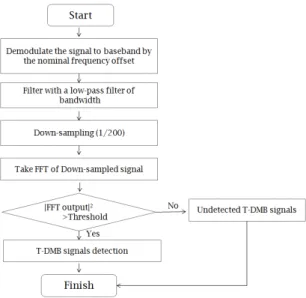
The energy detection scheme is one of signal detection scheme in CR system and is feature detection. We applied fast Fourier transform (FFT) based on energy detection of signal bandwidth. This scheme performs the signal measurements and determines the unoccupied channel by predefined threshold value. T-DMB signal received pass through frequency shift filter process and filtering the low-pass filter of bandwidth 40kHz. The filter bandwidth should be large enough to accommodate any unknown frequency offsets.
Filtered T-DMB signal is down-sampled and finally take FFT process [6]. FFT based on signal detection process is presented by Fig. 3. The condition to detect T-DMB signal is that noise floor value is -174 dBm/Hz and whole noise figure of receiver from noise figure (NF) of low noise amplifier (LNA), coupling loss and radio frequency (RF) switch loss is assumed by 8dB. In receiver, we taken power density function (PDF) of noise
(7)
and average power of included noise in 6MHz bandwidth of T-DMB is calculated
Fig. 3. Flow chart of Signal detection process.
×
≈
(8)
However, the signal power of signals is presented by 116dBm. So, we calculated signal to noise in case of the spectrum presence in frequency band.
(9)
From this result, the T-DMB signal power lower about 18 dB than noise power. Therefore, performance has to satisfy T-DMB required condition when SNR value is under 18 dBm
V. Simulation
We considered various fading channel environments which are AWGN, Rayleigh, COST 207. The COST 207 channel defined that channel response value is implemented in real environment as described Section VI.
We analyzed the system performance in accordance with applied channel. The threshold value applied to detect T-DMB signal is determined by using constant the false alarm rate (CFAR) algorithm [7].
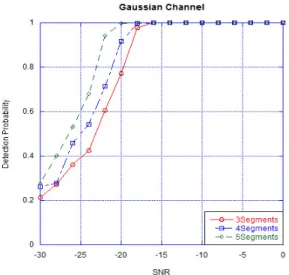
Fig. 4. Detection performance - AWGN environment.
In case of AWGN channel, the detection performance is increased as the number of data segments increases and the 90% value of detection probability can be got when SNR value is -23dB, -20dB and -18dB, separately.
However, when apply Rayleigh channel, the performance of detection probability is about – 18dB, -15dB and -14dB.
Through the result between Gaussian channel and Rayleigh channel, we confirmed that channel state has an effect on detection performance and detection probability is improved as data segments increase. Finally, we implemented case of COST 207 channel which are closely alike. In case of COST 207 channel, detection performance is presented by Fig 6. This result shows that detection performance is increased in accordance with increasing the number of data segments.
Fig. 5. Detection performance - Rayleigh environment.
Fig. 6. Detection performance - COST 207 environment.
The detection probability exceeds 90% when SNR value is -21dB, -18dB and -16dB. We analyzed that this result data was better than Rayleigh case and was worse than Gaussian case. The detection probability according to data segments is similar.
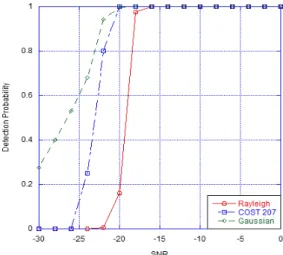
Fig 7 is presented by comparison for detection performance among applied channels. This figure is based on 5 segments of T-DMB signal. The system performance
in accordance with channel is best when apply Gaussian channel. We confirmed that the COST 207 channel performance has a value close the result of Gaussian case when SNR is 90%.
Fig. 7. Comparison of the detection performance for different environments.
VI. Conclusions
In this paper, we proposed the signal detection method based on energy detection for T-DMB signals and estimated system performance in term of detection probability. Before the simulation process, we generated the signal by using the reference documents of T-DMB standard and determined threshold by using the CFAR algorithm. In simulation, we analyzed performance of detection probability in accordance with channel and data segments. The performance of detection probability was the best among other channels applied. It was also demonstrated that detection performance was improved according to increasing the data segments.
참 고 문 헌
[1] J. Y. Kim, Wireless Multimedia Digital Broadcasting Systems, Hongreung Science Publishers, Seoul, Korea, 2009.
[2] European Standard, “Radio broadcasting systems; digital audio broadcasting (DAB) to Mobile, portable and fixed receivers,” ETSI EN 300 401 V1.4.1, June 2006.
[3] COST 207 Digital land mobile radio Communications, final report, September 1988.
[4] AC 318 Motivate: Deliverable 06: Reference Receiver Conditions for Mobile Reception, January 2006.
[5] D Book 3: Digital Terrestrial Television, Requirements for
Interoperability, Digital. Television Group 1999.
[6] W. Gao, H. Chen, M. Ghosh, and S. Shellhammer, “Text on ATSC signature sequence correlation-for informative annex on sensing techniques,” IEEE 802.22-07/0268r2, June 2007.
[7] G. Minkler and J. Minkler, CFAR, Magellam Book Company, 1990.
저자
김 승 종 (Seung Jong Kim)
․2009년 : 청주대학교 정보통신공학과 졸업
․2009년~2011: 광운대학교 전파공학과 석사
․2011년~현재: LS산전(주)
<관심분야>: ATSC DTV, Cognitive Radio, LTE
박 영 식(Young Sik Park)
․2013년 2월:광운대학교 전파공학과 졸업
․2013년 3월~현재:광운대학교 전파 공학과 석사과정
<관심분야> : 위치공학, 가시광 통신, 협력통신
김 진 영(Jin Young Kim) 종신회원
․1998년 2월:서울대학교 전자공학과 공학박사
․2001년 2월:SK텔레콤 네트웍연구소 책임연구원
․2001년 3월~현재:광운대학교 전자 융합공학과 교수
<관심분야> : 디지털통신, 가시광통신, UWB, 부호화, 인지 무선통신, 4G 이동통신