Analysis of Mathematical Structure to Identify Students' Understanding of a Scientific Concept: pH Value and scale
Eun Jung Park∙Kyunghee Choi*
Abstract: Many topics in science, especially, abstract concepts, relationships, properties, entities in invisible ranges, are described in mathematical representations such as formula, numbers, symbols, and graphs. Although the mathematical representation is an essential tool to better understand scientific phenomena, the mathematical element is pointed out as a reason for learning difficulty and losing interests in science. In order to further investigate the relationship between mathematics knowledge and science understanding, the current study examined 793 high school students' understanding of the pH value. As a measure of the molar concentration of hydrogen ions in the solution, the pH value is an appropriate example to explore what a student mathematical structure of logarithm is and how they interpret the proportional relationship of numbers for scientific explanation. To the end, students were asked to write their responses on a questionnaire that is composed of nine content domain questions and four affective domain questions. Data analysis of this study provides information for the relationship between student understanding of the pH value and related mathematics knowledge.
Key words: student understanding, pH value and scale, additive and multiplicative reasoning, student interest in science
Ewha Womans University
Ⅰ. Introduction
There has been considerable change and development in the field of science and technology. As compared with the era of scientific revolution, however, currently, science and technology take less attention from students for their future profession (Hilton & Lee, 1988).
While building emphasis on scientific literacy, there are many concerns in losing students' interest in the field of science and technology (Jenkins, 1994; Osborne, Simon, & Collins, 2003).
According to Osborne and Collins (2001), in a focus-group interview question asking students' interest in science (aimed to examine student views for the value of school science), many students from twenty state schools in UK (n=144) picked biology as the more interesting subject than chemistry and physics. Besides, some of the students commented that science, particularly physics and chemistry, is not an interesting but a difficult subject to study. For a reason of learning difficulty in those subjects,
the students picked mathematical aspects such as formulaic, numeric, graphic representations and problem solving procedures in those manners. In addition, many students think science, itself as a complex and difficult something. Although their responses may be limited for generalization, these factors are considered to have profound impact on the decline of attention to the field regardless of its use and need in our rapidly developing society.
In fact, many topics in science are described by mathematical representations such as formula, numbers, symbols, equations, and graphs.
Particularly, in order to explain abstract concepts, relationships, properties, entities in invisible ranges and etc., the mathematical representation is an essential tool to make them tangible/describable. For example, quantum numbers, values of conserved quantities in the dynamics of the quantum system (http://en.
wikipedia.org/wiki/Quantum_number), are a solution of complex mathematical operations (Schro
‥dinger wave function) and they inform the
*Corresponding author: Kyunghee Choi ([email protected])
**Received on 11 October 2010, Accepted on 29 November 2010
***The paper(author) was supported by RP-Grant 2010 of Ewha Womans University
structure of an atom (state of an electron in an atom). As such, with or without understanding the mathematical meaning of related scientific phenomena, most of students accept and conceive ideas elicited from scientific observation and inference. Moreover, many teachers and students in a science classroom think mathematics in/for science as prior concepts in no need of additional studies or as a fundamental skill which should be covered in a mathematics classroom. However, as can be seen in the findings of the current study, studies reveal many students have difficulty to master the conceptual meaning of scientific phenomena due to the limited understanding of mathematics (Drane et al, 2009; Akatugba &Wallace, 2009).
For example, a study examined students' understanding of size/scale in nano-science contexts (Swarat et al, 2010). In order to deal with materials in the nano range, estimating size of materials and their relative positions in scale is a fundamental step and that conceptualization facilitates students to comprehend the unique nano-properties. Analysis of the study showed variation in student conceptions, that is, size estimation and scale construction. Types of scales were varied from fragmented to logarithmic and a following study (Park & Light) reviewed student conceptions of scale in science in terms of the mathematical development of a number line. By analyzing mathematical structure of student reasoning for scale, the study claimed the impact of limited/superficial mathematics knowledge on student understanding of scientific phenomena. This approach provided a potential solution explaining student difficulty of learning size/scale and related scientific phenomena. In order to further investigate the relationship between mathematics knowledge and science understanding, the current study searched science topics including mathematics components and for this purpose, examined 793 high school students' understanding of the pH value.
Ⅱ. Related Studies
The acid and base is an important topic of chemistry and science in general. In addition, it is a familiar term used frequently in everyday life. However, it has also been pointed out as a topic associated with learning difficulties in science (Dhindsa, 2002; Lin & Chiu, 2010). The pH value is a measure of the acidity or basicity of a solution and as such is a measure of the molar concentration of hydrogen ions in the solution. Generally, the value is used in various fields: engineering, environmental science, biology, chemistry, etc. However, as pointed out in many studies about acid and base, the pH value has been frequently taught as a descriptive scale requiring rote memorization of indicative terms and characteristic scopes of the substance.
For that reason, despite students' thinking of acid and base as an easy concept, studies identified various misconceptions related to the topic and limited understanding of the pH value (Lin & Chiu, 2007; Nakhleh & Krajcik, 1994;
Ross & Munby, 1991; Schmidt, 1991).
According to Dhindsa (2002), when defining
the pH value, many students were confused by
terms of concentration and strength of acid and
base. This limited student ability to build a
continuous scale for the pH value. Instead,
fragmented numbers were assigned for specific
substances and the lowest value of the scale was
generally limited to 1.0. Meaningful understanding
of the pH value asks students to possess
mathematical knowledge of exponential/logarithmic
functions as well as being aware of scientific
phenomena such as solubility, ionization,
neutralization, equilibrium, etc. A study by
Watters and Watters (2006) showed student
learning difficulty in solving problems relating to
acid and base. They suggested deficiency in
mathematics skills, particularly logarithm, as a
key reason for the learning difficulty and lack of
understanding of the pH value. Studies of
numeracy in mathematics support complexity of
understanding logarithm and building logarithmic
scale as higher order thinking (Confrey, 1991;
Jones et al, 2006; Smith & Confrey, 1994).
Napier's (1550-1617) thought about logarithms originated from his effort to link geometry to arithmetic for ease of calculation, which combined the two separate worlds established by Pythagoras: discrete world of arithmetic and continued world of geometry (Turnbull, 1969).
Along with the decimal and exponential system, it has been used in fields as diverse as statistics, chemistry, physics, astronomy, computer science, economics, music, and engineering.
About complexity of learning logarithm, Smith and Confrey (1994) explored the historical development of multiplication, in particular logarithms, in terms of the cognitive development of student thinking. Their study suggests that “a number line”develops from counting (size of magnitude) to addition (basic operation), and then to multiplication (includes the procedures of repeated addition, ratio/proportion, and exponential/logarithmic function). The intellectual progression (understanding logarithmic function requires higher order thinking) helps us to better understand student learning difficulty and related misconceptions in fields.
In the view of mathematics, the pH value is an appropriate example to examine what a student mathematical structure of logarithm is and how they interpret the proportional relationship of numbers in logarithmic scale. This mathematical understanding is deeply related to the scientific meaning of the pH value and pH scale. To the end, this study assessed student responses to a questionnaire in following perspectives: 1.
student understanding of the pH value (definition, use, measure, range of values), 2.
student understanding of the pH scale and mathematical reasoning used for explanation (difference between pH 1 and pH 3, pH scale), and 3. student interest in science and difficulty of learning science. Not only illustrating student understanding of the pH value/scale, but the current study also shows how students deal
logarithmic function to explain scientific phenomena about acid and base. The analysis of this study provides information about the relationship between student understanding of science and mathematical reasoning ability. In addition, data for student interest in science may cue for the view of this study explaining the relationship of the two; deficiency in mathematical reasoning and science understanding.
Ⅲ. Methods
Data setting and Participants
In order to examine students' understanding of the pH value and its representation including their interest in this subject, this study targeted high school students for data collection. Science curriculum of the high school has been set up to teach the pH value in two different ways (General Science and Chemistry II). At the first year of the high school (10
thgrade), the concept has been taught in General Science as chapters of “acid/ base neutralization in aqueous solution,” “acid rains,”and “digestion and enzymes.”Then, in a mathematics classroom at the second-year of the school (11
thgrade), students learn the logarithm. Although it depends on students' choice for their college preparation (the Korean college system has two main division of liberal arts/social science vs.
natural sciences, depending on affiliation, required and elective courses for the college entrance examination are different), students who picked Chemistry II as an elective for college entrance exams learned “acid/base reaction (definition, intensity, molarity of hydrogen ion, pH value, neutralization &
titration, etc)”at their 3
rdschool year (12
thgrade).
Seven hundred ninety three students from two nearby high schools participated in this study.
The schools (boys and girls each) are located in
the south-eastern area of Seoul and students
were randomly assigned to the schools by their
living locations. Socio-economic status of parents was a little lower than the middle range and some students have had experience of private tutoring along with classes from the schools. When compared to the public school system in the city, the two schools were ranked to the average level in their academic achievement. The participants were varied by gender and grade levels: 367 female students and 426 male students ranging from the first year 10
th(220) to second year 11
th(232) and third year 12
thgrade levels (341). Depending on students' choice for the college division, this study categorized them into 5 groups: group1- first year students (10
thgrade, n=220), group 2- the second year students (11
thgrade, n=141) for liberal arts/social science division, group 3- second year students (11
thgrade, n=91) for natural sciences division, group 4- third year students (12
thgrade, n=147) for liberal arts/social science division, and group 5- third year students (12
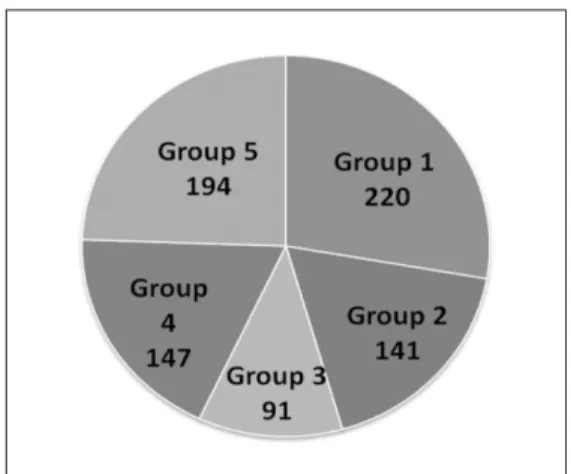
thgrade, n=194) for natural science division. Figure 1 (below) displays numbers of student distribution for each group.
Particularly, the current study limited group 5 with students who took Chemistry II as their elective for college entrance exams. When the interview was conducted, instruction for chapters of the pH value and related topics was completed.
Instrument and Data Analysis
For the analysis of students' conceptions of the pH value, an open-ended questionnaire was administered around 10
thweek of the spring semester at 2010 and students were asked to write their responses on the questionnaire.
Thirty minutes were given for students to complete all sixteen items composed of nine content domain questions (1-9), four affective domain questions (13-16), and three questions (10-12) asking prior learning experiences (see Appendix A). The first domain is composed of items asking definition, usage, scope, measure, relative difference between values, and representation of values on scale or graph. Items in this domain were designed to measure conceptual variations of student thoughts about the pH value and related scientific phenomena.
Particularly, items 7 and 8 were required to answer in diagrammatic representations of scale.
As well as informing student understanding of the pH value, the analysis of items 6, 7, 8, and 9 shows how students conceive scales/number line for the pH value and the scientific meaning of relative difference of values. Two scale types, linear scale by addition and logarithmic scale by multiplication, were referenced to measure student scale conceptions. Due to the limitation of questionnaire responses, detailed analysis with the types will be discussed in a following study with interview data. Table 1 lists codes used to identify types of scale/number line ordering pH values in this study. On the other hands, items in the affective domain were prepared to gather information categorizing students by interest in science.
Fig. 1 Number of students in each group
Table 1
Types of scale for pH values
Type of scale/number line Code Linear scale
(addition based number line) L Logarithmic scale
(multiplication based number line) M
All responses were qualitatively categorized and frequencies and correlations of identified categories were measured. For the analysis of student written and diagrammatic responses, three researchers who have background in science and education (M.S. or Ph. D level) participated. For each item, researchers individually identified types of student responses and constructed a list of categories grouping them. Through in-depth discussion, common codes appropriately representing all student conception types were developed. In order to build reliability among raters, three researchers evaluated student responses from four randomly selected classes at the same time. Then, student responses from other four classes were randomly selected and assessed by them separately to measure the inter-rater reliability. Codes from the three raters were agreed by 89.25 % correspondence and the inter-rater reliability of them was in an acceptable range by 0.889 Chronbach's Alpha.
Ⅳ. Results
Conceptual variation: Understanding the pH value and pH scale
Almost half of the students (394/793) in this
study defined the pH value as ‘measure of acid, neuter, and base.’For the purpose of the current study, this category includes several sub- categories such as measure of concentration of, measure of strength of, and unit of. On the other hand, about 11% of students (85/793) could explain the value as concentration of hydrogen ion [H
+] in solution and only 4% students (35/793) were able to describe it by logarithm of hydrogen ion concentration, -log[H
+]. However, only the students in group 5 (12
thgrade natural science division) have taught the pH value as -log[H
+] before taking this questionnaire.
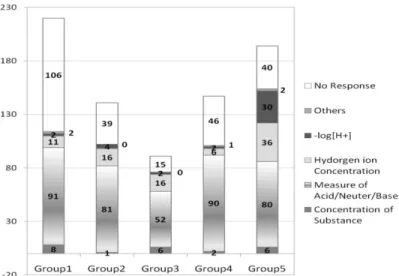
Figure 2 (below) illustrates frequency and distribution of student responses by grade groups. As can be seen in Figure 2, when the two groups (groups1-4 vs. group5) were compared, more students (30/194=15%) in group 5 defined the pH value as -log[H
+]. However, the current study shows that logarithmic function transforming values into a simplified form was appreciated by only few students. Although the numbers are negligible, there were students who used terms of oxygen or oxidation instead of acid. However, because it is not clear what they meant, all included into the “others”category.
This indicates that students' understanding of the pH value and related scientific phenomena is quite limited regardless of thinking of it as an
Fig. 2 Number of students defining the pH value by grade groups
easy concept related to the “acid and base.”As a general scope of the pH value (item 3), student responses were very similar to the pH scale listed in many references (images in textbooks, references, and internet); from 0 or 1 to 14 with 7 in the center. Generally, acid was marked with lower values and base was with larger values, however, there were students who made an opposite sequence. Only fourteen students extended the lower end of the scale into the negative value, however, there was no evidence whether the students understand the meaning of the negative pH value or not. Figure 3 shows a pH scale example with negative values. The student (PS
1in group1) did not provide any details for this scale and her definition of the pH value remained at a descriptive level. Based on her responses, it is hard to think that she understood values on scale as concentration of [H
+].
To the question 5 asking students how to get the pH value of solutions, 74 % of students did
not respond and about 17% of students answered the ‘use of indicators’(by checking change of colors in specific ranges) as a way getting the pH value without referring details related to the hydrogen ion concentration. 4% of students suggested ‘to measure hydrogen ion concentration in solution’and 3% of students thought ‘values on a pH meter or pH measuring equipment as the [H
+].’Student responses to the items 6 and 7 - questions asking the difference between pH1 and pH3 in written and diagrammatic forms show a student' understanding of the pH value and its relative intensity. Table 2 lists categories of student responses and the number/percentile of them. As can be seen in Table 2 (below), many students (58.3%) did not answer and many students responded in a descriptive way rather than making direct comparison. This covers the first three categories in Table 2. 5.4 percent of the students (43/793) answered by saying 'difference in the degree of acidity/ ionization' without detailed calculation. Among the participants, 22.8% of students think pH1 is/has stronger acid, weaker base, or higher concentration of hydrogen ion, [H
+], and 4.4% of students were opposed to the answer as weaker acid, stronger base, or lower concentration of [H
+].
The remaining answers were varied by Fig. 3 Student PS's pH scale
1)
PS is an arbitrary pseudo name code of a student
Table 2
Number of student responses to the item 6 asking difference between pH1 and pH3
Category of Response Number of
Students % of Response
Difference in the degree of acidity or ionization 43 5.4
pH 1 is/has the stronger acid/weaker base/higher [H
+] concentration
than pH 3 181 22.8
pH 1 is/has the weaker acid/stronger base/lower [H
+] concentration
than pH 3 35 4.4
10
-1/10
-3or 10
-3/10
-166 8.3
10
-1-10
-3or 10
-3-10
-11 0.1
3-1(=2) 5 0.6
No Response 462 58.3
Total 793 100
different ways of calculation depending on their mathematics reasoning for scale; a) 10
-1/10
-3or 10
-3/10
-1, b) 10
-1-10
-3or 10
-3-10
-1, and c) 3-1. In order to map out student understanding for the pH scale, the typology for scales in Table 1 was applied to interpret the three responses. The three were embodied in two different scales for the pH value and those were consistently captured in their responses to the next two questions 7 and 8. Students with additive reasoning for the pH values got the difference by subtracting values (3-1 or 10
-1-10
-3) and students with multiplicative reasoning divided the values to get ratio/proportion (10
-1/10
-3or 10
-3/10
-1). As explained in previous studies in terms of historical development of number lines in mathematics (Smith & Confrey, 1994) and hierarchical orders in the conception typology of scale (Swart et al, 2010), student' pH scales in
the current study were varied from linear scale by addition to logarithmic scale by multiplication. Although with given data, it is hard to see general correlation among student responses to questions 6-8, item analysis, especially, responses to questions 6 and 7 show relatively higher link between them (correlation coefficient=0.538, p=0.000). This indicates the existence of reasonable consistency in description of pH scales.
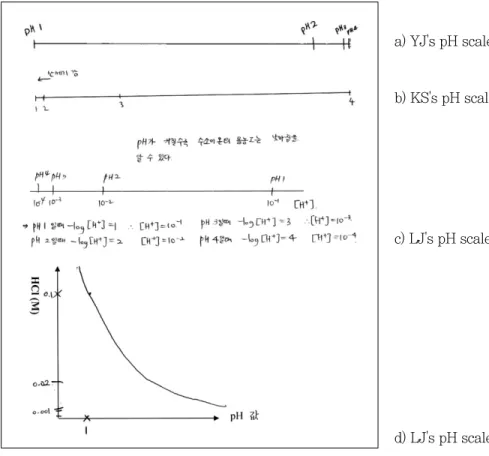
First, followings in Figure 4 are case descriptions of the linear scale (addition based number line).
Although the questionnaire responses are limited to reveal student mental models holistically, a student (YJ
2-Figure 4a) in group 1 constructed a linear scale based on additive change of numbers. On the other hand, another student (KS
2-Figure 4b) in group 5 constructed a
Fig. 4 Students' (YJ, KS, and LJ) linear scale by addition
a) YJ's pH scale
b) KS's pH scale
c) LJ's pH scale
d) LJ's pH scale
2)
YJ and KS are arbitrary pseudo name codes of students
similar linear scale with oppositely spaced sequence. In her case, the relative difference between 1 and 2 is much smaller than between 3 and 4. It is not sure if the student (KS) got values 1~4 from 10
1, 10
2, 10
3, 10
4instead of 10
-1, 10
-2, 10
-3, and 10
-4or by using log[H
+] instead of - log[H
+]; however, the diagram from KS show a similar pattern as the linear scale of YJ. All five student responses in this linear scale category (except one, LJ
3in group 5 below) do not include procedures of value transformation by logarithmic function. However, data collected from the student, LJ (Figure 4c) well describe the linear scale with scientific notation and logarithmic transformation. This indicates the student understood definition of the pH value as -log[H
+] and its relative intensity by additive change. Figure 4c illustrates how he conceives the pH value in scale and the linear pattern was
consistently represented in the graphic description for the item 8 (Figure 4d). Unlike YJ, LJ illustrated the procedures of log transformation and added scientific notation in linear scale. The relationship between concentration of acid and pH value is appropriately represented in the graphical diagram of an exponential curve to the item 8.
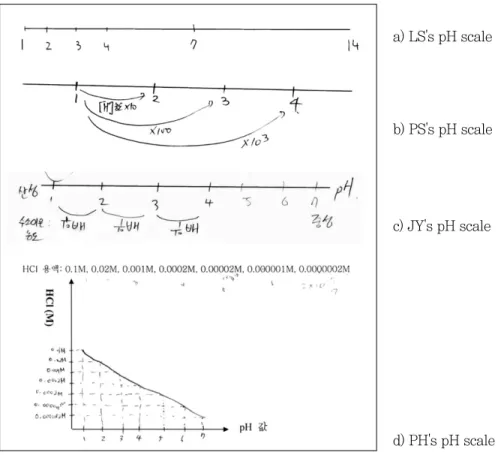
Second, there were students who constructed the logarithmic pH scale by proportional change of values (see Figure 5).
About 30% of students constructed a logarithmic scale with evenly spaced values ranging from 1 to 14 in general (Figure 5a).
Depending on prior knowledge about the pH values, there were several response types in this category. First, without understanding the pH value as -log[H
+], students can build a scale arranging values in the ascending order.
Fig. 5 Students' (LS
3, PS
3, JY
3, and PH
3) multiplicative scale by multiplication a) LS's pH scale
b) PS's pH scale
c) JY's pH scale
d) PH's pH scale
3)
LJ, LS, PS, JY and PH are arbitrary pseudo names of students
Although it's hard to identify clear thinking process and intent, responses to other questions frequently indicate limited understanding of the pH value as [H
+] or -log[H
+]. On the other hand, students who understand -log[H
+] can build an exactly same scale assigning values in the same order, however, in this case, the values were acquired through logarithmic function. Without details, Figure 5a, LS's pH scale (group 3) can be either one of them. Second, some students created a scale with description of concentration increase by a factor of 10 and others did in an opposite way, that is, decrease by a factor of 10 or increase by a factor of 10
-1along with ascending values in scale. Accordingly, this difference was appeared in a graph of the item 8 in forms of proportional increase/decrease (Figure 5d by PH in group 5). Figures 5b (PS in group 5) and 5c (JY in group 3) are examples of multiplicative scale spaced by multiplication (proportion).
Interest and Difficulty in Science vs. Scale Conceptions
The analysis of items 13-16 provides information about student interest in science.
Student responses to item 13 evaluated in Likert scale (1: science is the least favorite subject, 10:
sciences is the most favorite subject) show difference between groups. As expected by the characteristics of divisions depending on college preparation, students in group 3 and 5 showed significantly higher interest in science than other groups (F=59.334, p=0.000). In addition, t- test reveals that male students are more interested in science (statistically meaningful, t=
4.742, p=0.000) than female students. As an important reason of learning difficulty and limited interest in science, one hundred sixty seven (167) students in this study picked the use of mathematical 1) representations in formulaic, numeric, and graphic forms and 2) problem solving procedures to understand the scientific phenomena. In particular, as reflected in the
interest analysis, much more students in groups 2 and 4 responded in this way than the remaining groups (F=8.014, p=0.000). This indicates fear and rejection to mathematics can give a negative impact on learning science. Data analysis also shows difference by gender, this indicates more female students struggle with the mathematical components of science than male student (t=2.897, p=0.004).
Discussion
Types of scale depicted by students represent students' conceptions and thinking processes.
Constructing a number line by repeated multiplication requires a complex level of operation in multiplicative thinking, i.e., ratio/proportion. Students in this category constructed scale by a factor of 10 acquired by division of each pH value. This first suggests students should understand the proportional difference of pH values in order to compare the strength of acidity or basicity. For example, hydrochloric acid by stomach lining of pH 1 (when assumed the substance is completely ionized) has 10
3times higher concentration of H
+than beer/tomatoes in pH 4. Second, logarithm as a tool for building linear relationship is a critical concept/skill to understand meaning of the pH values. Findings from this study indicate that “proportion”and “logarithm”are critical aspects to understand the pH value and related scientific phenomena. Without meaningful understanding the two concepts, student conception for the pH value, even more about acid/base, can vary into several alternative conceptions and stay on the initial level defining it as measure of acidity (descriptive level).
Particularly, the two concepts are not only
fundamental elements for scientific reasoning
but also key parts of a number line and
mathematical reasoning for multiplication. As
pointed out in student interest responses,
mathematics has strong impact on student
understanding of science and interests in the
field. The current study provides an appropriate example of the mathematical influence on scientific understanding, i.e., the importance of proportion/logarithm to understand the pH values and scale. This suggests the potential of an integrated lesson of science and mathematics in an appropriate way to facilitate student science learning and increase interest in science.
In addition, terms of concentration, strength, reactivity, and rate (often considered as the same meaning, but it can lead students to different directions) need to be clarified while defining the pH value and relative difference of values on the pH scale. Especially, defining the pH value as strength of acidity/basicitiy can lead students to think about it as a set value characterizing the substance. However, instruction focused on the concentration of hydrogen ion in solution can help students to develop a continuous scale and to build flexible limits in the lower and upper ends of the pH scale. The current study also identified the gender difference in questions about interest in science and reason for learning difficulty.
Student responses to the latest one may cue why female students have less interest in science.
The mathematics element of concepts and problem solving procedures (which was picked as a reason making science learn difficult by more female students) attribute to the female students' lower interest in science. However, data are limited to make assumptions of direct relationship among student understanding of the pH value, interest in science, and mathematics components. Further studies based on interviews with students representing each pattern are in progress to examine the relationship between student understanding of the pH value and mathematical reasoning. In addition, students in advanced grade levels showed reasoning skills in a higher order and hierarchically ranked conceptions from the typology. This suggests importance of cognitive preparedness to make better understanding of scale/number line and the meaning of pH value. Therefore, the
development of appropriate instruction methods and materials should be further discussed.
References
Akatugba, A. H., & Wallace, J. (2009). An integrative perspective on students' proportional reasoning in high school physics in a West African context. International Journal of Science Education, 31(11), 1473-1493.
Confrey, J. (1991). Learning to listen: A student's understanding of powers of ten. E. von Glasersfeld (ed.), Radical Constructivism in mathematics education, 111-138. Kluwer Academic Publishers. Netherlands.
Dhindsa, H. S. (2002). Pre-service science teachers' conceptions of pH. Australian Journal of Educational Chemistry, 60, 19-24.
Drane, D., Swarat, S., Hersham, M., Light, G., & Mason, T. (2009). An evaluation of the efficacy and transferability of a nanoscience module. Journal of Nano Education, 1(1), 8 14.
Hilton, T. L., & Lee, V. E. (1988). Student interest and persistence in science: Changes in the educational pipeline in the last decade.
Journal of Higher Education, 59(5), 510-526.
Jenkins, E. W. (1994). Public understanding of science and science education for action.
Journal of Curriculum Studies, 26(6), 610-611.
Jones, M. G., Taylor, A., Minogue, J., Broadwell, B., Wiebe, E., and Carter, G. (2006).
Understanding scale: Powers of ten. Journal of Science Education and Technology, 16(2), 191- 202.
Lin, J-W., & Chiu, M-H. (2007). Exploring characteristics and diverse sources of students' mental models in acids and bases. International Journal of Science Education, 29(6), 771-803.
Lin, J-W., & Chiu, M-H. (2010). The mismatch between students' mental models of acids/bases and their sources and their teacher's anticipations thereof. International Journal of Science Education, 32(12), 1617-1646.
Nakhleh, M. B., Krajcik, J. S. (1994). The
effect of level of information as presented by
different technologies on students' understanding of acid, base and pH concepts. Journal of Research in Science Teaching, 31(10), 1077-1096.
Ross, B., & Munby, H. (1991). Concept mapping and misconceptions: A study of high- school students' understanding of acids and bases. International Journal of Science Education, 13(1), 11-24. (EJ 442 063)
Osborne, J., & Collins, S. (2001). Pupils' views of the role and value of the science curriculum: a focus-group study. International Journal of Science Education, 23(5), 441-467.
Osborne, J., Simon, S., & Collins, S. (2003).
Attitudes towards science: a review of the literature and its implication. International Journal of Science Education, 25(9), 1049-1079.
Park, E-J., & Light, G. (under review).
Student understanding of scale: from additive to multiplicative reasoning in the construction of scale representation by ordering objects in a number line.
Schmidt, H. J. (1991) A label as a hidden persuader: Chemists' neutralization concept.
International Journal of Science Education, 13(4), 459-471.
Smith, E., & Confrey, J. (1994). Multiplicative structures and the development of logarithms:
What was lost by the invention of function? Eds.
G, Harel, & J, Confrey. The development of multiplicative reasoning in the learning of mathematics. State University of New York Press, Albany
Swarat, S., Light, G., Park, E-J., & Drane, D.
(in press). A Typology of Undergraduate Students' Conceptions of Size and Scale:
Identifying and Characterizing Conceptual Variation, Journal of Research in Science Teaching.
Tretter, T. R., Jones, M. G., Andre, T., Negishi, A., & Minogue, J. (2006). Conceptual boundaries and distances: Students' and experts' concepts of the scale of scientific phenomena.
Journal of Research in Science Teaching, 43(3).
282-319.
Turnbull, H. W. (1969). The great mathematicians. New York: New York University Press.
Watters, D. J., & Watters, J. J. (2006).
Student understanding of pH: “I don't know
what the log actually is, I only know where the
button is on my calculator” . Biochemistry and
Molecular Biology Education, 34(4). 278-284.
다음은 과학교육에서 다루어 지는 한 개념인 pH 값에 관련된 질문입니다. 질문을 읽고 항목에 해당되는 사항에 관한 여러분들의 생각을 주어진 여백에 답하여 주세요.
1. pH 값에 관해 들어보았다면, 어떤 분야/과목에서 사용되는 용어인지 설명하세요.
2. pH 값이란 무엇인지 정의/설명하세요.
3. pH 값의 일반적인 범위는 어떻게 되는지 설명하세요.
4. pH 값은 어떻게 사용되는지 또는 무엇을 설명하기 위해 사용되는지, 그 용도를 설명하세요. (구체적 예를 들어서 설명하여도 됨)
5. 문제 4에서 설명된 용도로 pH 값을 사용하기 위해 어떻게 pH 값을 얻을 수 있는지 설명하세요. (구체적 예를 들 어서 설명하여도 됨)
6. 예를 들어 네 pH 값 1, 2, 3, 4가 있다고 가정하면, 이들 값의 상대적 차이, 예를 들면, pH 1 과 3의 상대적 차이는 무엇을 의미하는지, 즉 어떻게 다르며, 또 얼마나 다른지를 설명하세요.
7. 위 질문 6번에서 설명한 pH 값 1, 2, 3, 4의 차이를, 즉 어떻게 다르며, 또 얼마나 다른지를 아래의 선위에 값을 표시하고 비교/설명하세요 (그림 또는 도형 등의 표현 방법을 이용해 비교/설명하여도 됨).
8. 아래의 값들은 한 화학실험실에서 얻은 값입니다. HCl(염산) 용액의 몰농도(M) 값과 pH 값의 관계를 좌표에 표시 하고 얻어진 그래프를 이용해 두 값들간의 관계를 설명하세요.
HCl 용액: 0.1M, 0.02M, 0.001M, 0.0002M, 0.00002M, 0.000001M, 0.0000002M
Appendix A. 과학 개념이해도 조사 설문지