LH형 도시재생사업 진단 지표 및 체크리스트 개발
A Study on the Diagnosis Indicators and checklist for Urban Regeneration Projects by LH
박동선1· 이영은2· 김호창3
Dong Sun Park
1, Young Eun Lee
2, Ho Chang Kim
3(Received May 30, 2018 / Revised July 14, 2018 / Accepted July 20, 2018)
ABSTRACT
The purpose of this study is to suggest diagnosis indicators and checklist for urban regeneration projects by Korea Land & Housing Corporation(LH). There are already deprivation indices in the Urban Regeneration Act but not any additional guidelines in the practical aspect.
In order to use the diagnosis indicators, the central government should supply more specific checklist to the actors in the regeneration field.
The key actor of many stakeholders is LH as an operator and implementer in the regeneration projects. So far, LH has developed housing and cities and there haven't been any obvious changes to realize public benefit in the deteriorated area. From now on, It has to plan, implement, and manage a lot of regeneration projects entirely. Therefore, It is necessary to develope and apply the diagnosis indicators and checklist based on projects. This paper came up with the 6 factors related with LH business field : housing, urban infrastructure, public service, private service, environment, and smart city. For these, 32 diagnosis indicators and 72 checklists were selected that can include both physical and qualitative indicators. These can be used not only for the selection of regeneration projects but also for the process monitoring such as planning and implementation.
Key words : Urban Regeneration(도시재생), Urban Deprivation(도시쇠퇴), Korea Land and Housing Corporation(LH, 한국토지주택공사), Diagnosis Indicators(진단 지표)
1) 한국토지주택공사 도시재생계획단 단장(주저자: [email protected]) 2) 한국토지주택공사 토지주택연구원 연구위원(교신저자: [email protected]) 3) 한국토지주택공사 도시재생계획단 과장
http://lhi.lh.or.kr
1. 서 론
1.1 배경 및 목적
우리나라는 1980년대 이후 도시화 문제를 해결하기 위하 여 기존 도시의 정비보다는 신도시 건설, 대규모 신규 토지 공급 등의 양적 확대를 지향해왔다. 신도시의 성장과 기존 도 시의 팽창으로 기성시가지의 기반시설과 건축물은 시간이 지 남에 따라 상대적으로 쇠퇴하게 되었다. 또한 이는 물리적인 쇠퇴뿐만 아니라 산업구조의 변화 및 산업의 이동과 이에 따 른 인구유출 등의 부정적인 변화를 가져왔다. 이러한 도시의 비물리적 쇠퇴는 지역경제 침체, 실업 증가, 소득계층 분화 등의 문제를 낳으며 도시 커뮤니티 약화를 가져와 구도심의 활력이 저하되었다. 이를 개선하기 위해 「도시 및 주거환경 정비법」에 의한 소위 ‘도시정비사업’이 시행되었지만 주택을 철거 후 정비하는 재개발방식은 물리적 개선을 중심으로 하
는 공동주택개발 방식에서 크게 벗어나지 않아 김경천 외 (2015)는 뉴타운사업과 도시정비사업이 본질적으로는 동일 한 개념이라고 보았다. 기성시가지에 대한 사업들이 거주민 의 정주환경, 생활수준, 각종 서비스 등에 대한 종합적인 분 석 없이 이루어진 외형적 재개발에 불과했기 때문이다. 최근 의 도시재생 정책은 상기의 문제점들을 해결하기 위하여 물 리적 정비에서 사회, 문화, 경제, 환경적 관점의 도시재생으 로 전환되기 시작했다. 이러한 여건 하에 2013년 6월 제정된
「도시재생 활성화 및 지원에 관한 특별법(이하 도시재생특별
법)」에는 물리적 환경개선 위주의 도시 환경개선 정책 및 사
업에서 다양한 가치 중심으로 도시환경을 개선하고자 하는
새로운 관점이 반영되었다. 도시재생특별법에 근거하여 2014
년이후 4년간 국가 재정 지원사업으로서 도시재생사업을 추
진한 결과 도시재생특별법상 제시되고 있는 쇠퇴 진단 및 여
건분석 지표들이 사업 대상지의 특성을 반영하지 못하거나
Urban Regeneration New Deal Policy Review
Legal and Institutional
Review
Reviewing domestic evaluation standard and deprivation indices
Reviewing other countries’
evaluation indices and deprivation
indices
• Urban Regeneration Act
• Urban regeneration new deal planning guidelines
• Urban Regeneration Act
• LH’s Repair maintenance working manual
• England
• Portugal
• Australia
Setting up 6 categories
Reviewing 146 Checklists, 45 Diagnosis Indicators and 6 Categories
72 Checklists of 32 Diagnosis Indicators in 6 Categories
Fig.1 Research flow chart 유형별 특성을 반영하지 못함에 따라 관련 지표의 수정‧보완
필요성이 제기되고 있다. 그리고 물리적, 비물리적 요소(지 표)가 모두 분류 체계에 포함되어 있기는 하지만, 주민 삶의 질이나 지속가능한 환경 보전, 스마트 기술 등 도시재생로드 맵에서 새롭게 추가된 정책 목표와 관련된 지표도 부족하다.
여기서 더 나아가 2017년 정부는 도시재생특별법을 모법으 로 하되 실행력 제고를 도모하는 도시재생뉴딜정책을 발표하 였다. 도시재생 로드맵을 통해 국가재정지원사업의 목표를 보다 구체화하고 분화시켜 「주거복지 실현, 도시 경쟁력 회 복, 사회 통합, 일자리 창출」의 4대 목표와 57개 단위사업 요 소, 5대 사업유형을 제시하였다. 그러나 상위의 목표 및 유형 만 제시했을 뿐 실질적인 수단이나 목표에 적합한 실질적인 진단 지표의 발굴이 필요하다. 특히, 공공기관 제안형과 같이 공공성과 신속한 사업 추진을 동시에 추구하는 새로운 제도 의 안착을 위해서는 무엇보다 해당 지역에 알맞은 사업유형 을 검토하는 지표와 공공성 확보 및 실행력 제고를 위한 사 전 진단 지표가 개발되어야 한다. 따라서 본 연구의 목적은 현행 쇠퇴진단지표와 도시재생 평가지표에 대한 분석을 통해 보다 사업적 측면에서 공공성과 실행력을 모두 확보할 수 있 는 사전 진단 지표를 도출하는데 있다. 총 24개의 공공기관 제안형 사업중 17개(70.8%)를 담당하고 있는 한국토지주택 공사(이하 LH)가 도시재생사업 대상지를 선정하고 사업을 추진하는 원칙과 객관적 기준을 제시하는 것은 도시재생사업 의 정책적 성공 여부에 큰 영향을 미칠 수 있다. 이를 위해 본 논문은 대상지 선정시 쇠퇴 정도를 사전에 진단하고 지역 의 쇠퇴 특성과 잠재력을 합리적으로 분석하는 진단 지표와 체크리스트를 도출하여 도시재생사업의 공공성 확보뿐만 아 니라 신속성을 확보하기 위한 구체적 진단 지표로 개발하고 자 한다.
1.2 방법 및 범위
본 연구는 도시재생 뉴딜 정책의 실현을 위한 대상지 분석 사전 진단 지표 개발을 위해 도시재생의 개념과 도시재생 뉴딜사업의 내용, 도시재생특별법에서 제시된 쇠퇴지표와 진 단기준을 검토하였다. 또한, 도시재생 및 쇠퇴지역에 관한 문 헌과 선행연구, 국내 기준 외에 미국, 호주의 건강도시 체크 리스트(Healthy Urban Checklist), 영국의 낙후지수(English Indices of Deprivation) 등을 검토하여 시사점을 도출하였다.
LH의 사업분야 및 역할을 검토함으로써 기존 지표들을 LH 의 사업분야와 연계하거나 추가적인 도시재생 지표를 발굴하 여 LH 도시재생 지표와 체크리스트로 제시하였다.
2. 쇠퇴진단 관련 국내외 사례
2.1 국내 진단 지표
도시재생 뉴딜 정책은 「주거복지 실현, 도시 경쟁력 회복,
사회 통합, 일자리 창출」을 목표로 하며 물리적 환경개선
(H/W)과 역량강화사업(S/W)의 종합적 추진을 통한 도시의
종합적 재생을 주요 전략으로 하고 있다. 사업 과정의 의사결
정 시스템의 중요성이 반영된 역량강화사업에는 중간지원조
직 인력양성 교육프로그램, 주민주도 자생적 조직의 참여 등
전통적 의미에서의 LH 사업과는 다소 상이한 비물리적 사업
이 다수 포함되어있다. 2017년도 처음 시작된 도시재생 뉴딜
사업 공모 지침을 분석하면 지자체마다 지역에 특화된 사업
내용을 발굴하고, 차별화된 사업모델로 발전시켜 모범사례로
추진하는 것을 강조하고 있다. 이를 위해 정부에서는 역사·문
화 연계, 차별화된 경관·건축, 역세권 청년주택, 스마트시티,
공공임대주택, 신재생에너지, 패시브하우스 등 특화된 사업
을 우선 선정하는 전략을 수립하는 등 새로운 정책목표가 제
시되었다. 그러나 특별법상 도시재생활성화계획의 유형과 쇠
퇴진단 지표는 여전히 그대로 유지되고 있어 정책 목표와 이
를 실현하는 근거인 법적 수단이 불일치되는 문제점을 가지
고 있다.
Indicator
Population and Society
Aged-child ratio Net migration rate Rate of population change Average years of education Rate of single elderly households recipient of basic living(per 1,000 people)
child headed family(per 1,000 people) Number of elderly people Supporting expenses for old age
Rate of rental housing Economically active population
Industry and Economy
Number of employee(per 1,000 people) Number of employee(per business) Rate of employee in manufacturing Rate of employee in high-level industry Number of employee(per major industry)
Fiscal self-reliance ratio Amount of local tax(per person) Fluctuation rate of land price(housing) Fluctuation rate of land price(business)
Medical insurance premium
Number of employee in wholesale and retail(per 1,000 people) Total number of businesses
Fluctuation rate of total number of businesses Fluctuation rate of total number of employees
Architecture and Environment
Rate of deteriorated housing Rate of new housing Rate of small-size housing
Rate of vacant house Vacancy rate Officially assessed land price Rate of deteriorated building Rate of housing frontage
Undersized lot
※ 해당 지방자치단체의 여건에 따라 별도 운영가능
Section Subsection Analysis
Related plan Higher or related plan
•Regions requiring regeneration according to higher or related plan
Spatial structure
Spatial structure
change
•Regions requiring strategic urban regeneration through change of base space, change of commercial area distribution
Disaster risk
•Regions where urban regeneration and safety can be comprehensively planned(such as frequent flood zone, landslide occurrence zone, etc.)
regional characteristics
Historical resource
•Regions where the city's industrial and regional identity can be secured by using historical and cultural resources
Cultural resource
•Regions where regeneration is possible through linkage with local festivals and local culture
Section Subsection Analysis
Human resource
•Regions where private organizations(community organization, NGO, social enterprise, etc.) are active and linking with local resources
Tourism resource
•Regions that can be localized through tourism and cultural resources
ㅊ
•Regions where improvement of local conditions is continuously required
•Regions requiring strategic maintenance and improvement
※ It can be operated separately according to the conditions of local government.
Key indicators
Kim Hyung-chul (2009)
Population, age, education, income, business slowdown rate, employment change rate, average land price, local government financial independence, old housing, new housing, water supply rate, road density
Lee Keum-yeon (2010)
Contact conditions(road widening), parcel scale, architectural structure, term of architecture, landowners, number of family members, residence period, ownership period, slope, land price, housing price
Park Soon-hee (2013)
Environment friendly, environment pollution prevention, beautiful city, rich city, convenient city, safe city, cultural city, historical city, creative city
Kim Kyung-chun et al.
(2015)
Land use, building conditions, accessibility, education, culture, welfare, environment, risk, disaster, industry, employment, business condition, financial soundness, real estate value
Kwon Oh-kyu (2017)
Education, income, age, financial self-reliance of local government, medical insurance premium level, old housing, new housing, residential area, housing supply rate
Table 1 Deprivation indicators (Quantitative Analysis) of Urban Regeneration Act
Table 2 Circumstance analysis(Qualitative analysis) of Urban Regeneration Act
최근 국내에서는 도시재생 쇠퇴를 진단하는 연구가 활발 히 전개된 바, 주로 물리적․사회적․경제적 지표로 구성되고 있 다. <Table 3>의 선행연구의 선정지표는 도시 쇠퇴요인과 도 시재생 평가지표가 혼용되어 있으나, 물리적 측면의 평가지 표가 공통적으로 보이며, 최근 연구에서 추가된 비물리적 지 표를 확인할 수 있다. 비교적 오래된 연구는 대부분의 물리적 지표와 일부 사회적 지표로 구성되어 있다. 반면, 최신 연구 일수록 문화, 복지관련 지표들이 추가되는 경향이 있는 것을 볼 수 있다.
Table 3 Domestic urban regeneration(deprivation) evaluation indices
2.2 해외 진단 지표
영국에서 개발한 낙후지수(English Indices of Deprivation)
는 2000년 최초 수립된 이후 약 5년 간격으로 발표되었다. 영
국 정부는 분야별 지표에 따라 가중치 분석을 실시하여 지역
별 낙후지수를 제시하고 이를 기반으로 지역별 정책을 수립
한다. 소득, 고용, 생활환경 등 인구․사회, 산업․경제, 물리․환
Countries Indicators England
Indices of Deprivation
(2015)
Income Deprivation, Employment Deprivation, Education, Skills and Training Deprivation, Health Deprivation and Disability, Crime, Barriers to Housing and Services, Living Environment Deprivation
Portugal Sustainable urban regeneration index
(2009)
Urban structure, land use planning, environment, biodiversity, energy, waterworks, waste treatment, air quality, noise, light pollution, safety, amenity, accessibility, regional and cultural identity, employment, investment, architecture, ICT
London Healthy Urban Development Unit
(2014)
Housing structure, accessibility, safety of movement, community consciousness, minimization of vehicle use, air quality, noise, square, biodiversity, flood prevention, medical education, employment, safety of workplace, grocery store, public building
NSW Government, Australia
(2009)
Exercise environment, resident diversity, housing price, transportation, accessibility, employment, security, public open space, community facilities, community cohesion, consideration of vulnerable classes, air quality, noise, disaster
LH’s fields Indicators
Housing Structural safety, deterioration, exterior of house, finishing work, ventilation, inside of house, machine, electricity Urban
infrastructure Road, public parking lot, park, square, water and sewage Public service Resident life, social welfare, economic activity,
health, safety
Private service Living, welfare, economy activity, health, security Living environment,
disaster prevention
Facility safety, steep slope, wind and flood, air quality, noise, light pollution
Smart city Smart Technology, Society, Economy, Environment
경 등 각 분야의 결핍정도를 진단하는 도구로 활용되었다. 포 르투갈의 지속가능 도시재생 지표는 도시구조, 토지지용계획 등 일반적인 요소뿐만 아니라 ICT(Information and Communication Technologies)와 지역 및 문화 정체성을 포함 하고 있다. 이는 스마트 도시 기술의 발전 및 상용화와 도시 주민의 생활에서 지역 고유자산이 점점 강조되고 있는 데 기 인한 것이라고 볼 수 있다. 한편, 영국과 호주의 건강도시진 단지표는 주택구조, 접근성 등 물리적 쇠퇴를 진단하는 지표 뿐만 아니라 공동체 의식, 운동장려 환경, 주민 다양성, 취약 계층 고려 등과 같은 사회적 지표들을 포함하여 사전 진단 항목이 매우 폭넓게 제시되고 있다. 이처럼 국내 쇠퇴 진단 지표에 비해 해외 선진국의 도시재생 정책은 쇠퇴의 정의를 매우 폭넓게 상정하고 이를 개선하기 위한 진단을 상시화 하 여 효과적인 국가정책 사업을 추진하고자 노력하고 있다.
Table 4 Overseas urban deprivation indicators
3. LH 도시재생사업 사전 진단 지표 및 체크리스트
3.1 LH 도시재생 진단 지표
앞서 검토한 국내외 진단은 주로 중앙이나 지방 정부에서 지역의 쇠퇴를 진단하고 이를 도시재생으로 회복하기 위한 사전 점검용으로 활용되었다. 이와 달리 구체적인 사업 목표 를 정하고 이를 위한 사업 유형과 수단을 결정하기 위해서는 사업주체의 도시재생사업과 직접적으로 연계되거나 사전 점 검이 필요한 항목을 중심으로 진단항목을 도출해야 한다. 따 라서 LH형 도시재생 진단 항목은 다음 <표 5>와 같이 국내 외사례에서 나타난 정부 차원의 진단 항목 중에서 LH 사업 구조상 사업의 목적과 밀접한 연관성을 갖는 요소를 주택, 도 시기반시설, 공공서비스, 민간서비스, 생활 환경‧방재, 스마트
도시의 6가지로 구분하고 이에 대해 물리적‧정성적 지표를 모두 포함 할 수 있는 32개 지표를 선정하였다.
Table 5 LH’s Diagnosis indicators for urban regeneration
기존 법제도에서 제시하고 있는 정량적 혹은 정성적 진단 이라는 기계적인 양분 방식을 지양하고 실질적인 사업 목표 에 따른 요소별 진단 항목을 설정하되 그 내에 정량적 지표 와 정석적 지표를 혼합 구성하고 양 측면의 체크리스트를 함 께 구성함으로써 목적지향적인 진단 지표를 구성하였다. 사 업의 목적이 명확하고 이를 위한 진단 지표를 구성함으로써 두 가지 효과를 기대할 수 있다. 첫째, 실질적인 사업 추진을 위한 대상지 진단이 가능하다. 도시재생 전략계획과 활성화 계획에서 지역의 쇠퇴를 1차적으로 진단하는 것이 도시기본 계획의 기초조사와 같은 일반해 추구형 진단이라면 LH형 도 시재생 진단은 해당 대상지의 사업적 목표를 무엇으로 상정 해야 가장 효과적인 지역활성화가 가능할지를 찾는 특수해 추구형 진단이라고 할 수 있다. 둘째, 사업 대상지 선정을 위 한 사전 진단 뿐만 아니라 사업을 추진하는 과정상 지속적 모니터링도 가능하다. 사업대상지의 핵심 목표에 따른 진단 지표의 운영은 사업의 효과가 어떻게 나타나는지 보다 명확 하게 인과관계를 가지고 그 효과를 측정할 수 있다.
3.2 LH형 진단 지표별 사전 체크리스트
앞서 도출한 LH형 진단 지표는 정부의 쇠퇴 진단보다 구 체적인 사업 관련 항목을 포함해야 하며 그 측정 방법은 정 량적 방법과 정성적 방법을 모두 포함해야 한다. 따라서 기존 의 계량 지표방식만으로는 이를 적용‧운영할 수 없으므로 사 전 진단지표별 체크리스트를 구축하고 이를 LH 도시재생 사 업의 시작과 과정, 완료 후 그 목적과 효과를 측정하는 기준 점으로 활용하도록 한다.
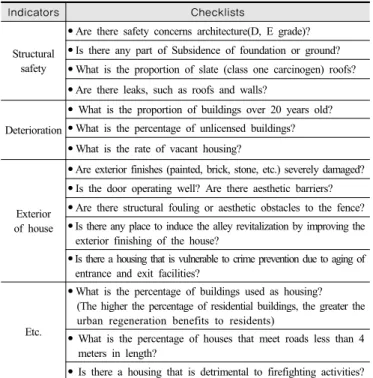
주택 분야는 구조안전, 노후도, 주택외부상태 및 기타항목
으로 구분하여 사업실행 전 진단해야할 체크리스트를 구성하
였다. 안전과 관련하여 가장 기본적인 안전우려 건축물(D, E
등급)의 존재여부와 슬레이트 지붕으로 된 주택비율에 대한
내용을 수록하였다.
Indicators Checklists
Structural safety
•Are there safety concerns architecture(D, E grade)?
•Is there any part of Subsidence of foundation or ground?
•What is the proportion of slate (class one carcinogen) roofs?
•Are there leaks, such as roofs and walls?
Deterioration
• What is the proportion of buildings over 20 years old?
•What is the percentage of unlicensed buildings?
•What is the rate of vacant housing?
Exterior of house
•Are exterior finishes (painted, brick, stone, etc.) severely damaged?
•Is the door operating well? Are there aesthetic barriers?
•Are there structural fouling or aesthetic obstacles to the fence?
•Is there any place to induce the alley revitalization by improving the exterior finishing of the house?
•Is there a housing that is vulnerable to crime prevention due to aging of entrance and exit facilities?
Etc.
•What is the percentage of buildings used as housing?
(The higher the percentage of residential buildings, the greater the urban regeneration benefits to residents)
•What is the percentage of houses that meet roads less than 4 meters in length?
• Is there a housing that is detrimental to firefighting activities?
* Reference: LH’s Repair maintenance working manual
Indicators Checklists
Park
•What is the park area per person?
•Is the park adequately distributed so that the park users can safely and smoothly gather and disperse? Is it on the road?
•Is safety maximized for the visibility of inside and outside park users?
• Has proper design and materials been used to maintain a safe environment?
Square
• Has the location of the square considered public transportation, pedestrian lines, nearby facilities and land use status?
• Does it provide adequate rest space for pedestrians?
Indicators Checklists
• Is it improving the cityscape in connection with the surrounding landscape and architectural plans?
• Has the square been considered to be linked to local facilities such as markets and cultural facilities?
•Are there facilities for recreation, relaxation, etc. of residents?
water and sewage
•What is the percentage of water pipes that have passed 20 years or more?
•What is the flow rate of the water network?
•What is the percentage of sewers over 20 years old?
•What is the separation ratio between the water storm sewer and waste pipes?
Indicators Checklists
Resident life
•Are educational services provided for children of all ages, from infants to seniors? What is the number of related facilities (ratio)?
•What is the proportion of infant nursing facilities?
•Are there employment support services for women, the elderly, the disabled, and foreigners? What is the number of related facilities (ratio)?
•Is access to mail services good?
•What is the number (ratio) of resident community facilities? Is accessibility good?
Social welfare
•Are services such as jobs, education, and caring for people with disabilities provided? Is the center accessible?
•What is the proportion of youth welfare facilities? Is the facility accessible?
Table 6 Housing Diagnosis Checklist
도시기반시설 관련 사업은 주민 체감도가 가장 높은 재생 사업으로서 도로 정비와 주차장 사업등이 포함된다. 구도심 에는 자전거도로, 식수대 등의 설치를 위한 여유가 부족하 다. 공원은 인당 공원면적을 파악하여 일차적으로 절대 면적 의 필요성을 확인한 후, 입지여건, 접근성 및 안전도 등을 종 합적으로 판단한다. 광장의 경우 기본적인 위치와 주변 상업․
문화시설과의 연계성, 광장 내 휴게공간의 적절성 등을 확인 하여야 한다. 상하수도 분야에 있어서는 관의 노후도를 중점 적으로 분석하는 작업이 필요한데 이는 누수의 대부분의 원 인은 노후관 방치이기 때문이다. 또한 구도심에서는 우오수 합류관거를 사용하는 경향이 있는데, 이로 인해 우기시 심각 한 수질오염이 초래될 수 있기 때문에 우오수 차집율 조사가 필요하다.
Table 7 Urban Infrastructure Diagnosis Checklist
<Table 8>의 공공서비스 분야는 물리․비물리적 여건을 모 두 포함할 수 있으나 본 체크리스트에서는 가급적 자료 구득 이 용이하고, 현장에서 조사할 수 있는 항목들 위주로 다루었 다. 공공서비스는 기존 연구 및 사례들에서 다루지 않은 분야 이다. 금번 도시재생 뉴딜사업에서는 복합커뮤니티시설, 어 울림 플랫폼 등 공동체 공간 조성사업을 특화사업으로 제시 하고 있다. 공동체 공간에는 주민 커뮤니티시설과 더불어 공 공청사 및 각종 지원센터가 입주할 수 있으므로 공공서비스 분야에 대한 진단결과를 활용하여 공공서비스 시설의 종류를 설정할 수 있다. 동 분야에서 두드러진 주민생활과 관련된 공 공서비스는 교육, 양육, 일자리, 공동체 시설 등에 대한 항목 들을 수록하였다. 특히, 일자리의 경우 사회적 약자의 해당 서비스 접근성을 진단항목으로 채택하였다. 각 항목에 해당 되는 공공서비스 관련시설은 전국적으로 분포되어 국민들에 게 서비스를 제공하고 있다. 따라서 본 분야에서 중요한 부분 은 구도심(대상지) 주민들이 해당 서비스를 얼마나 원활히 받을 수 있는가하는, 즉 접근성이다. 접근성 확인을 위해 시 설의 개수와 인구대비 시설비율을 조사하여 간접적으로 파악 하고, 직접적인 소요시간, 교통 편의성 등을 확인하여야 한다.
Table 8 Public service Diagnosis Checklist
Indicators Checklists
Living
•What is the number (ratio) of private institutes and teaching facilities?
•What is the number of grocery stores, marts and convenience stores?
•What is the number of sports facilities?
Welfare •Is accessibility of long-term care for the elderly facilities?
Economic
activity •Is access to financial services good?
Health •What is the number (percentage) of medical facilities? Is accessibility good?
Security •What is the usage ratio of private security services?
Indicators Checklists
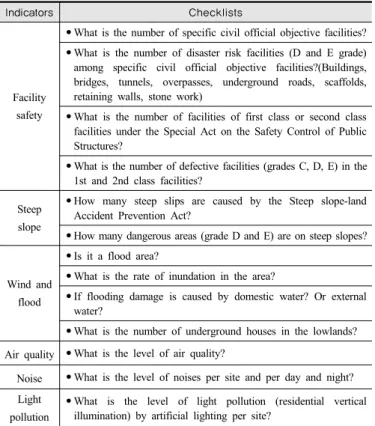
Facility safety
•What is the number of specific civil official objective facilities?
•What is the number of disaster risk facilities (D and E grade) among specific civil official objective facilities?(Buildings, bridges, tunnels, overpasses, underground roads, scaffolds, retaining walls, stone work)
•What is the number of facilities of first class or second class facilities under the Special Act on the Safety Control of Public Structures?
•What is the number of defective facilities (grades C, D, E) in the 1st and 2nd class facilities?
Steep slope
•How many steep slips are caused by the Steep slope-land Accident Prevention Act?
•How many dangerous areas (grade D and E) are on steep slopes?
Wind and flood
•Is it a flood area?
•What is the rate of inundation in the area?
•If flooding damage is caused by domestic water? Or external water?
•What is the number of underground houses in the lowlands?
Air quality • What is the level of air quality?
Noise •What is the level of noises per site and per day and night?
Light pollution
•What is the level of light pollution (residential vertical illumination) by artificial lighting per site?
Indicators Checklists
Smart Technology
• What is the informatization plan for the site, and the U-City basic plan?
• What is the result of analysis using social / economic big data?
(Vulnerability Analysis of Industry by credit card use state and search frequency per business)
• What is the result of SNS keyword analysis?
• What is the overall status of CCTV installation? (Multi-purpose, crime prevention, etc.)
•What is the ratio of the number of CCTV installations to crime cases?
Indicators Checklists
Economy activity
•Is accessibility of facilities related to start-up support good?
•Is accessibility of small and medium enterprises support facilities good?
Health •Is the local public health center accessible?
Safety
•What is the number (percentage) of police boxes, police patrol division, etc? Is accessibility good?
•What is the crime rate?
•What is the accident rate?
•Is access from the fire station to the accident site good?
<Table 9>의 민간서비스 분야는 공공서비스와 달리 시장 에서 제공되는 분야로서 도시재생사업과 직접적으로 관련 있 는 분야는 아니지만, 민간서비스 제공수준은 해당지역의 쇠 퇴를 간접적으로 확인할 수 있는 지표이다. 본 분야의 항목들 은 기본적인 생활과 관련된 민간서비스 분야와 함께 복지, 경 제활동 등 앞서 제시한 공공서비스 분야의 평가지표와 동일 한 것들로 구성되어 있다. 간접적인 지표인 만큼 각 평가지표 에 대한 체크리스트 항목은 필수적인 내용들 위주로 반영하 였다.
Table 9 Private service Diagnosis Checklist
<Table 10>의 안전 분야는 시설물안전, 급경사지, 풍수해, 대기질, 소음, 빛공해와 같은 평가지표로 구성되어 있다. 방 재의 경우 기존 연구에서는 다루지 않거나 재해율이라는 지 표제시 정도에 그치는 분야였으나, 본 체크리스트에는 여러 항목으로 구분하여 수록하였다. 구도심의 시설물은 도시의 쇠퇴와 함께 안전등급도 떨어지는 경향이 있는 것으로 판단 하였다. 풍수해와 관련하여 일반적으로 외수(外水)보다는 내 수(內水)가 침수피해의 원인이 된다. 이 경우 대상지 내의 기 반시설 및 방재시설에 대한 정비가 필요하다. 환경 관련지표 중 빛공해는 수면장애, 생체리듬 파괴 등의 문제점을 일으키 는 요소로서 쾌적한 삶에 대한 요구가 점차 높아지는 사회적 추세를 반영한 것이다.
Table 10 Safety Diagnosis Checklist
스마트시티 분야는 구도심의 쇠퇴정도를 진단하고 해당 서비스 제공을 위하여 스마트시티 서비스의 가장 기본적인 안전, 복지 분야를 기본으로 하여 <표 11>과 같이 체크리스 트를 제시하였다. 타지역에 비해 범죄 발생율이 높은 대상지 의 경우 CCTV 설치율 및 서비스 수준향상이 문제해결의 방 법이 될 수 있다. 노인인구비율이 높은 것은 구도심의 특징이 라고 볼 수 있어, 노인 관련 스마트시티 서비스는 도시재생사 업에서 필수적인 요소이다. 정부에서 추구하는 특색 있는 도 시재생 뉴딜사업을 위해서는 지역의 역사문화자원의 확보가 필요하다. 스마트시티 서비스를 이러한 지역 자산과 접목하 여 제공한다면 관광산업 활성화에 기여할 수 있다.
Table 11 스마트 도시 진단 지표별 체크리스트
Indicators Checklists
•Is the level of the image quality of CCTV installed that can identify the look and dressing, license plate, etc.?
•Is the Bus Information System available?
•Is there a safety living monitoring service for the elderly?
•Are the dementia elderly services or Lost child prevention services provided?
•Have APPs related to historical and cultural resources been developed?
4. 결론
국내 도시재생 평가 제도는 지표 중심으로 정리되어각종 평가 가이드라인으로 제시되고 있을 뿐 구체적인 체크리스트 가 제시되어있지 않다. 그 결과 올해부터 도입된 실현가능성 평가나 매년 수행되는 성과 평가시 지자체나 사업 주체들이 지표별 진단 결과를 어떻게 제시해야하는지 임의적으로 판단 해서 제시함으로써 전국차원의 객관적인 평가에 어려움을 겪 고 있다. 이에 본 연구는 정부차원의 쇠퇴진단 지표보다 구체 적으로 LH가 도시재생 뉴딜사업 대상지를 선정하고 실질적 으로 사업을 추진‧관리하는데 활용할 수 있는 진단 지표와 지 표별 체크리스트를 도출하는 데 목적이 있다. 이를 위해 LH 의 사업 분야에 따른 관련 요소들을 체계화하여 LH 도시재 생 진단 지표를 구성하고 이에 필요한 정량적‧정성적 체크리 스트 항목을 제시하였다. LH가 사전 진단을 위해 검토해야 할 분야는 총 6가지 분야로 주택, 도시기반시설, 공공서비스, 민간서비스, 안전, 스마트도시재생이 그것이다.
주택 분야는 구도심 내 노후주택비율, 공가율 등 전반적인 쇠퇴를 진단하는 수준의 체크리스트와 개별 주택의 내․외부, 환기상태 등을 면밀히 조사하는 세부적인 수준의 체크리스트 로 구분하였다. 이는 주거환경을 직접적으로 개선하는 주거 재생형의 도시재생 뉴딜사업 추진시 유용하게 활용할 수 있 도록 해준다. 체크리스트에 제시된 정량적 기준들은 현재 LH 에서 「수선유지급여 개보수공사를 위한 실태조사」에서 활용 되고 있는 것들이기 때문에 현장 적용 가능성이 높다. 도시기 반시설 분야는 물리적 측면의 지표들과 항목들로 구성되어 있으나, 약자배려 및 시설물의 연계성 등을 분석한다는 측면 에서 기존의 연구들과 차이가 있다. 공공․민간서비스 분야는 기존의 지표들에서 전혀 다루지 않은 항목들을 제시하고 있 다. 통상의 연구에서는 자료 구득의 용이성, 지표의 중요도 등을 감안하여 평가지표를 선정․제시하는 것이 일반적이기 때문이다. 자료 구득과 쇠퇴진단이 쉽지는 않지만 도시재생 뉴딜에서 추구하는 ‘삶의 질을 개선하고 일자리를 창출하는 도시재생’이라는 측면에서 반드시 포함하여야 할 분야이므로 LH가 주도하는 공공기관제안형에 한해서 사전진단 지표로
포함시킬 필요가 있다. 안전 분야는 도시재생특별법에서 제 시하고 있는 재해 위험에 대한 정성적 분석틀에서 더욱 발전 된 내용들을 담고 있다. 구도심의 주요 재해 중 하나인 침수 피해와 잠재적인 재난요소인 위험등급 구조물의 존재 여부에 대한 항목들을 제시하였다. 마지막으로 스마트시티 분야는 금번 도시재생 뉴딜에서 중요하게 다루는 요소이다. 신도시 개발 및 도시개발에 적용되는 다양한 스마트시티 기술과는 달리 도시재생에서는 비교적 특정 기술들 위주로 적용이 가 능하다. 하지만 스마트시티 기술은 대규모 물리적 변화를 통 한 도시기능의 향상보다도 그렇지 않은 지역에 적용함으로써 동등한 효과를 거둘 수 있다는 측면에서 도시재생 분야에 적 합한 기술이라고 할 수 있다. 따라서, 기존 평가지표에 포함 되지 않은 스마트시티 관련 항목들을 구도심이라는 비교적 낙후된 지역을 감안하여 제시하였다. LH 관련 요소와 도시 재생 진단 지표를 연계하여 LH 도시재생 체크리스트를 제시 함에 있어서 체크리스트의 범용성 측면에서 가급적 다수의 항목들을 추가하여 사용자 중심의 선별적 사용을 지향하였 다. 하지만, 본 연구에서 수행하지 못한 지표별․항목별 중요 도 분석과 특정 대상지에 대한 체크리스트 적용을 통한 사용 성 검증 등 지표 적용성 검증 관련 후속 연구가 필요하다.
참고문헌