www.kicem.or.kr (pISSN 2005-6095 / eISSN 2465-9703) http://dx.doi.org/10.6106/KJCEM.2019.20.6.132 KJCEM 20. 6. 132~141
November 30, 2019
1. 서론
1.1 연구의 배경 및 현황
1990년대 국내 건설시장은 주택 200만호의 건설과 SOC 투자 확대 등으로 GDP 대비 건설투자 비중은 20%를 차지 하며, 2008년의 이후 주택 보급률 또한 100%로 상회하였 다. 그러나 2014년을 기준으로 건설투자의 증가율이 GDP 대비 약 14%로 하락 하였으며, 현재까지 건설투자 비중은 지속적으로 하락하고 있다(KGFG, 2105). 향후 건설시장 은 신규공급보다는 기존 주택의 운영 및 유지관리시장으로 확대될 것으로 전망된다. 20년 이상 경과한 노후 건축물이 2015년에 403만호에 도달 하였다(MOLIT, 2015). 특히, 30
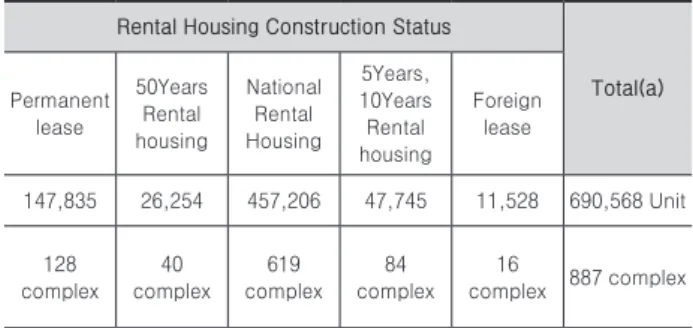
년 이상의 노후 장기 공공임대 주택의 비율은 39%로써 전체 노후임대 주택의 90.6%를 차지한다. 현재 한국토지주택공 사(이하 LH)의 임대주택 관리물량은 총 698,068호이며, 건 설임대의 25.9%가 입주 후 20년이 경과된 노후주택이므로 임대주택 재고의 유지관리와 관련한 새로운 사업영역 확장 이 필요한 실정이다.
Table 1. Rental Housing Status of Land and Housing Rental Housing Construction Status
Total(a)
Permanentlease
50Years Rental housing
National Rental Housing
5Years, 10Years Rental housing
Foreign lease
147,835 26,254 457,206 47,745 11,528 690,568 Unit
128 complex
40 complex
619 complex
84 complex
16
complex 887 complex
* Corresponding author: Bae, Byungyun, Land and Housing Institute(LHI). Daejeon 34074, Korea
E-mail: [email protected]
Received August 30, 2019: revised October 30, 2019 accepted November 19, 2019
가격영향요인과 건설제도를 활용한 건설사업 유형분류 체크리스트 제안
- 노후공공임대주택 중심으로 -
박성식1·배병윤*
1
한국토지주택연구원
Proposed a Checklist for the Classification of Construction Business Model by Utilizing the Price Influence Factors and the Construction Regulation
- As Focus on Aged Public Rental Apartment -
Park, Seongsik
1, Bae, Byungyun
*1
Land and Housing Institute
Abstract :
1990s, Construction market continued to grow in South Korea exceeding 20% of GDP. In 2015, more than 30 years of old multi-family dwellings amounted to 4.93 million and it continues to increase until 2019. In Particular, the share of Public rental Housing accounts for 90.6% of South Korea’s Total aging housing. Before checking the feasibility of Construction Project Management such as Renovation and Reconstruction, Checklists were presented through price impact factor analysis and analysis of housing construction system(Regulation). Based on 32 Price Influencing factors and 20 Indicators based on the housing construction system The Construction project management seems appropriate.
As a result, the 22 complexes were found to be suitable for remodeling. This study is meaningful enough to be used for Domestic rental Housing construction and Construction project management and to suggest specificity. Future Research is needed to Quantify the checklist.
Keywords :
Price Influencing Factors, Construction Regulation, Checklist, Construction Project Management
후공공임대주택 중심으로 -
정부는 2016년 8월에 공동주택 관리법을 제정 하고, 공공 주택 공급 및 관리계획을 수립하는 등 ‘기존주택 유지관리 중심’으로 정책변화 중에 있다. 그러므로 국내 시장 및 정책 변화에 선제적으로 공공임대 주택의 대응과 정부 및 공공기 관의 기능조정으로 양질의 신규택지 확보에 어려움이 가중 된 상황에서도 도심 내 기존 단지의 고도이용을 통한 새로 운 주거안정망 구축이 필요하다. 또한 수선유지비용의 관리 를 통해 투자비용을 예측하여 공공임대운영 손실절감이 가 능하므로 공공임대주택 보유재고의 전략적 활용계획 수립 이 필요하다.
1.2 연구의 목적 및 방법
현재까지 공공임대주택의 성능향상 및 유지관리를 위하 여 장기수선비를 사용한 수선·유지보수를 해왔고, 2006년 부터 2015년 까지 2조 1천억 원이 투입되었으며, 향후 10년 간 6조 5천억 원이 투입될 것으로 예상된다(LHI, 2015). 하 지만 공공임대 주택의 리모델링 및 재건축 등 건설 사업유 형분류가 가능한 방법이 없음으로 본 연구에서는 공공임대 주택의 늘어나는 장기수선비용을 절감하고, 주거안전망 구 축을 위해 리모델링 및 재건축 등의 타당성 검토 전에 활용 이 가능한 건설사업 유형분류기준을 가격영향요인분석과 주택건설 관련제도를 활용하여 체크리스트를 제시하고자 한다.
2. 기존이론 및 문헌고찰
2.1 장기공공임대주택의 재건축사업 프로세스 장기공공임대주택 재건축사업의 사업주체는 ‘도시 및 주 거환경 정비 법(이하 도정법)’에 따라 장기공공임대주택 및 복지서비스시설을 재건축할 수 있고, 장기공공임대주택을 재건축하는 경우 재건축에 따른 장기공공임대 주택 세대수 는 기존 장기공공임대주택 세대수 이상으로 하여야 한다.1)
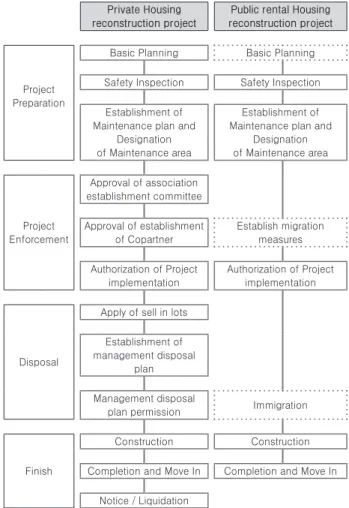
장기공공임대주택 재건축사업은 ‘장기공공임대주택 입주 자 삶의 질 향상 지원법(이하 삶의 질 지원법)’에 추진근거가 마련되어있다. 사업진행 시 도정법에 따른 사업절차를 준용 하되 공공시행자에 의한 사업으로 기본계획상 정비예정구 역을 지정하고, 조합설립 등 일부절차가 생략이 가능하다.2) 토지주택공사가 임대주택의 토지등소유자로 공공시행자 지 정을 통하여 사업을 추진할 경우, 아래 <Fig. 1>에서 보이는 것과 같이 정비예정구역 지정 없이 정비계획 입안을 제안할 수 있으며 추진위원회 승인 및 조합설립인가와 관리처분 계 획의 절차는 필요 하지 않다.3)
2.2 노후건축물의 개념
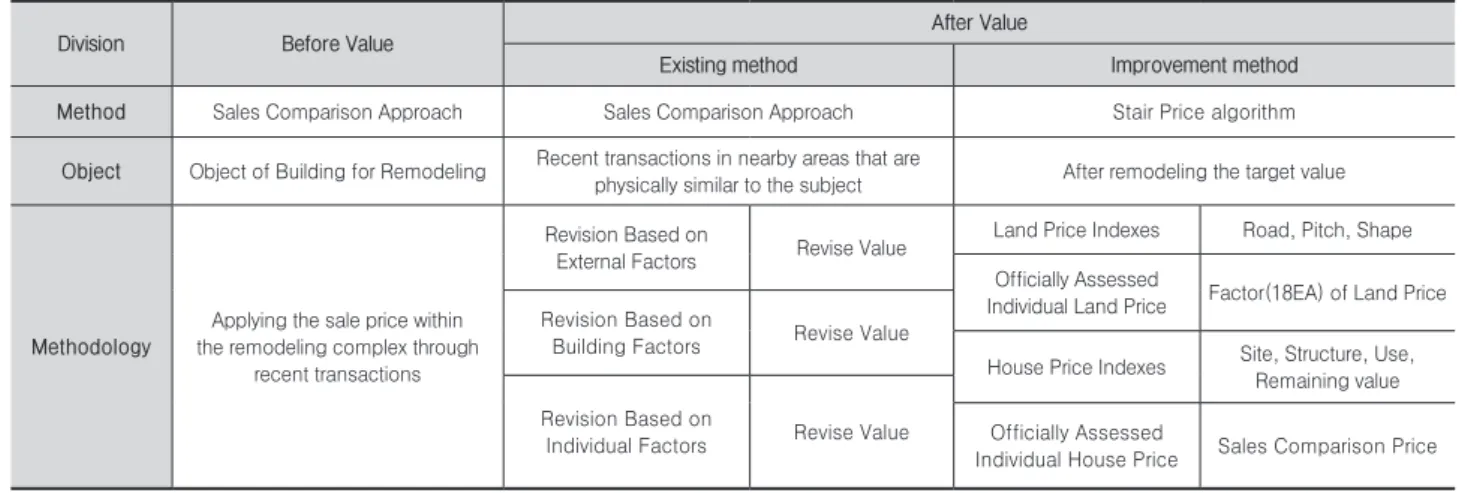
한국의 도시재생 활성화·지원에 관한 특별법 시행령 제 17조 제3항에서는 준공된 후 20년 이상 지난 건축물을 노 후주택으로 정의 하고 있다. 이에 따라 많은 선행연구에서 는 20년 이상의 공동주택의 가격영향요인에 관한 연구가 선 행 되었고, 가격 영향요인 비교분석을 통한 노후 공동주택 맞춤형 리모델링의 사업성 분석 방법론 연구에서는 기존 종 후가치 산정 방법의 거래사례비교법이 외부요인 보정과 건 물요인 보정, 그리고 개별요인을 보정하여 산정하기 때문 에 계단가격법을 사용하여 건축물가격 각 단계별 가격형
1) 장기공공임대주택 입주자 삶의 질 향상 지원법의 제9조(장기공공임 대주택의 재건축)
2) 도시 및 주거환경 정비 법(시행 2018.2.9.) 제14조(정비계획의 입안 제안) 토지등소유자가 제26조제1항 제7호 및 제8호에 따라 토지주 택공사 등을 사업시행자로 지정 요청하려는 경우
3) 도시 및 주거환경 정비 법(시행 2018.2.9.) 제26조(재개발사업·재 건축사업의 공공시행자) 시장·군수 등이 직접 정비 사업을 시행하 거나 토지주택공사 등을 사업시행자로 지정·고시한 때에는 그 고 시일 다음 날에 추진위원회의 구성승인 또는 조합설립인가가 취소 된 것으로 본다.
Private Housing reconstruction project
Public rental Housing reconstruction project
Project Preparation
Basic Planning Basic Planning
Safety Inspection Safety Inspection
Establishment of Maintenance plan and
Designation of Maintenance area
Establishment of Maintenance plan and
Designation of Maintenance area
Project Enforcement
Approval of association establishment committee
Approval of establishment of Copartner
Establish migration measures
Authorization of Project implementation
Authorization of Project implementation
Disposal
Apply of sell in lots
Establishment of management disposal
plan
Management disposal
plan permission Immigration
Finish
Construction Construction
Completion and Move In Completion and Move In
Notice / Liquidation
Fig. 1. Comparison of Processes for Reconstruction Private
Housing and Public Rental Housing
성요인으로 공공주택 가격 산정방법론을 개발하였다(Bae, 2017), <Table 2>.
본 연구에서 노후물량을 입주 후 20년을 기준으로 분류한 것은 장기공공임대주택은 거주자의 주인의식 및 유지관리 에 대한 인식이 상대적으로 낮으므로 노후화가 빠르게 진행 되는 점을 고려하여 도정법에서 규정한 최단 연한기준을 사 용하였다. 또한, 도시재생법 시행령에서도 준공된 후 20년 이상 지난 건축물을 노후주택으로 정의하고 있고, 노후주택 의 비율이 전체 건축물의 50% 이상을 기준으로 도시재생활 성화지역 지정요건의 하나로 활용 중이다.4)
3. 가격영향요인 분석
유지관리, 리모델링, 재건축 키워드 중심으로 공동주택 리모델링, 재건축 사업이 진행되는 일본, 영국, 우리나라 3 개국의 최근 10년 간 논문을 아래 <Table 3>와 같이 국가통 계포털과 과학기술정보 검색을 사용하여 검색한 후 가격영 향요인을 활용한 38건의 선행연구에서 418개의 가격영향 요인을 전부 추출하였다.
Table 3. Rental Housing Status of Land and Housing
Search Target
Apartment renovation
Period
January 2009-January 2019Keyword
Remodelling, Renovation, ReconstructionData
Base
KOSIS
NDSL
Research
Field
Architecture, Building선행연구에 사용된 가격영향요인 중에서 민간 분양주택 사업성 검토를 위한 “사업비, 주택면적, 주택가격, 분양주
택비율, 임대주택비율, 개발이익 및 조합업무에 관한사항”
에 대한 영향요인은 본 연구의 범위가 공공임대주택이므로 제거하였다. 또한, “세대 당 거주인수, 가족 수, 세대원 수”,
“단지의 경과년수, 준공년도”는 중복지표이므로 세대원 수 와 준공년도로 사용하였다.
3.1 가격영향요인의 분류
공동임대주택의 관리에 관한 도시 및 주거환경 정비 법과 도시재정비 촉진을 위한 특별법 및 공공임대주택 입주자의 삶의 질 향상 지원법을 검토하여 향후 공공임대주택의 재고 를 도시나 지역의 거점으로 활용 할 수 있도록 도시 및 단지 재생을 위해 아래 <Table 4>의 대분류에서 보이는 것과 같 이 인구·사회, 주거환경, 토지이용, 인프라, 지역경제로 유 형분류 하였다. 선정된 요인 간의 유사성이 있는 경우 대표 지표를 선정하거나 수정하였다. 공공임대단지 현장의 직접 적용을 위해서 시설정보, 거주자 속성, 개발여력, 거주 편의 성, 개발수요, 공급 가능성, 생활 편의성 총 7개의 중분류로 구분하였다.
3.2 전문가 인터뷰를 통한 요인 제거
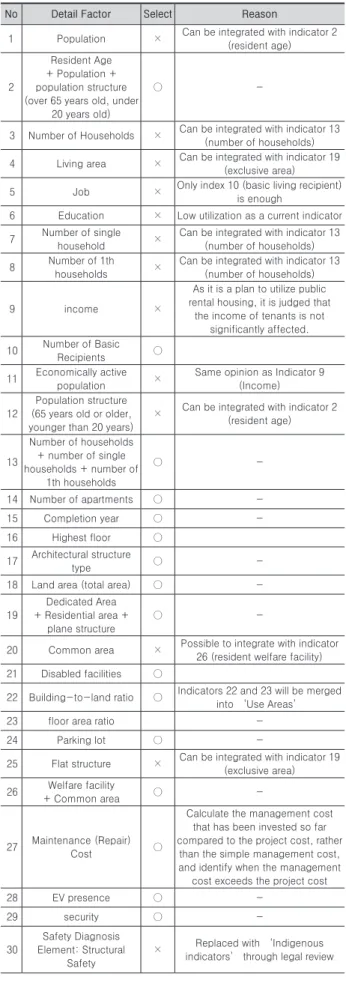
전문가 인터뷰를 통해 가격영향요인을 제거 하였다. 전문 가 인터뷰는 공기업에서 20년 이상 건설 사업관리 분야에 종사하는 전문가 10명을 대상으로 60분간 각1회의 인터뷰를 진행한 후 공공임대 주택의 관리를 위한 설명력이 미흡한 요인 및 별도의 방안으로 검토하는 요인을 제거 하였다. 공 공임대주택의 경우 건설사업의 발주자는 건설사업 시행을 포함하여 임대주택관리 또한 중요한 역할이다. 본 연구의 대상이 노후공공임대주택이고, 거주자 삶의 질 향상을 위한 임대주택관리 목적에서 앞서 말한 바와 같이 주택가격, 사 업비, 개발이익의 가격영향요인은 제거한 후 공공주택 가격 영향요인을 활용함에 따라서 공공임대주택관리 분야의 실
4) 도시재생 활성화·지원에 관한 특별법 시행령 제17조제3항
Table 2. Comparison of existing and improved methods of feasibility analysis
Division Before Value After Value
Existing method Improvement method
Method
Sales Comparison Approach Sales Comparison Approach Stair Price algorithmObject
Object of Building for Remodeling Recent transactions in nearby areas that arephysically similar to the subject After remodeling the target value
Methodology
Applying the sale price within the remodeling complex through
recent transactions
Revision Based on
External Factors Revise Value Land Price Indexes Road, Pitch, Shape Officially Assessed
Individual Land Price Factor(18EA) of Land Price Revision Based on
Building Factors Revise Value
House Price Indexes Site, Structure, Use, Remaining value Revision Based on
Individual Factors Revise Value Officially Assessed
Individual House Price Sales Comparison Price (Byungyun Bae, 2017)
무전문가의 인터뷰가 진행되었다. 인터뷰 결과 아래 <Table 5>와 같이 49개의 요인을 제거할 수 있고, 택지 및 도시개발 계획의 경우 재건축보다는 신규개발에 가까운 지표로 재고 자산 활용에는 적합하지 않음으로 가격영향요인에서 제거 되는 것으로 나타났다.
Table 5. Factor Removal Methodology Using Expert Interview Table 4. Selection of Price Influencing Factors
Sector (5) Category (14) Detail Factor (79)
Population and Society
population characteristics
Population, resident age, number of households, area of residence, occupation, education, income, number of single-person households, number of households
Social characteristics
The number of basic living beneficiaries, economically active population, Population structure (number of people over 65 years old, population under 20 years)
Residential building
Complex Scale
The number of households, the number of people, the year of completion (old age), the number of floors, building structure, building occupancy rate, floor area, land area (total area), exclusive area, public area, barrier-free facility,
Complex facility
Flat structure, social welfare facilities, elevators, maintenance and repair costs, Parking lot, security, security
Harmony with the surrounding
area
Aging building ratio, building closure rate, floor area ratio, Housing prices (differences and changes with surrounding areas such as rent),
Safety Diagnosis
Criteria
(Required) Structural safety, residential environment, construction deadline, mechanical equipment, electrical and communication (Others) Seismic Design, Design Drawing, Repair, Repair, Change History
Comfort Pollution source (factory, etc.), highway and railway presence
Land
Land use status
Unite Density, Population Density, Area of Use, Housing Type
Location and space
Population Movement, Housing Supply Plan, Urban, Sub-center, and Living Area Division, Housing Site and Urban Development Plan, Restriction of Land Use, Change of Space Axis (Suburbanization)
infra
accessibility Bus stop and number of lines, number of subway stations, road
Convenience
Number of commerce, education, childage, culture and medical facilities, number of public institutions
Local economy
Housing demand
Number of Basic Recipients, Economically Active Population, Number of Housing, Housing Supply Rate, Housing Type, Housing Area, Single Household, First-Generation Household, Old Housing Ratio, Number of Tenants (No Homeless), Population Structure Population)
Industry and economy
Number of businesses and workers, size of business, industrial structure, gross domestic product
Municipalities
Fiscal Inducement, Budget Size and Segmentation, Per Capita Local Taxes, Fiscal Soundness (liabilities), Land Price Change
No Detail Factor Select Reason
1 Population × Can be integrated with indicator 2 (resident age)
2
Resident Age + Population + population structure (over 65 years old, under
20 years old)
○ -
3 Number of Households × Can be integrated with indicator 13 (number of households) 4 Living area × Can be integrated with indicator 19
(exclusive area) 5 Job × Only index 10 (basic living recipient)
is enough
6 Education × Low utilization as a current indicator 7 Number of single
household × Can be integrated with indicator 13 (number of households) 8 Number of 1th
households × Can be integrated with indicator 13 (number of households)
9 income ×
As it is a plan to utilize public rental housing, it is judged that
the income of tenants is not significantly affected.
10 Number of Basic
Recipients ○
11 Economically active
population × Same opinion as Indicator 9 (Income)
12
Population structure (65 years old or older, younger than 20 years)
× Can be integrated with indicator 2 (resident age)
13
Number of households + number of single households + number of
1th households
○ -
14 Number of apartments ○ -
15 Completion year ○ -
16 Highest floor ○
17 Architectural structure
type ○ -
18 Land area (total area) ○ -
19
Dedicated Area + Residential area +
plane structure
○ -
20 Common area × Possible to integrate with indicator 26 (resident welfare facility) 21 Disabled facilities ○
22 Building-to-land ratio ○ Indicators 22 and 23 will be merged into ‘Use Areas’
23 floor area ratio -
24 Parking lot ○ -
25 Flat structure × Can be integrated with indicator 19 (exclusive area) 26 Welfare facility
+ Common area ○ -
27 Maintenance (Repair)
Cost ○
Calculate the management cost that has been invested so far compared to the project cost, rather
than the simple management cost, and identify when the management
cost exceeds the project cost
28 EV presence ○ -
29 security ○ -
30
Safety Diagnosis Element: Structural
Safety
× Replaced with ‘Indigenous indicators’ through legal review
No Detail Factor Select Reason
31
Safety Diagnosis Element: Residential
Environment
× -
32
Safety Diagnosis Element: Construction
Deadline
× -
33 Safety Diagnosis
Element: Machinery × -
34
Safety Diagnosis Element: Electricity &
Communication
× -
35 Other: Seismic Design × -
36 Others: Design Drawing × -
37 Others: Repair, Repair,
Change History × -
38 Household density ×
Low correlation between lake density and public lease housing
supply and management 39 Population density × Same opinion as indicator 47 (Unite
density)
40
Area of use + Restriction of land use + floor area ratio +
construction rate
○
Review of changes in the use area around the time of construction and
now
41 Housing type ×
Low association between housing type and public rental housing in
the surrounding area
42
Population movement + Population structure (65 years old or older, younger than 20 years)
○ -
43 Housing supply plan ○ -
44 Downtown, Subcenter,
and Living Area × Objective Criteria Ambiguity 45 Maintenance zone
designation ○
46 Housing Site and Urban
Development Plan × Indicative of new developments, not suitable for inventory use 47 Land use restrictions × Can be integrated with Indicator 49
(Use Area) 48 Space Axis Change
(Suburb) × Objective Criteria Ambiguity
49
Number of commercial, educational, childage,
cultural and medical facilities
○ -
50 Number of public
institutions ×
Civil affairs through public institutions in daily life are excluded
because they are being converted to the Internet.
51 Pollution source
(factory, etc.) ○ -
52 Highway and Railway ×
Low effectiveness as a regional indicator rather than a peripheral
indicator 53 Bus stop and number of
routes ○ -
54 Subway station ○ -
No Detail Factor Select Reason
55 Road ○ -
56 Housing price (different from rent area) ○
By measuring the price of private homes in quasi-equilibrium, it is possible to measure the local value
of current rental homes.
57 Old building ratio × Possible to integrate with the 69th index of old housing 58 floor area ratio × Can be integrated with Indicator 40
(Use Area)
59 Building-to-land ratio × Can be integrated with Indicator 40 (Use Area)
60 Number of Basic
Recipients ○
61 Economically active
population × Low utilization as a current indicator
62
Population structure (65 years old or older, younger than 20 years)
× Can be integrated with Indicator 51 (Population Movement)
63 Number of houses ×
Even if there are many houses nearby, it is difficult to say that the individual living conditions are good 64 Housing Supply Rate × Same opinion as indicator 63
(number of houses)
65 Housing type ×
Low association between housing type and public rental housing in
the surrounding area 66 Residential area × Low utilization as a current indicator
67 The number of single
household ○ Indicators 67 and 68 are merged into ‘number of households’
68 Number of 1th Households
69 Old Housing Ratio ○
70 The number of tenants (the homeless number) ○
71 Number of businesses
and workers ×
Indices of metropolitan area lack confidence in the surrounding areas
of apartment complexes
72 Business scale ×
Indices of metropolitan area lack confidence in the surrounding areas
of apartment complexes
73 Industrial structure ×
Indices of metropolitan area lack confidence in the surrounding areas
of apartment complexes
74 Regional gross domestic
product (GDP) ×
Indices of metropolitan area lack confidence in the surrounding areas
of apartment complexes
75 Financial support ×
Judging that there is little correlation between local government finance
and LH project
76 Budget size and sector
organization ×
Judging that there is little correlation between local government finance
and LH project
77 Local tax burden per
person ×
Judging that there is little correlation between local government finance
and LH project
78 Fiscal Soundness (liabilities) ×
Judging that there is little correlation between local government finance
and LH project 79 Land price change × Can be replaced with 30
3.3. 공공임대주택의 가격영향요인
이에 따라 총 30개의 공공임대주택의 가격영향요인을 채 택하였고, 민간 공동주택을 리모델링하는 경우 거주자는 매 도 및 이주가 가능 하지만 공공임대 주택의 경우에는 거주 자의 입주현황과 퇴거현황 및 공실현황을 파악하여 이주대 책이 동반되므로 공공임대주택의 리모델링은 사업기간 동 안 입주자의 주거공간이 확보되어야 한다. 또한 노약자 및 특정계층의 임대기간을 파악하여 인근지역 및 단지 내 공 실을 제공해야 하므로 임대료 및 이주비에 영향을 주는‘이 주대책의 유무’, ‘입주·퇴거·공실현황’을 추가하여 아래
<Table 6>에서 보이는 것과 같이 최종 32개의 가격영향요 인을 도출하였다.
Table 6. Final Price Influencing Factor Group
(2)
Sector (7)
Detail Factor (32)
Complex
Facility Information
Year of Construction, Type of Building Structure, Number of Buildings, Number of Floors Character of
Householder
Householder Status, Number of Households, Social Weaknesses
Development Land area, area of use, (newly) migration measures, occupancy, eviction, vacancy status
Residence convenience
Unit household flat, parking capacity, auxiliary welfare facility type and area, EV presence, management and repair cost, security and security facility installation,
barrier-free facility installation
Complex Area
Development demand
Population change, households, tenants, and basic life security beneficiaries Supply
possibility
Percentage of Old Housing, Current Use Area, Housing Supply Plan, Maintenance Zone
Convenience
Types and locations of living facilities, types and locations of hate facilities, number of bus stops and routes, number of subway stations and routes,
road conditions
4. 주택건설 관련 제도 분석
주택건설 관련 제기준이 사회적 요구수준을 반영해 지속 적으로 강화되면서 단지의 건설시점에 따라 주거품질이 상 대적으로 저하되고 있다. ‘진부화’란 시간이 지나면서 거주 자의 삶의 수준이 향상됨에도 불구하고 건축물의 물리적 형 태는 변하지 않는 것이다(KISTEC, 2017).
4.1. 제도적 기반의 평가지표의 활용
단지의 진부화 정도를 계량적으로 평가할 수 있는 지표도 출을 위해 건축법, 주택법, 소음·진동 관리법, 녹색건축물 조성 지원법, 장애인 편의 법을 분석하여 주택건설 관련 15 개 기준의 연혁을 아래 <Table 7>에서 보이는 것과 같이 단 지의 환경 및 거주자의 주거품질에 미치는 영향력이 크거나
최소 요건이 지속적으로 강화된 6개 기준에 대하여 제·개 정 시점을 조사하였다.
Table 7. Housing Construction Standards for Deriving Indicators
Select Contents Revision
Possibility
Construction standard to prevent heat loss and rationalize energy use of buildings
Insulation thickness standard 1985.12 Heat transmission
rate standard 1987.07 Rules about building structural
standards and building Act
Seismic Design Standard 1988.02 Fire Protection Act5) Sprinkler Standard 1990.06 Based on floor shock sound
protection structure (and standard floor structure)
Based on slab thickness 1991.01 Parking lot law, housing law, public
housing special law
Parking lot setting standard 1991.01 Health-Friendly Housing Construction Standards 2013.05 Crime Prevention Building Standards 2015.04
Not or Unnecessary
Thickness Standards of Boundary Walls among Households in Apartment Buildings (Related to Sound Insulation Performance)
1991.01
Height limit standards for securing sunshine 1991.05 Mandatory installation standards for convenience
facilities such as the disabled 1998.02 Energy use and waste materials utilization standard of
building 1999.02
Criteria for Efficient Energy Utilization and Eco-Friendly
Construction of Buildings 1999.02
Minimum residential area 2004.06
Housing performance labeling system 2005.01 Long life housing construction standards and
certification system 2013.12
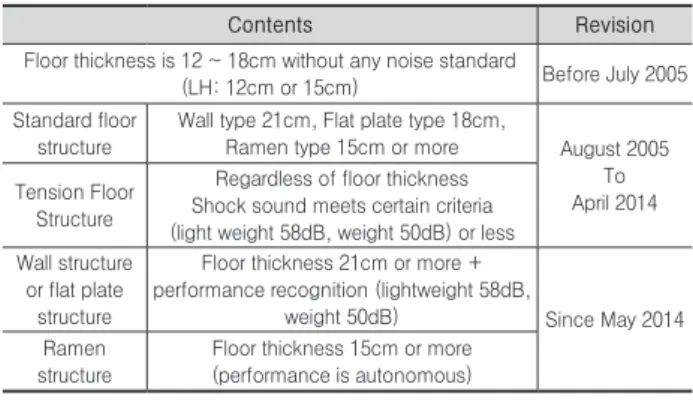
이후 지표 추출이 가능한 6개 기준에 대한 세부 변천과정 을 검토·분석하여 개정내용을 중심으로 평가지표 활용을 위해 정리하였다. 바닥충격음에 관련하여 슬래브두께 최소 기준의 변천과정은 2005년 7월 별도의 기준이 없이 바닥두 께를 12~18cm로 시공하도록 개정하였고, 이후 구조형식에 따라 바닥 두께기준과 충격음의 일정기준 등이 제정되었다
<Table 8>.
Table 8. Slab thickness minimum standard
Contents Revision
Floor thickness is 12 ~ 18cm without any noise standard
(LH: 12cm or 15cm) Before July 2005
Standard floor structure
Wall type 21cm, Flat plate type 18cm,
Ramen type 15cm or more August 2005 To April 2014 Tension Floor
Structure
Regardless of floor thickness Shock sound meets certain criteria (light weight 58dB, weight 50dB) or less Wall structure
or flat plate structure
Floor thickness 21cm or more + performance recognition (lightweight 58dB,
weight 50dB) Since May 2014
Ramen structure
Floor thickness 15cm or more (performance is autonomous)
5) 화재예방, 소방시설 설치·유지 및 안전관리에 관한 법률
거실 외벽이 외기에 직접 면한 경우 단열재 두께 및 열관 류 율은 1985년부터 2015년 까지 계속해서 기준이 상향되고 있다<Table 9>.
Table 9. Insulation thickness and heat transmission rate
Contents
Revision Insulation material minimum
thickness standard (Unit: mm)
Heat Transmittance Requirements (Unit: W / m
2· K)
50 0.58 1985
65 0.47 2001
85 0.36 2010
12 0.27 2013
155 0.21 2015
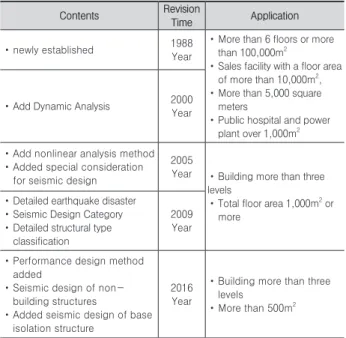
내진설계기준은 1988년에 신설되었고, 현재 내진설계기 준은 지진구역Ⅰ,Ⅱ로 구분하여 재현주기 2,400년 지진(진 도Ⅶ)에 견딜 수 있게 시행 중에 있다<Table 10>.
Table 10. Seismic Design Standard
Contents Revision
Time Application
• newly established 1988
Year
• More than 6 floors or more than 100,000m2
• Sales facility with a floor area of more than 10,000m2,
• More than 5,000 square meters
• Public hospital and power plant over 1,000m2
• Add Dynamic Analysis 2000 Year
• Add nonlinear analysis method
• Added special consideration for seismic design
2005
Year • Building more than three levels
• Total floor area 1,000m2 or more
• Detailed earthquake disaster
• Seismic Design Category
• Detailed structural type classification
2009 Year
• Performance design method added
• Seismic design of non- building structures
• Added seismic design of base isolation structure
2016 Year
• Building more than three levels
• More than 500m2
공동주택의 경우 16층 이상인 경우에는 16층 이상 층에 스프링클러 설비를 의무적으로 설치하는 제도가 1990년에 신설되었다<Table 11>.
Table 11. Mandatory installation of sprinkler equipment in case of Apartment housing
Contents Revision
If more than 16 floors,
more than 16 floors June 1990 (newly established) All floors above 11 floors May 2005 All floors above 6 floors January 2017
(Enforcement: 2018.1.27)
서울특별시를 대상으로 300세대 이상 주택의 경우 주차 장 설치기준은 2009년 7월까지는 「주택 건설기준 등에 관한 규정」에 따라 전용면적 합계를 면적당 대수 비율로 나누어 산정하였고, 2009.8월 이후에는 「공공주택업무처리 지침」에 따라 세대당 주차대수로 산정하였다. 1996.6월 「주택건설기 준 등에 관한 규정」 개정으로 면적당 대수 비율로 산정하되 세대당 주차대수는 1대(세대당 전용면적 60㎡이하인 경우 0.7대)이상 확보를 의무화하였다<Table 12>.
Table 12. Parking lot installation Contents
Revision Underground
parking lot construction
rate
Minimum ratio Dedicated Area Standard
Not applicable
1/115 (Amount/m2) 1/100 (Amount/m2)
less than 60㎡
less than 85m2 more than 60m2 January 1/100 (Amount/m2) 1991
1/85 (Amount/m2)
less than 60`
less than 85m2 more than 60m2 More 3/10 1/75 (Amount/m2) less than 85m2 February
1993 More 3/10
More 4/10 1/75 (Amount/m2) less than 60m2 less than 85m2 more than 60m2
December 1994
More 3/10
0.40 (Amount/House)
Permanent
lease - June 1996
0.80 (Amount/House)
National lease
less than 40m2
August 2009 0.90
(Amount/House)
more 40m2 and less than 50㎡
1.00 (Amount/House)
more 50m2 and less than 60m2
2013년 6월 이후 청정건강주택 건설기준에 신설된 건강 친환경주택 건설기준은 실내공기 오염물질을 최소화하도록 건설하는 것을 의무화 하고 있다<Table 13>.
Table 13. Health-friendly Housing Construction Standards (Clean Health Housing Construction Standards)
Applicable Revision
Housing construction or remodeling Project of 500 households or more
June 2013 (new established)
2014년 5월 이후 아파트를 건설할 때는 단지의 범죄예방 과 안전한 생활환경 조성을 위해 범죄예방 건축기준6) 적용 을 의무화 하고 있다<Table 14>.
Table 14. Crime Prevention Construction Standards
Applicable Revision
(Duty) 500 households or more (Recommended) Less than 500 households
May 2014 (new established)
6) 국토부고시제2015-198호
4.2 공공임대 주택의 건설 제도적 기반 지표 임대주택단지의 건설시점에 따라 주거품질이 상대적으로 저하되는 수준을 준공년도를 이용하여 평가하는 7개 세부지 표를 활용하여 최종지표를 도출하였다<Table 15>.
Table 15. Indicators for the level of Obsolescence of Complexes
Evaluation Item Evaluation Criteria (Evaluation Unit: Year Built)
Interlayer noise reductionperformance Before 2005 2006~2014 After 2015 Insulation performance Before
2001 2002
~2010 2011
~2013 2014
~2016 After 2017 Seismic performance 1989~1994 1995~2005 2006~2016 After 2017 Fire Prevention and Fire
Fighting Performance Before 2004 After 2005 Underground Parking Lot Before 1995 After 1996 Application level of indoor
clean technology Before 2013 After 2014 Crime prevention design
level Before 2014 After 2015
노후도 평가는 단지의 물리적 성능열화현상을 현지 조사 나 비파괴검사·계측 등의 결과를 활용하여 평가하는 반면 에 진부화 평가는 지표별 성능수준이 최근의 법적 요구수준 과 비교하여 상대평가 하는 것이다. 대상단지의 준공시점이 지표별로 설정된 구간에 해당하는 유무를 체크하고, 각 32 개의 항목을 사용하여 최근의 법적 요구수준 대비 성능수준 을 확인하는 것이 가능하다.
5. 가격영향요인과 건설제도기반의 체크리스트
본 연구의 목적과 같이 노후공공임대단지 중 건설 사업 유형 의사결정을 위해서 첫째, 위 <Table 6>의 영향요인과
<Table 15>의 건설 제도적 기반 지표 중 가격영향요인을 취 사선택하여 체크리스트를 아래 <Table 16>과 같이 제시하 였다. 예를 들어 대상 단지의 노후 도를 파악하기 위한 준공 연도 요인은 20년 이상의 경우 재건축에 적합하고, 순환용 임대주택 건설이 가능한 여유부지의 유무를 파악하기 위해 대지면적(건폐율)요인이 용도지역지구의 한계보다 작아야 한다<Table 14>.
둘째, 기존 단지의 특성에 맞는 활용방안을 모색하기 위 해 거주자의 속성, 거주 편의성, 개발여력, 개발수요, 입지 여건 등 다양한 지표를 위 <Table 6>의 영향요인과 <Table 15>을 취사선택하여 적용하였다<Table 16>. 리모델링대상 의 용적률은 재건축이 가능한 대상의 용적률보다 낮지만 임 대주택 추가공급 추진이 가능해야 하고, 유지보수는 재건축 과 리모델링 추진을 위한 여유 용적률이 없는 단지에서 가 능하다.
Table 16. Construction Project Management Type of Classification Checklist
Evaluation item
Complex
Aging degree
Less than 20 years of
age
20-25 years
26-30 years
More than 30 years
Seismic Standard Completion Since 2017
Completion 2006-2016
Completion 1995-2005
Completion 1989- 1994(10)
floor area ratio
Over 190%
of floor area ratio
170-189%
of floor area ratio
150-169%
of floor area ratio
Less than 150% of floor
area ratio
Have on land None Have
Around Location
Population growth rate
Less than 3% for 3 consecutive
years
3-5% for 3 consecutive
years
6-8% for 3 consecutive
years
Over than 3% for 3 consecutive
years Average private
rental price within 1km
Less than 3
times 3-4 Times 4-5Times More than 5 times Residential and
commercial rates within a radius of
1 km
Less than
60% 60-69%(5) 70-79 More than 80%
Old Housing Ratio
Less than
50% 50-59% 60-69% More than 70%
500m radius bus stop and number
of routes
Bus Stop 2 / Route 3
Bus Stop 3 / Route 4
Bus Stop 4 / Route 5
Bus Stop 5 / Route 6
6. 사례의 적용
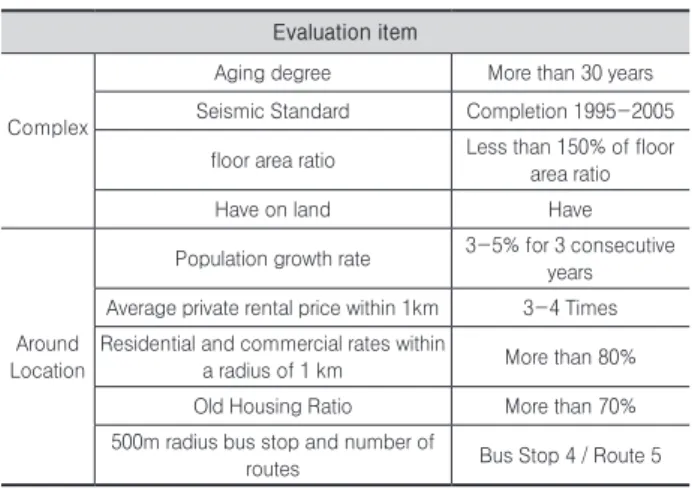
대전에 있는 00단지를 대상으로 가격영향요인과 건설제 도기반의 체크리스트를 적용하여 건설사업유형을 판단하였 다. 공동주택단지 평가항목으로 가격영향요인에서 노후도, 용적률, 여유 부지를 취사선택하였고, 건설제도 기반 지표 에서 내진기준을 취사선택하였다. 대상단지의 경우 경과년 수가 30년을 초과하기 때문에 재건축과 리모델링에 적합하 지만 내진기준 지표에서 ‘95년 ~‘00년이므로 진부화 향상을 위해서는 내진보강이 필요하다. 주변지역의 경우 3년 연속
Table 17. Apply A Construction Project Management Type of Classification Checklist To Case
Evaluation item
Complex
Aging degree More than 30 years Seismic Standard Completion 1995-2005
floor area ratio Less than 150% of floor area ratio
Have on land Have
Around Location
Population growth rate 3-5% for 3 consecutive years Average private rental price within 1km 3-4 Times Residential and commercial rates within
a radius of 1 km More than 80%
Old Housing Ratio More than 70%
500m radius bus stop and number of
routes Bus Stop 4 / Route 5
3~5%의 순인구 증가율을 보였고, 반경 1km이내의 민간공 공주택단지의 임대료는 대상단지에 비해 3~5배 높은 것으 로 조사되었다<Table 17>. 분석된 대상단지와 주변지역 평 가항목의 관계를 통해서 본 대상 단지의 건설사업유형은 내 진보강에 대한 비용 상승요인을 배제하고, 경과년수 30년 이상이며, 재건축사업이 법적으로 허용되는 단지이므로 주 변 민간공공주택 단지에 비해서 슬럼화 방지를 위한 재건축 사업을 추진하는 것으로 판단하였다.
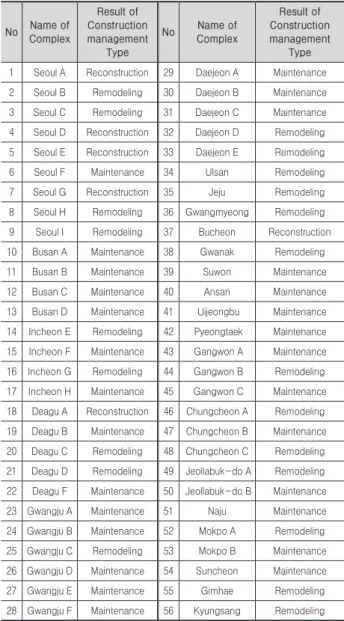
이와 같은 방법으로 장기공공임대주택 단지 56개에 적용 해본 결과 리모델링이 가능한 단지는 아래 <Table 18>에서 보이는 것과 같이 22개단지로 분석되었고, 이중에서 5개 장 기공공임대주택 단지는 리모델링 사업이 최근 5년 동안 사 업시행 및 완공되었다.
7. 결론
우리나라 국민 수준의 향상과 건설정책의 변화에 따라 건 설시장의 형태 또한 유지관리 시장으로 확대되고 있다. 본 연구에서는 공공임대주택을 대상으로 가격영향요인을 활 용하여 거주자의 삶의 질 향상을 위해서 건설사업에 활용할 수 있도록 건설사업 유형분류 체크리스트를 개발하였다. 민 간건설사업과 공공건설사업의 차이를 서론에서 설명한 바 와 같이 건설사업 프로세스에서 조합설립, 관리 처분계획 등의 사업기간단축이 가능하므로 사업추진을 위한 건설사 업 유형분류를 할 때 대상단지의 사업성 분석 전 체크리스 트를 사용한다면 건설 사업유형 의사결정에 도움을 줄 수 있을 것이다. 건설사업 유형분류 체크리스트에 사용된 공공 임대공동주택 가격영향요인은 32개로 분석되어 적용하였 고, 주택건설 제도를 사용한 평가지표는 7개를 사용하여 총 20개의 지표를 적용하였다. 사례적용을 통한 유형분류 결과 대상단지는 재건축사업이 적합단지로 판단되었으며, 56개 공공임대주택에 확대 적용해본 결과 22개의 단지가 리모델 링이 적합한 단지로 판단되어 현재 5개의 노후공공임대단지 가 사업진행 중에 있다.
본 연구는 국내 공공임대주택 건설사업유형에 대한 의사 결정과 거주자 삶의 질 개선을 위한 노후 공공임대공동주택 성능개선사업에 활용가능하고, 공공임대주택의 특수성을 시사에 의미가 있다. 하지만 공공임대주택을 대상으로 진행 한 연구이고, 공공임대주택의 재건축 및 리모델링이 필요한 현 시점에서 연구대상 적용사례가 아직은 매우 제한적이다.
그러므로 민간공공주택의 사업성 분석을 위한 경제학 측면 의 가격영향요인을 활용하여 건설 사업유형분류 연구를 진 행하였지만 공공임대주택의 개선사업을 위한 향후 연구에 서는 체크리스트의 정량화를 위한 연구가 진행되어야 하고, 유형분류에서는 사회과학 연구방법론을 사용하여 특수세대 를 고려한 계층별 거주자의 가치영향요인이 함께 연구되어 야 할 것이다.
감사의 글
본 연구는 2019년도 국토교통부 주거환경연구개발사업에 의한 결과의 일부임(과제번호:19RERP-B099826-05).
Table 18. Health-friendly Housing Construction Standards (Clean Health Housing Construction Standards)
No Name of Complex
Result of Construction management
Type
No Name of Complex
Result of Construction management
Type
1 Seoul A Reconstruction 29 Daejeon A Maintenance 2 Seoul B Remodeling 30 Daejeon B Maintenance 3 Seoul C Remodeling 31 Daejeon C Maintenance 4 Seoul D Reconstruction 32 Daejeon D Remodeling 5 Seoul E Reconstruction 33 Daejeon E Remodeling6 Seoul F Maintenance 34 Ulsan Remodeling
7 Seoul G Reconstruction 35 Jeju Remodeling
8 Seoul H Remodeling 36 Gwangmyeong Remodeling 9 Seoul I Remodeling 37 Bucheon Reconstruction
10 Busan A Maintenance 38 Gwanak Remodeling
11 Busan B Maintenance 39 Suwon Maintenance
12 Busan C Maintenance 40 Ansan Maintenance
13 Busan D Maintenance 41 Uijeongbu Maintenance 14 Incheon E Remodeling 42 Pyeongtaek Maintenance 15 Incheon F Maintenance 43 Gangwon A Maintenance 16 Incheon G Remodeling 44 Gangwon B Remodeling 17 Incheon H Maintenance 45 Gangwon C Maintenance 18 Deagu A Reconstruction 46 Chungcheon A Remodeling 19 Deagu B Maintenance 47 Chungcheon B Maintenance 20 Deagu C Remodeling 48 Chungcheon C Remodeling 21 Deagu D Remodeling 49 Jeollabuk-do A Remodeling 22 Deagu F Maintenance 50 Jeollabuk-do B Maintenance
23 Gwangju A Maintenance 51 Naju Maintenance
24 Gwangju B Maintenance 52 Mokpo A Remodeling 25 Gwangju C Remodeling 53 Mokpo B Maintenance 26 Gwangju D Maintenance 54 Suncheon Maintenance 27 Gwangju E Maintenance 55 Gimhae Remodeling 28 Gwangju F Maintenance 56 Kyungsang Remodeling
References
Bae, B.Y., Kim, K.R., Shin, D.W., and Cha, H.S.
(2017). “Analysis Methodology for Feasibility Study of Remodeling of Aged Apartment by Comparative Analysis of Price Influencing Factor.” Korean Journal of Construction Engineering and Management, KICEM, 18(6), pp. 47-56.
Bae, B.Y., Kim, K.R., Shin, D.W., and Cha, H.S. (2017).
“Improvement of Calculating Method of the Officially assessed individual House Price of Aged Apartment Remodeling reflecting Feasibility Analysis.”
Korean Journal of Construction Engineering and Management, KICEM, 18(6), pp. 89-97.
Berlin startet neues Modernisierungsförderprogramm (2018). “https://www.stadtentwicklung.berlin.de/
aktuell/pressebox/archiv_volltext.shtml?arch_1812/
nachricht6652.html”
Berlin-Neukölln “Wohnungshttps://www.berliner- genossenschaft.de/impressum/bauprojekte/”
Bureau of Urban Development Tokyo Metropolitan Government (2016). “Urban Development in Tokyo 2016.
Euroconstruct (2017). “European Construction Market Outlook until 2017-Continued Strong Market Performance.” 83rd Euro construct Conference, EUROPE’S LEADING.
Junko ABE (2016). “Proposals to Improve the Housing Estates in Tama New Town, Japan” Tokyo Metropolitan University.
Kim, E.I., and Lee, Y.K. (2019). “A Study on the Policy for Small-sized Apartment Housing Remodeling Focusing on Housing Status” Architectural Institute Of Korea, KICEM, 29(6), pp. 35-45.
Kim, K.R., Yoon, Y.H., and Kim, C.H. (2016).
“Improvements in the Business Process Model for the Aged Apartment Remodeling Project – In Case of the Number of Units Increased -” Journal of The Korean Housinf Association, 17(5), pp. 45-53.
Yoon, Y.H., Kim, K.R., Shin, S.K., Park, S.S., and Lee, D.H. (2018). “A Study on Old Multi-Family Residential Remodeling Project’s Scope and Process Based on Business Models.” Journal of The Korean Housing Association, 29(6), pp. 35-46.
요약 :
1990년대 한국의 건설 시장은 GDP대비 20%를 상회하며 계속해서 성장해 왔다. 2015년에는 30년 이상의 노후 공동주택이 403만호에 이르렀고, 2019년 현재까지 계속해서 증가하고 있다. 특히 공공임대 주택의 비율은 한국 전체 노후공동주택의 90.6%
를 차지한다. 리모델링 및 재건축 등 건설사업의 타당성 검토 전에 활용이 가능한 사업유형 분류기준을 가격영향요인분석과 주택 건설 관련제도의 분석을 통해 체크리스트를 제시하였다. 공공임대주택의 가격영향요인 32개와 주택건설제도 기반 20개 지표를 사 례적용 한 결과 대상단지는 재건축사업이 적합한 것으로 판단되었고, 56개 단지에 확대 적용해본결과 22개단지가 리모델링이 적 합한 단지로 판단되었다. 본 연구는 국내 임대주택 건설환경과 삶의 질 향상을 위한 노후공동주택 성능향상에 활용가능하고, 특수 성을 시사하는 것에 충분한 의미가 있다. 향후 연구에서는 체크리스트의 정량화를 위한 연구가 필요하다.
키워드 :