www.earticle.net
π-ray를 처리한 사료의 급여가 육계의 육성성적과 도체특성에 미치는 영향
김일영1#⋅고용균2#⋅안준상3⋅손기활1⋅박병기2⋅신종서2⋅이향자4*
강원대학교 동물생명과학대학 대학원생1, 교수2; 축산과학원 한우연구소3; 연변대학교 농학대학 교수4
Effects of π-Ray Treated Feeds on Growth Performance and Carcass Characteristics of Broiler
Il Young Kim1#, Yong Gyun Goh2#, Jun Sang Ahn3, Gi Hwal Son1, Byung Ki Park2, Jong Suh Shin2 and Xiang Zi Li4*
1Graduate Student, 2Professor, College of Animal Life Sciences, Kangwon National University, Chuncheon 24341, Korea
3Hanwoo Research Institute, National Institute of Animal Science, RDA, Pyeongchang 25340, Korea
4Department of Animal Science, College of Agriculture, Yanji 133002, China
ABSTRACT1)
This study investigated the effects of π-ray treated feeds on the growth performance, carcass composition, internal organ weight, and sensory evaluation of broilers. One hundred and eighty broiler chicks were used as experimental animals. These were divided into four treatment groups according to the π-ray treated feed supplement level: 0% (control) 1%, 3%, and 5%. The π-ray treated feeds did not significantly affect on the body weight gain (2,484–2,602 g), feed intake (4,747–4,944 g), and feed efficiency (1.90–1.98) in broilers (p>0.05). Also, carcass protein (20.2–20.4%) and fat (4.6–4.9%) contents were not affected. The lengths (178.0, 182.7, 198.0, and 190.3 cm) and weights (38.4, 41.2, 44.2, and 38.9 g/kg of body weight) of the small intestine were slightly but not significantly higher in the π-ray treatments than in the control. Further, there were no overall effect of the π-ray treatment on the abdominal fat pad (2.3, 2.1, 2.1, and 1.8%), and cecum (6.7, 4.0, 5.6, and 6.0 g/kg of body weight) and gizzard (16.8, 15.2, 18.0, and 16.6 g/kg of body weight) weights of the broilers in the present study (p>0.05). The stickiness (2.25, 4.25, 4.50, and 4.38) and flavor (2.44, 4.25, 4.31, and 4.38) of cooked breast meat were higher in the π-ray treatments than in the control (p<0.01). This study also found that, in humans, eating cooked breast meat of broilers that were fed π-ray treated feeds had a positive effect on the blood circulation in the capillaries. Thus, the findings of this study suggest that dietary π-ray treatment has a positive effect on the sensory evaluation of broilers, without any negative effect on their body weight gain, feed intake, and feed efficiency, and that the consumption of these broilers is beneficial for humans on their blood circulation.
(Key words: π-ray treated feeds, Body weight gain, Feed efficiency, Sensory evaluation, Capillary)
# These authors equally contributed to this study as first author.
* Corresponding Author: Xiang-Zi Li, Department of Animal Science, College of Agriculture, Yanji 133002, China. Tel:
+86-433-243-5628, E-mail: [email protected]
This is an Open Access article distributed under the terms of the Creative Commons Attribution Non-Commercial License (http://creativecommons.org/licenses/by-nc-nd/3.0/deed.ko), which permits unrestricted non-commercial use, distribution, and reproduction in any medium, provided the original work is properly cited. The moral rights of the named author(s) have been asserted.
[Provider:earticle] Download by IP 118.70.52.165 at Monday, December 20, 2021 7:46 PM
www.earticle.net
Ⅰ. INTRODUCTION
As the national income have been increasing, safe food has been recognized as a way to increase human health. Recently, studies have been undertaken on the bio energy projection materials to improve immune function and prevent degenerative disease to cause aging (Kim et al., 1995). Additionally, studies have been conducted with regard to using the bio-energy treated feed to improve the productivity of livestock while decreasing the ammonia content in chicken excretion have been (Goh and Kim, 1999).
Until recently, π-ray as a vital energy or bio-energy has been applied in many industrial areas related to human health (Oh, 2001). Materials that radiate π-ray are mainly ionic minerals such as quartz porphyry, ionic antimicrobial, red clay, illite (Mokyashinchi, 2001).
π-ray has known as very important role to the bio activity of life cycle due to energy which was produced by the spiral rotation, not the simple rotation of the electro magnetic wave. It is reported that π-ray is advantageous for improving energy flow, strengthening immune system and sterilizing harmful microbes, In addition, when exposed to π-ray, molecules flowing in the capillary of the human body absorb π-ray and make crystals, stimulating the autonomic nerves, and positively affecting blood circulation (Jung, 2001).
In the livestock industry, interest in the application of π-ray is steadily increasing (Park, 2004). In Son and Park's study, the addition of quartz porphyry increased blood triglyceride and cholesterol concentrate in broiler chickens. Munmpton and Fishman (1977) reported that silicate contained in quartz porphyry decreased the number of toxic bacteria by changing the intestinal pH through cation exchange. There have been some studies in which supplementation of substance that emits π-ray, but there are no study about the productivity of livestock by treating π-ray to concentrate feed without adding it directly to the feed.
Therefore, the aim of this study was to investigate the effects of dietary levels of π-ray on growth performance, carcass composition, internal organ weight
and sensory evaluation of broiler.
Ⅱ. MATERIALS AND METHOD
1. Animals and experiment design
In this experiment, 5-day-old healthy broiler chicks (Ross species) from the Kangnam Hatchery, Osan were used. Feeding trial and carcass analysis were done in the College of Animal Life Sciences, Kangwon National University. One hundred and eighty chickens were randomly assigned to control and three dietary treatments (12 groups of 3 replication). Fifteen chickens were allocated to each treatment through completely random block design, and fed with feeds containing 1%, 3% and 5% π-ray treated feed.
2. Experimental feed
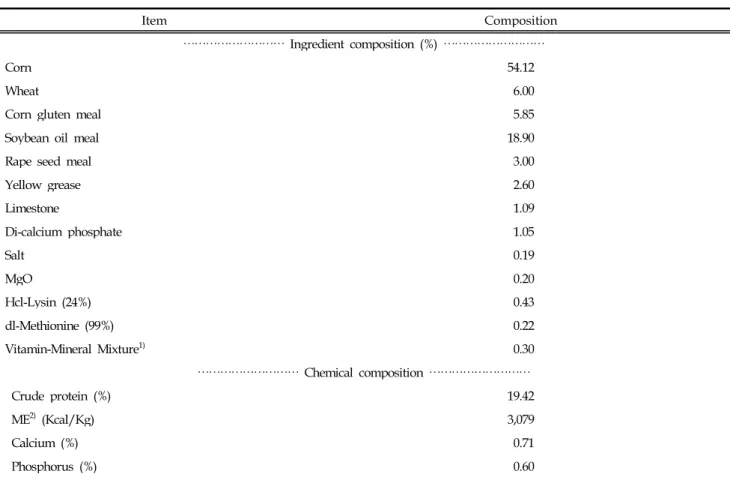
Experimental feed contains 19.42% of crude protein and 3,079 kcal/kg of metabolizable energy (Table 1). After the experimental feed mixed, part of experimental feed was replaced with π-ray treated feed (π-ray science, co. Seoul, Korea), of which the replacing ratio was 1%, 3% and 5%.
3. Feeding and Management
Broiler chicks were raised in 3 × 1 m pens. The experimental feed and water was freely available all the time. Other feeding management was conducted in accordance with the guidelines of experimental farm of college.
4. Body weight gain, feed intake and feed efficiency
Body weight and feed intake were measured once a week. Feed efficiency was calculated on the basis of unit feed consumed to unit body weight gain for each replicate separately.
[Provider:earticle] Download by IP 118.70.52.165 at Monday, December 20, 2021 7:46 PM
www.earticle.net
Table 1. Ingredient and chemical composition of experimental diets
Item Composition
……… Ingredient composition (%) ………
Corn 54.12
Wheat 6.00
Corn gluten meal 5.85
Soybean oil meal 18.90
Rape seed meal 3.00
Yellow grease 2.60
Limestone 1.09
Di-calcium phosphate 1.05
Salt 0.19
MgO 0.20
Hcl-Lysin (24%) 0.43
dl-Methionine (99%) 0.22
Vitamin-Mineral Mixture1) 0.30
……… Chemical composition ………
Crude protein (%) 19.42
ME2) (Kcal/Kg) 3,079
Calcium (%) 0.71
Phosphorus (%) 0.60
1)Vitamin-mineral mixture provided following nutrients per kg of diet: Vitamin A, 9,000,000 IU; Vitamin D3, 2,100,000 IU; Vitamin E, 15,000 IU; Vitamin K, 2,000 mg; Vitamin B1, 1,500 mg, Vitamin B2, 4,000 mg; Vitamin B6, 3,000 mg; Vitamin B12, 15 mg;
Pan-Acid-Ca, 8,500 mg; Niacin, 20,000 mg; Biotin, 110 mg; Folic-Acid, 600 mg; Co, 300 mg; Cu, 3,500 mg; Mn, 55,000 mg; Zn, 40,000 mg; I, 600 mg.
2)ME: metabolizable energy (calculated values).
5. Analysis of carcass and sensory test
At the end of the feeding trial, the abdominal fat pad and internal organs were examined from three broilers per dietary treatment. The fat and protein compositions of the experimental diets were analyzed according to Association of Official Analytical Chemists (AOAC) method. At the end of the 6 weeks feeding trial, three broilers were picked randomly from each treatment for sensory test. After these broilers were sacrificed, boiled and cut into specific size, 15 panellists evaluated the stickiness and flavor by 5 score measurement mensuration (5=very good, 4=good, 3=average, 2=bad and 1=very bad). The blood circulation in capillary was checked on the upper part of the third finger, using 2D laser blood flow imager (omegawave, INC.) before and
after eating broiler fed with π-ray treated feed.
6. Statistical analysis
All results were verified by the Duncan multiple range test (p<0.05) using Minitab statistical program (Minitab, 2005).
Ⅲ. RESULTS AND DISCUSSION
1. Body weight gain, feed intake and feed efficiency
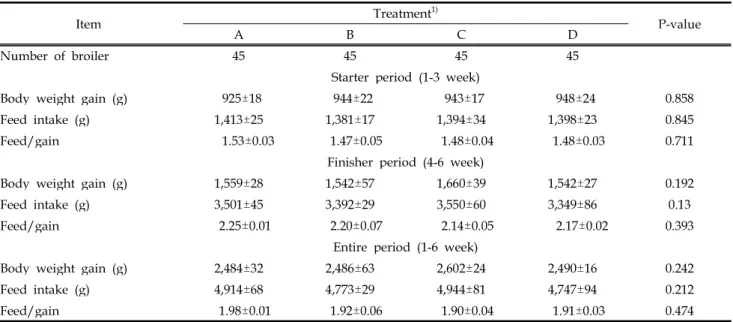
The body weight gain, feed intake and feed efficiency are shown in Table 2.
[Provider:earticle] Download by IP 118.70.52.165 at Monday, December 20, 2021 7:46 PM
www.earticle.net
Table 2. Effect of π-ray treated feeds on growth performance of broiler
Item Treatment1)
P-value
A B C D
Number of broiler 45 45 45 45
Starter period (1-3 week)
Body weight gain (g) 925±18 944±22 943±17 948±24 0.858
Feed intake (g) 1,413±25 1,381±17 1,394±34 1,398±23 0.845
Feed/gain 1.53±0.03 1.47±0.05 1.48±0.04 1.48±0.03 0.711
Finisher period (4-6 week)
Body weight gain (g) 1,559±28 1,542±57 1,660±39 1,542±27 0.192
Feed intake (g) 3,501±45 3,392±29 3,550±60 3,349±86 0.13
Feed/gain 2.25±0.01 2.20±0.07 2.14±0.05 2.17±0.02 0.393
Entire period (1-6 week)
Body weight gain (g) 2,484±32 2,486±63 2,602±24 2,490±16 0.242
Feed intake (g) 4,914±68 4,773±29 4,944±81 4,747±94 0.212
Feed/gain 1.98±0.01 1.92±0.06 1.90±0.04 1.91±0.03 0.474
1)A, supplementation percent of π-ray treated feed was 0% (control); B, supplementation percent of π-ray treated feed was 1%; C, supplementation percent of π-ray treated feed was 3%; D, supplementation percent of π-ray treated feed was 5%.
For the starter period, body weight gain was slightly but not significantly higher in B, C and D than in A (control). For the finisher period, body weight gain was highest in the C, but it was not significantly different from that in the other treatments. As a result, body weight gain during entire period was highest in the C, but it was not significantly different from that in the other treatments.
For the starter period, feed intake was slightly but not significantly lower in the π-ray treatments than in control. For the finisher and entire period, feed intakes were slightly higher in A and C than in B and D;
however, there was no consistent tendency or statistical significance based on π-ray level.
Feed efficiencies (feed/gain) were lower in the π-ray treatments than those of the control at starter, finisher and entire period; however, there were no statistically significant differences.
In Son and Park's study, the supplementation of quartz porphyry may improve growth performance by increase of blood triglyceride and cholesterol concentrate in broiler chickens; however, In the present study, there were no overall effects of the π-ray treatment on body weight gain, feed intake, and feed efficiency of broiler.
Goh and Kim (1999) reported that there was no effect of the penac (bio energy projection material) on feed intake and efficiency, which is in agreeance with our results. These results are considered to caused by differences in treating method to energy projection material, projection time, experimental period and animals (breed and age).
2. Carcass characteristics
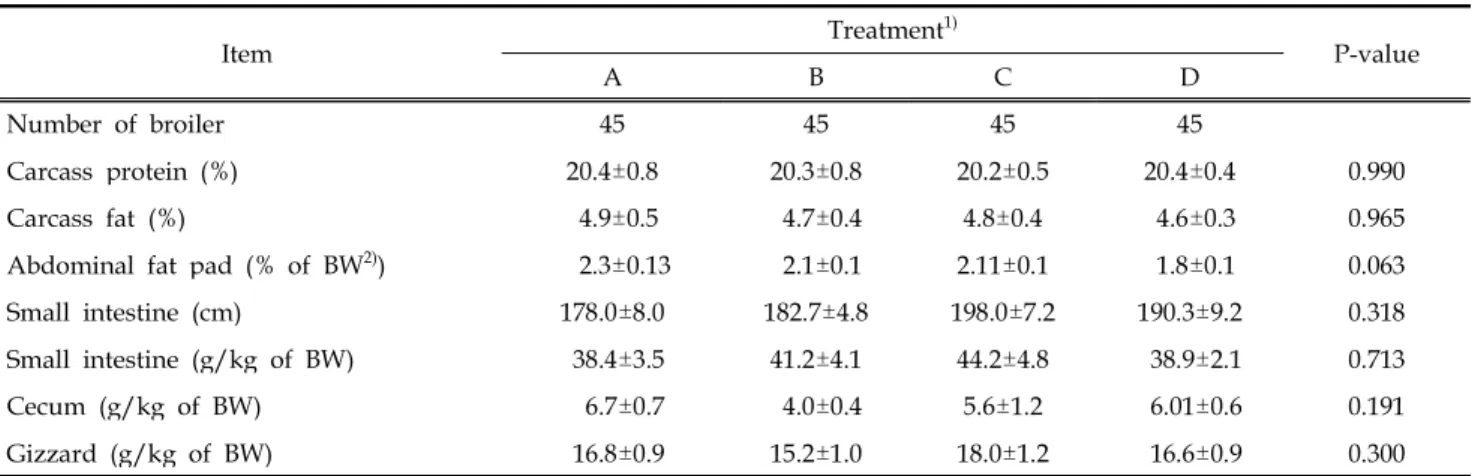
The carcass composition, weight of internal organs and abdominal fat pad of broiler are shown in Table 3.
There were no differences in the protein and fat contents of carcass among the treatments. The effect of π-ray level on the abdominal fat pad was not significant; however, that was numerically low in the D compared to the other treatments.
The length and weight of small intestine were slightly higher in the π-ray treatments than in control; however, there was no consistent tendency or statistical significance based on π-ray level. The dietary level of π-ray did not affect cecum and gizzard weights in broiler.
In general, the length and weight of the small intestine
[Provider:earticle] Download by IP 118.70.52.165 at Monday, December 20, 2021 7:46 PM
www.earticle.net
have a high correlation with the feed passing rate of the small intestine. Because of microbial community residing in the small intestine, the longer the length of the small intestine, the higher the digestibility (de Vries et al., 2012). In addition, Son (2002) reported that the number of anaerobic bacteria increased as the length of the cecum increased.
In the present study, the length and weight of small intestine were considered to be slightly advantageous in π-ray treatments than that of the control. On the other hand, there were no overall effects of the π-ray treatment on carcass composition, abdominal fat pad, cecum and gizzard weights of broiler in the present study. Therefore, we considered that the dietary π-ray level did not affect carcass composition and internal organ development in broiler.
3. Sensory evaluation and blood circulation in capillary
Effect of π-ray treated feed on sensory evaluation of cooked breast meat of broiler are shown in Table 4.
Stickiness of cooked breast meat was higher in π-ray treatments than in control (p<0.01). In addition, flavor of cooked breast meat was increased by the dietary π-ray treatment (p<0.01), and that was higher in the order of D, C, B, and A.
In the present study, there were positive effects of the dietary π-ray treatment on stickiness and flavor of cooked breast meat in broiler. This result was probably due to the influence of functional effects (increased physiological activity, strengthened immune function, etc.) of π-ray as bio-energy (Park, 2004; Jung, 2001).
However, it is necessary to study the additional cause for the present results under the same condition.
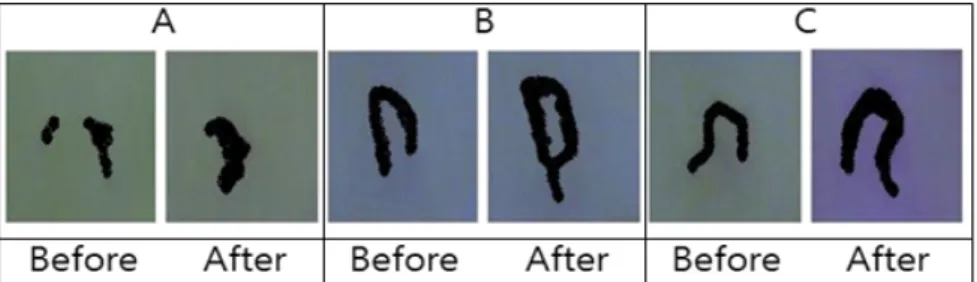
Changes on blood circulation in human capillary of according to consumption of π-ray treated broiler breast meat of broiler is shown in Fig. 1.
Table 3. Effect of π-ray treated feeds on carcass composition, abdominal fat pad, weight of internal organs of broiler
Item Treatment1)
P-value
A B C D
Number of broiler 45 45 45 45
Carcass protein (%) 20.4±0.8 20.3±0.8 20.2±0.5 20.4±0.4 0.990
Carcass fat (%) 4.9±0.5 4.7±0.4 4.8±0.4 4.6±0.3 0.965
Abdominal fat pad (% of BW2)) 2.3±0.13 2.1±0.1 2.11±0.1 1.8±0.1 0.063
Small intestine (cm) 178.0±8.0 182.7±4.8 198.0±7.2 190.3±9.2 0.318
Small intestine (g/kg of BW) 38.4±3.5 41.2±4.1 44.2±4.8 38.9±2.1 0.713
Cecum (g/kg of BW) 6.7±0.7 4.0±0.4 5.6±1.2 6.01±0.6 0.191
Gizzard (g/kg of BW) 16.8±0.9 15.2±1.0 18.0±1.2 16.6±0.9 0.300
1)A, supplementation percent of π-ray treated feed was 0% (control); B, supplementation percent of π-ray treated feed was 1%; C, supplementation percent of π-ray treated feed was 3%; D, supplementation percent of π-ray treated feed was 5%.
2)BW: body weight.
Table 4. Effect of π-ray treated feed on sensory evaluation of cooked breast meat of broiler
Item Treatment1)
P-value
A B C D
Stickiness 2.25±0.25b 4.25±0.16a 4.50±0.19a 4.38±0.18a 0.001
Flavor 2.44±0.18b 4.25±0.19a 4.31±0.21a 4.38±0.18a 0.001
1)A, supplementation percent of π-ray treated feed was 0% (control); B, supplementation percent of π-ray treated feed was 1%; C, supplementation percent of π-ray treated feed was 3%; D, supplementation percent of π-ray treated feed was 5%.
a,bMean values followed by different letters in the same row are significantly different (p<0.05).
[Provider:earticle] Download by IP 118.70.52.165 at Monday, December 20, 2021 7:46 PM
www.earticle.net
Fig. 1. Changes on blood circulation in human capillary of according to consumption of π-ray treated broiler breast meat of broiler.
Before eating π-ray treated breast meat, the size of capillary was small and the circulation speed was slow, but the size of capillary was increased and the circulation speed became faster 10 minutes after eating π-ray treated breast meat. It is thought that rotating elective magnetic wave of π-ray increases the blood circulation and speeds up metabolism. Jung (2001) reported that when exposed to π-ray, molecules flowing in the capillary of the human body absorb π-ray and make crystals, stimulating the autonomic nerves, and positively affecting blood circulation, which is in agreeance with our results.
Thus, the finding of this study indicate that dietary π-ray treatment have a positive effect on sensory evaluation (stickiness and flavor) and human blood circulation without any negative effect on body weight gain, feed intake and feed efficiency of broiler.
Ⅳ. REFERENCES
1. A.O.A.C. 2007. Official Method of Analysis. 18th ed.
Association of Official Analytical Chemists. Washington.
D.C., USA
2. Goh, Y. G. and Kim, B. W. 1999. Effect of the biological energy projection material(Penac) supplementation on egg production and ammonia concentration in feces of brown layers. Kor. J. Rural. Dev. 3:133.
3. Jung, J. H. 2001. A Study on the Clinical Treatment of Cancer Based on π-ray Science. M.S. thesis, AJou University, Suwon, Korea
4. Kim, K. H., Lee, Y. S., Yun, Y. U., Park, Y. H., Cho,
M. H., Jung, Y. C., Hong, C. M., Jang, D. D. and Moon, J. S. 1995. Effects of the biological energy projector on cancer and immunity. Kor. J. Lab. Anim.
Science 2:193.
5. Minitab. 2005. Minitab release 1.4. Korea Minitab co.
6. Oh, H. K. 2001. Science of rotating electromagnetic wave (π-ray) and explosive findings of new technologies.
Ajou University press, Suwon, Korea., pp. 94.
7. Park, S. 2004. A Study of Industrial Application to Measurement Technique of Rotating Electro Magnetic Waves. M. S. thesis, AJou University, Suwon, Korea 8. Son, J. H. 2002. A study on the correlation of cecal
anaerobic bacterial counts with cecal length in growing chicks. Korean J. Poult. Sci. 29:255
9. Son, J. H. and Park, C. I. 1997. Effects of dietary quartz porphyry supplementation on moisture content of excreta, intestinal ammonia contents and blood composition of growing broilers. Korean J.
Poult. Sci. 24(4):179-184.
10. Mumpton, F. A. and Fishman, P. H. 1977. The application of natural zeolites in animal science and aquaculture. J. Anim. Sci. 45:1188-1203.
11. Mokyashinchi. 2001. The water of life π (pi) water.
Kookil Media, Seoul, Korea.
12. De Vries, S., Pustjens, A. M., Kabel, M. A., Kwakkel, R. P. and Gerrits, W. J. J. 2014. Effects of processing technologies and pectolytic enzymes on degradability of nonstarch polysaccharides from rapeseed meal in broilers. Poult. Sci. 93(3):589-598.
(Received 22 June 2020, Revised 10 September 2020, Accepted 22 September 2020)
[Provider:earticle] Download by IP 118.70.52.165 at Monday, December 20, 2021 7:46 PM