This is an Open-Access article distributed under the terms of the Creative Commons Attribution Non-Commercial License(http://creativecommons.org/licenses/by-nc/3.0) which permits unrestricted non-commercial use, distribution, and reproduction in any medium, provided the original work is properly cited.
클래드강 적용을 위한 선급용 강재의 열처리 특성 평가
신 용 택*,†
*동아대학교 공과대학 조선해양플랜트공학과
Clad Steel for Application of Hull Structure
Yong-Taek Shin*,†
*Dept. of Naval Architecture and Offshore Engineering, Dong-A University, Busan 656-710, Korea
†Corresponding author : [email protected]
(Received October 13, 2015; Revised October 20, 2015 ; Accepted October 22, 2015)
Abstract
Clad steel has good corrosion resistance and mechanical properties arising from the hot rolling of dissimilar metals, such as carbon steel and stainless steel. However both good corrosion resistance from the cladding plate material(stainless steel) and mechanical properties from the base plate material (carbon steel) are difficult to obtain because the different steels display opposite behaviors during the cladding process. In order to make clad steel for application in the hulls of ships, proper materials selection and heat-treatment conditions are necessary. In this study, mechanical properties of base plate materials with different chemical composition were evaluated according to heat condition of cladding plate material.
Key Words : Clad steel, Base plate materials, Super duplex stainless steel
ISSN 1225-6153 Online ISSN 2287-8955
(a) FPSO side shell plate
(b) Chemical tanker, inner plate of tank
Fig. 1 Applicable area of clad steel
1. 서 론
최근 오일가스산업은 정책과 환경 문제로 인하여 많 은 제한을 받고 있으며, 이로 인하여 많은 오일가스관 련 해양설비들은 극지 및 심해로 이동을 하고 있다. 뿐 만 아니라, 지구 온난화로 인하여 극지 개발에 대한 기 대치가 높아지고 있으며, 일환으로 극지용 부유식 해양 생산설비(FPSO)의 건조도 거론이 되고 있는 실정이 다. 극지에서는 많은 유빙이 존재하고, 이들 유빙은 선 박이나 해양구조물의 선체 손상을 유발할 가능성이 높 다. 일반적으로 FPSO, 플랫폼, 잭업 리그 등은 한번 설치가 되면 30년 이상 운영이 되어야 하고, 또한 보수 할 수 있는 여건이 제한적임에 따라 FPSO 선체 외판 등은 부식 및 유빙의 손상에서 가능한 자유롭게 설계가 이루어져야 한다. 또한, 화학운반선의 화물창은 이상 스테인리스강(Duplex Stainless Stee, DSS)를 적용 하는 경우가 많다. 이 경우, 이상 스테인리스강을 클래 드강으로 변경하면 강재 가격의 절감에 따른 경쟁력 상 승을 기대해 볼 수 있다.
이런 문제로 인하여 Fig. 1과 같이 실제 산업체에서 는 FPSO의 선체 외벽 및 화학운반선의 화물창을 클래
특 집 논 문
대한용접․접합학회지 제33권 제5호, 2015년 10월 405
Fig. 4 Schematic potential issue at fabrication stage Fig. 6 Time–temperature-transformation diagram for secondary
phase formation in duplex stainless steel12)
Fig. 5 Schematic process of roll cladding process Fig. 2 Applied area of JSL310Mo stainless clad steel for
the new icebreaker ‘SHIRASE’
Fig. 3 Clad steel plates
드강으로 적용해 볼 필요가 있다. 일본에서는 쇄빙선인 시라세(Shirase) 선박
1)에 대해 선체 외판 재료로 스테 인리스 클래드강을 적용하여 운항하고 있다.(Fig. 2)
클래드강은 Fig. 3과 같이 두 종류의 재질로 이루어 진다.
2)베이스재인 탄소강은 강도소재로서의 역할을 수 행하고, 클래드재인 스테인리스강은 부식을 방지하기 위한 용도로 적용을 한다. 이런 클래드강은 압연을 통 하여 제조하거나, 또는 용접(스트립 오버레이 용접
3)또 는 폭발용접)을 통하여 제조하게 된다. 그러나, 압연을 통한 방법은 용접대비 원가 및 생산성 향상을 기대할 수 있으므로 원가경쟁력측면뿐만 아니라 품질 측면에서 도 유리한 입장이 있다. 또한, Fig. 4와 같이 건조단계 에서 용접작업에 의하여 베이스재와 클래드재 사이에 갭이 발생되고, 이는 운항중의 피로문제가 대두될 소지 가 충분하다. 이런 문제는 해결하는데 많은 노력과 시 간이 필요하고, 불행하게도 해결이 되지 않는 경우도 많 이 있다. 따라서, 선체 외판에 적용을 위해서는 압연 공
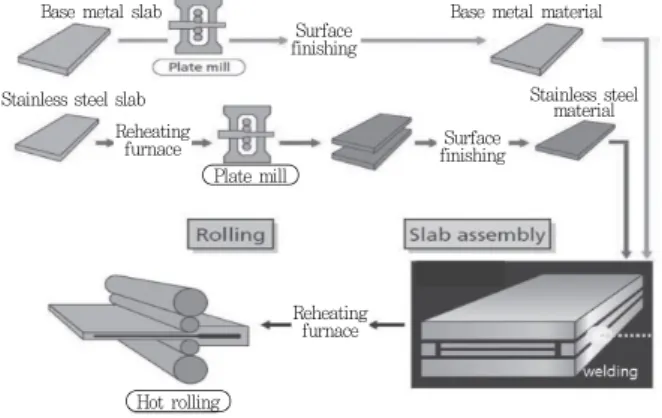
정에 의한 클래드강 제조가 유리하다고 볼 수 있다. 클래 드강 압연은 Fig. 5와 같은 제조공정을 통상 따른다. 이 경우 베이스재인 탄소강은 클래드재의 종류에 의거한 열 처리 조건에 충분히 견딜 수 있는 물성을 확보해야 한 다. 일반적으로 클래드재로 스테인리스강을 사용하는 경 우, 유해한 2차상의 생성을 억제하여 내식성을 확보하기 위하여 Fig. 6에서 보는 바와 같이 1000 °C 이상에서 열처리를 수행해야 한다.
4,5)시그마상, 카이상 및 크롬질화 물과 같은 2차상 주위에 크롬 결핍현상을 발생시키며 이러 한 현상은 내식성을 저하하기 때문이다.
6,7,8)이 경우, 베이 스재인 탄소강은 1000 °C 이상의 고온 열처리로 인하여 결 정립 성장이 발생하게 되고, 이로 인하여 강도 및 인성을 충분히 확보하기 곤란해진다. 즉, 베이스재와 클래드재의 제조 공정이 상호간에 악영향을 미치는 경우가 발생된다.
이에 본 연구에서는 극지용 FPSO의 선체 외판 및 화학 운반선의 화물창에 클래드강(탄소강+슈퍼듀플렉 스강)을 적용하는 것으로 가정하여, 클래드재인 슈퍼듀 플렉스(SDSS)의 열처리 조건을 충분히 견딜 수 있는 베이스재(탄소강)의 적용 가능성을 검토하였다. 즉, 베 이스재인 선급강에 대하여 클래드재의 열처리 조건을 충분히 감안하고, 탄소강의 제조 공정을 고려하여 충분 한 강도와 인성을 확보할 수 있는지를 사전 검토하였다.
Clad plate material
Base Plate material
Clad plate material
Base Plate material
Welding deformation
Welding
Base metal slab
Stainless steel slab Reheating
furnace
Surface finishing
Surface finishing
Base metal material
Stainless steel material
Plate mill
Hot rolling
Reheating furnace
1000
300
Time
Mo, W, SiCr, Mo, Cu, W
Cr, Mo, Cu, W
M7C3 carbide, CrN nitride HAZ Cr
Mo W Si
σphase Cr2N nitride χphase
γphase R phase M23C6 carbide
πphase εphase α' phase
G phase
Material Chemical compositions (wt% max) Mechanical properties
C Si Mn P S YP(MPa) TS(MPa) El(%) IE(J)
EH 40 0.18 0.10-0.50 0.09-1.60 0.025 0.025 390 510-650 20 34
(1)Notes (1) for thickness ≤ 50 mm
Table 2 Chemical compositions and mechanical properties of EH 40
Material S32750 S31254
Min. solution annealing
temperature (°C) 1025 1150
Table 1 Minimum solution annealing temperature to resolve
secondary phasesMaterial C Si Mn P S Cr Ni Cu Al Ti Nb V
Steel A 0.07 0.19 1.52 0.006 0.002 0.17 0.22 0.11 0.029 0.015 0.025 <0.001
Steel B 0.06 0.17 1.90 0.006 0.001 0.18 0.34 0.34 0.021 0.010 0.028 <0.001
Table 3 Chemical compositions of Steel A and B
2. 시험 방법
2.1 사용재료 및 열처리 조건
본 연구에서 고려한 클래드강은 탄소강과 슈퍼듀플렉 스강의 조합이다. 슈퍼듀플렉스로 선정한 이유는 일반 듀플렉스강의 내식성 대비 보수성과 안전성을 고려할 수 있고, 또한 ASTM A312/A312M
9)& A790/790M
10)의 규격인 Table 1에서 보는 바와 같이 동등 내식성을 가진 S31254 대비 어닐링 온도가 낮기 때문에 베이스 재의 물성을 확보하는 데 다소 유리하다고 판단하였기 때문이다.
또한, 선체 외판 재질로 EH40을 적용하는 것으로 목표를 수립하였다. 따라서, 슈퍼 듀플렉스의 고온 열 처리 조건(Table 1)을 고려하여 EH40의 물성(Table 2)
11)을 확보할 가능성이 있는 조선용 강재를 2종 선정 하였고, Table 3에 사용한 강재의 화학성분을 나타내 었다. A 강재인 경우, 고온에서의 결정립 성장을 억제 할 수 있는 성분을 보유한 강재이고, B 강재는 선급용 고강도 강재이다. 열처리 조건은 Table 4에 보여주는 바와 같이 클래드재인 슈퍼듀플렉스의 열처리 요구 조 건을 고려하여 3종의 열처리 조건을 선정하였고, 이어 서 오일 퀜칭을 수행하였다. 강재의 물성을 확보하기 위한 템퍼링 열처리를 580°C에서 2시간 수행하는 것 으로 하였다. 템퍼링 열처리 조건은 클래드재에 2차상 이 발생될 수 있는 온도범위를 고려하여 선정하였다.
2.2 시험 조건
본 연구에서는 EH40의 물성 확보 가능성을 검토하
기 위하여 ASTM E8M 및 E23에 의거하여 인장 및 충격시험을 수행하였다. 인장시험은 12.5mm 지름과 50 mm 게이지 길이를 가진 원형 인장시험편을 사용하 였고, 충격시험은 사르피 V-노치 시험편을 사용하였다.
또한 열처리 조건에 따른 미세조직 관찰을 수행하였고, 이때 사용한 부식액은 5% nital solution(5ml Nitric Acid + 95ml Methanol)을 사용하였다
3. 시험결과 및 고찰 3.1 인장 및 충격시험 결과
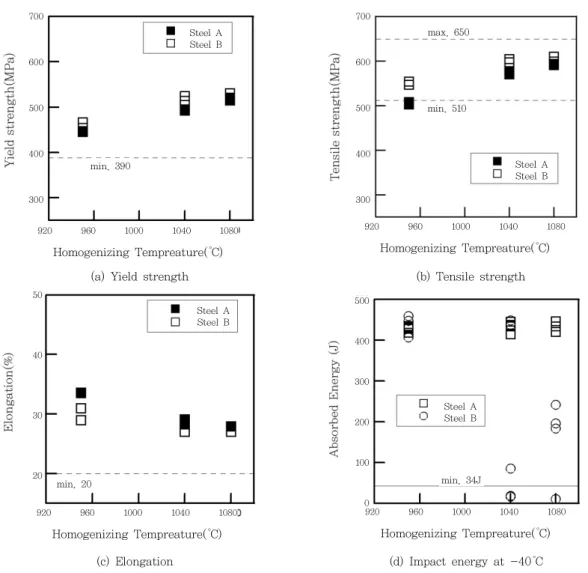
열처리 조건에 따른 인장 및 충격시험 결과를 Fig.
7에 나타내었다. A, B 강재 모두 항목 및 연신율은 EH40 규격을 모두 만족하는 결과를 보였으나, 인장 강도인 경우, A 강재의 값이 960°C 열처리 조건에서 규격 하한값에 근접한 결과를 보였다. 영하 40°C에서 시험한 충격 인성 결과는 다소 큰 차이를 보이고 있다.
A 강재인 경우, 3종의 열처리 조건에서 모두 양호한 결 과를 보여준 반면, 강재 B인 경우 클래드재의 최소열조 리 규격인 1040°C, 1080°C 열처리 온도에서 일부 규 격을 만족시키지 못하는 결과를 보였다. 따라서, A 강 재인 경우, 클래드강의 베이스재로 조선용 EH40 규격 을 만족할 수 있는 가능성을 가지고 있음을 확인하였다.
3.2 미세조직 관찰
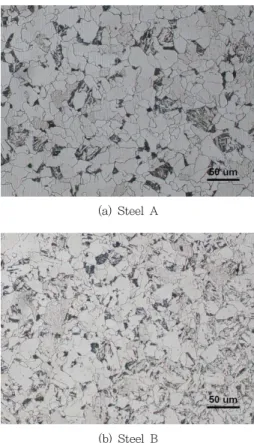
열처리를 수행한 A 강재의 미세조직을 Fig. 8에 나 타내었다. 1080°C에서 열처리한 시험편은 베이나이트 조직이 강한 경향을 보이고 있으나, 온도가 낮아짐에 따라 침상 페라이트 및 베이나이트 혼재 조직의 경향을 보이고 있다. 또한, 1040°C에서 열처리한 A 및 B 강 재의 조직사진을 Fig. 9에 나타내었는데, B 강재가 A 강재보다 베이나이트가 우세하고, 오스테나이트 결정립 크기가 상대적으로 크게 형성되어 있다.
이는 Fig. 10에서 보는 바와 같이 동일 열처리 온도
대한용접․접합학회지 제33권 제5호, 2015년 10월 407
Homogenization Tempering
Hold temp.
(°C)
Hold time (h)
Cooling method
Hold temp.
(°C)
Holding time (h)
Cooling method
1080 1 Oil 580 2 Air
1040 1 Oil 580 2 Air
950 1 Oil 580 2 Air
Table 4 Heat-treatment conditions (QT)
(a) 1080゚C
(b) 1040゚C
(c) 1080゚C
Fig. 8 Microstructure of steel-A quenched at different temperature and tempered at 580°C
(a) Yield strength (b) Tensile strength
(c) Elongation (d) Impact energy at -40゚C
Fig. 7 Mechanical properties of base plate material after heat-treatment at different conditions
에서 수행한 노말라이징 온도후의 조직사진을 보면 분명 히 알 수 있다. A 강재인 경우, 페라이트와 펄라이트 조 직을 보이고 있으며, 결정립 크기 및 형상 또한 균질한 경향을 보이고 있다. 그러나 B 강재인 경우, 조직이 불 균질하고 조대하며, 페라이트, 펄라이트 및 베이나이트가 혼재된 조직을 보이고 있다. 이는, 결정립 미세화 원소의 영향으로 A 강재에서 B 강재 대비 결정립 미세화에 다 소 유리했던 것으로 판단된다
13~16). 뿐만 아니라, B 강
700
600
500
400
300
920 960 1000 1040 1080
Homogenizing Tempreature(゚C)
Steel A Steel B700
600
500
400
300
920 960 1000 1040 1080
Homogenizing Tempreature(゚C)
50
40
30
20
920 960 1000 1040 1080
Homogenizing Tempreature(゚C)
500
400
300
200
100
0
920 960 1000 1040 1080
Homogenizing Tempreature(゚C)
Steel A Steel BSteel A Steel B Steel A
Steel B min. 390
max. 650
min. 510
min. 20 min. 34J
(a) Steel A
(b) Steel B
Fig. 9 Microstructure of base plate material quenched
at 1040°C and tempered at 580°C(a) Steel A
(b) Steel B
Fig. 10 Microstructure of Steel A and B normalized
at 1040°C재인 경우 고강도 및 고인성 특성을 위하여 Ni, Mn, Cu성분이 A강재에 비하여 많이 첨가되어 있고, 특히, Cu 인 경우 HSLA강에 있어 500~600°C로 템퍼링하 는 경우, 다량의 Cu 석출물로 인하여 강도는 상승하나, 인성이 저하된다고 보고되고 있다.
17,18)본 실험 결과에서 도 결정립 미세화 원소 및 Cu등의 효과로 인하여 A강재 가 B 강재 대비 우세한 인성을 확보한 것으로 판단된다.
4. 결 론
본 연구에서는 극지용 FPSO의 선체외판 및 화학운 반선의 화물창에 대하여 클래드강을 적용하는 것으로 가정하여, 클래드재인 슈퍼듀플렉스(SDSS)의 열처리 조건을 충분히 견딜 수 있는 베이스재(탄소강)의 개발 가능성을 검토하였다. 산업체에서 사용중인 선급용 강 재를 대상으로 열처리 조건에 따른 인장, 충격 및 조직 관찰을 수행하였으며, 인장시험 결과, 선급규격을 만족 하는 강도를 확보할 수 있음을 확인하였다. 또한, 충격 시험 결과, 결정립 미세화 원소를 확보한 강재를 사용 한다면, 충격인성도 확보 가능함을 확인하였다. 본 시 험 결과로 볼 때, 조선해양산업에서의 클래드강 적용도 충분히 고려해 볼 수 있다고 판단된다.
References
1. JFE steel, Corrosion Resistant Clad Steels, Technical
Report 20 (2015)
2. DNV, Classification of SHIPs/High Speed, Light Craft and Naval Surface Craft, Materials and Welding, Pt. 2, Cpt. 3, Sec.3 (2007)
3. I.C. Jung, D.N. Shim, J. G. Byun, Overlay welding of incone material for nuclear power components, J. of
KWJS, 27 (2) (2009),4-6 (in Korean)
4. Pohl, M., Storz, O., & Glogowski, T., Effect of inter- metallic precipitations on the properties of duplex stain- less steel. Materials Characterization, 58 (1) (2007), 65-71.
5. Ramirez, a J., 2003. The Relationship between Chromium Nitride and Secondary Austenite Precipitation in Duplex Stainless Steels. Metallurgical and Materials
Transactions A, 34A (2003), 1575-1597
6. Cvijović, Z., & Radenković, G. , Microstructure and pit- ting corrosion resistance of annealed duplex stainless steel. Corrosion Science, 48 (12) (2006), 3887-3906 7. Lopez, N. Cid, M. Puiggali, M., Influence of sig-
ma-phase on mechanical properties and corrosion re- sistance of duplex stainless. Corrosion Science, 41 (1999), 504-520.
8. Tan, H., Jiang, Y., Deng, B., Sun, T., Xu, J., & Li, J., Effect of annealing temperature on the pitting corrosion
대한용접․접합학회지 제33권 제5호, 2015년 10월 409 resistance of super duplex stainless steel UNS S32750.
Materials Characterization, 60(9)(2009), 1049-1054
9. ASTM A312/312M-01a, Standard specification forSeamless, Welded and Heavily Cold Worked Asutenitic Stainless Steel Pipes. ASTM International.
10. ASTM A790/A790M-05a, Standard Specificaiton for Seamless and Welded Ferritic/Austenitic Stainless Steel Pipes. ASTM International
11. ABS rules for Material and Welding 2005, Pt. 2,
American Bureau of Shipping
12. Charles, J.H., The duplex stainless steels: materials to meet your needs. Proceedings of the Conference
'Duplex stainless steel '91', Beaune. France. 1 (1991),
3-4813. J.O. Moon,C.H.Lee, Precipitation and Precipitate Coarsening Behavior According to Nb Addition in the Weld HAZ of a Ti-containing Steel, J. of KWJS, 26 (1) (2008), 76-82 (in Korean)
14. G. R. Wang, T. W. Lau, G. C. Weatherly, T. H. North, Weld thermal cycle and precipitation effects in
Ti-V-containing HSLA steels, Metall. Trans. A20 (1989), 2093-2100
15. J. Fermandez, S. Illnescas, J.M.Guilemany, Effect of microalloying elements on the austenitic grain growth in a low carbon HSLA steel, Materials Letters, 61 (2007), 2389-2392
16. S.J. Lee, Y.K. Lee, Prediction of austenite grain growth during austenitization of low alloy steels, Materials
and Design, 29 (2008), 1840-1844
17. G.C.Hwang, S.H.Lee, J.Y.Yoo,W.Y.Choo, Effect of di- rect quenching on microstructure and mechanical prop- erties of copper-bearing high-strength alloy steels,
Materials Science and Engineering A, 252 (1998),
256-26818. S.K.Dhua, A.Ray, D.S.Sarma, Effect of tempering tem- perature on the mechanical properties and micro- structure of HSLA-100 type copper-bearing steels,
Materials Science and Engineering A, 318 (2001),
197-210∙신용택
∙1968년생
∙동아대학교 조선해양플랜트공학과
∙용접 강도 및 야금
∙e-mail: [email protected]