CEP
Vol. 63, No. 11, 438–446, 2020 https://doi.org/10.3345/cep.2020.00640Original article
Background: Most developmental screening tools in Korea are adopted from foreign tests. To ensure efficient screening of infants and children in Korea, a nationwide screening tool with high reliability and validity is needed.
Purpose: This study aimed to independently develop, stan
dardize, and validate the Korean Developmental Screening Test for Infants and Children (KDST) for screening infants and children for neurodevelopmental disorders in Korea.
Methods: The standardization and validation conducted in 2012–2014 of 3,284 subjects (4–71 months of age) resulted in the first edition of the KDST. The restandardization and revalidation performed in 2015–2016 of 3.06 million atten
dees of the National Health Screening Program for Infants and Children resulted in the revised KDST. We analyzed interitem consistency and testretest reliability for the reliability analysis.
Regarding the validation of KDST, we examined the construct validity, sensitivity and specificity, receiver operating charac
teristic curve analysis, and a criterionrelated validity analysis.
Results: We ultimately selected 8 questions in 6 developmental domains. For most age groups and each domain, internal con
sistency was 0.73–0.93 and testretest reliability was 0.77–
0.88. The revised KDST had high discriminatory ability with a sensitivity of 0.833 and specificity of 0.979. The test sup
ported construct validity by distinguishing between normal and neurodevelopmentally delayed groups. The language and cognition domain of the revised KDST was highly correlated with the KBayley Scales of Infant DevelopmentII’s Mental Age Quotient (r=0.766, 0.739), while the gross and fine motor
domains were highly correlated with Motor Age Quotient (r=
0.695, 0.668), respectively. The Verbal Intelligence Quotient of Korean Wechsler Preschool and Pri mary Scales of Intelligence was highly correlated with the KDST cognition and language domains (r=0.701, 0.770), as was the performance intelligence quotient with the fine motor domain (r=0.700).
Conclusion: The KDST is reliable and valid, suggesting its good potential as an effective screening tool for infants and children with neurodevelopmental disorders in Korea.
Key words: Developmental screening test, Infant and child, Korean Developmental Screening Test for Infants and Children, Standardization, Validation
Key message
Question: Can the Korean Developmental Screening Test for Infants and Children (KDST) be a useful screening tool for infants and children in Korea?
Finding: The KDST has high reliability (internal consistency of 0.73–0.93, testretest reliability of 0.77–0.88) and a high discriminatory ability with a sensitivity of 0.833 and specificity of 0.979.
Meaning: The KDST is an effective and reliable screening tool for infants and children with neurodevelopmental disorders in Korea.
Corresponding author: Baik-Lin Eun, MD, PhD. Department of Pediatrics, Korea University Guro Hospital, 148 Gurodong-ro, Guro-gu, Seoul 08308, Korea E-mail: [email protected], https://orcid.org/0000-0001-8735-292X
Received: 12 April, 2020, Accepted: 7 May, 2020
This is an open-access article distributed under the terms of the Creative Commons Attribution Non-Commercial License (http://creativecommons.org/licenses/by-
Development of the Korean Developmental Screening Test for Infants and Children (K-DST)
Hee Jung Chung, MD, PhD1, Donghwa Yang, MD2, Gun-Ha Kim, MD, PhD3, Sung Koo Kim, MD, PhD4, Seoung Woo Kim, MD, PhD5, Young Key Kim, MD6, Young Ah Kim, PhD7, Joon Sik Kim, MD, PhD8, Jin Kyung Kim, MD, PhD9, Cheongtag Kim, PhD10, In-Kyung Sung, MD11, Son Moon Shin, MD, PhD12, Kyung Ja Oh, PhD13, Hee-Jeong Yoo, MD, PhD14, Hee Joon Yu, MD, PhD4, Seoung-Joon Lim, MD15, Jeehun Lee, MD, PhD16, Hae-Ik Jeong, MD15, Jieun Choi, MD, PhD17, Jeong-Yi Kwon, MD, PhD18, Baik-Lin Eun, MD, PhD3
1Department of Pediatrics, National Health Insurance Service Ilsan Hospital, Goyang, Korea; 2Department of Pediatrics, Severance Children’s Hospital, Yonsei University College of Medicine, Seoul, Korea; 3Department of Pediatrics, Korea University College of Medicine, Seoul, Korea; 4Department of Pediatrics, Dongtan Sacred Heart Hospital, Hallym University College of Medicine, Hwasung, Korea; 5Department of Rehabilitation Medicine, National Health Insurance Service Ilsan Hospital, Goyang, Korea; 6Department of Psychiatry, National Health Insurance Service Ilsan Hospital, Goyang, Korea; 7Yonsei University Human Behavior Research Institute, and HUNO, Seoul, Korea; 8Department of Pediatrics, Keimyung University School of Medicine, Daegu, Korea; 9Department of Pediatrics, Catholic University of Daegu School of Medicine, Daegu, Korea; 10Department of Psychology, Seoul National University, Seoul, Korea; 11Department of Pediatrics, Catholic University College of Medicine, Seoul, Korea; 12Department of Pediatrics, Inje University Busan Paik Hospital, Inje University College of Medicine, Busan, Korea; 13Department of Psychology, Yonsei University, Seoul, Korea; 14Department of Psychiatry, Seoul National University Bundang Hospital, Seoul National University College of Medicine, Seongnam, Korea; 15Korean Pediatric Association, Seoul, Korea; 16Department of Pediatrics, Samsung Medical Center, Sungkyunkwan University School of Medicine, Seoul, Korea; 17Department of Pediatrics, Seoul Metropolitan Government - Seoul National University Boramae Medical Center, Seoul, Korea; 18Department of Physical and Rehabilitation Medicine, Samsung Medical Center, Sungkyunkwan University School of Medicine, Seoul, Korea
Introduction
The assessment of growth and development is essential for growing children. Particularly, infants and children are the most important periods for development, and developmental evalua
tion during this period may reduce the chances of future disor
ders and prevent secondary sequelae. The most common clini
cal symptom of neurodevelopmental disorders is the lack of developmental skills consistent with their age. Therefore, if early screening of infants and children who may have future develop
mental problems is possible through assessment, then a more accurate assessment should be conducted to plan for appro priate treatments and rehabilitation.
National Health Screening Program for Infants and Children (NHSPIC) has been rolled out nationwide since November 2007 to keep track of the growth and development of infants and children and to provide proper education programs to care givers, with the introduction of a health checkup program suitable for the age of infants and children. NHSPIC is conducted for the first to seventh rounds as protocols divided by the scope of questionnaire and physical examination, physical measurements, development evaluation and consultation, health education, and oral examination. Among these, the develop mental evaluation is the major screening item of NHSPIC, with the first 9–12 months, the second in 18–24 months, the third in 30–36 months, the fourth in 42–48 months, the fifth in 54–60 months, and the sixth in 66–71 months of age, all but 4–6 months, the first NHSPIC period.1)
The developmental screening tools used in the NHSPIC should be able to comprehensively assess the developmental domains to sensitively identify children at risk of suffering from neurodevelopmental disorders. As part of the NHSPIC project, Korean Developmental Screening Test for Infants and Children (KDST) is a new developmental screening tool tailored as per the characteristics of the Korean children.24) It was developed by experts in related fields including the ‘The Korean Pediatric Society,’ ‘Korean Society of Pediatric Rehabilitation and De
velopmental Medicine,’ ‘Korean Academy of Child and Adole
scent Psychiatry,’ and ‘Korean Psychological Association.’ For preschool children under 6 years of age (4–71 months), KDST is a parentreported screening test that allows parents to directly monitor the development of their children, taking less time and is able to quickly and effectively identify any developmental delays in primary care institutions. The tool was developed to allow the use of not only printed test sheets but also online test to in crease the accessibility to examinees. This study reviewed the de velop ment of KDST and evaluated the standardization and valida tion of this tool to see how accurately it could identify the target at risk of neurodevelopmental disorders. Moreover, we investigated the reliability and validity of the revised KDST, which established new cutoff points by means of restandardi
zation in 2017 based on the 3.06 million cases accu mulated since the first edition of KDST was conducted in 2014. This study was conducted after obtaining approvals from the Insti
tutional Review Board of Korea University Guro Hospital (2013GR0048, 2016GR0083, 2017GR0223).
Methods
1. Study design
Following the earlier study in 2010, preliminary items were developed, and the standardization and validation of the test were conducted between 2012 and 2014 to test reliability. As a result, the first edition of KDST was developed. Since then, the restandardization and revalidation of the test were conducted in 2017 involving the 3.06 million infants and children who checked for NHSPIC from 2015 to 2016, and the revised K
DST was subsequently published.
2. Prior study
In the earlier study from August 2010 to April, the content composition, characteristics, and discrimination procedures of Korean and foreign development screening tools for infants and children were reviewed. From the expert meeting, the focused group interview, professional opinions on the assessment do
mains and questions were reviewed. Based on these data analyses, future test tools were proposed.
3. Standardization and validation of K-DST 1) Preliminary items
The preliminary items were developed for infants and child
ren between 4 months and 83 months of age. NHSPIC was conducted for children between 4 months and 71 months of age.
However, groups that extended from 4 months to 83 months of age were selected considering factors such as maximizing the utilization of tools and statistical accuracy as well as further study expansion. The subdomain of the examination consisted of a total of 6 developmental domains, including the gross motor, fine motor, cognition, language, social skills, and selfhelp, based on the review of the results of the prior studies.
The test was conducted in the form of a parent report and scored on a 4point scale. Data were collected through the distribution of test papers to the child's parents at either the hospitals or daycare centers. Eventually, 876 cases were record
ed, and they filled a questionnaire. On the 4point scale of the collected data, the 'always possible' was 1 and the rest was con
verted to zero and then a 2parameter item response theory (IRT) model was used to estimate the level of difficulty and the discrimination of question, and gauge the ability of each subject.5) After obtaining the function of the subject's age and ability by using the Gompertz function, we then used the item characteristic curve (ICC) in combination to search for the appropriate age group to distinguish each item well.6)
2) Standardization of KDST (1) Data collection
Two rounds of data collection were conducted from May
to October 2013. Based on the 2010 Population and Housing Census, stratification sampling was conducted according to age, geographical location, regional size, and gender. The population group was assigned to a distinct age range, and the data were collected with an aim of collecting a total of 3,100 valid samples.
The data collection process was aimed at recruiting a total of 1,500 cases by allocating the first large online panel based on region, academic background, and gender. After identifying the deficiencies based on the regional target samples based on the data collected from the first round, secondary data collection was conducted by determining the suitability of demographic information in a total of 40 hospitals and daycare centers countrywide. Finally, 8 questions for each domain were selected from the initial questions that consisted of a total of 10 questions through review and prior investigation. Additionally, the selfhelp domain had the characteristics of developing after acquiring a certain developmental skill, making it difficult to independently evaluate the domain of children under 18 months old. Therefore, the final structure of the examination was also finalized by deciding to measure the selfhelp domain after 18 months. The final questions selected included 57 items in the gross motor, 56 in the fine motor, 59 in the cognition, 53 in the language, 56 in the social skills, and 44 in the selfhelp domain.
(2) Data analysis
The reliability analysis of the test assessed the coefficient of internal consistency in the developmental domains with age and testretest reliability. Within each age group, the coefficient of internal consistency for each domain was calculated using Cronbach alpha, as an indicator of how consistent the multiple questions are in measuring construct concepts. Generally, this value is interpreted as having a acceptable reliability if it has a value of 0.7 or higher.7) For the testretest reliability, 300 child
ren were randomly selected from a population group and re
examined 2–4 weeks later. A total of 106 children completed the reexamination.
Item analysis was conducted through the IRT and the ICC, and investigation done on whether each question had a high discriminability for children of a particular age.5,6)
3) Validation of KDST
In regards to KDST validation, we conducted construct validity analysis, sensitivity and specificity analysis, receiver ope
rating characteristic (ROC) curve analysis, and criterionrelated validity analysis to determine whether KDST's items accurately reflect the main domains of development.
To verify the construct validity, confirmatory factor analy sis was conducted, where 8 questions were affected in 6 developmen tal domains for each age group.8) Cutoff points were calculated based on the score of the KDST population group. The cutoff points consist of scores corresponding to the 2 standard deviation (SD),
1 SD of the domain scores for each age group, and less than 2 SD correspond to ‘Recommendation for further evaluation, 2 SD and less than 1 SD correspond to ‘need for followup’.
To determine the sensitivity and specificity of KDST, 184 cases of subjects diagnosed with neurodevelopmental disorders and 206 cases in the control group were analyzed, according to the diagnosis by the doctors and the cutoff point of KDST.
Groups having scores below the cutoff point in one or more of the 6 domains of KDST were referred to as ‘clinical group,’
while those with points above the cutoff point were classified as
‘control group’ and were subsequently compared with clinical diagnosis. In addition, ROC curve analysis was performed in order to evaluate clinical discrimination as a screening measure of KDST.
In order to confirm the criterionrelated validity of the KDST, we examined the Korean Bayley Scales of Infant DevelopmentII (KBSID) for children aged between 4 and 42 months, and the Korean Wechsler Preschool and Primary Scales of Intelligence (KWPPSI) for children aged between 30 and 71 months.9,10) Finally, the correlation between the subscale values of each test and the total scores of each subdomain of KDST was analyzed.11)
4. Restandardization and revalidation of K-DST 1) Data collection
The restandardization and revalidation was conducted from September 2016 to September 2017 for more than 3.06 million infants and children who were involved in NHSPIC across the country from 2015. The control group for validation analysis administered all the KDST questionnaires according to age classified as normal in KDST in a total of 12 research hospitals.
Children over the age of 9 months and younger than 6 years undertook KBSIDII or KWPPSIR (or KWPPSIIV). The final number of people sampled was 235 for the control group and 413 for the clinical group.
2) Data analysis
Using data from more than 3.06 million subjects from the National Health Insurance Service, new cutoff points were deter mined after analyzing the average, median, standard devia
tion, maximum, minimum, and score distribution for subdo
main of each age group. During the 1sttest development, the sample size was smaller compared to 3.06 million cases and the distribution of the population was unidentified, thus, the normal distribution was assumed and the cutoff points using standard deviation were established. However, since largescale data was used for restandardization, the distribution of the population sample was assumed to be asymptotic and the cutoff points were set via percentile scores. Since this test was designed to discriminate infants and children with developmental delay, infants with normal development mostly had high test scores.
Therefore, the distribution of the test scores was a onesided distribution rather than a normal distribution, and when the cutoff point was established using standard deviation from the skewed distribution, the percentage of children from a particular section failed to match the percentage of normal distribution.
Therefore, using percentile scores seemed reasonable than arith metically using 2 SD and 1 SD. In regards to normal and
clinical groups, a validity analysis was performed via ROC curve analysis and investigated the changes in sensitivity, specificity, and accuracy using both the previous cutoff points and the new cutoff points. KDST scores were categorized into 2: control groups (1 SD or higher), and clinical groups (less than 2 SD) in order to analyze whether they are properly discriminated between normal and clinical groups. To analyze criterionrelated validity, we investigated the relevance of KBSIDII, KWPPSI test in comparison with the revised KDST.
Results
1. Standardization and validation of the first edition of K-DST 1) Basic statistical analysis
The number of population group was 3,284, the results based on age, region, regional size, and gender were presented in Supplementary Table 1. The distribution by region was con
sistent with the 2010 Population and Housing Census, with the highest rates being in the metropolitan area (n=1,022, 31.1%).
The distribution of the population groups was evenly distributed between 100–200 cases for each age group, with 1,602 cases being men (48.8%) and 1,682 cases (51.2%) being women (Sup
plementary Table 2). For each age group, the mean and standard deviation for each area of the examination paper were presented in Supplementary Table 3.
2) Reliability analysis
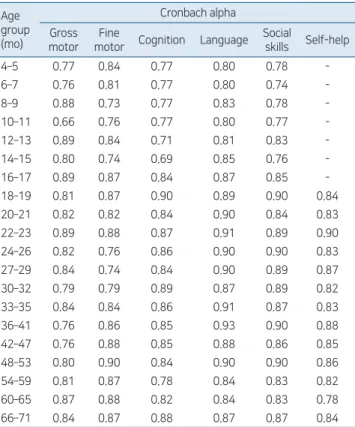
There were medium to high levels of internal consistency (0.71–0.93) within all age groups and subdevelopmental do
mains, except for the gross motor domain (10–11 months), which had a slightly lower internal consistency of about 0.66 (Table 1). The coefficients of testretest reliability were as high as 0.77–0.88 (0.86 for gross motor, 0.83 for fine motor, 0.86 for cognition, 0.88 for language, 0.83 for social skills, and 0.77 for selfhelp).
3) Item analysis
The discrimination ability and difficulty level were calculated using the IRT and are shown in Supplementary Table 4. As a result of the analysis, the discrimination ability for most of the questions was 2.3 or higher. The difficulty level of the question was observed to increase with an increase in the number of ques
tion, confirming that the difficulty level was fitting.
4) Validity analysis
Confirmatory factors analysis for determining the construct validity showed that the root mean square error approximation (RMSEA) value was within an acceptable range of 0.052–0.097 and the factor loading for each item was also estimated to be high (Table 2, Supplementary Table 5).
Regarding the sensitivity and specificity analysis, 10 of the 206 cases were classified as developmental abnormalities for children in the control group, and 163 of the 184 cases in the clinical group were classified as developmental abnormalities (sensitivity, 0.886; specificity, 0.951; accuracy, 0.921). The falsepositive value was 4.9%, and the falsenegative value was 11.4%.
As a result of ROC curve analysis, most of the domains were well classified and exhibited larger area under the curve (AUC) values (0.763–0.999). Cerebral palsy was screened by the gross and fine motor domains with high accuracy (AUC=0.971, 0.936), and developmental language disorder was screened by language and social domains with high accuracy (AUC=0.924, 0.957). Autism spectrum disorder was screened by the social Table 1. Internal consistency of developmental domains of the
K-DST 1st edition by monthly age group Age
group (mo)
Cronbach alpha Gross
motor Fine
motor Cognition Language Social
skills Self-help
4–5 0.77 0.84 0.77 0.80 0.78 -
6–7 0.76 0.81 0.77 0.80 0.74 -
8–9 0.88 0.73 0.77 0.83 0.78 -
10–11 0.66 0.76 0.77 0.80 0.77 -
12–13 0.89 0.84 0.71 0.81 0.83 -
14–15 0.80 0.74 0.69 0.85 0.76 -
16–17 0.89 0.87 0.84 0.87 0.85 -
18–19 0.81 0.87 0.90 0.89 0.90 0.84
20–21 0.82 0.82 0.84 0.90 0.84 0.83
22–23 0.89 0.88 0.87 0.91 0.89 0.90
24–26 0.82 0.76 0.86 0.90 0.90 0.83
27–29 0.84 0.74 0.84 0.90 0.89 0.87
30–32 0.79 0.79 0.89 0.87 0.89 0.82
33–35 0.84 0.84 0.86 0.91 0.87 0.83
36–41 0.76 0.86 0.85 0.93 0.90 0.88
42–47 0.76 0.88 0.85 0.88 0.86 0.85
48–53 0.80 0.90 0.84 0.90 0.90 0.86
54–59 0.81 0.87 0.78 0.84 0.83 0.82
60–65 0.87 0.88 0.82 0.84 0.83 0.78
66–71 0.84 0.87 0.88 0.87 0.87 0.84
K-DST, Korean Developmental Screening Test for Infants and Children.
Table 2. Result of model conformity of the K-DST 1st edition by monthly age group
Age group (mo)
Number CFI RMSEA Age group
(mo)
Number CFI RMSEA
4–5 121 0.646 0.097 24–26 142 0.733 0.075 6–7 121 0.661 0.089 27–29 142 0.776 0.065 8–9 120 0.696 0.090 30–32 137 0.700 0.082 10–11 143 0.671 0.080 33–35 131 0.792 0.063 12–13 145 0.687 0.088 36–41 195 0.846 0.059 14–15 127 0.665 0.081 42–47 203 0.831 0.056 16–17 122 0.730 0.092 48–53 181 0.856 0.056 18–19 123 0.737 0.085 54–59 211 0.829 0.052 20–21 120 0.692 0.085 60–65 168 0.760 0.069 22–23 129 0.828 0.074 66–71 183 0.794 0.064 K-DST, Korean Developmental Screening Test for Infants and Children; CFI, comparative fit index; RMSEA, root mean square error of approximation.
skills domain with the highest accuracy (AUC=0.999), while intellectual disability was also screened by cognition, language, and social skills do mains with high accuracy (AUC=0.951, 0.959, 0.964) (Table 3).
In the case of KBSIDII test, MDI and PDI results showed no detailed scores for less than 50, thus the correlation was per
formed by converting them into the Mental Age Quotient and
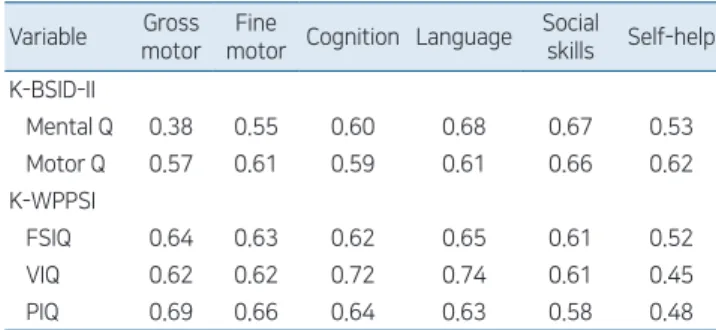
Motor Age Quotient. In the criterionrelated validity analysis, the correlation be tween the first edition KDST and KBSIDII was relatively high (r=0.38–0.68). Particularly, the correlation between Bayley's mental age quotient (Mental Q) and KDST's language and social skills domains were high (r=0.68, 0.67), and
Table 3. ROC curve analysis results of K-DST 1st edition by neurode velopmental disorder
Variable
Area under the curve Cerebral
palsy
Developmental language disorder
Autism spectrum
disorder
Intellectual disability
Gross motor 0.971 0.763 0.887 0.936
Fine motor 0.936 0.921 0.984 0.952
Cognition 0.860 0.893 0.953 0.951
Language 0.874 0.924 0.952 0.959
Social skills 0.874 0.957 0.999 0.964
Self-help 0.932 0.930 0.954 0.890
ROC, receiver operating characteristic; K-DST, Korean Developmental Screening Test for Infants and Children
Table 4. Results of correlation analysis of K-DST 1st edition, K-BSID-II, and K-WPPSI
Variable Gross motor
Fine
motor Cognition Language Social
skills Self-help K-BSID-II
Mental Q 0.38 0.55 0.60 0.68 0.67 0.53
Motor Q 0.57 0.61 0.59 0.61 0.66 0.62
K-WPPSI
FSIQ 0.64 0.63 0.62 0.65 0.61 0.52
VIQ 0.62 0.62 0.72 0.74 0.61 0.45
PIQ 0.69 0.66 0.64 0.63 0.58 0.48
K-DST, Korean Developmental Screening Test for Infants and Children;
K-BSID-II, Korean Bayley Scales of Infant Development-II; Mental Q, mental age quotient; Motor Q, Motor age quotient; K-WPPSI, Korean Wechsler Preschool and Primary Scales of Intelligence; FSIQ, full scale intelligence quotient; VIQ, verbal intelligence quotient; PIQ, performance intelligence quotient.
Age (mo) Age (mo)
Age (mo) Age (mo)
Age (mo) Age (mo)
Fig. 1. Change in cutoff points based on monthly age group and subdomains. (A) Gross motor domain; (B) fine motor domain; (C) cognition domain; (D) language domain; (E) social skills domain; (F) self-help domain. SD, standard deviation. Dotted lines represent arithmetically calculated standard deviations; solid lines represent standard deviation using percentage scores.
motor age quotient (Motor Q) and the fine motor domain was also high (r=0.61). The correlations between the KWPPSI's full scale intelligence quotient (FSIQ) and KDST were 0.52–0.65, which was also showed high correlation. For instance, the verbal intelligence quotient (VIQ) of KWPPSI was highly correlated with the language domain of KDST (r=0.74), and the perfor
mance intelligence quotient (PIQ) with the fine motor domain (r=0.66) (Table 4).
2. Restandardization and revalidation of K-DST 1) Basic statistics and new cutoff points
The distribution by age group of population groups for restan
dardization was shown as in Supplementary Table 6. Approxi
mately 3.06 million people were examined, and most of the subjects were evenly distributed based on their age. However, there were very few cases in certain age groups that did not have NHSPIC (6–7 months, 27–29 months). The change of the cutoff point based on the restandardization is illustrated by the areaby
area diagram (Fig. 1). The cutoff points set using percentiles were relatively lower compared to those set using arithmetic standard deviations.
2) Validity analysis
Sensitivity and specificity analysis revealed that 11 of 235 subjects were classified as having developmental problems in normal children and 350 of 413 patients in the clinical group.
Based on previous cutoff points, the sensitivity was 0.847 and the specificity was 0.953, and when the cutoff points were subjected to restandardization, the sensitivity was 0.833 and the specificity
was 0.979. The accuracy was about 0.886, indicating a high predictive accuracy as a screening tool (Table 5).
ROC curve analysis of neurodevelopmental disorders reveal
ed that the AUC values in the gross and fine motor domains for cerebral palsy (AUC: 0.969, 0.907), the language and social skills domains for developmental language disorders (AUC:
0.980, 0.998), the language and social skills domains for autism spectrum disorder (AUC: 0.974, 0.943), and the cognition, lan
guage, and social skills domains for intellectual disabilities (AUC:
0.960, 0.974, 0.979), were high, and correlated very well (Table 6).
Based on the criterionrelated validity analysis, the 6 subdo
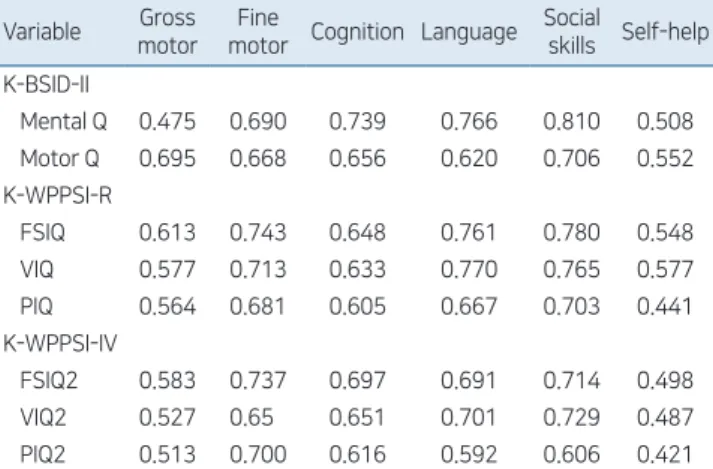
mains of revised KDST showed a high correlation with the KBSIDII test scores, and also showed high correlations with the KWPPSIR and KWPPSIIV tests. Mental Age Quotient showed high correlations with the language, cognition, and social skills domains of the revised KDST (r=0.766, 0.739, 0.810) and the Motor Age Quotient was highly correlated with KDST’s gross and fine motor domains (r=0.695, 0.668). The KWPPSIR and KWPPSIIV tests also exhibited a high correlation with the revised KDST. For instance, VIQ of Wechsler’s tests showed the highest correlation with the langu age domain (r=0.770 for KWPPSIR, 0.701 for KWPPSIIV), while PIQ also showed the highest correlation with the fine motor domain (r=0.681 for KWPPSIR, 0.700 for KWPPSIIV) (Table 7).
Discussion
Since the 2000s, the low birth rate coupled with an aging society has led to the widespread perception that social responsibility should be enhanced to create an environment favorable for childbirth and child nurturing. NHSPIC is in line with the basic direction of the nation's welfare policy, which aims to progress Table 5. Sensitivity and specificity analysis of restandardi-
zation (before and after setting of new cutoff points) Variable Previous cutoff points New cutoff points
Control group Clinical group Control group Clinical group
Normal 224 63 230 69
Abnormal 11 350 5 344
Total 235 413 235 413
Sensitivity 0.847 0.833
Specificity 0.953 0.979
Accuracy 0.886 0.886
Table 6. ROC curve analysis results of K-DST revised edition by neuro developmental disorder
Variable
Area under the curve Cerebral
palsy
Developmental language
disorder
Autism spectrum
disorder
Intellectual disability
Gross motor 0.969 0.881 0.769 0.858
Fine motor 0.907 0.944 0.894 0.943
Cognition 0.836 0.940 0.914 0.960
Language 0.849 0.980 0.974 0.974
Social skills 0.881 0.998 0.943 0.979
Self-help 0.894 0.893 0.860 0.889
ROC, receiver operating characteristic; K-DST, Korean Developmental Screening Test for Infants and Children.
Table 7. Results of correlation analysis of K-DST revised edition, K-BSID-II, and K-WPPSI
Variable Gross motor
Fine
motor Cognition Language Social
skills Self-help K-BSID-II
Mental Q 0.475 0.690 0.739 0.766 0.810 0.508 Motor Q 0.695 0.668 0.656 0.620 0.706 0.552 K-WPPSI-R
FSIQ 0.613 0.743 0.648 0.761 0.780 0.548
VIQ 0.577 0.713 0.633 0.770 0.765 0.577
PIQ 0.564 0.681 0.605 0.667 0.703 0.441
K-WPPSI-IV
FSIQ2 0.583 0.737 0.697 0.691 0.714 0.498
VIQ2 0.527 0.65 0.651 0.701 0.729 0.487
PIQ2 0.513 0.700 0.616 0.592 0.606 0.421 K-DST, Korean Developmental Screening Test for Infants and Children;
K-BSID-II, Korean Bayley Scales of Infant Development-II; Mental Q, mental age quotient; Motor Q, Motor age quotient; K-WPPSI, Korean Wechsler Preschool and Primary Scales of Intelligence; FSIQ, full scale intelligence quotient; VIQ, verbal intelligence quotient; PIQ, performance intelligence quotient.
towards a better welfare state through investing efficiently in the health of the people.
One of the effective ways to assess development is to adopt standardized developmental tools. Developmental screening test is a test developed to screen children who do not lie within the normal range of development and determines whether pro
fessional diagnosis is required.12) The development of infants and children should be considered as a continuous series of functions that are variable. Therefore, developmental screen ing test should be conducted more than once, and it is essen tial to repeat the test in time series in order to monitor the developmental changes of infants and children with age.13,14)
The developmental testing tools used in Korea are either de
veloped inhouse or in foreign countries. The latter was used after some amendments and standardization by Korean standards or restandardizing foreign tests. Some of the de velopmental tests developed in foreign countries include Den ver Development Assessment Testing, Bayley Scales of Infant Development (BSID), Early Screening Inventory (ESI), and Developmental Indicators for Assessment of Learning (DIAL).9,1517) The developmental testing tools that were de veloped in foreign countries and stand
ardized in Korea include Korean DenverII, Korean DIAL3, Korean Ages and Stages Ques tionnaire (KASQ), Korean Bayley Scales of Infant Development (KBISD), and ESIRevisited (ESIR).9,1518) How ever, most test tools used in Korea are limited to children living in cities and thus not reflective of the national samples based on the standardization process. Also, some tests did not report the characteristics of samples such as areas or demographic information.
The NHSPIC, which has been implemented in Korea since 2007, utilizes developmental screening tools to evaluate develop
ment, but initially used either KASQ or DenverII. However, DenverII is difficult to apply to all children in the Korean me
dical environment, as it is timeconsuming since the examiner must perform the test in person. Therefore, KASQ was favor
ed as parents would fill out the questionnaire themselves in the NHSPIC. KASQ is a Korean version of Ages & Stage Ques
tionnaires, the second edition developed in the United States and standardized for Korea.19,20) However, KASQ is a test developed in the United States, which makes it unsuitable for Korean infants since children grow in culturally different environ ments.
To verify the standardization and validity of KDST, the re
liability analysis was conducted by evaluating the coefficient of internal consistency, construct validity analysis, sensitivity and specificity analysis, ROC curve analysis, and criterionrelated validity analysis.
The results obtained by the analyses were as follows. In the item analysis identified by the IRT, the variability of most ques
tions was higher than 1.7, which was very high by the criterion of Baker.21) The internal consistency coefficient for each domain for reliability analysis showed good Cronbach alpha values of about 0.73–0.93 in most domains.
Compared with KASQ, showing that the RMSEA value was significantly lower in the model's fit at 0.096–0.118 over 24
months, KDST's Confirmatory Factor Analysis confirmed that the RMSEA value was within the acceptable range of 0.052–
0.097 for all the age groups.22) Therefore, the structure of KDST was verified.
The sensitivity of the KASQ was 0.75 and the specificity was 0.86 and that level was reportedly good.18) The sensitivity and specificity of the KASQ in the 30 and 36 months groups were 0.88–0.96 and the accuracy was 0.92 and 0.89, respectively, with good discrimination power in general. In con trast, in the 60 months group, the specificity was high at 0.95, but the sensitivity was relatively low at about 0.65.23) In comparison, the results of the sensitivity and specificity analysis of the first edition of KDST showed that the sensitivity was 0.886 and the specificity was 0.951, which is generally higher compared to that of KASQ.
In addition, The KASQ had the ability to select clinical groups such as intellectual disability and autism spectrum disorders as a risk group for neurodevelopmental disorders, but failed to select the groups with delayed language development such as developmental language disorders.23) In contrast, the ROC curve analysis results of the first edition KDST showed an AUC value of 0.9 or higher for each disease. In particular, in the case of developmental language disorders, AUC values of 0.924 for language and 0.957 for social skills showed high correlation with the subdomains associated with neurodevelopmental disorders.
In the criterionrelated validity analysis, KASQ showed sta
tistically significant correlation with criterion variables but not generally high. There were also areas where there were no sig
nificant correlations related to other measures. For example, KASQ's gross motor domain in the 30month age group had no significant correlation with KBSIDII's motor quotient score.23) This suggests that it may be insufficient to predict the actual motor functions for that particular month. In comparison, the correlations between mental quotient of KBSIDII and the cognition, language, and social skill domains areas of the first edition of KDST showed high correlation at 0.60, 0.68, and 0.67, respectively, and the correlations between motor quotient of KBSIDII and the gross motor and fine motor do mains of the first edition KDST were also high at about 0.57 and 0.61.
Between KWPPSI and first edition KDST, the correlation between VIQ and the cognition and language domains of the first edition KDST was higher than compared to that of the other developmental domains. In addition, the correlation between PIQ and the gross and fine motor domain was relatively high at 0.69 and 0.66, respectively. These results suggest that although KDST is a developmental screening test based on parental reports, it has a high correlation with KBSIDII and KWPPSI, which are the most widely used test tools for confirming neuro
developmental disorder. This suggests that KDST is a highly reliable developmental screening tool for Korean infants and children.
In the case of revised KDST, the sensitivity slightly decreased (from 0.847 to 0.833) in the newly adjusted cutoff point analysis compared to the existing cutoff point, while the specificity in
creased slightly (from 0.953 to 0.979). The falsenegative values
increased slightly from a value of 15.3% for the previous cutoff points to 16.7% using the new cutoff points, while the false
positive values decreased from 4.7% for previous cutoff points to 2.1% for the new cutoff points, reducing the probability of judging a normal child as a child with developmental problems
According to the ROC curve analysis of the revised KDST, the highest AUC values were found in the gross motor domain for cerebral palsy, the language domain for developmental language disorder, the social skills and language domains for autism spectrum disorder, and the cognition domain for intellectual disability. Compared with the first edition of KDST, the revised KDST showed increasing AUC values of the language and social domains (AUC=0.980, 0.998) in developmental language disorder, and also higher AUC values of the cognition, language, and social domains (AUC=0.960, 0.974, 0.979) in intellectual disability, showing better discrimination power for the revised KDST compared to that of the first edition KDST. In the correlation between KBSIDII and revised KDST, comparing with the first edition KDST, the correlation between Mental Age Quotient and revised KDST increased from 0.60 to 0.739 in the cognition domain, and from 0.68 to 0.766 in the language domain. The correlation between Motor Age Quotient and revised KDST, also increased from 0.57 to 0.695 in the gross motor domain, and from 0.61 to 0.668 in the fine motor domain, signifying better criterionrelated validity than that of the first edition KDST. In the case of KWPPSIR, KWPPSIIV and revised KDST, also showed an increase or slight decrease in the correlation between VIQ and the language domain from 0.74 to 0.701 in KWPPSIR, and from 0.74 to 0.770 in KWPPSIIV. Increased correlation between PIQ and the fine motor domain was also noted, increasing from 0.66 to 0.681 in KWPPSIR and from 0.66 to 0.700 in KWPPSIIV. Therefore, we verified that the revised KDST has a higher criterionrelated validity compared with that of the first edition of KDST.
However, the correlation between the gross motor domain of the revised KDST and KWPPSIR and KWPPSIIV was somewhat low (r=0.513, 0.564). This is because the minimum age of the Wechsler intelligence test should be above 30 months, which is considered to be the main development period of the fine motor domain as opposed to that of the gross motor domain.
The illustration of the results derived from this study is as follows. First, the first edition KDST showed high sensitivity and specificity compared to KASQ, which is known as a suitable screening test, which distinguishes well various neurodevelop
mental diseases disorder. In particular, KDST is an indepen
dently developed tool that suits the characteristics of infants in Korea, not a modified or standardized tool for existing foreign tests, and the reliability and validity of the tests were verified through various analyses. Compared to the KBSIDII and K
WPPSI, the correlations for reliability and validity were high, therefore the validity as a screening test is confirmed. Second, the revised KDST has become a more powerful discriminating tool because the AUC values are higher in the ROC curve analysis, and the correlation coefficient is higher in the criterionrelated
validity analysis as compared to that of the first edition of KDST.
Since the revised KDST had the advantage of using 3.06 million NHSPIC’s big data and the distribution of the population sample is assumed to be asymptotic and the cutoff points were set using percentile scores, the revised KDST exhibits higher reliability and validity as compared to that of 1st edition KDST.
However, in the case of revised KDST, the number of certain age group, not included in the NHSPIC schedule were small (27–29 months). As a result, the cutoff point for the 27–29 months group is lower than that of the other age group, which limits the interpretation of this particular section.
In conclusion, KDST is an independently developed tool that has been developed to suit the characteristics of Korean infants and children, in addition, it is a screening test tool that checks the reliability and validity through various procedures, and is restandardized using largescale data. In particular, the revised KDST has a higher sensitivity and specificity compared to KASQ, which is considered as a good screening test tool, and shows better discrimination ability compared to the first edition of KDST through the ROC curve analysis and criterionrelated validity analysis. The KDST shortens the test time and enhances accessibility to the examinee by allowing the test to be conducted online as well as in paperandpencil test. KDST can be utilized as a useful developmental screening tool for NHSPIC, as well as a developmental assessment tool for developmental surveillance, screening, and posttreatment changes of normal infants. In the future, if the standardization is conducted periodically using the accumulated data from NHSPIC, it can be applied as a better tool through the application of changes based on the socio
cultural development period. As more clinical data accumulate, further research may be required to determine how the classi
fication accuracy of KDST varies in a more diverse group of neurodevelopmental disorders that were not included in the validation study at the time of development.
Conflicts of interest
No potential conflict of interest relevant to this article was reported.
Acknowledgments
This work was supported by Research Program funded by the Korea Centers for Disease Control and Prevention (fund code 2010E3303300, 2012E3301600, 2013E3301800, 2016
E3301100).
Supplementary materials
Supplementary Tables 16 can be found via https://doi.org/
10.3345/cep.2020.00640.
References
1. Eun BL, Kim SW, Kim YK, Kim JW, Moon JS, Park SK, et al. Overview of the national health screening program for infant and children. Korean J
Pediatr 2008;51:22532.
2. Eun BL, Chung HJ. A study on the development and validation of Korean developmental screening test for infant and children (1st year). Cheongju (Korea): Korea Centers for Disease Control and Prevention, 2013.
3. Eun BL, Chung HJ. A study on the development and validation of Korean developmental screening test for infant and children (2nd year). Cheongju (Korea): Korea Centers for Disease Control and Prevention, 2014.
4. Eun BL. Standardization and validity reevaluation of the Korean developmental screening test for infants & children. Cheongju (Korea):
Korea Centers for Disease Control and Prevention, 2017.
5. Hambleton RK, Swaminathan H, Rogers HJ. Fundamentals of item response theory. London: Sage Publications, 1991.
6. Ramsay JO. Kernel smoothing approaches to nonparametric item characteristic curve estimation. Psychometrika 1991;56:61130.
7. Santos JR. Cronbach’s alpha: a tool for assessing the reliability of scales. J Ext 1999;37:15.
8. Cole DA. Utility of confirmatory factor analysis in test validation research.
J Consult Clin Psychol 1987;55:58494.
9. Park HW, Cho BH. Korean Bayley scales of infant development: inter
pretation manual. 2nd ed. Seoul (Korea): KIDSPOP Publishing Co., 2006.
10. Park HW, Kwak KJ, Park KB. The development of Korean version of WPPSI: the standardization study (1). Korean J Dev Psychol 1996;9:60
70.
11. Cohen J. Statistical power analysis for the behavioral sciences. 2nd ed.
New York (NY): Lawrence Erlbaum Associates, 1988.
12. Meisels SJ, Shonkoff JP. Handbook of early childhood intervention.
Cambridge: Cambridge University Press, 1990.
13. MardellCzudnowski C, Goldenberg D. DIAL3: developmental indica
tors for the assessment of learning. Circle Pines (MN): American Gui
dance Service, 1998.
14. Bagnato SJ, Neisworth JT, PrettiFrontczak K. LINKing authentic assessment and early childhood intervention: best measures for best practice. Baltimore (MD): Paul H Brookes Publishing, 2010.
15. Frankenburg WK, Dodds J, Archer P. Denver II: screening manual.
Denver (CO): Denver Developmental Materials Inc., 1990.
16. Bayley N. Bayley scales of infant development. 2nd ed. San Antonio (TX):
Psychological Co., 1993.
17. Meisels SJ, Marsden DB, Wiske MS, Henderson LW. ESIR: early screen
ing inventoryrevised. examiner's manual. Ann Arbor (MI): Rebus Incorp., 1997.
18. Heo KH, Squires J, Yovanoff P. Crosscultural adaptation of a preschool screening instrument: comparison of Korean and US populations. J Intellect Disabil Res 2008;52:195–206.
19. Bricker D, Squires J. The ages and stages questionnaires (ASQ): a parent
completed, child monitoring system. 2nd ed. Baltimore (MD): Paul H Brookes Publishing Co., 1999.
20. Squires J, Bricker D. Potter L. Revision of a parentcompleted develop
ment screening tool: ages and stages questionnaires. J Pediatr Psychol 1997;22:31328.
21. Baker FB, Kim SH. Item response theory: parameter estimation techni
ques. New York (NY): CRC Press, 2004.
22. Eun BL, Chung HJ, Cho S, Kim JK, Shin SM, Lee JH, et al. The appro
priateness of the items of Korean ages and stages questionnaires (KASQ) developmental screening test in Korean infants and children. J Korean Child Neurol Soc 2014;22:2941.
23. Chung HJ, Eun BL, Kim HS, Kim JK, Shin SM, Lee JH, et al. The validity of Korean ages and stages questionnaires (KASQ) in Korean infants and children. J Korean Child Neurol Soc 2014;22:111.
How to cite this article: Chung HJ, Yang D, Kim GH, Kim SK, Kim SW, Kim YK, et al. Development of the Korean Develop
mental Screening Test for Infants and Children (KDST). Clin Exp Pediatr 2020;63:43846. https://doi.org/10.3345/cep.2020.
00640