Introduction
Conventional computed tomography (CT)–guided per- cutaneous transthoracic needle biopsy (PTNB) is a well- established method and is the most common imaging mo- dality used to obtain tissue from a lung lesion
1. Cone-beam CT (CBCT)–guided PTNB has recently been in the spotlight because of its real-time fluoroscopic capability, greater flex- ibility in orientating the detector around the patient, and rela- tively low radiation exposure compared with CT fluoroscopy- guided PTNB
2,3. The advantage of CBCT-guided PTNB over conventional CT-guided PTNB is its real-time properties that enable operators to avoid dangerous structures and access the target lesion in patients unable to cooperate with breath hold-
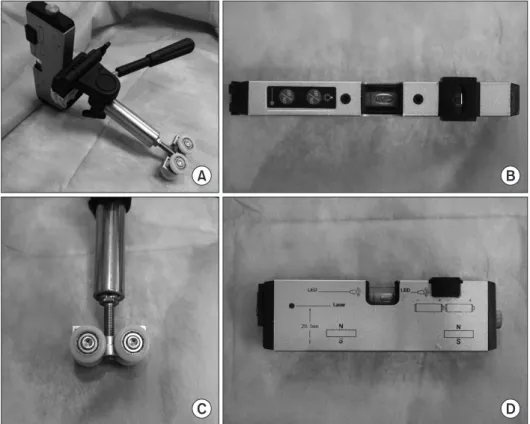
CT-Guided Percutaneous Transthoracic Needle Biopsy Using the Additional Laser Guidance System by a Pulmonologist
with 2 Years of Experience in CT-Guided Percutaneous Transthoracic Needle Biopsy
Min-Cheol Jeon, Ph.D.
1, Ju Ock Kim, M.D., Ph.D.
2, Sung Soo Jung, M.D., Ph.D.
2, Hee Sun Park, M.D., Ph.D.
2, Jeong Eun Lee, M.D., Ph.D.
2, Jae Young Moon, M.D., Ph.D.
2, Chae Uk Chung, M.D., Ph.D.
2, Da Hyun Kang, M.D.
2and Dong Il Park, M.D.
21
Department of Radiology, Daejeon Health Institute of Technology, Daejeon,
2Division of Pulmonary and Critical Care Medicine, Department of Internal Medicine, Chungnam National University Hospital, Daejeon, Korea
Background: We developed an additional laser guidance system to improve the efficacy and safety of conventional computed tomography (CT)–guided per cutaneous transthoracic needle biopsy (PTNB), and we conducted this study to evaluate the efficacy and safety of our system.
Methods: We retrospectively analyzed the medical records of 244 patients who underwent CT-guided PTNB using our additional laser guidance system from July 1, 2015, to January 20, 2016.
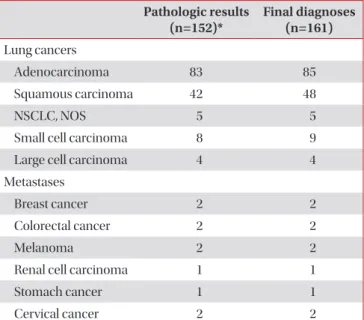
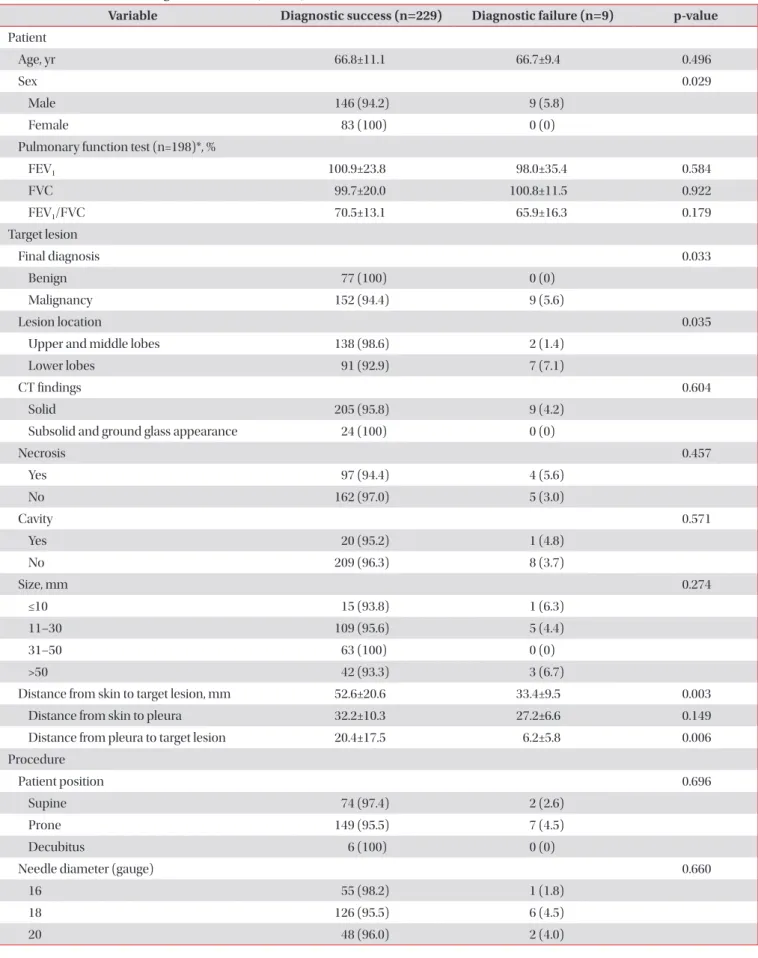
Results: There were nine false-negative results among the 238 total cases. The sensitivity, specificity, positive predictive value, negative predictive value, and diagnostic accuracy of our system for diagnosing malignancy were 94.4% (152/161), 100% (77/77), 100% (152/152), 89.5% (77/86), and 96.2% (229/238), respectively. The results of univariate analysis showed that the risk factors for a false-negative result were male sex (p=0.029), a final diagnosis of malignancy (p=0.033), a lesion in the lower lobe (p=0.035), shorter distance from the skin to the target lesion (p=0.003), and shorter distance from the pleura to the target lesion (p=0.006). The overall complication rate was 30.5% (74/243). Pneumothorax, hemoptysis, and hemothorax occurred in 21.8% (53/243), 9.1% (22/243), and 1.6% (4/243) of cases, respectively.
Conclusion: The additional laser guidance system might be a highly economical and efficient method to improve the diagnostic efficacy and safety of conventional CT-guided PTNB even if performed by inexperienced pulmonologists.
Keywords: Lasers; Solitary Pulmonary Nodule; Lung Neoplasms; Biopsy, Needle
Address for correspondence: Dong Il Park, M.D.
Division of Pulmonary and Critical Care Medicine, Department of Internal Medicine, Chungnam National University Hospital, 282 Munhwa-ro, Jung-gu, Daejeon 35015, Korea
Phone: 82-42-280-7147, Fax: 82-42-257-5753 E-mail: [email protected]
Received: Dec. 3, 2017 Revised: Jan. 16, 2018 Accepted: Feb. 20, 2018 Published online: Jun. 19, 2018
cc It is identical to the Creative Commons Attribution Non-Commercial License (http://creativecommons.org/licenses/by-nc/4.0/).