1
Veterinary Medicine for Aerospace Medicine
Won-Chang Lee, DVM, MPH, Ph.D.
College of Veterinary Medicine, Konkuk University, Seoul, Korea
1858년 비교의학(Comparative Medicine)자 Rudolp Virchow는 동물과 사람을 대상으로 하는 의학은 그 응용 은 다를 지라도 - 의학적 기반은 구분되지 않고, 구분 되어서도 안 된다고 하였다. 현대 수의학(獸醫學)의 발전은 애완동물이나 가축의 질병을 다루는 범위 이외에 인수공통전염병, 생태학, 역학, 식품위생 및 안정성, 환경위생학 그리고 기초의학을 중심으로 하는 생의학(Biomedicine)과 항공우주의학(航空宇宙醫學) 및 군진의학(軍陳醫學) 분야에 이르기까지 관련되어 있음은 주지의 사실이다. 특히 20세기에 들어와서 항공우주의학의 기간이 되는 생 체기초실험의 인간을 대신하는 실험동물연구의 상당부분을 성공적으로 이끌어 온 것은 수의학의 업적이라고 하겠다. 미국의 경우 NASA에는 항공우주의학분야에 수의학 담당관이 있고, 일부 연구관 중에서는 우주비행사로 활약 하거나 우주선내에서의 동물실험 연구원으로 활약하는 수의학자들이 있다는 사실은 별로 알려져 있지 않아, 항공우주의학분야와 관련된 수의학분야를 소개하고자 한다.
Key words:
Animals in space, Veterinary activity, Aerospace medicine
Received: February 25, 2010, Accepted: July 19, 2010
Correspondence: Won-Chang Lee, College of Veterinary Medicine, Konkuk University, 1, Hwayang-dong, Gwangjin-gu, Seoul 143-701, Korea
Tel: 02-456-1185
E-mail: [email protected]
I. INTRODUCTION
In 1858, Rudolp Virchow, the father of comparative medicine, stated, “Between animal and human medicine there are no dividing line-nor should there be. The object is different but the experience obtained constitutes the basis of all medicine” [1].
Today comparative and interdisciplinary research is critical to translating scientific advances from one discipline or species to another and providing new insights into human health problems.
Scientific field such as laboratory animal medicine, pathology, and toxicology, when combined with veterinary medicine, haven especially relevant to success in biomedical research [2].
People readily associate the role of veterinarians with private veterinary practice focused on pets and farm animals, but the true dimensions and contributions of veterinary medicine are much broader and reflect expanding societal needs and contemporary challenges to animal and human health and to the environment [3]. Veterinary medicine has responsibility in biomedical research
included laboratory animal medicine for basic and experimental medicine such as aerospace and deep-sea medicine etc. [4];
ecosystem management; public health; food and agricultural systems; and care of companion animals, zoonoses, wildlife, exotic animals and food animals [5,6].
II. VETERINARY MEDICINE IN KOREA
Veterinary medicine in Korea has gone a long way since its inception in 1907, when the first veterinary medical institute attached to Suwon Agricultural College, opened its doors to the initial batch of students. After 1945, the Korean Veterinary Medical Association was established as a national association on October 10th 1948, by the Korean Veterinary Act. The objective of association is to advance the sciences and art of veterinary medicine which are not only contributing to the development of livestock production as a guardian of human lives by the protection of our animal food supply and the improvement of public health but also promoting the social status and dignity of the members of the association [6].
Today’s veterinarian (Doctor of Veterinary Medicine; D.V.M.)
is a member of a major health profession with its own system of
education, licensing, organization, and ethics. In taking the
veterinarian’s oath, the doctors solemnly swears to use his or her
scientific knowledge and skills “for the benefit society, through the
Fig. 1. Dr. Rick Linnehan, DVM, Chief Veterinary Officer for NASA (Ref. 8).
promotion of animal health, the relief of suffering, the conservation of livestock resources, the promotion of public health, biomedical work for basic and experimental medicine including comparative medicine, and the advancement of medical knowledge”.
The majority of veterinarians work either in veterinary clinics or public health service in our society, although they may do both.
They give veterinary medical service that is similar to the service rendered in human medicine. Education is a minimum six years of college work, including two years of a pre-veterinary science course in veterinary medicine before a degree of D.V.M. in Korea from 1998.
III. VETERINARIANS ACTIVITIES IN AEROSPACE MEDICINE
Veterinarians are responsible for the health of all the animals for aerospace medicine whether on the ground or in space. When a space shuttle experiment involving animals is scheduled, a veterinarian is consulted to ensure that the animals selected appropriate for those experiments. They also provide instructions for the proper care of the animals during the voyage, including information on how to avoid unacceptable treatments or proce- dures. At National Aeronautics Space Administration (NASA) headquarters, the duties of veterinarians include monitoring the health of research animals, planning and conducting experiments, collecting data/measurements, interpreting results of their research, and writing reports on their findings for NASA [4,7].
1. Chief Veterinary officer for NASA
In the U.S., veterinary officer job for NASA, which mean that they work at Ames and anywhere else that their have animals. Dr.
Joe Bielitzki, chief veterinary officer for NASA [8]. His respon- sibilities are to make sure that the animals are always properly taken care of experience minimal pain and diseases if they have to experience pain and distress, and that everything they do follows the laws, rules and regulations that the government has established for animal care. His job also involves working with researchers that use animals in their projects. He provides expert consultation on things like anesthesia, husbandry (the breeding and rising of animals) and nutrition. In some cases he helps with experimental design when an experiment involves training animals, conditioning animals or certain surgical procedures. The job is quite divers and he do a lot of different things. He seem to get a lot of non-specific problems that people don’t know how to handle and because he
work for NASA headquarters, he can often cut through red tape and deal with issues that other people can’t get on track. He is also responsibility for animals while they are flying as far as their health and well being. He has two other veterinarians that are going to be on this mission. Dr. Rick Linnehan, who aside from being Payload Commander, is the inflight attending veterinarian.
This means that when he is working in the shuttle, he is responsible for the animals; he doesn’t have to talk to me about problems. The other veterinarian is Dr. Alex Dunlap who is an alternate Payload Specialist. Dr. Alex is also a physician. He has been named Duty Veterinarian which means he can approve changes in animal protocols during the mission. He is intimately familiar with everything that they are doing. He is an ideal person for this and will spend a lot of time in communication with the orbiter. He can also deal with other animal problems if they occur on the shuttle. Dr. Joe Bielitzki job has to do with societal benefits At NASA the job has to do with being able to identify the risk of space travel for the astronauts. If they are going to fly humans then we should know what’s going to make them sick, how sick.
Most of that work is going to be tested and developed with animals, so the animal models are real important.
Veterinarians are the first people you look to when you are
looking at new treatments or new medicines or new ways to deal
with the problems that the astronauts might have, because much
of the early work will be done in models (Fig. 1) [8].
Fig. 3. Dr. Martin Joseph Fettman, BS, DVM, MS, Ph.D., Payload Specialist (Ref.10).
Fig. 2. Dr. Richard M. Linnehan, DVM, MPA. NASA Astronaut (Ref.
9).
2. Astronaut and Payload Specialist in Veteri- narians for NASA
Dr. Richard M. Linnehan (DVM, MPA, Dr.Sc. in Hor) [9], he was born September 19, 1957, in Lowell, Massachusetts. After graduation, he received the degree of Doctor of Veterinary Medicine (DVM) from The Ohio State University College of Veterinary Medicine in 1985. Dr. Linnehan entered private practice. Later, he was later accepted to a 2-year joint internship in zoo animal medicine and comparative pathology at the Baltimore Zoo and the Johns Hopkins University. After completing his internship, he was commissioned as a Captain in U.S. Army Veterinary Corps and served at the Naval Ocean System Center, San Diego, California, as chief clinical veterinarian for the US Navy’s Marine Mammal Program. In 1992, he was selected by NASA to begin astronaut training. He is a veteran of two spaceflight and has logged more than 787 hours in space.
Dr. Linnehan first flew as a mission specialist in 1996 on STS-78, the Life Sciences and Microgravity Spacelab (LMS) mission. The longest Space Shuttle flight to date, 17-day mission included studies sponsored by ten nations and five space agencies. It was the first mission to combine both a full microgravity studies agenda and a comprehensive life sciences payload (Fig. 2) [9].
Dr. Martin Joseph M. Fattman (BS, DVM, MS, Ph.D., Dip.
ACVP) [10], he was born December 31, 1956, in Brooklyn, New York. After graduation, Doctor of Veterinary Medicine (DVM) degree and Master of Science degree in nutrition from Cornell
University in 1980, and Ph.D. degree in Physiology from Colorado State University in 1982. He received board certification in veterinary clinical pathology in 1984 and is a diplomat of the American College of Veterinary Pathologist. In his first affiliation with NASA, Dr. Fettman was selected as a payload specialist candidate in December 1991, as the prime payload specialist for Spacelab Life Sciences-2 in October 1992, and flew on STS-58 in October 1993. Since the flight, he has made over seventy public appearances representing space life sciences research before higher education, medical, veterinary, and lay organizations, and visited over twenty K-12 schools around the United States and Canada.
He is presently a member of the NASA Advisory Council Life and Biomedical Sciences and Application Advisory Subcommittee (Fig.
3) [10].
IV. VETERINARIANS HELP ANIMALS IN SPACE
Veterinarians who train to become astronauts desire to work
other researchers to study what happens to people and animals in
space where there is no gravity-also known as zero-g. They
perform experiments on earth and space shuttle mission in order
to observe the long-term health effects of space travel and
zero-gravity environment on experiments with animals. This kind
of research has led to improved lifestyle of astronauts during
subsequent space missions and continues to provide new infor-
mation for future human life in space [4,7,8]. Before humans
Fig. 4. Astronaut of Sam (Ref. 4).
actually went into space, one of the prevailing theories of the perils of space flight was that humans might not be to survive long periods of weightlessness. For several years, there had been a serious debate among scientists about the effects of prolonged weightlessness. American and Russian scientists utilized animals- mainly monkeys, chimps and dogs - in order to test each country’s ability to launch a living organism in to space and bring it back alive and unharmed as following [4,7-11].
On June 11, 1948, a V-2 Blossom launched in to space from White Sand, New Mexico carrying Albert 1, a rhesus monkey.
Lack of fanfare and documentation made Albert an unsung hero of animal astronauts. On September 20, 1951, a monkey named Yorick and 11 mice were recovered after an Aerobee missile flight of 236,000 feet at Holloman Air Force Base, New Mexico. Yorick got a fair amount press as first monkey to live through a space flight [4].
The world, especially the U.S., was shocked, when on October 4, 1957, the USSR launched the world’s first satellite, Sputnik 1.
The name comes from a world for “traveling companion of the world.” It carried a thermometer and two radio transmitters.
Circling the earth once ever 96.2 minutes it transmitted atmospheric information by radio [7,11]. On November 3, 1957, Sputnik 2 blasted in to earth orbit with a dog named Laika aboard. Laika, which is Russian for “Husky” or “Barker,” had the real name of Kudryavka (“Little Curly”). In the U.S. she was eventually dubbed “Muttnik.” Laika was a small stray mongrel picked up from street. She was hastily trained and put aboard in a metal carrier under the second Sputnik sphere. There was no time to work out any reentry strategy and Laika expired after few
hours. Sptunik 2 finally burned up in the outer atmosphere in April 1958 [4,7,11].
Sam, a rhesus monkey, was one of the most well known monkeys of the space program. His name was an acronym for the U.S. Air Force School of Aviation Medicine at Brooks Air Force Base, Texas. He was launched on December 4, 1959, housed in a cylindrical capsule within the Mercury spacecraft atop a Little Joe rocket in order to test the launch escape (LES). Approximately one minute into the flight, traveling at a speed of 3,685 mph, the Mercury capsule aborted from the Little Joe launch vehicle.
After attaining an altitude of 51 miles, the spacecraft landed safely in the Atlantic Ocean was recovered, several hours later, with no ill effects from his journey. He was later returned to the colony in which he trained where he died in November 1982 and his remains were cremated (Fig. 4) [4].
Miss Sam, another rhesus monkey and Sam’s mate, was launched on January on 21, 1960, for another test of LES. The Mercury capsule attained a velocity of 1,800 mph and an altitude of 9 miles. After landing in the Atlantic Ocean 10.8 miles downrange from the launch site. Miss Sam was also retrieved in overall good condition, she was returned to her training colony until her death on unknown date [4].
In the Soviet Union, meanwhile, testing was also taking place on more dogs. On July 28, 1960, Bars (“Panther” or “Lynx”) and Lisichka (“Little Fox”) were launched on a Korabl Sputnik, a prototype of the Vostok manned spacecraft. The booster exploded on launch, killing the two dogs. On March 9, 1961, another Russian dog, Chemushka (“Blacke”) was launched on Sputnik 9 or Korabl Sputinik 4. Chemushka was accompanied into space with a dummy cosmonaut, some mice, and guinea pig. Zvezdochka (“Little Star”) was launches onboard Sputnik 10 or Korabl Sputnik 5, 1961. The dog went up with simulated cosmonaut “Ivan Ivanovich” and successfully tested the spacecraft’s structure and systems [4].
On January 31, 1961, Ham, whose name was an acronym for
Holloman Aero Med, became the first chimpanzee in space, aboard
the Mercury Redstone rocket on a sub-orbital flight. Ham was
brought from the French Camaroons, West Africa, where he was
born July 1957, to Hollman Air Force Base in New Mexico in
1959. The original flight plan called for an altitude of 115 miles
and speed ranging up to 4,400 mph. However, due to technical
problems, the spacecraft carrying Ham reached an altitude of 157
miles and a speed of 5,857 mph and landed 422 miles downrange
rather than the anticipated 290 miles. Ham performed well during
his flight his and splashed down in the Atlantic Ocean60 miles
from the recovery ship. He experienced a total of 6.6 minutes of
Fig. 5. A Fish swimming in microgravity (Ref. 4). Fig. 6. An astronaut training a frog with care in space (Ref. 4).
weightlessness during a 16.5 minutes flight. A post-flight medical examination found Ham to be slightly fatigued and dehydrated, but in good shape otherwise. Ham’s mission paved for the successful launch of American’s first human astronaut. Alan B.
Shepard Jr., on May 5, 1961. Upon the completion of a through medical examination, Ham was placed on display at the Washington Zoo in 1963 where he lives alone until September 25, 1980. He then was move to the North Carolina Zoological Park in Asheboro. Upon his death on January 17, 1983. Ham’s skeleton would be retained for ongoing examination by the Armed Forces Institute of Pathology. His other remains were respectfully laid to rest in front of the International Space Hall of Fame in Alamogordo, New Mexico [4,12,13].
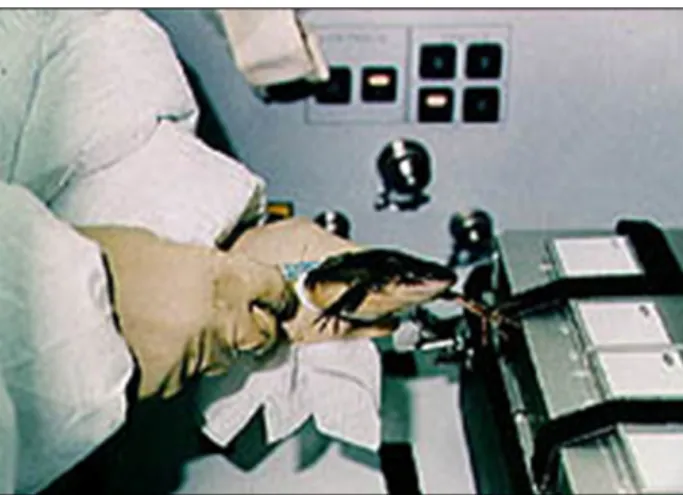
After the manned lunar landing of Apollo11, the role of animals was limited to the status of “biological payload.” The range of species broadened to include rabbits, turtles, spiders, fish, jellyfish, amoeba, and algae. Although they were still in test dealing with long-range health effects in space, tissue development, and mating in a zero-g environment, etc.. From 1973 to 1996, Russia, or its predecessor, the Soviet Union, launched a series of life sciences satellites called Bion. Starting with Bion 6 (Kosmos 1514), these missions have carried pairs monkey. Bion6/Kosmos 1514 was launched December 14, 1983, and carried the monkeys Abrek and Bion on a five-day flight. Bion7/Kosmos 1667 was launched July 10, 1985 and carried the monkeys Verny (“Faithfull”) and Gordy (“Proud”) on a seven- day flight. Bion 8/Kosmos 1887 was launched September 29, 1887, and carried the monkeys Yerosha (“Drosy”) and Dryoma (“Shaggy”) on a 13-day flight. Yerosha partially freed himself from his restraints and explored his orbital cage during the mission. On reentry, Bion 8 missed its touchdown point by 1850 miles, resulting in the death of several fish on board due to the frigid weather. Bion 9/Kosmo 2044 was launched
September 15, 1989, and carried the monkeys Zhakonya and Zabiyaka (“Troublemarker”) on a 14-day flight. Temperature problems onboard resulted on in the loss of ant earthworm experiments (Fig. 5, 6).
From 1983 to present day, the Space Shuttle has flown over two dozen Spacelab experimental packages in its payload bay.
Life-Science Spacelab mission have included experimental involving the human astronauts as well as the animals and insects carried on these missions.
Over the past 50 years, American and Soviet scientists have utilized the animal world for testing. Despite losses, these animals have taught the scientist a tremendous amount more than could have been learned without them. Without animal testing in the early days of the human space program, the Soviet and American programs could have suffered great losses of human life. These animals performed a service to their respective countries that no human could or would have performed. They gave their lives and /or their service in the name of technological advancement, paving the way for humanity’s many forays in to space [4].
V. VETERINARY SERVICE FOR THE ARMED FORCES IN KOREA
Korean veterinarians are to serve as medical officers in the armed forces (Army, Navy and Air Force) in compliance with the regulations of the Veterinary Officers in Veterinary Corps (VC).
They are to engaged in supervision of military public health
services, including food inspection for food safety and sanitary
controls of military facilities, quarantine of zoonoses, research and
laboratory work in biomedical science, and aerospace medicine and
sea-biology, diet development, environmental sanitation and
Fig. 7.
industrial hygiene services, military animal and laboratory animal medicine, and additional lectures for public health veterinary in the military medical service school in the ROK. This was particularly evident in public health field (Fig. 7).
Especially, veterinary officers in Korean Air Forces has gone a long was since inception in 1958, when the first veterinary officers in the Aeromedical Research Laboratory under the Aerospace Medical Center, and military public health and veterinary service for air bases in ROKAF [14].
VI. CONCLUSION
Over the past half century, American and Soviet included other countries scientists have utilized the animal world for testing.
Despite losses, these animals have taught the scientist a tremendous amount more than could have been learned with them.
Veterinarians who train to become astronauts desire to work other researchers to study what happens to people and animals in space where there is no gravity also known as zero-g. This kind of research has led to improved lifestyle of astronauts during subsequent space missions and continues to provide new
information for future human life in space. They gave their lives and/or their service in name of technological advancement, paving the way for humanity’s many forays in to space.
Finally, I’d like to say to the veterinary medical student and veterinarians in Korea, “to be a good veterinary doctor, you must be a first-class biomedical scientist and your must be know- ledgeable and expert in comparative medical work for human as well”. By the twentieth century, veterinary medicine and biome- dicine have matured in Korea, and will become a pioneering profession in twenty-first century.
REFERENCES
1. Schwab CW. Veterinary Medicine and Human Health. 3rd ed.
Baltimore, MD: Williams and Wilkins, 1984;3:2.
2. Committee on Increasing Veterinary Involvement in Bio- medical Research, National Research Council. National need and priorities for veterinarians in biomedical research. Washington, DC:
National Academies Press. 2004.
3. Hoblet KM, McCabe AT and Heider L. Veterinarian in population health and public practice: meeting critical national needs. J Vet Med Educ 2003;30:287-294.
4. National Aeronautics and Space Administration (NASA). A brief history of animals in space. NASA History Division. http://
history.nasa.gov/animals.html.
5. King LJ. Veterinary Medicine and Public Health at CDC. Morbidity Mortality Weekly Report 2006;55:7-9.
6. Lee WC. Veterinary Medicine for Human Health; Perspective at the Threshold of the 21st Century in Korea. J Korean Public Health Assoc 2000;1:99-103.
7. American Veterinary Medical Association (AVMA), Veteri- narians Help Animals in Space. A teacher resource developed by the AVMA. http://www.avma.org/educators/teacher_guide/space_bgnd.pdf.
8. Bielitzki J. Chief Veterinary Officer for NASA. National Aeronautics and Space Administration, An educational Web. http://Quest.nasa.go/
neuron/team/bielitzki.html.
9. Linnehan RM. Biographical Data, NASA. November, 2009. http://
www.jsc.nasa.gov/Bios/htmlbios/linnehan.html.
10. Fettman MJ. Biographical Data, NASA. June, 1995. http://www.
jsc.nasa.gov/Bios/PS/fettman.html.
11. Gray S. A Brief History of Animals in Space. Steve Garber, NASA History Web Curator Site design by NASA HQ Printing & Design.
August 2, 2004. http://history.nasa.gov/animals.html.
12. SPACE. Space History Milestone: Sputnik 1 Launch. Space News October 5, 1999. http://www.space.com/news/spytnik42_991005.html.
13. GRIN. Ham. Great Images in NASA. GPN-2000-001002-Ham.
http://grin.hq.nasa.gov/ABSTRACTS/GPN-2000-001002.html.
14. American Veterinary Medical Association (AVMA). Korean Veterinarian First Foreign Officers in Course. J Amer Vet Asso 1969;155:1305.