• 검색 결과가 없습니다.

Effects of Employees' Job Characteristics, Commitment, and Self-Leadership on Organizational Citizenship Behavior

N/A
N/A
Protected

Academic year: 2021

Share "Effects of Employees' Job Characteristics, Commitment, and Self-Leadership on Organizational Citizenship Behavior"

Copied!
9
0
0

로드 중.... (전체 텍스트 보기)

전체 글

(1)

Print ISSN: 1738-3110 / Online ISSN 2093-7717 doi: 10.13106/jds.2014.vol12.no7.13.

Effects of Employees’ Job Characteristics, Commitment, and Self-Leadership on Organizational Citizenship Behavior*

2)

Keun Eom**, Hoe-Chang Yang***

Received: May 08, 2014. Revised: May 24, 2014. Accepted: July 16, 2014.

Abstract

Purpose - This study reveals antecedent factors to help de- velop expressway rest areas in which employees were exposed to inferior environments, using Hackman and Oldham’s Job Characteristics Theory.

Research design, data, and methodology - The survey was conducted on 148 expressway rest area employees in Gyeonggi-do. After excluding questionnaires with invalid re- sponses, 141 questionnaires were analyzed.

Results - The sub-factors of job characteristics had a positive influence on the organizational commitment of employees, and organizational commitment had a positive influence on organiza- tional citizenship behavior (OCB). Further, the results of media- tion effects showed that organizational commitment and self-leadership were partially mediated. Finally, the results of the moderation effect of self-leadership showed that self-leadership was thought to be vital to let members endeavor to promote the competitiveness of expressway rest areas.

Conclusions - The expressway rest area company needed to design jobs to let employees be self-motivated, productive, pos- itive, responsible, and aspirational; job redesign, including job enrichment and job enlargement can be considerably helpful for affirmative influence.

Keywords: Job Characteristics, Organizational Commitment, Self-Leadership, Organizational Citizenship Behavior (Ocb), Expressway Rest Areas.

JEL Classifications: M10, M12, M54.

* This Paper has been represented by KODISA 2013 Winter International Conference. Reviewed by new discussion of two panelist and revised faithfully reflected by three anonymous reviewers.

** 1 st Author, Professor, Department of Distribution Management, Jangan University. Tel: +82-10-6809-3137, Fax:+82-31-299-3131, E-mail:

[email protected]

*** Corresponding Author, Assistant Professor, Department of Distribution Management, Jangan University. Tel: +82-10-8897-1002, Fax:+82-31- 299-3131, E-mail: [email protected]

1. Introduction

Expressway rest areas had various kinds of use patterns and purposes in accordance with expansion of expressway infra- structure, one-day life zone by passenger cars and 5-days work- week (Lee, 2013). As many as 197 expressway service areas at 26 expressway lines in the nation were said to do business (see, 2013 homepage of KHSA). In 2013, 99 members of KHSA were said to do business at rental and/or commission shop (http://has.or.kr). Expressway rest areas that were essential to travel provided users with services of meal, taking rest, ob- servation, exchange of information, standby and rest rooms, etc and gave services of inspection, car wash, simple repairing, fuel supply to be bases of traffic accident handling and replacement at emergency (Kim & Ham, 2001). Despite tremendous increase of use, search the results of KERIS (Korea Education and Research Information Service) provided RISS (Research Information Service System) showed that 86 graduate theses, 75 journal theses and 246 books were published according to retrieval of "Expressway service areas", and no more than 25 studies were published at retrieval of KIS (Korean Studies Information) provided KISS (Koreanstudies Information Service System). Most of the results of the studies described such as improvement of location and use of expressway service areas, and only some papers investigated consumer satisfaction (e.g.

Jeong, 2003; Kim & Ham, 2001). No demographic statistical da- ta about more than 40,000 employees at 197 expressway rest areas including full-time and temporary workers were not re- ported ever, and the employees who were exposed to worse working conditions and emotional labor had higher turnover rate than employees of other business types had no finding to have no political approach such as better service through service workers who contacted so many users.

‘7Ps’of service marketing mix added three factors of people, physical environment and process to four factors of existing marketing mix (i.e. product, price, promotion and place), and many scholars such as Srinivasan (2012) and others thought very much of 'people' among three service marketing factors.

People who participated in service delivery process, that is, par-

ticipants had influence upon perception of buyers. In other

(2)

words, the costume, appearance, attitudes and behaviors of the employees had great influence and important clues upon cus- tomers' service perception (Gang, 2010). From the point of view, it is very necessary for the satisfaction of customers to study of employees working at expressway rest areas apart from various studies with respect to the use of the expressway rest areas.

The purpose of the study was to find out antecedent factors that could help develop expressway rest areas of which employ- ees were exposed to inferior environment. We expected that finding these factors will directly contribute and offer important clues to promote customer satisfaction through the solution of the problem such as the employees with high turnover rate un- der inferior service conditions. And, the study investigated what factors had influenced upon employees' voluntary self-develop- ment efforts. Especially, the study investigated characteristics of the employees from point of view of 'Y' theory of McGregor (1957) who were ready to be responsible to have strong desire of self-development and to cognize fruitfulness at accomplishment. And, the study investigated intervening factors as well as facilitation factors.

For this purpose, this study selected outcome variable as or- ganizational citizenship behavior that could help develop organ- ization of the employees to be given attention recently, and sub-factors of job characteristics as antecedent variables that had influence upon organizational citizenship behavior. According to Hackman & Oldham (1976)’s job characteristic theory, they argued that the one who had skill variety, task identity, task sig- nificance, autonomy and feedback and psychological features could be satisfied with upper level desire. So, design of job that kept characteristics of job itself could give motives. In this study, commitment was likely to mediate between members' job characteristics and organizational citizenship behavior. In other words, the one who had motives by job characteristics could have influence upon organizational citizenship behavior by medi- ating variable as commitment. Finally, the study paid attention to self-leadership that the employees cognized, and it build up a model subject to effects of members' cognition of self-leadership between job characteristics and commitment, and between com- mitment and organizational citizenship behavior, respectively.

The results of this study will be provide various personal and organizational level of the clues through any mechanism that may contribute to the development of expressway rest areas, and to let the employees work in affirmative way to be satisfied by themselves and to be happy.

2. Literature Review

Sims et al. (1976) reported that The problem of measuring job characteristics has been important to at least three areas of management research. Specifically, first, the current interest in alienation from work gives special impetus to serious research

into how job characteristics influence the satisfaction and per- formance of workers. Indeed, many of the recent efforts to de- velop job enrichment and job enlargement programs are directed toward redesigning jobs to reduce the problems of boredom and alienation at the work place, which in turn will hopefully in- crease productivity. Second, the psychological study of work mo- tivation, both at the worker level and at the managerial level, is thought by some to be highly related to the characteristics of the work itself. Third, the study of leadership has frequently ig- nored the influence of task characteristics upon the relationship between leader behavior and subordinate satisfaction and performance.

The job characteristics model was introduced by Hackman &

Oldham (1976). They explained that the basic job characteristics model is five "core" job dimensions are seen as prompting three psychological states which, in turn, lead to a number of benefi- cial personal and work outcomes. They argued that job charac- teristics factors were composed of 3 elements such as three job characteristics (i.e. skill variety, task identity and task sig- nificance) combine additively to determine the psychological meaningfulness, toward experienced responsibility, and toward knowledge of results of a job (Hackman & Oldham, 1976).

Specifically, they explained the following factors: First of psycho- logical meaningfulness is skill variety, it means that the degree to which a job requires a variety of different activities in carry- ing out the work, which involve the use of a number of different skills and talents of the person. second of psychological mean- ingfulness is task identity. it means that the degree to which the job requires completion of a "whole" and identifiable piece of work; that is, doing a job from beginning to end with a visible outcome. Third component of psychological meaningfulness is task significance, it means that the degree to which the job has a substantial impact on the lives or work of other people, whether in the immediate organization or in the external environment. The job characteristic predicted to prompt employ- ee feelings of personal responsibility for the work outcomes is autonomy toward experienced responsibility. Autonomy means that the degree to which the job provides substantial freedom, independence, and discretion to the individual in scheduling the work and in determining the procedures to be used in carrying it out. The job characteristic that fosters knowledge of results is feedback toward knowledge of results. Feedback is defined that the degree to which carrying out the work activities required by the job results in the individual obtaining direct and clear in- formation about the effectiveness of his or her performance (Hackman & Oldham, 1976). According to job characteristics model, job characteristics affect the performance of organization.

According to Yang & Tasnuva (2013), they reported that com- mitment(e.g. Kang et al., 2011; Lyu & Yang, 2013; Yang et al., 2011; Yang & Lee, 2009) has the following three properties.

First, strong trust and submission to organization’s goals and

values, second, tendency to work hard for the organization,

third, a desire to remain a member of the organization (Mowday

et al., 1982). Both Porter et al. (1974) and Northcroft & Neale’s

(3)

(1990) definitions posit that organizational commitment is not simply loyalty towards the organization but a process by which organizational members work for the long-term benefit of the organization. Social exchange theory states that employees form relationships at work, which could form the basis of commitment. Organizational commitment has the following three properties. First, strong trust and submission to organization’s goals and values, second, tendency to work hard for the organ- ization, third, a desire to remain a member of the organization (Mowday et al., 1982). Organizational commitment is con- ceptualized as a state where many aspects of the individual and organization’s values are in agreement, and in these state, organizational members strive to accomplish organizational goals through self-actualization efforts, increasing the effectiveness of the organization.

3. Models and Hypotheses

According to Cho et al. (2009), the perception of job charac- teristics of employees are vary from individual to individual, and if employees who had the more positive level of job satisfaction for their job, than they accepted the more attractive with their process of job and work experiences, and they perceived that they’d been provided with an one side of stable work environment. And, previous studies (Choi & Lee, 2007; Joo &

Lim, 2007; Kiggundu, 1983; Sims et al., 1976; Singh, 1998;

Steers, 1997) reported that the relationship between the job characteristics and organizational commitment had strong relationship. For example, Steers (1997) argued that organiza- tional commitment would determined the characteristics of the individual, job, role, and factors related to organizational characteristics. Also, Breaugh & Becker (1987) reported that au- tonomy was higher related than other job characteristics. James (1993) argued that perceived task significance will recognized to contribute to their organization, and that can increase con- tribution to the organization. Therefore, we established the fol- lowing hypotheses.

Hypothesis 1. Job characteristics will exert a positive influ- ence on organizational commitment.

Hypothesis 1-1. Skill variety will have a positive impact on organizational commitment.

Hypothesis 1-2. Task identity will have a positive impact on organizational commitment.

Hypothesis 1-3. Task significance will have a positive im- pact on organizational commitment.

Hypothesis 1-4. Autonomy will have a positive impact on organizational commitment.

Hypothesis 1-5. Feedback will have a positive impact on organizational commitment.

Organ (1988) was defined that OCB was not to be role of job to have no compensation according to contract and to be beneficial to organization, And Smith et al. (1983) explained that OCB was defined to member's discretional deed to overcome

obligations of an organization to be other behaviors than no compensation by official compensation system. OCB is con- structive behavior, not included in an employee’s formal job de- scription (Organ, 1988). Specifically, Ang et al. (2003) focus on helping forms of organizational citizenship, the most commonly researched form of OCB, such as when workers use discretion and decide to assist co-workers with their work or when they volunteer to do things that benefit the workgroup (LePine et al., 2002). Ju et al. (2013) reported that the organizational citizen- ship behavior (OCB) means other behaviors than job role so that considerable portion of behavior for enterprises and/or cus- tomers of a member shall follow not regulation of the role but voluntary and optional rule. Even if OCB of frontline employee of the service industry may have influence upon customer's per- ception to promote effectiveness of business, it is unable to re- flect customers' position. This is because scale that can test OCB of the employees from point of view of customers is not enough and OCB is tested not by self-reporting but by other's evaluation to test insufficiently (Moon & Kim, 2006). In a recent meta-analysis, Mathieu & Zajac (1990) presented evidence on the links between organizational commitment and a number of critical in-role behaviors, including performance, absence, late- ness, and turnover. Furthermore, commitment may be partic- ularly important in predicting nonrole behaviors (Scholl, 1981;

Wiener, 1982), such as organizational citizenship behavior (Shore & Wayne, 1993). Also, We expected that organizational commitment will mediated between sub-factors of job character- istics and organizational citizenship behavior, respectively.

Therefore, we established the following hypotheses.

Hypothesis 2. Organizational commitment will have a positive impact on organizational citizenship behavior.

Hypothesis 3. Organizational commitment will mediate between job characteristics and organizational citizenship behavior.

Hypothesis 3-1. Organizational commitment will mediate be- tween skill variety and organizational cit- izenship behavior.

Hypothesis 3-2. Organizational commitment will mediate be- tween task identity and organizational cit- izenship behavior.

Hypothesis 3-3. Organizational commitment will mediate be- tween task significance and organizational citizenship behavior.

Hypothesis 3-4. Organizational commitment will mediate be- tween autonomy and organizational citizen- ship behavior.

Hypothesis 3-5. Organizational commitment will mediate be- tween feedback and organizational citizen- ship behavior.

Hougton & Yoho (2005) reported that self-leadership (Manz,

1986; Manz & Neck, 2004; Manz & Sims, 2001) is a process

through which people influence themselves to achieve the self-di-

rection and self-motivation necessary to perform. Manz and Sims

(1980) introduced the idea that employee self-management can

serve as a substitute for leadership and thereby provides an al-

(4)

ternative to more typical top-down views of leadership. According to Manz (1986), self-leadership is conceptualized as a compre- hensive self-influence perspective that concerns leading oneself toward performance of naturally motivating tasks as well as man- aging oneself to do work that must be done but is not naturally motivation. Self-leadership has deep roots in several related the- ories of self-influence including self-regulation (Carver &

Scheier,1981; Kanfer, 1970), self-control (Cautela, 1969; Mahoney

& Arnkoff, 1978, 1979; Thoresen & Mahoney, 1974), self-man- agement (Andrasik & Heimberg, 1982; Luthans & Davis, 1979;

Manz & Sims, 1980), intrinsic motivation theory (e.g., Deci &

Ryan, 1985), social cognitive theory (e.g., Bandura, 1986), and clinical cognitive psychology (e.g., Beck et al., 1979; Burns, 1980, Ellis, 1977; Seligman, 1991). Building on these theoretical foundations, self-leadership prescribes specific sets of behavioral and cognitive strategies aimed at positively affecting individual performance outcomes (Hougton & Yoho, 2005).

In addition, resent study presented that it need to consider associated moderating variables as individual differences and or- ganizational related variables in order to explain the relationship between job characteristics and the response of the employees.

We expected that self-leadership was to serve a moderating or mediating role among job characteristics, organizational commit- ment and organizational citizenship behavior on the basis of previous studies such as Thakor & Joshi (2003), Choi & Jang (2004), and Kim & Han (2006). Therefore, we established the following hypotheses.

Hypothesis 4. Self-leadership will moderate the relationship between job characteristics and organizational commitment.

Hypothesis 4-1. Self-leadership will moderate the relation- ship between skill variety and organiza- tional commitment.

Hypothesis 4-2. Self-leadership will moderate the relation- ship between task identity and organiza- tional commitment.

Hypothesis 4-3. Self-leadership will moderate the relation- ship between task significance and organ- izational commitment.

Hypothesis 4-4. Self-leadership will moderate the relation- ship between autonomy and organizational commitment.

Hypothesis 4-5. Self-leadership will moderate the relation- ship between feedback and organizational commitment.

Hypothesis 5. Self-leadership will moderate the relationship between organizational commitment and or- ganizational citizenship behavior.

Hypothesis 6. Self-leadership will mediate between organiza- tional commitment and organizational citizen- ship behavior.

Hypotheses and research model were presented in <Figure 1>.

Job Characteristics Organizational

Commitment OCB

Self- Leadership

• Skill variety

• Task identity

• Task significance

• Autonomy

• Feedback

<Figure 1> Research Model

4. Empirical Analysis

4.1. Designs and Data Collection

The survey were conducted 148 participants who worked for expressway rest areas in Gyeonggi-do. 141 copies that excluded questionnaire with unfaithful answer were used. Demographic characteristics of these participants consisted of 81 female (57.4%) and 60 male (42.6%). and 86 participants were un- married (61%) and 55 participants were married (39.0%) in mar- ital status. In the age distribution, 52 participants (36.8%) were 30 or below, 53 participants (37.6%) were the most common 31 years old to 40 years old, and 34 participants (26.5%) of more than 40 years old. The participants had lower educational back- ground than the ones at another jobs had. Specifically, 68 par- ticipants (48.2%) of high school graduates or lower, 35 partic- ipants (24.8%) of college graduates, and 31 participants (22.0%) of university graduates and 7 participants (5.0%) of other educa- tional background. It could been seen that the years of service is less than three years in the case of 107 participants (75.9%) is reflected at a high turnover late and the harsh working conditions. However, working identity to be presented in good condition just like 106 full-time workers (75.2%) larger than 35 temporary workers (24.8%) compared to other working sectors reflected serious manpower shortage of the employees in ex- pressway rest areas.

4.2. The Questionnaire

The following self-report measures were used. Specifically, sub-factors of job characteristics were measured 25 item likert 5-point scale based on Hackman & Oldham (1976).

Organizational commitment was measured 9 item likert 7-point

scale based on Mowday et al. (1979), and organizational cit-

izenship behavior was measured 12 item likert 7-point scale

based on Organ (1988). Self-leadership was measured 35 item

likert 5-point scale based on Hougton & Neck (2002). In order

to compensate for scale difference of the variables, we con-

verted z-score.

(5)

Variable Final

item Cronbach's

α Construct

Reliability AVE

Skill variety 4 .870 .875 .638

Task identity 5 .851 .876 .590

Task significance 5 .798 .819 .478

Autonomy 4 .817 .831 .557

Feedback 5 .855 .881 .600

Organizational

commitment 7 .926 .855 .459

Self-leadership 28 .947 .965 .507

OCB 12 .939 .937 .558

1 2 3 4 5 6 7 8

1. Skill variety (.638) 2. Task

identity .632** (.590)

3. Task

significance .638** .746** (.478) 4. Autonomy .584** .618** .631** (.557) 5. Feedback .540** .632** .649** .719** (.600) 6. OC .291** .291** .479** .432** .476** (.459) 7. Self-

leadership .294** .386** .487** .358** .512** .526** (.507) 8. OCB .416** .499** .572** .493** .575** .637** .668** (.558)

Mean 3.12 3.43 3.25 3.25 3.34 4.10 3.48 4.67

S.D 0.83 0.72 0.70 0.78 0.71 1.22 0.62 1.03

Step

Independent Variables(IV) Skill

variety Task identity

significa Task

nce Autonomy Feedback OC 1(β 1 ) .321** .298** .496** .452** .485** .524**

2(β 2 ) .488** .522** .592** .502** .590** .625**

4.3. Reliability and Validity Test

Cronbach α was used to test reliability and to evaluate in- ternal consistency of measuring items. According to Nunnally (1978), Cronbach α coefficient should exceed 0.7. In this study, Cronbach α was 0.817 or more to be ensure the reliability.

Analyses of the results for the validation of the variables, the confirmatory factor analysis was completed with maximum like- lihood estimation. The results of factor loading of each factor exceeded 0.5 to have construct validity, and AVE(average var- iance extracted) of each variables except organizational commit- ment (AVE=.459) exceeded 0.5 to have convergent validity. Also organizational commitment was validated comparing with the re- sults of correlation analysis (r2) and AVE have convergent validity. These results are shown in <Table 1>.

<Table 1> Reliability and Validity

4.4. Correlation Analysis

Correlation analysis was done to verify relations and direction between the variables (see <Table 2>). Comparison between or- ganizational commitment (AVE=0.459) with less than 0.5 of AVE and coefficient of determination (r 2 ) had convergent validity.

However, there may be the problem of multicollinearity that the results of relationship between task identity and task significant (r =.746, p<.01) compared to AVE of task significant (AVE=0.478), we conducted using tolerance, and the result veri- fied by the tolerance value of 0.424, 0.433 showed have no problem. To verify with residual independence, we conducted the Durbin-Watson test. As a result showed that Durbin-Watson threshold of one explanatory variable 2 (k=2) and 100 number of observation (n=100) accounted for 1.502 ≤ D ≤ 1.582, 150 number of observation (n=150) accounted for 1.598 ≤ D ≤ 1.651 whereas result of d-value did 1.705 to have no au- to-correlation.

<Table 2> Mean, standard deviations and correlation matrix

Note) * p<.05, ** p<.01, OC: organizational commitment, OCB: organizational citizenship behavior

4.5. Hypothesis Test

A regression analysis was done with control of gender, age, educational level and year of service to test hypothesis of direct effect. Specifically, skill variety (β=.321, p<.01), task identity (β

=.298, p<.01), task significant (β=.496, p<.01), autonomy (β

=.452, p<.01) and feedback (β=.485, p<.01) had positive influ- ence upon organizational commitment, respectively. Therefore, hypothesis <1-1>, <1-2>, <1-3>, <1-4>, and <1-5> was sup- ported, respectively. It was found that organizational commitment (β=.625, p<.01) had strong positive influence upon organizational citizenship behavior. So, hypothesis 2 was supported, too. And multiple regression analysis was done to investigate effect of sub-factors of job characteristics showed that task significance (β=.427, p<.01) and feedback (β=.291, p<.05) had positive influ- ence upon organizational citizenship behavior, respectively.

However, skill variety (β=-.032, n.s) and autonomy (β=.152, n.s) was not statistically significant. Unusual point, the result of task identity (β=-.269, p<.05) had negative influence upon organiza- tional commitment suggested that it need for cautious inter- pretation of expressway rest areas employees’perceived task identity.

At analysis upon Baron & Kenny (1986)’s 3-step regression for mediating effects with control of demographic variables, not only organizational commitment between sub-factors of job char- acteristics and organizational citizenship behavior but also self-leadership between organizational commitment and organ- izational citizenship behavior was partially mediated, respectively. Therefore, hypothesis <3-1>, <3-2>, <3-3>, <3-4>,

<3-5> and hypothesis 6 was supported. These results pre- sented in <Table 3>.

<Table 3> Results of mediation effect

(6)

Independent Variables(IV) Skill

variety Task identity

significa Task

nce Autonomy Feedback OC model

1

IV .132 .080 .291** .285** .278** .384

MV .481** .491** .378** .420** .375** .459 model

2 IV*MV .207** .237** .055 .137 .039 .132*

3(β 3 ,IV) .313** .365** .365** .270** .372** .384**

3(β 4 ,MV) .543** .527** .458** .513** .450** .459**

Note) * p<.05, ** p<.01, MV: Mediating variable - Organizational commitment In this study, we predicted that self-leadership would moder- ate the relationship between sub-factors of job characteristics and organizational commitment, and the relationship between or- ganizational commitment and organizational citizenship behavior, respectively. Therefore, the multiple regression analysis using in- teraction terms were conducted. These results presented in

<Table 4>.

<Table 4> Results of moderation effect

Note) * p<.05, ** p<.01, MV: Moderating variable (Self-leadership) and dependent variable is organizational commitment except OC.

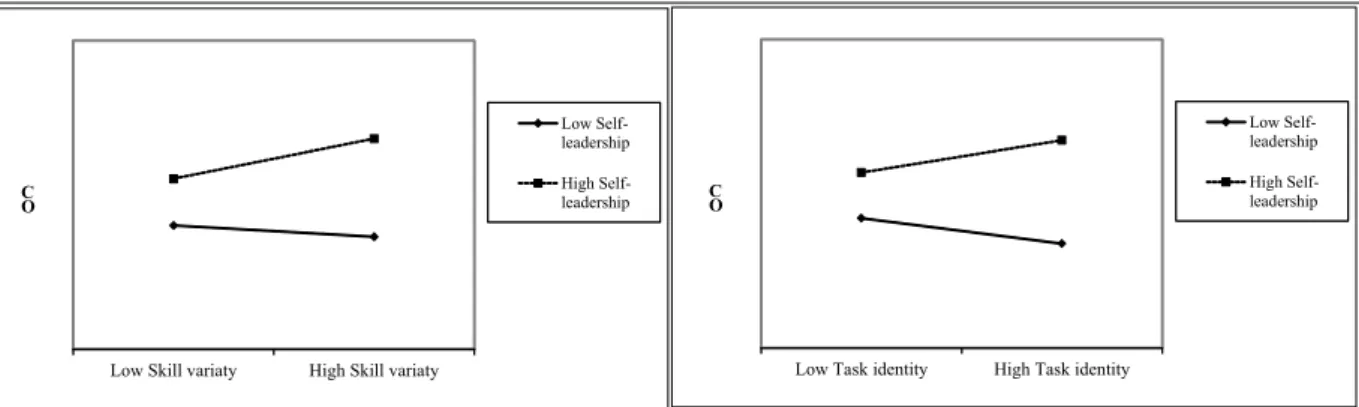
The results of multiple regression analysis showed that self-leadership had moderation effect between the interaction term of skill variety (β= .207, p<.01), and between the inter- action term of task identity (β= .237, p<.01) was statistically sig- nificant, respectively. So, hypothesis <4-1> and <4-2> was supported. But the interaction term of task significant, autonomy and feedback was not significant, respectively (see, Table 4).

So, hypothesis <4-3>, <4-4>, <4-5> was not supported. In addi- tion, self-leadership had moderation effect between organizational commitment and organizational citizenship behavior. Therefore, hypothesis 5 was supported, too.

5. Conclusions and Research Limitations

In this study, we were looking for the antecedents variables to provide that the employees could give good quality services by themselves despite of worked at inferior environment in the era of one-day life zone throughout the nation owing to ex- pansion of expressway infrastructure and passenger cars as well as 5-days workweek to increase expressway rest areas.

Especially, the study investigated characteristics of the employ- ees from point of view of 'Y' theory of McGregor (1957) who were ready to be responsible to have strong desire of self-de- velopment and to cognize fruitfulness at accomplishment. And, the study investigated moderating factors as well as mediating

factors. This study selected organizational citizenship behavior that could help the employees develop organization, and it adopted external factor of job characteristics that could have in- fluence upon organizational citizenship behavior. In this study, we added build up research model such as commitment was likely to mediate between job characteristics and organizational citizenship behavior. Self-leadership that was important to im- prove inferior environment was likely to have affirmative influ- ence between job characteristics and commitment, and between commitment and organizational citizenship behavior, respectively.

The study was the first research with precedence variable of job characteristics, mediating variable of organizational commit- ment and moderating variable of self-leadership that had influ- ence upon organizational citizenship behavior of the employees:

And, the study gave several findings and implications: First, sub-factors of job characteristics had positive influence upon or- ganizational commitment of the employees, and organizational commitment had positive influence upon organizational citizen- ship behavior. Therefore, company of expressway rest areas needed to design jobs to let the employees be satisfied with self-realization, fruitfulness, acknowledgment, responsibility and upper grade desires. At multiple regression analysis, factors of job characteristics had positive influence upon task significance and feedback only and had no influence upon skill variety and autonomy, and task identity had negative influence upon organ- izational commitment. These results reflected that the employees who worked in expressway rest areas with very much simple task and mechanically working upon request of so many customers. Therefore, it means that job redesign such as job enrichment and job enlargement can be considerably helpful for affirmative influence. And a variety of training was needed to let the employees cognize that their jobs were connected with cus- tomers' satisfaction and loyalty. Second, the results of mediation effects showed that organizational commitment was partially mediated between sub-factors of job characteristics and organ- izational citizenship behavior, and self-leadership between organ- izational commitment and organizational citizenship behavior, too.

These results indicated that we considered antecedents to in- crease the level of organizational commitment apart from sub-factors of job characteristics suggested by previous studies.

And, employees should cognize values of self-leadership that members could increase efficiency and make efforts for organ- izations by their own efforts, and should set up their own direc- tions and create environment for motivation and give vision.

Finally, the results of moderation effect of self-leadership

showed that self-leadership was thought to be very much im-

portant to let members make efforts by themselves in order to

promote the competitiveness of the expressway rest areas, be-

cause self-leadership had moderation effect upon skill variety,

task identity and organizational commitment that were not sig-

nificant at multiple regression analysis.

(7)

Low Skill variaty High Skill variaty O C

Low Self- leadership High Self- leadership

Low Task identity High Task identity O C

Low Self- leadership High Self- leadership

<Figure 2> Moderation effect of self-leadership between job characteristics and organizational commitment

Not only skill variety but also job identity had less influence than other sub-factors of job characteristics compared than task significance, the results of interaction term multiplied by self-leadership could develop organizational commitment. And in- teraction term multiplied by organizational commitment self-lead- ership could develop organizational citizenship behavior, too(see.

Figure 3). Theses results proposed that when the employees were given vision for higher self-leadership to have opportunity of doing by themselves through belief and empowerment that they could do, they could decrease turnover rate to provide cus- tomers with good quality service.

Low OC High OC

O C B

Low Self- leadership

High Self- leadership

<Figure 3> Moderation effect of self-leadership between organizational commitment and organizational citizenship behavior

There are at least several potential limitations in this study that need to be considered. First, because the subjects of this study have been limited only to members of expressway rest areas near Seoul, the possibility for generalization may be said to be quite low. And, the study made use of self-report ques- tionnaire has problems of hindsight bias and is based on cross-sectional study. So, further studies shall discover and de- velop objective scale and investigate by longitudinal study to overcome problems of cross-sectional study.

References

Andrasik, F., & Heimberg, J. S. (1982). Self-management procedures.

In L.W. Frederikson (Ed.), Handbook of organizational behavior management (pp. 219-247). New York: Wiley.

Ang, S., Van Dyne, L., & Begley, T. M. (2003). The employ- ment relationships of foreign workers versus local em- ployees: A field study of organizational justice, job sat- isfaction, performance, and OCB. Journal of Organizational Behavior, 24(5), 561-583.

Bandura, A. (1986). Social foundations of thought and action: A social cognitive theory. Englewood Cliffs, NJ: Prentice-Hall.

Baron, R. M., & Kenny, D. A. (1986). The moderator-mediator var- iable distinction in social psychological research:

Conceptual, strategic, and statistical considerations. Journal of Personality and Social Psychology, 51(6), 1173-1182.

Beck, A. T., Rush, A. J., Shaw, B. F., & Emery, G. (1979).

Cognitive theory of depression. New York: Guilford Press.

Breaugh, J. A., & Becker, A. S. (1987). Further examination of the work autonomy scales: Three studies. Human Relation, 40(6), 381-399.

Burns, D. D. (1980). Feeling good: The new mood therapy. New York: William Morrow.

Carver, C. S., & Scheier, M. F. (1981). Attention and self-regu- lation: A control theory approach to human behavior.

New York: Springer-Verlag.

Cautela, J. R. (1969). Behavior therapy and self-control:

Techniques and applications. In C.M. Franks (Ed.), Behavioral therapy: Appraisal and status (pp. 323-340).

New York: McGraw-Hill.

Cho, Sun-Bai, Kim, Selk-Young., & Jeong, Seung-Hwan (2009).

The Effect of Hotel & Restaurant Employee’s Job Characteristics on the Group Cohesiveness, Job Satisfaction, and Job Commitment. Korea Academic Society of Hotel Administration, 18(4), 201-215.

Choi, Byung-Woo, & Jang, Ik-Hwan (2004). Extension and

Evaluation on Job Characteristic Model of Job

Satisfaction: focused on the Small and Medium Sized

Firms in Gyeongin Area. Journal of Industrial Economics

and Business, 17(6), 2315-2334.

(8)

Choi, Young-Ki, & Lee, Yoon-Young (2007). A Study on the Relationship between Hotel Employee’s Job Characteristics, Reward Satisfaction and Organizational Efficiency. Journal of Hospitality and Tourism Studies, 9(1), 167-181.

Deci, E., & Ryan, R. (1985). The support of autonomy and con- trol of behavior. Journal of Personality and Social Psychology, 53, 1024-1037.

Ellis, A. (1977). The basic clinical theory of rationale motive therapy. New York: Springer.

Hackman, J. R., & Oldham, G. R. (1976). Motivation through the design of work: Test of a theory. Organizational Behavior and Human Performance, 16, 250-279.

Houghton, D., & Neck, C. P. (2002). The revised Self-Leadership Questionnaire: Testing a hierarchical fac- tor structure for self-leadership. Journal of Managerial Psychology, 17(8), 672-691.

Houghton, J. D., & Yoho, S. K. (2005). Toward a contingency model of leadership and psychological empowerment:

when should self-leadership be encouraged?. Journal of Leadership & Organizational Studies, 11(4), 65-83.

James, A. S. (1993). Productivity loss in performance group: A motivation analysis. Psychological Bulletin, 113(1), 67-81.

Jeong, Yeong-Ju (2003), The Research Regarding an Express Highway Rest Smallness Service and Menu Satisfactory Degree. Korea Academic Society of Tourism Information, 15, 169-190.

Joo, Hyun-Sik, & Lim, Geun-Wook (2007). A Study of the differ- ence Analysis for the Job Characteristics of Convention Center Employee and Organization Immersion:

Organization Citizen Action. Journal of Convention Sciences, 15, 69-87.

Ju, Yoon-Hwang., Cho, Hee-Young., & Yang, Hoe-Chang (2013).

The Impact of New Silver-Generation Consumer’s Perceived Quality of Service and the Service Provider’s Organizational Citizenship Behavior on Consumer Response: Perspective of Consumer’s Person-Environment Fit. Journal of Convergence Information Technology (JCIT), 13, August. 233-245.

Kang, Gi-Du (2010). Service Marketing. Seoul: Booknet.

Kang, Sung-Ju, Kim, Jae-Yeong, & Park, Young-Kyun (2011).

Th Effects of the Attractiveness of an Internet Shopping Mall and Flow on Affective Commitment, Journal of Distribution Science, 9(4), 29-42.

Kanfer, F. H. (1970). Self-regulation: Research, issues, and speculations. In C. Neuringer & J. L. Michael (Eds.), Behavioral Modification in Clinical Psychology (pp.

178-220). New York: Appleton-Century-Crofts.

Kiggundu, M. N. (1983). Task interdependence and job design:

Test of Theory. Organizational Behavior and Human Performance, 31(2), 145-155.

Kim, Ki-Young, & Ham, Hyung-Man (2001). A Study on the Vitalizations Plan of Restaurants Menu at Resting Places in the Expressway. Tourism Research, 15, 17-41.

Kim, Min-Joo, & Han, Sook-Young (2006). A Comparative Study on Perceived Job Characteristics and its Outcomes of

Hotel Employees in Korea and America: Based on Job Characteristics Model of Hackman and Oldman. Journal of Hospitality and Tourism Studies, 8(1), 65-78.

Lee, Chul-Soo (2013). A Development of the Design Guidelines for Connecting roads in Highway Rest Areas. Seoul, Korea: Thesis for Doctorate in Hanyang University.

LePine, J. A., Erez, A., & Johnson, D. E. (2002). The nature and dimensionality of organizational citizenship behavior:

a critical review and meta-analysis. Journal of Applied Psychology, 87, 52-65.

Lyu, Myoung-Keun, & Yang, Hoe-Chang (2013). Th Effect of Trust and Justice on Relation Satisfaction and Long-term Commitment in Frenchise Business, Journal of Distribution Science, 11(1), 25-34.

Luthans, F., & Davis, T. (1979). Behavioral self-management (BSM): The missing link in managerial effectiveness.

Organizational Dynamics, 8, 42-60.

Mahoney, M. J., & Arnkoff, D. B. (1978). Cognitive and self-con- trol therapies. In S. L. Garfield & A. E. Borgin (Eds.), Handbook of psychotherapy and therapy change (pp.

689-722). New York: Wiley.

Mahoney, M. J., & Arnkoff, D. B. (1979). Self-management:

Theory, research, and application. In J. P. Brady & D.

Pomerleau (Eds.), Behavioral medicine: Theory and prac- tice (pp.75-96). Baltimore: Williams and Williams.

Manz, C. C. (1986). Self-leadership: Toward an expanded theory of self-influence processes in organizations. Academy of Management Review, 11, 585-600.

Manz, C. C., & Neck, C. P. (2004). Mastering self-leadership:

Empowering yourself for personal excellence (Third edi- tion). Upper Saddle River, NJ: Prentice Hall.

Manz, C. C., & Sims, H. P., Jr. (1980). Self-management as a substitute for leadership: A social learning perspective.

Academy of Management Review, 5, 361-367.

Manz, C. C., & Sims, H. P., Jr. (2001). The new Super Leadership:

Leading others to lead themselves. San Francisco, Berrett-Koehler.

Mathieu, J. E., & Zajac, D. M. (1990). A review and meta-analy- sis of the antecedents, correlates, and consequences of organizational commitment. Psychological Bulletin, 108, 171-194.

McGregor, D. (1957). An uneasy look at performance appraisal.

Boston, Massachusetts: Soldiers Field.

Moon, Huoung-Koo, & Kim, Kyoung-Seok (2006). A Critical Review on OCB Studies in Korea. Korean Management Review, 35(2), 609-643.

Mowday, R. T., Porter, L. W., & Steers, R.M. (1982). Employee- Organization Linkages. San Diego, CA: Academic Press.

Mowday, R. T., Steers, R. M., & Porter, L. W. (1979). The measurement of organizational commitment. Journal of Vocational Behavior, 4, 224-247.

Northcraft, G. B., & Neale, M. A. (1990). Organizational behavior:

A management challenge, Forth Worth: The Dryden Press.

Nunnally, J. C. (1978). Introduction to Psychological Measurement.

New York: McGraw-Hill.

Organ, D.W. (1988). Organizational citizenship behavior: The good

(9)

soldier syndrome. Lexington, MA: Lexington Books.

Porter, L.W., Steers, R. M., Mowday, R. T., & Blulian, P. V.

(1974). Organizational commitment, job satisfaction, and turnover among psychiatric technicians. Journal of Applied Psychology, 59, 603-609.

Scholl, R. W. (1981). Differentiating organizational commitment from expectancy as a motivating force. Academy of Management Review, 6, 589-599.

Seligman, M. E. P. (1991). Learned optimism. New York: Alfred Knopf.

Shore, L. M., & Wayne, S. J. (1993). Commitment and employ- ee behavior: comparison of affective commitment and continuance commitment with perceived organizational support. Journal of Applied Psychology, 78(5), 774-780.

Sims, H. P. JR., Szilagyi, A. D., & Keller, R. T. (1976). The Measurement of Job Characteristics. Academy of Management Journal, 19(2), 195-212.

Smith, C. A., Organ, D. W., & Near, J. P. (1983). Organizational Citizenship Behavior: It’s Nature and Antecedents. Journal of Applied Psychology, 68(4), 653-663.

Steers, W. D. (1997). Physiology and pharmacology of the blad- der and urethra. In Campell's Urology, ed. Walsh, P., Retic, A., Vauguhan, E.D., & Wein, A., pp. 870-915. W.

B. Saunders, Philadelphia, USA.

Srinivasan, R. (2012). Service Marketing, The Indian Context, New Delhi; PHI Learning Private Limited.

Thakor, M. V., & Joshi, A. W. (2003). Motivating salesperson customer orientation: Insights from the job characteristics model. Journal of Business Research, 58(5), 584-592.

Thoresen, C. E., & Mahoney, M. J. (1974). Behavioral self-control. New York: Holt, Rinehart, and Winston.

Wiener, Y. (1982). Commitment in organizations: A normative view. Academy of Management Review, 7, 418-428.

Yang, Hoe-Chang, & Lee, Young-Chul (2009). An Empirical Study in Relationship between Franchisor’s Leadership Style and Franchisee’s Revenue: Mediating Effect of Commitment and Moderating Effect of Motivation, Journal of Distribution Science, 7(4), 5-14.

Yang, Hoe-Chang, Kim, Sung-Il, Park, Young-Ho, & Lee, Shang-Nam (2011). A Study on the Relationship be- tween the Degree of Awareness on Low Carbon Green Growth and the Organizational Commitment Focused on the Traditional Retailers, Journal of Distribution Science, 9(3), 37-46.

Yang, Hoe-Chang, & Tasnuva, K. (2013), Issues of Workplace

in Korea: How to Inspire Temporary Workers?. East

Asian Journal of Business Management, 3(1), 23-27.

수치

Figure  3).  Theses  results  proposed  that  when  the  employees  were  given  vision  for  higher  self-leadership  to  have  opportunity  of  doing  by  themselves  through  belief  and  empowerment  that  they  could  do,  they  could  decrease  turno

참조

관련 문서

This study will verify what effect of leadership behavior characteristics has on organizational citizenship behavior on the subject of college students in Korea and China to

NO Hypothesis Results 1-1 Self-leadership of the researcher will have a positive(+) effect on self- efficacy Adopted 1-2 Self-leadership of the researcher will have a

선행연구를 바탕으로 본 연구에서 사용할 변수들의 인 과관계를 설정한 경로모형을 설계하였다. 모형의 독립변 수와 매개변수, 종속변수 간의 관계는 위의

The purpose of this research is to study empirically the relationship between servant leadership and organizational effectiveness and more importantly the

Nevertheless, results of this study indicated that albeit job satisfaction of newly-employed nurses could be improved by solely strengthening self- leadership, adoption of

Authentic leadership and perceived organizational support are effected as a direct positive effect on job engagement, and the influence of perceived

When investigating analysis result, first, as the result of investigating the relation between emotional leadership and job insecurity, self-recognition ability

Key Words : Authentic Leadership, Self-Awareness, Internalized Moral Perspective, Relational Transparency, Balanced Processing of Information, Organizational