574 Corresponding author: [email protected]✽
청상아리
( Isurus oxyrinchus )
껍질 콜라겐의 물리 화학적 특성박순형・김태완・김선봉✽
부경대학교 식품공학과/식품연구소
Characterization of Physicochemical Properties of Collagen from Shark (Isurus oxyrinchus) Skin
Soon-Hyung Park, Tae-Wan Kim and Seon-Bong Kim✽
Department of Food Science and Technology/Institute of Food Science, Pukyong National University, Busan 608-737, Korea
Acid- and pepsin-solubilized collagens were extracted from the skin of shark (Isurus oxyrinchus) and their physicochemical properties were characterized by amino acid analysis, SDS-PAGE, the composition of collagen types, solubility and denaturation temperature. Acid - and pepsin-solubilized collagens from shark skin had an imino acid of 188.8 and 186.2 residues/1,000 amino acids, respectively. SDS-PAGE showed two differentα chains (α1 and α2) and β-component. The component ratio of type I and V was 10:1, and the type III was not found. Solubility of acid-soluble collagen was low in the range of pH 6.0 to pH 11.0. On the other hand, pepsin-solubilized collagen showed a low solubility in the range of pH 7.0-9.0.
Temperature for denaturation of acid- and pepsin-solubilized collagens were 25℃ and 27℃, respectively.
Key words : Collagen, Shark, Isurus oxyrinchus, Physicochemical properties
서 론
Collagen은 척추 동물의 총 단백질의 20~30%를 차지하며 (Harkness, 1961), 주로 조직이나 장기를 지탱하면서 체표를 둘러싸고 있어 체형을 유지시키는 역할을 한다 (Piez, 1985).
Collagen은 3중 나선구조로 이루어져 있으며, 그 일차 구조는 -Gly-X-Y-의 반복적인 순서를 취하고 있으며, X와 Y 위치에 proline과 hydroxyproline이 많은 특징이 있다 (Bellaet al., 2006). 콜라겐을 이루는 기본단위인 tropocollagen은 분자 내 또는 분자간의 공유결합성 cross linkage에 의해 물리, 화학적 으로 안정한 구조를 이루고 있다 (McClain et al., 1971).
Collagen은 현재 25종류 이상 (Type I-XXV) 보고 되고 있으 며 (Deyl et al., 2003), 크게 fibrous collagen (Type I, II, III, V, and XI), network collagen (Type IV, VIII, and X), Filamentous collagen (Type VI), fibril associated collagen (Type IX, XII, and XIV) 등으로 나누어진다 (Bailey, 1998). 그 중 type I collagen은 가장 연구가 많이 된 collagen이며, 뼈의 유기 질량 의 90% 이상을 형성하고 두뇌, 수정체 등과 같은 몇몇 조직을 제외하고 힘줄, 피부, 인대, 각막 등 많은 결합조직의 구성 성분으로 되어 있다 (Gelse et al., 2003).
어류 콜라겐에 대한 연구로는 yellowfin tuna (Thunnus albacares) (Woo et al., 2008), bigeye sn0apper (Priacanthus tayenus) (Nalinanon et al., 2007), deep-sea redfish (Sebastes mentella) (Wang et al., 2008), channel catfish (Ictalurus punctaus) (Liu et al., 2007), minke whale (Balaenoptera acutorostrata)
(Nagai et al., 2008), black drum (Pogonias cromis)와 sheepshead seabream (Archosargus probatocephalsu) (Ogawa et al., 2003), nileperch (Lates niloticus) (Muyonga et al., 2004) 등을 이용하 여 추출조건, 물리화학적 특성 등 다양한 연구가 보고되었다.
Collagen은 이러한 생체 조직에서의 중요성 외에도 세포의 증식과 기관의 형성, 상처의 치유 촉진 등의 생리기능성에도 큰 영향을 미칠 뿐 아니라 식품산업에서 젤라틴의 원료로서 중요한 비중을 차지하고 있고, 항 피부노화 (Kwon et al., 2008), 피부 탄력개선(Kwon et al., 2007), 관절염 예방 (Hu et al., 2003), 혈관이나 인대 등의 인공 장기 (Lee et al., 2001) 등으로 용도가 확대되고 있다.
현재 유통되고 있는 collagen 제품은 주로 소, 돼지 등 육상 동물에서 유래한 것으로 최근 전파성 해면성 뇌증 (Transmissible spongeiform encephalopathies : TSE)의 종류인 광우병 (bovine spongiform encephalopathy) 등으로 인한 인간 광우병 (variant Creutzfeldt-Jakob disease)등의 전이의 위험성과 구제역 (Foot-and-mouth disease:FMD) 등의 위험으로 위생적 안전성 에 대한 소비자의 우려가 사회적으로 대두되어 천연의 안전성 이 확보된 새로운 원료 소재에 대한 연구가 요구되고 있는 실정이다 (Trevitt et al., 2003; Epstein, 2005; Helcke, 2000).
현재 전 세계적으로 1년에 900만 마리에 가까운 상어가 어획되고 있으며 (FAO, 2006), 그에 따른 껍질, 뼈 등 가공 부산물이 상당량 배출되고 있으나 대부분 이용도가 낮아 폐기 되어 자원 낭비는 물론 환경오염의 원인이 되기도 한다. 이러 한 일면에서 상어 가공 부산물인 상어의 껍질을 콜라겐 및 젤라틴과 같은 산업적 소재로 이용할 수 있다면 그 의미는 매우 크다 할 수 있다.
따라서, 본 연구에서는 청상아리 (Isurus oxyrinchus) 껍질로 부터 collagen을 추출 분리하여 아미노산분석, 전기영동, 콜라 겐 type별 조성, 용해도 및 변성온도 등을 측정하여 그 물리화 학적 특성을 해석하였다.
재료 및 방법 재료
본 실험에는 상어가공 부산물인 청상아리 (Isurus oxyrinchus) 껍질을 선영 (주) (부산, 한국)에서 냉동 상태로 제공받아 해동 후 협잡물을 제거하여 시료로서 사용하였다. 그 밖의 시약으 로는 chloramine T, ρ-dimethylaminobenzaldehyde, acid soluble kangaroo Type I collagen (E.C. 232-697-4)을 Sigma-Aldrich Co. (U.S.A)에서 구입하여 이용하였으며, 이 외에 사용한 모든 시약은 연구용 특급품을 사용하였다.
Acid- 및 pepsin-solubilized collagen의 제조 Acid- 및 pepsin-solubilized collagen은 Ogawa et al. (2003)의 방법을 수정하여 제조하였다. 상어껍질을 2~3 cm로 세절한 후, 수세하여 불순물을 제거한 다음 원료량의 5 배 (v/w)의 0.15 N NaOH 용액을 사용해 4℃에서 17 시간 동안 알칼리 처리를 하였다. 그리고 중화 및 수세를 하고, 원료량의 20 배의 0.5 N acetic acid 용액을 가해 4℃에서 48 시간 동안 collagen을 추출하였다. Acetic acid 용액으로 산 가용성 collagen을 추출한 다음 이 추출액에 최종 농도가 5%되게 NaCl 용액을 가하여 염석 시키고, 중화 시켜 10,000×g에서 1 시간 동안 원심분리 하여 침전물을 수 차례 수세한 뒤 동결 건조해 서 acid-soluble collagen을 얻었다. 그 후 동결건조 시킨 산 추출 잔사물을 다시 0.5N acetic acid에 suspension 시키고 pepsin을 건조중량대비 1%를 가해 4℃에서 48시간 추출하였 다. 이 추출액에 최종 농도가 5%되게 NaCl 용액을 가하여 염석 시키고, 중화 시켜 10,000×g에서 1 시간동안 원심분리 하여 침전물을 수차례 수세한 뒤 동결건조해서 pepsin- solubilized collagen을 얻었다.
Collagen의 정량
Collagen의 함량은 Goll et al. (1963)의 방법에 따라 hydroxyproline을 정량한 다음 계수 7.25를 곱한 값으로 하였 다. 한편 hydroxyproline은 Bergman and Loxely (1963)의 방법 을 약간 수정하여 정량하였다. 시료 약 50-100 mg을 정칭하여 pyrex tube (16×150 ㎜)에 넣고, 6 N HCl 5 mL를 가하여 봉한 후 110℃의 dry bath (Thermolyne DRI-BATH, Model DB28125, Thermolyne, U.S.A)에서 24시간 가수분해하였다. 분해액을 glass filter로 여과하고 감압건조하여 HCl을 제거한 다음, 2 mL의 acetate/citrate buffer (pH 6.0)를 가한 후 0.3 M NaCl로서 25 mL로 정용하여 시료액을 조제 하였다. 시료액에서 300 μL을 평취하여 7% (w/v) chloramine T 수용액과 acetate/citrate buffer로서 조제된 oxidant solution과 isopropanol을 각각 600, 300 μL을 가한 다음 4 시간 방치시킨 뒤, 2 g의 ρ -dimethylaminobenaldehyde를 3 mL의 60% perchloric acid에
녹인 용액과 isopropanol의 혼합용액 (3:13)인 Ehrlich's 시약 4 mL 가하고, 60℃에서 25 분간 수욕상에서 반응시킨 뒤 558 nm에서 흡광도를 측정하여 hydroxyproline의 량을 계산하였 다.
SDS-polyacrylamidegel electrophoresis (SDS-PAGE) Laemmli (1970)의 방법에 따라 6% resolving gel을 slab겔 용 유리판에 충전하고 그 상부에 5% stacking gel을 충전한 다음, 상온에서 1 시간 동안 방치하여 고분자를 중합시켰다.
그리고 tracking dye와 동량의 시료를 혼합하고 5분간 100℃의 수욕상에서 반응시킨 후 단백질량이 50 ㎍ 되도록 조제한 시료를 농축용 겔 상부에 충전시킨 다음 200 V, 80 mA의 조건에서 전기영동을 하였다. 전기영동이 끝난 겔은 coomassive brilliant blue R-250용액으로 염색한 다음, 탈색, 건조하여 단백 질 band를 확인하였다.
Type 별 collagen의 분리
Morales et al. (2000)의 방법을 약간 수정하여 추출, 정제된 collagen을 type I, III, V로 분리하였다. 즉, 0.5 M acetic acid에 가용시킨 다음 최종농도가 0.45 M 되게 NaCl을 가한 후, 11℃
에서 18시간 교반시켜 35,000×g에서 30분간 원심분리하여 잔사를 탈염, 동결건조시켜 type I으로 하였고, 상층액에 NaCl 을 가하여 최종농도가 각각 2 M, 0.9 M 되게 한 후 염석시켜 10,000×g에서 20분간 원심분리하여 잔사를 탈염, 동결건조시 켜 각각 type V, III로 하였고, 비율은 건조된 시료의 무게의 비로 하였다.
아미노산의 분석
아미노산은 collagen 약 5 ㎎을 정칭하여 ampoule에 넣고 6 N HCl 3 mL를 가하여 봉한 후 110℃의 dry bath (Thermolyne DRI-BATH, Model DB28125, Thermolyne, U.S.A)에서 24 시간 가수분해하였다. 분해액을 glass filter로 여과하고 감압건고하 여 HCl을 제거한 다음, 증류수 10 mL 가하여 다시 감압 건고한 후 구연산완충용액 (pH 2.2, Sigma-Aldrich Co., U.S.A)을 사용 하여 25 mL로 정용하였다. 이의 일정량을 취하여 Spackman et al. (1958)의 방법에 따라 아미노산 자동분석기 (LKB4150 α)로 분석하여 정량하였다.
용해도의 측정
Yamashita et al. (1975)의 방법에 따라 0.1 N acetic acid에 1% (w/v)가 되게 collagen을 용해시킨 후 0.1 N HCl 및 0.1 N NaOH 용액으로 pH를 조절하여 20℃에서 30 분간 교반 한 다음, 원심분리 (2,000×g, 15 min)하여 Lowry (1951)법으로 상층액의 가용성 질소를 측정하였다. 용해도는 pH 3일 때의 값을 100으로 하여 각 pH 별 상대 용해도로 나타내었다.
변성온도의 측정
0.1 N acetic acid에 시료 collagen을 4℃에서 10 ㎎/mL의 농도로 용해시켜 rheometer (Rheostress 1 RS30, HAAKE Co., Ltd., Germany)를 이용해 30 분 동안 4-45℃로 온도를 변화 시키면서 G″를 측정하여 값이 초기 값의 절반이 될 때 온도를
변성온도(Td)로서 측정하였다.
결과 및 고찰 아미노산 조성
Acid- 와 pepsin-solubilized collagen의 아미노산 조성을 kangaroo tail type I collagen과 비교하여 Table 1에 나타내었다.
전체적으로 kangaroo tail type I collagen과 유사했으며, glycine 의 함량이 30% 이상을 차지하였고, 상어 껍질 collagen은 필수 아미노산의 함량이 아미노산 1,000 잔기당 139로 비교적 높아 영양적 가치가 있다고 하겠다. Acid-soluble collagen와 pepsin-solubilized collagen의 hydroxyproline 함량이 각각 아미 노산 1,000 잔기당 95.8, 91.0으로 나왔으며, Acid soluble collagen 와 pepsin-solubilized collagen의 imino acid (hydroxyproline+ proline) 의 함량은 각각 188.8과 186.2가 나왔는데, kangarootail type I collagen의 198.3보다 약간 낮았다. yellowfin tura (T. albacares) 등껍질 collagen의 imino acid의 함량은 205였고 (Woo et al., 2008), black drum (P. cromis)의 acid soluble collagen과 pepsin-solubilized collagen의 imino acid의 함량은 각각 199.8, 197.1이었으며, sheepshead seabream (A. probatocephalus)의 acid soluble collagen과 pepsin-solubilized collagen의 imino acid 의 함량은 각각 205.1, 198.1 이었다 (Ogawa et al., 2003).
nileperch (L. niloticus)의 acid soluble collagen의 imino acid 함량 은 치어가 193, 성어가 200이 나왔다 (Muyonga et al., 2004).
Imino acid 함량은 gelatin의 품질에 중요한 영향을 미치는데 imino acid의 함량이 높을수록 점탄성과 겔강도가 증가한다고 알려지고 있다 (Gómez-Guillén et al., 2002).
Table 1. Amino acid composition of collagens
(Number of Residues/1000 Amino Acids) Kangaroo
tail collagen
Shark skin acid soluble
collagen
Shark skin pepsin-solubilized
collagen
Threonine 17.5 21.8 23.2
Valine 23.1 23.3 21.7
Methionine 9.9 10.2 11.0
Isoleucine 11.5 21.1 11.2
Leucine 26.4 27.9 32.1
Phenylalanine 14.5 13.3 13.5
Lysine 33.3 18.0 17.1
Histidine 9.1 9.5 9.1
Arginine 54.3 54.1 59.0
Aspartic acid 35.0 47.4 48.1
Gulutamic acid 83.0 89.2 85.1
Serine 35.9 49.7 50.1
Glycine 334.0 328.6 325.6
Alanine 104.6 94.6 102.9
Tyrosine 3.6 2.6 4.1
Proline 95.3 93.0 95.2
Hydroxyproline 109.0 95.8 91.0
전기영동 특성
상어 껍질로부터 추출한 acid- 및 pepsin-solubilized collagen 의 SDS-PAGE를 실시한 결과는 Fig. 1과 같다. Acid soluble collagen과 pepsin-solubilized collagen은 동일한 pattern을 보였 고 α1, α2의 band를 가지는 heterotype의 tropocollagen이었으 며, kangarootail type I collagen의 pattern과는 다소 α1, α2의 이동도가 달랐으며, β band를 가지고 있었다.
Ayu (Plecoglossus altivelis)의 뼈 collagen의 경우에는 분자 내외에 crosslinked components가 많아 각 α chain이 불명확하 다고 하였으며 (Nagai et al., 2000a), 또 고등어 껍질 collagen은 α1 chain 하나만을 가지는 homotype의 tropocollagen이었으며 (Kimura et al., 1988), minke whale (B. acutorostrata) unesu (Nagai et al., 2008) 와 nileperch (L. niloticus) 껍질 (Muyonga et al., 2003) collagen은 상어껍질 collagen의 경우와 마찬가지 로 α1과 α2를 가지는 heterotype의 tropocollagen이었다. 한편 yellowfin tuna (T. albacares) (Woo et al., 2008), brownstripe red snapper (L. vitta) (Jongjareonrak et al., 2005), black drum (P. cromis)와 sheepshead seabream (A. probatocephalus) (Ogawa et al., 2003) collagen은 α1과 α2 chain과 β와 γ components를 가졌다.
Fig. 1. SDS-polycarylamide gel electrophoresis of shark skin and kangaroo tail type I collagen.
(A), kangaroo tail acid soluble type I collagen;
(B), shark skin acid soluble collagen;
(C), shark skin pepsin-solubilized collagen.
상어껍질 collagen의 type 별 조성
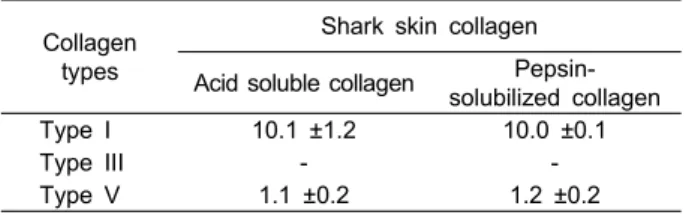
상어껍질 acid soluble collagen과 pepsin-solubilized collagen 을 껍질 collagen의 대부분을 차지하는 type I, III과 V 별로
Table 2. Amount ratio of shark skin collagen types
Collagen types
Shark skin collagen Acid soluble collagen Pepsin-
solubilized collagen
Type I 10.1 ±1.2 10.0 ±0.1
Type III - -
Type V 1.1 ±0.2 1.2 ±0.2
분리하여 그 조성비를 Table 2에 나타내었다. 그 결과 acid soluble collagen, pepsin-solubilized collagen 모두 type III는 발견되지 않았고 type I과 V의 비가 10:1로 나타났는데, 두족류 의 껍질 collagen 의 경우 상어껍질 collagen과 마찬가지로 type I이 V의 8~10배로 많은 함량을 가지고 있다고 했다 (Morales et al., 2000).
Collagen은 type I 이 전 collagen의 85~90%를 차지하며, type I을 제외하고는 연골 조직중에 type II와 IV 그리고 많은 기관에 다양하게 분포하는 III와 V가 있으며, 이 밖에도 다양 한 type의 collagen이 존재한다 (Friess, 1998). Collagen type III는 육상동물에서 type I의 주위에 분포하여 collagen 구조를 단단하게 유지시키는 역할을 하는데, 해상 동물의 경우에는 type V가 대신 수행한다고 볼 수 있다 (Brik et al., 1990). 따라서 상어껍질 collagen은 섬유형 type I이 주로 존재하며, type V가 구조를 견고하게 유지시키는 역할을 한다고 생각된다.
용해도
Acid soluble collagen과 pepsin-solubilized collagen의 용해도 에 대한 pH의 영향을 알아본 결과는 Fig. 2와 같다. Acid soluble collagen은 pH 5이하에서 용해도는 높았지만 pH 6에서 11까지 는 거의 용해되지 않았으며, pH 12이상에서 22%의 용해도를 보였다. Pepsin-solubilized collagen은 pH 7에서 9까지는 낮은 용해도를 보였으나 산성영역과 알칼리 영역으로 갈수록 용해 도는 급격히 증가하였다. 이와 같은 현상은 산가용화 collagen 이 산성영역에서 재용해가 일어나 용해도가 증가한 것으로 생각된다.
Fig. 2. Effect of pH on solubilities of shark skin collagens.
Relative solubility(%) was indicated as the solubility at given pH against the solubility at the pH 3.
Fig. 3. Dynamic viscosity of shark skin collagens.
The concentration of collagen is 10 mg/mL, and the loss modules G'' are plotted against temperature.
등전점에서는 단백질 하전이 전기적으로 중성이 되어 점 도, 팽윤도 및 용해도가 가장 낮아지는데, 우피 collagen의 용해도는 pH 5~8 범위에서 제일 낮았고, 이 pH 범위를 벗어나 산성 및 알칼리성에서 용해도는 증가하였으며, 염농도가 높을 수록 collagen 용해도는 증가하였고, 인산염은 산성측에서보 다 알칼리측에서 용해도는 증가되었다고 보고된 바 있다 (Ranganayaki et al., 1982). yellowfin tuna (T. albacares)의 등껍 질 collagen은 pH 6~9에서 용해도가 급격히 낮아졌으며 (Woo et al., 2008), tiger puffer (Takifugu rubripes), dushy spinefoot (Siganus fuscescens) 껍질 collagen은 pH 6~10에서, sea chub (Kyphosus bigibbus), eagle ray (Myliobatis tobijei)와 red stingray (Dasyatis akajei) 껍질에서 추출한 collagen의 용해도는 pH 7~10에서, yantai stingray (Dasyatis laevugata) 껍질 collagen은 pH 8~10에서 용해도가 가장 낮았다 (Bae et al., 2008). 또 어류 collagen의 용해도는 포유동물의 그것에 비해 표본의 연령과 영양상태에 크게 의존하지 않는다고 보고하였다 (Love, 1976).
변성온도
Acid soluble collagen과 pepsin-solubilized collagen의 변성온 도 (Td)를 측정한 결과는 Fig. 3과 같다. Acid soluble collagen와 pepsin-solubilized collagen의 Td는 각각 25℃와 27℃로 kangaroo tail type I collagen의 변성온도 37℃보다 약 10℃
정도 낮았다.
이 같은 결과는 kangaroo tail type I collagen의 아미노산 조성 중 hydroxyproline의 함량이 높았기 때문이라 생각된다.
Collagen의 변성온도는 hydroxyproline의 함량에 비례한다고 알려져 있다 (Doty and Nishihara, 1958). 또한 proline과 hydroxyproline이 모두 collagen의 변성온도와 관계가 있으며 (Piez and Gross, 1960), Gly-Pro-Ala, Gly-Pro-Hyp 등의 아미노 산 배열이 적으면 변성온도가 낮아진다고 했다 (Kimura, 1971).
Yellowfin tuna (T. albacares)의 등껍질 collagen의 변성온도
는 32℃였고 (Woo et al., 2008), rhizostomous (Rhopilema asamushi)의 변성온도는 28.8℃였으며 (Nagai et al., 2000b), black drum (P. cromis)의 acid soluble collagen과 pepsin- solubilized collagen의 변성온도는 각각 34.2℃, 35.8℃이었으 며, sheepshead seabream (A. probatocephalus)의 경우는 각각 34.0℃, 34.3℃ 이었다 (Ogawa et al., 2003). nileperch (L.
niloticus)의 acid soluble collagen의 변성온도는 치어가 36.0℃
이었고, 성어가 36.5℃가 이었다 (Muyonga et al., 2004). 또 허파 호흡을 하는 Ophiocephalus striatus의 변성온도는 32.9℃
로 나타났는데, 이는 imino acid (proline+hydroxyproline)의 함 량과 환경온도에 영향이 있다고 했으며 (Rama and Chandrakasan, 1983), 수심 2,000 m (2-4℃)에서 어획된 어피 collagen의 융해온도는 수심 200 m (16-18℃)에서 어획된 어피 의 collagen보다 훨씬 낮았다고 했다 (Rigby and Prosser, 1975).
변성온도는 collagen의 total pyrrolidine 함량과 관계가 있는 반면, pyrrolidine 잔기가 없는 total collagen triplets의 예상된 빈도와 직접적인 관계가 있다고 했다 (Josse and Harrington, 1964).
사 사
본 연구는 (재)부산테크노파크의 산학공동기술혁신사업 지원에 의해 수행되었습니다.
참고문헌
Bae IW, Osatomi K, Yoshida A, Osako K, Yamaguchi A and Hara K. 2008. Biochemical properties of acid- soluble collagens extracted from the skins of underutilised fishes. Food Chem 108, 49-54.
Bailey AJ, Paul RG and Kintt L. 1998. Mechanisms of maturation and ageing of collagen. Mech Ageing Dev 106, 1-56.
Bella J, Liu J, Kramer R, Reodsky B and Berman HM.
2006. Conformational effects of Gly–X–Gly interru- ptions in the collagen triple helix. J Mol Biol 362, 298-311.
Bergman I and Loxely R. 1963. Two improved and simplified methods for the spectrophotometric determination of hydroxyproline. Anal Chem 35, 1961-1965.
Brik DE, Fitch JM, Babiarz JP, Doane KJ and Linsenmayer TF. 1990. Collagen fibrillogenesis in vitro: interaction of types I and V collagen regulates fibril diameter. J Cell Sci 95, 649-657.
Deyl Z, Miksik I and Eckhardt A. 2003. Preparative procedures and purity assessment of collagen proteins. J Chromatogr B 790, 245-275.
Doty P and Nishihara T. 1958. Recent advances in gelatin and glue research. In: Stainsby G, ed.
Pergamon Press, New York, 263.
Epstein HA. 2005. Risk assessment of variant creutzfeldt- jakob disease in cosmetics. Skinmed 4, 377-378.
FAO. 2006. Report of the FAO expert consultation on the implementation of the FAO international plan of action for the conservation and management of shark. FAO Fisheries Report 795, 1-23.
Friess W. 1998. Collagen-biomaterial for drug delivery.
Eur J Pharm Sci 45, 113-136
Gelse K, Poschlb E and Aigner T. 2003. Collagens – structure, function and biosynthesis. Adv Drug Deliv Rev 55, 1531-1546.
Gómez-Guillén MC, Turnay J , Fernández-Díaz MD, Ulmo N, Lizarbe MA and Montero P. 2002.
Structural and physical properties of gelatin extr- acted from different marine species: a comparative study. Food Hydrocolloids 16, 25-34.
Goll DE, Bray RW and Hoekstra WG. 1963. Age- Associated changes in muscle composition. The isolation and properties of a collagenous residue from bovine muscle. J Food Sci 28, 503-509.
Harkness RD. 1961. Biological functions of collagen.
Biol Rev 36, 399-455.
Helcke T. 2000. Gelatin, the food technologist’s friend or foe?. Int Food Ingredients ed 1, 6–8.
Hu Y, Zhao W, Qian X and Zhang L. 2003. Effects of oral administration of type II collagen on adju- vant arthritis in rats and its mechanisms. Chin Med J 116, 284-287
Jongjareonrak A, Benjakul S, Visessanguan W, Nagai T and Tanaka M. 2005. Isolation and characterisation of acid and pepsin-solubilised collagens from the skin of brownstripe red snapper (Lutjanus vitta).
Food Chem 93, 475-484.
Josse J and Harrington WF. 1964. Role of pyrrolidine residues in the structure and stabilization of collagen.
J Mol Biol 9, 269-287.
Kimura S. 1971. Studies on marine Invertebrate collagens-III. Characterization of cuticle collagens in annelids. Nippon Suisan Gakkai 37, 419-431.
Kimura S, Zhu XP, Matsui R, Shijoh M and Taka- mizawa S. 1988. Characterization of fish muscle typeⅠcollagen. J Food Sci 53, 1315-1318.
Kwon MC, Qadir SA, Kim HS, Ahn JH, Cho NH and Lee HY. 2008. UV protection and whitening effects of collagen isolated from outer layer of the squid Todarodes pacificus. J Kor Fish Soc 41, 7-12.
Kwon MC, Kim HC, Kim HS, Syed AQ, Hwang BY
and Lee HY. 2007. Anti-wrinkle activity of low molecular weight peptides derived from the collagen isolated from Asterias amurensis. Korean J Food Sci Technol 39, 625-629.
Laemmli UK. 1970. Cleavage of structural proteins during the assembly of the head of bacteriophage T4. Nature 227, 680-685.
Lee CH, Singla A and Lee Y. 2001. Biomedical appli- cations of collagen. Int J Pharm 221, 1-22.
Liu HY, Li D and Guo SD. 2007. Studies on collagen from the skin of channel catfish (Ictalurus punctaus).
Food Chem 101, 621-625.
Love RM, Yanaguchi K, Creach Y and Lavety J. 1976.
The connective tissues and collagens of cod during starvation. Comp Biochem Physiol B Biochem Mol Biol 55, 487-492.
Lowry OH, Rosebrough NJ, Farr AL and Randall RJ.
1951. Protein measurement with the folin phenol reagent. J Biol Chem 193, 265-275.
McClain PE, Wiley ER, Bodwell CE and Hornstein I.
1971. Amino-acid composition and cross-linking- characteristics of collagen from intramuscular connective tissue of striated muscle (bos taurus).
Int J Biochem 2, 121-124.
Morales J, Montero J and Moral A. 2000. Isolation and partial characterization of two types of muscle collagen in some cephalopods. J Agric Food Chem 48, 2142-2148.
Muyonga JH, Cole CGB and Duodu KG. 2004.
Characterisation of acid soluble collagen from skins of young and adult nileperch (Lates niloticus).
Food Chem 85, 81-89.
Nagai T and Suzuki N. 2000a. Preparation and charac- terization of several fish bone collagens. J Food Biochem 24, 427-436.
Nagai T, Worawattanamateekul W, Suzuki N, Naka- mura T, Ito T, Fujiki K, Nakao M and Yano T.
2000b. Isolation and characterization of collagen from rhizostomous jellyfish (Rhopilema asamushi).
Food Chem 70, 205-208.
Nagai T, Suzuki N and Nagashima T. 2008. Collagen from common minke whale (Balaenoptera acutorostrata) unesu. Food Chem 111, 296-301.
Nalinanon S, Benjakul S, Visessanguan W and Kishimura H. 2007. Use of pepsin for collagen extraction from the skin of bigeye snapper (Priacanthus tayenus). Food Chem 104, 593-601.
Ogawa M, Moody MW, Portier RJ, Bell J, Schex- nayder MA and Losso JN. 2003. Biochemical
properties of black drum and sheepshead seabream skin collagen. J Agric Food Chem 51, 8088- 8092.
Piez KA and Gross J. 1960. The amino acid composition of some fish collagens: the relation between composition and structure. The J Biol Chem 235, 995-998.
Piez KA. 1985. Collagen In: Encyclopedia of Polymer Science and Engineering. Vol. 3, Mark HF, Bikales N, Overberger CG, Menges G and Kroschwitz JI, Eds. Wiley Interscience, New York, U.S.A., pp. 699–724.
Rama S and Chadrakasan G. 1983. Physico-chemical characterization and molecular organization of the collagen from the skin of an air-breathing fish (Ophiocephalus striatus). J Biosci 5, 147-154.
Ranganayaki MD, Asghar A and Henrickson RL.
1982. Influence of anion and cation on the water- holding capacity of bovine hide collagen at different ph values. effect of sodium chloride and polypho- sphateson hydration. J Food Sci 47, 705-710.
Rigby BJ and Prosser CL. 1975. Thermal transitions of collagen from fish recovered from different depths. Comp Biochem Physiol B Biochem Mol Biol 52, 98-90.
Spackman DH, Stein WH and Moore S. 1958. Auto- matic recording apparatus for use in chromatography of amino acids. Anal Chem 30, 1190-1206.
Trevitt CR and Singh PN. 2003. Variant creutzfeldt- jakob disease: pathology, epidemiology, and public health implications. Am J Clin Nutr 78, 651s- 656s.
Wang L, An X, Yang F, Xin Z, Zhao L and Hu Q.
2008. Isolation and characterisation of collagens from the skin, scale and bone of deep- sea redfish (Sebastes mentella). Food Chem 108, 616-623.
Woo JW, Yu SJ, Cho SM, Lee YB and Kim SB.
2008. Extraction optimization and properties of collagen from yellowfin tuna (Thunnus albacares) dorsal skin. Food Hydrocolloids 22, 879-887.
Yamashita MS, Arai S, Kokubo S, Aso K and Fujimaki M. 1975. Synthesis and characterization of a glutamic acid enriched plastein with greater solubility. J Agric Food Chem 23, 27-30.
2009년 10월 19일 접수 2009년 11월 16일 수정 2009년 12월 2일 수리