Amyotrophic lateral sclerosis (ALS) is a relent- lessly progressive neurodegenerative disorder involving primarily motor neurons in the cerebral cortex, brainstem, and spinal cord. A complete understanding of the pathogenesis of ALS remains elusive. The variability in clinical find- ings early in the course of ALS and the lack of any biological diagnostic marker make absolute diagnosis difficult and compromise the certainty of diagnosis in clinical practice, therapeutic trials and other research purposes.
1 - 4Electrophysiological studies are the centerpiece of the diagnostic evaluation of ALS since L a m b e r t’s criteria at 1957. Traditionally, those studies has been used to document lower motor neuron (LMN) loss and has been most valuable in
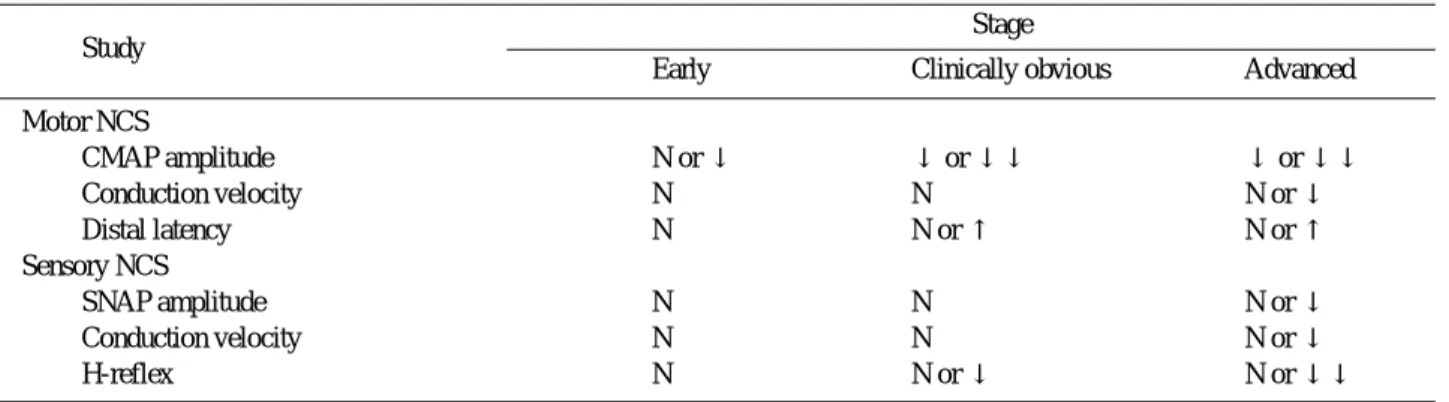
the diagnostic process. Electrophysiological test- ing provides unique information on the compen- satory or secondary changes that occur in muscle with denervation and consequently is a sensitive measure of LMN loss. Electrophysiological studies has also provided insight into the pathological changes that occur in muscle with disease pro- gression, and a number of those tests can be employed to follow disease progression and are useful in clinical trials. More recently, special electrophysiological methods have been developed to study upper motor neuron (UMN) loss.
2 , 3 , 5 - 71. Diagnostic criteria
1) Clinical diagnosis
The World Federation of Neurology (WFN) con- vened in El Escorial, Spain, in 1994 to formulate a set of research criteria for the diagnosis of ALS.
The criteria were reviewed in 1998 at a subse- quent WFN meeting, which led to a revised set of criteria with a limited number of changes. The criteria focus on four key features; (1) evidence
근위축성 측삭경화증의 진단에 있어서 전기진단학적 검사
대구가톨릭대학교 의과대학 신경과학교실
이 동 국