153
Teachers’ Decision and Enactment of Their Content Knowledge Assessed Through Problem Posing - A U.S. Case 1)
Noh, Jihwa (Pusan National University)
164 preservice elementary teachers’ decision and enactment of their knowledge of fraction multiplication were examined in a context where they were asked to write a story problem for a multiplication problem with two proper fractions. Participants were selected from an entry level course and an exit level course of their teacher preparation program to reveal any differences between the groups as well as any recognizable patterns within each group and overall. Patterns and tendencies in writing story problems were identified and analyzed.Implications of the findings for teaching and teacher education are discussed.
I. Introduction
Teachers make various decisions when they use curriculum to plan and enact a lesson. Teachers decide whether to use the task in the curriculum and, if so, how to use it. Such decisions impact the quality of enacted lessons. One important factor critical to such decisions is the way teachers understand the mathematics they teach.
In recent years, increased attention has been given to the adequacy of teachers’ content knowledge (Common Core State Standards Initiative [CCSSI], 2010; Conference Board of the Mathematical Sciences, 2001, 2012; National Council of Teachers of Mathematics [NCTM], 2000; National Research Council, 2001) and teachers’ mathematical knowledge and their ability to enact their mathematical knowledge have been identified as key components of teacher effectiveness and for quality learning (Charalambous, Hill, &
Mitchell, 2012; Hill, Rowan, & Ball, 2005; Newton, 2008). Within the related literature, many words, such as deep, conceptual, connected, flexible, and profound are used to clarify what is meant by the kind of mathematical knowledge teachers need to have. Ball, Thames, and Phelps (2008) used the term specialized content knowledge.
In comparison to common content knowledge that is expected to be held by any educated adult (for example being able to get a correct answer when multiplying 1/3 times 1/2), specialized content knowledge is the unique mathematical understanding and reasoning on which teachers draw to effectively perform mathematical tasks of teaching such as selecting appropriate tasks, choosing and developing useable definitions, and recognizing what is involved in a particular representation. Teachers who lack specialized content knowledge may be unable to help students understand underlying meanings such as why it makes
* 접수일(2017년 3월 28일), 심사(수정)일(2017년 4월 23일), 게재확정일(2017년 4월 25일)
* ZDM Classification : C32, F42
* 2000 Mathematics Subject Classification : 97B50, 97C30
* Key words : Fraction multiplication, Mathematical knowledge for teaching, Problem posing, Teacher preparation
1)This work was supported by a 2-year Research Grant of Pusan National University.
sense to multiply the numerators and the denominators when multiplying fractions or develop flexibility in moving among multiple representations such as diagrams, graphical displays, and symbolic expressions.
Thus, for students to be able to learn and use sophisticated mathematical ideas and procedures, teachers must hold well-developed specialized content knowledge and their learned specialized content knowledge needs to be assessed to identify the support they need.
Ⅱ. Theoretical Background
Teachers’ ability to generate story problems has been identified as important as it helps students connect the mathematics they are learning to real-life situations and understand how the theoretical language of mathematics and the everyday language of story problems are related (Ball, Hill, & Bass, 2005; McAllister &
Beaver, 2012; National Mathematics Advisory Panel, 2008; Rittle-Johnson & Koedinger, 2005). Asking PSTs to pose problems such as writing relevant story problems provides information about what meaning they attach to those situations because problems they pose and interpretations they use reflect the mathematical understanding, skills, and beliefs they have (Toluk-Uçar, 2009). Such mathematical understandings and meanings PSTs use to make sense of the given situations are essential elements in performing those mathematical tasks of teaching described above. Also, uncovering PSTs’ existing understandings creates an opportunity to question and revise these understandings and meanings. Therefore, tasks in which PSTs are asked to create appropriate story problems can be useful tools for the learning of specialized content knowledge and assessing their learned specialized content knowledge.
Previous studies examined the mathematics problems posed by preservice and inservice teachers (Barlow
& Cates, 2006; Crespo, 2003; Toluk-Uçar, 2009; Whitin, 2004). While some of these studies were concerned with the role of problem posing in shaping teachers’ beliefs, content knowledge, and teaching, other studies focused on teachers’ ability to pose problems during instruction in order to gain insights into their students’
mathematical understanding. Where these studies used problem posing as a teaching technique to help teachers reflect on their own understandings and practices, this present study used problem posing primarily as an assessment tool to reveal features of PSTs’ specialized content knowledge regarding the concept of fraction multiplication by classifying the types of interpretations used in the story problems they created.
There are a few studies that used problem posing to examine teachers’ understanding of operations with fractions (McAllister & Beaver, 2012; Toluk-Uçar, 2009). These studies highlighted errors made by teachers.
The present study considered PSTs’ approaches, both valid and invalid, in order to provide insight into the knowledge PSTs rely on for interpreting multiplication of fractions. It is beneficial to examine not only erroneous approaches but also valid approaches because expertise involves having greater flexibility in approaches to solving problems as well as having more elegant ways of using a single approach (Lee, Brown, & Orrill, 2011; Smith, diSessa, & Roschelle, 1993). This helps teacher educators provide appropriate feedback and develop lesson plans to bolster the strengths and compensate for the weaknesses.
The domain of fraction multiplication was chosen because previous research suggests that preservice and inservice teachers’ understanding of fraction operations is limited (Ball, 1990; Ball et al., 2008; Thompson &
Saldanha, 2003; Tirosh, 2000; Tirosh & Graeber, 1990) and studies of PSTs’ knowledge of fraction operations
primarily focuses on fraction division (Ball, 1990; Ma, 1999; Son & Crespo, 2009; Tirosh, 2000; Young &
Zientek, 2011).
To uncover the above mentioned aspects of PSTs’ interpreting fraction multiplication, this study addressed the following questions:
1. What patterns are evidenced in PSTs’ written story problems for multiplication of two proper fractions?
2. How do the observed patterns in the written story problems compare between PSTs at the entry level and the exit level of their teacher preparation program?
Ⅲ. Method
1. Participants
Data for this study were collected from 164 PSTs in different phases of their teacher preparation program offered at a public university in the Midwestern United States. Sixty-five of the participants were selected from an entry level course of their teacher preparation program; the remaining 99 were enrolled in an elementary mathematics methods course which was at the end of their program. This selection was made to observe any differences in the findings obtained from PSTs at the entry level and exit level. It should be made clear, however, that this is a cross-sectional study, whose primary purpose is to describe and/or make inference about certain features of the populations, rather than reveal cause-and-effect relationships (Krathwohl, 1998).
The entry level course used in this study was the first of three mathematics content courses required of elementary education majors at the university from which data were collected. At this university, the mathematics requirement for elementary education majors had recently changed from two content courses to three content courses in mathematics, which included a course on statistics and algebraic reasoning, in addition to a course on number and operations, and a course on geometry and measurement. This adjustment was partly due to the change in the state requirement for elementary teaching licensure.
Therefore, depending on when participants declared their major, the exit level participants had taken two or three elementary mathematics content courses before taking the methods course.
In either case, the first content course for all PSTs focused on number sense in whole numbers and rational numbers. Instruction on fractions and fraction operations typically lasted 4-5 semester weeks. While there may have been some variation in covering particular topics and time spent on each topic taught, the instructional focus for the course, as well as the other content courses, was sense-making, reasoning and justification for skills, and using models. Since the entry level data collection took place during the first week of class, it could be reasonably assumed that most of these PSTs had no exposure to formal instruction on fractions at the college level and thus their responses may have been primarily influenced by their K-12 mathematics experiences.
The methods course, which was used as the exit level course in this study, was the final course in the
mathematics sequence for elementary education majors and was taken after completing the required
Write a story problem that can be answered by:
×
mathematics content courses; therefore these PSTs had exposure to a variety of content topics described above.
The data for the exit group of PSTs were collected during the last two weeks of the methods class. It should be noted that since the focus of the methods course was on pedagogy rather than content, minimal, if any, attention was given to fraction operations in this course.
2. Assessment Item
In order to address the research questions of the study, the following assessment item (Figure III-1) was created and analyzed. Please note that the intent of using a fraction, such as five-sevenths, that is infrequently used in everyday life, was so that PSTs’ attempting to convert to whole numbers, which might be the case with fractions in a typical repertoire such as one-fourth or five-eighths, would be discouraged.
With 2/3×1/4, for example, if you say you would take 1/4 of a foot followed by 2/3 of that result (or 2/3 of a foot followed by 1/4 of that result), the solving process involves a multiplicative thought action involving 2/3 and 1/4. It, however, does not require actually doing the multiplication 2/3×1/4 (or 1/4×2/3). In addition, the answer may be easily left as a whole number, 2 inches, rather than the answer to the multiplication problem, which is 1/6. By using an infrequently encountered fraction as one of the fractions in the item, it was hoped that PSTs’ sense-making of the answer to a fraction multiplication problem in relation to the unit whole could be captured better.
[Figure III-1] Problem Posing Task 3. Data Coding and Scoring
3.1 Correctness
Each response on the problem posing task was analyzed based on both correctness and type of interpretation used to create the story problems. Story problems were first coded according to the degree to which they illustrate a multiplication situation and give the correct numerical answer to the given multiplication expression. How realistic or practical a story problem might be was not considered when evaluating the correctness of a story problem. For example, a story problem utilizing a pan of brownies where the pan measures 2/3cm by 5/7cm could be judged as an unrealistic story problem. Such a problem was coded as correct if the problem modeled the multiplication problem and would produce the correct answer when successfully solved. Patterns observed in written story problems including this example are discussed later in this paper.
While one can distinguish between the following two multiplication problems: 2/3×5/7 (the total in 2/3 of
a group of 5/7) and 5/7×2/3 (the total in 5/7 of a group of 2/3), those distinctions were not made when
Criteria Description Fully
Correct
The story problem modeled a multiplication situation involving the original fractions and the question asked in the story problem would produce the correct answer to the given fraction expression if successfully solved.
Partially Correct
The story problem described a multiplication situation involving the original fractions but had an error such as an incorrect question or insufficient information, which would lead to an incorrect answer or no answer.
Incorrect Operation
The story problem modeled an operation that is not multiplication (i.e., addition, subtraction, division, or a combination of more than one of these three operations).
This Incorrect Operation category has two sub-categories:
Ÿ Solvable: A numerical answer could be obtained when the story problem was successfully solved.
Ÿ Unsolvable: A numerical answer could not be obtained due to insufficient information or erroneous mathematics.
Translating Multiplication Sign
into Words
The story problem used the words multiply or times in a non-sense-making way.
Unanalyzable There was no response or an attempt was made without substantial information to be analyzed.
analyzing the story problems that were written for this study. In addition, even though the PSTs may not have stated it directly in their written story problems, the assumption was made that the unit wholes of the same kind referred to in the problems were the same size unless noted otherwise (e.g. in a story problem, I ate 2/3 of a pizza and you ate 5/7 of another pizza …, it was assumed that the pizzas were the same size).
Criteria for coding on correctness are shown below in Table III-1.
<Table III-1> Criteria for Correctness
Criterion Incorrect Operation was divided into two subcategories, Solvable and Unsolvable, to determine if participants could at least write story problems that could be solved even if the problems posed by them do not model multiplication. Although criteria Translating Multiplication Sign into Words and Unanalyzable could be combined, they were kept separate since problems posed by a considerable number of PSTs fell into this category, which deserved attention for a later analysis.
3.2 Interpretations
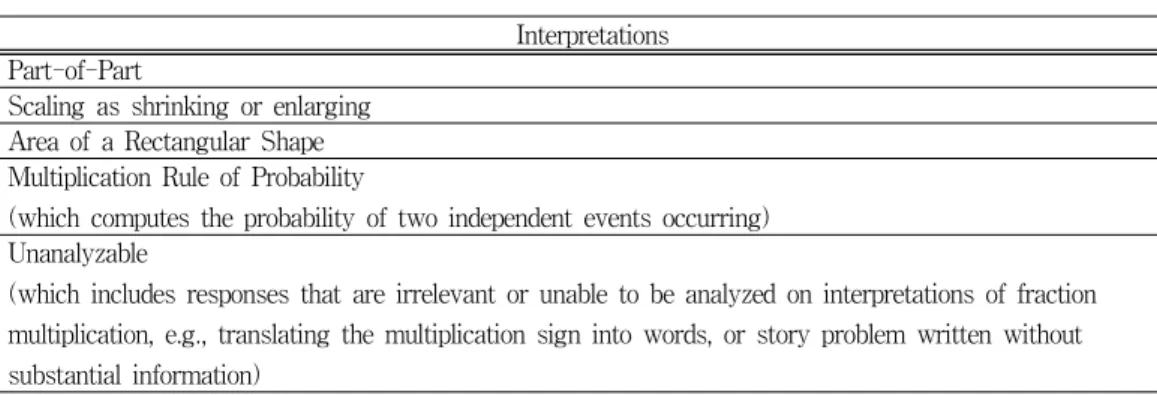
Independent from the coding results on correctness, each written story problem was also coded according to a type of interpretation for fraction multiplication that appeared to be used in the story problem. A list of possible types of interpretations was created based on related literature and the authors’ prior experience.
The initial list was refined and extended as the coding progressed. The final list of criteria used to analyze
interpretations of multiplication of fractions is shown below in Table III-2.
Interpretations Part-of-Part
Scaling as shrinking or enlarging Area of a Rectangular Shape Multiplication Rule of Probability
(which computes the probability of two independent events occurring) Unanalyzable
(which includes responses that are irrelevant or unable to be analyzed on interpretations of fraction multiplication, e.g., translating the multiplication sign into words, or story problem written without substantial information)
<Table III-2> Types of Interpretation
Although repeated addition is a common way of looking at multiplication, this interpretation was not considered in developing a list of valid interpretations. Since this study focused on multiplication of fractions when neither was a whole number; repeated addition would not be suitable for such multiplication situations.
All types, except Unanalyzable, were considered valid interpretations for multiplication of proper fractions.
Coding and scoring of data were carried out by two mathematics education researchers including the author. Both of the researchers first coded several responses independently using the initial code descriptions developed prior to the data gathering and then compared each other’s codes to discuss any clarifying questions. Each repetition of this process resulted in a more refined list of code descriptions. Once the researchers felt confident in the final version of code descriptions, which was used in this study, we independently coded a subset of the responses that we had previously coded using code descriptions that were not the final version. Once agreement was met on these responses, we independently coded every response and compared the codes. Inter-rater agreement was estimated by calculating Cohen’s kappa statistic, 0.8472, which is in a range indicating substantial agreement between the raters (Landis & Koch, 1977).
Ⅳ. Results and Discussion
1. Correctness
Table IV-1 presents a classification of the written story problems in response to the problem posing task
based on correctness within each group as well as overall. Eighteen out of the 164 PSTs were able to
create a story problem that was fully correct, indicating the story problem written illustrated the given
multiplication situation and asked a correct question leading to the correct numerical answer to the
multiplication problem when successfully solved. This included 1 out of 65 PSTs in the entry group and 17
out of 99 PSTs in the exit group. Combining the fully and partially correct categories, about 11% of the
entry group and 40% of the exit group, which accounted for about 29% of the total participating PSTs,
created a story problem that modeled a situation whose numerical answer could be obtained by 2/3×5/7 or
Correctness Entry N=65
Exit N=99
Combined (%) N=164
Chi-square independence test
Fully Correct 1 17 18 (11%)
χ
2= 29.769 df = 4
p -value = 0.000 Cramer’s V = 0.426
Partially Correct 6 23 29 (18%)
Incorrect Operation Solvable Unsolvable
18 16 2
30 26 4
48 (29%) 42 (26%) 6 (3%) Multiplication sign
into words 11 1 12 (7%)
Unanalyzable 29 28 57 (35%)
an expression requiring other computation including 2/3×5/7, such as 1+(2/3×5/7), 1–(2/3×5/7), or 2/3×5/7×N, where N represented the total number of objects in the unit whole being referenced in the story problem.
In each group, a little less than 1/3 of the responses were categorized as incorrect operation, which described a situation that would be answered by performing a single operation that was not multiplication or an expression involving multiplication that was different from the given multiplication problem. The most common operation used was addition. A substantial portion of the responses in each group, about 45% in entry and 28% in exit, made no attempt or contained no substantial information which made the problem unable to be analyzed.
A chi-square independence test, summarized in Table IV-1, shows that there is a statistically significant association between groups of PSTs (entry/exit) and correctness of the story problems written. Cramer’s V statistic indicates that this association is relatively strong (Rea & Parker, 1992). The data also provide enough statistical evidence to conclude that the population proportion of exit PSTs able to write a fully correct story problem exceeds the corresponding proportion of entry PSTs (p-value = 0.001).
<Table IV-1> Correctness of Story Problems
A similar conclusion is obtained when comparing the population proportions of entry/exit PSTs able to write story problems modeling the correct operation (with correct question or with error) ( p -value = 0.000).
The odds in favor of writing a fully correct (correct operation with correct question) story problem were 13.22 times larger for the exit group compared to the entry group, while the odds in favor of writing a fully or partially correct story problem were 4.35 times larger for the exit group compared to the entry group.
Therefore, the data support the conclusion that exit PSTs are more successful than entry PSTs in writing story problems that modeled the correct operation with correct question or with error.
2. Interpretations
Regardless of whether the story problems written contained errors, mathematical or non-mathematical,
whenever identifiable, the approaches to interpreting the fraction multiplication expression evidenced in story
problems were analyzed and presented in Table IV-2. Some errors were subtle and others were fundamental.
Types of Interpretations Entry N=65
Exit N=99
Combined (%) N=164
Chi-square independence test Valid
Part-of-part
8 2
41 26
49 (30%) 28 (17%)
χ
2= 15.866 df = 1 p -value = 0.000 Cramer’s V = 0.311
Scaling 4 13 17 (11%)
Area of rectangle 0 2 2 (1%)
Multiplication rule of probability 2 0 2 (1%)
Invalid (Unanalyzable types) 57 58 115 (70%)
Recognizable error patterns and tendencies that were observed in the work required of PSTs to generate story problems are considered in the discussion section of this paper. All the statistical tests performed in this study have a significance level of 0.05.
Overall, 49 out of 164 PSTs, 41% of the entry group PSTs and 12% of the exit group PSTs, used a valid interpretation, which is applicable for multiplication of two fractions less than 1, such as part-of-part, area of a rectangular shape, scaling, or multiplication rule of probability for independents events. Among the valid types of interpretations, part-of-part, followed by scaling, were the most frequently used types, both overall and in the exit group.
The data from Table IV-2 show that there is a statistically significant association between groups of PSTs and validity of interpretation (valid/invalid) used in writing story problems. Cramer’s V statistic shows that this association is moderate (Rea & Parker, 1992). The data also provide enough statistical evidence that the population proportion of exit PSTs able to use valid interpretations in their story problems exceeds the corresponding population proportion of entry PSTs ( p -value = 0.000). The odds in favor of using a valid interpretation when writing a story problem were 5.86 times larger for the exit group than for the entry group. Therefore, it can be concluded that exit PSTs were more successful than entry PSTs in making use of a valid type of interpretation for multiplication of fractions in their attempt to write a story problem (although their uses of valid interpretations did not necessarily result in a correct story problem).
<Table IV-2> Types of Interpretations Used in Story Problems
To find PSTs’ preference for a particular type of interpretation, the different types of interpretations used in fully or partially correct story problems were examined and are presented in Table IV-3. Part-of-part and scaling were predominantly utilized in those problems, with part-of-part being the prevalent type of interpretation used in the problems that were fully correct. Although not shown in this table, half of the 28 PSTs using the part-of-part interpretation wrote fully correct story problems. Very few PSTs from the entry group, however, used either type of interpretation. Due to their low frequencies, the other two types of interpretations (area and probability) were combined into a single category when analyzing the data.
In order to determine if PSTs predominantly used a particular type of interpretation, chi-square goodness
of fit tests were conducted both overall and for the population of exit PSTs. The analyses indicate that the
part-of-part interpretation was used predominantly both overall and by the exit PSTs over the other types
Interpretations Entry N=7
Exit N=40
Combined N=47
Part-of-part 2 26 (65%) 28 (60%)
Scaling 3 12 (30%) 15 (32%)
Area/Probability 2 2 (5%) 4 (8%)
Chi-square goodness of fit test χ
2(df)
p -value - 21.80 (2)
0.000
18.43 (2) 0.000
of interpretations ( p -value = 0.000). No similar statistical test was conducted for the population of entry PSTs due to the small number of correct responses. The numbers from the table, however, suggest that entry PSTs did not favor one type of interpretation over the others.
<Table IV-3> Valid Interpretations Used in Fully or Partially Correct Story Problems
3. Comparison Between Groups
In the problem-posing task, exit level PSTs were more successful in creating a suitable story problem and making use of an appropriate interpretation for multiplying proper fractions than entry level PSTs. In our statistical analyses, the influence of the group level appeared to be strong. The exit group PSTs’
success may have been due to the deeper mathematical understanding they may have gained during their course work throughout the content courses and methods course in which PSTs are encouraged to think about mathematical problems conceptually. The fact that less than half of the exit group PSTs were successful in this task, though, indicates that veteran PSTs still struggle with stating a story problem correctly or very carefully.
Non-sense-making errors, such as multiplying two candy bars, clearly indicate a lack of understanding of fraction multiplication. Subtle errors, though, such as using incorrect wholes, further confirm that the problem of writing good story problems is a challenging task, which even experts find difficult at times (e.g., Crespo, 2003), and thus may suggest that more attention to writing word problems is warranted.
V. Conclusions and Implications
The analysis of the PSTs’ performance on the problem-posing task revealed misconceptions and gaps in the PSTs’ thinking and conceptual understanding regarding the operation under consideration. Even PSTs at the end of a teacher education program seemed to have a weak conceptual understanding of fraction multiplication.
Although more information could have been gained by employing additional data sources such as
interviews or more assessment items, the findings of this study may suggest several implications for teacher
education which could give insight for future studies. First, PSTs may benefit from increased, more sustained engagement in thinking about content in a multi-faceted way. A content course might focus on helping PSTs strengthen their own content knowledge and make intellectual connections among important mathematical ideas. A methods course, which traditionally focuses on the tools of teaching such as lesson plans, unit planning, classroom management, and assessments, could blend the study of pedagogy with content, which would allow PSTs to revisit previously learned content with a focus on analyzing others’
errors and misconceptions, as well as extending their prior learning.
Analyzing the thinking of others is an important task of teaching. As Lampert (1998) describes, teaching is a thinking practice that integrates reasoning and knowing with action. Therefore, this would promote PSTs’ experience using their knowledge (such as writing a story problem for a mathematical expression) to understand others’ thinking (such as making sense of story problems written by others). These would lend better support in planning learning experiences specifically designed to address those aspects of the topic. If PSTs are given such structured opportunities, hopefully they will have an easier time transferring this understanding into their own classrooms.
Second, PSTs’ ability to use an appropriate interpretation did not seem advantageous in writing a correct story problem. This may suggest that the process of utilizing the meaning of an operation is more than just renaming the multiplication sign as times more or a portion of another portion. Using various contextual situations, each of which embodies a different interpretation for multiplication of fractions, could help them realize, for example, the differentiated roles of the two numbers in a multiplication problem, as well as the meaning of the denominator in the answer which help give meaning to the formal rule for fraction multiplication.
Third, later in the semester, when the entry PSTs were working on a task of matching story problems with the correct operations, it was rather surprising to observe that they did better than anticipated based on their previous weak performance on the problem posing task used in this present study. Matching story problems to the correct operations may require a different kind of thinking than writing story problems on their own.
It is beneficial, then, to also have PSTs write story problems that encompass a variety of contextual situations as a way to further probe their thinking to determine the extent to which they understand fraction operations, which may not be captured in other ways (e.g., Noh & Sabey, 2014). This concurs with the recommendation of the CCSSM (2010) and NCTM (2000) for teachers using multiple methods to help their students demonstrate their understandings. Since PSTs’ understanding of other fraction operations might be similar, such a problem-posing task could be used as a tool for instruction and assessment for different operations.
Lastly, PSTs’ thorough investigation of various textbooks in relation to approaches for operations of
fractions may be suggested. The PSTs’ performance observed in this study would have been influenced by
their prior mathematics experiences. Our brief review of different types of school mathematics textbooks in
the domain of fraction multiplication revealed a wide range of variations in interpretations used to introduce
multiplication of two fractions (e.g., part-of-part, double-shading). Representations (e.g., number line,
paper-folding, pattern-blocks) were used with varying degrees of depth and not all textbooks included drawn
models. The types of tasks required for students to do also varied among the textbooks.
This study involved U.S. preservice teachers only, which would limit the capacity of applying the conclusions and implications suggested through the findings of this study directly to the Korean mathematics education community. Some aspects of the findings of this study, however, may be of help and/or interest to the work of Korean mathematics educators. Not only has understanding of fractions and fraction operations been an area where students, preservice teachers and inservice teachers demonstrate various degrees of inadequacies in their understanding historically, but the informative power of a problem-posing task need to be understood. In fact, problem-posing is identified as one of the key components of the problem-solving competency in the document of the 2015 Curriculum Guideline for Mathematics. It could be reasonably argued that preservice teachers and inservice teachers should be provided with ample opportunities to engage in problem-posing tasks during their teacher education programs or professional development programs in order to have their students help develop the problem-solving competency through problem-posing tasks. Another consideration might be an examination of how problem-posing tasks are presented in mathematics textbooks that are currently used in schools. Learning about problem-posing tasks and the differences in textbooks could not only facilitate reflecting on their own understanding, but also help them realize that such varied learning opportunities might contribute to or limit their future students’
understanding of fractions and fraction operations (e.g., Noh & Webb, 2014; Remillard, Herbel-Eisenmann, &
Lloyd, 2009).
References
Ball, D.L. (1990). Prospective elementary and secondary teachers’ understanding of division, Journal for Research in Mathematics Education , 21 , 132-144.
Ball, D., Hill, H.C., & Bass, H. (2005). Knowing mathematics for teaching: who knows mathematics well enough to teach third grade and how can we decide? American Educator , 29 , 14-22, 43-46.
Ball, D.L., Thames, M.H., & Phelps, G. (2008). Content knowledge for teaching: What makes it special?
Journal of Teacher Education , 59(5), 389-407.
Barlow, A.T. & Cates, J.M. (2006). The impact of problem posing on elementary teachers’ beliefs about mathematics and mathematics teaching, School Science and Mathematics , 106(2), 64-73.
Charalambous, C.Y., Hill, H.C., & Mitchell, R.B. (2012). Two negative don’t always make a positive:
Exploring how limitations in teacher knowledge and the curriculum contribute to instructional quality, Journal of Curriculum Studies , 44(4), 489-513.
Common Core State Standards Initiative. (2010). The common core state standards for mathematics, Washington DC: National Governors Association Center for Best Practices and Council of Chief State School Officers.
Conference Board of the Mathematical Sciences. (2001). The mathematical education of teachers, Washington, DC: Mathematical Association of America.
Conference Board of the Mathematical Sciences. (2012). The mathematical education of teachers II,.
Washington, DC: Author.
Crespo, S. (2003). Learning to pose mathematical problems: Exploring changes in pre-service teachers’
practices, Educational Studies in Mathematics , 52(3), 243-270.
Hill, H.C., Rowan, B., & Ball, D.L. (2005). Effects of teachers’ mathematical knowledge for teaching on student achievement, American Educational Research Journal , 42(2), 371-406.
Krathwohl, D.R. (1998). Methods of educational and social science research: An integrated approach (2nd ed.), New York: Addison Wesley Longman.
Lampert, M, (1998). Study teaching as thinking practice. In J. Greeno & S.G. Goldman (Eds.), Thinking practice (53-78). Hillsdale, NJ: Erlbaum.
Landis, J.R. & Koch, G.G. (1977). The measurement of observer agreement for categorical data, Biometrics , 33(1), 159-174.
Lee, S., Brown, R.E., & Orrill, C.H. (2011) Mathematics teachers' reasoning about fractions and decimals using drawn representations, Mathematical Thinking and Learning , 13(3), 198-220.
Ma, L. (1999). Knowing and teaching elementary mathematics: Teachers’ understandings of fundamental mathematics in China and the United States., M ahwah, NJ: Erlbaum.
McAllister, C. & Beaver, C. (2012). Identification of error types in preservice teachers’ attempts to create fraction story problems for specified operations, School Science and Mathematics , 112 ( 2), 88-98.
National Council of Teachers of Mathematics. (2000). P rinciples and standards for school mathematics, Reston, VA: Author.
National Mathematics Advisory Panel. (2008). Foundations for success: The final report of the National Mathematics Advisory Pane,. Washington, DC: U.S. Department of Education. Retrieved from http://www.ed.gov/about/bdscomm/list/mathpanel/report/final-report.pdf
National Research Council. (2001). Adding it up: Helping children learn mathematics, Washington, DC:
National Academy Press.
Newton, K.J. (2008). An extensive analysis of pre-service elementary teachers’ knowledge of fractions, American Educational Research Journal , 45 ( 4), 1080-1110.
Noh, J. & Sabey, K. (2014). What does multiplying two candy bars really mean? Educational Leadership 71 (7). http://www.ascd.org/publications /educational-leadership/apr14/vol71/num07/abstract.
aspx#What_Does_Multiplying_Two_Candy_Bars_Really_Mean¢.
Noh, J. & Webb, M. (2014). Teacher learning of subject matter knowledge through an educative curriculum, Journal of Educational Research , 108(4), 292-305.
Rea, L.M. & Parker, R.A (1992). Designing and conducting survey research, San Francisco: Jossey-Boss.
Remillard, J.T., Herbel-Eisenmann, B.A., & Lloyd, G.M. (2009). Mathematics teachers at work: Connecting curriculum materials and classroom instructio,. New York: Routledge.
Rittle-Johnson, B. & Koedinger, K.R. (2005). Designing knowledge scaffolds to support mathematical problem solving. Cognition and Instruction , 23(3), 313-349.
Smith, J.P., diSessa, A.A., & Roschelle, J. (1993). Misconceptions reconceived: A constructivist analysis of knowledge in transition, The Journal of the Learning Sciences , 3(2), 115-163.
Son, J.W., & Crespo, S. (2009). Prospective teachers’ reasoning and response to a student’s non-traditional strategy when dividing fractions, Journal of Mathematics Teacher Education , 12, 235-261.
Thompson, P.W., & Saldanha, L.A. (2003). Fractions and multiplicative reasoning. In J. Kilpatrick, W.G.
Martin, & D. Schifter (Eds.), A research companion to principles and standards for school mathematics (95-113). Reston, VA: NCTM.
Tirosh, D. (2000). Enhancing prospective teachers’ knowledge of children’s conceptions: The case of division of fractions, Journal for Research in Mathematics Education , 31, 5-25.
Tirosh, D., & Graeber, A.O. (1990). Evoking cognitive conflict to explore preservice teachers’ thinking about division, Journal for Research in Mathematics Education , 21, 98-108.
Toluk-Uçar, Z. (2009). Developing preservice teachers understanding of fractions through problem posing, Teaching and Teacher Education , 25(1), 166-175.
Whitin, D.J. (2004). Building a mathematical community through problem posing. In R.N. Rubenstein (Ed.), Perspectives on the teaching of mathematics: Sixty-sixth yearbook (129-140). Reston, VA: NCTM.
Young, E. & Zientek, L. (2011). Fractions operations: An examination of prospective teachers’ errors,
confidence, and bias, Investigations in Mathematics Learning , 4(1), 1-23.
문제 만들기를 통해 알아본 교사의 내용지식 사용에 대한 결정과 수행
-
미국 사례를 중심으로1)노지화
Department of Mathematics Education, College of Education, Pusan National University, Busan, 46241, Korea E-mail : [email protected]
본 연구에서는 예비교사가 문제 만들기 과제를 위해 분수곱셈지식을 사용하는 과정에서 드러나는 이해의 정 도와 유형을 미국사례를 중심으로 조사하였다. 이를 위하여, 미국 대학 교사교육과정의 입문단계와 종료단계에 있는 총 164명의 예비초등교사를 대상으로 분수곱셈에 대한 문장제 문제를 작성하게 하고, 이를 수학적 정교성 과 작성한 문제에 사용한 분수곱셈의 의미의 유형으로 분석하였다. 분석결과는 교육과정 입문단계와 종료단계의 예비교사 그룹 간의 차이점, 각 그룹, 그리고 전체적인 경향에 대해 기술하였고, 분수곱셈 지도와 교사교육에 대 한 시사점을 제공하였다.
* ZDM분류 : C32, F42
* MSC2000분류 : 97B50, 97C30
* 주제어 : 분수곱셈, 수학교수학적 지식, 문제 만들기, 교사교육