Print ISSN: 2288-4637 / Online ISSN 2288-4645 doi:10.13106/jafeb.2020.vol7.no9.639
Understanding the Entrepreneurial Intention in the Light of Contextual Factors: Gender Analysis
Md. Atikur RAHAMAN
1, Md. Julfikar ALI
2, Zahidur Rahman MAMOON
3, Ahmed Al ASHEQ
4Received: July 03, 2020 Revised: July 28, 2020 Accepted: August 10, 2020
Abstract
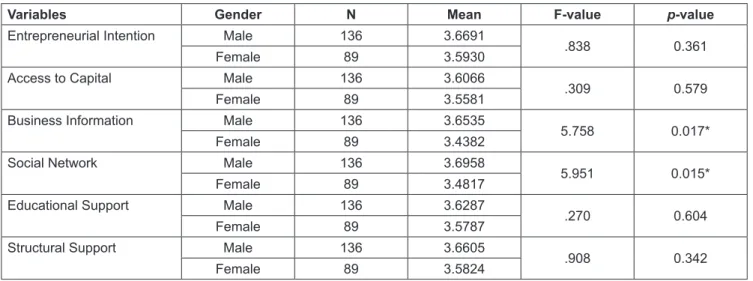
Entrepreneurial intention is receiving immense recognition in entrepreneurship researches, as it motives an individual to become an entrepreneur. Still, the interplay between gender perspective and contextual factors (i.e., access to capital, business information, social network, educational support, structural support) are not fully investigated in understanding the entrepreneurial intention in developing countries like Bangladesh. Therefore, the paper aims to examine the gender difference and educational discipline difference in the university’s students’ entrepreneurial intention in relation to contextual factors in Bangladesh. In this study, sample has been particularly taken from the different disciplinary students of private universities. Five-point Likert scale-based survey questionnaire was developed based on past researches. 280 online survey forms were distributed among the university students and finally 225 students’ response were found correct as the study sample size (final survey response rate = 80%), after eliminating the incorrect survey responses. For statistical analysis SPSS 23.0 version is used. One-way ANOVA is used to measure the gender and discipline difference on entrepreneurial intention among male and female students. The results show that business information and social network will have more influence on male students’ entrepreneurial intention, and comparatively, business students have more willingness to become entrepreneurs than other departmental students.
Keywords: Entrepreneurial Intention, Gender, Business Information, Social Networks, Bangladesh JEL Classification Code: M10, M13, M21
developed countries, hence, there is not much information on the same matter for developing countries (Bruton, Ahlstrom,
& Obloj, 2008) and information on entrepreneurship in economies that are developed may differ from that of economies that are growing in terms of application (Bruton et al., 2008). Researchers in the field of entrepreneurship essentially exhibited that entrepreneurial functions and their determinants are triggered by different dimensional aspects of socio-cultural and political circumstances, which would vary remarkably across various nations, and it would limit the applicability of the research findings of developed economies to developing economies (Bruton et al., 2008).
Ever since the 1980s, entrepreneurship has received much attention. It has been regarded as a driving factor for the growth of social and economic matters by building novel opportunities for employment and supplying goods/
services to the people (Wennekers et al., 2005) and work as an antidote for issues namely, high inflation and high unemployment (Wennekers & Thurik, 1999). The real and possible entrepreneurs have been provided with support through diverse range or trainings and finances by the governments and NGOs. Entrepreneurship departments or at
1. Introduction
Encouragement of entrepreneurship is a nationwide priority for many governments worldwide, especially for the developing nations as entrepreneurship has a positive impact on a country’s economic development and its ability to create job opportunities. Up to now, most researches on encouraging entrepreneurship has been conducted for
1
First Author. Associate Professor, School of Economics & Management, Jiujiang University, Jiangxi, China. E-mail: [email protected]
2
Associate Professor, Department of Business Administration, The International University of Scholars (IUS), Bangladesh.
E-mail: [email protected]
3
Senior Lecturer, Department of Business Administration, Eminence College Uttara, Dhaka, Bangladesh. E-mail: [email protected]
4
Corresponding Author. Lecturer, World School of Business, World University of Bangladesh, Bangladesh [Postal Address: Dhanmondi, Dhaka 1205, Bangladesh] E-mail: [email protected]
© Copyright: The Author(s)
This is an Open Access article distributed under the terms of the Creative Commons Attribution Non-Commercial License (https://creativecommons.org/licenses/by-nc/4.0/) which permits unrestricted non-commercial use, distribution, and reproduction in any medium, provided the original work is properly cited.