낙동강 수계에서의 X-선 조영제(Iopromide)의 분포 특성
염훈식․손희종*․류동춘․장성호1)
부산광역시 상수도사업본부 수질연구소, 1)부산대학교 지역환경시스템공학과
(2012년 5월 25일 접수; 2012년 7월 25일 수정; 2012년 8월 20일 채택)
Occurrence of X-ray Contrast Media (Iopromide) in the Nakdong River Basin
Hoon-Sik Yoom, Hee-Jong Son*, Dong-Choon Ryu, Seung-Ho Jang1)
Water Quality Institute, Busan Water Authority, Kimhae 621-813, Korea
1)
Department of Environment System Engineering, Pusan National University, Miryang 627-706, Korea
(Manuscript received 25 May, 2012; revised 25 July, 2012; accepted 20 August, 2012)Abstract
The aims of this study were to investigate and confirm the occurrence and distribution patterns of iodinated X-ray contrast media (iopromide) in Nakdong river basin (mainstream and its tributaries). Iopromide was detected in 16 sampling sites. The concentration levels of iopromide on February 2011 and on October 2011 in surface water samples ranged from not detected (ND) to 1481.1 ng/L and ND to 1168.2 ng/L, respectively. The highest concentration level of iopromide in the mainstream and tributaries in Nakdong river were Goryeong and Jincheon-cheon, respectively. The sewage treatment plants (STPs) along the river affect the iopromide levels in river and the iopromide levels decreased with downstream because of dilution effects.
Key Words : Iodinated X-ray contrast media, Iopromide, Nakdong river basin, Detection, LC/MS-MS
1)
1. 서 론
최근에는 분석기술의 발달로 인해 정수처리 분야 에서는 ng/L 수준의 극미량까지 미량오염물질들에 대 해 정성 및 정량이 가능하게 됨으로서, 다양한 신종 오 염물질들, 특히 잔류 의약물질들의 상수원 오염현황 에 대한 연구결과들이 보고되고 있다(손과 장, 2011).
최근에 발표된 연구결과들 중에서 전 세계적으로 수 돗물에 함유된 잔류 의약물질들의 종류 및 농도를 조 사한 Mompelat 등의 연구결과(Mompelat 등, 2009) 에 의하면 비스테로이드성 항염증제(Non-steroidal
*Corresponding author : Hee-Jong Son, Water Quality Institute, Busan Water Authority, Kimhae 621-813, Korea Phone: +82-51-669-4635
E-mail: [email protected]
anti-inflammatory drugs), 항경련제(Anticonvulsant) 및 X-선 조영제(X-ray contrast media)들이 수돗물에 서 검출되는 농도가 다른 잔류 의약물질들에 비해 높 은 것으로 보고하고 있다. 특히, X-선 조영제들은 다 른 잔류 의약물질들에 비해 상수원수에서 검출농도가 월등히 높은 것으로 알려져 있다(Pérez와 Barceló, 2007).
X-선 조영제는 X-선을 이용하여 부드러운 조직을 진단시에 진단 부위의 이미지를 선명하게 나타내주는 역할을 하며, 대표적으로 요오드계 X-선 조영제 (Iodinated X-ray contrast media)들이 많이 사용된다 (Christiansen, 2005). X-선 진단시 최대 200 g/회 이상이 체내로 투여된 후 24시간 내에 전혀 대사되지 않은 상태 로 소변에 포함되어 체외로 배출된다(Steger-Hartmann, 2002). 이들은 대사적(metabolic)으로 매우 안정적이
Compound Class CAS-No. Structure Formular M.W. Log Kow
Iopromide non-ionic 73334-07-3 C18H24I3N3O8 791.8 -2.05a
aKim et al., 2007
Table 1. Physico-chemical characteristics of iopromide
어서 하수처리장의 기존(conventional) 처리공정에서 는 효과적으로 제거되지 않기 때문에 하수처리장 방 류수에서 비교적 고농도로 검출된다(Clara 등, 2005).특히, 이들은 매우 친수성이 강하기 때문에 수환경 중 에 널리 분포하며(Santos 등, 2010), 지표수, 지하수 및 수돗물에서도 μg/L 수준으로 검출된 경우도 있다 (Busetti 등, 2008; Putschew 등, 2000; Sacher 등, 2001; Ternes와 Hirsch, 2000; Trenholm 등, 2006). 비 록 여러 독성 실험결과에서 단기적인 생체독성은 낮 은 것으로 알려져 있으나 장기적인 생체독성에 대해 서는 구체적인 연구가 진행 중에 있으며, 수환경에서 의 지속적인 노출과 먹이사슬에 의한 생물농축 등으 로 인한 생체독성이 유발될 가능성이 높은 것으로 알 려져 있다(Huber 등, 2003; Santos 등, 2010).
선진 외국의 경우 수환경 중에서의 요오드계 X-선 조영제와 같은 다양한 잔류 의약물질들에 대한 오염 현황 및 사용량을 정량적으로 파악하기 위한 조사를 이미 시작하였으며, 상수나 하수처리 공정에서의 제 거기술에 관한 다양한 연구도 활발히 수행하고 있다 (손과 장, 2011; Jeong 등, 2010). 또한, 산화공정 또는 생물학적 처리공정에서의 요오드계 X-선 조영제의 생성 부산물들에 대한 연구도 한창 진행 중에 있다 (Kormos 등, 2011; Seitz 등, 2008). 그러나 국내의 경 우는 Yoon 등(2010)이 한강의 지류들 및 본류의 몇몇 지점에 대해 조사․보고한 결과들을 제외하면 거의 없는 실정이며, Yoon 등의 연구결과(2010)에서 지류 들에서 검출농도는 780∼8,100 ng/L (평균 : 3,745 ng/L) 및 본류 지점들의 경우는 33∼1800 ng/L (평균 : 1,013 ng/L)의 검출농도를 나타내었다고 보고하였 다. 이와 같이 요오드계 X-선 조영제에 대한 전국 주 요하천과 상수원에 대한 모니터링 결과도 매우 부족
한 실정이다.
본 연구에서는 요오드계 X-선 조영제 중에서 국내 에서의 사용량이 전체의 39%(헬스코리아뉴스, 2009) 로 가장 많은 iopromide에 대해 본류와 지류를 포함한 낙동강 전 수계 29개 지점에서의 검출 현황을 조사하 기 위하여 on-line SPE-HPLC/MS-MS 시스템을 이 용․분석하여 낙동강에서의 검출 농도 및 특성을 파 악하고자 하였으며, 또한 낙동강에서의 검출 결과를 국내․외의 여러 연구결과와 비교하여 상수원 관리를 위한 기초자료로 활용하고자 하였다.
2. 재료 및 방법
2.1. Iopromide
본 실험에 사용된 요오드계 X-선 조영제 물질인 iopromide는 미국의 USP사에서 제조한 순도 99% 이상 의 특급물질을 사용하였으며, 실험에 사용된 iopromide 에 대한 물리․화학적 특성들을 Table 1에 나타내었 다. Table 1에서 볼 수 있듯이 iopromide는 요오드계 X-선 조영제들 중에서 비이온성(non-ionic)계열로 분 류되며, Log Kow 값이 –2.05로 친수성이 강한 특성을 나타낸다.
2.2. 낙동강 수계 시료채수 지점 및 채수
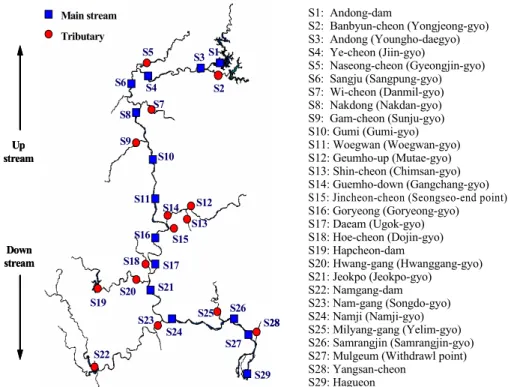
시료의 채수는 2011년 2월과 9월에 2회 하였으며, 깨 끗이 세척한 1 L 용량의 갈색 유리병에 시료수를 채수 한 후에 시료수의 변질을 막기 위해 분석 전까지 4℃로 냉장 보관하였다. 시료 채수지점은 낙동강 상류부터 하 류까지 본류 14개 지점과 지류 15개 지점을 선정하여 채수하였으며, Fig. 1에 29개의 채수지점을 간략히 나 타내었고, 본류 채수지점은 ■, 지류 채수지점은 ●로 나타내었다.
S1
S2 S3 S4 S5 S6
S8 S7
S9 S10
S11
S13 S14 S16 S15 S18 S17
S19 S20 S21
S22 S23
S24
S25 S26 S27
S29 S28 Down
stream Up stream
S12 Main stream
Tributary
S1
S2 S3 S4 S5 S6
S8 S7
S9 S10
S11
S13 S14 S16 S15 S18 S17
S19 S20 S21
S22 S23
S24
S25 S26 S27
S29 S28 Down
stream Up stream
S12 Main stream
Tributary
S1: Andong-dam
S2: Banbyun-cheon (Yongjeong-gyo) S3: Andong (Youngho-daegyo) S4: Ye-cheon (Jiin-gyo)
S5: Naseong-cheon (Gyeongjin-gyo) S6: Sangju (Sangpung-gyo) S7: Wi-cheon (Danmil-gyo) S8: Nakdong (Nakdan-gyo) S9: Gam-cheon (Sunju-gyo) S10: Gumi (Gumi-gyo) S11: Woegwan (Woegwan-gyo) S12: Geumho-up (Mutae-gyo) S13: Shin-cheon (Chimsan-gyo) S14: Guemho-down (Gangchang-gyo) S15: Jincheon-cheon (Seongseo-end point) S16: Goryeong (Goryeong-gyo) S17: Daeam (Ugok-gyo) S18: Hoe-cheon (Dojin-gyo) S19: Hapcheon-dam
S20: Hwang-gang (Hwanggang-gyo) S21: Jeokpo (Jeokpo-gyo)
S22: Namgang-dam S23: Nam-gang (Songdo-gyo) S24: Namji (Namji-gyo) S25: Milyang-gang (Yelim-gyo) S26: Samrangjin (Samrangjin-gyo) S27: Mulgeum (Withdrawl point) S28: Yangsan-cheon
S29: Hagueon
Fig. 1. Description of the sampling sites in Nakdong river basin.
2.3. 시료수 전처리
모든 샘플은 SPE로 농축하기 전에 0.2 μm 멤브레 인 필터(Millipore, USA)로 여과하여 입자성 불순물 을 제거하였으며, 0.1 N-H2SO4를 첨가하여 시료수의 pH를 3 이하로 조절하였다(Ternes와 Hirsch, 2000).
Iopromide의 분석에 있어 대상 시료의 농축 및 추 출을 위한 전처리 장치로 Spark Holland사의 on-line SPE equipment (Symbiosis, Spark Holland, Netherlands) 를 사용하였으며, 농축 및 추출에는 PLRP-S extraction SPE cartridge (2 mm x 10 mm, 15∼20 μm, Spark- Holland, Netherlands)를 사용하였다. SPE cartridge 는 먼저 1 mL 100% MeOH 그리고 1 mL DI water를 순서대로 사용하여 conditioning하였다. 시료수 50 mL를 10 mL/min의 유속으로 cartridge를 통과시켰으 며, 추출시에는 0.1% ammonium hydroxide가 첨가된 5% acetonitrile을 사용하여 0.4 mL/min의 유속으로 cartridge에 흡착되어 있는 iopromide를 용출시켰으 며, 이 때 cartridge는 LC/MS-MS와 on-line으로 연결 되어 cartridge 내에 수집된 iopromide 전량이 LC 컬
럼으로 보내어지기 때문에 off-line으로 작업시 발생 할 수 있는 손실을 줄일 수 있다(Choi 등, 2007). Table 2에는 SPE cartridge의 컨디셔닝, 세척, 분석시료 농축 및 용리 과정을 나타내었다.
Item Analytical condition
Solvation 1 mL 100% MeOH
Equillibration 1 mL water Sample loading volume 50 mL (10 mL/min)
Washing 1 mL water
Elution 5% acetonitrile (0.1% ammonium hydroxide)
Table 2. Analytical conditions of SPE equipment
2.4. Iopromide 분석
요오드계 X-선 조영제의 일종인 iopromide의 분석 을 위해 HPLC (ACQUITY, Waters, USA)/MS-MS (Quattro, Micomass, UK)를 이용하였으며, LC 컬럼 은 Water사에서 제조한 Lichrospher RP-18 (125 mm
Distilled water (1000 ng/L spiking)
792.0 > 572.9
Maeri water (1000 ng/L spiking)
792.0 > 572.9
Jincheon-cheon (none spiking) 792.0 > 572.9 1.72e4
1.81e4
1.35e4
1000 ng/L
1000 ng/L
1481.1 ng/L (a)
(b)
(c)
Fig. 2. LC-MS/MS chromatogram of distilled water (1000 ng/L spiked) and MR water (1000 ng/L spiked),
and Jinchun-chun sample (none spiked).Sampling sites
S1 S3 S4 S6 S8 S10 S11 S16 S17 S21 S24 S26 S27 S29
Iopromide (ng/L)
0 200 400 600 800
February September
2 STPs S5 (STP) S7
(STP) S9 (STP)
STPs S14 (STPs)
S15 (STP) S18 & S20
S23 S25
S28 (STP) 667.2
305.9
Fig. 3. Variation of iopromide concentration in main streams of Nakdong river basin.
x 3 mm, 5 μm particle size)을 사용하였다(Ternes와 Hirsch, 2000). 분석에 사용된 이동상은 95% water + 5% acetonitrile + 0.1% ammonium hydroxide 용액을 사용하였다. Iopromide의 분석을 위한 MS 조건은 ESI (electro spray ionization) positive mode를 사용 하였으며, iopromide의 정성과 정량에 사용된 parents ion과 daughter ion 값은 각각 792.0과 572.9였고, iopromide의 이온화에 사용된 cone voltage 및 collision 에너지 값은 각각 40 V 및 25 V였다.
Fig. 2에는 순수에 1,000 ng/L 및 낙동강 매리원수 에 1000 ng/L의 농도로 iopromide를 spiking하여 분 석한 크로마토그램과 2011년 2월에 채수하여 분석한 진천천(S15) 시료수의 chromatogram을 나타낸 것이 다. Fig. 2 (a)와 Fig. 2 (b)에 나타낸 순수와 낙동강 매 리원수에 1,000 ng/L의 농도로 iopromide를 spiking한 시료들의 경우는 2.00분대에서 검출되는 iopromide peak의 퍼짐현상이 나타나지 않았으나 Fig. 2 (c)에 나
타낸 진천천 시료수에서는 iopromide peak의 퍼짐현 상이 나타났다. 진천천의 경우는 하수처리장 방류수 의 영향을 많이 받는 지천으로 하수처리장에서 제거 되지 않은 다양한 유기물질들이 시료수 자체의 matrix 에 영향을 준 것으로 판단된다.
3. 결과 및 고찰
3.1. 낙동강 본류에서의 iopromide 분포 특성
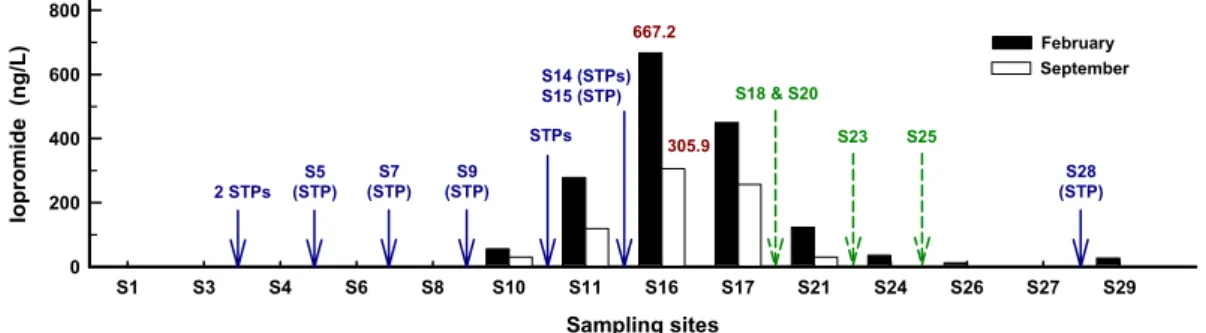
2011년 2월과 9월에 낙동강 본류 14개 지점에서의 iopromide 검출결과를 Fig. 3에 나타내었다. 지류의 하 수처리장 (STP)의 존재 유․무에 따라 실선과 점선으 로 표시하여 지류의 유입을 나타내었으며, 지류에 하 수처리장이 존재하더라도 방류량이 적거나 지류의 상 류에 위치하여 본류에 영향을 미치지 않는 경우는 제 외하였다.
2011년 2월과 9월 모두 낙동강 본류에서는 안동댐
Sampling sites
S2 S5 S7 S9 S12 S13 S14 S15 S18 S19 S20 S22 S23 S25 S28
Iopromide ( ng/L)
0 300 600 900 1200 1500
February September Max. concentration
in main stream (September) (February)
1481.1 1168.2
992.7
621.5
Fig. 4. Variation of iopromide concentration in tributaries of Nakdong river basin.
(S1)에서부터 낙동(S8)까지는 iopromide가 검출되지 않았으며, 구미(S10) 지점에서부터는 iopromide가 검 출되었다. 구미(S10) 지점 하류로는 본류에 영향을 미 치는 하수처리장들이 각 지류나 본류 부근에 위치하고 있어 iopromide가 지속적으로 검출되며, 구미(S10) 지 점의 경우 지류인 감천(S9) 지점에 위치한 하수처리장 의 영향을 받는 것으로 보이며, 왜관(S11) 지점의 경우 는 유입되는 본류 주변에 위치한 구미 하수종말처리장 (330,000 m3/day)과 중소 규모의 하수처리장에서 방류 한 방류수가 iopromide의 농도 증가에 기여한 것으로 나타나고 있다. 또한, 고령(S16) 지점의 경우는 본류의 채수지점 중에서 가장 높은 검출농도인 667.2 ng/L (2 월)와 305.9 ng/L (9월)를 나타내어 금호강(S12∼S14) 과 진천천(S15) 지점에 위치한 하수처리장들의 방류 수에 많은 영향을 받는 것으로 나타나고 있으며, 고령 (S16) 지점의 하류로는 지류인 회천(S18), 황강(S20), 남강(S23) 및 밀양강(S25)과 같은 지류의 유입에 의한 희석효과로 iopromide의 검출농도가 감소하는 것을 알 수 있다. 그러나 하구언(S29) 지점의 경우 지류인 양 산천(S28)의 영향을 받아 2011년 2월에 27.0 ng/L의 농도로 검출되었다.
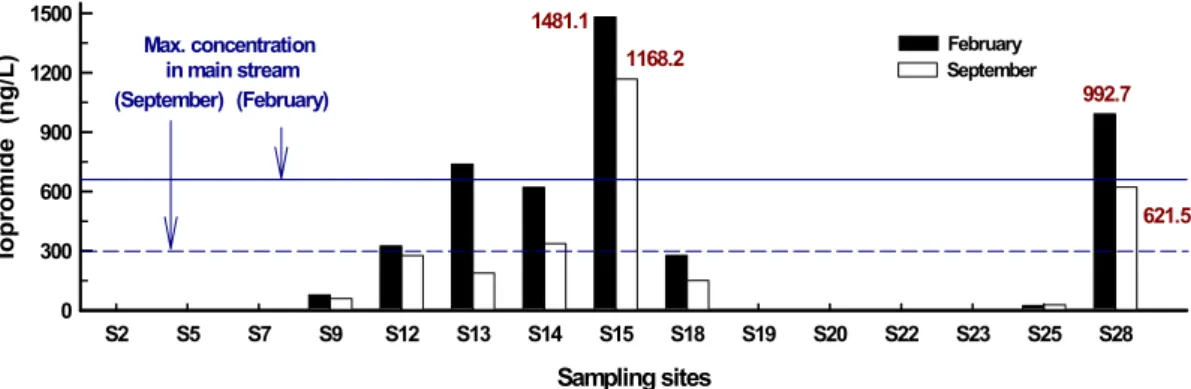
낙동강 본류의 iopromide 농도 증가에 미치는 지류 들의 영향을 파악하기 위하여 Fig. 4에서는 각각의 지 류들에서의 iopromide 검출농도를 살펴보았다. 비교 적 높은 검출농도를 나타내는 지류들은 감천(S9), 금 호강(S12∼S14), 진천천(S15), 회천(S18) 및 하류에 위치한 양산천(S28)으로 나타났다. 지류들 중에서 가
장 높은 검출농도를 나타낸 지점은 진천천(S15)으로 2011년 2월과 9월에 각각 1481.1 ng/L와 1168 ng/L 의 검출농도를 나타내었으며, 다음으로는 양산천 (S28) 지점으로 각각 992.7 ng/L와 621.5 ng/L의 검출 농도를 나타내었다. 양산천(S28)의 경우는 Fig. 3에서 볼 수 있듯이 하구언(S29) 지점에서 iopromide의 검 출농도가 높지 않기 때문에 본류에는 큰 영향을 미치 지 않는 것으로 나타났다. 따라서 본류에 영향을 미치 는 지류는 구미(S10) 지점에 영향을 미치는 감천(S9) 과 고령(S16) 지점에 영향을 미치는 금호강(S12∼
S14)과 진천천(S15)이며, 본류에서의 최고 검출농도 보다 높게 검출되는 지류들은 금호강(S12∼S14), 진 천천 (S15) 및 양산천(S28)으로 나타났다.
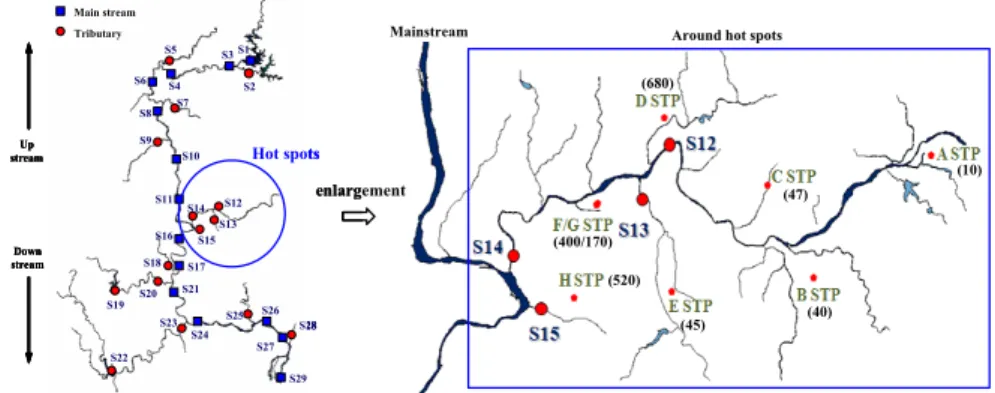
본류에서 iopromide의 검출농도가 가장 높은 고령 (S16) 지점에 영향을 미치는 지류들인 금호강(S12∼
S14) 부근과 진천천(S15) 지점 부근을 hot spot으로 선정하여 주변에 대한 하수처리장 위치 및 방류량에 대해 조사한 것을 Fig. 5에 나타내었다. Hot spot 부근 을 조사한 결과, 10,000 m3/day 처리용량의 A 하수처 리장과 40,000 m3/day 처리용량의 B 하수처리장 및 47,000 m3/day 처리용량의 C 하수처리장이 금호강 상 류(S12) 지점의 상류에 위치하고 있어 금호강 상류 (S12) 지점은 이 3개의 하수처리장에 영향을 받고 있 으며, 신천(S13) 지점은 관거를 통해 하천의 유지용수 로 공급되는 100,000 m3/day의 D 하수처리장 방류수 와 45,000 m3/day 처리용량의 E 하수처리장 방류수의 영향을 많이 받는다. 금호강 하류(S14) 지점의 경우는
S1 S2 S3 S4 S5
S6 S8 S7
S9 S10
S11 S13 S14
S16 S15 S18 S17
S19 S20 S21
S22 S23
S24 S25 S26
S27 S29
S28 Down
stream Up stream
S12 Main stream
Tributary
(10) (47)
(45) (40) (680)
(520) (400/170)
Mainstream Around hot spots
enlargement Hot spots
S1 S2 S3 S4 S5
S6 S8 S7
S9 S10
S11 S13 S14
S16 S15 S18 S17
S19 S20 S21
S22 S23
S24 S25 S26
S27 S29
S28 Down
stream Up stream
S12 Main stream
Tributary
S1 S2 S3 S4 S5
S6 S8 S7
S9 S10
S11 S13 S14
S16 S15 S18 S17
S19 S20 S21
S22 S23
S24 S25 S26
S27 S29
S28 Down
stream Up stream
S12 Main stream
Tributary
(10) (47)
(45) (40) (680)
(520) (400/170)
Mainstream Around hot spots
enlargement Hot spots
Fig. 5. Description of STP locations and their capacities (unit: × 103 m3/day) around hot spots.
Country
Water source
Refrence Surface water
(ng/L) Drinking water
(ng/L) WWTP & STP effluent (ng/L)
Australia - - WWTP : 960∼2,480 Busetti et al., 2008
Belgium - - STP : 322∼495 Forrez et al., 2011
Germany SW : 150 70 STP : 590∼3,100 Hirsch et al., 2000
Danube RW : <40∼220 - - Seitz et al., 2006
RW : 100∼910 - STP : 6,500∼9,700 Ternes and Hirsch, 2000
SW : 1,600 <50 - Putschew et al., 2000
SW : 37∼127 <3∼33 WWTP : 3,400 Kormos et al., 2011
- - STP : 4,400∼6,000 Ternes et al., 2003
RW : 238∼298 - WWTP : 2,462∼2,878 Nödler et al., 2010
SW : 1,500∼9,000 - STP : 18,000∼23,000 Putschew et al., 2001
SW : 737∼841 - - Grünheid et al., 2005
Korea SW : 20∼361 - WWTP : 1,170∼4,030 Kim et al., 2007
Han RW : 33∼8,100 - - Yoon et al., 2010
- - WWTP : 470 Lee et al., 2009
Nakdong RW : ND∼1481.1 - - This study
Spain - - STP : 8,800∼9,300 Carballa et al., 2004
RW : 74.4∼505.0 - - Boleda et al., 2011
Switzerland - - WWTP : 5,700∼8,300 Morasch et al., 2010
USA - - WWTP : 4.6 Kim et al., 2007
SW : ND∼22.4 ND∼<9.9 - Wang et al., 2011
Table 3. Concentration of iopromide found in various water sources in the world wide
금호강 유역에 있는 8개 하수처리장 (A∼G STP)의영향을 받고 있으나 금호강 상류와 신천의 합류 및 주 변 지천들의 유입에 따른 희석효과로 신천(S13) 지점 보다는 다소 낮은 검출농도를 나타내었다. 진천천 (S15) 지점의 경우 하천유량의 대부분이 H 하수처리 장 방류수로 유지되고 있어 조사된 지류들 중에서 가 장 높은 검출농도를 나타내었다. 따라서 hot spot 부근 의 채수지점들은 하수처리장 방류수의 영향이 지배적
인 것으로 나타나 본류인 고령(S16) 지점이 Fig. 3에 서 보는 바와 같이 본류에서 iopromide의 검출농도가 가장 높은 것으로 나타나고 있다.
낙동강 본류 지점들 및 지류 지점들에서의 iopromide 검출농도와 국․내외의 여러 연구결과들에서 보고된 하수처리장 방류수, 지표수 및 수돗물에서의 검출된 농도를 Table 3에 나타내었다. 하수처리장 방류수에 서의 iopromide 검출농도는 독일에서 최대 23,000
ng/L의 농도를 나타내었으며(Putschew 등, 2001), 스 페인과 스위스에서도 각각 9,300 ng/L (Carballa 등, 2004)와 8,300 ng/L (Morasch 등, 2010)의 최대 검출 농도를 보였다. 강이나 호소수와 같은 지표수의 경우 도 독일에서 9,000 ng/L의 최대 검출농도를 나타내었 으며(Putschew 등, 2001), 우리나라의 경우도 한강에 서 최대 8100 ng/L의 농도로 검출된 것으로 보고되었 으며(Yoon 등, 2010), 본 연구결과에서와 같이 낙동 강의 경우는 최대 1481.1 ng/L의 농도를 나타내어 한 강에서의 최대 검출농도의 18% 정도인 것으로 나타 났다. 국내에서의 수돗물에서의 검출현황에 대한 연 구보고는 아직 보고된 바는 없으며, 외국의 경우도 Table 3에서 보는바와 같이 독일에서 33∼70 ng/L로 검출된 것으로 나타났고(Hirsch 등, 2000; Kormos 등, 2011; Putschew 등, 2000), 미국의 경우는 한 연구에 서 정량한계(9.9 ng/L) 미만인 것으로 보고하고 있다 (Wang 등, 2011).
4. 결 론
낙동강 수계에서의 요오드계 X-선 조영제인 iopromide 의 검출현황을 조사한 결과 다음과 같은 결론을 얻었다.
1. 낙동강 본류에서 가장 높은 검출농도를 나타낸 지 점은 중류에 위치한 고령지점(고령교)으로 2월과 9월에 각각 667.2 ng/L와 305.9 ng/L가 검출되었고, 지류에서는 진천천 지점으로 2월에 1,481.1 ng/L와 8월에 1,168.2 ng/L의 검출농도를 나타내었다.
2. Iopromide는 낙동강 상류부근에서는 거의 검출되 지 않았으나 중류부근인 구미 지점부터 하수처리 장 방류수의 영향을 받아서 농도가 증가하였고, 금 호강과 진천천(hot spot)의 영향을 많이 받는 고령 지점에서 최대농도를 나타낸 후 하류로 갈수록 희 석효과에 의해 농도가 점점 감소하였다.
참 고 문 헌
이민주, 류재나, 오재일, 김현배, 2009, 하수처리장 유 입․유출수 내 EDC/PPCPs의 발생 특성, 대한환경 공학회지, 31(9), 783-792.
손희종, 장성호, 2011, 상수원에서의 잔류 의약물질 검출,
거동, 분포현황 및 독성, 대한환경공학회지, 33(6), 453-479.
헬스코리아뉴스, 2009, http://www.hkn24.com/news/
articlePrint.html?idxno=29933.
Boleda, M. R., Galceran, M. T., Ventura, F., 2011, Behavior of pharmaceuticals and drugs of abuse in a drinking water treatment plant (DWTP) using combined conventional and ultrafiltration and reverse osmosis (UF/RO) treatments, Environ.
Pollut., 159, 1584- 1591.
Busetti, F., Linge, K. L., Blythe, J. W., Heitz, A., 2008, Rapid analysis of iodinated X-ray contrast media in secondary and tertiary treated wastewater by direct injection liquid-chromatography-tandem mass spectrometry, J. Chromatogr. A., 1213, 200-208 . Carballa, M., Omil, F., Lema, J. M., Llompart, M.,
Garcia-Jares, C., Rodriguez, I., Gómez, M., Ternes, T., 2004, Behavior of pharmaceuticals, cosmetics and hormones in a sewage treatment plant, Water Res., 38, 2918-2926.
Choi, K. J., Kim, S. G., Kim, C. W., Kim, S. H., 2007, Determination of antibiotic compounds in water by on-line SPE-LC/MSD, Chemosphere, 66, 977-984.
Christiansen, C., 2005, X-ray contrast media-an overview, Toxicology, 209(20), 185-187.
Clara, M., Strenn, B., Gans, O., Martinez, E., Kreuzinger, N., Kroiss, H., 2005, Removal of selected pharmaceuticals, fragrances and endocrine disrupting compounds in a membrane bioreactor and conventional wastewater treatment plants, Water Res., 39(19), 4797-4807.
Forrez, I., Carballa, M., Fink, G., Wick, A., Hennebel, T., Vanhaecke, L., Ternes, T., Boon, N., Verstraete, W., 2011, Biogenic metals for the oxidative and reductive removal of pharmaceuticals, biocides and iodinated contrast media in a polishing membrane bioreactor, Water Res., 45, 1763-1773.
Grünheid, S., Amy, G., Jekel, M., 2005, Removal of bulk dissolved organic carbon (DOC) and trace organic compounds by bank filtration and artificial recharge, Water Res., 39, 3219-3228.
Hirsch, R., Ternes, T. A., Lindart, A., Haberer, K., Wilken, R. D., 2000, A sensitive method for the determination of iodine containing diagnostic agents in aqueous matrices using LC-electrospray- tandem-MS detection, Fresenius J. Anal. Chem., 366, 835-841.
Huber, M. M., Canonica, S., Park, G., von Gunten, U.,
2003, Oxidation of pharmaceuticals during ozonation and advanced oxidation processes, Environ. Sci.
Technol., 37, 1016-1024.
Jeong, J., Jung, J., Cooper, J. W., Song, W., 2010, Degradation mechanisms and kinetic studies for the treatment of X-ray contrast media compounds by advanced oxidation/reduction processes, Water Res., 44, 4391-4398.
Kim, S. D., Cho, J., Kim, I. S., Vanderford, B. J.,Snyder, S. A., 2007, Occurrence and removal of pharmaceuticals and endocrine disruptors in South Korean surface, drinking, and waste waters, Water Res., 41, 1013-1021.
Kormos, J. L., Schulz, M., Ternes, T. A., 2011, Occurrence of iodinated X-ray contrast media and their biotransformation products in the urban water cycle, Environ. Sci. Technol., 45, 8723-8732.
Mompelat, S., Le Bot, B., Thomas, O., 2009, Occurrence and fate of pharmaceutical products and by-products, from resources to drinking water, Environ. Int., 35, 803-814.
Morasch, B., Bonvin, F., Reiser, H., Grandjean, D., Alencastro, L. F., Perazzolo, C., Chèvre, N., Kohn, T., 2010, Occurrence and fate of micropollutants in the Vidy Bay of Lake Geneva, Switzerland. part II:
micropollutant removal between wastewater and raw drinking water, Environ. Toxicol. Chem., 29(8), 1658-1668.
Nödler, K., Licha, T., Bester, K., Sauter, M., 2010, Development of a multi-residue analytical method, based on liquid chromatography-tandem mass spectrometry, for the simultaneous determination of 46 micro-contaminants in aqueous samples, J.
Chromatgr. A, 1217, 6511-6521.
Pérez, S. B., 2007, Fate and occurrence of X-ray contrast media in the environment, Anal. Bioanal.
Chem., 387, 1235-1246.
Putschew, A., Schittko, S., Jekel, M., 2001, Quantification of triiodinated benzene derivatives and X-ray contrast media in water samples by liquid chromatography- electrospray tandem mass spectrometry, J. Chromatgr.
A, 930, 127-134.
Putschew, A., Wischnack, S., Jekel, M., 2000, Occurrence of triiodinated X-ray contrast agents in the aquatic environment, Sci. Total Environ., 255, 129-134.
Sacher, F., Lange, F. T., Brauch, H. J., Blankenhorn, I., 2011, Pharmaceuticals in groundwaters. analytical methods and results of a monitoring program in Baden-
Württemberg, Germany, J. Chromatogr. A, 938, 199-210.
Santos, L. H. M. L. M., Araújo, A. N., Fachini, A., Pena, A., Delerue-Matos, C., Montenegro, M. C. B. S. M., 2010, Ecotoxicological aspects related to the presence of pharmaceuticals in the aquatic environment, J. Hazard. Mater., 175, 45-95.
Seitz, W., Jiang, J. Q., Schulz, W., Weber, W. H., Maier, D., Maier, M., 2008, Formation of oxidation by-products of the iodinated X-ray contrast medium iomeprol during ozonation, Chemosphere, 70(7), 1238-1246.
Seitz, W., Weber, W. H., Jiang, J. Q., Lloyd, B. J., Maier, M., Maier, D., Schulz, W., 2006, Monitoring of iodinated X-ray contrast media in surface water, Chemosphere, 64, 1318-1324.
Steger-Hartmann, T., Länge, R., Schweinfurth, H., Tschampel, M., Rehmann, I., 2002, Investigations into the environmental fate and effects of iopromide (ultravist), a widely used iodinated X-ray contrast medium, Water Res., 36(1), 266-274.
Ternes, T. A., Hirsch, R., 2000, Occurrence and behavior of X-ray contrast media in sewage facilities and the aquatic environment, Environ. Sci.
Technol., 34, 2741-2748.
Ternes, T. A., Stuber, J., Herrmann, N., McDowell, D., Ried, A., Kampmann, M., Teiser, B., 2003, Ozonation: a tool for removal of pharmaceuticals, contrast media and musk fragrances from wastewater?, Water Res., 37, 1976-1982.
Trenholm, R. A., Vanderford, B. J., Holady, J. C., Rexing, D. J., Snyder, S. A., 2006, Broad range analysis of endocrine disruptors and pharmaceuticals using gas chromatography and liquid chromatography tandem mass spectrometry, Chemosphere, 65, 1990-1998.
Yoon, Y., Ryu, J., Oh, J., Choi, B. G., Snyder, S. A., 2010, Occurrence of endocrine disrupting compounds, pharmaceuticals, and personal care products in the Han River (Seoul, South Korea), Sci.
Total Environ., 408, 636-643.
Wang, C., Shi, H., Adams, C. D., Gamagedara, S., Stayton, I., Timmons, T., Ma, Y., 2011, Investgation of pharmaceuticals in Missouri natural and drinking water using high performance liquid chromatography- tandem mass spectrometry, Water Res., 45, 1818- 1828.