• 검색 결과가 없습니다.

Analysis of Bacterial Diversity in Water from the Han River Water Source Protection Area via a Pyrosequencing Assay

N/A
N/A
Protected

Academic year: 2021

Share "Analysis of Bacterial Diversity in Water from the Han River Water Source Protection Area via a Pyrosequencing Assay"

Copied!
6
0
0

로드 중.... (전체 텍스트 보기)

전체 글

(1)

파이로시퀀싱을 이용한 한강상수원보호구역 수계 중의 세균 다양성

김희정 · 권덕인 · 김창수* · 이시원*

,†

서울대학교 지구환경과학부

*국립환경과학원 상하수도연구과

Analysis of Bacterial Diversity in Water from the Han River Water Source Protection Area via a Pyrosequencing Assay

Heejung Kim, Dugin Kaown, Changsoo Kim *, and Siwon Lee*

,†

School of Earth and Environmental Sciences, Seoul National University, Seoul, Korea

*Water Supply & Sewerage Research Division, National Institute of Environmental Research, Incheon, Korea

ABSTRACT

Objectives: We investigated bacterial diversity in the Han River water resource protection area in order to provide basic microbiological information on the drinking water safety of the Seoul metropolitan region.

Methods: Samples were collected in the spring and winter, but not during the rainy season. Pyrosequencing, gene amplification, and extraction of nucleic acids were employed in this study.

Results: In total, 57 and 48 operational taxonomic units were respectively analyzed in samples collected during spring and winter. Proteobacteria were predominant in all samples. The samples contained phylogenetically diverse bacterial communities, with eleven major phyla and 36 genera. Cyanobacteria were predominant in the spring samples, but not in the winter samples. The predominant species in the samples collected during both seasons belonged to the genus Aquamicrobium and Bradyrhizobium. Moreover, no pathogenic bacteria were detected in the samples.

Conclusion: Proteobacteria were predominant in the samples from the Han River water source protection area.

Cyanobacteria were more predominant in the spring samples than in the winter samples, but Aquamicrobium and Bradyrhizobium were predominant in both sampling seasons.

Key words: Drinking water safety, Han River, Pyrosequencing, water resource protection area

I. 서 론

상수원보호구역은 깨끗한 상수원수를 확보하여 안 전한 먹는 물 공급을 위해 지정된 장소이다. 우리나 라에는 한강, 낙동강, 금강, 섬진강, 영산강 및 제주 도 권역에 각각 지정되어 있으며,

1)

이 중 한강 수계 는 우리나라 인구의 절반을 차지하는 수도권 주민의 생명수이다.

2,3)

따라서, 서울 경인지역에 거주하는 국

민들의 먹는물 안전성 확보를 위해서는 한강상수원 보호구역의 보존을 위한 노력과 함께 지속적인 모니 터링이 필요하다. 그러나, 정수처리 공정과 음용수에 대한 미생물학적 연구

4,5)

에 비하여 상대적으로 상수 원수 중 미생물 연구는 미흡한 실정이다. 국내 상수 원수에서 Legionella spp., Yersinia spp., Salmonella spp., Shigella spp., Escherichia coli 등 병원성 미생 물 유전자 분포에 대한 연구가 보고

6)

된 바 있었으

Corresponding author: Water Supply & Sewerage Research Division, National Institute of Environmental Research, Incheon 22689, Korea, Tel: +82-32-560-8354, E-mail: [email protected]

Received: 22 July 2016, Revised: 15 August 2016, Accepted: 16 August 2016

단 신 Brief reports

(2)

나 후속적 연구가 보고되지 않았으며, 상수원수의 모 니터링을 위한 미생물학적 다양성 연구는 매우 미흡 한 실정이다. 최근 파이로시퀀싱 등 메타지놈 분석 법은 시료에서 특정 미생물 유전자의 다양성을 신속 하게 분석할 수 있는 방법으로, 수계, 토양, 대기, 생 활 등 다양한 환경에서 적용되고 있다

7-10)

. 이에 따 라, 이번 연구에서는 파이로시퀀싱 분석법을 활용하 여, 봄과 겨울철 한강상수원보호구역 수계 중의 세 균 다양성을 모니터링하였다.

II. 재료 및 방법 1. 조사 지점 및 시료 채취

경기도 양평군 양서면 양수리에 위치한 한강상수 원보호구역(37°32' N 127°18' E)을 조사 지점으로 선정하였다. 보호구역의 면적은 0.541 Km

2

으로 서북 쪽으로는 북한강과 남쪽에는 남한강이 위치하며, 조 사 지점은 두 강이 합류하는 지점에 위치하고 있다.

한강홍수통제소에 따르면, 양수리 섬 주변을 둘러 싸고 있는 한강의 수위는 팔당댐에 의해 25.2 M 내외로 유지되고 있으며, 관측정의 수위는 지표로 부터 2~2.5 M로 유지되고 있다. 주변 지형은 전반 적으로 EL.200 M 이하의 저지가 형성되며, EL.100~300 M사이의 고도를 갖는 지형이 대부분을 차지한다. 한편, 가평군과 경계를 이루는 옥천면과 용문면 일대에는 EL.800 M 이상의 통방산, 중미 산, 소구니산, 유명산, 봉미산 등 산악 지형이 위치 해 있다. 조사 지점은 1:5,000 축적의 지형도를 기 준으로 EL.+30 M 이하의 고도였다. 시료는 2014년 중 비의 영향이 없는 봄철(3월)과 겨울철(12월)에 1 회씩 채취하였다.

2. 핵산추출 및 세균 16S rRNA 유전자 증폭 시료에서 핵산 추출은 PowerWater DNA Isolation Kit (MO BIO, USA) 로 제품의 순서에 따라 수행하 였다.

11)

추출한 핵산을 주형으로 세균 16S rRNA 유 전자(27F-1492R primer)를 활용하였으며, PCR 조 성, 조건, 전기영동 등은 이 등(2009)

12)

의 방법과 동 일하게 수행하였다.

3. 파이로시퀀싱 분석

파이로시퀀싱은 마크로젠(Seoul, Korea)에 의뢰하

여 분석을 수행하였다. 파이로시퀀싱 플랫폼은 GS- FLX Titanium (Roche, Switzerland) 을 활용하였으며, GS-FLX 소프트웨어 3.0으로 자료를 분석하였다.

III. 결 과

파이로시퀀싱 분석 결과, 봄(3월)과 겨울(12월) 시 료에서 각각 1,708개와 1,933개 reads가 분석되었으 며, 봄철은 57개 operational taxonomic unit (OTUs), 겨울철은 48개의 OUTs가 분석되었다(Fig. 1).

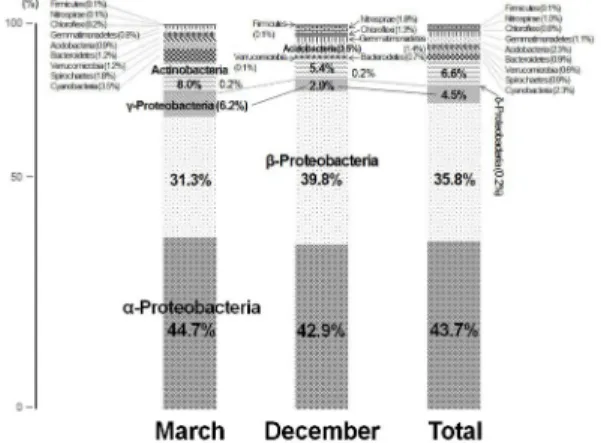
한강상수원보호구역 수계 중 세균군집 특성은 분 석한 평균 값을 사용하였다. 2014년 한강상수원보 호구역 수계 세균의 phylum-level 분석 결과, Proteobacteria 문이 84.2%의 높은 비율로 우점 및

Fig. 2. Bacterial diversity of water from the Han river water source protection area in March and December, 2014 at the phylum and class-level.

Fig. 1. Rarefaction curve for water from the Han river

water source protection area in March and

December, 2014

(3)

Actinobacteria 문이 6.6%로 차우점하였다. 그리고 Acidobacteria 문(2.3%), Cyanobacteria문(1.6%), Gemmatimonadetes 문(1.1%), Nitrospirae문(1.0%) 순으로 나타났으며, 1% 미만으로 Bacteroidetes, Spirochaetes, Chloroflexi, Verrucomicrobia 및 Firmicutes 문이 나타나면서, 총 11개의 세균 phyla가 분포하였다. 한강상수원보호구역에서 가장 높은 비율 로 우점한 Proteobacteria문은 class-level에서 세부적 으로 분석한 결과, α-Proteobacteria강이 43.7%로 가 장 높았고, β-Proteobacteria강이 35.8%로 나타 났으며, γ-와 δ-Proteobacteria강은 각각 4.5%와 0.2%

로 나타났다(Fig. 2). 또한, genus-level에서는 총 36개 세균 속이 나타났으며, 미동정(unidentified, 22.5%)을 제외하고 Aquamicrobium (21.0%), Bradyrhizobium (17.0%) 및 Variovorax속(7.8%)이 주요 세균속으로 나타났다(Table 1).

한편, 한강상수원보호구역 수계의 봄과 겨울철의 세균군집 특성을 비교한 결과, 봄철(3월)에는 11개, 겨울철(12월)에는 9개의 세균 phyla가 나타났다.

Phylum-level 에서는 Proteobacteria문이 봄철(82.4%) 과 겨울철(85.8%) 공통적으로 높은 비율의 우점이 나타났으나, 봄철에 비해 상대적으로 겨울철에 약 3.4% 높게 우점하였다. 그러나 봄철에는 겨울철에 비해 Cyanobacteria, γ-Proteobacteria, Actinobacteria, Spirochaetes, α-Proteobacteria, Verrucomicrobia 및 Bacteroidetes의 비율이 상대적으로 높게 나타났고, 겨울철에는 봄철에 비해 β-Proteobacteria, Acidobacteria, Nitrospirae, Chloroflexi 및 Gemmatimonadetes문의 비율이 상대적으로 높게 나타났다. 특히, Cyanobacteria 와 Spirochaetes문은 봄철에만 나타나면서, 겨울철에 비해 다양한 세균 phyla가 나타났다(Fig. 2). 또한, genus-level 에서는 봄철에 Aquamicrobium속(32.1%) 이 우점, Variovorax속(12.6%)이 차우점하였으며, Pseudomonas 속(5.9%) 등 총 33개 속이 분포하였다.

그러나 겨울철은 Bradyrhizobium속(26.5%)이 우점 및 Aquamicrobium속(11.1%)이 차우점하였으며, Methylotenera 속(7.4%), Ferribacterium속(6.6%) 등 총 29개 속이 존재하는 것으로 나타났다. 봄철에만 나타난 속은 Frigoribacterium, Janthinobacterium, Methylobacterium, Naxibacter, Pelomonas, Sphingomonas 및 Spirochaeta속이었으며, Nordella, Pedobacter 및 Thiobacillus 속은 겨울철에만 나타났다(Table 1). 낮 Table 1. Rates of bacterial genera from the Han river

water source protection area in spring March and December, 2014

Genus

Rate (%) Spring

(March)

Winter

(December) Total

Unknown 19.3 25.5 22.5

Acidovorax 1.2 0.7 1.0

Albidiferax 0.2 0.2 0.2

Aquabacterium 0.4 2.2 1.3

Aquamicrobium 32.1 11.1 21.0

Arthrobacter 0.9 1.5 1.2

Bacillus 0.1 0.1 0.1

Bradyrhizobium 6.2 26.5 17.0

Brevundimonas 1.6 3.1 2.4

Devosia 2.0 0.2 1.1

Ferribacterium 2.5 6.6 4.7

Flavobacterium 1.2 0.6 0.9

Frigoribacterium 1.6 0.0 0.7

Gemmatimonas 0.8 1.4 1.1

Herbaspirillum 0.2 0.1 0.1

Janthinobacterium 0.1 0.0 0.1

Lysobacter 0.2 0.1 0.1

Methylobacterium 0.2 0.0 0.1

Methylophilus 0.1 1.0 0.5

Methylotenera 0.1 7.4 4.0

Naxibacter 0.2 0.0 0.1

Nitrospira 0.1 1.8 1.0

Nordella 0.0 0.1 0.0

Opitutus 1.2 0.1 0.6

Pedobacter 0.0 0.1 0.0

Pelomonas 0.1 0.0 0.0

Polaromonas 0.2 0.4 0.3

Pseudolabrys 0.9 0.5 0.7

Pseudomonas 5.9 2.8 4.2

Ramlibacter 0.2 0.3 0.2

Rhodococcus 4.7 2.0 3.3

Sphingomonas 0.1 0.0 0.1

Spirochaeta 1.8 0.0 0.9

Stenotrophomonas 0.1 0.1 0.1

Thiobacillus 0.0 0.1 0.0

Undibacterium 1.1 0.1 0.5

Variovorax 12.6 3.6 7.8

Total 100.0 100.0 100.0

(4)

은 비율로 나타났으나 봄과 겨울철에 일정하게 나타 난 세균속은 Albidiferax, Bacillus, Herbaspirillum, Lysobacter, Polaromonas, Pseudolabrys, Ramlibacter 및 Stenotrophomonas속이었다(Table 1). 또한, 봄과 겨울철 Shannon index 및 Simpson index가 각각 2.74-2.81와 0.11-0.14 수준으로 유사하게 나타났으 나(Data not shown), phylum과 genus-level 분석 결과로 봄철이 겨울철에 비해 다양한 종류의 세균 군집이 나타나고 있는 것으로 보인다. 한편, Aquamicrobium 속은 봄철에 비해 겨울철에 21% 감 소하면서 우점속이 변화하였으며, 봄철 또는 겨울철 에만 존재하는 세균 속이 나타나는 등 계절적 변화 가 분석되었다.

V. 고 찰

이번 연구에서는 한강상수원보호구역의 수계 중 세균군집 다양성을 조사하였다. 한강상수원보호구역 에서 특징적으로 나타난 세균속은 다음과 같았다.

Aquamicrobium 속은 조사 지점에서 평균적으로 우점 하는 속으로, 특히 봄철에 높은 비율로 나타났다. 겨 울철에 비율이 감소하였으나, 차우점 속으로 연간 지 속적으로 11.1-32.1% 수준이 나타났다. 이들은 각각 활성슬러지, 산업폐수처리공장, 갯벌 등 수계에서도 보고된 바 있었으나, 가축(오리)사육장, 화학공장 주 변의 오염된 토양, 실험용 바이오필터 등에서도 서

13-15)

하는 속으로 Aquamicrobium속에 대한 추가적

조사가 필요할 것으로 보인다. Bradyrhizobium속은 조사 지점에서 평균적으로 차우점하였으며, 겨울철 에 가장 높은 비율로 우점하고 있는 세균 속이다.

Bradyrhizobium 속은 주로 토양에서 서식하며, 해수 욕장과 농업지역 등의 실외 공기 중에서도 높은 비 율로 분포한다.

16)

Bradyrhizobium속은 현재까지 27 종이 보고되고 있으며, 콩과 식물의 뿌리혹, 질소 고 정 등 환경에서 유익한 세균속으로 알려져 있다.

16)

Methylotenera 속은 겨울철 차우점하였으며, 특히 봄 철(0.1%)에 비해 겨울철에 높은 비율(7.4%)이 분석 된 세균 속이다. Methylotenera속은 현재까지 2종(M.

mobilis 및 M. versatilis)이 보고되었고, 이들은 모두 호수 저질토에서 서식하는 obligately methylamine utilizing bacteria 로 알려져 있다.

17)

Variovorax 속 은 봄철 차우점 속으로, 토양, 근권, 하수 등 환경

에서 서식하며, 현재까지 7종이 보고되고 있다.

18)

Pseudomonas 속은 봄철에만 5.0% 이상 나타난 속으 로, 이들은 주로 수계 환경에 서식한다. Pseudomonas 속은 아종을 포함하여 약 250 여종 이상 보고된 큰 분류군이며, 여기에는 잠재적 인체병원성 P.

aeruginosa 도 포함된다.

19)

Ferribacterium 속은 겨울 철 5.0% 이상 나타난 속으로, 현재까지 오직 F.

limneticum 한 종만이 보고되고 있다. F. limneticum 는 담수 저질토에서 서식하는 철 환원 미생물로 알 려져 있다.

20)

이에 따라, 특징적으로 나타나고 있는 Aquamicrobium, Bradyrhizobium, Methylotenera, Variovorax, Pseudomonas 및 Ferribacterium속 등 주 요 세균속과 함께 봄 또는 겨울철에만 나타난 Frigoribacterium, Janthinobacterium, Methylobacterium, Naxibacter, Pelomonas, Sphingomonas, Spirochaeta, Nordella, Pedobacter 및 Thiobacillus속 등에 대한 후속적 연구가 필요할 것으로 보인다.

한편, 이번 연구는 향후 먹는물의 안전관리에 대

한 미생물학적 기초 자료로 활용될 수 있을 것으로

생각된다. 현재 먹는물 중 미생물 검사는 환경부 먹

는물수질공정시험기준에 따라 이루어지고 있다. 환

경부 먹는물수질공정시험기준에 따르면, 음용지하수

를 포함한 수돗물, 병입수 등 먹는샘물 및 먹는물공

동시설(우물, 샘터, 약수터 등)로 나뉘며, 이에 따른

항목들에 대하여 검사를 수행하고 있다. 현재 검사

항목은 저온성 및 중온성 일반세균, 총대장균군, 대

장균(또는 분원성대장균군), 분원성연쇄상구균, 녹농

균, 아황산환원혐기성포자형성균, 살모넬라, 쉬겔라

및 여시니아이다. 그 밖에 세계보건기구 및 미국 환

경보호청 등에 의하면 수계 환경에서는 인체 병원성

세균으로 Mycobacterium sp., Aeromonas sp.,

Legionella spp., Camphylobacter 및 Vibrio chlerae

등이 알려져 있다. 이번 연구에서는 봄과 겨울철 나

타난 36개 세균 속들 중 녹농균(P. aeroginosa)을 포

함하는 Pseudomonas속을 제외하고는 나타나지 않았

다. 그러나 이번 연구에서 분석한 16S rRNA 유전

자는 P. aeroginosa 종 수준 동정이 어려우며

21)

, 배

양 및 비배양법에 의해 P. aeroginosa로 동정이 되

더라도 인체 병원성을 가지고 있다고 확정 할 수는

없다. 또한, 먹는 물은 상수원수의 정수처리 과정에

의해 후속적으로도 충분히 미생물을 제거하므로 상

수원수에 오염되어 있다고 하더라도 수돗물까지 올

(5)

가능성은 매우 희박하다. 그러나 한강상수원보호구 역 수계에서는 타 병원성 세균에 비해서는 상대적으 로 조사해볼 필요성은 있다고 보인다. 이번 연구에 서는 한강상수원보호구역의 수계 중 존재하는 세균 군집 특성을 조사하였다. 본 연구에서 제안한 후속 적 연구들은 향후 한강상수원보호구역 수계에 존재 하는 미생물 특성을 이해하고 및 상수원 보호 등 관 리에 미생물학적 기초자료로 제공 될 것으로 기대된다.

V. 결 론

한강 상수원보호구역 수계에서는 11개의 세균 phylum이 나타났고, 이 중 매우 높은 비율로 Proteobacteria 문이 우점하였다. 또한, 겨울철에는 검 출 감도 미만이던 남세균(Cyanobacteria)와 Spirochaetes 문이 봄철에만 나타났다. 속 수준에서는 봄철에 Aquamicrobium 속, 겨울철에는 Bradyrhizobium속이 우점하였으며, 우점하는 종을 포함한 특징적으로 나 타나는 세균 속들에 대한 후속적 연구가 필요한 것 으로 보인다. 한편, 인체 잠재적 병원성 세균속은 나 타나지 않았으나, 녹농균(P. aeroginosa)에 대한 추 가적 조사가 필요할 것으로 보인다.

감사의 글

이 논문은 2015년 정부(미래창조과학부)의 재원으 로 한국연구재단의 지원을 받아 수행된 연구(NRF- 2015R1C1A2A01052726) 입니다.

References

1. Kim JH. A study of sustainable and efficient man- agement of water resource protection zones. [disser- tation]. [Wonju]: Yonsei University; 2010

2. Yang JY. The study on management improvement of regulatory system in Phal-dang water source pro- tection area. [dissertation]. [Seoul]: University of Seoul; 2009

3. Lee SH, Kim MH. A study on water quality pollu- tion level of water supply source protection area in medium and small towns. J Kor Soc Environ Admin. 2008; 14(3): 123-132.

4. Jung HM, Yoon JY. The opinion with microbiolog- ical standard of American drinking water. J Kor Soc

Water wastewater. 1994; 10: 62-71.

5. Pipes WO. An overview of drinking water micro- biology. J Kor Soc Environ Eng. 1996; 18(7): 793- 804.

6. Park HK, Jung EY, Jung JM, Yu PJ. Detection and distribution of bacterial pathogens in raw water and during water treatment process by polymerase chain reaction. J Life Sci. 2007; 17(10): 1374-1380.

7. Hong PY, Hwang C, Ling F, Andersen GL, LeCh- evallier MW, Liu WT. Pyrosequencing analysis of bacterial biofilm communities in water meters of a drinking water distribution system. Appl Environ Microbiol. 2010; 76(16): 5631-5635.

8. Ascota-Martinez V, Dowd SE, Sun Y, Wester D, Allen V. Pyrosequencing analysis for characteriza- tion of soil bacterial populations as affected by an integrated livestock-cotton production system. Appl Soil Ecol. 2010; 45: 13-25.

9. Bowers RM, Lauber CL, Wiedinmyer C, Hamady M, Hallar AG, Fall R, et al. Characterization of air- borne microbial communities at a high-elevation site and their potential to act as atmospheric ice nuclei. Appl Environ microbiol. 2009; 75(15): 5121- 5130.

10. Lee S, Chung HM, Park ER. Characteristics of bac- teria in the living room and bathroom of a residen- tial environment using the pyrosequencing method.

Microbiol Biotechnol. 2016; 44(1): 84-88.

11. Kaevska M, Slana I. Comparison of filtering meth- ods, filter processing and DNA extraction kits for detection of mycobacteria in water. Ann Aqric Envi- ron Med. 2015; 22(3): 429-432.

12. Lee SW, Oh HW, Lee KH, Ahn TY. Methylobacte- rium dankookense sp. nov., isolate from drinking water. J Microbiol. 2009; 47(6): 716-720.

13. Bambauer A, Rainey FA, Stackebrandt E, Winter J.

Characterization of Aquamicrobium defluvii gen.

nov. sp. nov., a thiophene-2-carboxylate-metaboliz- ing bacterium from activated sludge. Arch Micro- biol. 1998; 169(4): 293-302.

14. Lipski A, Kampfer P. Aquamicrobium ahrensii sp.

nov. and Aquamicrobium segne sp. nov., isolated from experimental biofilters. Int J Syst Evol Micro- biol. 2012; 62(10): 2511-2516.

15. LPSN. List of prokaryotic names with standing in nomenclature, Genus Aquamicrobium. Available:

http://www.bacterio.net/Aquamicrobium.html [accessed 7 July 2016].

16. National Institute of Environmental Reasearch.

Study on the microorganisms of bioaerosol for sur-

roundings (I-II). 2014-2015

(6)

17. LPSN. Genus Methylotenera. Available: http://

www.bacterio.net/Methylotenera.html [accessed 7 July 2016].

18. LPSN. Genus Variovorax. Available: http://

www.bacterio.net/Variovorax.html [accessed 7 July 2016].

19. LPSN. Genus Pseudomonas. Available: http://

www.bacterio.net/Pseudomonas.html [accessed 7 July 2016].

20. LPSN. Genus Ferribacterium. Available: http://

www.bacterio.net/Ferribacterium.html [accessed 7 July 2016].

21. Lee S, Kim JH, Lee BR, Joo YL, Choe B, Park SJ,

et al. Isolation and identification of Pseudomonas

aeruginosa in natural environments by interna-

tional organization for standardization ISO/NP

16266. Kor J Microbiol. 2014; 50(4): 384-386.

수치

Fig. 1. Rarefaction curve for water from the Han river water source protection area in March and December, 2014

참조

관련 문서

Chang Goo Kang, Ah Hyun Park, Jang Ho Ha, Young Soo Kim, Joon-Ho Oh, Jeong Min Park, Soo Mee Kim, Seung-Jae Lee, Seung Hee Lee, and Han Soo Kim(KAERI). Fabrication

P02C14 A Preliminary Study on the Conceptual Design of Thorium/Uranium Mixed Nuclear Fuel for the Alternative of BurnabIe Poison in Commercial Pressurized Water Reactor Dong

The public water surface covers very wide area and produces a variety of goods and services and also generates the problem of common resources related

 include a fire protection strategy fireproofing or improved water spray coverage - flanges, valves, fittings and liquid LPG piping connected to the bottom of the sphere

withdrawn from the tank at a steady rate of m = 0.2 kg/s, how long will it take for the temperature of the water in the tank to drop from 60 to 35 o C.. Assume cold water

(c) Does the water level in the pool move upward, move downward, or remain the same if, instead, a cork (or buoy) is dropped from the boat into the water, where it

(c) Does the water level in the pool move upward, move downward, or remain the same if, instead, a cork (or buoy) is dropped from the boat into the water, where it

The water balance analysis is performed with the runoff curve numbers(CN) derived from the soil classification and land use characteristics and with the