A Survey on Insect Diversity of Mulyeongari-Oreum Wetland, on Jeju Island, South Korea
1aYoungho Cho2b, Yong-Gu Han2b, Seongjoon Park3, Youngjun Park3 , Youngjin Kim2, Min-Joo Choi2, Sang-Ho Nam2*
제주도 물영아리오름 습지의 곤충다양성에 관한 연구
1a조영호2b․한용구2b․박성준3․박영준3․김영진2․최민주2․남상호2*
ABSTRACT
The purpose of this study is to identify insects inhabiting Mulyeongari-Oreum wetland and to provide basic information for conservation of wetlands. As a result, a total 229 species, 73 families, 9 orders of insects were collected: 136 species, 39 families, 6 orders from Mulyeongari-Oreum Wetland and 121 species, 52 families, 9 orders from Mt. Sooryeong. Of the 229 species of insects investigated, Copris tripartitus Waterhouse, an endangered species of wildlife fauna in Korea, was found with many individuals. Also, Lychnuris rufa(Olivier), having a narrow habitat near unpolluted water and mountains, was also recorded with 3 individuals and then should be considered as a protected species in Wetlands. To identify the community structure of moth on Mulyeongari-Oreum wetland, a light trap was examined and a total 76 species of moths were collected. Total dominant species was Hydrillodes morosa(Butler) with index of 0.12 and the species diversity on the moth community from survey area was the highest in July with index of 3.42.
KEY WORDS: INSECT DIVERSITY, MULYEONGARI-OREUM WETLAND, RAMSAR CONVENTION
1 접수 2011년 3월 3일, 수정(1차: 2011년 7월 1일, 2차: 2011년 8월 1일), 게재확정 2011년 8월 2일 Received 3 March 2011; Revised(1st: 1 July 2011, 2nd: 1 August 2011); Accepted 2 August 2011 2 대전대학교 Dept. of Biology, Daejeon(300-716), Korea([email protected])
3 국립환경과학원 National Institute of Environment Research, Incheon(404-708), Korea a 이 논문은 환경부 습지보호지역 정밀조사의 일환으로 수행되었음.
b These authors contributed equally to this paper.
* 교신저자 Corresponding author([email protected])
요 약
본 논문은 물영아리오름 습지에 서식하는 곤충류를 파악하여 습지 보전에 대한 기초적인 정보를 제공하고자 실시되었 다. 조사결과 총 9목 73과 229종이 조사되었으며, 물영아리오름 습지는 6목 39과 136종, 수령산은 9목 52과 121종이 조사되었다. 조사된 229종의 곤충류 중 멸종위기종인 애기뿔소똥구리가 포함되었다. 또한 오염되지 않은 습한 산 주위에 서 주로 서식하는 늦반딧불이가 3개체 조사되었으며 이는 청정지역임을 나타내는 대표적인 종으로 습지에서 보호되어야 할 가치가 있는 것으로 판단된다. 또한 물영아리오름 습지의 나방류 확인을 위해 야간 유인등 조사를 실시하였으며 조사 결과 총 76종이 조사되었다. 넓은띠담흑수염나방이 0.12의 우점도 지수로 전체 우점종으로 조사되었으며, 종다양
도는 7월 조사에서 3.42로 가장 높게 나타났다.
주요어: 곤충다양성, 물영아리오름 습지, 람사르 협약
INTRODUCTION
Although wetlands occupy only about 4% of the total surface of the earth(Hunter et al., 2002), they are recognized to have significant functions of high value.
With this recognition, people came to have interest in and to pay attention to the preservation of wetlands, with results such as the Ramsar Convention. Wetlands are defined as those with high water content in the soil(Gove, 1969). They are known to have high primary productivity and to have critical roles in the life cycles of many aquatic species, many of which are economically important(National Research Council, 1992). They also serve life support functions including adjustment of water flow and storage of excesses, mitigating damage by floods. In addition, plant and bacterial species of wetlands serve to remove contaminants from circulating water and thus improve water quality(National Research Council, 1992). In the Wetlands Conservation Act of Korea, they are defined as inland and coastal land which is permanently or temporarily covered with fresh water, brackish water or salt water(Lee et al., 2003).
Mulyeongari-Oreum Wetland is located in Sumang-ri, Namwon-eup, Seogwipo-si, Jeju-do, South Korea. It is classified as inland wetland, specifically forest wetland, and more specifically basin wetland(Kwon, 2006). It was designated as a Wetlands Conservation Area in December, 2000 by the Ministry of Environment and registered as the fifth Ramsar Wetland in Korea in October, 2006.
Based on its geographical condition, within the secluded mountaintop crater of Mt. Sooryeong, it is considered an independent ecosystem. There are always some wet parts in the wetland all year round, although conditions within specific areas vary according to the season. The natural environment of the area is excellent, with abundant vegetation that provides a variety of microhabitats. It is considered to have high conservational value.
Regarding the insects of the Mulyeongari-Oreum Wetland, Cho and Kim(1988a) and Cha(1999) reported 41
species and 26 species, respectively, for a total of 47 species up to now. These surveys were performed before the existence of the Ramsar Convention. From this perspective, this survey is highly meaningful in that it is the first survey since the Ramsar Convention. There are other surveys on the other Ramsar Registered Wetlands in Korea such as the High Moor, Yonneup of Mr.
Daeam(Kim and Jung, 2007), Upo Wetland(Lee and Oh, 2006), Muljangori-oreum Wetland(Cho and Kim, 1998a;
Jung, 2001), Moojechineup(Lee, 1997; Cho and Kim, 1998b; Do et al., 2002; Lee and Lee, 2006), Jangdo Island High Moor(Kim, 2004; Paek and Song, 2007) and Du-ung Wetland(Cho and Kim, 2002).
This survey of the insects inhabiting Mulyeongari-Oreum Wetland and its supporting area on Mt. Sooryeong was performed to provide basic information for preservation and recovery of Mulyeongari-Oreum Wetland as part of the Mulyeongari-Oreum Wetland Precision Survey Project by the Ministry of Environment.
MATERIALS AND METHODS
1. Place and Time of Survey
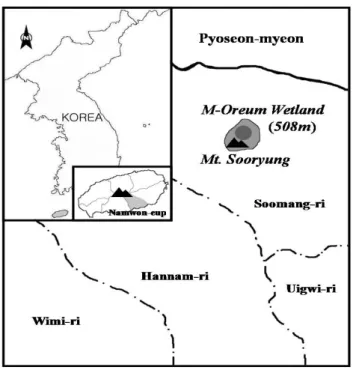
Surveys were performed separately in Mulyeongari-Oreum Wetland(N: 33° 22′57″, E: 126° 42′42″) and its supporting area on Mt. Sooryeong(N: 33° 21′21″, E: 126°
41′11″)(Figure 1). They were performed three times:
April 28 to 30, July 17 to 19 and September 30 to October 2, for a total of nine days, in 2008. All specimens are preserved in the laboratory of animal taxonomy and ecology in Daejeon University.
2. Method of Survey and Analysis
As insects have diversified habitats and behavioral habits, we used as many different collection methods as possible, according to the characteristics of the adults of each taxonomic group. For daytime collection, searching, sweeping and beating were adopted and qualitative
Figure 1. Survey area
Site Season Order Family Species Individuals
Mulyeongari- Oreum Wetland
April 4 16 46 157
July 5 23 74 197
October 4 22 49 129
Total 6 39 136 483
Mt. Sooryeong
April 3 7 18 15
July 8 38 77 153
October 9 31 60 115
Total 9 52 121 283
Table 1. Species composition of investigated areas surveys were done for various taxonomic groups. At night, to identify the community of moths, light trap quantitative surveys were done seasonally from 20:00 to 24:00 hours, to make three times in total. Additionally, to make a qualitative survey of the ground beetles in the wetland, pitfall trap was performed using silkworm pupae.
The insects collected in the field were temporarily anesthetized and then transported to the laboratory. Some were made into dried specimens and the others were made into immersion specimens in 70% ethanol. The collected insects were classified based on the previous literature and articles, and followed the classification scheme in "Checklist of Insects from Korea(1994)".
Moths were analyzed using dominance index and diversity index. For dominance index, McNaughton's
formula(1967) was used. For diversity index, Shannon-Weaver Diversity(1949) was used to create a baseline for comparison in the future.
RESULTS AND DISCUSSION
1. Total Taxonomic Groups
From the surveys, a total of 483 individuals belonging to 136 species, 39 families and 6 orders of adult insects were collected from Mulyeongari-Oreum Wetland and a total of 283 individuals, belonging to 121 species, 52 families and 9 orders of insects were collected from Mt.
Sooryeong. The most species were reported in July for both Mulyeongari-Oreum Wetland and Mt. Sooryeong, 74 species and 77 species, respectively. In April, relatively smaller number of species were reported, 46 species and 18 species respectively(Table 1).
In the earlier Mulyeongari-Oreum Wetland surveys, Cho and Kim(1998a) reported 41 species, 22 families in 5 orders, while Cha(1999) reported 26 species, 14 families in 5 orders, for a total of 47 reported species. A considerable number of the reported insects were aquatic(18 species, approximately 40%) and the surveys were somewhat biased toward certain taxonomic groups because of the characteristics of the wetland. However, in this survey we were able to add approximately 90 species using the seasonal surveys in spring, summer and autumn and through a wider variety of collection methods for Lepidoptera and Coleoptera. Additionally, Mt. Sooryeong, which has not been surveyed before, and which has significant meaning in biology and ecology as it supports and nurtures Mulyeongari-Oreum Wetland was included in this survey.
In Muljangori-Oreum, another Ramsar Wetland on Jeju Island, Cho and Kim(1998a) reported 31 species, 20
Wetlands
(Area, ha) Investigated results
Muljangori- Oreum Wetland
(63)
Cho and Kim (1998a) Jung(2001) 31 species,
20 families in 7 orders
182 species, 72 families in 11 orders High Moor, Yongneup of
Mt. Daeam (106)
Kim and Jung (2007) 220 species,
62 families in 11 orders Jangdo Island
High Moor (9)
Kim (2004) Paek and Song (2007) 126 species,
60 families in 15 orders
308 species, 102 families in 15 orders Du-ung
Wetland (6)
Cho and Kim (2002) 81 species, 43 families in 11 orders
Upo Wetland (854)
Lee and Oh (2006) 121 species,
18 families in 9 orders
Moojechineup (4)
Lee (1997) Do et al. (2002) Lee and Lee (2006) 60 species,
40 families in 8 orders
124 species, 60 families in 11 orders
34 species, 22 families in 10 orders Mulyeongari-
Oreum Wetland (31)
Cho and Kim (1998a) Cha (1999) This study (2008) 41 species,
22 families in 5 orders
26 species, 14 families in 5 orders
136 species, 39 families in 6 orders Table 2. Insect diversity of registered Ramsar wetlands in South Korea
families in 7 orders and Jung(2001) reported 182 species, 72 families in 11 orders. In the High Moor, Yongneup of Mt. Daeam, Kim and Jung(2007) reported 220 species, 62 families in 11 orders. Kim(2004) and Paek and Song(2007) reported 126 species, 60 families in 15 orders and 308 species, 102 families in 15 orders respectively in Jangdo Island High Moor. Cho and Kim(2002) reported 81 species, 43 families in 11 orders in Du-ung Wetland area and Lee and Oh(2006) reported 121 species, 18 families in 9 orders in Upo Wetland area. Additionally, Lee(1997) reported 60 species, 40 families in 8 orders, Do et al.(2002) reported 124 species, 60 families in 11 orders and Lee and Lee(2006) reported 34 species, 22 families in 10 orders terrestrial insects in Moojechineup area. In particular, in Muljangori Wetland, the High Moor, Yongneup of Mt. Daeam and Jangdo Island High Moor various insects were reported as 182 species, 220 species
and 308 species respectively.
Muljangori Wetland(63 ha) and the High Moor, Yongneup(106 ha) of Mt. Daeam have lower insect diversity per unit than Mulyeongari-Oreum Wetland because they are relatively wider than Mulyeongari-Oreum Wetland(31 ha). Jangdo Island High Moor(9 ha) showed high level of insect diversity per unit reporting more species than Mulyeongari-Oreum Wetland although it is no more than a third of Mulyeongari-Oreum Wetland in size. However, Jangdo Island High Moor survey result included 126 literature species and the survey area was wide because wide area around the wetland was included in the survey. It is judged that the 229 species which come from Mulyeongari-Oreum Wetland and its neighboring ecosystem in Mt. Sooryeong can compete with other wetlands considering the aforementioned reasons(Table 2).
Season Dominant Species Dominance Index Species Diversity Index
April Odontopera arida (Butler) 0.21 2.49
July Hydrillodes morosa (Butler) 0.19 3.42
October Neocifuna jankowskii (Oberthür) 0.19 2.94
Total Hydrillodes morosa (Butler) 0.12
Table 4. Seasonal community analysis of moths collected from Mulyeongari-Oreum Wetland
Order Mulyeongari-Oreum Wetland Mt. Sooryeong Total
Families Species Families Species Families Species
Odonata 0 0 2 6 2 6
Mantodea 0 0 1 2 1 2
Orthoptera 0 0 6 10 6 10
Hemiptera 3 11 7 9 8 19
Homoptera 1 1 3 3 3 3
Coleoptera 16 31 10 19 20 45
Hymenoptera 3 15 5 17 6 25
Diptera 1 1 7 13 7 13
Lepidoptera 15 77 11 42 20 106
Total 39 136 52 121 73 229
Table 3. Number of families and species within the orders collected in investigated areas 2. Taxonomic Composition
Looking at the appearance ratio by order, members of Lepidoptera and Coleoptera made up approximately two thirds of total species as 106 species(46%) and 45 species (20%), respectively. The next orders are Hymenoptera (11%) with 25 species, Hemiptera(8%) with 19 species, and Diptera(6%) with 13 species. By survey place, in Mulyeongari-Oreum Wetland the order of species was reported as Lepidoptera 77 species(57%), Coleoptera 31 species(23%), Hymenoptera 15 species(11%). In Mt.
Sooryeong, the same order was reported as Lepidoptera 42 species(35%), Coleoptera 19 species(16%), Hymenoptera 17 species(14%)(Table 3).
It is thought that the reasons why members of Lepidoptera and Coleoptera were absolutely dominant in the survey are because they are large taxonomic groups and because the methods used to collect the insects, Light Trap and Pitfall Trap, favored collection of these kinds of insects. Cho and Kim(1998) and Cha(1999) used relatively simple collection methods such as air net and sweeping the water weed field for adult aquatic insects.
As a result, in their surveys, not even a single species of Lepidoptera, Hymenoptera or Diptera was reported. Most
of the specimens they collected were members of Coleoptera(28 species, 60%), Hemiptera(8 Species, 17%), and Odonata(4 species, 8%).
3. Moth Community Analysis
For the moth community analysis of the Mulyeongari-Oreum Wetland, the highest species diversity index occurred in July(3.42) and the lowest in April(2.49). The dominant species was Hydrillodes morosa(Butler) with dominance index of 0.12(Table 4).
The species diversity index ranged from 2.49 to 3.42.
This was relatively lower than general survey results. One reason many kinds of moths were not reported may have been because light from the light trap was obstructed by the trees with same height as Mulyeongari-Oreum Wetland is located in a deep crater. Additionally, on the interior slope, broad-leaved forest trees such as Carpinus laxiflora (Siebold & Zucc.) Blume, Cornus kousa F.Buerger ex Miquel, Styrax japonicus Siebold & Zucc. and Neolitsea sericea(Blume) Koidz. were dominant, while on the exterior slope, there was an artificial plantation of trees such as Cryptomeria japonica(L.f.) D.Don and Pinus thunbergii Parl.. Therefore, it is possible that the food plants of the
Investigated areas Endemic species
Specific species
Species Approved for Overseas Delivery
Endangered
species Total
Literature Mulyeongari-
Oreum Wetland (2008) 8 3 1
Copris tripartitus Waterhouse 12 Cho and Kim
(1998) 2 3 1 1
Lethocerus deyrollei (Vuillefroy) 7 Cha
(1999) 1 2
2
Lethocerus deyrollei (Vuillefroy), Copris tripartitus Waterhouse
5
Mt. Sooryeong (2008) 5 19 1
Copris tripartitus Waterhouse 25 Table 5. Legally protected species collected from Mulyeongari-Oreum Wetland and Mt. Sooryeong
Figure 2. Copris tripartitus Waterhouse, the Second Grade of Endangered Species in Korea, collected from Mulyeongari-Oreum Wetland and Mt. Sooryeong in 2008
moths were restricted in that area. Hydrillodes morosa(Butler) was the dominant species not only in July but also in total, and appeared from May till August. It is a general species distributed all over Korea. Odontopera arida(Butler) is also a general species appearing from May to June and from August to September. On the other hand, Neocifuna jankowskii(Oberthür) appears once a year from July to September. Although they are species with not many individuals, they were dominant in the Autumn survey.
The food plants for those three species are unknown(Kim et al., 1983; Shin et al., 1983; Shin, 2001).
4. Protected Species
No species registered on the IUCN Red List were collected in this area. However, 37 species of protected species were reported, including Copris tripartitus Waterhouse which falls under the Second Grade of endangered species of wildlife fauna and flora in Korea. In the Mulyeongari-Oreum Wetland, 12 species were reported such as 8 specific species, 3 approved species for delivering overseas and 1 endangered species. In Mt. Sooryeong, 25 species such as 5 endemic species, 19 specific species and 1 endangered species were reported. Cho and Kim(1998a) and Cha (1999) reported 7 and 5 protected species respectively including Lethocerus deyrollei(Vuillefroy) and C. tripartitus Waterhouse(Figure 2, Table 5).
In our survey, many more protected species were reported compared to previous surveys. However, the second grade endangered species, L. deyrollei(Vuillefroy) was not reported in this survey because our survey focused on terrestrial insects and did not make separate surveys of benthic macroinvertebrates and aquatic insects. The C.
tripartitus Waterhouse was first reported by Cha(1999) and confirmed in this survey in 2008. This means that the habitat has been preserved well for nearly ten years and that conditions favor C. tripartitus Waterhouse habitation as cow and horse dung is very abundant. Although L.
deyrollei(Vuillefroy) has not been reported in this survey, in 2008, as well as 1998 to 1999, it was reported in two places near Dongbaekdongsan(Mt.) which is near Mulyeongari-Oreum Wetland. Considering that, it is highly probable that they still inhabit this area. As they are a protected species being endangered, continuous and precise monitoring should be performed. In the nighttime light trap survey, Lychnuris rufa(Olivier) was identified.
Thus, it seems that two kinds of fireflies inhabit this area with Luciola lateralis Motshulsky which was identified by hearing from local residents.
LITERATURE CITED
Cha J.Y.(1999) Natural Environment Survey of Mulyeongari-Oreum Wetland in Jeju, Korea. Ministry of Environment, pp. 36-41. (in Korean)
Cho, Y.B. and D.S. Kim(1998a) Insect Fauna of Some wetlands in Cheju Island, Korea. Bulletin of the KACN. 17(4): 57-74. (in Korean with English abstract)
Cho, Y.B. and D.S. Kim(1998b) Insect Fauna of Moojechi Moor on Mt. Jeongjok, Ministry of Environment, pp. 62-78. (in Korean with English summary)
Cho, Y.B. and D.S. Kim(2002) A report of investigation on natural ecosystem of the Coastal Sand Dune (Du-ung Wetland) in Sinduri, Taean-Gun. National Institute of Environmental Research, pp.71-86. (in Korean)
Do, Y.H., T.Y. Moon and S.H. Nam(2002) Toxonomic Diversity and Ecological Assessment of Insect Fauna at Mt. Jungjok-san in Ulju-gun, Natural Science (Daejeon Uni.) 13(1): 65-79. (in Korean with English abstract)
Gove, P.B.(1969) Webster's Third New International Dictionary. G
& C. Merriam Co., Chicago, 2662pp.
Hunter, D., J. Salzman and D. Zaelke(2002) International Environmental Law and Policy (2nd ed.). Foundation Press, West Group, 1029pp.
Jung, S.H.(2001) Natural Environment Survey of Inland Wetlands in Korea; Muljangori Wetland area. Ministry of Environment, pp. 71-100. (in Korean)
Kim, C.H., S.H. Nam and S.M. Lee(1983) Illustrated Flora & Fauna of Korea, Vol. 26, Insecta(Ⅷ). Samhwa Publishing Co. Ltd., Seoul, 595pp. (in Korean)
Kim, K.G.(2004) Natural Environment Survey of Jangdo Island High Moor, National Institute of Environmental Research, 109pp.
Kim, K.G. and D.E. Jung(2007) A detailed Survey of Wetland Conservation Area; High Moor, Yongneup of Mt. Daeam.
National Institute of Environmental Research, pp. 213-231. (in Korean)
Kwon, D.H.(2006) Korean Landform. Hanul Academy, Seoul, pp.
118-130. (in Korean)
Lee, C.E.(1997) Insect Fauna of Moojechi Moor on Mt. Jeongjok, Ministry of Environment, pp. 87-106. (in Korean with English summary)
Lee, J.W. and S.H. Oh(2006) A detailed Survey of Wetland Conservation Area; Upo Wetland. National Institute of Environmental Research, pp. 247-297. (in Korean)
Lee, J.W. and S.M. Lee(2006) A detailed Survey of Wetland Conservation Area; Moojechineup. National Institute of Environmental Research, pp. 411-431. (in Korean)
Lee, M.W., O.J. Kwon and B.K. Lim(2003) Environmental design laws for sustainable development in South Korea. Academy book Publishing, Seoul, 901pp. (in Korean)
McNaughton, S.J.(1967) Relationship among functional properties of California grassland. Nature 216: 168~174.
National Research Council(1992) Restoration of Aquatic Ecosystems; Science, Technology and Public Policy. National Academy Press, Washington, D.C.
Paek, M.K. and Y.J. Song(2007) A detailed Survey of Wetland Conservation Area; Jangdo Island High Moor. National Institute of Environmental Research, pp. 399-430. (in Korean) Shannon, C.E. and W. Weaver(1949) The Mathematical Theory of
Communication. University of Illinois Press, Urbana.
Shin, Y.H.(2001) Coloured Illustrations of The Moths of Korea.
Academybook Publishing, Seoul, 360pp. (in Korean) Shin, Y.H., K.T. Park and S.H. Nam(1983) Illustrated Flora &
Fauna of Korea, Vol. 27, Insecta(Ⅸ). Samhwa Publishing Co.
Ltd., Seoul, 260pp. (in Korean)
The Entomological Society of Korea and Korean Society of Applied Entomology(1994) Check List of Insects from Korea, Kon-Kuk University Press, Seoul. (in Korean)
Scientific name Korean name
April July October Cho
&
(1998a)Kim Cha (1999) MOW MS MOW MS MOW MS
Order Odonata 잠자리目
Family Coenagrionidae 실잠자리科
Ceriagrion melanurum Selys 노란실잠자리 ○ ○
Family Lestidae 청실잠자리科
Indolestes gracilis peregrinus (Ris) 가는실잠자리 ○ ○
Family Gomphidae 부채장수잠자리科
Sieboldius albardae Selys 어리장수잠자리 1
Family Libellulidae 잠자리科
Lyriothemis pachygastra (Selys) 베치레잠자리 1 2 ○ ○
Sympetrum darwinianum (Selys) 여름좀잠자리 1
Sympetrum eroticum eroticum (Selys) 두점박이좀잠자리 1
Sympetrum infuscatum (Selys) 깃동잠자리 1 ○ ○
Sympetrum pedemontanum elatum (Selys) 날개띠좀잠자리 2 4
Order Orthoptera 메뚜기目
Family Tettigoniidae 여치科
Phaneroptera falcata (Poda) 실베짱이 2 5 ○
Ruspolia lineosa (Walker) 매부리 1
Family Gryllidae 귀뚜라미科
Teleogryllus emma (Ohmachi et Matsumura) 왕귀뚜라미 1 3
Family Gryllotalpidae 땅강아지科
Gryllotalpa orientalis (Burmeister) 땅강아지 1
Family Tetrigidae 모메뚜기科
Criotettix japonicus (de Haan) 가시모메뚜기 1
Tetrix japonica (Bolivar) 모메뚜기 2
Family Pyrgomorphidae 섬서구메뚜기科
Atractomorpha lata (Motschulsky) 섬서구메뚜기 2
Family Acrididae 메뚜기科
Oxya japonica japonica (Thunberg) 벼메뚜기 1 ○ ○
Acrida cinerea cinerea (Thunberg) 방아깨비 1 1
Locusta migratoria (Linné) 풀무치 1 ○
Order Mantodea 사마귀目
Family Nabidae 사마귀科
Statilia maculata (Thunberg) 좀사마귀 2
Tenodera aridifolia (Stoll) 왕사마귀 2 ○
Order Hemiptera 노린재目
Family Belostomatidae 물장군科
Lethocerus deyrollei (Vuillefroy) 물장군 ○ ○
Family Pleidae 둥글물벌레科
Plea japonica (Horvath) 둥글물벌레 ○ ○
Family Notonectidae 송장헤엄치게科
Notonecta triguttata Motschulsky 송장헤엄치게 ○ ○
Family Gerridae 소금쟁이科
Aquarius paludum (Fabricius) 소금쟁이 ○ ○
Family Nabidae 쐐기노린재科
Nabis (Nabis) stenoferus Hsiao 긴날개쐐기노린재 1
Family Reduviidae 침노린재科
Sphedanolestes impressicollis (Stal) 다리무늬침노린재 2
Family Miridae 장님노린재科
Ectmetopterus micantulus (Horváth) 큰검정뛰어장님노린재 ○
Family Lygaeidae 긴노린재科
Lygaeus hanseni Jakovlev 애십자무늬긴노린재 2
Pachygrontha antennata (Uhler) 더듬이긴노린재 1 ○
Nysius (Nysius) plebejus Distant 애긴노린재 ○
Pamerana scotti (Distant) 스코트표주박긴노린재 ○
Appendix 1. List of insect species collected from Mulyeongari-Oreum Wetland and Mt. Sooryeong
Scientific name Korean name
April July October Cho
&
(1998a)Kim Cha (1999) MOW MS MOW MS MOW MS
Neolethaeus dallasi (Scott) 달라시긴노린재 2
Family Alydidae 호리허리노린재科
Riptortus clavatus (Thunberg) 톱다리개미허리노린재 1
Family Lygaeidae 알노린재科
Coptosoma bifarium Montandon 알노린재 5
Family Acanthosomatidae 뿔노린재科
Acanthosoma forficula Jakovlev 녹색가위뿔노린재 2
Acanthosoma haemorrhoidale (Linné) 뿔노린재 3
Acanthosoma labiduroides Jakovlev 긴가위뿔노린재 5 2
Elasmostethus interstinctus (Linné) 진얼룩뿔노린재 1
Elasmucha putoni Scott 푸토니뿔노린재 2
Family Phyllocephalidae 억새노린재科
Gonopsis affinis (Uhler) 억새노린재 1
Family Pentatomidae 노린재科
Carbula putoni (Jakovlev) 가시노린재 1 2
Lelia decempunctata (Motschulsky) 열점박이노린재 1
Halyomorpha halys (Stal) 썩덩나무노린재 1
Nezara antennata Scott 풀색노린재 3
Palomena angulosa (Motschulsky) 북방풀노린재 1
Plautia stali Scott 갈색날개노린재 13 2
Order Homoptera 매미目
Family Cercopidae 쥐머리거품벌레科
Eoscartopsis assimilis (Uhler) 쥐머리거품벌레 3
Family Cicadellidae 매미충科
Bothrogonia japonica Ishihara 끝검은말매미충 25 ○ ○
Family Aphrophoridae 거품벌레科
Aphrophora maritima (Matsumura) 갈잎거품벌레 ○
Family Delphacidae 멸구科
Sogatella furcifera (Horváth) 흰등멸구 ○
Family Cicadidae 매미科
Graptopsaltria nigrofuscata (Motschulsky) 유지매미 2 1
Order Coleoptera 딱정벌레目
Family Carabidae 딱정벌레科
Carabus (Parhomopterus) sternbergi sternbergi Roeschke 우리딱정벌레 20 2
Carabus (Isiocarabus) fiduciarius saishutoicus Csiki 제주왕딱정벌레 15 3 ○
Carabus (Parhomopterus) sternbergi touzalini Lapouge 제주우리딱정벌레 ○
Nebria (Orientonebria) chinensis chinensis Bates 중국먼지벌레 1 9
Family Harpalidae 먼지벌레科
Dolichus halensis (Schaller) 등빨간먼지벌레 1
Colpodes (Eucolpodes) japonicus (Motschulsky) 일본줄납작먼지벌레 ○
Harpalus (Pseudoophonus) vicarius Harold 북방머리먼지벌레 ○
Oxycentrus argutoroides (Bates) 긴머리먼지벌레 1 ○
Dischissus mirandus Bates 큰털보먼지벌레 1
Scarites (Parallelomorphus) terricola pacificus Bates 긴조롱박먼지벌레 ○
Galerita (Galerita) orientalis Schmidt-Goebel 목가는먼지벌레 2
Family Brachinidae 폭탄먼지벌레科
Pheropsophus javanus (Dejean) 남방폭탄먼지벌레 10 1
Pheropsophus jessoensis Morawitz 폭탄먼지벌레 36 5 13
Family Noteridae 자색물방개科
Noterus japonicus Sharp 자색물방개 ○ ○
Canthydrus politus (Sharp) 노랑띠물방개 ○ ○
Family Cicindelidae 길앞잡이科
Cicindela (Myriochile) specularis Chaudoir 쇠길앞잡이 5 2
Family Dytiscidae 물방개科
Hydaticus Conspersus Regimbart 1
Cybister (Meganectes) brevis Aube 검정물방개 3 ○ ○
Laccophilus difficilis Sharp 무늬깨알물방개 ○ ○
Agabus browni Kamiya 큰땅콩물방개 ○ ○
Appendix 1. (Continued)
Scientific name Korean name
April July October Cho
&
(1998a)Kim Cha (1999) MOW MS MOW MS MOW MS
Agabus congener (Thunberg) 북쪽땅콩물방개 ○ ○
Hydaticus (Hydaticus) bowringi Clark 줄무늬물방개 ○ ○
Hydaticus sp. 알물방개류 ○ ○
Family Gyrinidae 물맴이科
Gyrinus (Gyrinus) gestroi Régimbart 참물맴이 ○ ○
Family Hydrophilidae 물땡땡이科
Sternolophus (Sternolophus) rufipes Fabricius 애물땡땡이 ○ ○
Family Staphylinidae 반날개科
Stenus (Hypostenus) cicindeloides (Schaller) 북방알락딱부리반날개 ○
Stenus (Nestus) melanarius verecundus Sharp 좀딱부리반날개 ○
Lathrobium dignum Sharp 홍딱지개미반날개 ○
Family Silphidae 송장벌레科
Nicrophorus (Nicrophorus) quadripunctatus Kraatz 넉점박이송장벌레 1
Necrodes asiaticus Portevin 큰수중다리송장벌레 1
Family Staphylinidae 반날개科
Stenus sp. 1 5
Ocypus sp. 1 2
Family Helodidae 알꽃벼룩科
Scirtes japonicus Kiesenwetter 알꽃벼룩 2 ○
Family Lucanidae 사슴벌레科
Serrognathus platymelus castanicolor Motschulsky 넓적사슴벌레 1
Family Scarabaeidae 소똥구리科
Scarabaeus typhon (Fischer-Waldheim) 뿔소똥구리 1 ○
Copris tripartitus Waterhouse 애기뿔소똥구리 1 2 7 10 5 ○
Onthophagus (Strandius) lenzii Harold 렌지소똥풍뎅이 ○
Onthophagus (Phanaeomorphus) fodiens Waterhouse 모가슴소똥풍뎅이 ○
Family Aphodiidae 똥풍뎅이科
Aphodius (Aphodius) elegans Allibert 큰점박이똥풍뎅이 1 ○
Family Melolonthidae 검정풍뎅이科
Holotrichia diomphalia (Bates) 참검정풍뎅이 1
Family Rutelidae 풍뎅이科
Adoretus tenuimaculatus Waterhouse 주둥무늬차색풍뎅이 1
Anomala albopilosa Hope 청동풍뎅이 26
Bifurcanomala aulax Wiedemann 홈줄풍뎅이 2
Popillia quadriguttata quadriguttata (Fabricius) 녹색콩풍뎅이 18 8
Family Cetoniidae 꽃무지科
Protaetia brevitarsis seulensis (Kolbe) 흰점박이꽃무지 1 1
Family Elateridae 방아벌레科
Pectocera fortunei Candéze 왕빗살방아벌레 1 2 2
Family Lampyridae 반딧불이科
Lychnuris rufa (Olivier) 눚반딧불이 3
Family Coccinellidae 무당벌레科
Anatis halonis Lewis 달무리무당벌레 3
Coccinella (Coccinella) septempunctat Linné 칠성무당벌레 1
Harmonia axyridis (Pallas) 무당벌레 2 1 2
Propylea japonica (Thunberg) 꼬마남생이무당벌레 1 3 1
Family Cerambycidae 하늘소科
Spondylis buprestoides (Linné) 검정하늘소 1
Leptura arcuata Panzer 긴알락꽃하늘소 1
Agapanthia pilicornis (Fabricius) 남색초원하늘소 1
Anoplophora malasiaca (Thomson) 알락하늘소 2
Massicus raddei (Blessig) 하늘소 1
Family Chrysomelidae 잎벌레科
Lilioceris (Lilioceris) ruficollis (Baly) 고려긴가슴잎벌레 2
Galerucella grisescens (Joannis) 딸기잎벌레 9
Galerucella nipponensis (Laboissiere) 일본잎벌레 ○
Lema (Lema) coronata Baly 가시다리큰벼잎벌레 ○
Altica caerulescens (Baly) 발리잎벌레 2
Appendix 1. (Continued)
Scientific name Korean name
April July October Cho
&
(1998a)Kim Cha (1999) MOW MS MOW MS MOW MS
Batophila acutangula Heikertinger 콩알벼룩잎벌레 17
Chaetocnema (Chaetocnema) ingenua (Baly) 두줄털다리벼룩잎벌레 4
Sphaeroderma placidum Harold 2
Family Anthribidae 소바구미科
Tropideres naevulus Faust 날개떡소바구미 1
Order Hymenoptera 벌目
Family Ichneumonidae 맵시벌科
Pimpla luctuosa Smith 1
Ophioninae sp. 4
Trogus bicolor Radoszkowski 두색맵시벌 1
Alomyini sp. 1
Family Scoliidae 배벌科
Campsomeris (Megacampsemeris) prismatica Smith 금테줄배벌 1
Family Formicidae 개미科
Camponotus kiusuensis Santsch 갈색발왕개미 +
Camponotus vitiosus Kim et Kim 제주왕개미 +
Crematogaster matsumurai Forel 마쓰무라밑들이개미 ++
Crematogaster osakensis Forel 노랑밑들이개미 +++ +++ +++ +++ +++ +++
Formica japonica Motschulsky 곰개미 +++ + +++ + +++
Lasius flavus (Fabricius) 황개미 +
Lasius hayashi Yamauchi et Hayashida 하야시털개미 ++ ++ +
Lasius japonicus (Latreille) 고동털개미 ++ +
Myrmecina nipponica Wheeler 가시방패개미 +
Pachycondyla javana Mayr 일본침개미 +
Paratrechina flavipes (Smith) 스미스개미 ++ ++ ++ ++ ++ ++
Pheidole fevida (Smith) 극동흑개미 ++ ++ ++ ++ ++ ++
Tetramorium tsusimae (Linné) 주름개미 + ++ + ++ ++
Vollenhovia emeryi Wheeler 에메리개미 +
Camponotus (Camponotus) japonicus Mayr 일본왕개미 +
Camponotus (Camponotus) obscuripes Mayr 홍가슴개미 +
Family Pompilidae 대모벌科
Cyphononyx dorsalis (Lepeletier) 대모벌 2
Family Sphecoidae 구멍벌科
Psen affinis Gussakovskij 구사코브스키꼬마구멍벌 1
Family Apidae 꿀벌科
Ceratina japonica Cockerell 일본광채꽃벌 2
Apis mellifera Linné 양봉꿀벌 2
Order Diptera 파리目
Family Stratiomyidae 동애등에科
Hermetia illucens (Linnaeus) 아메리카동애등에 1
Family Asilidae 파리매科
Promachus yesonicus Bigot 파리매 1
Family Dolichopodidae 장다리파리科
Mesorhaga nebulosa (Matsumura) 얼룩장다리파리 1
Family Syrphidae 꽃등에科
Episyrphus balteatus (de Geer) 호리꽃등에 1
Betasyrphus serarius (Wiedemann) 검정넓적꽃등에 2
Sphaerophoria menthastri (Linné) 꼬마꽃등에 3
Melanostoma mellinum (Linné) 광붙이꽃등에 1
Paragus haemorrhous Meigen 고려꽃등에 3
Helophilus (Helophilus) virgatus Coquillett 수중다리꽃등에 1 1
Family Platystomatidae 알락파리科
Rivellia alini Enderlein 알린콩알락파리 5
Family Muscidae 집파리科
Musca domestica (Linné) 집파리 2
Family Tachinidae 기생파리科
Tachina nupta (Rondani) 등줄기생파리 1
Cylindromyia (Cylindromyia) brassicaria (Fabricius) 표주박기생파리 1
Appendix 1. (Continued)
Scientific name Korean name
April July October Cho
&
(1998a)Kim Cha (1999)
MOW MS MOW MS MOW MS
Order Lepidoptera 나비目
Family Tortricidae 잎말이나방科
Archips audax Razowski 뒷노랑잎말이나방 2
Family Pyralidae 명나방科
Bradina geminalis Caradja 외줄들명나방 5
Charema noctescens Moore 노랑다리들명나방 1
Cnaphalocrocis medinalis (Guenée) 혹명나방 2
Herpetogramma luctuosalis (Guenée) 포도들명나방 2
Palpita inusitata Butler 애기흰들명나방 1
Palpita nigropunctalis (Bremer) 수수꽃다리명나방 1 2
Hymenia recurvalis (Fabricius) 흰띠명나방 1
Lamoria glaucalis Caradja 앞붉은부채명나방 6
Craneophora ficki (Christoph) 줄보라집명나방 3
Teliphasa amica (Butler) 흰무늬집명나방 5
Orthaga achatina Butler 갈색집명나방 1
Endotricha consocia (Butler) 큰홍색뾰족명나방 3
Maruca testulalis Geyer 콩명나방 3
Family Thyrididae 창나방科
Striglina cancellata (Christoph) 창나방 1
Family Limacodidae 쐐기나방科
Austrapoda dentata (Oberthür) 흰점쐐기나방 1
Narosa fulgens (Leech) 꼬마얼룩무늬쐐기나방 1
Phlossa conjuncta (Walker) 남방쐐기나방 1
Family Drepanidae 갈고리나방科
Auzata nigrata Park et Shin 얼룩갈고리나방 1
Deroca inconclusa (Walker) 남방흰갈고리나방 3
Family Thyatiridae 뾰족날개나방科
Habrosyne aurorina (Butler) 애기담홍뾰족날개나방 2 2
Thyatira batis (Linné) 무늬뾰족날개나방 2 1
Family Cyclidiidae 왕갈고리나방科
Cyclidia substigmaria (Hübner) 왕갈고리나방 1
Family Geometridae 자나방科
Geometra dieckmanni Graeser 흰줄푸른자나방 1
Ecliptopera umbrosaria (Motschulsky) 큰톱날물결자나방 1 1
Eulithis fabiolaria (Oberthür) 무늬박이흰물결자나방 1
Gandaritis fixseni (Bremer) 큰노랑물결자나방 1
Heterophleps confusa (Wileman) 애기담흑물결자나방 2 1
Amraica superans (Butler) 노박덩굴가지나방 1
Ascotis selenaria (Denis et Schiffermüller) 네눈쑥가지나방 1 1 2 2
Chiasmia cinerearia (Bremer et Grey) 줄마디가지나방 1
Corymica specularia (Moore) 큰노랑애기가지나방 2
Hypephyra terrosa Butler 뒷노랑뾰족가지나방 1
Ectropis excellens (Butler) 줄고운가지나방 3
Fascellina chromataria Walker 갈고리가지나방 2
Heterolocha aristonaria (Walker) 뒷분홍가지나방 1
Hypomecis punctinalis (Scopoli) 네눈가지나방 1 1
Menophra atrilineata (Butler) 뽕나무가지나방 1 1 1
Menophra senilis (Butler) 먹그림가지나방 1 9
Ninodes splendens (Butler) 보라애기가지나방 1
Obeidia tigrata (Guenée) 노랑날개무늬가지나방 1 1
Nothomiza aureolaria Inoue 앞노랑가지나방 1
Odontopera arida (Butler) 남방갈고리가지나방 5 3
Chiasmia normata (Alphéraky) 고운날개가지나방 1 1
Ourapteryx maculicaudaria (Motschulsky) 흰제비가지나방 1 1
Pareclipsis gracilis (Butler) 끝짤름노랑가지나방 4 4
Zethenia rufescentaria Motschulsky 솔밭가지나방 4 5
Alcis angulifera (Butler) 털뿔가지나방 5
Family Lasiocampidae 솔나방科
Appendix 1. (Continued)
Scientific name Korean name
April July October Cho
&
(1998a)Kim Cha (1999)
MOW MS MOW MS MOW MS
Dendrolimus spectabilis (Butler) 솔나방 1
Family Bombycidae 누에나방科
Bombyx mandarina (Moore) 멧누에나방 1
Family Sphingidae 박각시科
Ambulyx japonica (Rothschild) 갈고리박각시 1
Callambulyx tatarinovii (Bremer et Grey) 녹색박각시 2
Anuga multiplicans Walker 애물결박각시 1
Dolbina tancrei Staudinger 물결박각시 1
Marumba gaschkewitschii (Bremer et Grey) 분홍등줄박각시 1
Marumba spectabilis (Butler) 제주등줄박각시 3
Acosmeryx naga (Moore) 포도박각시 1 1
Macroglossum saga Butler 검정꼬리박각시 1
Rhagastis mongoliana (Butler) 우단박각시 4
Family Notodontidae 재주나방科
Quadricalcarifera cyanea (Leech) 때죽나무재주나방 1
Family Lymantriidae 독나방科
Neocifuna jankowskii (Oberthür) 갈색독나방 11
Family Arctiidae 불나방科
Miltochrista miniata (Forester) 주홍테불나방 2
pilarctia seriatopunctata Motschulsky 줄점불나방 5
Family Noctuidae 밤나방科
Agrotis tokionis Butler 숫검은밤나방 2
Sineugraphe exusta (Butler) 쌍검은밤나방 1
Hadena rivularis (Fabricius) 줄흰무늬밤나방 3
Xestia stupenda (Butler) 앞노랑점밤나방 4
Pseudaletia separata (Walker) 멸강나방 1
Callopistria repleta Walker 얼룩어린밤나방 1
Cosmia achatina Butler 제주꼬마밤나방 1
Ctenoplusia (Acanthoplusia) agnata (Staudinger) 콩은무늬밤나방 2 2
Ercheia niveostrigata Warren 청백무늬밤나방 6
Metopta rectifasciata (Ménétriès) 흰줄태극나방 2 4
Spirama helicina (Hübner) 톱니태극나방 1
Anomis mesogona (Walker) 무궁화잎밤나방 1 1 1
Oraesia emarginata (Fabricius) 작은갈고리밤나방 1
Hypersypnoides astrigera (Butler) 흰별밤나방 1
Hypena trigonalis (Guenée) 대만수염나방 1
Simplicia niphona (Butler) 곧은띠수염나방 1 2
Hypena amica (Butler) 뒷노랑수염나방 1
Herminia tarsicrinalis (Knoch) 갈색줄수염나방 1
Hydrillodes morosa (Butler) 넓은띠담흑수염나방 2 23
Macdunnoughia confusa (Stephens) 국화은무늬밤나방 1
Family Hesperiidae 팔랑나비科
Pyrgus maculatus (Bremer et Grey) 흰점팔랑나비 1
Daimio tethys (Ménétriès) 왕자팔랑나비 3 2
Erynnis montanus (Bremer) 멧팔랑나비 2
Parnara guttata (Bremer et Grey) 줄점팔랑나비 2 1
Pelopidas mathias (Fabricius) 제주꼬마팔랑나비 1
Family Papilionidae 호랑나비科
Graphium sarpedon (Linné) 청띠제비나비 2 1
Papilio xuthus Linné 호랑나비 1 1
Papilio bianor Cramer 제비나비 7
Family Pieridae 흰나비科
Artogeia melete (Ménétriès) 큰줄흰나비 3 1
Artogeia rapae (Linné) 배추흰나비 2 2
Colias erate (Esper) 노랑나비 2 2
Eurema hecabe (Linné) 남방노랑나비 1 4
Eurema laeta (Boisduval) 극남노랑나비 1
Appendix 1. (Continued)
Scientific name Korean name
April July October Cho
&
(1998a)Kim Cha (1999)
MOW MS MOW MS MOW MS
Family Lycaenidae 부전나비科
Lycaena phlaeas (Linné) 작은주홍부전나비 1 2
Pseudozizeeria maha (Kollar) 남방부전나비 2
Family Nymphalidae 네발나비科
Neptis sappho (Pallas) 애기세줄나비 6 1
Argyronome laodice (Pallas) 흰줄표범나비 1
Damora sagana (Doubleday) 암검은표범나비 1
Polygonia c-aureum (Linné) 네발나비 1 3 5
Melanargia epimede (Staudinger) 조흰뱀눈나비 1
Minois dryas (Scopoli) 굴뚝나비 2 1
Ypthima motschulskyi (Bremer et Grey) 물결나비 1 2
Mycalesis francisca (Cramer) 부처사촌나비 1 1
Appendix 1. (Continued)
Note: 1. MOW, Mulyeong-Oreum Wetland; MS, Mt. Sooryeong
2. The number of ants is not counted in this study due to too many individuals;
+, under individuals 30; ++, individuals between 30 and 50; +++, over individuals 100