Received November 5, 2009; Accepted February 1, 2010 Corresponding author: Choi, Kwang-Sik
Tel: +82 (64) 754-3422 e-mail: [email protected] 1225-3480/24333
The Diversity and Ecology of Mollusks in Seogundo off The Southern Jeju Island,
Republic of Korea
Ronald G. Noseworthy
1and Choi, Kwang-Sik
21
Field Associate, Shellfish Aquaculture and Research Laboratory, Faculty of Marine Biomedical Science, Jeju National University
2
Faculty of Marine Biomedical Science, Jeju National University, 66 Jejudaehankno, Jeju 690-756 Republic of Korea
ABSTRACT
Seogundo is a small island adjacent to the southern coast of Jeju Island and connected to it by a boulder beach at low tide Surveys of this area were conducted from 2001 to 2009 to enumerate the mollusks there and also to examine their diversity, relative abundance, and ecological relationships. Both the boulder beach itself and several large tide pools were studied, including the coarse sand substrate and several species of seaweed and coralline algae found in the tide pools. Of the 121 species obtained or observed, there were 97 gastropods, 16 bivalves, and 8 polyplacophorans. Live specimens were obtained for about half of those species. About one third were found on rocky substrate, with the most common species being Nodilittorina radiata and Nerita japonica in the upper intertidal zone, N. radiata and Littorina brevicula in the middle intertidal, and Turbo (Lunella) coronata coreensis and Acanthopleura japonica in the lower intertidal and shallow subtidal. The seaweeds and coralline algae contained about 40% of all mollusk species. The most common mollusks in two species of brown seaweed were Ittibittum parcum, Musculus nanus, and Euplica scripta. In a species of red seaweed, Komaitrochus pulcher was the most frequent, as in the coralline algae, along with M. nanus. The coarse sand in the tidepools contained about 25% of the species, with the Cerithiidae having the largest number. A sample of beach drift contained 17 species, with Bittium aleutaceum and Rissoina (Phosinella) pura being most common. Most species, about 60%, were found in a variety of habitats, especially the marine flora; few species exhibited any habitat preferences.
Biographically, Jeju Island is part of the Warm Temperate Northwest Pacific Province and the East China Sea ecoregion with a strong faunal affinity with southern Japan, eastern China, and northeastern Taiwan.
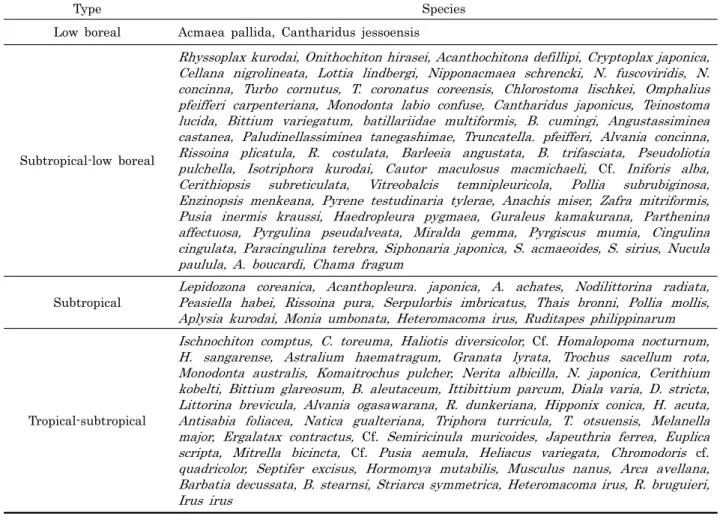
Zonal-geographical groupings reveal that the fauna is mainly subtropical-low boreal, preferring moderately warm water, with a somewhat smaller number of tropical-subtropical species.
Key words: Mollusca, Diversity and Ecology, Species List, Seogundo, Jeju, Korea.
INTRODUCTION
Jeju Island, Korea’s largest and southernmost island, is a volcanic island located about 80 km south of the mainland. The coastline is mainly rocky with several sandy beaches. Although cooler water currents exert some influence, the warm Tsushima Current
flowing from the southwest, gives the island a subtropical climate. Jeju Island has a rich mollusk fauna, with over 1000 species presently recorded. The major families are the Trochidae, Muricidae, Pyramidellidae, Mytilidae, and Veneridae. This fauna is a combination of warm temperate (Central Japan to the Yellow Sea) and tropical and subtropical species (Southern Japan to Indo-West Pacific) (Noseworthy et al., 2007).
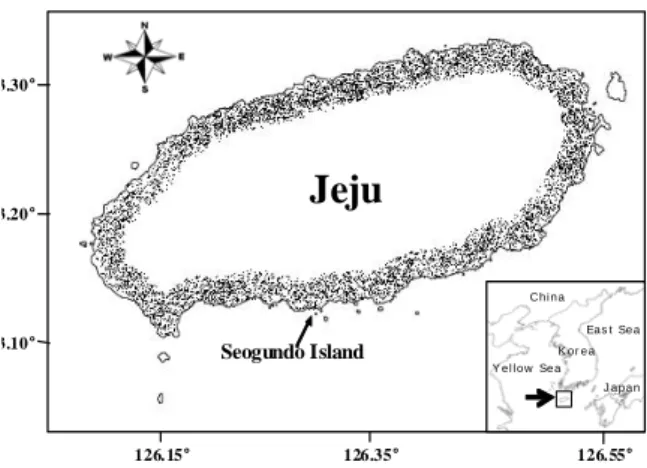
Seogundo (33° 13’ 48" N 126° 29’ 55" E) is a small
island, located approximately 5 km west of Seogwipo
on the south coast of the island (Fig. 1). It is
surrounded by low cliffs. During low tide it is
Jeju
Yellow Sea East Sea China
Korea Japan
3.30°
3.20°
3.10°
126.55°
126.35°
126.15°
Seogundo Island
Fig. 1. Seogundo, showing its proximity to the shoreline.
connected to the mainland by a wide boulder beach, containing several large tidepools. This area is on an open coast, and is subjected to moderately wide tidal ranges (SCUBA in Korea, 1999)and strong wave action. The island shelters the shallow, rocky area which connects it to the shoreline, and contains a variety of habitats conducive to a varied population of marine organisms.
Beginning in April, 2001, three surveys of the Seogundo area were conducted and a total of 121 different species was collected. The general purpose of these surveys was to enumerate the mollusks of this area in order to examine their diversity. The study also focused on living mollusks to investigate habitat preferences. Additional sampling was also conducted in April and June 2009. The present study for the first time reports on the molluscan fauna of Seogundo surveyed in 2001 and 2009.
MATERIALS AND METHODS
The main survey was conducted in April, 2009, during an extremely low tide. According to Wells et al,(2008), an intensive visual search of a variety of habitats at low tide for a duration of at least one hour is sufficient to provide an effective estimate of molluscan biodiversity. The mollusks were collected using both visual searches and processing of material from various habitats. The area surveyed included the boulder beach itself as well as two large tidepools.
Mollusks on the beach were obtained from the exposed surface of rocks as well as their undersides.
Rocks in the tidepools were also examined. Several species, e.g., some opisthobranchs, were observed, with descriptive notes being made, but not collected.
Field notes were made of the relative abundance of the more common species. Samples were also taken of the coarse sand substrate at the bottom of the tidepools. Furthermore, three types of seaweedfound in the tidepools, as well as a sample of coralline algae from the bottom of the pools, were also obtained in order to check for mollusks inhabiting these specific habitats.
The samples were separated in the field and processed separately. The seaweeds and coralline algaewere placed in fresh water overnight, then rinsed vigorously and broken apart to remove all mollusks. The material obtained was then dried. The sand from the tidepoolswas dried and then sieved through three sizes of mesh in order to remove all mollusks, the smallest-sized mesh being .75 mm. The dried material was then sorted with the aid of a 15 x magnifier, and all mollusks obtained were then identified, a stereo microscope being used for the smaller specimens. Note was also made of the number of each species, and whether the specimens were living or dead when obtained.
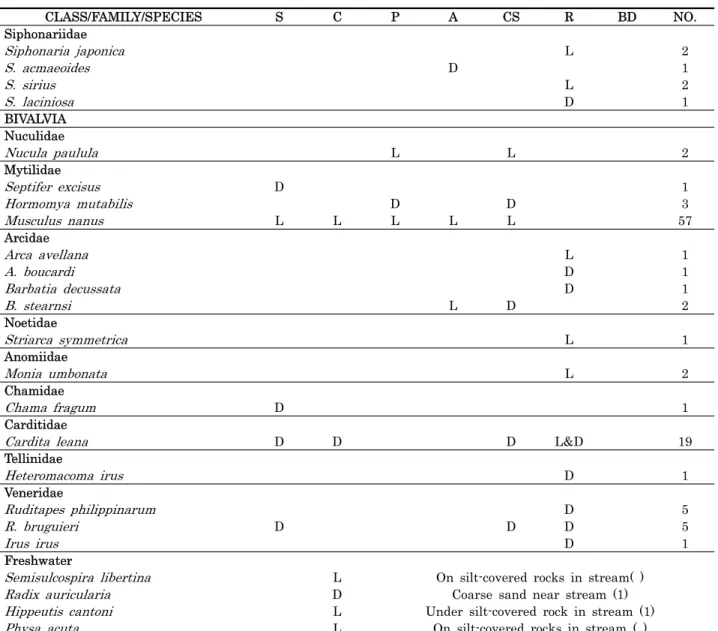
A variety of sources was used to identify the mollusks obtained or observed in the field based upon Okutani (2000), Min et al. (2004) as well as a variety of internet sources. Species lists were then prepared for each habitat for comparison purposes, and finally a total list was prepared (Table 1). The nomenclature used is based mainly on Higo, Callomon, and Goto (1999). Specimens collected are kept either at the Shellfish Aquaculture and Research Laboratory at Jeju National University or in the senior author’s collection.
RESULTS
A total of 121 different species were identified,
altogether a grand total of 202 species was collected
from all habitats four more were identified to the
genus or family level. There were 97 gastropods, 16
bivalves, and eightpolyplacophorans. The gastropod families with the largest number of species overall were the Trochidae, with nine, the Turbinidae with seven, and the Pyramidellidae and Rissoidae both with sixspecies. Among the bivalves, the Arcidae numbered four species, and the Mytilidae and Veneridae three each. The polyplacophorans belonged to the Acanthochitonidae and Chitonidae, each with three species, and the Ischnochitonidae, with two.
Living mollusks comprised slightly more than half (51%) of the total number: all polyplacophorans, 50%
of the gastropods, and about 40% of the bivalves.
1. Habitat Observations
The habitat preferences of living mollusks was one of the goals of this survey. The six habitats sampled contained a grand total of 87 of those species. A detailed examination was made of the mollusk diversity for each habitat, and a comprehensive list was compiled (Table 1).
2. Rocky substrate
The boulder beach was sampled over a wide area, both the exposed surface of rocks and their undersides. The rocky sides of the tidepools were also sampled. A total of 61 species, most of them including live specimens, waseither observed or collected. In the upper intertidal Nodilittorina radiata (Souleyet, 1852) and Nerita (Heminerita) japonica Dunker, 1860 were abundant. N. japonica and Littorina brevicula (Philippi, 1844) were common in the mid intertidal zone, and Turbo (Lunella) coronata coreensis (Recluz, 1853) was moderately common in the lower intertidal zone. The lower intertidal and shallow subtidal zones yielded eight species of Polyplacophora. The most prevalent species were Acanthopleura japonica (Lischke, 1873), moderately common on exposed surfaces, and Ischnochiton comptus (Gould, 1859) and Onithochiton hirasei Pilsbry, 1901, common on and under rocks in shallow water. Two opisthobranchs were observed; Aplysia (Varria) kurodai (Baba, 1937) was crawling on rocks in one of the tidepools, and Chromodoris cf. quadricolor (Rüppell and Leucart, 1828) occupied the underside of a small boulder.
Species of Nacellidae, Lottiidae, and Siphonariidae,
especially Siphonaria (Anthosiphonaria) sirius Pilsbry, 1894, were moderately common. Surprisingly mytilids were rarely found in this environment, but specimens of Arca avellana Lamarck, 1819 and Cardita leana Dunker, 1860 inhabited crevices in the undersides of rocks in shallow water. Japeuthria ferrea (Reeve, 1847), and the trochids Monodonta australis Lamarck, 1822 and M. labio confusa Tapparone-Canefri, 1874 were also common on the exposed surfaces of rocks.
3. Sand
Samples of coarse sand from the bottoms of the tidepools yielded 45 species, of which 12 included live specimens. Of those, two were bivalves, Nucula paulula A. Adams, 1856 and Musculus nanus (Dunker, 1856), and also there were two members of the Triphoridae, Triphora turricula (Hervier, 1897) and T. otsuensis (Yokoyama, 1920). The others were single species from a variety of gastropod families.
Overall, the Cerithiidae had the largest number of species, five, followed by the Triphoridae with four, and the Pyramidellidae, Rissoidae, and the Turbinidae, with three each.The most common species was Homalopoma sangarense (Schrenck, 1857), although no live specimens were obtained. The species composition of the two tidepools was compared but the assemblages of mollusks were basically the same.
Cantharidus japonicus (A. Adams, 1853), which usually occurs in seaweed, and M. nanus, which prefers rocky substrates (Okutani, 2000), were also found in this habitat.
4. Marine Flora
Specimens of the dominant species of seaweed inhabiting the tidepools were obtained in order to examine habitat preferences. Two species of brown seaweed, Sargassum sp. and Padina arborescens Holmes, 1896, one red seaweed, Chondrus crispus Stackhouse, 1797, and one coralline algae, Alatocladia cf. modesta (Yendo) Johansen, 1969 (Kang, 1968), were collected.
A sample of Sargassum sp. floating on the surface
of the tidepool yielded 31 species, of which 11
included live specimens. Among the living species
CLASS/FAMILY/SPECIES S C P A CS R BD NO.
POLYPLACOPHORA Ischnochitonidae
Lepidozona coreanica L 2
Cf. Lepidozona coreanica D 1(v)
Ischnochiton comptus L L 17
Cf. Ischnochiton comptus D 1
Chitonidae
Rhyssoplax.kurodai L 1
Onithochiton hirasei L 10
Acanthopleura japonica L 3(MC)
Acanthochitonidae
Acanthochitona defilippi L 1
A. achates L 2
Cryptoplax japonica L 2
GASTROPODA Nacellidae
Cellana nigrolineata D 3
C. toreuma D L 7
Lottiidae
Lottia. lindbergi L 1
Lottia. cf. lindbergi D 3
Nipponacmaea schrencki D L 2
N. fuscoviridis D D 3
N. concinna D D L D 5
Acmaeidae
Acmaea pallida D 1
Haliotidae
Haliotis diversicolor D 2
Scissurellidae
Scissurella staminea D 1
Fissurellidae
Diodora sieboldi D 1
Turbinidae
Liotina semiclathratula D 1
Cf. Homalopoma nocturnum D 1
H. sangarense D D D D D D 25
Turbo cornutus D 2
T. coronatus coreensis L L&D L&D D 14
Astralium haematragum D 1
Tricolia variabilis D 1
Trochidae
Chlorostoma lischkei D D D L&D 12
Omphalius pfeifferi carpenteri D 1
Granata. lyrata D 1
Trochus sacellum rota D L 3
Monodonta labio confusa D D 3
M. australis L&D 2
Cantharidus. japonicus L L L D 4
C. jessoensis L 1
Komaitrochus pulcher L L L L 27
Table 1. Species list and habits. L = living; D = dead S = Sargassum sp. C = Chondrus crispus; P. = Padina arborescens; A = Alotocladia cf. modesta; CS = coarse sand; R = rocks; BD = beach drift; NO. = total number; MC = moderately common;
A = abundant; * = observation only; v = valves (polyplacophora)
CLASS/FAMILY/SPECIES S C P A CS R BD NO.
Skeneidae
Teinostoma lucida D 6
Neritidae
Nerita albicilla L&D 5
N. japonica L&D 3(A)
Cerithiidae
Cerithium kobelti D L L D D 9
Bittium cf. glareosum D 1
Bittium glareosum L 1
B. aleutaceum D D D D D D 30
B. variegatum D D 3
Ittibittium parcum L&D L L L&D D 14
Dialidae
Diala varia D L D D 9
D. stricta D 1
Batillariidae
Batillaria multiformis D D 4
B cumingi L L&D D 9
Littorinidae
Littorina brevicula L 1(MC)
Nodilittorina radiata D D D L D A
Peasiella habei L D 2
Assimineidae
Angustassiminea castanea D D 2
Paludinellassiminea tanegashimae D 1
Truncatellidae
Truncatella pfeifferi D D 2
Rissoidae
Alvania concinna L 1
A. ogasawarana L 1
Rissoina plicatula D 5
R. costulata D D D D 11
R. pura D D L&D D 17
R. dunkeriana D D 2
Barleeidae
Barleeia angustata L L D 13
B. trifasciata D 3
Vitrinellidae
Pseudoliotia pulchella D D 2
Hipponicidae
Hipponix conica L D 3
H. acuta D 1
Antisabia foliacea D 1
Vermetidae
Serpulorbis imbricatus L* 1
Cf. Serpulorbis imbricatus D 1
Cypraeidae
Cypraeidae sp. D 1
Naticidae
Natica gualteriana D 7
Triphoridae
Isotriphora kurodai D 1
Table 1. Continued
CLASS/FAMILY/SPECIES S C P A CS R BD NO.
Triphora turricula L 1
T. otsuensis L L&D 4
Cautor maculosus macmichaeli D 1
Iniforis alba D 1
Triphoridae sp. D D 3
Cerithiopsidae
Cerithiopsis subreticulata L 1
Cerithiopsis cf. subreticulata D D 2
C. marileutes L 2
Eulimidae
Melanella major L 1
Vitreobalcis temnipleuricola L L 2
Muricidae
Ergalatax contractus D 3
Thais bronni L&D 5
Semiricinula cf. muricoides L 1
Buccinidae
Pollia cf. mollis D 1
Pollia mollis L 2
P. subrubiginosa L D 3
Japeuthria ferrea L MC
Enzinopsis menkeana L 1
Columbellidae
Euplica scripta L 8
Pyrene testudinaria tylerae L&D 4
Mitrella bicincta L 2
Mitrella sp. D 1
Anachis miser L L L 3
Zafra mitriformis L 1
Nassariidae
Hima fratercula L 1
Costellariidae
Cf. Pusia aemula D 2
P. inermis kraussi L D 2
Turridae
Haedropleura pygmaea D 2
Guraleus kamakurana D 1
Architectonicidae
Heliacus variegata D 1
Pyramidellidae
Parthenina affectuosa D 1
Pyrgulina pseudalveata D 1
Cf. Pyrgulina pseudalveata D 3
Miralda gemma D 1
Pyrgiscus mumia D D D D D 12
Cingulina cingulata D D 3
Paracingulina terebra D 2
Pyramellidae sp. D 1
Aplysiidae
Aplysia kurodai L* 3
Chromodorididae
Chromodoris cf. quadricolor L* 2
Table 1. Continued
CLASS/FAMILY/SPECIES S C P A CS R BD NO.
Siphonariidae
Siphonaria japonica L 2
S. acmaeoides D 1
S. sirius L 2
S. laciniosa D 1
BIVALVIA Nuculidae
Nucula paulula L L 2
Mytilidae
Septifer excisus D 1
Hormomya mutabilis D D 3
Musculus nanus L L L L L 57
Arcidae
Arca avellana L 1
A. boucardi D 1
Barbatia decussata D 1
B. stearnsi L D 2
Noetidae
Striarca symmetrica L 1
Anomiidae
Monia umbonata L 2
Chamidae
Chama fragum D 1
Carditidae
Cardita leana D D D L&D 19
Tellinidae
Heteromacoma irus D 1
Veneridae
Ruditapes philippinarum D 5
R. bruguieri D D D 5
Irus irus D 1
Freshwater
Semisulcospira libertina L On silt-covered rocks in stream( )
Radix auricularia D Coarse sand near stream (1)
Hippeutis cantoni L Under silt-covered rock in stream (1)
Physa acuta L On silt-covered rocks in stream ( )
Table 1. Continued
were three trochids, Komaitrochus pulcher Kuroda and IW. Taki, 1958, Cantharidus jessoensis (Schrenck, 1863), and C. japonicus, and two columbellids, Zafra (Zafra) mitriformis A. Adams, 1860 and Anachis miser (Sowerby II, 1844). The other species were single members of six other families. M. nanus was the dominant species, and Ittibittium parcum (Gould, 1861) was the most common live gastropod in this habitat. The Cerithiidae was the dominant family in the Sargassum with five species, followed by the Rissoidae with three. There were four bivalve species.
A second brown seaweed species, Padina
arborescens, which prefers the deepest parts of the tidepools, contained 15 species, of which eight included live specimens. There was one each of eight families. Overall, there were two species of Trochidae and two of Cerithiidae, with the columbellid Euplica scripta Lamarck, 1822 being the most common. This species is epiphytal, grazing on seagrass and algae (Seashells of New South Wales, 2009). Four species which have been reported as preferring rock or gravel substrates, Cerithium kobelti Dunker, 1877, Alvania.
ogasawarana (Pilsbry, 1904), Cerithiopsis.
subreticulata (Dunker, 1859) and Vexillum (Pusia)
0 10 20 30 40 50 60 70 80 90 100
ROCKS SAND
SARGA SSUM
PAD INA
CHONDRUS ALATOCLADIA
P e r cen ta g e
Fig. 2. Percentage of living mollusks occurring in each habitat.
Locality Upper Middle Lower
Daepo N. radiata M. neritoides M. neritoides
N. japonica N. japonica A. japonica
T. coronata coreensis Seogundo N. radiata N. radiata T. coronata coreensis
N. japonica L. brevicula A. japonica
Beophwan N. japonica M. neritoides M. neritoides M. neritoides N. japonica A. japonica
N. concinna Fig. 3. Intertidal dominance (nomenclature updated, adapted from Lee & Jwa, 1998).
inerme kraussi (Dunker, 1861) (Okutani, 2000) were also discovered in this habitat.
The red algae, Chondrus crispus, which occurred from relatively shallow water to the bottom of the tidepools, yielded 13 species, five of which included live specimens. K. pulcher, which is usually found in seaweed in the upper subtidal, was the most common species in this habitat, and M.nanus was also present.
A sample of coralline algae, Alatocladia cf. modesta, was also collected from the bottom of the tidepool, and this sample yielded 20 species, 11of which included live specimens. The most abundant species were M. nanus and K. pulcher, of which there were 32 and 13 specimens respectively. The former species was not only the most common live bivalveobtained in this survey but was alsothe most common small live species. The arcid Barbatia (Ustularca) stearnsii (Pilsbry, 1895), which is usually found attached to
rubble in the intertidal area (Okutani, 2000) also occurred in this environment.
Lutaenko (2002) and Wells (2008), who cite several reports, suggest that dead shells should be included in biodiversity studies, as they generally reflect the distribution of live mollusks. A sample of beach drift from among rocks in the mid-tidal area was obtained in order to further examine the diversity of mollusks in this area. This sample yielded 17 species. The Pyramidellidae was most frequent with three species, and the Cerithiidae and Turbinidae had two each.
Bittium aleutaceum Gould, 1861, in the Cerithiidae, and Rissoina (Phosinella) pura Gould, 1861, in the Rissoidae, had the largest number of specimens.
Most of the mollusks in this areawere found on rocky substrate and in coarse sand. Of those inhabiting the marine flora, most were on Sargassum and Alatocladia. The percentages of living mollusks found in the six habitats sampled are shown in Fig. 2.
DISCUSSION
In an island-wide study of intertidal mollusks, Lee
& Jwa (1998) examined the dominant species in the upper, middle, and lower intertidal zones at twenty-five locations on Jeju Island. Two locations adjacent to Seogundo, Daepo to the west and Beophwan to the east, were included in this report.
Although the surveys of the Seogundo area were not
quantitative in nature, a comparison of the most
common species found there with those at the above
locations revealed a basic similarity, but also some
significant differences (Fig. 3). With the exception of
Monodonta neritoides (Philippi, 1849) at Beophwan,
the most common mollusks in the upper intertidal zone at all three locations were the same species. The greatest difference was in the middle intertidal zone the dominant mollusks at Beophwan and Daepo were the same but were quite different at Seogundo, with N. radiata and L. brevicula being most frequently encountered. With the exception of M. neritoides and N. concinna at Beophwan and Daepo, the other dominant mollusks at those locations were the same as those at Seogundo. An interesting feature of this comparison was the absence of M. neritoides at the latter location, although this species was one of the dominant ones at the other two locations.
Of the total number of mollusk species collected in the Seogundo area from various environments, those found in beach drift were not included in the habitat study because they have been washed ashore from several different habitats. About one third of the mollusks in this study, mostly live, were found on hard substrates, the prevalent habitat in this area.
The Polyplacophora were almost exclusively rock dwellers, although one species, I. comptus, was also found in coarse sand at the bottom of one of the the tidepools. Among the astropods, the Patellogastropoda and most trochids and turbinids also preferred hard substrates. Most species of Arcidae were also found in this environment. A significant number of species, approximately 25%, were obtained from sand and/or gravel, in particular, most of the Triphoridae, Costellariidae, and Turridae, as well as all species of Bittium, and, among the bivalves, the Veneridae.
However, only a small number were living these were mostly small species. This suggests that a significant number of dead shells may have been deposited in the tidepools at high tide. The majority of the mollusks, about 40%, such as the Dialidae, Barleeidae, and some smaller trochids, inhabited seaweed and coralline algae. Whereas the three seaweed species contained relatively few live specimens, about half the mollusks obtained from the Alatocladia were live. This suggests that more of the smaller species may prefer a coralline algae habitat.
Most species, about 60%, were found in a variety of habitats, especially the marine flora. O’Hara (2000),
in a habitat study in Australia, states: "There appear to be relatively few individual species that are exclusive to a single dominant vegetation type". This was mainly confirmed by the present study, although the mollusks in the empty shells found in those habitats could have died in situ, or the shells could have been deposited by wave action at high tide.
Among the live mollusks, the mytilid M. nanus and the cerithiid I. parcum were found in coarse sand in tide pools as well as well as the coralline algae and all three varieties of seaweed sampled. Two trochids, C.
japonicus and K. pulcher inhabited several seaweed species as well as the coralline algae and sand in tide pools. The turbinid T. (Lunella) coronatus coreenisis exhibited a wide range of habitat preferences: the juveniles preferred coarse sand and coralline algae, while the adults were rock dwellers.
Several species merit special comment. A species of chromodorid nudibranch, Chromodoris cf. quadricolor (Rüppell and Leucart, 1828), was observed. This species has been reported mainly from the western Indian Ocean, and is one of a complex of related species (Rudman, 2004). It has also been reported from the north coast of Jeju Island (Min et al, 2004), but this record and the Seogundo observation may prove to be a related species. As well, a living sub-adult specimen of Semiricinula cf. muricoides (Blainville, 1832) was obtained from the underside of a rockin one of the tidepools (See Houart (1990; figs.
26-30). This Indo-West Pacific species also occurs in Southern Japan (Okutani, 2000). A careful examination of the available literature has revealed no other Korean records. More specimens will have to be obtained to verify the identification of this species if it is confirmed it will be a new record for the country.
Four specimens of the polyplacophoran Cryoptoplax japonica Pilsbry, 1901 were obtained or observed during the last two surveys of this area. This species appears to be rather uncommon on Jeju Island.
Although there are several records in the literature
(Lee & Hyun, 1992, 1997; Lee & Jwa, 1988; Lee et
al., 1989, 1995, 2001), eight years of intensive
fieldwork by the senior author have yielded only a
• TEMPERATE
NORTHERN PACIFIC REGION
• WARM TEMPERATE NORTHWEST PACIFIC PROVINCE
• (ECOREGIONS 51 AND 52)
• EAST CHINA SEA (52)