597
"J. Korean Soc. Radiol., Vol. 11, No. 7, December 2017"
A Study on the Effective Half-life after the High Dose Radioactive Iodine (
131I) Therapy for Thyroid Cancer Patients
Seongcheol Kim,1,2 DaYeong Gwon,1 Yongmin Kim1,*
1Department of Radiological Science, Daegu Catholic University
2Department of Nuclear Medicine, Kyungpook National University Hospital
Received: November 16, 2017. Revised: December 15, 2017. Accepted: December 31, 2017
ABSTRACT
High-dose 131I therapy has been generally carried out to remove remaining thyroid tissue or to cure metastasize lesion of patients who received full thyroidectomy due to differentiated thyroid cancers. In case high-dose 131I therapy is carried out for a patient, the patient should be hospitalized being isolated for a certain period in order to restrict the amount of exposure to radiation of people at large from the patient within the limit of a level of radiation. Effective half-life is an important value to calculate how family members are exposed to radiation from a patient or to decide the period of isolation of the patient from the family members. Therefore, in this study we calculated the effective decay constant, effective half-life and period of isolation of high-dose 131I therapy patient using NM670 SPECT/CT.
As a result of carrying out this study, the effective half-life of high-dose 131I therapy patients was derived and the time to reach the discharge level of 1.2 GBq was confirmed. When they were compared with each other in each of curative doses, the effective half-life did not have significant difference, but the time when the level of radiation remaining in the interior of the body to reach the criteria of isolation and discharge showed significant difference and it could be confirmed that the higher the curative dose the longer the period of isolation becomes.
When the effective half-lives in each type of preparation were compared with each other, they did not show significant difference. However, When the times to reach the level of radiation that is the criteria of isolation and discharge in each type of preparations, they showed significant difference. The cause of the shortening of the isolation period for rhTSH patients group is decided to be low curative dose.
Accordingly, if the current national health insurance (the insurance is applied to using of rhTSH in 3.7 GBq or lower) is maintained, while discerning them in each of types of preparation, we would be able to discharge patients at the time earlier than the current period of isolation (2 nights and 3 days).
Keywords: 131I, Radioactive iodine therapy, Effective half-life, rhTSH
Ⅰ
. INTRODUCTION
40세 이상에서 많이 발생한다고 알려진 갑상선 암의 원인은 1) 소아기 때 두경부의 방사선 노출, 2) 갑상선암 가족력 등이 있으나, 원인을 알지 못하 는 경우가 대부분이다. 갑상선암의 대부분은 갑상 선의 여포세포로부터 발생하는 갑상선분화암이며,
갑상선분화암은 유두암(85%) > 여포암(12%) > 저 분화암(3% 미만) 순이다.[1] 갑상선분화암으로 갑상 선전절제술을 받은 환자는 보편적으로 방사성요오 드 치료를 받게 되며, 치료를 하는 목적은 다음과 같다.
1) 수술로써 완전히 제거하지 못한 잔여갑상선 조직을 완전 제거한 후 갑상선글로불린 측정 https://doi.org/10.7742/jksr.2017.11.7.597
* Corresponding Author: Yongmin Kim E-mail: [email protected] Tel: +82-53-850-2522
또는 방사성요오드를 이용한 전신 스캔 등의 검사 시 특이도를 높여 재발판정에 용이 2) 국소적 재발 위험성 감소 및 명확히 규명되지
않은 전이병소를 완전히 파괴하여 환자 생존 률 향상
방사성요오드 치료 시 고용량 131I을 투여한 환자 로 인해 환자 주변인(환자 보호자 및 간병인 등)은 불필요한 피폭을 받게 된다. 이에 주변인 피폭을 방 지하기 위해 환자는 일정기간 납으로 차폐된 격리 병실에 입원할 필요가 있다. 미국 NRC는 환자의 체 내에 131I 잔류량이 33 mCi 이하 또는 1 m 거리에서 외부 방사선량률이 7 mrem/hr 이하일 때 격리병실 에서 퇴원 하도록 권고하고 있다.[2] 국내의 경우에 는 환자의 체내 131I 잔류량이 1.2 GBq 이하 또는 1 m 거리에서 외부방사선량률이 0.07 mSv/hr 이하일 때 격리병실로부터 퇴원할 수 있다고 규정[3]하고 있 어, 일반적인 치료 후 격리기간은 2박 3일이다.
그러나, 격리병실에 입원하는 환자 중 일부는 신 경/정신과 문제 또는 다른 원인으로 인해 폐쇄된 공 간에서 생활하는 것이 힘든 경우도 있으며, 격리병 실이 부족하여 치료 지연이 발생하기도 한다. 따라 서, 환자 격리기간을 현행보다 단축한다면 앞서 제 시된 문제점들을 해결할 수 있을 것으로 예상된다.
격리기간 단축에 있어 중요한 인자는 131I의 치료 선량 결정 및 환자로 인한 주변인 피폭선량 계산에 사용되는 유효반감기이다. 갑상선분화암 환자 중 고용량 131I 치료를 시행한 한국인들의 외부선량률 을 물리학적 방법으로 측정하여 131I의 유효반감기 를 도출한 연구들은 많으나[5-8], SPECT/CT를 이용 하여 유효반감기를 도출한 연구는 보고된 바 없다.
이에 본 연구에서는 SPECT/CT를 이용하여 정량적 인 방법으로 유효반감기를 도출하고, 환자의 치료 선량 및 전처치 유형별 유효반감기를 확인하여 그 에 따른 격리기간 차이를 확인하고자 한다.
Ⅱ.
MATERIAL AND METHODS
본 논문에서는 갑상선 분화암으로 갑상선 전절 제술을 시행한 환자 중 131I 고용량 치료를 위해 격 리병실에 입원한 환자를 대상으로 연구를 진행하 였다. 연구대상에 관한 정보는 Table 1과 같다.Table 1. Patient characteristics
Research period 2014.03 ~ 2014.11 The number of patients 49 persons (male:10, female:39)
Patient age 50.3 ± 13.3 year (14 ~ 82 year) 131I Therapy Dose 2.96 ~ 7.4 GBq
성공적인 잔여갑상선 제거를 위한 전처치로 갑 상선자극호르몬(TSH; Thyroid stimulating hormone) 의 자극이 필요하다.[4] TSH를 자극하기 위한 방법 으로는 갑상선호르몬 투약을 중단 하거나(THW;
Thyroid hormone withdrawal), 유전자 재조합 인간 갑 상선 자극 호르몬주사제(rhTSH; recombinant human TSH)를 사용하는 방법이 있다. 전처치 방법에 대한 정보는 Table 2와 같다. rhTSH 주사제를 사용하는 경우 치료 2일전, 치료 1일전 근육주사를 맞도록 하였다. 두 환자군 모두 TSH 값은 30 mIU/dl 를 넘 었다.
Table 2. Preparation methods according to the type Thyroid hormone
withdrawal(THW)
Recombinant human TSH(rhTSH) Period of T4 hormone
withdrawl 5 week 5 day
Period of swich to T3 3 week ·
Period of low iodine
diet 2 week 2 week
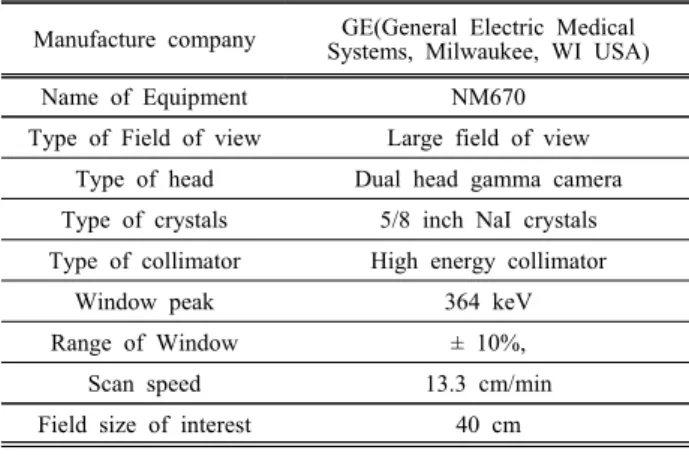
본 논문에서는 전신 선량을 측정하기 위해 SPECT/CT를 사용하였고, 제원은 Table 3 및 Fig. 1 과 같다.
Table 3. Specification of SPECT/CT
Manufacture company GE(General Electric Medical Systems, Milwaukee, WI USA)
Name of Equipment NM670
Type of Field of view Large field of view Type of head Dual head gamma camera Type of crystals 5/8 inch NaI crystals Type of collimator High energy collimator
Window peak 364 keV
Range of Window ± 10%,
Scan speed 13.3 cm/min
Field size of interest 40 cm
"J. Korean Soc. Radiol., Vol. 11, No. 7, December 2017"
Fig. 1. SPECT/CT NM670.
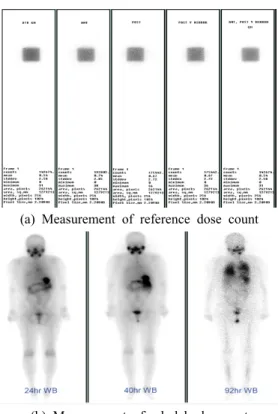
치료선량에 해당하는 Count를 얻기 위해 Fig. 2 (a)와 같이 Wholebody Scan과 동일한 조건으로 기 준선량에 대해 Count를 측정한 후 치료선량으로 보 정하였다. 그리고 131I 치료 이후 1일, 2일, 4일 또는 5일 째 Fig. 2 (b)와 같이 Wholebody Scan을 시행하 였다.
(a) Measurement of reference dose count
(b) Measurement of wholebody count Fig. 2. Measurement of counts.
Wholebody Scan을 통해 측정된 Count를 Excel에 입력한 후 곡선적합(curve fitting)기능을 사용하여 지수함수 곡선을 획득하였다. Fig. 3과 같이 유도된 곡선의 함수에서 유효붕괴상수를 확인하여 유효반
감기 및 격리기간을 도출하였다.
Fig. 3. An example of Time-Counts curve.
도출된 결과값은 Excel, ANOVA 등을 이용해 통 계적으로 유의한 값인지 분석하였다.
Ⅲ.
RESULT
131I 고용량 치료환자 (2.96 ~ 7.4 GBq) 전체 유효 붕괴상수는 0.053 ± 0.01 /hr (0.033 ~ 0.076 /hr), 유 효반감기는 13.64 ± 2.58 hr (9 ~ 21 hr)이었다. 그리 고 체내에 남은 방사능량이 격리 및 퇴원기준인 1.2 GBq 에 도달하는 시간은 26.99 ± 7.54 hr (13.84
~ 45.88 hr)이었다.
Table 4 및 Fig. 4에 제시된 것과 같이 치료 선량 별 비교 시, 유효반감기는 유의한 차이가 없었으나 (p=0.686) 체내 잔류 방사능량이 격리 및 퇴원기준 에 도달하는 시간은 유의한 차이를 보였으며, 치료 선량이 높을수록 격리기간이 길어짐을 확인할 수 있었다(p<0.001).
Table 4. Effective half life and period of hospitalization by therapy dose
Dose [GBq]
Effective half life [hr]
Time to body retention become 1.2 GBq [hr]
2.96 12.91 ± 1.88 16.49 ± 2.4
N=6 (10.83 ~ 15.75) (13.84 ~ 20.13)
3.7 13.2 ± 3.04 21.12 ± 4.86
N=11 (9.12 ~ 19.8) (14.59 ~ 31.68)
5.55 14.04 ± 2.58 30.66 ± 5.64
N=28 (9.24 ~ 21) (20.19 ~ 45.88)
6.66~7.4 13.2 ± 1.42 32.31 ± 3.48 N=4 (11.18 ~ 14.44) (27.36 ~ 35.34)
(a) Effective half life
(b) Period of hospitalization Fig. 4. Effective half life and period of
hospitalization by therapy dose
Table 5. Effective half life and Period of hospitalization by type of preparation
rhTSH Thyroid hormone
withdrawal (THW) Effective
half life [hr]
13.23 ± 2.44 (9.12 ~ 19.8)
13.86 ± 2.62 (9.24 ~ 21) Period of
hospitalization [hr]
20.63 ± 5.47 (13.83 ~ 31.68)
30.38 ± 6.17 (14.78 ~ 45.88)
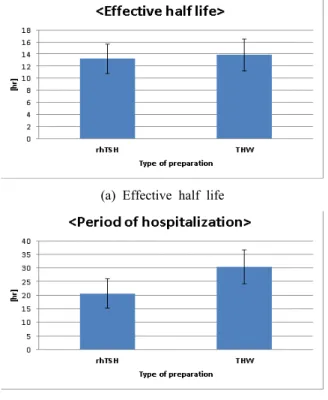
Table 5 및 Fig. 5 (a)에 제시된 것과 같이 전처치 유형별 유효반감기를 비교 시, 유효반감기가 rhTSH 환자군은 13.23 ± 2.44 hr 이고, THW 환자군 은 13.86 ± 2.62 hr 로 도출되어 유의한 차이를 보 이지 않음을 확인할 수 있었다(p=0.422).
Table 5 및 Fig. 5 (b)에 제시된 것과 같이 전처치 유형별 격리 및 퇴원기준 방사능량에 도달하는 시 간 비교 시, 격리기간은 rhTSH 환자군이 20.63 ± 5.47 hr, THW 환자군이 30.38 ± 6.17 hr로 유의한 차이를 나타냄을 확인할 수 있었다(p<0.001).
(a) Effective half life
(b) Period of hospitalization
Fig. 5. Effective half life and period of hospitalization by type of preparation
Ⅳ.
DISCUSSION
물리학적방법으로 외부선량률 측정을 통한 유효 반감기를 계산한 선행연구들의 결과는 다음과 같 다.
(1) 250명의 131I 고용량 치료환자를 대상으로 연 구를 수행한 결과 유효반감기는 14 hr (7.3 ~ 106 hr)[6]
(2) 14명의 131I 고용량 치료환자를 대상으로 전자선 량계와 열형광검출기(TLD; Thermoluminescence Dosimeter)를 왼쪽가슴에 착용하여 외부선량률 측정 후 계산된 유효반감기는 12.5 hr[7]
(3) 한국인 대상으로 외부선량률 측정 후 계산된 유효반감기는 15.4 ± 4.3 hr(9.4 ~ 32.5 hr)였 으며[8], 이후 수행한 연구에서는 유효반감기 가 14.2 ± 3.1 hr(8.3 ~ 23.1 hr)[5]
본 연구에서 갑상선암으로 갑상선전절제술을 시 행한 후 131I 고용량 치료를 시행한 환자를 대상으 로 Wholebody scan을 통해 획득한 Count 값으로부
"J. Korean Soc. Radiol., Vol. 11, No. 7, December 2017"
터 도출된 유효반감기는 13.64 ± 2.58 hr (9.1 ~ 21 hr)이였다.
따라서, 본 논문에서 도출된 유효반감기가 외부 선량률을 측정하여 도출된 값과 유사하게 나타났 으나, 표준편차는 감소한 것으로 확인되었다.
치료선량별로 분류하여 유효반감기와 격리기간 을 비교하였을 때 유효반감기는 유의한 차이를 보 이지 않았고(p=0.686) 치료선량이 증가할수록 격리 기간이 길어지는 것으로 확인되었다(p<0.001). 그리 고 치료선량, 전처치 유형에 관계없이 환자 체내에 잔류하는 방사성동위원소의 방사능량이 격리 및 퇴원기준인 1.2 GBq를 충족시키는데 걸리는 시간 은 26.99 ± 7.54 hr 였으며, 가장 오래 걸린 환자의 시간은 45.88 hr 였다. 따라서, 48 시간 이내에 모든 환자가 퇴원기준을 충족시키는 것으로 확인되어 현행 2박 3일의 격리기간은 충분한 것으로 판단된 다.
rhTSH환자군과 THW환자군의 선행연구 결과 두 환자군 사이에는 치료효과의 차이가 없고[9-12], rhTSH 환자군은 T4호르몬 차단 기간이 짧은 이유 로 갑상선 기능저하에 빠지지 않아 신장으로 배출 되는 방사능량이 THW환자군보다 많다고 알려져
있다.[13-15] 그러나, 본 연구에서는 전처치 유형별로
유효반감기를 비교했을 때 유의한 차이를 보이지 않았다(p=0.422).
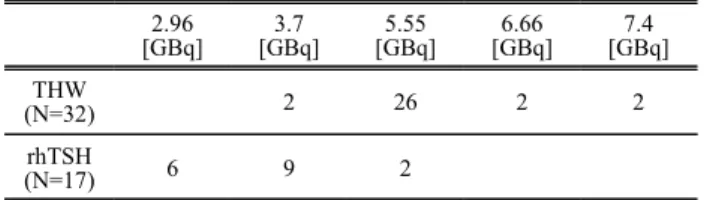
격리기간을 비교했을 때는 Table 5에서 알 수 있 듯이 rhTSH 환자군이 THW 환자군보다 약 10 시간 짧은 것으로 나타났다(p<0.001). 이는 Table 6과 같 이 rhTSH 환자군의 경우 주로 현행 의료보험기준 인 3.7 GBq 이하로 치료하였고, THW 환자군(고위 험군 환자)의 경우 5.55 GBq 이상으로 치료를 수행 하였기 때문에 치료선량의 차이로 인해 rhTSH 환 자군의 격리기간이 짧아진 것으로 판단된다.
Table 6. Number of patients by Therapy dose
2.96
[GBq]
3.7 [GBq]
5.55 [GBq]
6.66 [GBq]
7.4 [GBq]
THW
(N=32) 2 26 2 2
rhTSH
(N=17) 6 9 2
Ⅴ.
CONCLUSION
본 연구에서 도출한 131I 고용량 치료환자의(2.96
~ 7.4 GBq) 유효반감기는 13.64 ± 2.58 hr(9 ~ 21 hr) 이다. 본 연구는 선행연구와 달리 SPECT/CT를 이 용하였고, 정량적인 방법을 사용해 유효반감기를 도출하였다. 그 결과 외부선량률 측정 방법에 비해 표준편차가 감소하였다. 이는 방사선량률을 외부에 서 측정 시 체내 131I의 분포 및 측정위치에 따라 측 정값의 편차가 크기 때문으로 생각된다.
또한, 현행 의료보험체계(rhTSH 사용 시 3.7 GBq 이하에서 보험적용)가 유지된다면, 전처치 유형별 로 구분하여 환자의 체내에 잔류하는 방사능량이 1.2 GBq 이하로 남을 예상기간이 경과한 후, 퇴원 시 측정한 외부 방사선량률이 0.07 mSv/hr 이하일 때 현행격리기간(2박3일) 보다 이른 시간에 환자를 퇴원시킬 수 있을 것이다.
Acknowledgement
이 논문은 2017학년도 대구가톨릭대학교 교내연 구비지원에 의한 것임.
Reference
[1] B. Aschebrook-Kilfoy, M. H. Ward, M. M. Sabra, S.
S. Devesa. “Thyroid cancer incidence patterns in the United States by histologic type, 1992-2006.” Vol. 2 1, No. 2, pp. 125-34, 2011.
[2] United States Nuclear Regulatory Commission Office of Federal and State Material and Environmental Man agement Programs 2009 Washington, DC: 20555-000 1. NRC Information Notice 2003-22, Supplement 200 9.
[3] Nuclear Safety Commission No. 19 Regulations on T echnical Standards such as Radiation Safety Managem ent. Nuclear Safety Commission Notification No. 201 5-5 Technical Standards on Radiation Safety Manage ment in the Medical Sector
[4] K. H. Yi, E. K. Lee, H. C. Kang, Y. W. Koh, S.
W. Kim, I. J. Kim, D. G. Na, K. H. Nam, S. Y. Pa rk, J. W. Park, S. K. Bae, S. K. Baek, J. H. Baek, B. J. Lee, K. W. Chung, Y. S. Jung, G. J. Cheon,
W. B. Kim, J. H. Chung, Y. S. Rho, “2016 Revised Korean Thyroid Association Management Guidelines f or Patient with Thyroid Nodules and Thyroid Cance r.” Int J Thyroidol, Vol. 9, No. 2, pp. 59-126, 2016.
[5] S. G. Park. “Suggestion of A Practical Simple Calcul ation Method for Safe Transportation Time after Radi oactive Iodine Treatment in Patients with Thyroid Ca ncer.” Journal of the Korea Academia - Industrial co operaion Society,Vol. 16, No. 6, pp. 3919-25, 2015.
[6] D. L. North, D. R. Shearer, J. V. Hennessey, G. L.
Donovan. “Effective half-life of 131I in thyroid cance r patients.” The radiation safety journal Health Physic s Vol. 81, No. 3, pp. 325-9, 2001.
[7] C.D. Venencia, A.G Germanier, S.R. Bustos, A.A. Gi ovannini, E.P. Wyse.“Hospital discharge of patient wi th thyroid carcinoma treated with 131I.” The Journal of Nuclear Medicine, Vol. 43, No. 1, pp. 61-5, 2002.
[8] S. G. Park. “Effective Half-life of I-131 in Patients with Differentiated Thyroid Cancer Treated by Radioa ctive I-131.” The Korea Society of Nuclear Medicine, Vol. 42, No. 6, pp. 464-468, 2008.
[9] U. Mallick, C. Harmer, B. J. Wadsley, S. Clarke, L.
Moss, A. Nicol, P. M. Clark, K. Farnell, R. McCrea dy, J. Smellie, J. A. Franklyn, S. John, C. M. Nutti ng, K. Newbold, C. Lemon, G. Gerrard, A. Abdel-Ha mid, J. Hardman, E. Macias, T. Roques, S. Whitaker, R. Vijayan, P. Alvarez, S. Beare, S. Forsyth, L. Kad alayil, A. Hackshaw, “Ablation with low-dose radioio dine and thyrotropin alfa in thyroid cancer.” The new england journal of medicine, Vol. 366, No. 18, pp. 1 674-85, 2012.
[10] M. Schlumberger, B. Catargi, I. Borget, D. Deandrei s, S. Zerdoud, B. Bridji, S. Bardet, L. Leenhardt, D.
Bastie, C. Schvartz, P. Vera, O. Morel, D. Benisvy C. Bournaud, F. Bonichon, C. Dejax, M. Toubert, S.
Leboulleux, M. Ricard, E. Benhamou, “Strategies of radioiodine ablation in patients with low-risk thyroid cancer.” The new england journal of medicine, Vol.
366, No. 18, pp. 1663-73, 2012.
[11] J. D. Lee, M. J. Yun, K. H. Nam, Y. W. Chung, E. Y. Soh, C. S. Park. “Quality of life and effective ness comparisons of thyroxine withdrawal, triiodothyr onine withdrawal, and recombinant thyroid-stimulatin g hormone administration for low-dose radioiodine re mnant ablation of differentiated thyroid carcinoma.”
Thyroid, Vol. 20, No. 2, pp. 173-9, 2010.
[12] Pacini F, Ladenson PW, Schlumberger M, Driedger A, Luster M, Kloos RT, et al. “Radioiodine ablation of thyroid remnants after preparation with recombina nt human thyrotropin in differentiated thyroid carcino ma: results of an international, randomized, controlle d study.” J Clin Endocrinol Metab, Vol. 91, No. 3, pp. 926-32, 2006.
[13] M. Matović, Edited by Dr. Thomas J. Fahey, “Prepa ring Patients for Radioiodine Treatment: Increasing T hyroid Cell Uptake and Accelerating the Excretion o f Unbound Radioiodine.” Updates in the Understandi ng and Management of Thyroid Cancer (InTech), p p. 306, 2012.
[14] H. Remy, I. Borget, S. Leboulleux, N. Guilabert, F.
Lavielle, J. Garsi, C. Bournaud, S. Gupta, M. Schlu mberger, and M. Ricard. “131I Effective Half-Life a nd Dosimetry in Thyroid Cancer Patients Preparing Patients for Radioiodine Treatment: Increasing Thyroi d Cell Uptake and Accelerating the Excretion of Un bound Radioiodine.” The Journal of Nuclear Medicin e, Vol. 49, No. 9, pp. 1445-50, 2008.
[15] V. Angela, C. Traino, B. Giuseppeb, G. Marianob, L. Patriziab, C. Chiarac, D. Maria Vittoriad, F. Gior giod, L. Mauroa, M. Giulianob, F. Marcoe “Compari son between remnant and red-marrow absorbed dose in thyroid cancer patients submitted to 131I ablative therapy after rh-TSH stimulation versus hypothyroidis m induced by L-thyroxine withdrawal.” Nuclear Med icine Communications, Vol. 28, No. 3, pp. 215-23, 2007.
"J. Korean Soc. Radiol., Vol. 11, No. 7, December 2017"
갑상선암 환자에서 고용량 방사성요오드 치료 후 유효반감기에 대한 연구
김성철,1,2 권다영,1 김용민1,*
1대구가톨릭대학교 방사선학과
2경북대학교병원 핵의학과
요 약
고용량 131I 치료는 분화갑상선암으로 인한 갑상선전절제술을 받은 환자에게 보편적으로 시행되어 왔다.
고용량 131I 치료를 하는 경우 환자로부터 일반인이 받게 되는 피폭선량을 선량한도 이내로 제한하기 위해 환자를 일정 기간 동안 격리하여야 한다. 유효반감기는 환자로부터 가족들이 얼마나 피폭되는지 계산하거 나 격리기간을 결정하는데 중요한 값이다. 이에 본 연구에서는 NM670 SPECT/CT를 이용해 고용량 131I 치 료환자의 유효붕괴상수, 유효반감기, 격리기간을 도출하였다.
본 연구를 통해 고용량 131I 치료환자의 유효반감기를 도출하였고, 체내에 잔류 방사능량이 퇴원기준인 1.
2 GBq 에 도달하는 시간을 확인하였다. 또한 치료선량별 유효반감기를 비교하였을 때 유의한 차이가 없 었으나, 격리기간은 치료선량이 커질수록 격리기간이 길어지는 것을 확인할 수 있었다. 전처치 유형별 유 효반감기를 비교하였을 때 rhTSH 환자군과 THW 환자군의 유효반감기가 유의한 차이를 보이지 않았으나, 격리기간은 rhTSH 환자군이 THW 환자군 보다 짧게 나타났다. 이는 치료선량의 차이로 인해 격리기간이 짧아진 것으로 판단된다.
따라서 현행 의료보험체계(rhTSH 사용 시 3.7 GBq 이하에서 보험적용)가 유지된다면, 전처치 유형별로 구분하여 현행 격리기간(2박 3일)보다 더 이른 시간에 환자를 퇴원시킬 수 있을 것이다.
중심단어: 131I, 방사성 요오드 치료, 유효 반감기, rhTSH