한국컴퓨터정보학회 하계학술대회 논문집 제29권 제2호 (2021. 7)
223
● 요 약 ●
Recently, k-farthest neighbor (kFN) queries have not as much attention as k-nearest neighbor (kNN) queries. Therefore, this study considers moving k-farthest neighbor (MkFN) queries for spatial network databases. Given a positive integer , a moving query point , and a set of data points , MkFN queries can constantly retrieve data points that are farthest from the query point . The challenge with processing MkFN queries in spatial networks is to avoid unnecessary or superfluous distance calculations between the query and associated data points. This study proposes a batch processing algorithm, called MOFA, to enable efficient processing of MkFN queries in spatial networks. MOFA aims to avoid dispensable distance computations based on the clustering of both query and data points.
Moreover, a time complexity analysis is presented to clarify the effect of the clustering method on the query processing time. Extensive experiments using real-world roadmaps demonstrated the efficiency and scalability of the MOFA when compared with a conventional solution.
키워드: 움직이는 k-최원접 이웃 질의(moving k-farthest neighbor query), 도로망(road network), 공유 실행 접근 방식(shared execution approach)
도로망에서 움직이는 k -최원접 이웃 질의를 위한 일괄 처리 알고리즘
조형주O
O경북대학교 소프트웨어학과
e-mail: [email protected]O
Batch Processing Algorithm for Moving k -Farthest Neighbor Queries in Road Networks
Hyung-Ju ChoO
ODept. of Software, Kyungpook National University
I. Introduction
Given a positive integer , a query point , and a set of data points , a k-farthest neighbor query retrieves data points farthest from the query point q, whereas a k-nearest neighbor (kNN) query retrieves k data points closest to the query point
[1, 2]. In fact, kFN queries are the logical opposite of kNN queries. This study considers moving k-farthest neighbor (MkFN) queries in spatial networks. MkFN queries constantly retrieve
data points farthest from the moving query point on the spatial network. The kFN query has many real-life applications, including computational geometry, artificial intelligence, pattern recognition, and information retrieval. Specifically, an FN query determines the minimum radius of a circle centered at a point
that covers all data points. In the real world, a new supermarket owner may want to find the farthest customer to identify the
delivery range to cover before opening the supermarket in the town. In another example, consider a case where a team of commandos is on a mission and the leader requests that no member of the team is more than 5 km away from him. The leader clearly should pay special attention to the farthest team members so that they can monitor their activities and request them not to move too far away from him.
한국컴퓨터정보학회 하계학술대회 논문집 제29권 제2호 (2021. 7)
224
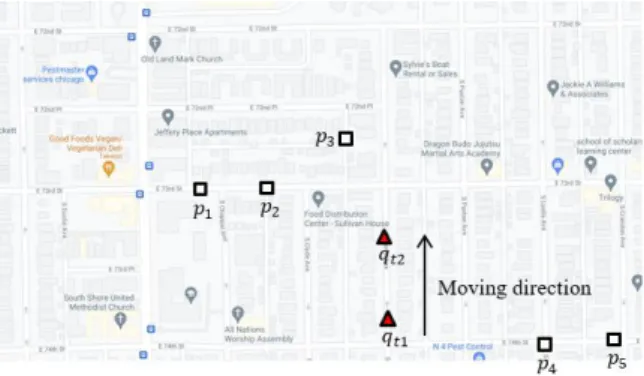
Fig. 1. Example of MkFN queries in a spatial network
As shown in Figure 1, given a positive integer , a moving query point q, and a set of five data points , the MkFN queries constantly retrieve the two data points farthest from a moving query point . Suppose that the locations of a query point are represented by
and
at timestamps and , respectively.
Clearly, and are the two data points farthest from
at timestamp , whereas and are the two data points farthest from
at timestamp . A simple solution for MkFN queries in spatial networks involves computing the network distance from a query point to each data point in , which corresponds to the single-source shortest path problem. Then, additional O(|P|log|P|) time is used to retrieve the data points farthest from . However, this solution cannot be used as it is expensive for practical use. Therefore, this study proposes a new algorithm, called MOFA, that enables the efficient evaluation of MkFN queries in spatial networks. MOFA clusters nearby data points into a data cluster to quickly filter redundant data points that cannot be answered. Moreover, MOFA clusters moving query points into a query segment and then exploits shared computation to remove the dispensable distance computations between the query and data points. Although the batch computation of spatial queries has received significant attention, no batch computation has been applied to MkFN queries in spatial networks. This study exploits batch computation to efficiently process MkFN queries in spatial networks. MOFA can be easily implemented, facilitating its incorporation with state-of-the-art distance computation algorithms, such as transit node routing (TNR) and G-tree, for spatial network databases.
The contributions of this study are summarized as follows.
This study proposes a batch computation algorithm, called MOFA, which is based on the clustering of query and data points for MkFN queries in spatial networks. To the best of our knowledge, this is the first attempt to study batch processing of MkFN queries thoroughly in spatial networks.
This study presents a clustering method for both query
and data points to avoid dispensable distance computations between query and data points. Moreover, a time complexity analysis is presented to clarify the effect of the clustering method on the query processing time.
Extensive experiments were performed using real-world roadmaps to demonstrate the superiority of MOFA over conventional solutions.
II. Conclusions
This study is motivated by the fact that moving query points, such as pedestrians and vehicles, arbitrarily move on a spatial network. Therefore, existing solutions, based on Euclidean distances, cannot answer spatial queries for spatial network databases. This study proposed a batch processing algorithm based on the clustering of query and data points, known as MOFA, to efficiently process MkFN queries in spatial networks.
MOFA is the first attempt to perform batch processing of MkFN queries in spatial networks to avoid unnecessary distance computations between the query and data points. Empirical evaluation showed that MOFA scales well with the sampling frequency of MkFN query points and significantly outperforms the conventional solution, particularly when data points exhibit a highly skewed distribution in spatial networks.
ACKNOWLEDGEMENT
This research was supported by Basic Science Research Program through the National Research Foundation of Korea(NRF) funded by the Ministry of Education (NRF-2020R1I1A3052713).
REFERENCES
[1] T. Kim, H.-J. Cho, H. J. Hong, H. Nam, H. Cho, G. Y.
Do, and P. Jeon, “Efficient processing of k-farthest neighbor queries for road networks,” Journal of The Korea Society of Computer and Information, vol. 24, no.
10, pp. 79−89, 2019.
[2] H.-J. Cho and M. Attique, “Group processing of multiple k-farthest neighbor queries in road networks,” IEEE Access, vol. 8, pp. 110959−110973, 2020.