골드 코드 기반의 RFID 간섭제거 시스템 성능분석
카드카 그리쉬마*․황석승**
Performance Analysis of RFID Interference Suppression System Based on the Gold Code
Grishma khadka*․Suk-Seung Hwang**
요 약
RFID(Radio Freqeuncy Identification)는 무선통신 기술과 모바일 컴퓨팅 환경이 발전함에 따라 유비쿼터스 컴퓨팅의 중요하고 필수적인 요소로 자리 잡았고, 특정 사물에 대한 빠른 처리나 식별을 돕기 위해 주요하게 사용되고 있다. 일반적으로, 다수개의 태그들이 근접하게 분포되어 있고, 휴대용 RFID 수신기를 사용할 시 각 태그들에 의한 간섭들이 존재하게 된다. 본 논문은 다수개의 태그들이 단일 RFID 리더 인식범위에 동시에 존 재할 시 간섭들의 영향을 최소화 할 수 있는 RFID 시스템을 고려한다. 좁은 지역에 많은 태그들이 부착된 물 체들이 존재할 수 있는데, 이 경우 다수개의 RFID 태그들은 서로에게 간섭으로 작용할 수 있고, 이로 인해 RFID 시스템의 데이터 신뢰도 및 효율성이 저하될 수 있다. 다수개의 인접한 태그들로 부터의 간섭신호를 억 제하기 위해 본 논문은 확산대역 기술을 사용하는 골드코드를 조사, 분석하여 RFID 시스템에 적용시키는 것 을 목적으로 한다 . 이 RFID 시스템에서 데이터 비트들은 각 태그들에서 고유의 골드코드로 확산되고, 확산 된 데이터 비트들은 리더에서 같은 골드코드에 의해 역확산 된다. 고려된 RFID 간섭제거 시스템의 성능분석 은 컴퓨터 시뮬레이션을 통하여 확인된다.
ABSTRACT
Radio frequency identification (RFID) is an important and essential components of ubiquitous computing, with the development of wireless communication technologies and mobile computing environment. Recently, RFID becomes the mainstream application that helps fast handling and uniquely identifying the physical objects. It utilizes the electromagnetic energy for data transmission from a tag to a reader in the presence of arbitrary interference and noise. In order to employ the portable mobile RFID reader, a tag-collision problem between two or more adjacent tags should be considered. In this paper, we present the operation of RFID system in which numerous tags are present in the interrogation zone of a single reader at the same time. Since there may exist a number of tagged objects in the narrow area, multiple RFID tags may interfere each other, caused to degrade the data reliability and efficiency of the RFID system. In order to suppress interference signals from multiple neighboring tags, we present an application of Gold code for RFID communication system, which uses spread spectrum technique. In this RFID system, data bits are spreaded in each tags with the unique Gold code and the spreaded data bits are despreaded in the reader with the same Gold code. The performance analysis of the considered RFID anti-collision system is illustrated via computer simulation examples.
키워드
RFID(Radio Frequency Identification Technology), Interference Suppression, Gold Code, Wireless Communications RFID, 간섭제거, 골드코드, 무선통신
* 조선대학교 첨단부품소재학과 정밀기계설계공학전공([email protected])
** 교신저자(corresponding author) : 조선대학교 메카트로닉스공학과([email protected])
접수일자 : 2013. 08. 23 심사(수정)일자 : 2013. 09. 23 게재확정일자 : 2013. 10. 21
Ⅰ. Introduction
RFID technology is becoming a primary player in automated data collection, identification and analysis of system with the development in digital electronics, signal processing and wireless commu- nication. It is a low-cost, low-power, and auto ID wireless sensor system which allows for noncontact and non-line of sight reading of data by the means of electromagnetic signals. RFID has established itself in a wide range of applications which include asset management, supply chain, medicine, stock, construction, and material management etc [1]. It consists of reader (interrogator), tag (transponder), and middle-ware software which helps in data processing from a tag to a reader in order to make operation accurate, user-friendly and to reduce human intervention using radio frequency (RF) signals [2]-[4].
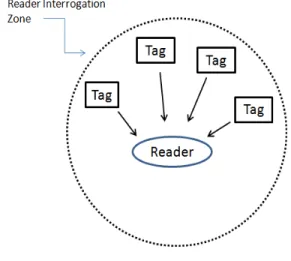
The RFID tag suffers from interference signals by its neighbouring tags which ultimately results in the tag-to-tag collision problem as shown in Figure 1. This problem prevents detecting informations for all tags in its interrogation zone [5]. In order to design an efficient anti-collision protocol for interference cancellation, we present the implementation of the Gold code technique [6], which is capable of accommodating multiple RFID tags [7]. For the efficient communication between multiple low-cost passive RFID tags and single reader, employing Gold code in the RFID system might be a good solution, because it supplies a number of codes with good balance between auto and cross correlation with high flexibility in code length and is relatively simple to implement, only requiring shift register to generate all codes [8].
In this paper, we compare the BER performance of the RFID system based on Gold code with the conventional system without an anti-collision technique and the RFID system based on the time division (TD) technique which uses the specific
time slots and the fixed number of data bits for the preamble and main data [9].
The rest of the paper is organized as follows:
Section II contains the received signal model. In Section III, we discuss about the anti-collision technique based on Gold code for RFID. In Section IV, we present our simulation results and lastly our conclusions are presented in Section V.
Fig. 1 Tag-to-tag collision
Ⅱ. Received Signal Mode
For the received signal, we consider Tags which individually transmit spread spectrum signals at the same time. In order to spread a signal spectrum in the transmitter, the data bit for the th tag, , is directly multiplied by the element of the cyclostationary Gold code with length for the th tag, , written as
(1)
The received signal vector at sample index
can be modeled as
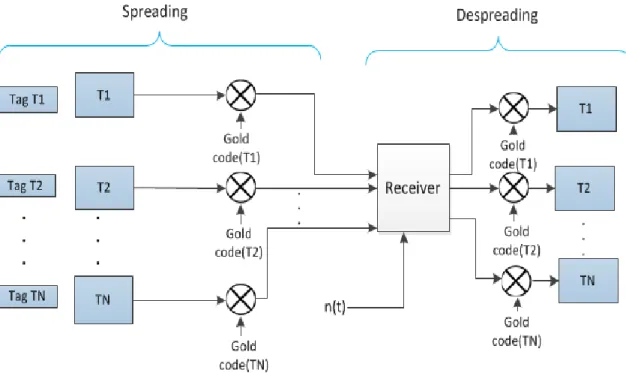
Fig. 2 Spreading and despreading of gold code signal sequence
(2)
where is the additive white Gaussian noise (AWGN) with independent and identically distributed components, each with zero mean and variance . In (2), remains constant over the length of one cycle of the Gold code.
The gold code for the th tag is defined as
(3)
where is the length of Gold code.
Using Friis free space equation, the distance relation is calculated where the transmitted power from the reader and the power received by the antenna of the tag is given by
(4)where the transmitter and receiver antenna gain are represented by and respectively, is the wavelength in meters, and is the distance between transmitter and receiver antenna[10].
Ⅲ. RFID Anti-Collision Based on Gold Code
In this section, we present Gold code technology for interference cancellation in RFID for receiving information from multiple tags to a single reader.
For this system, we allocate the fixed number of unique Gold code to each tag. The transmitted signal is spreaded in each tag and the received signal is despreaded in the reader with each unique Gold code to detect the desired data shown in
Figure 2.
Ⅲ.1. Spreading of the Transmitted Signal During Transmission, in order to provide the unique Gold code to each tag and to spread the signal spectrum, the data bit for the th tag,
is directly multiplied by the element of Gold code for the th tag, , which is independent on
.
Ⅲ.2. Despreading of the Received Signal In a receiver, the multiplexed signal from all tags and the noise are received and multiplied again by the same Gold code for th tag to detect the desried data for the th tag and to suppress the interference signal from other tags.
Since and ≠ , the despreaded signal with th Gold code is given by
⋮
⋯ ⋯
(5)
where
… (6) and
… (7)
The despreader output includes the signal of the interested tag, additive Gaussian noise (AGN), and residual interference signals with the low-power, because the power of the signal for the desired th tag is increased and the interference signals from other tags are suppressed, after despreading.
Employing this method, we minimize the inte- rference signals from other tags while commu- nicating from multiple tags and a reader.
Ⅳ. Computer Simulation
In this section, we analyze the considered RFID system through computer simulation to illustrate the performance of the interference suppression. For the simulation, we assume that the received signal consists of four RFID tag signals and AWGN with zero mean and variance , the frequency of RFID signal is 900MHz, all RFID tag is passive, the transmitted power of the tag is fixed for distance of 2m with minimum loss in bits, and the length of Gold code, , is 15. For the simulation, we consider two cases as follows:
Case 1: Four RFID tags transmit each signal, which are located at the reader interrogation zone at the same distance of 2m.
Case 2: Four RFID tags transmit each signal, which are located at the reader interrogation zone with different distances of 1.5m, 2m, 2.5m, and 3m.
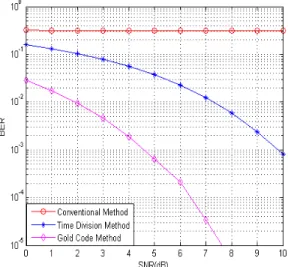
Figure 3 and 4 shows the bit error rate (BER) curves for the first case with the same distance and the BER curves for the second case with the different distance, respectively. From Figure 3, we observe that BER of the Gold code system is much lower than them of the time division (TD) and conventional RFID system. In Figure 4, BERs of the Gold code RFID system are lower than them of the TD system and BERs are lower when the distance between tags and a reader is shorter for both systems.
The simulated frame error rate (FER) curves for t h e f i r s t c a s e o f t he Go l d c o d e , TD, a n d conventional RFID systems are shown in Figure 5.
For this simulation, we assume that the length of the data frame is 64 bits. From the figure, we observe that the Gold code system is more efficient for receiving the transmitted data from the RFID tag comparing with TD and conventional systems.
Note that the conventional RFID system without considering anti-collision technique does not work for RFID data transmission, when there exist
Fig. 3 BER performance of the gold code, TD, and conventional RFID systems for the first case
Fig. 4 BER performance of the gold code, TD, and conventional RFID systems for the second case
serious interference signals from adjacent tags.
Figure 6 shows FER performance for the second case with different distances. In this case, we also observe that the Gold code system has better performance comparing with other systems and that the RFID system has better performance for the shorter distance between a tag and a reader for all
cases.
Note that the considered Gold code RFID system has better performance of the interference supp- ression comparing with TD system and the conventional RFID system without anti-collision function.
Fig. 5 FER performance of the gold code, TD, and conventional RFID systems for the first case
Fig. 6 FER performance of the gold code, TD, and conventional RFID systems for the second case
Ⅴ. Conclusion
RFID with various applications is one of core technologies for managing and identifying multiple objects. The data transmission from a tag to a reader suffers from the interference signals from adjacent tags, because we generally use many tags and single reader in a interrogation zone. In this paper, we presented and evaluated an anti-collision method based on spread spectrum technique using Gold code to suppress the interference signals from neighboring tags in RFID computing environments.
Since the implementation of the Gold code for the RFID technique plays an important role to solve the interference problem, it may improve simultaneous reading of multiple tags using single reader. The considered RFID architecture has better performance comparing with TD and conventional RFID systems and it helps to improve the data reliability and the efficiency. The interference suppression performance of this RFID technique was analyzed through computer simulation examples with two cases.
감사의 글
이 논문은 2012년도 정부(교육과학기술부)의 재원으 로 한국연구재단의 기초연구 사업지원을 받아 수행 된 것임(No. 2012-0008837)
References
[1] Young-Jun Lim, Ha-Joo Song, Oh-Heum Kwon, “Massive RFID Tag Write Technique using Parallel Deployment of Readers”, The Journal of The Korea Institute of Electronic Communication Sciences, Vol. 7, No. 6, pp.
1493-1498, 2012.
[2] Nemai chandra Karmakar, “Handbook of smart antennas for RFID system”, Wiley, Oct.
2010.
[3] Miodrag bolic, Pavid simplot-RYL, Ivan
storjmenouic, “RFID System Research Trends and Challenges”, Wiley, Sep. 2010.
[4] Seoung-Bin Ye, Soon-Hee Han, Hee-Taek Ceong, “Functions for RFID Middleware Development on Mobile Device Emulator”, The Journal of The Korea Institute of Electronic Communication Sciences, Vol. 3, No. 2, pp. 11-1116, 2008.
[5] Jshweta Jain, Samir R. Das, “Collision Avoidance in a Dense RFID Network”, WiN- TECH '06 Proceedings of the 1st international workshop on Wireless network testbeds, expe- rimental evaluation & characterization, pp.
49-56, Sep. 2006.
[6] Maina, Joshua Y,Mickle, Marlin H, Lovell, Michael R. Schaefer, Laura A, “Application of CDMA for anti-collision and increased read efficiency of multiple RFID tags”, Journal of Manufacturing Systems, Vol. 26, pp. 37-43, 2007.
[7] Myoung-ku Kang, “Structure and Performance Analysis of a New Long Code MMSE Detectors in a W-CDMA”, The Journal of The Korea Institute of Electronic Communication Sciences, Vol. 6, No. 2, pp. 163-170, 2010.
[8] Mutti, C,Floerkemeier, C, “CDMA-based RFID Systems in Dense Scenarios: Concepts and Challenges”, RFID, 2008 IEEE International Conference, pp. 215-222, Apr. 2008.
[9] Grishma Khadka, Suk-seung Hwang, “An Anti-collision RFID system Based on Time Division in Construction Workplace”, The Conference of The korea Institute of Electronic Communication sciences, Vol. 6, No. 2, pp.
157-161, 2012.
[10] Weilian Su, Senior Member, IEEE, Nikolaos and Tri T. Ha, Fellow, IEEE, “Multiple RFID Tags Access Algorithm”, IEEE Transactions on Mobile computing, Vol. 9, No. 2, pp. 174-187, 2010.
저자 소개
카드카 그리슈마(Grishma Khadka) 20011년 6월 Khwopa Engineering College, Affiliated to Purbanchal University, Department of Computer Engineering
2012년 3월 조선대학교 대학원 첨단부품소재공학과 (정밀기계설계공학전공) 석․박사통합과정
※ 관심분야 : RFID, 적응신호처리, 무선통신 시스템, 위치추정
황석승(Suk-Seung Hwang) 1997년 2월 광운대학교 제어계측 공학과 졸업
2001년 6월 University of Cali- fornia, Santa Barbara, Electrical &
Computer Engineering Department 대학원 졸업(공학 석사)
2006년 University of California, Santa Barbara, Electrical & Computer Engineering Department 대학원 졸업(공학박사)
2006.5~2008.3 삼성전자 통신연구소 책임연구원 2008.3~현재 조선대학교 메카트로닉스공학과 조교수
※ 관심분야 : 적응신호처리, 위치추정, 채널추정, 이동로봇용 위치추정, 간섭제거