오징어 간 액젓으로부터 분리된 Angiotensin Converting Enzyme 저해 Peptide의 특성
박 영 범
강원도립대학 식품가공제과제빵과
Characteristics of Angiotensin Converting Enzyme Inhibitory Peptides from Salt-fermented Squid Liver Sauce
Yeung Beom Park
Dept. of Food Processing and Bakery, Gangwon Provincial College, Gangwon 210-804, Korea
Abstract
In order to utilize squid liver by-products, which is normally discarded as industrial waste in the process of squid manufacturing, salt-fermented squid liver sauce was prepared experimentally and also tested for inhibitory activity against angiotensin converting enzyme (ACE). ACE inhibitory activity of squid liver sauce was increased with the elapse of fermentation days until 12 months, followed by a constant level of inhibitory activity thereafter. 15-month-old sauce (IC
50=29.66 μg) was filtered through PM-10 membrane (M.W. cut-off 10,000 Da) to obtain the peptides fractions with ACE inhibition activity. Filtered fractions were applied to a Bio-gel P-2 column and three active fractions (A, B and C) were collected. Among them, fraction B applied to a SuperQ-Toyopearl 650S column chromatography lead to the isolation of active B-1 fraction. It has the ACE inhibitory activity (IC
50=5.46 μg). The main composition of its amino acids is lysine, glycine and proline, which cover about 85% of the total amino acids.
Key words: angiotensin converting enzyme, squid liver, salt-fermented sauce
E-mail: [email protected]
Phone: 82-33-660-8232, Fax: 82-33-660-8235
서 론
2008년 우리나라 주요 3대 사망원인으로는 암, 심장질환, 뇌혈관질환으로 총 사망자의 절반(48.1%)을 차지하는 것으 로 알려져 있다. 이들 사망원인 중 뇌졸중, 심근경색, 동맥경 화 등의 순환기계 질환의 원인인자는 고혈압과 밀접한 상관 성을 가지고 있는 것으로 보고되고 있다(1). 이와 같이 순환 기계 질병의 원인이 되는 고혈압은 혈압의 조절과 항상성을 유지하는 renin-angiotensin system(RAS)의 angiotensin converting enzyme(ACE)이 중요한 역할을 한다고 알려져 있다(2). RAS에서 renin에 의해 angiotensinogen으로부터 생성된 angiotensin-Ⅰ은 ACE에 의해 C말단인 dipeptide (His-Leu)가 절단되어 강한 혈관수축을 유발하는 호르몬인 angiotensin-Ⅱ로 변화되는데 이는 부신피질에서의 aldo- steron, vasopressin의 분비를 활성화시켜 세뇨관의 Na
+흡 수, 수분의 재흡수, 신장의 혈류량 감소 등을 유발함으로써 혈압을 상승시킨다(3). 또한 ACE는 혈관확장의 촉진, 혈소 판의 흡착저해 등의 효과를 보이는 bradykinin과 kallidin (Lys-bradykinin)의 C말단(Phe-Arg)을 분해하여 혈관 이 완을 억제함으로써 혈압을 상승시킨다(4). 이와 같이 ACE 는 고혈압뿐만 아니라 심근경색 및 심장 관련 질병과 크게
관련이 있으므로 ACE의 저해가 필수적이며 ACE 저해제는 심근경색(5), 고혈압 및 심장관련 질환(6)의 치료를 위해 사 용되고 있다.
ACE 활성을 저해하기 위해 다양한 식품단백질을 중심으 로 한 연구가 진행되어, 대두(7), zein(8), casein(9), 가자미 (10), 오징어(11), 참치(12), 멸치(13), 젤라틴(14) 등의 식품 에서 다수의 ACE 저해 펩타이드가 보고되었다. 또한 최근 정어리단백질 유래 디펩타이드인 Valyl-tyrosine은 경중고 혈압 환자에 대해 강압효과를 나타내어 우리나라 제 1호 개 별 인정형 건강기능식품으로 인정받았다.
한편, 오징어는 한국인의 식미기호에 맞아 다른 나라에
비해 널리 이용되는 수산 자원이다. 우리나라 연근해 오징어
의 생산량은 2002년 이후 최근 2008년까지 연평균 202,788톤
이 어획되어 횟감과 같이 생체로 이용되거나 외투와 팔 등의
근육부분을 대상으로 한 마른오징어, 조미오징어 및 젓갈
등의 가공제품 등으로 널리 소비된다. 그러나 가공과정 중
발생되는 어체의 20~30%를 차지하는 간장, 생식기관 등을
포함한 내장 부분은 식품가공 소재로 이용되지 못하고 사료
또는 비료로 이용되거나 매립되어 환경오염의 원인이 되고
있다(15). 오징어 내장에는 일반어류에 비해 지방, 비타민
B군, 무기질 함량이 높으며 또한 단백질, 효소, 생리활성 물
질 등이 함유되어 있어 유효성분의 효율적인 이용방안이 요 구되고 있다.
최근에는 오징어 내장 및 내장 유래 효소를 활용한 식품이 용 및 생리활성성분에 대한 연구가 시도되고 있다. 즉, 오징 어 간장 유래 조효소를 이용한 육의 물성 개선(16), 치즈(17) 및 액젓(18-20)의 발효 촉진, 쓴맛 제거 및 풍미 개선(21,22), 오징어 내장을 함유한 된장의 제조(23), 오징어 내장 가수분 해물을 포함하는 국수용 장국 조성물(특허 10-0816118), 오 징어 내장 분획물의
in vitro에서의 암세포 성장억제 효과 (24) 등이 있다.
본 연구에서는 오징어 내장의 대부분을 차지하고 있는 간 을 원료로 하여 제조한 액젓의 ACE 저해효과를 숙성기간에 따라 비교하고 이로부터 ACE 저해 peptide를 한외여과, 겔 크로마토그래피, 이온크로마토그래피로 분리하여 그 저해 효과를 검토하였다.
재료 및 방법
실험재료
실험에 사용한 오징어 간은 2008년 9월 강원도 강릉시 주 문진 근해에서 어획된 오징어(
Todarodes pacificus)를 주문 진 항에서 직접 구입하여 쇄빙으로 채워진 아이스박스에 담 아 신선한 상태로 운반하여 실험에 사용하였다. 토끼 허파로 부터의 ACE 정제효소와 기질(hippuryl-histidyl-leucine)은 Sigma-Aldrich사(St. Louis, MO, USA)에서 구입하여 사용 하였다.
오징어 간 액젓의 제조
오징어를 적출하여 꺼낸 간을 3%(w/w)의 천일염으로 제 조한 염수에 3회씩 수세와 수절을 반복한 후 2
oC 이하에서 원심분리(4,000×
g, 30 min)하여 지질층을 제거하였다. 지질 이 제거된 오징어 간 20 kg에 대하여 25%(w/w)의 천일염을 가하고 잘 혼합하여 20 L 용량의 전통 옹기(∅×H, 20.5 cm×37.5 cm)에 담아 15~20
oC의 암실에서 전통적인 방법 으로 숙성 1개월부터 1주일에 2~3회씩 위, 아래로 휘저어주 면서 18개월 동안 숙성하였다. 숙성 2개월부터 1~3개월 간 격으로 액화된 원액을 원심분리(4,000×
g, 30 min)하고 감압 여과(buchner funnel ∅110 mm; pore size 1 μm) 하여 -20
oC 이하의 동결고에 보관하면서 시료로 사용하였다.
일반성분 분석
오징어 간의 일반성분은 AOAC 방법(25)에 준하여 수분 정량은 105
oC 상압가열 건조법, 조단백질은 semi-micro Kjeldahl법, 조지방은 Soxhlet추출법, 조회분은 550
oC에서 직접 회화법으로 측정하였다.
ACE 저해능
ACE 저해능은 Lee 등(26)의 방법으로 측정하였다. 15 μL 의 시료용액에 ACE 정제효소(60 mU/mL) 50 μL를 가한 후,
37
oC에서 5분간 preincubation시켰다. 여기에 borate buffer (pH 8.3, 400 mM NaCl 함유)로 용해한 5 mM hippuryl- histidyl-leucine 기질 125 μL를 가하고 37
oC에서 30분간 incubation 시킨 후, 10% trifluoroacetic acid(TFA) 20 μL를 가하여 반응을 정지시켰다. 이들 반응 용액 20 μL를 Zorbax 300SB C
8column(4.6×150 mm, Agilent Tech. Inc., Santa Clara, CA, USA)이 장착된 역상 HPLC(Thermo Separation Products Inc., San Jose, CA, USA)에 주입하여 분석하였다.
분석 시 용출속도는 1 mL/min, 이동상으로는 0.1%의 TFA 를 함유한 acetonitrile을 linear gradient(0~63%)하여 기질 로부터 유리된 hippuric acid를 228 nm에서 검출하여, 시료 첨가 전후의 잔존 활성의 백분율로써 ACE 저해능을 나타내 었다.
Gel chromatography에 의한 분리
액젓을 한외여과막(PM-10, Amicon Co., Beverly, MA, USA)을 사용하여 분자량 10,000 Da 이하의 저분자물질을 회수하고 원심농축(CVE-100D, Eyela Co., Tokyo, Japan) 한 것을 gel chromatography 시료액으로 사용하였다.
Bio-gel P-2(Bio-Rad Lab., Hercules, CA, USA)를 충진 한 column(2.2×80 cm)을 사용하여 시료액 2 mL를 탈이온 수로써 용출(MP-3N, Eyela Co.; 유속 21 mL/hr, 분획량 5.25 mL/tube)시켰으며 분획한 각 용출액은 280 nm에서 흡 광도를 측정하여 chromatogram을 작성하였다.
Ion exchange chromatography에 의한 분리
활성획분을 탈이온수로 평형화시킨 SuperQ-Toyopearl 650S(Tosoh Co., Ltd., Tokyo, Japan) column(16×650 mm) 에 주입하고 흡착시킨 다음 탈이온수로 용출하고 다시 NaCl 용액(0~1 M)을 사용하여 linear gradient(LPG1000, Eyela Co.; 유속 30.6 mL/hr, 분획량 5.1 mL/tube)로 용출, 분리하 였다.
아미노산 분석
단백질 함량이 약 10 mg이 되는 시료 1 mL를 유리관에 넣고 6 N HCl 1 mL를 가하여 질소 충전시킨 후 밀봉하여 110
oC, 24시간 가수분해하였다. 분해액을 감압 건조하여 HCl을 제거하고 여기에 증류수 10 mL를 가하여 다시 감압 건조한 후, 구연산나트륨 완충용액(pH 2.2)으로 정용하고 0.45 μm membrane filter로 여과하여 일정량을 취하여 아미 노산 자동분석기로 분석하였다.
결과 및 고찰
오징어 간의 일반성분
오징어 간의 일반성분을 분석하여 수분, 조단백질, 지방, 회분함량을 Table 1에 나타내었다. 그 결과 수분함량 64.0%, 조단백질 15.9%, 조지방 17.4% 및 회분이 1.4%로 나타났다.
이와 같은 결과는 Kim 등(27)의 원양산 오징어의 내장전체
Table 1. The proximate composition of squid liver (g/100 g) Moisture Crude protein Crude lipid Ash 64.0±0.3
1)15.9±0.4 (44.2)
2)17.4±0.3 (48.3) 1.4±0. 1(3.9)
1)
Each value presents the mean±SD of triplicate determinations.
2)
The numbers in the parenthesis are dry weight basis.
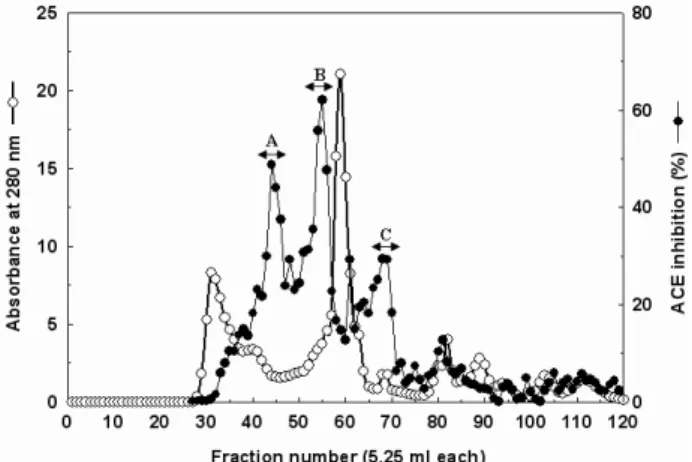
Fig. 1. Gel chromatogram on a Bio-gel P-2 column of salt- fermented squid liver sauce filtered with PM-10 membrane.
Arrow lines were collected separately.
Table 2. Changes of the peptide-nitrogen and the ACE in- hibitory activity of salt-fermented squid liver sauce during fermentation
Fermentation
(month) Peptide-nitrogen
(mg/100 mL) IC
50(μg protein) 2 3
4 5 6 10 8 12 15 18
1,008±39
1)d2)1,043±14
cd1,073±22
bc1,096±32
ab1,115±29
ab1,135±24
a1,134±10
a1,111±33
ab1,035±25
cd908±40
e67.56 58.42 52.66 63.41 46.86 41.34 38.07 30.46 29.66 28.12
1)
Each value presents the mean±SD of triplicate determinations.
2)
Values with different superscript letters within a column are significantly different at p<0.05 by Duncan's multiple range test.
로 한 일반성분(수분 62.9%, 조단백질 17.2%, 조지방 16.9%, 회분 1.6%)의 결과와 큰 차이를 나타내지 않았다. 한편, 건물 당 단백질과 지질로는 각각 44%와 48%를 나타내어 오징어 내장의 대부분을 차지하는 간은 단백소재 및 지질소재로 이 용 가능하리라 생각된다.
오징어 간 액젓의 숙성에 따른 peptide-nitrogen 함량 및 ACE 저해효과
숙성기간에 따른 ACE 저해효과(Table 2)는 액젓을 담근 2개월째에 IC
50값이 67.56 μg이었으며 숙성이 진행됨에 따 라 18개월까지 저해 효과가 감소됨이 없이 완만히 증가되었 고, 12, 15 및 18개월째에는 IC
50값이 각각 30.46, 29.66 및 28.12 μg으로 거의 일정한 저해효과를 나타내었다.
이러한 오징어 간 액젓의 숙성에 따른 ACE 저해효과는 오징어 간의 자가 소화효소 및 미생물이 분비하는 단백질 분해효소에 의해 액젓 단백질로부터 유리되는 peptide에 기 인하는 것으로 예상된다. 한편, 이들 숙성 기간에 따른 ACE 저해효과를 peptide-nitrogen 함량과 비교해 볼 때 숙성 8개 월경의 peptide nitrogen 함량이 1,135 mg/100 mL로 최대값 을 나타내었다가 함량이 감소되는 12개월(1,111 mg/100 mL), 15개월(1,035 mg/100 mL) 및 18개월(908 mg/100 mL) 개월에도 ACE 저해효과는 감소되지 않고 일정하게 유지되 어 ACE 저해효과와 peptide-nitrogen 함량 사이에는 뚜렷 한 상관성을 나타내지 않았다. 이와 관련하여 Kim 등(28)과 Lee 등(29)의 담수어 효소 가수분해물 및 김 가수분해물에서 도 ACE 저해능과 가수분해율 및 peptide-nitrogen 함량 사
이에는 상관성이 없는 것으로 보고하고 있어 본 실험과 유사 한 결과를 나타내었다. 따라서 숙성기간에 따른 액젓의 ACE 저해능 차이는 액젓 단백질로부터 생성된 peptide의 아미노 산 조성, 사슬길이 등이 관계되는 것으로 판단된다.
오징어 간 액젓의 ACE 저해 활성 획분의 분획 및 아미노 산 조성
ACE 저해 peptide와 관련하여 보고되는 많은 연구에서 고분자 peptide에 비해 저분자 peptide가 ACE 저해효과가 높은 것으로 보고(10,30)되고 있어 15개월째의 액젓을 mo- lecular weight cut-off가 10,000 Da 이하인 한외여과막을 통과한 저분자 분획물을 Biogel P-2 column에 주입하여 겔 크로마토그래피를 실시하였다. 분획 후, 각 용출획분의 280 nm에서의 흡광도 및 ACE 저해효과를 검토하여 활성획분인 A(tube No 44, 45), B(tube No 54, 55) 및 C(tube No 68, 69)를 분리하였다(Fig. 1). 이들 각 획분의 ACE 저해효과(IC
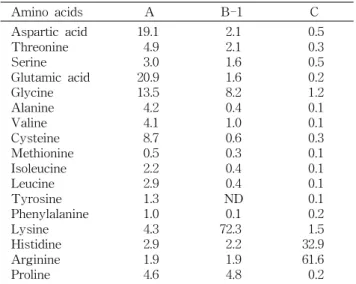
50)는 각각 4.51 μg, 3.23 μg 및 19.6 μg이었으며(데이타 미제시), 이들 획분 중 ACE 저해능이 우수한 B 획분을 원심농축하고 SuperQ-Toypearl 650S column을 이용한 음이온 교환 크로 마토그래피를 행하여 B 획분으로부터 증류수 용출 획분인 B-1(tube No, 14, 15)을 분리하였다(Fig. 2). 이와 같이 분리 된 용출획분 A, B-1 및 C의 아미노산 조성을 Table 3에 나타 내었다.
분리된 획분 B-1의 주요 아미노산은 lysine(72.3%), gly- cine(8.2%) 및 proline(4.8%)으로 이들 3종류의 아미노산이 전체아미노산의 약 85%를 차지하였으며 ACE 저해효과는 IC
50=5.46 μg이었다. 이와 관련하여 Guang와 Phillips(31)는 ACE 저해 peptide의 C말단에 guanidine기 또는 ε-amino기 를 가지고 있어 양전하를 띠고 있는 arginine 및 lysine은 ACE 저해활성에 크게 기여하는 것으로 보고하고 있다.
한편 Matsumura 등(32)도 ACE 저해효과를 나타내는 가
다랑어 내장 peptide를 분리하고 이를 바탕으로 한 peptide를
합성한 결과, 저해활성이 강한 peptide들은 공통적으로 N말
Fig. 2. Ion chromatogram on a SuperQ-Toyopearl 650S col- umn of the active fraction B eluted from Bio-gel P-2 column.
Arrow lines were collected separately.
Table 3. Amino acid composition of each active fractions eluted from Bio-gel P-2 and SuperQ-Toyopearl 650S col-
umn (% to total amino acids)
Amino acids A B-1 C
Aspartic acid Threonine Serine Glutamic acid Glycine Alanine Valine Cysteine Methionine Isoleucine Leucine Tyrosine Phenylalanine Lysine Histidine Arginine Proline
19.1 4.9 20.9 3.0 13.5 4.2 4.1 8.7 0.5 2.2 2.9 1.3 1.0 4.3 2.9 1.9 4.6
2.1 2.1 1.6 1.6 8.2 0.4 1.0 0.6 0.3 0.4 0.4 ND 0.1 72.3 2.2 1.9 4.8
0.5 0.3 0.5 0.2 1.2 0.1 0.1 0.3 0.1 0.1 0.1 0.1 0.2 32.9 1.5 61.6 0.2 ND: not detected.
단 아미노산잔기에는 valine, isoleucine 및 leucine과 같은 소수성 아미노산이, 중앙에는 arginine 및 lysine과 같은 염 기성 아미노산이, C말단의 아미노산잔기는 proline으로 구 성되었다고 보고하였다. 특히 이들 합성 peptide C말단의 아 미노산잔기인 proline은 ACE 활성부위와의 결합에 중요한 역할을 하여 강력한 ACE 저해제로 작용한다고 보고하였으 며 본 실험에서의 B-1 획분의 proline 함량은 4.8%로 나타 났다.
Cheung 등(33)은 dipeptide의 C말단 및 N말단 아미노산 의 잔기의 영향에 대하여 검토하였으며 이들 dipeptide 중에 서 lysine, glycine 및 proline을 함유한 ACE 저해 dipeptide 로는 Gly-Pro(IC
50=450 μM), Gly-Lys(IC
50=5400 μM), Gly- Gly(IC
50=7200 μM), Lys-Gly(IC
50=3200 μM), Pro-Gly(IC
50= 17,000 μM)을 보고하고 있다.
또한 Ichimura 등(13)은 멸치 액젓으로부터 Ala-Pro(IC
50= 29 μM), Gly-Pro(IC
50=360 μM), Lys-Pro(IC
50=22 μM) 등을
분리하고 이들 중 Lys-Pro이 강력한 ACE 저해효과를 나타 냄을 보고하고 있으며 이와 유사한 Leu-Lys-Pro은 일본에 서 혈압강하용 특정 보건용 식품으로 상품화 되어 있다. 따 라서 ACE 저해활성이 우수한 B-1의 주요 아미노산인 lysine, glycine, 및 proline이 ACE 저해활성과 관계가 있을 것으로 추정된다.
A 획분의 경우에는 산성아미노산인 gluatamic acid(20.9
%), aspartic acid(19.1%)와 glycine(13.5%)이 전체 아미노 산의 약 50% 이상을 차지하였으며 이들 외에 cystein이 8.7%, valine, leucine 및 isoleucine이 약 9%로 나타났다. 이 들 결과와 관련하여 Yeum 등(34)은 복합효소와 bromelain 에 의한 ACE 저해활성을 갖는 고등어 단백질 가수분해물은 glutamic acid, aspartic acid, lysine, alanine, valine 및 leucine 등이 대체적으로 많은 것으로 보고하여 본 실험의 A 획분의 아미노산 조성과 다소 유사하였다.
C 획분의 주요 아미노산은 histidine(32.9%)과 arginine (61.7%)으로 이들 두 종류의 염기성 아미노산이 전체 아미 노산의 94.6%를 차지하였으며 그 외의 아미노산은 5.4%에 불과하였다. 그 저해활성은 IC
50=19.6 μg으로 획분 A 및 B-1 에 비하여 낮았다. Lee 등(35)은 rotifer(
Brachionus caly- ciflonus)의 효소 가수분해물로부터 ACE 저해 peptide인 Ala-Gln-Gly-Glu-Arg-His-Arg을 분리하고 그 저해활성 은 IC
50=40.01 μg/mL로 보고하였다. 이와 관련하여 C 획분 의 주요 아미노산인 histidine과 arginine의 함량비가 약 2:1 임을 고려해 볼 때 C 획분 중에 존재하는 peptide도 Lee 등 (35)이 보고한 peptide C말단의 tripeptide(-Arg-His-Arg) 배열과 유사한 peptide로 예측된다. 한편 Shin 등(36)은 된장 으로부터 저해활성이 우수한 His-His-Leu(IC
50=2.22 μg/
mL)을 분리하고 높은 저해활성은 ACE 기질인 angiotensin I의 C말단 잔기(-His-Leu)와의 유사성에 기인할 것으로 추 정하고 있다. 이외에도 angiotensin I의 C말단 잔기(-His- Leu)와 유사한 저해 peptide로는 His-His-Thr(IC
50=800 μM), Gly-Val-His-His-Ala(IC
50=71.8 μM) 등이 보고되어 있다 (37,38).
Andrews 등(39)과 Hernández-Ledesma 등(40)은 ACE 저해효과를 가지는 peptide에 있어서 C말단의 tripeptide 잔 기가 경쟁적 저해활성에 중요한 역할을 하며, tripeptide로 구성된 ACE 저해 peptide의 경우, C말단의 잔기는 tryp- tophan, tyrosine phenylalanine과 같은 방향족 아미노산 및 valine, leucine, isoleucine과 같은 가지달린 아미노산 또는 소수성 아미노산이 ACE 저해활성에 더욱 효과적이며 친수 성 아미노산의 경우 약한 저해활성을 나타내는 것으로 보고 (31,41)하고 있다.
따라서 C 획분의 낮은 저해활성(IC
50=19.6 μg)과 아미노
산 조성을 고려해 볼 때 C 획분에 존재하는 peptide는 주로
방향족 또는 소수성아미노산이 적으며 주로 histidine과
arginine으로 구성되어 있을 것으로 예측된다.
이상에서 살펴본 바와 같이 오징어 간 액젓에 존재하는 ACE 저해 peptide는 그 구성아미노산의 조성, 함량에도 영 향을 미칠 것으로 예측되나 그 외에도 peptide의 아미노산 배열순서, 길이 등이 더 크게 저해활성에 영향요인이 될 수 있을 것으로 판단된다.
요 약
오징어 가공 부산물인 오징어 간의 효율적 이용을 위하여 오징어 간을 이용하여 액젓을 제조하고 이들 액젓의 ACE 저해효과를 살펴보았다. 액젓의 ACE 저해활성은 12개월까 지는 점차적으로 증가하였으나 그 이후에는 저해활성이 둔 화되어 거의 일정한 저해활성을 유지하였다. 숙성 액젓 중 15개월째 액젓(IC
50=29.66 μg)을 한외여과막으로 통과시켜 회수한 분자량 10,000 Da 이하의 저분자물질을 Bio-gel P-2 gel chromatography를 행하여 ACE 저해효과를 가지는 3개 획분을 분취하였다. 이들 획분 중에서 ACE 저해효과가 가 장 높은 B 획분을 SuperQ-Toyopearl 650S column을 이용 한 음이온 교환크로마토그래피에 의해 B-1의 활성획분을 분리하였다. 획분 B-1의 아미노산 조성은 lysine, glycine 및 proline의 함량이 가장 많아 전체의 약 85%를 차지하였으 며 IC
50은 5.46 μg으로 나타났다.
문 헌