반응표면분석을 이용한 트레할로스와 변성전분 혼합사용 떡의 품질 특성
김상숙1․정혜영2†
1한국식품연구원 특화연구본부 쌀연구단
2경원대학교 식품영양학과
Quality Characteristics of a Korean Rice Cake (Karedduk) with Mixture of Trehalose and Modified Starch by Using Response Surface Methodology
Sang Sook Kim1 and Hae Young Chung2†
1Korea Food Research Institute, Gyeonggi 463-746, Korea
2Dept. of Food and Nutrition, Kyungwon University, Gyeonggi 461-701, Korea
Abstract
Texture and descriptive sensory characteristics of a Korean rice cake (Karedduk) added with mixture of treha- lose and Sun-Tender were investigated after 2, 24, and 48 hrs of storage at 5oC. A central composite design was used for treatment arrangement. The trehalose were added in 0, 3, 6, 9 and 12% levels and Sun-Tender added in 0, 0.3, 0.6, 0.9, and 1.2% levels to dry rice flour. The mixture amounts of trehalose and Sun-Tender on texture and descriptive sensory characteristics of a Korean rice cake (Karedduk) were optimized using re- sponse surface methodology (RSM). The two independent variables selected for the RSM were amounts of treha- lose (X1) and amounts of Sun-Tender (X2). The predicted value at stationary point or a minimum for texture hardness by RSM was found as 591.5440 after 24 hrs of storage at 5oC. Also the adhesiveness, hardness, cohe- siveness and sweetness by sensory characteristics were significantly different as compared to the control. The results suggested that a Korean rice cake (Karedduk) added with mixture of trehalose and Sun-Tender can be made from the mixture amounts of trehalose 9.5826% and Sun-Tender 0.2216% in retarding retrogradation.
Key words: trehalose, Sun-Tender, texture properties, sensory characteristics, retrogradation, RSM
†Corresponding author. E-mail: [email protected]
†Phone: 82-31-750-5970, Fax: 82-31-750-5974
서 론
전분의 노화는 호화된 상태에서 시간이 경과함에 따라 아밀 로오스와 아밀로펙틴의 이중 헬릭스 구조의 분자 간 재배열과 응집효과로 일어나고 전분함유 식품의 탄력성, 단단함 및 구조 적으로 굳음 등 물리적 변화를 일으킨다(1,2). 또한 아밀로오스 와 아밀로펙틴의 함유 비율에 의해 노화 속도는 달라지며 일반 적으로 아밀로오스가 많은 전분이 노화가 빨리 일어난다(3,4).
전분의 구성 성분 중 아밀로오스의 노화는 냉각과 같은 짧은 시간에 일어나는 반면에 아밀로펙틴의 노화는 몇 주 또는 몇 달 동안의 과정에서 천천히 진행된다(5-9). 이런 전분의 노화 현상은 쌀 가공제품의 대표적인 멥쌀 떡을 쉽게 굳게 하므로 상품성을 저하시키고 쌀 가공제품의 유통 및 판매에서도 성장 을 감소시킴으로써 쌀 가공업계에도 영향을 주는 중요한 요인 이 된다(3,4). 따라서 쌀 가공제품의 노화를 해결하고 노화억제 기술을 개발하여 전분에 의한 노화가 문제인 모든 가공제품에 적용한다면 쌀 가공제품의 경쟁력 강화와 쌀 소비 촉진을 유도 할 수 있을 것이다.
전분의 노화를 억제하기 위하여 첨가하는 여러 가지 첨가물 에는 가용성 당류(10-14), 올리고당(15), 펜토산(16), 식이섬유 (17), 셀룰로오스(18), 지방질 및 유도체(19,20), 염류(21,22), 유 화제(23-26) 등이 있으며 대부분의 연구에서 이들 첨가물질을 단일물질로 첨가하여 노화억제에 효과를 설명하였다. 그러나 노화억제에 효과적이라고 알려진 여러 가지 단일 물질들을 혼 합사용하여 노화억제 가능성과 혼합 최적 조건을 검색하는 연 구는 거의 없는 현실이다.
본 연구는 떡의 노화억제에 효과적인 물질(27)로 검색된 여 러 가지 물질 중에서 당류 물질인 트레할로스와 변성전분인 썬텐더를 중심합성계획법에 따라 쌀가루 기준으로 트레할로 스는 0, 3, 6, 9 또는 12% 농도로, 썬텐더는 0, 0.3, 0.6, 0.9 또는 1.2% 농도로 혼합사용하여 첨가한 가래떡을 제조하였으며 5oC 저장 2, 24, 48시간 후 텍스처를 측정하여 실험군을 무첨 가군에 비교하여 쌀 가공제품인 가래떡의 노화를 억제할 수 있는 첨가물 혼합의 최적 조건을 반응표면분석법으로 구하였 다. 그리고 관능검사는 24시간 경과 후 가래떡의 묘사특성 분 석을 실시하였고 반응표면분석법에 의해 관능적 품질 특성 효
과를 분석하여 실험군의 떡을 무첨가군과 비교하였다. 실험군 의 떡을 무첨가군 떡과 비교 연구함으로써 노화억제 기술 개 발에 대한 기초 자료를 얻어 객관적인 평가 자료로 활용하고 자 하였다.
재료 및 방법
재료
본 실험에서 가래떡 제조 시에 사용한 쌀가루는 2003년산 경기 추청미로 3시간 침지한 후 roll mill(경창기계, 경기도 광 주, 한국)을 사용하여 습식방법에 의해 제분하였으며 쌀가루 제조 후 사용 전까지 폴리에틸렌 봉지에 포장하여 냉동 (-20oC)보관하였다. 가래떡에 첨가된 당류 물질 트레할로스는 삼양제넥스(서울, 한국), 변성전분 썬텐더는 보락(주)(경기도 화성, 한국)에서 구입하였다.
가래떡의 제조
떡의 제조는 쌀가루(300 g)에 따라 수분함량을 43%로 조정 하였고 쌀가루 기준으로 트레할로스는 0, 3, 6, 9 또는 12%
농도로 첨가하고 썬텐더는 0, 0.3, 0.6, 0.9 또는 1.2% 농도로 혼합사용하여 전기찜기(SO2-6166, Shanghai SEB Electric Appliances Co., Shanghai, China)에 40분간 증자한 후 녹즙 기(DC-502, 동아산업, 서울, 한국)를 이용하여 지름 1.5 cm로 제조하였다. 노화억제 효과의 분석조건은 가래떡을 20 cm 정 도 길이로 제조한 다음 폴리에틸렌 백에 밀봉하여 5oC 냉장 보관하면서 사용하였으며, 제조시간 2, 24 및 48시간 경과 후 측정 분석하여 실험군 떡의 텍스처 특성을 무첨가군 떡과 비 교하였다.
기계적 텍스처 특성
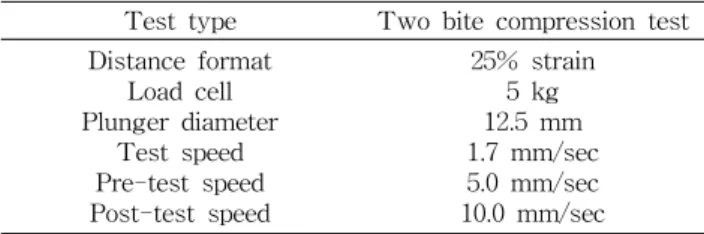
제조된 가래떡은 지름×높이=12.5×15 mm 크기로 자른 후 Texture Analyzer(model TA-XT2, Stable Micro System Ltd., Haslemere, England)를 이용하여 Bourne(28)에 의해 기 술된 방법으로 쌀 가공제품 노화억제 연구(27)와 같은 조건으 로 분석하였다(Table 1). TPA(texture profile analysis) 방법 으로 two bite compression에 의해 3회 반복(5회 측정/실험), 총 15회 측정하여 평균값으로 부착성(adhesiveness), 경도 (hardness) 및 응집성(cohesiveness)을 측정하였다.
관능적 묘사분석
본 실험에 사용된 관능검사 방법은 변형된 정량적 묘사분석
Table 1. Texture analyzer conditions for texture hardness of a Korean rice cake (Karedduk)
Test type Two bite compression test Distance format
Load cell Plunger diameter
Test speed Pre-test speed Post-test speed
25% strain 5 kg 12.5 mm 1.7 mm/sec 5.0 mm/sec 10.0 mm/sec
방법(29)을 사용하였고, 쌀 가공제품 노화억제 연구(27)와 같 은 조건으로 분석하였다. 검사에 참여한 패널은 13명의 유경험 패널이었으며, 부착성(adhesiveness), 경도(hardness), 응집성 (cohesiveness), 단맛(sweetness), 쓴맛(bitterness) 및 떫은/
아린 맛(astringency) 등을 검사하였다. 관능검사를 위해 제시 된 가래떡은 개인용 사기용기에 담고 플라스틱 랩을 덮은 후 칸막이와 조명이 조절되는 개인 검사대에 3개 시료를 한 번에 제시하였다. 각 시료의 용기에는 난수표를 이용하여 추출된 숫자를 기입하였으며, 평가 시 입을 헹굴 수 있도록 정수기 (DoultonⓇ, London, UK)를 통과시킨 물과 뱉는 컵을 함께 제 시하였다. 시료의 크기는 텍스처 측정 시 사용된 크기(지름×
높이=12.5×15 mm)와 동일하였으며, 시료 제시순서는 제시 순서에 의한 오차를 최소화하기 위해 랜덤화하였다(30). 평가 시에 사용된 척도는 15 cm 선척도로, 양쪽 끝에서 1.25 cm 들어간 지점에 양극의 강도(0=없음, 15=대단히 강함)를 표시 하였다. 패널들은 부착성, 경도, 응집성, 단맛, 쓴맛과 떫은/아 린 맛의 순으로 평가하였으며 척도 위에 각 특성별로 해당강도 에 수직선을 긋고 시료번호를 기입하도록 하였다. 본 실험은 패널들 간의 상호작용을 최소화하기 위해 칸막이가 설치된 booth에서 수행하였으며 패널 13명의 3번 반복 측정으로 얻은 값을 평균값으로 계산하여 비교하였다.
통계분석
본 실험은 3회 반복 실험하였으며 실험군간 차이검증은 SAS(Statistical Analysis System ver. 8.2)를 이용하여 분산 분석을 실시하였다. 분산분석 결과 실험군간 차이가 있는 특 성의 경우, 실험군의 평균값 간의 차이수준 여부를 결정하기 위해 SNK(Student Newman Keul)의 다중비교 방법을 사용 하였다. 두 가지 첨가물을 사용한 혼합의 최적 조건을 구하기 위해 반응표면분석(response surface methodology, RSM) (31)은 SAS(Statistical Analysis System)를 사용하였고 회귀 분석 결과에서 정상점(stationary point)이 안장점(saddle point)이 아니고 최소점(minimum)일 경우의 예측된 값을 혼 합 최적 조건이라고 하였다. 첨가물질의 혼합조건에 사용한 실험 계획법은 Gacula(32)의 two factor composite design에 의한 중심합성계획법(central composite design)에 따라 실험 설계를 하였다. 텍스처와 관능적 특성을 반응변수로 하였고 독립변수는 혼합사용에서 중요한 변수로 고려되는 인자인 트 레할로스(X1)와 썬텐더(X2) 2개의 요인으로 설정하였다.
Table 2와 같이 각 요인들의 첨가수준을 -2, -1, 0, 1, 2의 5단 계로 부호화하여 중심합성계획법에 따라 9구간으로 설정하여 실험을 실시하였고(Table 3) 그 실험군의 결과값을 무첨가군 과 비교 분석하였다.
Table 2. Variable and level of a Korean rice cake (Karedduk) based on central composite design
Variable Symbol Coded-variables
-2 -1 0 1 2
Trehalose (%) Sun-Tender (%)
X1
X2
0 0
3 0.3
6 0.6
9 0.9
12 1.2
Table 3. Experimental design for optimization of mixture conditions of a Korean rice cake (Karedduk)
Experiment Number
Trehalose Sun-Tender
Code % Code %
1 2 3 4 5 6 7 8 9
-1 1 -1 1 -2 2 0 0 0
3 9 3 9 0 12
6 6 6
-1 -1 1 1 0 0 -2 2 0
0.3 0.3 0.9 0.9 0.6 0.6 0
1.2 0.6
결과 및 고찰
트레할로스와 변성전분의 혼합사용 떡의 텍스처 특성 트레할로스와 변성전분인 썬텐더의 혼합사용에 의한 떡의 품질 특성을 분석하기 위하여 트레할로스와 썬텐더를 two factor composite design(Table 2, 3)에 의한 중심합성계획법에 따라 쌀가루 기준으로 트레할로스는 0, 3, 6, 9 또는 12% 농도 로 첨가하고 변성전분인 썬텐더는 0, 0.3, 0.6, 0.9 또는 1.2%
농도로 혼합 사용하였고 쌀가루에 따라 수분함량을 43%로 조 정(27)하여 가래떡을 제조한 후 텍스처 변화를 조사하였다.
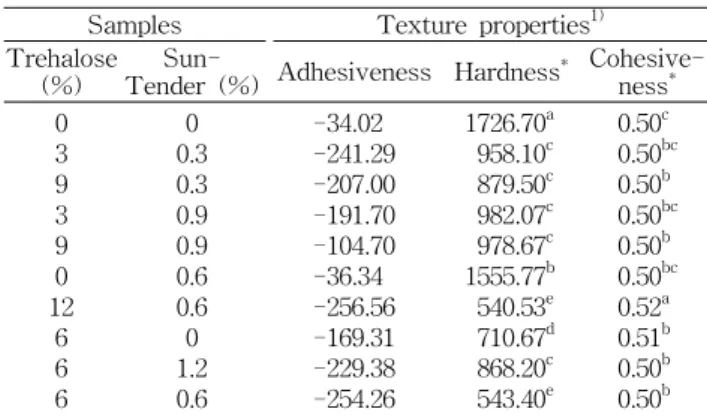
노화억제 효과 분석을 위하여 트레할로스와 썬텐더를 혼합 사용하여 제조한 가래떡을 5oC 냉장 보관하면서 제조시간 2, 24, 48시간 경과 후 가래떡의 부착성(adhesiveness), 경도 (hardness) 및 응집성(cohesiveness) 등 텍스처 변화를 측정하 여 비교하였고 노화억제 효과의 기준은 실험군 떡의 경도를 무첨가군(control) 떡과 비교하여 낮은 정도로 판단하였다. 무 첨가군 가래떡과 비교하여 Texture Analyzer에 의해 측정한 실험적 결과값은 Table 4~6과 같다.
트레할로스와 썬텐더를 혼합사용하여 제조한 떡의 5oC 저 장 2, 24 및 48시간 경과 후 TA에 의한 텍스처 변화에서 부착성 은 실험군과 무첨가군을 비교하였을 때 큰 차이가 없이 비슷한 경향이었다. 경도의 경우 가래떡의 5oC 저장 2시간 후 실험군
Table 4. Texture properties of a Korean rice cake (Karedduk) with mixture of trehalose and Sun-Tender after 2 hrs of storage at 5oC
Samples Texture properties1) Trehalose
(%)
Sun-
Tender (%) Adhesiveness Hardness* Cohesive- ness* 0
3 9 3 9 0 12
6 6 6
0 0.3 0.3 0.9 0.9 0.6 0.6 0 1.2 0.6
-222.00 -169.00 -223.33 -312.33 -190.33 -249.67 -176.33 -225.33 -338.33 -292.67
220.33c 260.33ab 186.00d 260.00ab 257.33ab 263.00ab 228.33bc 271.33a 253.33ab 204.33cd
0.53a 0.50b 0.50b 0.50b 0.50b 0.50b 0.50b 0.51b 0.50b 0.51b
1)Values with different superscripts within the same column are significantly different (p<0.05). *Significant at p<0.05.
Table 5. Texture properties of a Korean rice cake (Karedduk) with mixture of trehalose and Sun-Tender after 24 hrs of storage at 5oC
Samples Texture properties1) Trehalose
(%)
Sun-
Tender (%) Adhesiveness Hardness* Cohesive- ness* 0
3 9 3 9 0 12
6 6 6
0 0.3 0.3 0.9 0.9 0.6 0.6 0 1.2 0.6
-34.02 -241.29 -207.00 -191.70 -104.70 -36.34 -256.56 -169.31 -229.38 -254.26
1726.70a 958.10c 879.50c 982.07c 978.67c 1555.77b 540.53e 710.67d 868.20c 543.40e
0.50c 0.50bc 0.50b 0.50bc 0.50b 0.50bc 0.52a 0.51b 0.50b 0.50b
1)Values with different superscripts within the same column are significantly different (p<0.05). *Significant at p<0.05.
Table 6. Texture properties of a Korean rice cake (Karedduk) with mixture of trehalose and Sun-Tender after 48 hrs of storage at 5oC
Samples Texture properties1) Trehalose
(%) Sun-
Tender (%) Adhesiveness Hardness* Cohesive- ness* 0
3 9 3 9 0 12
6 6 6
0 0.3 0.3 0.9 0.9 0.6 0.6 0 1.2 0.6
6.30 19.68 -67.31 34.43 -30.27 -0.70 -36.40 4.36 13.72 -14.53
4299.82a 3670.75b 2019.08d 3224.85bc 1860.45d 3284.88bc 1263.73d 1662.53d 2694.78c 1912.85d
0.46d 0.47cd 0.48ab 0.47bc 0.48ab 0.47cd 0.49a 0.48ab 0.48ab 0.48ab
1)Values with different superscripts within the same column are significantly different (p<0.05). *Significant at p<0.05.
과 무첨가군을 비교하였을 때 첨가량에 따른 일정한 변화가 없었으나 24시간과 48시간 저장 후에서는 트레할로스의 첨가 수준이 증가할수록 경도가 감소하는 경향이었다(Table 4~6).
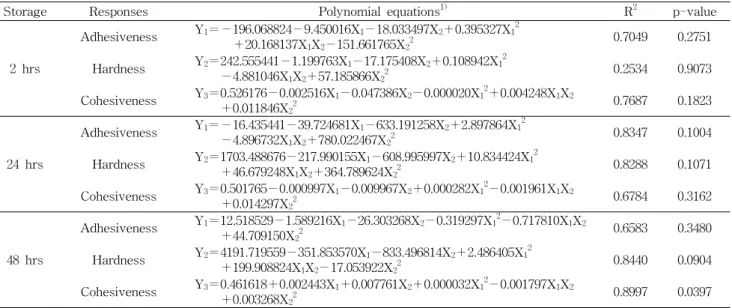
중심합성계획에 의해 실험을 실시하여 얻은 텍스처 변화 결과 값(Table 4~6)을 이용하여 반응표면회귀분석을 실시하 였고 각 반응변수에 대한 회귀식은 Table 7과 같다. 반응표면 분석은 회귀분석 결과에서 정상점(stationary point)이 안장점 (saddle point)이 아니고 최소점(minimum)일 경우의 예측된 값을 혼합 최적 조건이라고 하였다. 또한 무첨가군 가래떡과 비교하여 떡의 경도를 가장 많이 낮출 수 있는 두 가지 물질의 혼합 최적 조건을 반응표면분석법을 이용하여 도출하였으며 텍스처 특성에서 트레할로스와 썬텐더의 혼합 효과는 Fig. 1~
3과 같다.
트레할로스와 썬텐더를 중심합성계획에 따라 혼합사용하 여 제조한 떡의 5oC 저장 2시간 경과 후 텍스처 결과값의 반 응표면회귀분석에서 부착성에 대한 이차회귀식의 R2는 0.7049 이었고 예측된 정상점은 안장점의 형태를 보여주었다. 경도 의 R2는 0.2534이었고 예측된 정상점은 실험영역을 벗어난
Table 7. Polynomial equations calculated by RSM program for texture properties
Storage Responses Polynomial equations1) R2 p-value
2 hrs
Adhesiveness Y1=-196.068824-9.450016X1-18.033497X2+0.395327X12
+20.168137X1X2-151.661765X22 0.7049 0.2751
Hardness Y2=242.555441-1.199763X1-17.175408X2+0.108942X12
-4.881046X1X2+57.185866X22 0.2534 0.9073
Cohesiveness Y3=0.526176-0.002516X1-0.047386X2-0.000020X12
+0.004248X1X2
+0.011846X22 0.7687 0.1823
24 hrs
Adhesiveness Y1=-16.435441-39.724681X1-633.191258X2+2.897864X12
-4.896732X1X2+780.022467X22 0.8347 0.1004
Hardness Y2=1703.488676-217.990155X1-608.995997X2+10.834424X12
+46.679248X1X2+364.789624X22 0.8288 0.1071
Cohesiveness Y3=0.501765-0.000997X1-0.009967X2+0.000282X12
-0.001961X1X2
+0.014297X22 0.6784 0.3162
48 hrs
Adhesiveness Y1=12.518529-1.589216X1-26.303268X2-0.319297X12
-0.717810X1X2
+44.709150X22 0.6583 0.3480
Hardness Y2=4191.719559-351.853570X1-833.496814X2+2.486405X12
+199.908824X1X2-17.053922X22 0.8440 0.0904
Cohesiveness Y3=0.461618+0.002443X1+0.007761X2+0.000032X12
-0.001797X1X2
+0.003268X22 0.8997 0.0397
1)X1: Trehalose (%), X2: Sun-Tender (%).
Adhesiveness
Trehalose
0 2 4 6 8 10 12
ST
0.0 0.2 0.4 0.6 0.8 1.0 1.2
-240 -240
-240 -240
-240
-220 -220
-220 -220
-200 -200
-200
-180 -180
-160 -160
-260 -260
-260 -260
-280 -280
-280 -280
-300 -300
-320 -320 -300
-220
Hardness
Trehalose
0 2 4 6 8 10 12
ST
0.0 0.2 0.4 0.6 0.8 1.0 1.2
240
240 230
220 250
250
250
220 220 230
230 260
260 260
230 240
240 270
240 240 250
Cohesiveness
Trehalose
0 2 4 6 8 10 12
ST
0.0 0.2 0.4 0.6 0.8 1.0 1.2
0.500 0.500 0.500
0.500
0.500 0.500 0.500
0.505
0.505
0.505 0.505
0.510
0.510
0.510 0.510
0.515 0.515
0.515 0.505
0.505
0.520
Fig. 1. Response surface plots illus- trating optimal conditions for tex- ture properties of a Korean rice cake (Karedduk) with mixture of treha- lose and Sun-Tender after 2 hrs of storage at 5oC.
X1=Trehalose, X2=ST (Sun-Tender).
Adhesiveness
Trehalose
0 2 4 6 8 10 12
ST
0.0 0.2 0.4 0.6 0.8 1.0
1.2 200
100
100 100
100
0
0 0
0 -100 -100 -100
-200 -200 -200
-200 -200 -200 -200 200
200
-100 -100
Hardness
Trehalose
0 2 4 6 8 10 12
ST
0.0 0.2 0.4 0.6 0.8 1.0 1.2
800 800
800
800 800 800
800 1000
1000
1000 1000 1200
1200 1200
1200 1400
1400 1400 1400 1600
1600
Cohesiveness
Trehalose
0 2 4 6 8 10 12
ST
0.0 0.2 0.4 0.6 0.8 1.0 1.2
0.515
0.515 0.515 0.510
0.510
0.510
0.510 0.505
0.505
0.505
0.505 0.500
0.500 0.500
0.500 0.500
Fig. 2. Response surface plots illus- trating optimal conditions for tex- ture properties of a Korean rice cake (Karedduk) with mixture of treha- lose and Sun-Tender after 24 hrs of storage at 5oC.
X1=Trehalose, X2=ST (Sun-Tender).
최소점이었으며, 응집성의 R2는 0.7687이었고 안장점의 형태 를 보여주었다. 반응표면은 Fig. 1에서와 같이 실험군과 무첨 가군을 비교하였을 때 첨가량에 따른 영향은 적은 것으로 나 타났다.
트레할로스와 썬텐더를 혼합사용하여 제조한 떡의 5oC 저 장 24시간 경과 후 텍스처의 반응표면분석 결과 부착성, 경도 및 응집성에 대한 R2는 0.8347, 0.8288 및 0.6784이었고 모두 예측된 정상점의 형태는 모두 최소값을 보여주었다. 그 중에서 노화억제 효과의 기준인 경도의 능선분석을 실시하여 본 결과 트레할로스가 9.5826%, 썬텐더 0.2216%일 때 떡의 경도가 591.5440으로 가장 낮게 예측되었으며, 적합한 반응표면식의
정도를 설명하는 결정계수 R2는 0.8288로 높은 값이므로 추정 된 반응표면모형이 적합하다는 것을 나타내었다. 또한 이때의 경도에 대한 식은 다음과 같이 나타낼 수 있다(Table 7).
Y2=1703.488676-217.990155X1-608.995997X2+10.834424X12
+46.679248X1X2+364.789624X22 (R2=0.8288) Y2: 24시간 저장 후 경도, X1: 트레할로스, X2: 썬텐더
저장 24시간 후 텍스처에 대한 반응표면은 Fig. 2와 같이 썬텐더의 첨가량에는 크게 영향을 받지 않았으나 트레할로스 는 첨가량이 높아질수록 경도의 감소와 함께 부착성이 증가하 는 경향이었다. 본 실험결과 썬텐더보다 트레할로스가 떡의
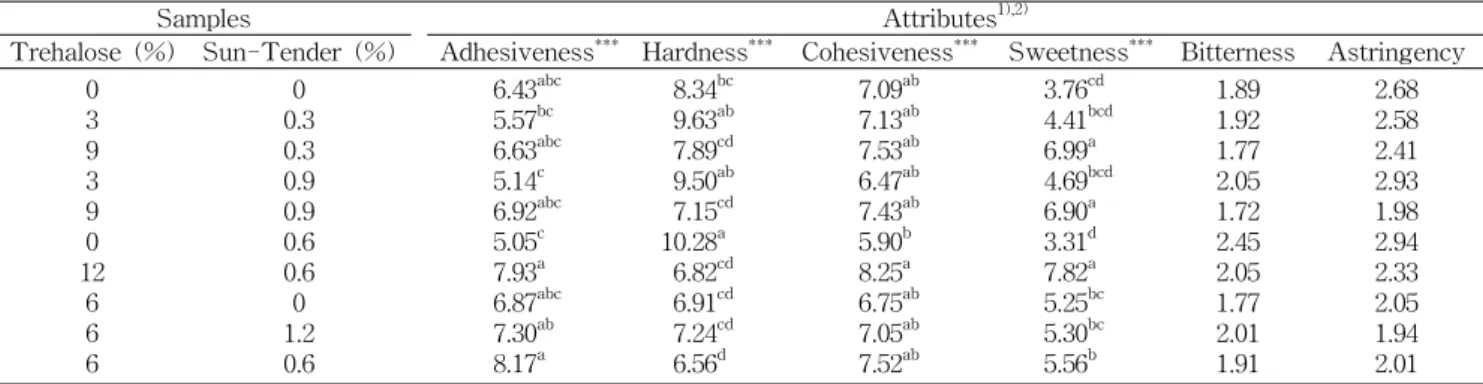
Table 8. Sensory descriptive analysis of a Korean rice cake (Karedduk) with mixture of trehalose and Sun-Tender after 24 hrs of storage at 5oC
Samples Attributes1),2)
Trehalose (%) Sun-Tender (%) Adhesiveness*** Hardness*** Cohesiveness*** Sweetness*** Bitterness Astringency 0
3 9 3 9 0 12
6 6 6
0 0.3 0.3 0.9 0.9 0.6 0.6 0 1.2 0.6
6.43abc 5.57bc 6.63abc 5.14c 6.92abc 5.05c 7.93a 6.87abc 7.30ab 8.17a
8.34bc 9.63ab 7.89cd 9.50ab 7.15cd 10.28a 6.82cd 6.91cd 7.24cd 6.56d
7.09ab 7.13ab 7.53ab 6.47ab 7.43ab 5.90b 8.25a 6.75ab 7.05ab 7.52ab
3.76cd 4.41bcd 6.99a 4.69bcd 6.90a 3.31d 7.82a 5.25bc 5.30bc 5.56b
1.89 1.92 1.77 2.05 1.72 2.45 2.05 1.77 2.01 1.91
2.68 2.58 2.41 2.93 1.98 2.94 2.33 2.05 1.94 2.01
1)Mean of three replications with 13 panels measurements; 0=none, 15=extremely.
2)Values with different superscripts within the same column are significantly different (p<0.05). ***Significant at p<0.001.
Table 9. Polynomial equations calculated by RSM program for sensory attributes
Responses Polynomial equations1) R2 p-value
Adhesiveness Y1=6.267206+0.174796X1-2.424265X2-0.014457X12
+0.380882X1X2
+0.207108X22 0.6382 0.3804
Hardness Y2=8.522941-0.352680X1+4.389869X2+0.023386X12
-0.372712X1X2
-1.758578X22 0.7633 0.1898
Cohesiveness Y3=6.956618+0.042443X1-0.720016X2-0.005315X12
+0.303758X1X2
-1.017565X22 0.8647 0.0696
Sweetness Y4=3.586029+0.297868X1+0.189788X2+0.001814X12
+0.090523X1X2
-0.624183X22 0.9811 0.0015
Bitterness Y5=1.934412-0.094853X1+0.762582X2+0.010114X12
-0.099346X1X2
+0.011438X22 0.8791 0.0564
Astringency Y6=2.608676-0.157100X1+1.129003X2+0.014216X12
-0.137418X1X2
-0.356209X22 0.8105 0.1284
1)X1: Trehalose (%), X2: Sun-Tender (%).
Adhesiveness
Trehalose
0 2 4 6 8 10 12
ST
0.0 0.2 0.4 0.6 0.8 1.0 1.2
-40
-40
-60 -20
-40 -20
-20 0
-20 -20 0
0 20
0 0 20
20 40
Hardness
Trehalose
0 2 4 6 8 10 12
ST
0.0 0.2 0.4 0.6 0.8 1.0 1.2
1500
1500 1500 2000
2000
2000 2000
2000 2500
2500 2500
2500 3000
3000
3000 3000 3500
3500 3500
3500 4000
Cohesiveness
Trehalose
0 2 4 6 8 10 12
ST
0.0 0.2 0.4 0.6 0.8 1.0 1.2
0.485 0.485 0.485 0.485
0.480 0.480 0.480 0.480
0.475 0.475 0.475 0.475
0.470 0.470 0.470 0.470
0.465
Fig. 3. Response surface plots illus- trating optimal conditions for tex- ture properties of a Korean rice cake (Karedduk) with mixture of treha- lose and Sun-Tender after 48 hrs of storage at 5oC.
X1=Trehalose, X2=ST (Sun-Tender).
노화 방지에 효과적이었다.
트레할로스와 썬텐더를 혼합사용하여 제조한 떡의 5oC 저 장 48시간 경과 후 텍스처의 반응표면분석 결과 부착성, 경도 및 응집성에 대한 이차회귀식의 R2는 0.6583, 0.8440 및 0.8997 이었고 예측된 정상점은 모두 안장점의 형태를 보여 주었다.
반응표면은 Fig. 3에서와 같이 실험군과 무첨가군을 비교하였 을 때 트레할로스의 함량이 많을수록 경도와 응집성이 낮아졌 다. 결과적으로 무첨가군 가래떡과 비교하여 떡의 경도를 가장 많이 낮출 수 있는 두 물질의 혼합 최적 조건은 트레할로스는 9.5826%, 썬텐더 0.2216%로 산출되었고 썬텐더보다 트레할로 스가 떡의 노화 억제에 효과적이었다.
트레할로스와 변성전분을 혼합사용 떡의 관능적 묘사특성 트레할로스와 썬텐더 혼합사용에 의한 가래떡의 5oC에서 24시간 저장 후 관능적 묘사 특성인 부착성(adhesiveness), 경 도(hardness), 응집성(cohesiveness), 단맛(sweetness), 쓴맛 (bitterness) 및 떫은/아린맛(astringency) 등 분석 결과는 Table 8과 같으며, 이들 관능적 묘사 특성 분석 결과에 대한 결과값을 이용하여 반응표면회귀분석을 실시하였고 각 반응 변수에 대한 회귀식은 Table 9와 같다. 그리고 트레할로스와 썬텐더의 효과를 반응표면분석법으로 나타낸 contour plot은 Fig. 4와 같다.
본 실험에서 트레할로스와 썬텐더를 혼합사용하여 제조한
Adhesiveness
Trehalose
0 2 4 6 8 10 12
ST
0.0 0.2 0.4 0.6 0.8 1.0 1.2
8.0
7.5 8.0 7.5
7.5 7.5
7.0 7.0
7.0 7.0
6.5 6.5
6.5 6.5
6.0 6.0
6.0 6.0 5.5
5.5
5.5
Hardness
Trehalose
0 2 4 6 8 10 12
ST
0.0 0.2 0.4 0.6 0.8 1.0
1.2 6
7 6 7
7 7 7
8 8
8 8 8
9 9
9 9
10
10
Cohesiveness
Trehalose
0 2 4 6 8 10 12
ST
0.0 0.2 0.4 0.6 0.8 1.0 1.2
8.0 8.0
8.0 8.0
7.5 7.5
7.5 7.5
7.0 7.0
7.0 7.0
6.5 6.5
6.5
Sweetness
Trehalose
0 2 4 6 8 10 12
ST
0.0 0.2 0.4 0.6 0.8 1.0 1.2
7
7 7 7
6 6 6 6 5
5 5 5 4
4 4 4
Bitterness
Trehalose
0 2 4 6 8 10 12
ST
0.0 0.2 0.4 0.6 0.8 1.0 1.2
2.0
1.9 1.9
1.9 1.9
1.9
1.8 1.8
1.8
1.7 1.7
1.7 1.9
2.0 2.0
2.0 2.0
2.1 2.1
2.1 2.1
2.2 2.2 2.2
2.3 2.3
Astringency
Trehalose
0 2 4 6 8 10 12
ST
0.0 0.2 0.4 0.6 0.8 1.0 1.2
2.0 2.0
2.2 2.2 2.2
2.2
2.2 2.2
2.0 2.0
2.4 2.4 2.4 2.4
2.6 2.6 2.6 2.6
2.8
2.8
2.8 3.0
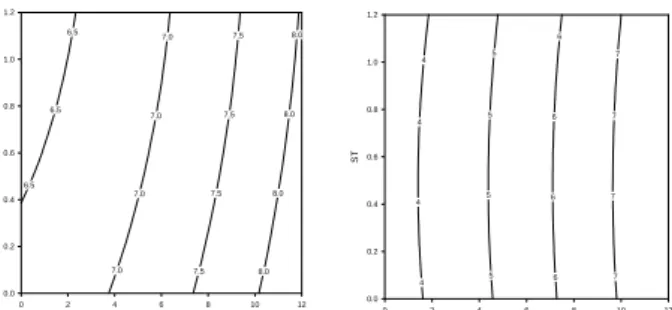
Fig. 4. Response surface plots illustrating optimal conditions for sensory descriptive attributes of a Korean rice cake (Karedduk) with mixture of trehalose and Sun-Tender after 24 hrs of storage at 5oC. X1=Trehalose, X2=ST (Sun-Tender).
떡의 제조 24시간 후 관능적 묘사 특징 중에서 부착성, 경도, 응집성 및 단맛의 경우, 실험군과 무첨가군을 비교하였을 때 유의적인 차이가 있었다. 트레할로스의 첨가량이 높을수록 부 착성, 응집성 및 단맛은 증가하였고, 경도는 감소하였으며 쓴 맛과 떫은맛에는 영향을 주지 않는 것으로 나타났다(Table 8).
트레할로스와 썬텐더를 혼합사용하여 제조한 떡의 5oC 저장 24시간 경과 후 관능적 결과의 반응표면분석 결과에서 회귀식 의 R2는 단맛에서 0.9811로 회귀 변동에 대한 신뢰가 가장 높았 으며(Table 9) 관능적 특성에서 예측된 정상점은 모두 안장점 의 형태를 보여주었다. 반응표면 contour plot은 Fig. 4와 같이 트레할로스의 첨가량이 높을수록 부착성, 응집성 및 단맛은 증가하였고 경도는 감소하였다. 본 실험에 사용된 트레할로스 와 썬텐더 첨가량의 사용 범위 내에서 가래떡의 쓴맛과 떫은맛 의 차이는 없었지만 썬텐더의 첨가량이 증가할수록 쓴맛이 증 가하는 경향을, 트레할로스의 첨가량이 증가할수록 떫은맛이 감소하는 경향을 보여주었다.
요 약
트레할로스와 변성전분인 썬텐더의 혼합사용에 의한 떡의 품질 특성을 반응표면분석에 의해 분석하였다. 중심합성계획 법에 따라 쌀가루 기준으로 트레할로스는 0, 3, 6, 9 또는 12%
농도로 첨가하고 변성전분인 썬텐더는 0, 0.3, 0.6, 0.9 또는 1.2% 농도로 혼합사용하여 제조한 가래떡을 5oC 저장 2, 24, 48시간 후 텍스처 변화를 Texture Analyzer에 의해 측정하였 고, 5oC 저장 24시간 후 관능적 묘사특성 효과를 분석하였다.
경도의 경우 가래떡의 5oC 저장 2시간 후 실험군과 무첨가군을 비교하였을 때 첨가량에 따른 일정한 변화가 없었으나 저장 24시간과 48시간 후에서는 트레할로스의 첨가 수준이 증가할
수록 경도가 감소하는 경향이었다. 반응표면분석 결과 저장 24시간 후 무첨가군 가래떡과 비교하여 떡의 경도를 가장 많이 낮출 수 있는 두 물질의 혼합 최적 조건은 트레할로스는 9.5826%, 썬텐더 0.2216%일 때 떡의 경도가 591.5440으로 가장 낮게 산출되었고 썬텐더보다는 트레할로스가 떡의 굳음 방지 에 효과적이었다. 가래떡을 5oC 저장 24시간 후 관능적 묘사 특징 중에서 부착성, 경도, 응집성 및 단맛의 경우 실험군과 무첨가군을 비교하였을 때 유의적인 차이가 있었으며, 트레할 로스의 첨가량이 높을수록 부착성, 응집성 및 단맛은 증가하였 고 경도는 감소하였으며 사용된 트레할로스와 썬텐더의 양은 쓴맛과 떫은맛에는 크게 영향을 주지 않는 것으로 나타났다.
감사의 글
본 연구는 농림부에서 시행한 농림기술개발 사업의 연구비 지원으로 수행된 연구결과의 일부로 이에 감사드립니다.
문 헌
1. van Sorest JJG, de Wit D, Tournois H, Vliegenthart JFG.
1994. Retrogradatrion of potato starch as studied by Fourier transform infrared spectroscopy. Starch 46: 453-457.
2. Atwell WA, Hood LF, Lineback DR, Varriano-Marston E, Zobel HF. 1988. The terminology and methodology asso- ciated with basic starch phenomena. Cereal Foods World 33: 306-311.
3. Hoseney RC. 1986. Principles of Cereal Science and Technology. The American Association of Cereal Chemists, Minnesota, USA. p 54.
4. Kim DH. 1992. Food Chemistry. Tamgudang, Seoul, Korea.
p 300-307.
5. Doublier JL, Choplin L. 1989. A rheological description of
amylose gelation. Carbohydr Res 193: 215-216.
6. Biliaderis CG, Zawistowiski J. 1990. Viscoelastic behavior of aging starch gels: Effects of concentration, temperature and starch hydrolysates on network properties. Cereal Chem 67: 240-246.
7. Silverio J, Sevensson E, Eliasson AC, Olofesson G. 1996.
Isothermal microcalorimetric studies on starch retrogradation.
J Thermal Anal 47: 1179-1200.
8. Miles MJ, Morris VJ, Orford PD, Ring SG. 1985. The roles of amylose and amylopectin in the gelation and retro- gradation of starch. Carbohydr Res 135: 271-281.
9. Lai VMF, Lu S, Lii CY. 2000. Molecular characteristics in- fluencing retrogradation kinetics of rice amylopectins.
Cereal Chem 77: 272-278.
10. Kohyama K, Nishinari K. 1991. Effects of soluble sugars on gelatinization and retrogradation of sweet potato starch.
J Agric Food Chem 39: 1406-1410.
11. I'Anson KJ, Miles MJ, Morris VJ, Bestford LS, Jarvis DA, Marsh RA. 1990. The effects of added sugars on the retro- gradation of wheat starch gels. J Cereal Sci 11: 243-248.
12. Choi CR, Shin MS. 1996. Effects of sugars on the retro- gradation of rice flour gels. Korean J Food Sci Technol 28: 904-909.
13. Kim SS, Chung HY. 2007. Texture properties of a Korean rice cake (Karedduk) with addition of carbohydrate materi- als. J Korean Soc Food Sci Nutr 36: 1205-1210.
14. Kim SS, Chung HY. 2007. Effects of carbohydrate materials on retarding retrogradation of a Korean rice cake (Kare- dduk). J Korean Soc Food Sci Nutr 36: 1320-1325.
15. Son HS, Park SO, Hwang HJ, Lim ST. 1997. Effect of oligo- saccharide syrup addition on the retrogradation of a Korean rice cake (Karedduk). Korean J Food Sci Technol 29:
1213-1221.
16. Kim SK, D'Appolonia BL. 1977. Effect of pentosans on the retrogradation of wheat starch gels. Cereal Chem 54: 150- 160.
17. Lee YH, Moon TW. 1994. Composition, water-holding ca- pacity and effect on starch retrogradation of rice bran diet- ary fiber. Korean J Food Sci Technol 26: 288-294.
18. Kohyama K, Nishinari K. 1992. Cellulose derivatives effects
on gelatinization and retrogradation of sweet potato starch.
J Food Sci 57: 128-131.
19. Hibi Y, Kitamura S, Kuge T. 1990. Effect of lipids on the retrogradation of cooked rice. Cereal Chem 67: 7-11.
20. Mun SH, Kim JO, Lee SK, Shin MS. 1996. Retrogradation of sucrose fatty acid ester and soybean oil added rice flour gels. Korean J Food Sci Technol 28: 305-310.
21. Russell PL, Oliver G. 1989. The effect of pH and NaCl con- tent on starch gel aging. J Cereal Sci 10: 123-138.
22. Lee SY, Lee SG, Kim KJ, Kwon IB. 1993. Effects of alum on the physiochemical properties. Korean J Food Sci Technol 25: 355-359.
23. Miura M, Nishimura N, Katsuta K. 1992. Influence of addi- tion of polyols and food emulsifiers on the retrogradation rate of starch. Food Structure 11: 225-236.
24. Lin PY, Czuchajowska Z. 1998. Role of phosphorous in vis- cosity, gelatinization, and retrogradation of starch. Cereal Chem 75: 705-709.
25. Katsuta K, Tsutsui K, Maruyama E, Makoto M. 2002.
Anti-firming efficacy of food emulsifiers on rice starch gel.
J Appl Glycosci 49: 145-152.
26. Kim SS, Chung HY. 2007. The texture and descriptive sen- sory characteristics of a Korean rice cake (Karedduk) with added emulsifier. Korean J Food Nutr 20: 427-432.
27. Kim SS, Kim JT, Rho JH. 2005. Development of anti-stal- ing agents for rice processed products to enhance rice con- sumption. Korea Food Research Institute. GA0547-05036.
28. Bourne MC. 1978. Texture profile analysis. Food Technol 32: 62-72.
29. Stone H, Sidel JL. 1985. Descriptive analysis. In Sensory Evaluation Practices. Academic press, Orlando, FL, USA.
p 194.
30. 김광옥, 김상숙, 성내경, 이영춘. 1993. 관능검사 방법 및 응용.
신광출판사, 서울, 한국. p 161-169.
31. 성내경. 1991. SAS/STAT-회귀분석. 자유아카데미, 서울, 한 국. p 201-238.
32. Gacula MC. 1993. Product optimization. In Design and Analysis of Sensory Optimization. Food & Nutrition press, Trumbull, CT, USA. p 105-236.
(2008년 12월 2일 접수; 2009년 2월 16일 채택)