Lab Anim Res 2015: 31(3), 148-152 http://dx.doi.org/10.5625/lar.2015.31.3.148
ISSN 2233-7660 (Online)
Extraction conditions of white rose petals for the inhibition of enzymes related to skin aging
Ehn-Kyoung Choi
1,#, Haiyu Guo
1,#, Jae-Kwon Choi
2, Su-Kil Jang
3, Kyungha Shin
1, Ye-Seul Cha
1, Youngjin Choi
1, Da-Woom Seo
1, Yoon-Bok Lee
2, Seong-Soo Joo
3,*, Yun-Bae Kim
1,*
1
College of Veterinary Medicine, Chungbuk National University, Cheongju, Korea
2
Central Research Institute, Dr. Chung’s Food Co. Ltd., Cheongju, Korea
3
Department of Marine Molecular Biotechnology, Gangneung-Wonju National University, Gangneung, Korea
In order to assess inhibitory potentials of white rose petal extracts (WRPE) on the activities of enzymes related to dermal aging according to the extraction conditions, three extraction methods were adopted.
WRPE was prepared by extracting dried white rose (Rosa hybrida) petals with 50% ethanol (WRPE-EtOH), Pectinex
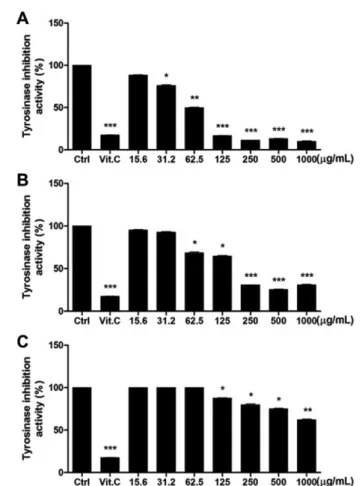
®SMASH XXL enzyme (WRPE-enzyme) or high temperature-high pressure (WRPE-HTHP). In the inhibition of matrix metalloproteinase-1, although the enzyme activity was fully inhibited by all 3 extracts at 100 µg/mL in 60 min, partial inhibition (50-70%) was achieved only by WRPE-EtOH and WRPE-enzyme at 50 µg/mL. High concentrations (≥250 µg/mL) of all 3 extracts markedly inhibited the elastase activity.
However, at low concentrations (15.6-125 µg/mL), only WRPE-EtOH inhibited the enzyme activity. Notably, WRPE-EtOH was superior to WRPE-enzyme and WRPE-HTHP in the inhibition of tyrosinase. WRPE-EtOH significantly inhibited the enzyme activity from 31.2 µM, reaching 80% inhibition at 125 µM. In addition to its strong antioxidative activity, the ethanol extract of white rose petals was confirmed to be effective in inhibiting skin aging-related enzymes. Therefore, it is suggested that WRPE-EtOH could be a good candidate for the improvement of skin aging such as wrinkle formation and pigmentation.
Keywords: Rosa hybrida, white rose petal extract, matrix metalloproteinase-1, elastase, tyrosinase
Received 23 August 2015; Revised version received 7 September 2015; Accepted 8 September 2015
With the improvement of economic level and the desire for beauty, the interest in health and skin care is increasing. For these demands, a variety of cosmetics and foods with novel bioactive ingredients for skin beauty are under research and development, attracting consumers’ attention [1].
Skin is influenced by various factors such as UV, stresses, hormones, and so on. During normal aging and photo-aging, the major features of the skin are wrinkle formation, decreased elasticity, and pigmentation. As a
mechanism, increase in collagenase activity that causes skin wrinkles is one of the major factors that bring about the degeneration of collagen fiber and breakdown [1,2].
Reactive oxygen species (ROS) generated in the body also promote the activation of collagenase such as matrix metalloproteinases (MMPs) and restrain synthesis of collagen, which results in the decrease of skin elasticity and the acceleration of wrinkle formation [2,3]. Notably, skin elastase plays a pivotal role in wrinkling and/or sagging of the skin via the impairment of elastic fiber
Letter
#