Original Article
Gene Expression Changes in a Rat Model of Oxygen-Induced Retinopathy
Na Eun Lee1, Yeon Jeong Park1, In Young Chung1,2, Seong Wook Seo1,2, Jong Moon Park1,2, Ji Myung Yoo1,2, Jun Kyoung Song1,2
1Department of Ophthalmology, Gyeongsang National University School of Medicine, Jinju, Korea
2Institute of Health Science, Gyeongsang National University, Jinju, Korea
Purpose: To identify altered patterns of retinal mRNA expression in a rat model of oxygen-induced retinopathy (OIR).
Methods: Sprague-Dawley rats from P2 to P14 were exposed to hyperoxia (80% oxygen) to induce OIR and then re- turned to normoxic conditions. Control rats were sustained in room air. Retinal gene expression between the rats of OIR and the controls was compared using cDNA microarray analysis. Reverse transcriptase polymerase chain reaction (RT-PCR) was used to verify the microarray results.
Results: Among a total of 12,731 cDNAs analyzed by mircroarray, 13 genes were strongly up- or down-regulated (>2-fold change over controls) in the OIR rats. We found a significant increase in expression of 10 genes (CaM-kinase Ⅱ inhibitor; acidic nuclear phosphoprotein 32 family, member A; vascular endothelial growth factor;
interferon α-inducible protein 27-like; similar to enthoprotin, epsin 4, clathrin interacting protein; nidogen [entactin];
tubulin, β5; fibrillin-1; spectrin β2; and stearoyl-coenzyme A desaturase 2) and a significant decrease in ex- pression of 3 genes (myelin-associated oligodendrocytic basic protein, heat shock protein, and decorin) in OIR rats compared to controls.
Conclusions: We confirmed changes in expressions of various retinal genes in a rat model of OIR by microarray and RT-PCR. This study should contribute to the understanding of genetic indicators associeated with OIR.
Key Words:Oxygen-induced retinopathy, Retinal gene expression
ⓒ2011 The Korean Ophthalmological Society
This is an Open Access article distributed under the terms of the Creative Commons Attribution Non-Commercial License (http://creativecommons.org/licenses /by-nc/3.0/) which permits unrestricted non-commercial use, distribution, and reproduction in any medium, provided the original work is properly cited.
Received: January 16, 2010 Accepted: September 15, 2010
Corresponding Author: In Young Chung, MD, PhD. Department of Ophthalmology, Gyeongsang National University School of Medicine,
#92 Chiram-dong, Jinju 660-751, Korea. Tel: 82-55-750-8170, Fax:
82-55-758-4158, E-mail: [email protected]
Retinopathy of prematurity (ROP) is a retinal disease asso- ciated with the development of neovascularization and oc- curs primarily in premature infants of low gestational age and low birth weight [1]. The disease is thought to result largely from an aberrant retinal response to hyperoxia during supple- mental oxygen therapy, compounded by functional retinal hypoxia as oxygen therapy is withdrawn [2]. While guide- lines for management and treatment have recently been re- fined, it remains difficult to identify those infants susceptible to the progressive stages of ROP that is a leading cause of childhood blindness [3-5].
Animal models of oxygen-induced retinopathy (OIR) have
been used for more than 40 years to yield insights into ROP.
These models have been instrumental in advancing our un- derstanding of the human disease, as well as the mechanisms of normal retinal microvascular development [3]. The nor- mal process of retinal development is driven by the local tis- sue hypoxia that accompanies retinal growth and maturation [6,7]. As retinal oxygen demand exceeds supply via diffusion from the choroidal circulation, a range of hypoxia-inducible angiogenic factors are released which further drive retinal vasculature formation. Exposure of neonatal rats to hyper- oxia increases the diffusion of oxygen from the choroidal cir- culation, thereby abrogating retinal physiological hypoxia and allowing retinal development to continue in the presence of an attenuated circulation [8]. When hyperoxic exposure is terminated and animals are returned to the normoxia of room air, the mature but poorly vascularized retina becomes acute- ly hypoxic and the resultant surge in angiogenic factor re- lease leads to aberrant retinal vascularization that resembles ROP [9].Recent studies in an OIR model have demonstrated
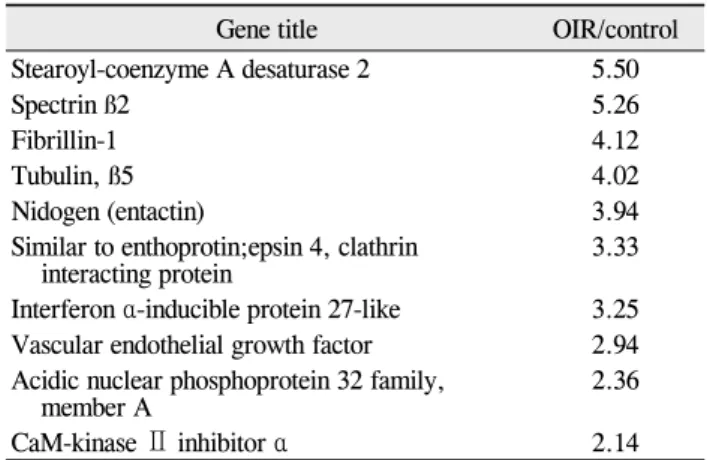
Table 1. Up-regulated genes (>2-fold change) in oxygen- induced retinopathy (OIR) retinae over controls
Gene title OIR/control
Stearoyl-coenzyme A desaturase 2 5.50
Spectrin ß2 5.26
Fibrillin-1 4.12
Tubulin, ß5 4.02
Nidogen (entactin) 3.94
Similar to enthoprotin;epsin 4, clathrin
interacting protein 3.33
Interferon α-inducible protein 27-like 3.25 Vascular endothelial growth factor 2.94 Acidic nuclear phosphoprotein 32 family,
member A 2.36
CaM-kinase Ⅱ inhibitor α 2.14
Table 2. Down-regulated genes (>2-fold change) in oxygen-induced retinopathy (OIR) retinae over controls
Gene title OIR/control
Myelin-associated oligodendrocytic basic protein 0.35
Heat shock protein 0.47
Decorin 0.50
Table 3. Adhesion genes (up- and down-regulated by 1.5- fold in oxygen-induced retinopathy retinae over controls)
Gene name Intensity
CaM-kinase II inhibitor α 2.36
Nucleobindin 1.69
Glycosylation dependent cell adhesion molecule 0.64
Regenerating islet-derived 1 0.66
Table 4. Growth and differentiation genes (up- and down- regulated genes by 1.5-fold in oxygen-induced retinopathy retinae over controls)
Gene name Intensity
Activating transcription factor-4 2.48
Rgc32 protein 1.86
Similar to down syndrome critical region 1.86 Insulin-like growth factor binding protein 1.79
Growth associated protein 43 0.53
Transducer of ERBB2, 1 0.57
Fibulin 5 0.62
the significant changes in the mRNA expression of vascular endothelial growth factor (VEGF), neuropilin 1, neuropilin 2, and mouse telomerase reverse transcription [10-12]. The purpose of this study was to identify altered patterns of reti- nal mRNA expression in a rat model of OIR and identify po- tential therapeutic treatment for the neovascularization that occurs in retinopathy.
Materials and Methods
Animals
Pregnant female Sprague-Dawley (SD) rats were pur- chased from Samtako (Osan, Korea). Rats were individually housed under an alternating 12-hour light/dark cycle and al- lowed standard rat chow and water ad libitum, in accordance with the Institutional Animal Care and Use Committee of Gyeongsang National University [10].
Oxygen-induced retinopathy rat model
To induce OIR, newborn SD rat pups were exposed to hy- peroxia (80 ± 1.3% O2) with 2 hr/day in room air from P2 to P14 and then returned to normal conditions (room air, 21 ± 1.5% O2) from P14 to P20 as previously described. Control rats were maintained in room air. In our previous study, retinal damage in response to OIR peaked at P18 [13]. In the present study, all control rats were sacrificed at P18 and all OIR rats were sacrificed at P16, P18, and P20 to investigate the changes in the rat retinae of OIR rats compared to control rats.
Total RNA extraction, microarray experiments, and reverse transcriptase polymerase chain reaction
Total retinal RNA was isolated from OIR and control rats at P16, P18, and P20, as previously described [14]. Microarray analysis was performed on OIR rats sacrificed at P18 only, but to confirm the maximal response of these P18 rats, re- verse transcriptase polymerase chain reaction (RT-PCR) was performed at P16, P18 and P20. To detect changes in retinal gene expression levels in OIR rats, cDNA microarray experiments were performed using a Platinum Biochip Rat 4.0K cDNA chip (GenoCheck Ltd., Ansan, Korea). cDNA was synthesized with reverse transcriptase (200 U; MMLV, Promega, Madison, WI, USA) and random hexamers [15].
Decorin-specific primers [5´-AAT CCC TTA CGA CCC TGA-3´ (forward) and 5´-CGC CCA GTT CTA TGA CAA-3´
(reverse)] were used to amplify DNA in a Gibco-BRL Life Technology thermocycler (Gaithersburg, MD, USA) for 2 minutes at 94℃, 1 minute at 60℃, and 2 minutes at 72℃ [14].
Glyceraldehyde-3-phosphate dehydrogenase mRNA levels were used as an internal loading control. Amplified cDNAs were collected after 30 cycles and resolved in 1.5% agarose gels [15].Changes in retinal mRNA levels were measured in four independent tests.
Results
Gene-expression patterns in oxygen-induced retinopathy Preliminary data obtained by comprehensive microarray analysis of P18 rat retinae demonsrated reproducible gene- expression variations between OIR and control groups. Among a total of 12,731 cDNAs, 13 genes were signaficantly up- or down-regulated in OIR rats (> 2-fold change over controls).
The total expressed signal intensities of 10 genes that in-
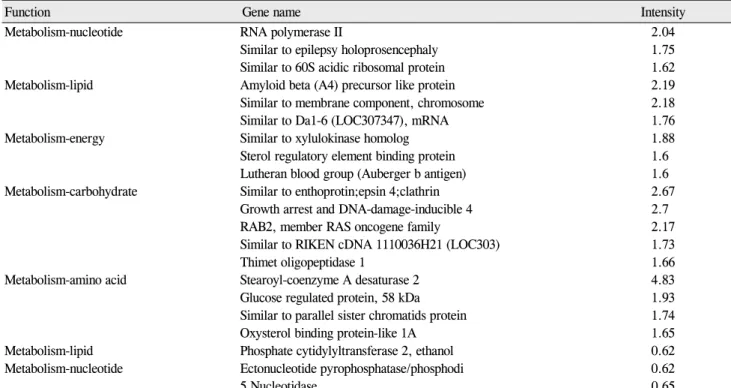
Table 5. Metabolism genes (up- and down-regulated by 1.5-fold in oxygen-induced retinopathy retinae controls)
Function Gene name Intensity
Metabolism-nucleotide RNA polymerase II 2.04
Similar to epilepsy holoprosencephaly 1.75
Similar to 60S acidic ribosomal protein 1.62
Metabolism-lipid Amyloid beta (A4) precursor like protein 2.19
Similar to membrane component, chromosome 2.18
Similar to Da1-6 (LOC307347), mRNA 1.76
Metabolism-energy Similar to xylulokinase homolog 1.88
Sterol regulatory element binding protein 1.6
Lutheran blood group (Auberger b antigen) 1.6
Metabolism-carbohydrate Similar to enthoprotin;epsin 4;clathrin 2.67
Growth arrest and DNA-damage-inducible 4 2.7
RAB2, member RAS oncogene family 2.17
Similar to RIKEN cDNA 1110036H21 (LOC303) 1.73
Thimet oligopeptidase 1 1.66
Metabolism-amino acid Stearoyl-coenzyme A desaturase 2 4.83
Glucose regulated protein, 58 kDa 1.93
Similar to parallel sister chromatids protein 1.74
Oxysterol binding protein-like 1A 1.65
Metabolism-lipid Phosphate cytidylyltransferase 2, ethanol 0.62
Metabolism-nucleotide Ectonucleotide pyrophosphatase/phosphodi 0.62
5 Nucleotidase 0.65
Signal transduction 25.6%
Others 20.8%
Metabolism 18.6%
Extracellular matrix 14.0%
Growth, differentiation
14.0%
Transcription 7.0%
Achesion 4.7%
Fig. 1. Diagram of the proportions of genes up- and down-regulated by 1.5-fold in oxygen-induced retinopathy rats versus controls ac- cording to function.
Table 6. Protein processing genes (up- and down-regulated by 1.5-fold in oxygen-induced retinopathy retinae over controls)
Gene name Intensity
Kinase D-interacting substance of 220 kD 2.41 Similar to protein (peptidyl-prolyl cis) 1.61 Proprotein convertase subtilisin/kexin 0.55 alpha(1)-inhibitor 3, variant I 0.66 cluded CaM-kinase Ⅱ inhibitor α; acidic nuclear phospho- protein 32 family, member A; VEGF; interferon α-inducible protein 27-like; similar to enthoprotin, epsin 4, clathrin inter- acting protein; nidogen (entactin); tubulin, ß5; fibrillin-1;
spectrin ß2; and stearoyl-coenzyme A desaturase 2 were in- creased two-fold in OIR rats over the controls (Table 1).
Conversely, the total expressed signal intensities of 3 genes that included myelin-associated oligodendrocytic basic pro- tein, heat shock protein, and decorin were decreased two-fold in OIR rats compared to controls (Table 2).
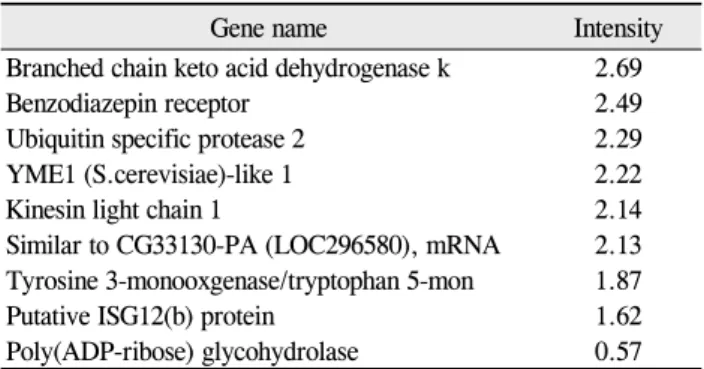
Among the cDNAs, genes associated with function were examined in greater detail. Functional classifications were identified as adhesion (Table 3), growth and differentiation (Table 4), metabolism, to include carbohydrate, energy, lipid, and nucleotide (Table 5), protein processing (Table 6), signal transduction (Table 7), structure (Table 8), transcription (Table 9), translation (Table 10), transport (Table 11), and others. The proportion of up- and down-regulated genes ac- cording to function was 25.6% in signal transduction, 20.8%
in others, 18.6% in metabolism, 14.0% in extracellular ma- trix, 9.3% in growth and differentiation, 7.0% in transcription,
and 4.7% in adhesion (Fig. 1).
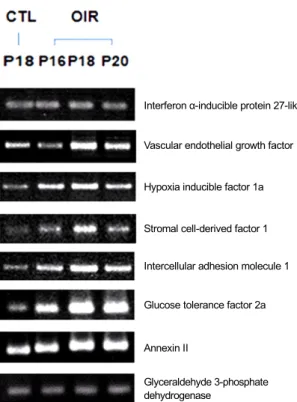
Up-regulated expression pattern (Fig. 2) observed through microarray analysis for gene such as interferon α-inducible protein 27-like, VEGF, hypoxia inducible factor 1a, stromal cell-derived factor 1, intercellular adhesion molecule 1, glu- cose tolerance factor and annexin Ⅱ and down-regulated gene expression pattern (Fig. 3) for genes such as heat shock protein and occluding were confirmed by RT-PCR.
Discussion
A monitored, multicenter clinical trial provided strong evidence to support a causal association between early
Table 9. Transcriptional genes (up-and down-regulated by 1.5-fold in oxygen-induced retinopathy retinae over controls)
Gene name Intensity
Branched chain keto acid dehydrogenase k 2.69
Benzodiazepin receptor 2.49
Ubiquitin specific protease 2 2.29
YME1 (S.cerevisiae)-like 1 2.22
Kinesin light chain 1 2.14
Similar to CG33130-PA (LOC296580), mRNA 2.13 Tyrosine 3-monooxgenase/tryptophan 5-mon 1.87
Putative ISG12(b) protein 1.62
Poly(ADP-ribose) glycohydrolase 0.57
Table 10. Translational genes (up-and down-regulated by 1.5-fold in oxygen-induced retinopathy retinae over controls)
Gene name Intensity
Similar to mmDj4 (LOC300721), mRNA 2.10 ATPase, H+ transporting, lysosomal (vacu) 1.82
SECIS binding protein 2 0.57
Ribosomal protein L39 0.62
Proteasome (prosome, macropain) subunit 0.63 Neurolysin (metallopeptidase M3 family) 0.63 Table 11. Transport genes (up-and down-regulated by 1.5- fold in oxygen-induced retinopathy retinae over controls)
Gene name Intensity
Similar to oxysterol-binding protein 1.61 Similar to 26S proteasome non-ATPase 2.12 Similar to DAZ associated protein 2 2.25 Interferon, alpha-inducible protein 27-l 3.16
Solute carrier family 2 0.64
Table 7. Signal transduction genes (up- and down-regulated by 1.5-fold in oxygen-induced retinopathy retinae over controls)
Gene name Intensity
Similar to ATPase, H+ transporting, V1 s 4.42
Fibrillin-1 3.15
Spermatogenesis-related protein 3.11
Similar to WSB-1 (LOC303336), mRNA 2.96 Similar to splicing factor Prp8 (LOC2875) 2.35 Similar to myelin basic protein expressi 2.29
Ac1176 mRNA, complete cds 2.22
Glutamate dehydrogenase 1 2.17
Similar to S-phase kinase-associated pro 2.14 Tyrosine 3-monooxygenase/tryptophan 5-mo 2.13 Similar to poly (rC) binding protein 3; p 2.12 Similar to Cas-associated zinc finger pr 2.11
Zinc finger protein 191 2.05
Cbp/p300-interacting transactivator 1.99
LOC361259 (LOC361259), mRNA 1.96
Similar to Sp3 protein (LOC311738), mRNA 1.92 Similar to SNM1 protein (LOC292127), mRNA 1.86 Similar to RIKEN cDNA 0610037P05 (LOC360) 1.77 Similar to small EDRK-rich factor 2 1.77 General transcription factor II I repeat 1.73 Similar to KIAA1086 protein (LOC314639) 1.7 Similar to Dapk1 protein (LOC306722), mRNA 1.67 Similar to Aa2-277 (LOC309176), mRNA 1.65 Solute carrier family 38, member 2 1.63 Similar to IgD B-cell receptor-associate 1.54 Similar to collagen alpha 1(IV) chain pr 1.54 Serine/threonine protein kinase CISK 0.42
Decorin 0.51
Protein kinase C-eta 0.63
Interferon-related developmental regulator 0.63
Bone morphogenetic protein 2 0.64
CD24 antigen 0.65
Angiotensin II receptor, type 1 0.65
Table 8. Structural genes (up-and down-regulated by 1.5- fold in oxygen-induced retinopathy retinae over controls)
Gene name Intensity
Similar to cysteine-rich repeat-containi 1.99
Calpactin I heavy chain 1.81
BWK-1 1.75
Similar to heat shock protein 40 (LOC361) 1.64
Caveolin 1.56
Myelin-associated oligodendrocytic basic protein 0.41
TRAP-complex gamma subunit 0.64
Olfactomedin 3 0.65
supplemental oxygen treatment and ROP. Inspired oxygen therapy does not account for all instances of this multifactorial disease, but it is widely accepted as a key agent in the pathogenesis of this condition [16].
OIR is a useful experimental model to study ROP [17] and is increasingly being used to identify the pathways and genes involved in retinal neovascularization [18-20].The under- vascularized state of the premature human retina closely re- sembles that of various newborn animals, for which retinal vascularization ordinarily occurs ex-utero [4].
In a majority of ROP cases, the clinical course progresses in a relatively uniform pattern, and is therefore likely to be controlled by specific molecules that are up- or down-regu- lated in a time-dependent fashion. Some molecules, such as VEGF and insulin-like growth factor-1 (IGF-1) are known to regulate angiogenesis in eyes with ROP [1].
van Wijngaarden et al. [2] revealed after 14 days of exposure to cyclic hyperoxia, expression of VEGF, Erythropoietin, VEGF receptor 2, Ang2, IGF-1, cyclooxgenase 2 and pig- ment epithelin-derived factor was significantly increased in the retinae of SD and Dark Agouti (DA) neonates compared with the F344 strain. The expression of a suite of genes known to be involved in angiogenesis was significantly high- er in those strains (SD and DA) that are sensitive to oxygen
Interferon α-inducible protein 27-like Vascular endothelial growth factor
Hypoxia inducible factor 1a
Stromal cell-derived factor 1 Intercellular adhesion molecule 1 Glucose tolerance factor 2a
Annexin Ⅱ
Glyceraldehyde 3-phosphate dehydrogenase
Fig. 2. Up-regulated genes of oxygen-induced retinopathy (OIR) rat retina in reverse transcriptase polymerase chain reaction. CTL = control group; P = postnatal.
Heat shock protein Occludin
Glyceraldehyde 3-phosphate dehydrogenase
Decorin
Fig. 3. Down-regulated genes of oxygen-induced retinopathy (OIR) rat retina in reverse transcriptase polymerase chain reaction. CTL
= control group; P = postnatal.
induced retinopathy, compared with a strain (F344) that is relatively resistant.
Sato et al. [1] reported a comprehensive gene-expression profile in a murine model of OIR that suggested. An in- flammatory response preceding angiogenesis resulted in dis- tinct up-regulation from the beginning to the late stages of OIR due to the induction of retinal neovascularisation.
Hypoxia inducible factor 1a (HIF-1a) and plasminogen were highly up-regulated, particularly at the beginning of OIR.
The high level of HIF-1a reflects an adaptation to the relative hypoxia by HIF-1, a heterodimeric transcription factor.
In this study, the most prominent retinal gene expression change observed was 1.5-fold increased signal transduction in the retinae of OIR rats over the controls. This may reflect a strong adaptation to relative hypoxia and the increased activ- ity needed for neovascularization. Oxygen stresses experi- enced in ROP trigger signaling through reactive oxygen spe- cies and lead to intravitreous neovascularization in an OIR rat model as reported by Byfield et al. [21]. We could not demonstrated an increase in expression inflammation medi- ated factors, since they were not included in our studies.
Ten genes were significantly up-regulated in OIR rat reti- nae (> 2-fold change over control) as determined by micro- array analysis including VEGF, interferon α-inducible pro- tein 27-like, and CaM-kinase Ⅱ inhibitor. Whereas 3 genes including myelin-associated oligodendrocytic basic protein, heat shock protein, and decorin were down-regulated by 2-fold compared to controls.
This study had some limitations. There was no gene group- ing comparisons of the early and late stages of OIR and the correlation between morphological and pathological changes in the rat retinae was not considered. All of the gene ex- pression patterns involved in OIR have not been determined in this study; however, the data should presented contribute to a better understanding of the genetic implications surrounding.
Further studies are necessary to establish the optimal con- ditions of pharmacological therapy to treat OIR.
Conflict of Interest
No potential conflict of interest relevant to this article was reported.
References
1. Sato T, Kusaka S, Hashida N, et al. Comprehensive gene-expression profile in murine oxygen-induced retinopathy. Br J Ophthalmol 2009;93:96-103.
2. van Wijngaarden P, Brereton HM, Gibbins IL, et al. Kinetics of strain-dependent differential gene expression in oxygen-induced retinopathy in the rat. Exp Eye Res 2007;85:508-17.
3. van Wijngaarden P, Brereton HM, Coster DJ, Williams KA.
Hereditary influences in oxygen-induced retinopathy in the rat. Doc Ophthalmol 2010;120:87-97.
4. van Wijngaarden P, Brereton HM, Coster DJ, Williams KA.
Stability of housekeeping gene expression in the rat retina dur- ing exposure to cyclic hyperoxia. Mol Vis 2007;13:1508-15.
5. Early Treatment for Retinopathy of Prematurity Cooperative Group. Revised indications for the treatment of retinopathy of prematurity: results of the early treatment for retinopathy of prematurity randomized trial. Arch Ophthalmol 2003;121:1684-94.
6. Chan-Ling T, Tout S, Holländer H, Stone J. Vascular changes and their mechanisms in the feline model of retinopathy of prematurity. Invest Ophthalmol Vis Sci 1992;33:2128-47.
7. Zhang W, Ito Y, Berlin E, et al. Role of hypoxia during normal retinal vessel development and in experimental retinopathy of prematurity. Invest Ophthalmol Vis Sci 2003;44:3119-23.
8. Stone J, Itin A, Alon T, et al. Development of retinal vascula- ture is mediated by hypoxia-induced vascular endothelial growth factor (VEGF) expression by neuroglia. J Neurosci
1995;15(7 Pt 1):4738-47.
9. Reynaud X, Dorey CK. Extraretinal neovascularization in- duced by hypoxic episodes in the neonatal rat. Invest Ophthalmol Vis Sci 1994;35:3169-77.
10. Min XJ, Zhou QJ, Liu T, et al. Expression of mouse telomerase reverse transcription in a mouse model of oxygen-induced retinopathy. Zhonghua Yan Ke Za Zhi 2009;45:199-205.
11. Budd SJ, Hartnett ME. Increased angiogenic factors asso- ciated with peripheral avascular retina and intravitreous neo- vascularization: a model of retinopathy of prematurity. Arch Ophthalmol 2010;128:589-95.
12. Zhang ZH, Jiang L, Qiao LX. Expression of mRNA of vas- cular endothelial growth factor in a rat model of hyper- oxia-induced retinopathy. Zhongguo Dang Dai Er Ke Za Zhi 2007;9:371-4.
13. Kim YH, Chung IY, Choi MY, et al. Triamcinolone suppresses retinal vascular pathology via a potent interruption of proin- flammatory signal-regulated activation of VEGF during a rel- ative hypoxia. Neurobiol Dis 2007;26:569-76.
14. Kim YH, Kim YS, Kang SS, et al. Expression of 14-3-3 zeta and interaction with protein kinase C in the rat retina in early diabetes. Diabetologia 2005;48:1411-5.
15. Noh HS, Lee HP, Kim DW, et al. A cDNA microarray analysis of gene expression profiles in rat hippocampus following a ke- togenic diet. Brain Res Mol Brain Res 2004;129:80-7.
16. Simons BD, Flynn JT. Retinopathy of prematurity and asso- ciated factors. Int Ophthalmol Clin 1999;39:29-48.
17. Madan A, Penn JS. Animal models of oxygen-induced retinopathy. Front Biosci 2003;8:d1030-43.
18. Ozaki H, Seo MS, Ozaki K, et al. Blockade of vascular endo- thelial cell growth factor receptor signaling is sufficient to completely prevent retinal neovascularization. Am J Pathol 2000;156:697-707.
19. Morita M, Ohneda O, Yamashita T, et al. HLF/HIF-2alpha is a key factor in retinopathy of prematurity in association with erythropoietin. EMBO J 2003;22:1134-46.
20. Sarlos S, Rizkalla B, Moravski CJ, et al. Retinal angiogenesis is mediated by an interaction between the angiotensin type 2 receptor, VEGF, and angiopoietin. Am J Pathol 2003;163:879-87.
21. Byfield G, Budd S, Hartnett ME. The role of supplemental oxygen and JAK/STAT signaling in intravitreous neo- vascularization in a ROP rat model. Invest Ophthalmol Vis Sci 2009;50:3360-5.