Predictors of Postoperative Mortality of Ruptured Abdominal Aortic Aneurysm: A Retrospective Clinical Study
Sang Dong Kim, Jeong Kye Hwang, Sun Cheol Park, Ji Il Kim, In Sung Moon, Jang Sang Park, and Sang Seob Yun
Division of Vascular and Endovascular Surgery, Department of Surgery, College of Medicine, The Catholic University of Korea, Seoul, Korea.
Received: June 20, 2011 Revised: September 28, 2011 Accepted: September 30, 2011
Corresponding author: Dr. Sang Seob Yun, Division of Vascular and Endovascular Surgery, Department of Surgery, College of Medicine, The Catholic University of Korea, 180 Wangsan-ro, Dongdaemun-gu, Seoul 130-709, Korea.
Tel: 82-2-958-2228, Fax: 82-2-958-2136 E-mail: [email protected]
This paper was presented at the 11th annual congress of Asian Society for Vascular Surgery, Westin Miyako, Kyoto, Japan, June 29 to July 2, 2010.
∙ The authors have no financial conflicts of interest.
© Copyright:
Yonsei University College of Medicine 2012 This is an Open Access article distributed under the terms of the Creative Commons Attribution Non- Commercial License (http://creativecommons.org/
licenses/by-nc/3.0) which permits unrestricted non- commercial use, distribution, and reproduction in any medium, provided the original work is properly cited.
Purpose: Despite significant improvements in surgery, anesthesia, and postopera- tive critical care, the postoperative mortality rate of ruptured abdominal aortic aneu- rysm (RAAA) has remained at 40% to 50% for several decades. Therefore, we evaluated factors associated with the postoperative mortality of RAAA. Materials and Methods: From January 1999 to December 2008, a retrospective study was performed with 34 patients who underwent open repair of RAAA. The preoperative factors included age, sex, smoking, comorbidities, serum creatinine, hemoglobin, shock, pulse rate, and time from emergency room to operation room. The intraoper- ative factors included blood loss, transfusion, aortic clamping site and time, aneu- rysmal characteristics, rupture type, graft type, hourly urine output (HUO), and op- erative time. The postoperative factors included inotropic support, renal replacement therapy (RRT), reoperation, bowel ischemia, multiple organ failure (MOF), and in- tensive care unit stay. The 2-day and the 30-day mortality rates were analyzed sepa- rately. Results: The 2-day and the 30-day mortality rates were 14.7% and 41.2%, respectively. On univariate analysis, shock, transfusion, HUO, inotropic support and MOF for the 2-day mortality and serum creatinine, transfusion, aortic clamping site, HUO, inotropic support, RRT and MOF for the 30-day mortality were statisti- cally significant. On multivariate analysis, shock, inotropic support and MOF for the 2-day mortality and aortic clamping site, RRT and MOF for the 30-day mortali- ty were statistically significant. Conclusion: To decrease the postoperative mortali- ty rate of RAAA, prevention of massive hemorrhage and acute renal failure with in- frarenal aortic clamping, as well as prompt operative control of bleeding and maintenance of systemic perfusion are important.
Key Words: Abdominal aortic aneurysm, ruptured, postoperative mortality
INTRODUCTION
The postoperative mortality rate of elective surgery for non-ruptured abdominal aor- tic aneurysm (AAA) has been reported to be less than 5%.1,2 And, it has been report- ed that if the diameter of AAA is more than 5.5 cm, the risk of rupture of AAA is in- creased; if the diameter of AAA is more than 6.5 cm, the risk of rupture of AAA is
disease (IHD), diabetes mellitus (DM), hypertension, stroke, chronic renal failure (CRF), chronic obstructive pulmonary disease (COPD)], serum creatinine, hemoglobin, shock, pulse rate, and time from ER to operation room (OR).
Shock meant circulatory shock defined as a systolic blood pressure <80 mm Hg upon hospitalization before the proce- dure.10 The intraoperative factors included blood loss, trans- fusion, aortic clamping site, aortic clamping time, character- istics of AAA (site, etiology, and shape) by standards for reporting,11 rupture type,11,12 involvement of the internal iliac artery (IIA), type of rupture, type of graft, sacrification of the IIA, hourly urine output (HUO), and operation time. We checked the amount of blood loss by counting the amount of blood collected in a suction bottle during the operation.
Rupture types were defined according to the Fitzgerald clas- sification where A type included intramural bleeding or a small hematoma, B type included a hematoma below the re- nal arteries and including the pelvis, C type comprised a he- matoma extending above the renal arteries and into the pel- vis, and D type comprised free blood in the peritoneal cavity.12 The postoperative factors included inotropic sup- port, RRT, reoperation, bowel ischemia, multiple organ fail- ure (MOF), and intensive care unit (ICU) stay. MOF in- volved renal failure, hepatic failure, pulmonary failure, and heart failure. The mortality rate was divided into postopera- tive 2-day and 30-day mortality rates. We also analyzed the 2-day and the 30-day mortality rates separately. There was no patient that received endovascular abdominal aneurysm repair (EVAR) for RAAA. Among 34 patients, 29 patients had been referred from other hospitals to the ER of our hos- pital for repair of RAAA, and 5 patients had been diagnosed in RAAA at the ER of our hospital without previous diagno- sis of AAA. So, we have no information about AAA before rupture for 34 patients. Statistical analysis was done by Chi- square test, Fisher’s exact test, and logistic regression using the SAS system for Windows, version 8. At first, we per- formed univariate analysis for the association of postopera- tive mortality and factors. Factors found to be significant on univariate analysis were entered into a multivariate analysis.
p-values <0.05 were considered statistically significant. Data were presented as mean±standard deviation.
RESULTS
For the 34 patients who underwent open repair of RAAA, the mean age was 70.0±7.8 years. The sexual distribution was greatly increased.3 Despite significant improvements in sur-
gery, anesthesia, and postoperative critical care, the mortality rate of ruptured AAA (RAAA) has not changed substantially over the last two decades.4,5 According to most reports,3,6,7 the postoperative mortality rate of RAAA has remained at 40- 50%, reaching 75-90% if deaths occurring before patients’
arrival at the hospital are included. The primary causes of death in patients undergoing emergency repair of RAAA, in most reports, are massive hemorrhage, cardiorespiratory dys- function, and acute renal failure (ARF).8 With respect to the high mortality rate of RAAA, Scarcello, et al.4 asserted that time before shock was the most important predictor of the postoperative mortality for RAAA, while Davies, et al.8 re- ported postoperative renal replacement therapy (RRT) as an independent risk factor of RAAA, and Halpern, et al.9 argued that loss of consciousness, preoperative hemoglobin level, preoperative and intraoperative systolic blood pressure, intra- operative urine output, intraoperative blood loss, and intraop- erative transfusion were risk factors of the mortality of RAAA. Similar to these, various authors have reported dif- ferent factors as risk factors of the postoperative mortality of RAAA.4,8,9 Therefore, we evaluated patients who underwent surgery of RAAA to define factors associated with the post- operative mortality of RAAA. This research was approved by the Institutional Review Board of our institute.
MATERIALS AND METHODS
A retrospective review of 34 patients, who were diagnosed with RAAA and underwent open repair at our hospital be- tween January 1999 and December 2008, was performed using their medical records. There were 246 patients who were diagnosed with AAA during this period. Among 246 patients, 43 patients were diagnosed with RAAA, but we excluded 9 patients that had expired in the emergency room (ER) before they underwent repair of RAAA. All open re- pairs of RAAA for the 34 patients during this period had been performed by surgical staff with vascular specialty and anesthesia staff with anesthesia specialty. To maintain hemo- dynamic status prior to surgery, we made an effort to con- duct prompt diagnosis and recovery from a shock state by fluid resuscitation and transfusion with plasma components in principle. We divided factors associated with the postop- erative mortality of RAAA into preoperative, intraoperative, and postoperative factors. The preoperative factors included age, sex, history of smoking, comorbidities [ischemic heart
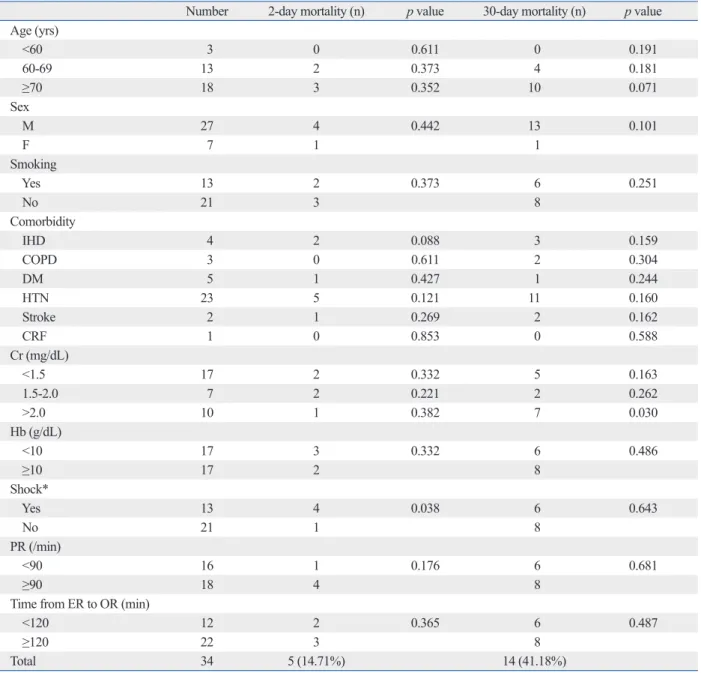
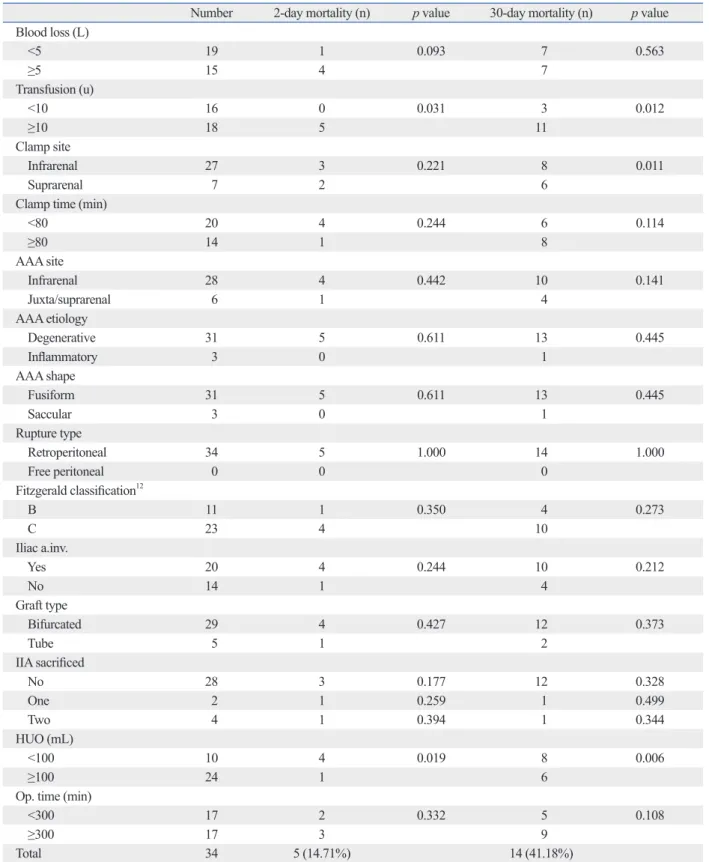
HUO (mL) was 107.76±57.16, and the operation time (min) was 294.12±68.23 (Table 1 and 2). The main reason of mas- sive bleeding during surgery was coagulopathy, and the other reasons included intraperitoneal rupture before aorta clamping and anastomosis site bleeding. The postoperative mortality rates were 14.7% (5 patients) for the 2-day mor- tality rate and 41.2% (14 patients) for the 30-day mortality rate (Table 1, 2 and 3).
On univariate analysis of the association of the 2-day mortality and factors associated with the postoperative mor- 27 male patients (79.4%) and 7 female patients (20.6%) (Ta-
ble 1). Comorbidities consisted of hypertension in 23 patients (67.6%), DM in 5 patients (14.7%), and IHD in 4 patients (11.8%) (Table 1). The level of preoperative serum creatinine (mg/dL) was 1.80±1.13, the level of preoperative hemoglobin (g/dL) was 10.19±2.18, the time from ER to OR (min) was 133.52±39.54, the amount of intraoperative blood loss (L) was 4.63±3.86, the amount of intraoperative transfusion [packed red blood cells (PRBC)] (u) was 12.18±9.00, the in- traoperative aortic clamping time (min) was 78.53±30.45, the
Table 1. Univariate Analysis of Preoperative Risk Factors Associated with Postoperative Mortality of RAAA
Number 2-day mortality (n) p value 30-day mortality (n) p value Age (yrs)
<60 3 0 0.611 0 0.191
60-69 13 2 0.373 4 0.181
≥70 18 3 0.352 10 0.071
Sex
M 27 4 0.442 13 0.101
F 7 1 1
Smoking
Yes 13 2 0.373 6 0.251
No 21 3 8
Comorbidity
IHD 4 2 0.088 3 0.159
COPD 3 0 0.611 2 0.304
DM 5 1 0.427 1 0.244
HTN 23 5 0.121 11 0.160
Stroke 2 1 0.269 2 0.162
CRF 1 0 0.853 0 0.588
Cr (mg/dL)
<1.5 17 2 0.332 5 0.163
1.5-2.0 7 2 0.221 2 0.262
>2.0 10 1 0.382 7 0.030
Hb (g/dL)
<10 17 3 0.332 6 0.486
≥10 17 2 8
Shock*
Yes 13 4 0.038 6 0.643
No 21 1 8
PR (/min)
<90 16 1 0.176 6 0.681
≥90 18 4 8
Time from ER to OR (min)
<120 12 2 0.365 6 0.487
≥120 22 3 8
Total 34 5 (14.71%) 14 (41.18%)
n, number; yr, year; M, male; F, female; IHD, ischemic heart disease; COPD, chronic obstructive pulmonary disease; DM, diabetes mellitus; HTN, hyperten- sion; CRF, chronic renal failure; Cr, creatinine; Hb, hemoglobin; PR, pulse rate; ER, emergency room; OR, operation room; RAAA, ruptured abdominal aortic aneurysm.
*Circulatory Shock, systolic blood pressure <80 mm Hg at hospitalization (before procedure).10
ative factors, intraoperative transfusion was statistically sig- nificant (p=0.031) (Table 2). In total, 5 of 18 patients with transfusion (u) of more than 10 expired. HUO was statisti- cally significant (p=0.019) (Table 2), and 4 of the 10 pa- tality of RAAA, preoperative shock was statistically signifi-
cant (p=0.038) (Table 1), and 4 out of 13 patients with shock expired. All preoperative factors except for shock were sta- tistically insignificant (p>0.05) (Table 1). Among intraoper-
Table 2. Univariate Analysis of Intraoperative Risk Factors Associated with Postoperative Mortality RAAA
Number 2-day mortality (n) p value 30-day mortality (n) p value Blood loss (L)
<5 19 1 0.093 7 0.563
≥5 15 4 7
Transfusion (u)
<10 16 0 0.031 3 0.012
≥10 18 5 11
Clamp site
Infrarenal 27 3 0.221 8 0.011
Suprarenal 7 2 6
Clamp time (min)
<80 20 4 0.244 6 0.114
≥80 14 1 8
AAA site
Infrarenal 28 4 0.442 10 0.141
Juxta/suprarenal 6 1 4
AAA etiology
Degenerative 31 5 0.611 13 0.445
Inflammatory 3 0 1
AAA shape
Fusiform 31 5 0.611 13 0.445
Saccular 3 0 1
Rupture type
Retroperitoneal 34 5 1.000 14 1.000
Free peritoneal 0 0 0
Fitzgerald classification12
B 11 1 0.350 4 0.273
C 23 4 10
Iliac a.inv.
Yes 20 4 0.244 10 0.212
No 14 1 4
Graft type
Bifurcated 29 4 0.427 12 0.373
Tube 5 1 2
IIA sacrificed
No 28 3 0.177 12 0.328
One 2 1 0.259 1 0.499
Two 4 1 0.394 1 0.344
HUO (mL)
<100 10 4 0.019 8 0.006
≥100 24 1 6
Op. time (min)
<300 17 2 0.332 5 0.108
≥300 17 3 9
Total 34 5 (14.71%) 14 (41.18%)
n, number; L, liter; u, unit; min, minute; a, artery; inv, involve; HUO, hourly urine output; Op, operation; RAAA, ruptured abdominal aortic aneurysm.
On multivariate analysis of the association of the 2-day mortality and factors found to be significant on univariate analysis, preoperative shock (p=0.049), postoperative ino- tropic support (p=0.002) and postoperative MOF (p=0.001) were statistically significant (Table 4).
On univariate analysis of the association of the 30-day mortality and factors associated with the postoperative mor- tality of RAAA, among preoperative factors, serum creati- nine was statistically significant (p=0.030) (Table 1). Seven of 10 patients with serum creatinine (mg/dL) of more than 2.0 expired. All preoperative factors except for serum creati- nine were statistically insignificant (p>0.05) (Table 1).
Among the intraoperative factors, transfusion was statistical- ly significant (p=0.012) (Table 2). Eleven of 18 patients with tients with HUO (mL) of less than 100 expired. Blood loss,
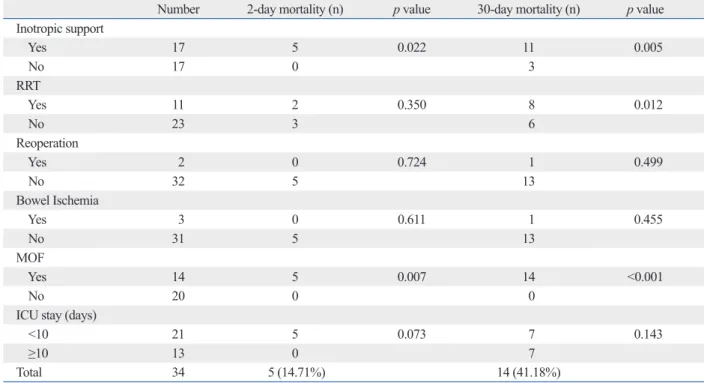
aortic clamping site, aortic clamping time, characteristics of AAA, type of rupture, Fitzgerald classification, sacrifica- tion of IIA, type of graft, and operation time were statisti- cally insignificant (p>0.05) (Table 2). Rupture types of all 34 patients were retroperitoneal ruptures (Table 2). Accord- ing to Fitzgerald classification, 11 of 34 patients were B type, and the other 23 patients were C type (Table 2). Among post- operative factors, inotropic support was statistically signifi- cant (p=0.022) (Table 3), and 5 of 17 patients with inotropic support expired. Also, 5 of 14 patients with MOF expired, and MOF was found to be statistically significant (p=0.007) (Table 3). RRT, reoperation, bowel ischemia, and ICU stay were statistically insignificant (p>0.05) (Table 3).
Table 3. Univariate Analysis of Postoperative Risk Factors Associated with Postoperative Mortality of RAAA
Number 2-day mortality (n) p value 30-day mortality (n) p value
Inotropic support
Yes 17 5 0.022 11 0.005
No 17 0 3
RRT
Yes 11 2 0.350 8 0.012
No 23 3 6
Reoperation
Yes 2 0 0.724 1 0.499
No 32 5 13
Bowel Ischemia
Yes 3 0 0.611 1 0.455
No 31 5 13
MOF
Yes 14 5 0.007 14 <0.001
No 20 0 0
ICU stay (days)
<10 21 5 0.073 7 0.143
≥10 13 0 7
Total 34 5 (14.71%) 14 (41.18%)
n, number; RRT, renal replacement therapy; MOF, multiple organ failure; ICU, intensive care unit; RAAA, ruptured abdominal aortic aneurysm.
Table 4. Multivariate Analysis of Risk Factors That Were Significant in Univariate Analysis of Risk Factors Associated with Postoperative Mortality of RAAA
2-day mortality (p value) 30-day mortality (p value)
Preoperative factor Cr (>2.0 mg/dL) 0.260
Shock (y) 0.049
Intraoperative factor
Transfusion (≥10 u) 0.183 0.167
Clamp site (suprarenal) 0.004
HUO (<100 mL) 0.261 0.086
Postoperative factor
Inotropic support (y) 0.002 0.322
RRT (y) 0.001
MOF (y) 0.001 <0.001
Cr, creatinine; u, unit; HUO, hourly urine output; y, yes; RRT, renal replacement therapy; MOF, multiple organ failure; RAAA, ruptured abdominal aortic aneu- rysm.
2-day and 30-day mortality rates, and analyzed these sepa- rately. Our results showed that the 2-day mortality rate was 14.71%, and the 30-day mortality rate was 41.18%. These results were comparable to those of other reports.2-6,13,14 In our study, we performed separate analysis of the 2-day mortality to find factors directly associated with postopera- tive mortality during the earlier and more critical period af- ter open repair of RAAA, as we conjectured that 2-day mortality would more directly reflect the influences of fac- tors, such as preoperative status and intra- and post-opera- tive bleeding, on postoperative mortality in earlier periods than the 30-day mortality. Also, we thought that 30-day mortality would better reflect the influences of factors on postoperative mortality in the recovery period than the 2-day mortality rate. In our study, preoperative shock, postopera- tive inotropic support and postoperative MOF were signifi- cantly related with 2-day mortality, suggesting that the pa- tients who could not recover from shock during surgery died.
As for the 30-day mortality, intraoperative aortic clamping site, postoperative RRT and postoperative MOF demonstrat- ed significant correlation. This suggested that even though the patients survived the shock of the emergency surgery, renal dysfunction, probably caused by renal ischemia, be- came the main cause of death. Accordingly, we think that there were meaningful differences in the factors related with mortality between 2-day and 30-day mortality.
Much research has been performed in an attempt to define factors associated with the mortality of RAAA.2,3,6,8,9,13-19 In the literature,2,3,6,8,9,13-19 age, sex, comorbidities (CRF, COPD, IHD etc.), hemodynamic status, cardiac arrest, postopera- tive care, complication, volume of surgeons, and specialty are reported to be significantly associated with the postop- erative mortality of RAAA. Cho, et al.3 suggested that in- traoperative transfusion and renal dysfunction, such as in- traoperative oliguria (<200 mL), consistent anuria, and postoperative increase of serum creatinine (>2.0 mg/dL), transfusion (u) of more than 10 expired. As 6 of 7 patients
with suprarenal aortic clamping expired, aortic clamping site was found to be statistically significant (p=0.011) (Table 2).
Also, 8 of 10 patients with HUO (mL) of less than 100 ex- pired, and HUO was statistically significant (p=0.006) (Table 2). All other intraoperative were statistically insignificant (p>0.05) (Table 2). Among the postoperative factors, inotro- pic support was statistically significant (p=0.005) (Table 3).
Eleven of 17 patients with inotropic support expired. Eight of 11 patients with RRT expired, and RRT was statistically sig- nificant (p=0.012) (Table 3). All 14 patients with MOF ex- pired, and MOF was statistically significant (p<0.001) (Table 3). All other postoperative factors were statistically insignifi- cant (p>0.05) (Table 3).
On multivariate analysis of the association of 30-day mor- tality and factors found to be significant on univariate analy- sis, intraoperative aortic clamping site (p=0.004), postopera- tive RRT (p=0.001) and postoperative MOF (p<0.001) were statistically significant (Table 4).
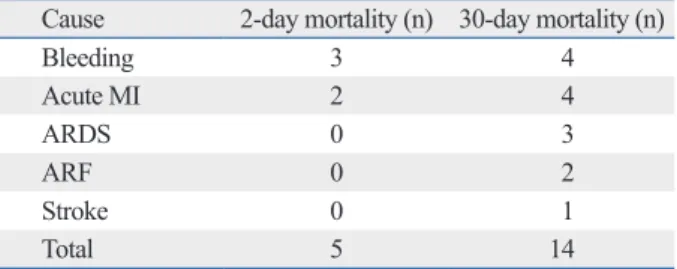
The causes of death for the 5 patients that expired within 2 days after open repair of RAAA were bleeding in 3 pa- tients and acute myocardial infarction (MI) in 2 patients (Ta- ble 5). The causes of death for the 14 patients that expired within 30 days after open repair of RAAA were bleeding in 4 patients, acute MI in 4 patients, acute respiratory distress syndrome in 3 patients, ARF in 2 patients, and stroke in 1 patient (Table 5). We diagnosed acute MI as the cause of death according to the symptoms of the patients, as well as changes in rhythms on electrocardiography (ECG) and ele- vations of cardiac enzymes. No patient died of the abdomi- nal compartment syndrome.
DISCUSSION
The postoperative mortality rate of RAAA has been report- ed as 40-50% in most reports.2-6,13,14 Despite several ad- vances in diagnostic imaging as well as intraoperative and postoperative critical care, the postoperative mortality rate of RAAA has not changed substantially over the last two decades.5,13 According to Korean reports, the postoperative mortality rates of RAAA have been reported as 36% by Kim, et al.,2 17.1% by Cho, et al.,3 and 36.8% by Beah, et al.14 However, Cho, et al.3 explained that the reason their mortality rate was relatively low was because there was no free peritoneal ruptures of AAA.
In our study, we divided postoperative mortality into
Table 5. Causes of Deaths of the Patients that Underwent Open Repair of RAAA
Cause 2-day mortality (n) 30-day mortality (n)
Bleeding 3 4
Acute MI 2 4
ARDS 0 3
ARF 0 2
Stroke 0 1
Total 5 14
n, number; MI, myocardial infarction; ARDS, acute respiratory distress syndrome; ARF, acute renal failure; RAAA, ruptured abdominal aortic aneu- rysm.
been many efforts to decrease the postoperative mortality of RAAA.2-4,6,14,20-22 Kim, et al.,2 Scarcello, et al.4 and Beah, et al.14 asserted that operations should be performed as soon as possible before preoperative cardiac arrest develops. Cho, et al.3 reported the importance of a prompt diagnosis and re- covery from a shock state by fluid resuscitation and transfu- sion, and they suggested that the rapid infusion system could be useful in this situation. Spinella, et al.20 and Gonzalez, et al.21 asserted the usefulness of “early plasma transfusion” or
“hemostatic resuscitation” in massively hemorrhaging pa- tients with equal ratios of fresh frozen plasma (FFP) to PRBC, and they suggested early plasma transfusion as a volume expander as well as a primary means for preventing coagulopathy. Mell, et al.6 demonstrated a marked decrease in mortality (15%) in RAAA patients who received equiva- lent transfusions of FFP : PRBC (high FFP), and the mor- tality of the group transfused at ratios similar to the tradi- tional resuscitation ratios of 1 unit FFP : 3-4 units PRBC (low FFP) was markedly higher (39%), which was similar to the mortality rates of many published RAAA series.
They also suggested that early plasma transfusion might correct coagulopathies from massive hemorrhages, result- ing in greater oncotic pressure in the immediately postoper- ative period and a decrease in hypoperfusion, which, there- fore, could decrease mortality.6 As another theory, permissive hypotension is a method used to decrease the risk of uncon- trolled hemorrhaging.22 This method is a technique in which enough volume is given to maintain a systolic blood pressure of 80-100 mm Hg until aortic control is achieved.22 The goal of this technique is to prevent an increase in blood pressure from excessive volume administration in order to avoid uncontrolled hemorrhaging by converting a con- tained retroperitoneal hemorrhage into a free intraperitoneal hemorrhage.6 In these methods, the authors made an effort to perform prompt diagnosis and recovery from a shock state by fluid resuscitation and transfusion with high FFP.
We mostly did not perform the permissive hypotension;
however, we had several experiences with deaths that were thought to be due to the conversion of a contained retroper- itoneal hemorrhage into a free intraperitoneal hemorrhage due to excessive volume administration. Therefore, we feel that we need to perform the permissive hypotension tech- nique in the future.
Additionally, different operation techniques have been re- ported.23-27 Chang, et al.23 suggested the retroperitoneal ap- proach for a postoperatively early recovery. The first series describing endovascular RAAA repair (REVAR) by Ohki were significant risk factors associated with the postopera-
tive mortality of RAAA. Davies, et al.8 reported that RRT was a significant risk factor of the postoperative mortality of RAAA, and Beah, et al.14 suggested that preoperative cardiac arrest was a significant risk factor of the postopera- tive mortality of RAAA. Rutledge, et al.15 reported that age was an important risk factor, as a mortality rate of more than 50% for patients older than 65 years was recorded in research of 1480 patients. Boyle, et al.17 suggested that age, ischemic electrocardiography (ECG), hemoglobin, serum creatinine, and loss of consciousness were preoperative risk factors. Sinicrope, et al.19 asserted that postoperative renal failure was the most important predictive factor of mortali- ty. In such situations, the causes of renal failure are mostly a decrease in renal perfusion and renal ischemic change due to hypotension and decreases in systemic blood volume from massive bleeding, and other causes could include the use of contrast dye and intraoperative suprarenal aortic clamping.3
In our study, we divided the factors associated with the postoperative mortality of RAAA into preoperative, intra- operative, and postoperative factors. On multivariate analy- sis, preoperative shock, postoperative inotropic support and postoperative MOF were significantly associated with the postoperative 2-day mortality, while intraoperative aortic clamping site, postoperative RRT, and postoperative MOF were significantly associated with the postoperative 30-day mortality. During both the earlier, more critical period (<2 days) and the recovery period (<30 days) after open repair of RAAA, MOF was a significant risk factor. During the earlier, more critical period (<2 days), preoperative shock and postoperative inotropic support were especially a sig- nificant risk factor. During the recovery period (<30 days), intraoperative aortic clamping site and postoperative RRT were significant risk factors. We think that postoperative inotropic support, postoperative RRT, and postoperative MOF are mostly due to ischemic changes and coagulopa- thy caused by systemic and renal hypoperfusion due to hy- povolemic shock, based on the massive hemorrhaging seen in RAAA patients, and suprarenal aortic clamping can also lead to renal hypoperfusion and ischemia. In the litera- ture,2,3,9,13-18 preoperative factors were the ones most fre- quently suggested as risk factors of the postoperative mor- tality of RAAA. However, our report outlines significant relationships among preoperative, intraoperative, and post- operative factors in the postoperative mortality of RAAA.
Based on the risk factors mentioned above, there have
nani F, et al. A new preoperative predictor of outcome in ruptured abdominal aortic aneurysms: the time before shock (TBS). Ann Vasc Surg 2010;24:315-20.
5. Noel AA, Gloviczki P, Cherry KJ Jr, Bower TC, Panneton JM, Mozes GI, et al. Ruptured abdominal aortic aneurysms: the exces- sive mortality rate of conventional repair. J Vasc Surg 2001;34:41-6.
6. Mell MW, O’Neil AS, Callcut RA, Acher CW, Hoch JR, Tefera G, et al. Effect of early plasma transfusion on mortality in patients with ruptured abdominal aortic aneurysm. Surgery 2010;148:955-62.
7. Lee RW, Rhodes JM, Singh MJ, Davies MG, Wolford HY, Diac- hun C, et al. Is there a selection bias in applying endovascular an- eurysm repair for rupture? Ann Vasc Surg 2008;22:215-20.
8. Davies RS, Dawlatly S, Clarkson JR, Bradbury AW, Adam DJ.
Outcome in patients requiring renal replacement therapy after open surgical repair for ruptured abdominal aortic aneurysm. Vasc Endovascular Surg 2010;44:170-3.
9. Halpern VJ, Kline RG, D’Angelo AJ, Cohen JR. Factors that af- fect the survival rate of patients with ruptured abdominal aortic aneurysms. J Vasc Surg 1997;26:939-45.
10. Bonardelli S, Cervi E, Maffeis R, Nodari F, De Lucia M, Guadrini C, et al. Open surgery in endovascular aneurysm repair era: sim- plified classification in two risk groups owing to factors affecting mortality in 137 ruptured abdominal aortic aneurysms (RAAAs).
Updates Surg 2011;63:39-44.
11. Johnston KW, Rutherford RB, Tilson MD, Shah DM, Hollier L, Stanley JC. Suggested standards for reporting on arterial aneu- rysms. Subcommittee on Reporting Standards for Arterial Aneu- rysms, Ad Hoc Committee on Reporting Standards, Society for Vascular Surgery and North American Chapter, International Soci- ety for Cardiovascular Surgery. J Vasc Surg 1991;13:452-8.
12. Fitzgerald JF, Stillman RM, Powers JC. A suggested classification and reappraisal of mortality statistics for ruptured atherosclerotic infrarenal aortic aneurysms. Surg Gynecol Obstet 1978;146:344-6.
13. Hsiang YN, Turnbull RG, Nicholls SC, McCullough K, Chen JC, Lokanathan R, et al. Predicting death from ruptured abdominal aortic aneurysms. Am J Surg 2001;181:30-5.
14. Beah MJ, Kwon TW, Cho YP, Kim HS, Kim GE. Factors affect- ing mortality rate of ruptured abdominal aortic aneurysm. J Kore- an Soc Vasc Surg 2000;16:33-7.
15. Rutledge R, Oller DW, Meyer AA, Johnson GJ Jr. A statewide, population-based time-series analysis of the outcome of ruptured abdominal aortic aneurysm. Ann Surg 1996;223:492-502.
16. Evans SM, Adam DJ, Bradbury AW. The influence of gender on outcome after ruptured abdominal aortic aneurysm. J Vasc Surg 2000;32:258-62.
17. Boyle JR, Gibbs PJ, King D, Shearman CP, Raptis S, Phillips MJ.
Predicting outcome in ruptured abdominal aortic aneurysm: a pro- spective study of 100 consecutive cases. Eur J Vasc Endovasc Surg 2003;26:607-11.
18. Alric P, Ryckwaert F, Picot MC, Branchereau P, Colson P, Mary H, et al. Ruptured aneurysm of the infrarenal abdominal aorta: impact of age and postoperative complications on mortality. Ann Vasc Surg 2003;17:277-83.
19. Sinicrope RA, Serra RM, Engle JE, Nicholas GG, Devine MF, Schoolwerth AC. Mortality of acute renal failure after rupture of abdominal aortic aneurysms. Am J Surg 1981;141:240-2.
20. Spinella PC, Perkins JG, Grathwohl KW, Beekley AC, Niles SE, McLaughlin DF, et al. Effect of plasma and red blood cell transfu- sions on survival in patients with combat related traumatic inju- ries. J Trauma 2008;64(2 Suppl):S69-77.
and Veith24 from the Montefiore group included 12 patients treated with a custom-made stent graft, with a mortality rate of only 12%, suggesting that REVAR could potentially im- prove the traditionally high mortality rates associated with open repair. Since then, the dissemination of endovascular technology has allowed centers to offer EVAR to a wide range of patients with more complex anatomy, and to per- form EVAR as the first line of treatment for RAAA in many cases.25 Mehta, et al.26 reported that they achieved a mortal- ity rate of 18% with emergent endovascular repair of hemo- dynamically stable and unstable patients. Davenport, et al.27 asserted that the performance of EVAR in RAAA patients with favorable anatomy could potentially result in lower morbidity and decreased transfusion requirements, as com- pared with open repair. However, the present authors have not yet introduced EVAR for RAAA.
In conclusion, minimizing preoperative shock, intraoper- ative suprarenal aortic clamping, postoperative inotropic support, postoperative RRT, and postoperative MOF is im- perative to minimizing the postoperative mortality of RAAA, according to our study. To do so, prompt diagnosis, opera- tion, and securing proper blood flow to minimize massive hemorrhages and coagulopathies are most important. So, in the preoperative period, prompt diagnosis, quick recovery from a shock state by fluid resuscitation and transfusion with high FFP, and permissive hypotension to maintain the hemodynamic status prior to surgery need to be performed.
In the intraoperative period, operative control of bleeding, maintenance of systemic perfusion, and infrarenal aortic clamping in infrarenal RAAA, regardless of neck length, as a possible means to avoid additional renal ischemic changes are vital. Of course, suprarenal aortic clamping in juxtarenal or suprarenal RAAA is obligatory. In the postoperative peri- od, critical and proper care for maintenance of systemic per- fusion and recovery of organ function must be undertaken.
REFERENCES
1. Hardman DT, Fisher CM, Patel MI, Neale M, Chambers J, Lane R, et al. Ruptured abdominal aortic aneurysms: who should be of- fered surgery? J Vasc Surg 1996;23:123-9.
2. Kim IH, Kim DI, Huh SH, Lee SJ, Lee BB. Factors that affect the survival rate of ruptured abdominal aortic aneurysm. J Korean Soc Vasc Surg 2001;17:199-202.
3. Cho MJ, Yoon HJ, Park JY, Huh S, Kim YW. The risk factors in- fluencing postoperative mortality in the patients with ruptured ab- dominal aortic aneurysm. J Korean Soc Vasc Surg 2004;20:208-13.
4. Scarcello E, Ferrari M, Rossi G, Berchiolli R, Adami D, Romag-
25. Ricotta JJ 2nd, Malgor RD, Oderich GS. Ruptured endovascular abdominal aortic aneurysm repair: part II. Ann Vasc Surg 2010;
24:269-77.
26. Mehta M, Taggert J, Darling RC 3rd, Chang BB, Kreienberg PB, Paty PS, et al. Establishing a protocol for endovascular treatment of ruptured abdominal aortic aneurysms: outcomes of a prospec- tive analysis. J Vasc Surg 2006;44:1-8.
27. Davenport DL, O’Keeffe SD, Minion DJ, Sorial EE, Endean ED, Xenos ES. Thirty-day NSQIP database outcomes of open versus endoluminal repair of ruptured abdominal aortic aneurysms. J Vasc Surg 2010;51:305-9.
21. Gonzalez EA, Moore FA, Holcomb JB, Miller CC, Kozar RA, Todd SR, et al. Fresh frozen plasma should be given earlier to pa- tients requiring massive transfusion. J Trauma 2007;62:112-9.
22. Roberts K, Revell M, Youssef H, Bradbury AW, Adam DJ. Hypo- tensive resuscitation in patients with ruptured abdominal aortic aneurysm. Eur J Vasc Endovasc Surg 2006;31:339-44.
23. Chang BB, Shah DM, Paty PS, Kaufman JL, Leather RP. Can the retroperitoneal approach be used for ruptured abdominal aortic aneurysms? J Vasc Surg 1990;11:326-30.
24. Ohki T, Veith FJ. Standard and new treatments for abdominal aor- tic aneurysms: the value of the Montefiore endovascular grafts for difficult aneurysms. Jpn Circ J 1999;63:829-37.