https://doi.org/10.7585/kjps.2019.23.4.297
Open Access
297
들깻잎 중 chlorantraniliprole과 tetraconazole 잔류양상의 kinetic model 적용
김효정·이상협·곽세연·김태화
1·김장억*
경북대학교 농업생명과학대학 응용생명과학부,
1㈜분석기술과 미래
Application of Kinetic Models for Residual Patterns of Chlorantraniliprole and Tetraconazole in Perilla leaves
Hyo-Jeong Kim, Sang-Hyeob Lee, Se-Yeon Kwak, Tae-Hwa Kim
1and Jang-Eok Kim * School of Applied Biosciences, Kyungpook National University, Daegu 41566, Republic of Korea
1
Analysis Technology and Tomorrow, Daegu 41566, Korea
(Received on October 14, 2019. Revised on November 20, 2019. Accepted on November 25, 2019)
Abstract Chlorantraniliprole and tebuconazole were different dissipation patterns in perilla leaves. As using kinetic model, it could be predicted dissipation patterns and half-lives of pesticides in perilla leaves. In this study, three kinetic models (zero order (ZO), first order (FO) and second order (SO)) were employed to compare and characterize the best-fit kinetic model describing the residual pattern of chlorantraniliprole and tetraconazole in perilla leaves as a minor crop. Chlorantraniloiprole (5%, WG) and tetraconazole (12.5%, EW) were diluted with water and sprayed 2 times and 3 times at interval of 7 days before harvesting. The residual amounts of chlorantraniliprole and tetraconazole were analyzed by HPLC-UVD and GC-ECD.
Comparing the correlation coefficients (r
2) of the kinetic models, chlorantraniliprole was 0.843, 0.847 and 0.851 for the ZO, FO, SO respectively and tetraconazole was 0.978, 0.980, 0.970 for the ZO, FO, SO respectively. Therefore SO was best fit to chlorantraniliprole but FO was best fit the dissipation patterns of tetraconazole. The equations of biological half-life of chlorantraniliprole were y = 0.0124x + 0.2926 (half-life:
23.7 days) by using SO and tetraconazole y = 10.9390e
-0.043x(16.1 days) by using FO respectively. Therefore, the biological half-life needs to be calculated with the optimal equation to predict.
Key words Biological half-life, Chlorantraniliprole, Kinetic models, Perilla leaves, Tetraconazole
<< ORCID
Jang-Eok Kimhttp://orcid.org/0000-0003-1412-9393
서 론
농약은 농작물을 가해하는 병해충 및 잡초를 방제하여 최 종 수확물의 생산성을 증대시키고 또한 품질 향상을 위하여 꾸준히 사용되고 있다. 농작물에 살포되거나 혹은 토양에 처리된 농약들이 목적을 다한 후에 무해한 물질로 분해가 되는 것은 이상적이지만 환경 중에 잔류 되는 농약들도 상
당 수 가 있다(Ahn et al., 2014; Jin et al., 2018; Lee et al., 2009).
농작물에 살포된 농약의 안전성을 평가할 때 농약의 잔류 량을 측정하여 농약잔류허용기준치 미만으로 잔류하면 안전 성에 문제가 없다고 평가한다(Yun et al., 2008; Lee et al., 2015). 농작물에 잔류되어 있는 농약도 시간이 지남에 따라 여러 요인들에 의하여 분해되어 가는데 생물학적 분해 반감 기를 구하여 농약 별로 또는 농작물 별로 잔류량을 예측할 수 있다(Jeon et al., 2015; Moon et al., 2013). 특별히 우리 나라에서 시행하고 있는 생산단계 잔류허용기준량 설정에서
*Corresponding author E-mail: [email protected]
ORIGINAL ARTICLES
는 분해 반감기를 어떻게 산출하는가가 출하시기를 결정하 는데 굉장히 중요한 요인이 된다(Chung et al., 2017; Jin et al., 2014; Kim et al., 2014; Lee et al., 2009).
농작물에 잔류된 농약의 시간 경과에 따른 반감기를 산출 할 때 어떤 kinetic model을 사용하였는가에 따라 반감기는 달라 질 수 있다(Fantke and Juraske 2013; Park et al., 2013).
물론 살포 횟수를 다양하게 하고 측정일 수의 간격을 좁히 면 좀 더 유의성이 있는 잔류 양상을 통계학적으로 구할 수 가 있지만 3-4회 살포하는 정도에서 생물학적 분해 반감기 를 산출해야 할 때 어떤 kinetic model을 사용하는 가에 따 라 반감기는 조금씩 달라질 수 있다(Fantke et al., 2014;
Hwang et al., 2018).
현재 우리나라에서 통상적으로 사용하고 있는 first order kinetic model 을 일괄적으로 적용하는 것 보다는 다른 kinetic model 을 적용하여 농약 잔류량의 변화와 시간과의 관계를 파악하고 높은 결정계수(r
2) 를 갖는 최적의 model을 찾아 이를 이용하여 생물학적 반감기를 산출하는 것이 바람 직하다고 판단된다.
연구에서 사용된 작물은 농약 허용물질 목록관리제도가 금년부터 본격적으로 시행됨에 따라 그룹잔류허용기준을 적 용 받는 소면적 재배작물로서 엽채류의 대표작물로 분류되 어 있는 들깻잎을 이용하여 기존 kinetic model에 적용하여 반감기의 차이를 알아보고자 한다(Park et al., 2018; Sparks, 2003).
시험 대상인 농약은 diamide계 살충제인 chlorantraniliprole 과 triazole계 살균제에 속하는 tetraconazole을 대상으로 하 였다. 본 연구의 목적은 들깻잎 중 살충제 chlorantraniliprole 과 살균제 tetraconazole의 시간 경과에 따른 잔류 양상을 조사하고 이를 kinetic model에 적용하여 생물학적 반감기
를 산출하여 서로 비교하고자 하였다.
재료 및 방법
농약 및 시약
Chlorantraniliprole 과 tetraconazole 표준품은 순도 97.0%
와 98.1%의 Sigma-Aldrich Co. (St. Louis, MO, USA) 및 AccuStandard Inc. (New haven, CT, USA) 의 제품을 사용 하였으며 시험 농약의 구조는 Table 1과 같다. 포장시험에 사용된 chlorantraniliprole은 5% 입상수화제[(주)동부팜한농, 알타코아]였으며, tetraconazole은 12.5% 유탁제[Bayer, 에 머넌트]였다. 잔류농약의 분석을 위한 용매 ethyl acetate, dichloromethane, n-hexane은 Burdick & Jackson (Muskegon, MI, USA) 사의 제품을 사용하였다. 시료의 정제를 위한 SPE cartridge (solid phase extraction) 는 Agilent Technolo- gies Inc. (California, CA, USA) 의 silica (1 g, 6 mL)와 florisil (1 g, 6 mL)제품을 사용하였다.
시험 포장 및 약제 살포
들깻잎의 시험 포장은 경상남도 밀양시 상남면 예림리에 위치한 비닐하우스 재배 포장을 임대하여 사용하였으며, 들 깻잎의 품종은 남천이었다. 구획 및 배치는 1.6 m × 6.25 m 크기로 구획하여 1 m의 완충구를 두고 3반복으로 배치하였 으며 재식 밀도는 10 cm × 10 cm로 파종하여 재배하였다.
살충제 chlorantraniliprole은 2,000배로 희석하여 7일 간격 으로 2회 처리하였으며, 살균제 tetraconazole은 1,000배 희 석하여 7일 간격으로 3회 처리하였다. 들깻잎 시료는 최종 약제 살포 2시간 후 수확한 0일 차를 포함하여 1, 3, 5, 7 및 10일차에 수확하여 잔류량을 분석하였다.
Table 1. Chemical structures and physico-chemical properties of chlorantraniliprole and tetraconazole
Pesticide Chlorantraniliprole Tetraconazole
Chemical Structure
IUPAC name
3-bromo-N-[4-chloro-2-methyl-6-(methylcarbam- oyl)phenyl]-1-(3-chloropyridin-2-yl)-1H-pyrazole-5- carboxamide
(RS)-2-(2,4-dichlorophenyl)-3-(1H-1,2,4-triazol-1- yl)propyl 1,1,2,2-tetrafluoroethyl ether
Molecular
formula C
18H
14BrCl
2N
5O
2C
13H
11Cl
2F
4N
3O
Log P 2.76 (pH 7) 3.56 (20
oC)
Solubility
in water 0.9-1.0 mg/L (pH 4-9, 20
oC) 156 mg/L (20
oC)
농약의 잔류분석
들깻잎 시료 10 g에 acetone을 가한 후 homogenize에서 추출하고 여과한 후 dichloromethane 50 mL로 2회 분배 추 출하였다. Dichloromethane 추출액을 anhydrous sodium sulfate 에 통과시켜 탈수하고 40
oC 수욕상에서 감압 농축한 후 SPE cartridge를 이용하여 정제하였다. Chlorantraniliprole 의 정제는 n-hexane/ethyl acetate (8/2, v/v) 10 mL 재용해 한 후 n-hexane으로 활성화된 silica SPE cartridge (1 g, 6 mL) 상부에 가하고 n-hexane/ethyl acetate (7/3, v/v) 10 mL 을 용출 후 n-hexane/ethyl acetate (6/4, v/v) 10 mL로 용출 시켜 그 용출 액을 분취하여 감압 농축 하였다. 농축 후 acetonitrile 2 mL에 재용해한 뒤 PSA (Primary secondary amine) 50 mg 및 C
1850 mg 을 첨가하여 잘 혼합한 후 5분 간 원심분리(4,000 rpm)하고 상등액 일정량을 분취하여 nylon syringe filter (0.2 µm, 13 mm) 에 여과하여 20.0 µL씩 주입하여 HPLC-UVD로 분석하였다. Tetraconazole의 정제 는 florisil SPE cartridge (1 g, 6 mL)를 10 mL n-hexane으 로 씻어 내린 후 n-hexane 5 mL 재용해한 시료를 가하고 n- hexane 10 mL 용출 시켜 버린 후 n-hexane/acetone (8/2, v/
v) 10 mL 용출 시켜 그 용출 액을 분취하여 농축 후 acetone 2 mL 재용해한 뒤 1.0 µL씩 주입하여 GC-ECD로 분석하였다.
Kinetic model에 따른 생물학적 반감기 산출
살포된 농약은 일정 시간이 지남에 따라 환경적 요인 및 농약의 물리화학적 특성에 의해 소실되는 경향이 있으며, 이러한 소실 속도는 지수 값으로 계산되는 반응 차수로 표 현 할 수 있으며, 이러한 반응 차수는 다양한 model로 적용 되고 있다(Park et al., 2005).
본 연구에서는 다양한 model 중 농약의 생물학적 반감기 산출에 많이 사용되고 있는 Zero order kinetic model (ZO),
first order kinetic model (FO) 및 second order kinetic model (SO)을 적용하였다. ZO, FO 및 SO의 적용 변수는 시간(t)에 따른 농약의 잔류 농도(Concentration, [C])로 나 타낼 수 있다. ZO는 [C]와 t의 관계, FO는 ln[C]과 t의 관계, SO 는 1/[C]와 t의 관계로 Table 2와 같이 도출하였다. 따라 서 농약의 반감기 산출에 적합한 kinetic model을 선정하기 위해 상기의 식을 적용하여 r
2를 산출하였다.
결과 및 고찰
검출한계 산출 및 회수율 시험
Chlorantraniliprole 과 tetraconazole을 0.2, 0.5, 1.0, 2.0, 5.0 및 10.0 mg/kg의 working solution으로 작성한 표준검량 선의 상관계수는 0.999 이상으로 높은 직선성을 보여 정량 분석에 적합하였다. 상기의 기기 분석 조건하에서 chloran- traniliprole 과 tetraconazole의 retention time은 20.4 및 19.5 min이었다.
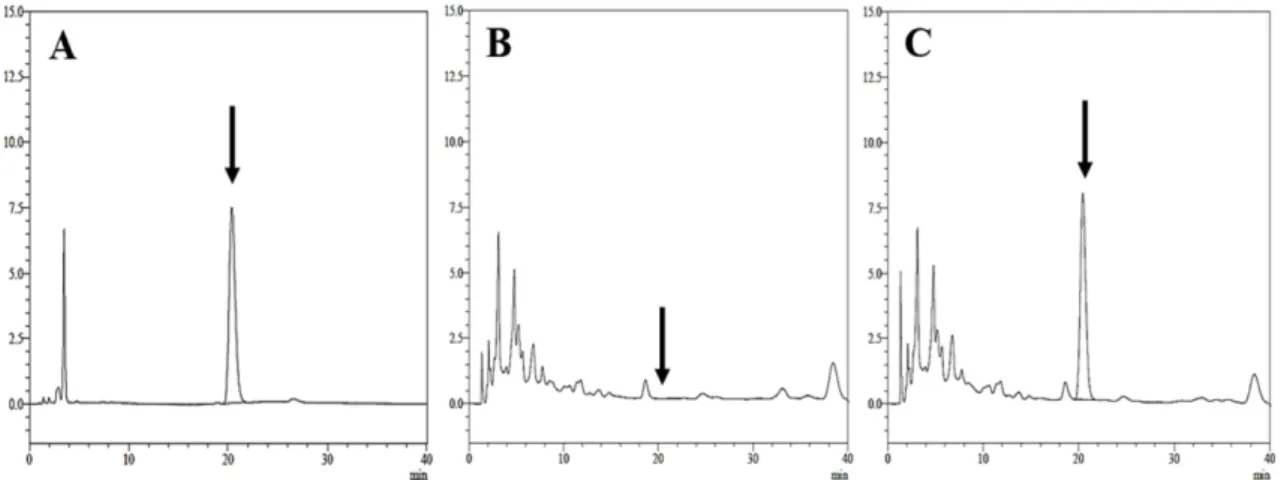
들깻잎 중 chlorantraniliprole과 tetraconazole의 최소검출 량은 각각 0.4 ng, 0.2 ng이었으며, 이를 산출한 분석법의 검 출한계는 0.04 mg/kg이었다. 시험농약의 회수율시험 결과는 Table 3 과 같이 chlorantraniliprole은 97.7-100.2%이었으며, tetraconazole은 85.6-104.9%로 잔류농약분석법 기준인 70- 120% 를 만족하는 것으로 나타났다. 표준용액 및 회수율 시 험의 분석 chromatogram은 각각 Fig. 1 및 2와 같았으며 시 료 중 간섭 peak는 존재하지 않았다.
들깻잎 중 잔류농약 양상의 kinetic 해석
들깻잎에 살포된 chlorantraniliprole과 tetraconazole 잔류 량은 Table 4와 같이 살포 후 시간의 경과에 따라 지속적으 로 감소하는 경향을 보였다. 들깻잎 중 chlorantraniliprole의
Table 3. Recoveries for analytical methods of tested pesticides in perilla leaves Pesticide Fortification level
(mg/kg)
Recovery (%) MDA
c)(ng)
LOD
d)(mg/kg)
1 2 3 Mean
a)± SD
b)Chlorantraniliprole 0.4 98.5 99.1 97.7 98.9 ± 0.7
4.0 0.04
2.0 99.7 100.2 99.5 99.8 ± 0.4
Tetraconazole 0.4 104.9 96.7 101.6 101.0 ± 4.1
0.2 0.04
2.0 85.6 86.8 88.5 87.0 ± 1.7
a) Mean of triplication; b) SD, Standard Deviation; c) MDA, Minimum Detectable Amount; d) LOD, Limit of Detection
Table 2. Models employed to estimate the half-life of the chlorantraniliprole and tetraconazole in perilla leaves
Models Rate law Equations
a)Half-life(days)
Zero order kinetic model -d[C] /dt = k [C]
t= – k t + [C]
0[C]
0/ 2 k First order kinetic model -d[C] /dt = k[C] [C]
t= [C]
0 Xe
−kt0.693 / k Second order kinetic model -d[C] /dt = k[C]
21/[C]
t= k t +1 / [C]
01/k [C]
0a) [C]t and [C]0: residual pesticide concentration(mg kg−1) at time t and 0 days, respectively; k: pesticide dissipation rate constants (day−1)
초기잔류량(0일차)은 3.41 mg/kg으로 식품의약품안전처에 서 들깻잎에 설정한 잔류허용기준인 10 mg/kg보다 낮게 나 타났으며, tetraconazole의 최대 잔류량의 경우도 처리 직후 11.86 mg/kg 으로 기존에 설정된 잔류허용기준인 15 mg/kg 보다 낮은 수준으로 나타났다. 들깻잎 중 두 농약의 잔류량 은 chlorantraniliprole의 경우 2회 살포하였을 때 살포 직후 3.41 mg/kg 에서 10일차에 2.50 mg/kg으로 약 27%로 감소하 였으며, tetraconazole의 경우 3회 살포하였을 때 살포 직후 11.86 mg/kg 에서 10일 차에 7.02 mg/kg으로 약 41%까지 지
속적으로 감소하였다.
들깻잎 중 시간에 따른 농약의 농도변화를 예측하기 위해 ZO, FO 및 SO을 사용하였으며, 3가지 식은 농약을 비롯한 환경오염 물질의 이동 및 동태를 예측하는데 주로 활용되는 model이다(Kim et al., 2012; Yang et al., 1995). 가장 적절 한 model의 선정은 큰 r
2와 작은 표준오차를 갖는 것을 기 준으로 삼는다(Omirou et al., 2009; Park et al., 2005; Yang et al., 1995). ZO, FO 및 SO을 사용하여 얻어진 회귀방정식 은 Table 5와 같았으며 감소 양상은 Fig. 3과 같다. 시간에 Fig. 1. Chromatogram of chlorantraniliprole in perilla leaves by HPLC-UVD (A: chlorantraniliprole standard solution 10 mg/kg, B:
control, C: fortification level 2.0 mg/kg).
Fig. 2. Chromatogram of tetraconazole in perilla leaves by GC-ECD (A: tetraconazole standard solution 10 mg/kg, B: control, C:
fortification level 2.0 mg/kg).
Table 4. Residual amounts of chlorantraniliprole and tetraconazole in perilla leaves after final application
Pesticide Number of application
Residual amounts
a)(mg/kg) ± SD
b)Days after final application
0 1 3 5 7 10
Chlorantraniliprole 2 3.40 ± 0.01 3.31 ± 0.00 3.27 ± 0.01 2.60 ± 0.01 2.54 ± 0.01 2.50 ± 0.01 Tetraconazole 3 11.10 ± 0.65 10.29 ± 0.14 9.37 ± 0.06 9.08 ± 0.07 8.25 ± 0.03 7.01 ± 0.21
a) Mean of triplication; b) SD, Standard deviation
따른 chlorantraniliprole의 잔류양상을 3가지 model 식에 적 용해 보았을 때 r
2는 ZO 0.8434, FO 0.8471 및 SO 0.8513 으로 SO의 r
2가 가장 높아 반감기 산출에 적합할 것으로 판 단된다. Tetraconazole의 경우 r
2가 ZO는 0.9785, FO는 0.9804 및 SO는 0.9703으로 FO의 r
2가 가장 높아 반감기 산출은 FO을 적용하는 것이 적합할 것으로 판단된다.
현재 농약이 작물에서 분해되는 것을 예측하기 위해 FO 을 주로 사용되고 있으며 FO의 반감기는 초기 농도와 상관 없이 감소 상수만 고려하여 반감기를 구할 수 있다(Chen et al., 2012). 더불어 FO에서 감소 상수를 산출하여 수확 시 잔류량이 MRL을 초과하지 않도록 수확 전 일자 별 잔류량 을 설정하는 생산단계 잔류허용기준을 설정하고 관리하고 있다(Hwang et al., 2012; Kim et al., 2017). 하지만 농약의 다양한 물리화학적 특성과 작물의 특성으로 일부 농약은 FO 가 적합하지 않을 수 있다. Table 5와 같이 들깻잎 중 chlorantraniliprole의 SO를 적용한 반감기는 23.7일이지만 FO 는 19.3일로 약 4일 차이 나는 것을 볼 수 있으며, SO의 r
2가 0.8513으로 FO 및 ZO의 r
2보다 근소하게 높아 반감기 산출에 더 적합한 것으로 판단된다. 이러한 model식에 따른 반감기의 차이는 생산단계 농약잔류허용기준 설정에서 정확 한 출하시기 및 출하일자의 잔류량을 예측하기 어려워 많은 연구가 필요하지만, 각 작물 및 농약마다 반감기를 예측하
는 model식에 대한 연구 및 기초자료가 부족한 실정이다.
따라서 본 결과는 작물 중 농약의 반감기를 다양한 model식 으로 산출하여 농약안전성평가에 기초자료로 사용할 수 있 을 것으로 판단된다.
감사의 글
이 연구는 식품의약품안전처의 2017년 소면적 재배 농산물 의 농약 잔류허용기준 설정 연구(과제번호: 00-17-8-033500) 의 연구비 지원으로 수행된 결과의 일부이며 이에 깊은 감 사드립니다.
Literature Cited
Ahn, C. H., Y. H. Kim, H. S. Eom, G. H. Lee and G. H. Ryu (2014) A study on crop group for pesticide efficacy and crop safety of minor crops. Kor. J. Pestic. Sci. 18(4):364- 375.
Chen, L., L. M. S. Guan, Y. N. Wu, L. J. Xu and F. F. Fu (2012) Study on the residue and degradation of fluorine-containing pesticides in Oolong tea by using gas chromatrography- mass spectrometry. J. Food. Control. 25(2):433-440.
Chung, H. S., M. H. Kabir, A. M. Abd El-Aty, H. S. Lee, M. M.
Table 5. Biological half-lives of pesticides in perilla leaves by kinetic models
Pesticide Models Regression curve
Half-life (days)
Equations r
2Chlorantraniliprole,
FO
a)Y = 3.4039e
−0.036x0.8471 19.3
ZO
b)Y = -0.1047x + 3.3936 0.8434 16.2
SO
c)Y = 0.0124x + 0.2926 0.8513 23.7
Tetraconazole
FO
a)Y = 10.9390e
−0.043x0.9804 16.1
ZO
b)Y = -0.3812x + 10.834 0.9785 14.6
SO
c)Y = 0.0049x + 0.0901 0.9703 18.4
a) First order kinetic model; b) Zero order kinetic model; c) Second order kinetic model