JPNT 3(4), 155-161 (2014)
http://dx.doi.org/10.11003/JPNT.2014.3.4.155
Copyright © The Korean GNSS Society
J PNT Journal of Positioning, Navigation, and Timing
http://www.gnss.or.kr Print ISSN: 2288-8187 Online ISSN: 2289-0866
1. INTRODUCTION
The market for location information services is expanding worldwide, and many Global Navigation Satellite System (GNSS) services are being developed to satisfy the needs of users who demand accurate location information in various fields (Kim 2013). Precise point positioning (PPP) is the most appropriate technology to apply to portable navigation of users since it has similar performance with Differential GPS (DGPS) without installing a separate device or reference station, as precise positioning is carried out solely by the receiver at the observing point. However, if PPP is conducted using only GPS, it has the limitation of not being able to calculate the location of the user when the visibility of satellite is not sufficiently secured. If GLObal NAvigation Satellite System (GLONASS), which succeeded
Development and Positioning Accuracy Assessment of Precise Point Positioning Algorithms Based on GLONASS Code-Pseudorange
Measurements
Mi-So Kim
1, Kwan-Dong Park
1†, Jihye Won
21
Department of Geoinformatic Engineering, Inha University, Incheon 402-751, Korea
2
Jipyong Space Inc., Incheon 402-751, Korea
ABSTRACT
The purpose of this study is to develop precise point positioning (PPP) algorithms based on GLONASS code-pseudorange, verify their performance and present their utility. As the basic correction models of PPP, we applied Inter Frequency Bias (IFB), relativistic effect, satellite antenna phase center offset, and satellite orbit and satellite clock errors, ionospheric errors, and tropospheric errors that must be provided on a real-time basis. The satellite orbit and satellite clock errors provided by Information-Analytical Centre (IAC) are interpolated at each observation epoch by applying the Lagrange polynomial method and linear interpolation method. We applied Global Ionosphere Maps (GIM) provided by International GNSS Service (IGS) for ionospheric errors, and increased the positioning accuracy by applying the true value calculated with GIPSY for tropospheric errors. As a result of testing the developed GLONASS PPP algorithms for four days, the horizontal error was approximately 1.4
~ 1.5 m and the vertical error was approximately 2.5 ~ 2.8 m, showing that the accuracy is similar to that of GPS PPP.
Keywords: GLONASS, precise point positioning, code pseudo range, phase center offset
in system normalization in 2011, is used to supplement the aforementioned limitation, the user’s location cannot be calculated without securing the visibility of GPS satellite.
The basic concept of PPP was introduced by Malys &
Ortiz (1989), and since Héroux & Kouba (1995) used the term “PPP” for the first time, various studies have been conducted until recently. Witchayangkoon (2000) studied PPP algorithms using satellite orbit and satellite clock error correction information provided by International GNSS Service (IGS, http://igscb.jpl.nass.gov/index.
html), and Gao & Chen (2004) studied PPP algorithms applying satellite orbit and satellite clock error correction information on a real-time basis. A study on PPP using GLONASS is conducted by Defraigne & Baire (2011), who matched the hour meter of the GLONASS system with the GPS system and studied the method to determine the frequency of GLONASS satellites with different frequencies using channel numbers provided by broadcast ephemeris and apply to PPP. Cai & Gao (2013) conducted PPP by studying the hardware errors that occur by the frequency division system of GLONASS. In Korea, Choi et al. (2011) developed PPP algorithms and calculated location Received Oct 08, 2014 Revised Nov 17, 2014 Accepted Nov 20, 2014
†
Corresponding Author E-mail: [email protected]
Tel: +82-32-860-7604 Fax: +82-32-863-1506
http://dx.doi.org/10.11003/JPNT.2014.3.4.155
information with approximately 3 cm of error level for static positioning, and Ha et al. (2012) analyzed the accuracy of PPP using predicted ephemeris of GIPSY. The previous studies mentioned above have limitations in applying to the portable navigations of users since the focus is on PPP based on carrier-phase observed value. Moreover, previous studies on PPP using GLONASS observed value are mostly about converting the hour meter of the GLONASS system and applying errors by the frequency division system. Thus, it is necessary to conduct additional research on correction of errors such as ionospheric errors or tropospheric errors.
This study is a prestudy to develop GPS/GLONASS integrated PPP algorithms, and it developed PPP algorithms using observed values of GLONASS code-pseudorange.
We aimed to analyze the performance according to the application of the error model of PPP algorithms developed in this study by applying the satellite orbit and satellite clock error correction information provided by Information- Analytical Centre (IAC, http://glonass-iac.ru/en/) and using the Global Ionosphere Maps (GIM) provided by IGS and tropospheric correction information calculated with GNSS Inferred Positioning System and Orbit Analysis Simulation Software package (GIPSY-OASIS).
2. GLONASS ERROR CORRECTION MODEL FOR PPP
The observed value of code-pseudorange is determined by using the signal transmission time for the distance between the satellite and receiver. However, while hardware errors and signals of the satellite and receiver are transmitted, the atmospheric impacts on signals hinder accurate positioning.
The observation equation of code-pseudorange including each error factor is as shown in Eq. (1). In Eq. (1), δt
ris receiver clock error, δt
sis satellite clock error, δI is ionospheric delay error, δT is tropospheric delay error, δM is multipath error, δ
ris receiver hardware error, δ
sis satellite hardware error, and ε is probable error (Misra & Enge 2011).
p c t (
r t
s) I T M
r s4.4428076333 10
10sin
t
RL e a E
1 (
2)
RL x y z
t xv yv zv
c
_ 1
(1602 0.5625)
Glonass L
f FCN MHz
_ 2
(1246 0.4375)
Glonass L
f FCN MHz
16
2 6 2
40.3 40.3 10
( 10 )
Glonass Glonass
Total number of electrons
I TECU TEC
Frequency f f
( ) ( )
h w h w
T T T m el ZHD m el ZWD
ZTD AHD AWD ZDC
(2.2779 0.0024) P
sZHD
(1)
To increase accuracy of PPP, the correction process of error factors is essential. However, for code-pseudorange used in this study, the size of the noise is ~m, indicating that there are error factors with very small impacts on positional accuracy improvement due to correction. Therefore, this study excluded error factors with small impacts on accuracy improvement and divided the remaining factors into two categories. The first category includes Inter Frequency Bias
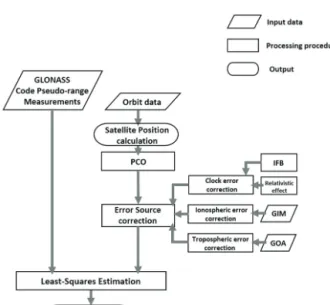
(IFB), relativistic effect, and phase center offset (PCO) errors that must be basically considered, and the second category includes GLONASS satellite orbit that must be applied as real-time correction information as well as clock error, ionospheric error and tropospheric error. The application process of correction information of PPP algorithms developed in this study is as shown in Fig. 1.
2.1 Basic Model
2.1.1 IFB and Relativistic Effects
IFB is errors on the hardware of satellite and receiver that occur in the process in which the frequency processes other signals. IFB occurs in all codes and carrier signals, and has different values according to the type of satellite and receiver. The IFB of code signals is also referred to as Differential Code Bias (DCB) (Kim 2013).
Unlike GPS, the signal division system of GLONASS is the Frequency Division Multiple Access (FDMA) method in which observed values have different frequencies for each satellite, which affects IFB. Therefore, IFB must be considered in PPP using GLONASS code-pseudorange (Aggrey & Bisnath 2014). The header part of IONosphere EXchange (IONEX) file provided by IGS provides DCB value of GLONASS and GPS, and this study calculated the correction quantity of IFB using the DCB value of IONEX file and frequency ratio of satellite signals.
The relativistic effects occur differently according to the relative motions of the satellite and receiver. They also influence the satellite orbit and signal transmission
Fig. 1. Flowchart of PPP algorithms process.
Mi-So Kim et al. Precise Point Positioning based on GLONASS 157
http://www.gnss.or.kr path and generate various errors on the clocks of satellites
and receivers. This study considered only the impacts of relativistic effects on satellite clock errors. The relativistic effects of GPS satellite are corrected by applying satellite eccentricity (e) provided by GPS broadcast ephemeris, semi- major axis (a), and eccentric anomaly (E) to Eq. (2) (Misra
& Enge 2011). However, it is easier to correct the relativistic effects of GLONASS satellite by applying the location and speed of satellite provided by GLONASS broadcast ephemeris to Eq. (3) (Xu 2007). Therefore, this study used Eq. (3) to correct the relativistic effects.
(
r s)
r sp c t t I T M
4.4428076333 10
10sin
t
RL e a E
1 (
2)
RL x y z
t xv yv zv
c
_ 1
(1602 0.5625)
Glonass L
f FCN MHz
_ 2
(1246 0.4375)
Glonass L
f FCN MHz
16
2 6 2
40.3 40.3 10
( 10 )
Glonass Glonass
Total number of electrons
I TECU TEC
Frequency f f
( ) ( )
h w h w
T T T m el ZHD m el ZWD
ZTD AHD AWD ZDC
(2.2779 0.0024) 1 0.00266cos2 0.00028
P
sZHD h
(2)
(
r s)
r sp c t t I T M
4.4428076333 10
10sin
t
RL e a E
1 (
2)
RL x y z
t c xv yv zv
_ 1
(1602 0.5625)
Glonass L
f FCN MHz
_ 2
(1246 0.4375)
Glonass L
f FCN MHz
16
2 6 2
40.3 40.3 10
( 10 )
Glonass Glonass
Total number of electrons
I TECU TEC
Frequency f f
( ) ( )
h w h w
T T T m el ZHD m el ZWD
ZTD AHD AWD ZDC
(2.2779 0.0024) 1 0.00266cos2 0.00028
P
sZHD h
(3)
In Eq. (2), e is orbital eccentricity, a is semi-major axis, and E is eccentric anomaly; in Eq. (3), c is speed of light, and (x, y, z) and (v
x, v
y, v
z) are satellite location and speed on the ECEF coordinate system.
2.1.2 Phase Center Offset
The observed value of code-pseudorange which is the distance between the satellite and receiver is provided as the phase center of transmitter/receiver antenna, and the orbit information coordinate of precise ephemeris is provided as the mass center of the satellite. The phase center and mass center of the satellite do not match with each other, and thus we need the process of converting the mass center coordinate of orbit information into the phase center coordinate in order to obtain more precise positioning result (Xu 2007).
Phase center variation (PCV) indicates the variance of mass center and phase center of antenna, and has different values according to frequency, antenna and satellite.
The mean value of PCV is phase center offset (PCO), and IGS provides phase center offset information of GPS and GLONASS in the form of ANTenna Exchange Format (ANTEX). PCV must be applied in precise positioning using the carrier-phase observed value, but just applying phase center offset is enough for precise positioning using the code-pseudorange observed value (Misra &
Enge 2011). In this study, we corrected the phase center offset by calculating the unit vector and rotation matrix in satellite body fixed reference frame using the IGS08 version information provided by ANTEX file.
2.2 Correction Information
2.2.1 Satellite Orbit and Satellite Clock Errors
To determine the coordinate of the receiver, we need the coordinate value of the satellite aside from the code- pseudorange observed value, and the coordinate of the satellite can be determined through the calculation using broadcast ephemeris or interpolation of precise ephemeris.
This study converted the coordinate into that of satellite observation time by applying the Lagrange polynomial that is optimum for precise ephemeris at 15-minute intervals provided by IAC (Kim 2009).
For satellite clock errors, there is the method of using the correction information at 30-minute intervals provided through broadcast ephemeris or correction information at 15-minute intervals provided through precise ephemeris, but this study used the clock error correction information provided by IAC in the form of CLK file. To use the CLK file that provides satellite clock error information at 5-minute or 30-second intervals, it is necessary to convert to the error value of observation time.
Since satellite clock errors are not significantly influenced by interpolation, the data processing speed was increased using the linear interpolation (Guo et al. 2010).
2.2.2 Ionospheric Errors
Ionosphere is made up of electrons and ions, among which electrons are easily influenced by external factors and thus distort and delay signals by colliding with them when satellite signals pass through the atmosphere. When observing dual frequency, ionospheric errors can be completely eliminated with ionospheric-free combination;
however, for single frequency, correction of ionospheric
errors is essential (Park et al. 2014). A general method to
correct ionospheric errors is to use the Klobuchar model,
which is a GPS ionospheric correction model, or the
NeQuick model, which is a Galileo ionospheric correction
model, as well as GIM model provided by IGS. In the case
of GLONASS, ionospheric correction factors to use the
Klobuchar and NeQuick model are not provided, but it
is possible to apply the Klobuchar and NeQuick models
to the correction of GLONASS ionospheric errors by
using the ratio of inter-satellite frequency. However, this
method can eliminate only about 50 ~ 60% of ionospheric
errors (Klobuchar 1987). Therefore, this study corrected
ionospheric errors using the GIM provided by IGS. The
GIM divides the globe into 2.5˚ × 5.0˚ grids and provides
the total number of ionosphere electrons in IONEX files at
2-hour intervals. The total number of electrons is provided
158 JPNT 3(4), 155-161 (2014)
as information on vertical direction under the assumption that electrons are concentrated on the single layer with the thickness of 0 at the altitude of 450km, and thus it is necessary to convert this to error in the gaze direction.
The unit of the number of electrons is TECU, and 1TECU indicates a distribution of 1 × 10
16free electrons on 1 m
2unit area.
Ionospheric correction quantity varies according to the satellite frequency as well as the atmospheric condition.
GPS has different frequencies for each signal with the code division multiple access (CDMA), but GLONASS has different frequencies for each satellite with the FDMA.
Therefore, for ionospheric correction of GLONASS, the process of calculating the frequency of each satellite is essential. The frequency of GLONASS satellite is determined by the channel numbers provided in the navigation message as shown in Eqs. (4) and (5), and the calculated frequency of satellite is applied to Eq. (6) to calculate the ionospheric delay.
(
r s)
r sp c t t I T M
4.4428076333 10
10sin
t
RL e a E
1 (
2)
RL x y z
t xv yv zv
c
_ 1
(1602 0.5625)
Glonass L
f FCN MHz
_ 2
(1246 0.4375)
Glonass L
f FCN MHz
16
2 6 2
40.3 40.3 10
( 10 )
Glonass Glonass
Total number of electrons
I TECU TEC
Frequency f f
( ) ( )
h w h w
T T T m el ZHD m el ZWD
ZTD AHD AWD ZDC
(2.2779 0.0024) 1 0.00266cos2 0.00028
P
sZHD h
(4)
(
r s)
r sp c t t I T M
4.4428076333 10
10sin
t
RL e a E
1 (
2)
RL x y z
t xv yv zv
c
_ 1
(1602 0.5625)
Glonass L
f FCN MHz
_ 2
(1246 0.4375)
Glonass L
f FCN MHz
16
2 6 2
40.3 40.3 10
( 10 )
Glonass Glonass
Total number of electrons
I TECU TEC
Frequency f f
( ) ( )
h w h w
T T T m el ZHD m el ZWD
ZTD AHD AWD ZDC
(2.2779 0.0024) 1 0.00266cos2 0.00028
P
sZHD h
(5)
(
r s)
r sp c t t I T M
4.4428076333 10
10sin
t
RL e a E
1 (
2)
RL x y z
t xv yv zv
c
_ 1
(1602 0.5625)
Glonass L
f FCN MHz
_ 2
(1246 0.4375)
Glonass L
f FCN MHz
16
2 6 2
40.3 40.3 10
( 10 )
Glonass Glonass
Total number of electrons
I TECU TEC
Frequency f f
( ) ( )
h w h w
T T T m el ZHD m el ZWD
ZTD AHD AWD ZDC
(2.2779 0.0024) 1 0.00266cos2 0.00028
P
sZHD h
(6)
In Eqs. (4) and (5), Frequency Channel Number (FCN) indicates channel number; and in Eq. (6), f
Glonassindicates the frequency of satellite determined by Eqs. (4) or (5).
2.2.3 Tropospheric Errors
When the signals of the satellite pass through the atmosphere, they are distorted and delayed by dry air and vapor in the troposphere. The degree of tropospheric errors is determined by temperature, humidity and atmospheric pressure, and the refractive index is the same regardless of frequency and thus cannot be eliminated even by using dual frequency. Therefore, to eliminate tropospheric errors, it is necessary to use statistical estimation or empirical model (Park et al. 2014).
Zenith Hydrostatic Delay (ZHD) that takes up 90% of tropospheric errors has physically stable distribution and can be accurately corrected by using pressure. However, Zenith Wet Delay (ZWD) that takes up 10% of tropospheric errors has big changes according to weather conditions and thus cannot be accurately corrected (Kim 2013). The tropospheric error of two types of delay is presented as shown in Eq. (7).
4.4428076333 10
10sin
t
RL e a E
1 (
2)
RL x y z
t xv yv zv
c
_ 1
(1602 0.5625)
Glonass L
f FCN MHz
_ 2
(1246 0.4375)
Glonass L
f FCN MHz
16
2 6 2
40.3 40.3 10
( 10 )
Glonass Glonass
Total number of electrons
I TECU TEC
Frequency f f
( ) ( )
h w h w
T T T m el ZHD m el ZWD
ZTD AHD AWD ZDC
(2.2779 0.0024) 1 0.00266cos2 0.00028
P
sZHD h
(7) In Eq. (7), δT is the tropospheric error of the gaze direction, and this value is equivalent to the sum of δT
h, the ZHD of the gaze direction, and δT
w, the ZWD of the gaze direction. The ZHD and ZWD of the gaze direction can be calculated by applying the altitude el, dry mapping function m
h, and wet mapping function m
wto the ZHD and ZWD of the zenith direction. The mapping function is a function that converts the delay of the zenith direction into delay of the gaze direction in which the signal is transmitted from the satellite to the receiver (Won et al. 2010).
This study compared the degree of improvement according to the tropospheric error correction model by applying the GIPSY calculation method (GOA) and Global Pressure and Temperature (GPT). GOA is the method of calculating total tropospheric delay by adding up the values of A priori Hydrostatic Delay (AHD) and A priori Wet Delay (AWD) as well as Zenith Delay Correction (ZDC) of the a priori delay estimated in GIPSY. This process is as shown in Eq. (8) (Kim et al. 2012).
(
r s)
r sp c t t I T M
4.4428076333 10
10sin
t
RL e a E
1 (
2)
RL x y z
t xv yv zv
c
_ 1
(1602 0.5625)
Glonass L
f FCN MHz
_ 2
(1246 0.4375)
Glonass L
f FCN MHz
16
2 6 2
40.3 40.3 10
( 10 )
Glonass Glonass
Total number of electrons
I TECU TEC
Frequency f f
( ) ( )
h w h w
T T T m el ZHD m el ZWD
ZTD AHD AWD ZDC
(2.2779 0.0024) 1 0.00266cos2 0.00028
P
sZHD h
(8)
Total tropospheric delay is equal to the sum of ZHD and ZWD, and ZHD can be calculated with Eq. (9). In Eq.
(9), φ is the latitude of the observatory, h is the ellipsoid of the observatory [m], and P
sis the atmospheric pressure acquired from meteorological sensor (Elgered et al. 1991).
We calculated the difference between the total tropospheric delay calculated from Eq. (8) and the ZHD value obtained from Eq. (9) to quantitatively divide ZHD and ZWD. We corrected the tropospheric error toward the gaze direction by applying Global Mapping Function (GMF) to the estimated ZHD and ZWD. GMF has similar accuracy with Vienna Mapping Function (VMF) and can be applied on a real-time basis unlike VMF, and it is a mapping function expanded so that the regionally limited data of VMF can be used in all global scope (Kim 2013).
(
r s)
r sp c t t I T M
4.4428076333 10
10sin
t
RL e a E
1 (
2)
RL x y z
t xv yv zv
c
_ 1
(1602 0.5625)
Glonass L
f FCN MHz
_ 2
(1246 0.4375)
Glonass L
f FCN MHz
16
2 6 2
40.3 40.3 10
( 10 )
Glonass Glonass
Total number of electrons
I TECU TEC
Frequency f f
( ) ( )
h w h w
T T T m el ZHD m el ZWD
ZTD AHD AWD ZDC
(2.2779 0.0024) 1 0.00266cos2 0.00028
P
sZHD h
(9)
GPT is an empirical model based on spherical harmonic function providing atmospheric pressure and temperature all over the globe. If latitude, altitude and observation date of the observatory are entered, it calculates the relevant atmospheric pressure and temperature (Böhm et al. 2012).
ZHD can be calculated by applying the latitude ( φ ) and
altitude (h) of the observatory and atmospheric pressure (P
s)
Mi-So Kim et al. Precise Point Positioning based on GLONASS 159
http://www.gnss.or.kr calculated from the GPT model to Eq. (9). The calculated
ZHD is corrected with gaze direction error by applying simple mapping function to the altitude angle. Parts relevant to ZWD are not considered in the GPT method.
3. PPP PERFORMANCE EVALUATION OF GLONASS
3.1 Observation Data
For performance verification and utility evaluation according to the application of PPP algorithms based on GLONASS code-pseudorange developed in this study to correction information, we used the IHUR observatory located in Inha University. IHUR uses the NetR5 receiver by Trimble and TRM41249.00 antenna, and we used the data recorded at 30-second intervals on July 31, 2014 (DOY212) and August 9 (DOY221), 19 (DOY231), and 29 (DOY241), 2014. Moreover, we collected pressure data through the meteorological sensor of Paroscientific Met-4A and divided tropospheric errors into ZHD and ZWD. We verified the performance of PPP algorithms on the basis of precise coordinate of IHUR observatory calculated with GIPSY.
3.2 Positioning Performance Evaluation Result According to the Application of Error Models
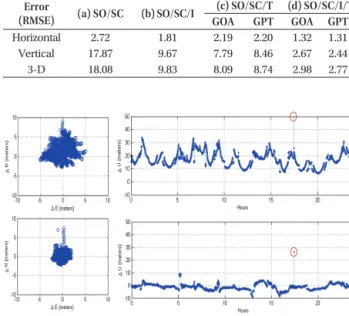
We evaluated the positioning performance according to the application of error models by applying the aforementioned error factors. Moreover, to determine the positioning performance according to the application of atmospheric correction information, we applied the correction of the basic model and clock error, after which we applied the correction of ionospheric errors and tropospheric errors in order. We applied the GIM model for ionospheric error correction, and GOA and GPT model for tropospheric error correction, comparing the degree of improvement in positioning accuracy. Table 1 is a result of applying each error correction model to the data of July 31, 2014 (DOY: 212). (a) is the case in which satellite orbit (SO) and satellite clock (SC) error correction models are applied; (b) is the case in which ionosphere (I) correction model is applied to (a); (c) is the case in which troposphere (T) correction model is applied to (a); and (d) is the case in which both ionosphere and tropospheric errors are applied to (a).
Table 1 shows that the accuracy improvement in the vertical direction is greater than in horizontal direction for both when ionospheric errors and tropospheric errors are corrected. An additional characteristic is that ionospheric
error correction improves horizontal accuracy more than tropospheric error correction, while tropospheric error correction improves vertical accuracy more than ionospheric error correction. As a result of verifying the contribution level of positioning accuracy improvement of the atmospheric model by applying both ionospheric and tropospheric error correction, it was found that, when GOA is applied, horizontal error is improved by approximately 51.4% from 2.72 m to 1.32 m and vertical error by 85% from 17.87 m to 2.67 m, compared to the case in which only satellite orbit error and satellite clock error are applied. This improvement can be found in Fig. 2 as well. Moreover, Fig. 2 also shows the increase in errors in certain sections, which is due to the temporary increase in errors in sections where visibility of satellite is not sufficiently secured.
To determine the performance of developed algorithms, we additionally tested 3 days (DOY: 221, 231, 241) aside from July 31, 2014 (DOY 212). Table 2 shows the result of (d) in which satellite orbit, satellite clock errors, ionospheric errors and tropospheric errors are all applied to four days.
1-1) Horizontal coordinate error of (a) SO/SC 1-2) Vertical coordinate error of (a) SO/SC 2-1) Horizontal coordinate error of (d) SO/SC/I/T 2-2) Vertical coordinate error of (d) SO/SC/I/T
Fig. 2. Horizontal and vertical PPP positioning error.
Table1. Positioning accuracy according to the application of each error correction model (unit: m)..
Error
(RMSE) (a) SO/SC (b) SO/SC/I (c) SO/SC/T (d) SO/SC/I/T GOA GPT GOA GPT
Horizontal 2.72 1.81 2.19 2.20 1.32 1.31
Vertical 17.87 9.67 7.79 8.46 2.67 2.44
3-D 18.08 9.83 8.09 8.74 2.98 2.77
Table 2. Positioning accuracy according to the application of data per date (unit: m).
Error (RMSE)
DOY 212 DOY 221 DOY 231 DOY 241 Average GOA GPT GOA GPT GOA GPT GOA GPT GOA GPT Horizontal 1.32 1.31 1.6 1.6 1.42 1.42 1.51 1.51 1.46 1.46 Vertical 2.67 2.44 2.67 2.35 2.92 2.68 2.84 2.54 2.75 2.5 3-D 2.98 2.77 3.12 2.84 3.25 3.03 3.22 2.96 3.14 2.9