JPNT 4(4), 181-186 (2015)
http://dx.doi.org/10.11003/JPNT.2015.4.4.181
Copyright © The Korean GNSS Society
J PNT Journal of Positioning, Navigation, and Timing
http://www.gnss.or.kr Print ISSN: 2288-8187 Online ISSN: 2289-0866
1. INTRODUCTION
In modern aerospace applications, a Strapdown Inertial Navigation System (SDINS) provides the position, velocity and attitude of the vehicle, which are critical to a mission’s success. The accuracy of the navigation information depends on the calculated attitude between body and navigation frame during the alignment process.
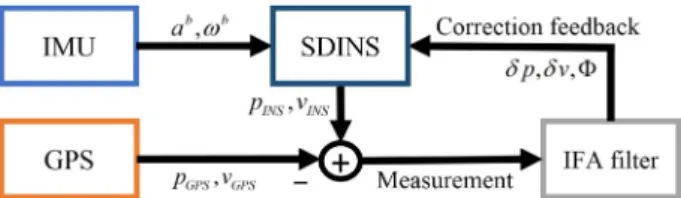
In-Flight Alignment (IFA) is an approach that determines and compensates the attitude with the help of external aiding sources, such as Global Navigation Satellite System (GNSS). Unlike the initial self-alignment, it doesn’t require the vehicle to be in a stationary state. Fig. 1 shows the characteristics of SDINS, GNSS and aided navigation. Due to the integration involved in SDINS, it has tendency of divergence over time, while GNSS output is bounded with instant position errors. IFA incorporates the advantages
High-degree Cubature Kalman Filtering Approach for GPS Aided In-Flight Alignment of SDINS
Hyun-choel Shin
1†, Haesung Yu
2, Heung-won Park
11
University of Science and Technology - Agency for Defense Development campus (UST-ADD), Daejeon 305-152, Korea
2
Agency for Defense Development, Daejeon, 305-152, Korea
ABSTRACT
A High-degree Cubature Kalman Filter (CKF) is proposed to deal with the Strapdown Inertial Navigation System (SDINS) alignment problem. In-flight Alignment (IFA) is an effective method to compensate for attitude errors of the navigation system. While providing precise attitude error compensation, however, the external source aided alignment often creates a nonlinear filtering problem caused by a large misalignment angle. Introduced recently, Cubature Kalman Filter is a suitable technique for various nonlinear problems. In this paper, a higher degree CKF is applied to this accuracy-is-everything SDINS IFA problem. The simulation results show that the proposed technique outperformed a traditional nonlinear filter in terms of precision and alignment time.
Keywords: fifth-degree cubature kalman filter, large attitude misalignment model, strapdown inertial navigation system, in-flight alignment
of each system, making the navigation more accurate and stable.
If coarse alignment is performed during flight or under disturbances, the uncertainty of the angular body rate and acceleration may prevent a precise determination of the
Received Oct 06, 2015 Revised Nov 11, 2015 Accepted Nov 18, 2015
†