• 검색 결과가 없습니다.

Effects of Age, Sex, and Menopausal Status on Blood Cholesterol Profile in the Korean Population

N/A
N/A
Protected

Academic year: 2022

Share "Effects of Age, Sex, and Menopausal Status on Blood Cholesterol Profile in the Korean Population"

Copied!
8
0
0

로드 중.... (전체 텍스트 보기)

전체 글

(1)

Korean Circulation Journal

Introduction

Cardiovascular disease is the leading cause of death in Korea, and its burden on society is steadily increasing due to an ageing popu- lation and worsening cardiovascular risk profiles. Elevation or im- balance in blood cholesterols is the most important cardiovascular

Print ISSN 1738-5520 • On-line ISSN 1738-5555

Effects of Age, Sex, and Menopausal Status on Blood Cholesterol Profile in the Korean Population

Ji Hye Park, BS 1 , Myung Ha Lee, PhD 2 , Jee-Seon Shim, PhD 3 , Dong Phil Choi, PhD 1 , Bo Mi Song, MSc 1 , Seung Won Lee, MSc 1 , Hansol Choi, MSc 1 , and Hyeon Chang Kim, MD 2,3

1

Department of Public Health, Yonsei University Graduate School, Seoul,

2
Department of Preventive Medicine,

3

Cardiovascular and Metabolic Diseases Etiology Research Center, Yonsei University College of Medicine, Seoul, Korea

Background and Objectives: To investigate age-specific and sex-specific distributions of blood cholesterol in the general Korean popu- lation.

Subjects and Methods: We analyzed data for 8284 men and 9246 women aged ≥10 years who participated in the fifth (2010–2012) Ko- rea National Health and Nutrition Examination Survey. Age-specific means, medians, and selected percentiles were calculated for men, pre- menopausal women, and postmenopausal women.

Results: Median total cholesterol (TC) level increased with age across all age groups, from 147 to 196 mg/dL in males and from 159 to 210 mg/dL in females. Triglyceride (TG) levels increased with age in females; however, in males, TG levels rapidly increased during young adult- hood, peaked at 50–54 years, and then decreased. High density lipoprotein-cholesterol (HDL-C) levels were higher in females than in males and decreased with increasing age in both males and females. Low density lipoprotein-cholesterol (LDL-C) levels increased with age across all age groups, from 89 to 127 mg/dL in males and from 82 to 113 mg/dL in females. Lipoprotein-cholesterol fraction (TC/HDL-C, LDL-C/

HDL-C, TG/HDL-C, non-HDL-C) levels increased with age in females, but increased more rapidly in males during young adulthood and de- creased after middle age.

Conclusion: Blood cholesterol levels and lipoprotein-cholesterol fractions present different distributions by age, sex, and menopausal status. (Korean Circ J 2015;45(2):141-148)

KEY WORDS: Cholesterol; Triglycerides; High density lipoprotein-cholesterol; Low density lipoprotein-cholesterol; Epidemiology.

Received: September 27, 2014 Revision Received: December 2, 2014 Accepted: December 18, 2014

Correspondence: Hyeon Chang Kim, MD, Department of Preventive Med- icine, Yonsei University College of Medicine, 50-1 Yonsei-ro, Seodaemun- gu, Seoul 120-752, Korea

Tel: 82-2-2228-1873, Fax: 82-2-392-8133 E-mail: [email protected]

• The authors have no financial conflicts of interest.

This is an Open Access article distributed under the terms of the Creative Commons Attribution Non-Commercial License (http://creativecommons.

org/licenses/by-nc/3.0) which permits unrestricted non-commercial use, distribution, and reproduction in any medium, provided the original work is properly cited.

risk factor. High levels of total cholesterol (TC) and low density lipo-

protein-cholesterol (LDL-C) are recognized as significant contrib-

uting factors to atherosclerotic cardiovascular disease,

1)2)

and elevat-

ed low serum high density lipoprotein-cholesterol (HDL-C) is asso-

ciated with increased risk of cardiovascular disease.

3)4)

Ratios of li-

poprotein-cholesterol fractions, such as TC to HDL-C ratio (TC/HDL-

C) or LDL-C to HDL-C ratio (LDL-C/HDL-C), are better than the ab-

solute level of LDL-C at discriminating between individuals who

are more or less likely to develop cardiovascular disease based on

the results from previous studies.

3)5)6)

Thus, TC/HDL-C or LDL-C to HDL-

C ratio (LDL-C/HDL-C) may prove to be a better marker for identi-

fying and monitoring cardiovascular disease risk.

7)

Increasing evi-

dence

8)9)

supports the theory that serum triglycerides (TG) may be

an independent risk factor for cardiovascular disease. Moreover, el-

evated TG and low HDL-C are basic characteristics of insulin resis-

tance and metabolic syndrome, which are both strongly associated

with cardiovascular disease.

10)11)

The TG/HDL-C, a relatively novel li-

poprotein index, could serve as a good predictor of cardiovascular

(2)

disease.

12)

At the same time, the non-HDL-C (calculated by subtract- ing HDL-C from TC) level provides a convenient measure of the cho- lesterol content of all atherogenic lipoproteins, and thus incorpo- rates the potential risk for cardiovascular disease.

13)

Many studies have investigated the prevalence of dyslipid- emia.

14-16)

However, to date, no study has yet reported on the dis- tributions of plasma lipid and lipoprotein-cholesterol fractions by age, sex, and menopausal status of Korean participants. Therefore, we investigated the distributions of TC, TG, HDL-C, LDL-C, and lipo- protein-cholesterol fractions according to age, sex and menopaus- al status in the Korean population.

Subjects and Methods

Participants

This study was based on data obtained from the fifth (2010–2012) Korean National Health and Nutritional Examination Survey (KN- HANES). The KNHANES is performed annually with a stratified mul- tistage probability cluster sample, which is designed to be represen- tative of the entire population of South Korea.

17)

A total of 25534 individuals participated in the fifth KNHANES. Among these partici- pants, we excluded individuals as follows: 1) aged <10 years; 2) tak- ing lipid-lowering agents; 3) use of hormone replacement therapy within the last 12 months; and 4) lipid profiles that were not avail- able. Finally, a total of 17530 subjects (8284 men and 9246 women) were analyzed for this study. Written informed consent was secured from each participant, and the KNHANES was conducted after ethi- cal approval by the Institutional Review Board of the Korean Centers for Disease Control and Prevention (approval no. 2010-02CON-21-C, 2011-02CON-06-C, 2012-01EXP-01-2C).

Measurements

Blood samples were taken after subjects had fasted for eight or more hours. Fasting blood samples collected from each individual during the survey were processed, refrigerated immediately, trans- ported in cold storage to the central laboratory (Neodin Medical In- stitute, Seoul, Korea), and analyzed within 24 hours after transpor- tation. Fasting glucose, TC, HDL-C, and TG levels were determined using a Hitachi 7600 automated chemistry analyzer (Hitachi, Tokyo, Japan). The Friedewald formula was used to calculate LDL-C for sub- jects with serum TG level ≤400 mg/dL

18)

and measured directly using the Hitachi 7600 analyzer for subjects with serum TG level >400 mg/dL. Non-HDL-C was calculated by subtracting HDL-C from TC.

Hypertension, diabetes, and dyslipidemia were defined as the cases where the participants replied that they had been diagnosed by a physician in the health interview survey. The health interview sur- vey asked the female participants whether they were currently men-

struating, then asked the cause of absent menstruation if they an- swered no. Menopausal status was dichotomized into premeno- pausal versus postmenopausal states, which included menopause with or without a hysterectomy. Body mass index was calculated by dividing weight by height (kg/m

2

). Smoking status was catego- rized into never/past or current (daily or intermittent) smoker. Alco- hol consumption was categorized according to the frequency of al- cohol consumed, and alcohol drinkers were defined as those who consume more than drinks at least once per month.

Statistical analyses

Mean, standard deviation, and selected percentile values were calculated for each variable by age, sex, and menopausal status. St- atistical analyses were conducted using Statistical Analysis System (SAS) version 9.2 (SAS Institute, Cary, NC, USA) and with the con- sideration of a two-sided p less than 0.05 as statistically significant for all analyses.

Results

Characteristics of the study population are shown in Table 1. Pre- valence of previously diagnosed hypertension, diabetes, and dys- lipidemia was 18.6%, 7.9%, and 7.9% in males, and 20.1%, 6.3%, and 10.5% in females, respectively. Males had significantly higher blood pressure, fasting glucose, TG, and history of smoking and drinking than females. Distributions of lipid levels and lipoprotein- cholesterol fractions are presented by 5-year age intervals in the tables and figures. Supplementary Table 1–8 contain the number of subjects, means, standard deviations of the means, and percen- tile values; figures contain only medians for each variable.

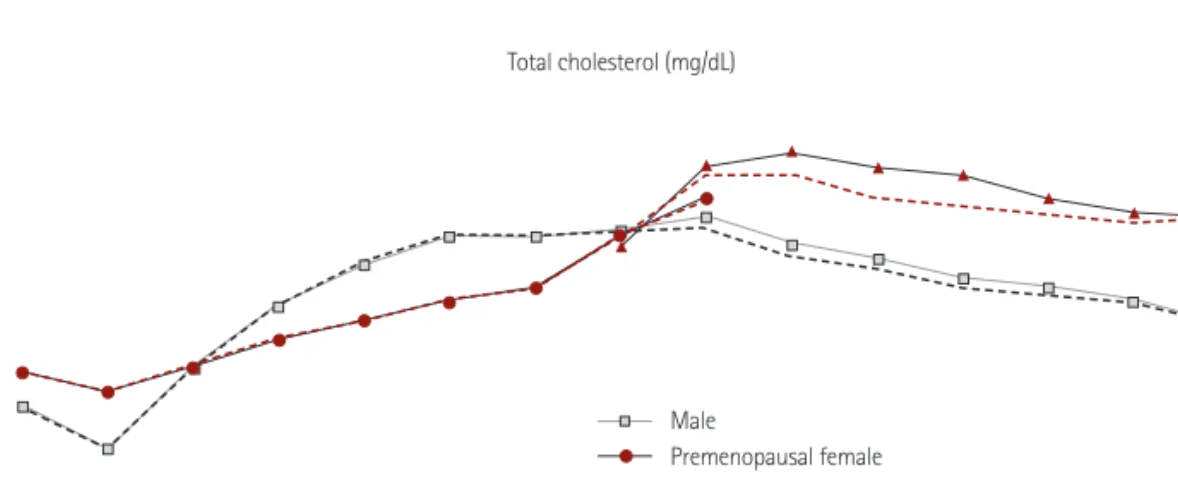
The level of TC increased from 156 mg/dL in the males 10–14 years old to a maximum of 196 mg/dL in the 50–54 year age group, and in females these levels increased from 163 mg/dL in 10–14 year olds to a maximum of 210 mg/dL in 55–59 year olds. Between age 25 to 49 years, TC level was higher in males than in females. How- ever, the TC level was higher in females than in males among the younger (10 to 19 years) and older (≥50 years) age groups (Fig. 1, Supplementary Table 1 and 2 in the online-only Data Supplement).

The level of TG increased with age and peaked among females aged ≥80 years, while the males reflected a more rapid increase of plasma TG levels during young adulthood (10 to 54 years) which decreased during middle age (55 to ≥80 years). The highest TG level was observed in 50–54 year (138 mg/dL) old males, and 65–69 years (124 mg/dL) in females. Between age 15 to 64 years, TG level was higher in males, but , higher in females after age 65 (Fig. 2, Supplementary Table 3 and 4 in the online-only Data Supplement).

The level of HDL-C were compared between males and females.

(3)

Females showed higher HDL-C levels than males in all age groups.

The highest value was observed among 25–29 year olds (59 mg/dL), which was followed by a decrease (47 mg/dL for females ≥80 years). In males, the highest value was observed among 10–14 year olds (53 mg/dL), followed by a decrease (44 mg/dL for males ≥80 years). The HDL-C level in males decreased almost linearly, while a more rapid decrease of these levels during middle age was observed in females (Fig. 3, Supplementary Table 5 and 6 in the online-only Data Supplement).

The level of LDL-C revealed a pattern similar to TC levels. The cr- ossover of LDL-C levels for the sexes occurred in the 50–54 year age

group and led to higher LDL-C values in females than in males over 50 years (Fig. 4, Supplementary Table 7 and 8 in the online-only Data Supplement).

The TC/HDL-C ratio rapidly increased from 2.85 in the males aged 10–14 to a maximum of 4.14 in the 45–49 year olds, while in fe- males it increased from 2.97 in 10–14 year olds to a maximum of 4.16 in the ≥80 year group. The crossover of TC/HDL-C ratio for the sexes occurred in those aged 60–64 and led to a higher ratio in fe- males compared to males older than 60 years (Fig. 5, Supplementary Table 9 and 10 in the online-only Data Supplement).

In males, the LDL-C/HDL-C ratio increased from 1.59 in 10–14

Table 1. General characteristics of study population

Variables Male (n=8284) Female (n=9246) p

Age (year) 44.4±19.9 44.1±19.1 0.462

Height (cm) 168.8±8.2 156.9±6.9 <0.001

Weight (kg) 67.1±12.6 56.2±9.7 <0.001

Body mass index (kg/m

2

) 23.4±3.4 22.8±3.6 <0.001

Waist circumference (cm) 82.1±10.4 76.6±10.4 <0.001

Systolic blood pressure (mm Hg) 120.0±16.0 115.1±17.6 <0.001

Diastolic blood pressure (mm Hg) 77.0±11.6 72.8±10.1 <0.001

Fasting glucose (mg/dL) 93 [87–101] 90 [85–97] <0.001

HbA1c (%) 5.8±0.9 5.7±0.8 <0.001

Total cholesterol (mg/dL) 182.8±36.1 187.8±36.5 <0.001

HDL-C (mg/dL) 49.9±11.9 55.4±12.6 <0.001

Triglycerides (mg/dL) 111 [74–167] 88 [62–131] <0.001

Known hypertension (%) 1324 (20.0) 1451 (15.7) <0.001

Known diabetes (%) 547 (6.6) 435 (4.7) <0.001

Known dyslipidemia (%) 303 (3.7) 329 (3.6) 0.424

Current smoker (%) 2812 (45.4) 462 (5.0) <0.001

Alcohol drinker (%) 4191 (50.6) 3108 (33.6) <0.001

Data are expressed as means±standard deviation, median [inter quartile range]. HbA1c: hemoglobin A1c, HDL-C: high density lipoprotein-cholesterol

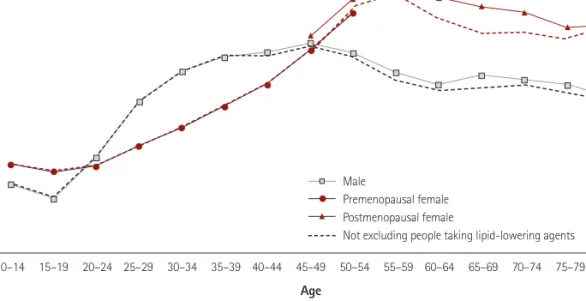
Fig. 1. Median values of total cholesterol for age, sex, and menopausal status.

220 210 200 190 180 170 160 150 140 130

120 10–14 15–19 20–24 25–29 30–34 35–39 40–44 45–49 50–54 55–59 60–64 65–69 70–74 75–79 80+

Total cholesterol (mg/dL)

Age Male

Premenopausal female Postmenopausal female

Not excluding people taking lipid-lowering agents

(4)

year olds to a maximum of 2.42 in 45–49 year old, while in females these values increased from 1.64 in 10–14 year olds to a maximum of 2.55 in 60–64 year olds. The crossover of LDL-C/HDL-C ratio for the sexes occurred in 55–59 year olds, which led to higher ratio in females than in males after 55 years (Fig. 6, Supplementary Table 11 and 12 in the online-only Data Supplement).

The TG/HDL-C ratio in males increased from 1.20 in 10–14 year olds to a maximum of 3.06 in 50–54 year olds, and in females these values increased from 1.40 in the 10–14 year olds to a maximum of 2.63 in those ≥80 years (Fig. 7, Supplementary Table 13 and 14 in the online-only Data Supplement).

The value of non-HDL-C in males increased from 100 mg/dL in 10–14 year olds to a maximum of 146 mg/dL in 45–54 year olds. In females, these values increased from 106 mg/dL in 10–14 year olds

to a maximum of 155.5 mg/dL in 55–59 year olds (Fig. 8, Supple- mentary Table 15 and 16 in the online-only Data Supplement).

Discussion

We reported the distributions of plasma lipid and lipoprotein- cholesterol fractions by sex and age among 17530 Koreans, which were sampled to represent the Korea population. These data are provided to facilitate the identification of individuals in the high- est lipid or lipoprotein percentiles by age, sex, and menopausal sta- tus. Plasma lipid and lipoprotein-cholesterol fractions levels in- creased with age in females, while the males tend to have a more rapid increase during young adulthood and a decrease during and after middle age.

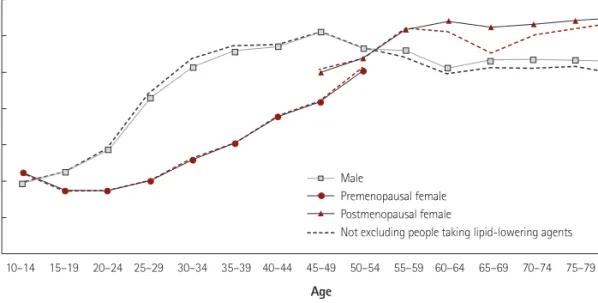
Fig. 2. Median values of triglycerides for age, sex, and menopausal status.

Triglycerides (mg/dL) 150

140 130 120 110 100 90 80 70 60 50 40

30 10–14 15–19 20–24 25–29 30–34 35–39 40–44 45–49 50–54 55–59 60–64 65–69 70–74 75–79 80+

Age Male

Premenopausal female Postmenopausal female

Not excluding people taking lipid-lowering agents

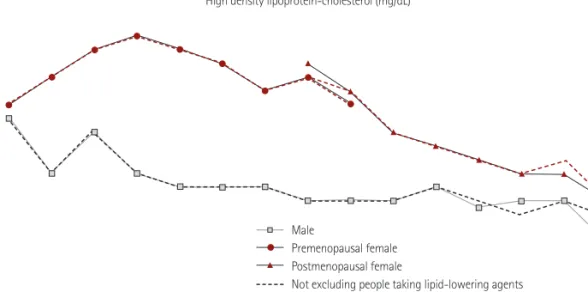
Fig. 3. Median values of high density lipoprotein-cholesterol for age, sex, and menopausal status.

High density lipoprotein-cholesterol (mg/dL) 60

58 56 54 52 50 48 46 44 42

40 10–14 15–19 20–24 25–29 30–34 35–39 40–44 45–49 50–54 55–59 60–64 65–69 70–74 75–79 80+

Age Male

Premenopausal female Postmenopausal female

Not excluding people taking lipid-lowering agents

(5)

Blood lipid level and lipoprotein composition have a role in the development of atherogenesis and vascular disorders. Most impor- tantly, the risk of atherosclerotic heart disease increases with in- creasing levels of TC and LDL-C;

19)

but the risk decreases with in- creasing levels of HDL-C.

20)21)

The age-related and sex-related ch- anges in LDL-C levels reported in this study closely resemble those for TC, as almost 70% of TC is transported by lipoproteins in the low-density range. When compared with US populations from the NHANES 2010,

22)

Korean males showed lower mean TC and LDL-C levels (TC 183 mg/dL; LDL-C 106 mg/dL) compared to American males (TC 194 mg/dL; LDL-C 116 mg/dL), and Korean females also showed lower mean levels (TC 188 mg/dL; LDL-C 111 mg/dL) than American females (TC 198 mg/dL; LDL-C 115 mg/dL). It is well- known that HDL-C is higher in females than in males.

23)

In our pop-

ulation, the mean HDL-C level was 50 mg/dL for males and 55 mg/

dL for females. Korean males displayed higher HDL-C levels than American males (47 mg/dL), while levels in Korean females were lower than American females (57 mg/dL). Accordingly, male-female difference in mean HDL-C level is only 5 mg/dL in the Korean pop- ulation, while it is about 10 mg/dL in the American population. The mean TG levels are consistently higher (males 134 mg/dL; female 107 mg/dL) than those found in previous surveys of the US popu- lations (males 119 mg/dL; female 102 mg/dL). A high carbohydrate diet may be the one of the possible causes of high TG levels in the Korean population, which in turn promotes the formulation of small and dense LDLs.

24)

The reason for the difference in lipoprotein profile between Korean and US populations might be due to genetics, en- vironmental factors, or both.

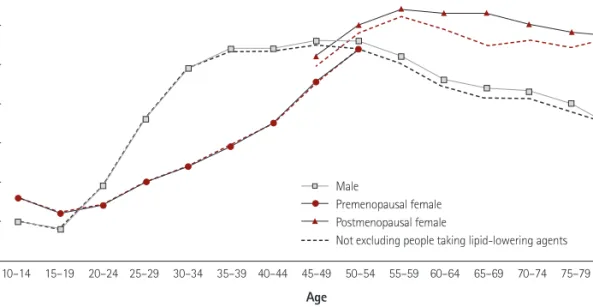
Fig. 4. Median values of low density lipoprotein-cholesterol for age, sex, and menopausal status.

Low density lipoprotein-cholesterol (mg/dL) 130

120

110

100

90

80

70 10–14 15–19 20–24 25–29 30–34 35–39 40–44 45–49 50–54 55–59 60–64 65–69 70–74 75–79 80+

Age Male

Premenopausal female Postmenopausal female

Not excluding people taking lipid-lowering agents

Fig. 5. Median values of TC/HDL-C ratio for age, sex, and menopausal status. TC: total cholesterol, HDL-C: high density lipoprotein-cholesterol.

TC/HDL-C 4.30

4.10 3.90 3.70 3.50 3.30 3.10 2.90 2.70

2.50 10–14 15–19 20–24 25–29 30–34 35–39 40–44 45–49 50–54 55–59 60–64 65–69 70–74 75–79 80+

Age Male

Premenopausal female Postmenopausal female

Not excluding people taking lipid-lowering agents

(6)

In our study population, the effects of ageing on plasma lipids and lipoprotein-cholesterol fractions significantly differed between males and females. Because females with elevated blood cholester- ol tend to be older, they also have a higher chance of developing cardiovascular disease. Furthermore, although plasma levels of TC, LDL-C, HDL-C, and TG are highly heritable,

25)

environmental factors affect plasma concentrations of these parameters. In previous stud- ies, it has been shown that diet composition, particularly dietary cholesterol and saturated fatty acids, has a significant effect on blood cholesterol.

26)27)

In females, menopause is an additional de- terminant of these parameters. The post-menopausal decrease of plasma estrogen levels may play a significant role in reducing the clearance of LDL particles and the subsequent increase in LDL-C lev-

els in postmenopausal women.

28)

Estrogen replacement treatment has been shown to decrease LDL-C and increase HDL-C levels in dyslipidemic postmenopausal women.

29)

The present study has several limitations that need to be dis- cussed. First, the KNHANES was designed to represent the Korean population, but the sample was limited to the non-institutionalized civilian population of Korean. Therefore, people who were admitted to the hospital or nursing homes were not included in this study.

Second, LDL-C levels were not directly measured but calculated by the Friedewald’s formula. However, this formula has been validated and used extensively to measure LDL-C levels in epidemiological studies.

30)

Third, we did not control for the effects of prevalent dis- eases which may affect plasma lipid levels. We were also unable to Fig. 6. Median values of LDL-C/HDL-C ratio for age, sex, and menopausal status. LDL-C: low density lipoprotein-cholesterol, HDL-C: high density lipopro- tein-cholesterol.

LDL-C/HDL-C

2.60 2.40 2.20 2.00 1.80 1.60 1.40

1.20 10–14 15–19 20–24 25–29 30–34 35–39 40–44 45–49 50–54 55–59 60–64 65–69 70–74 75–79 80+

Age Male

Premenopausal female Postmenopausal female

Not excluding people taking lipid-lowering agents

Fig. 7. Median values of TG/HDL-C ratio for age, sex, and menopausal status. TG: triglycerides, HDL-C: high density lipoprotein-cholesterol.

TG/HDL-C 3.50

3.00

2.50

2.00

1.50

1.00

0.50

0.00 10–14 15–19 20–24 25–29 30–34 35–39 40–44 45–49 50–54 55–59 60–64 65–69 70–74 75–79 80+

Age Male

Premenopausal female Postmenopausal female

Not excluding people taking lipid-lowering agents

(7)

exclude the participants who were unaware of which medications were prescribed to them. Thus we could not completely eliminate the effects of lipid-lowering medications.

Blood cholesterol levels and lipoprotein-cholesterol fractions pres- ent different distributions by age, sex, and menopausal status among the Korean population. Our findings suggest that a subgroup- specific approach is required to develop efficient cardiovascular disease prevention strategies.

Acknowledgments

This study was supported by a grant of the Korean Health Tech- nology R&D Project, Ministry of Health & Welfare, Republic of Ko- rea (HI13C0715).

Supplementary Materials

The online-only Data Supplement is available with this article at http://dx.doi.org/10.4070/kcj.2015.45.2.141.

References

1. Farzadfar F, Finucane MM, Danaei G, et al. National, regional, and glob- al trends in serum total cholesterol since 1980: systematic analysis of health examination surveys and epidemiological studies with 321 country-years and 3·0 million participants. Lancet 2011;377:578-86.

2. Stamler J, Wentworth D, Neaton JD. Is relationship between serum cholesterol and risk of premature death from coronary heart disease continuous and graded? Findings in 356,222 primary screenees of the Multiple Risk Factor Intervention Trial (MRFIT). JAMA 1986;256:

2823-8.

3. Natarajan S, Glick H, Criqui M, Horowitz D, Lipsitz SR, Kinosian B. Cho- lesterol measures to identify and treat individuals at risk for coronary

heart disease. Am J Prev Med 2003;25:50-7.

4. Gordon DJ, Probstfield JL, Garrison RJ, et al. High-density lipoprotein cholesterol and cardiovascular disease. Four prospective American stud- ies. Circulation 1989;79:8-15.

5. Kinosian B, Glick H, Preiss L, Puder KL. Cholesterol and coronary heart disease: predicting risks in men by changes in levels and ratios. J Inves- tig Med 1995;43:443-50.

6. Kastelein JJ, van der Steeg WA, Holme I, et al. Lipids, apolipoproteins, and their ratios in relation to cardiovascular events with statin treat- ment. Circulation 2008;117:3002-9.

7. Anderson KM, Wilson PW, Odell PM, Kannel WB. An updated coronary risk profile. A statement for health professionals. Circulation 1991;83:

356-62.

8. Hokanson JE, Austin MA. Plasma triglyceride level is a risk factor for cardiovascular disease independent of high-density lipoprotein cho- lesterol level: a meta-analysis of population-based prospective studies.

J Cardiovasc Risk 1996;3:213-9.

9. Assmann G, Schulte H, Funke H, von Eckardstein A. The emergence of triglycerides as a significant independent risk factor in coronary artery disease. Eur Heart J 1998;19 Suppl M:M8-14.

10. Malik S, Wong ND, Franklin SS, et al. Impact of the metabolic syndrome on mortality from coronary heart disease, cardiovascular disease, and all causes in United States adults. Circulation 2004;110:1245-50.

11. Wannamethee SG, Shaper AG, Lennon L, Morris RW. Metabolic syn- drome vs Framingham Risk Score for prediction of coronary heart dis- ease, stroke, and type 2 diabetes mellitus. Arch Intern Med 2005;165:

2644-50.

12. Gaziano JM, Hennekens CH, O’Donnell CJ, Breslow JL, Buring JE. Fast- ing triglycerides, high-density lipoprotein, and risk of myocardial in- farction. Circulation 1997;96:2520-5.

13. Packard CJ, Saito Y. Non-HDL cholesterol as a measure of atheroscle- rotic risk. J Atheroscler Thromb 2004;11:6-14.

14. Lee MH, Kim HC, Ahn SV, et al. Prevalence of Dyslipidemia among Korean Adults: Korea National Health and Nutrition Survey 1998-2005.

Fig. 8. Median values of non-HDL-C for age, sex, and menopausal status. HDL-C: high density lipoprotein-cholesterol.

Non-HDL-C (mg/dL) 160

150

140

130

120

110

100

90 10–14 15–19 20–24 25–29 30–34 35–39 40–44 45–49 50–54 55–59 60–64 65–69 70–74 75–79 80+

Age Male

Premenopausal female Postmenopausal female

Not excluding people taking lipid-lowering agents

(8)

Diabetes Metab J 2012;36:43-55.

15. Roh E, Ko SH, Kwon HS, et al. Prevalence and Management of Dyslip- idemia in Korea: Korea National Health and Nutrition Examination Survey during 1998 to 2010. Diabetes Metab J 2013;37:433-49.

16. Nam GE, Han K, Park YG, et al. Trends in lipid profiles among South Korean adults: 2005, 2008 and 2010 Korea National Health and Nu- trition Examination Survey. J Public Health (Oxf) 2014 Feb 25 [Epub].

http://dx.doi.org/10.1093/pubmed/fdu012.

17. Kweon S, Kim Y, Jang MJ, et al. Data resource profile: the Korea Na- tional Health and Nutrition Examination Survey (KNHANES). Int J Epi- demiol 2014;43:69-77.

18. Friedewald WT, Levy RI, Fredrickson DS. Estimation of the concentra- tion of low-density lipoprotein cholesterol in plasma, without use of the preparative ultracentrifuge. Clin Chem 1972;18:499-502.

19. Castelli WP. Cholesterol and lipids in the risk of coronary artery dis- ease--the Framingham Heart Study. Can J Cardiol 1988;4 Suppl A:

5A-10A.

20. Kosmas CE, Christodoulidis G, Cheng JW, Vittorio TJ, Lerakis S. High- density lipoprotein functionality in coronary artery disease. Am J Med Sci 2014;347:504-8.

21. Assmann G, Schulte H, von Eckardstein A, Huang Y. High-density li- poprotein cholesterol as a predictor of coronary heart disease risk.

The PROCAM experience and pathophysiological implications for re- verse cholesterol transport. Atherosclerosis 1996;124 Suppl:S11-20.

22. Carroll MD, Kit BK, Lacher DA, Shero ST, Mussolino ME. Trends in lipids and lipoproteins in US adults, 1988-2010. JAMA 2012;308:1545-54.

23. Yano Y, Irie N, Homma Y, et al. High density lipoprotein cholesterol levels in the Japanese. Atherosclerosis 1980;36:173-81.

24. Turley ML, Skeaff CM, Mann JI, Cox B. The effect of a low-fat, high- carbohydrate diet on serum high density lipoprotein cholesterol and triglyceride. Eur J Clin Nutr 1998;52:728-32.

25. Feinleib M, Garrison RJ, Fabsitz R, et al. The NHLBI twin study of car- diovascular disease risk factors: methodology and summary of results.

Am J Epidemiol 1977;106:284-5.

26. Schaefer EJ, Levy RI, Ernst ND, Van Sant FD, Brewer HB Jr. The effects of low cholesterol, high polyunsaturated fat, and low fat diets on plasma lipid and lipoprotein cholesterol levels in normal and hyper- cholesterolemic subjects. Am J Clin Nutr 1981;34:1758-63.

27. Sanders K, Johnson L, O’Dea K, Sinclair AJ. The effect of dietary fat level and quality on plasma lipoprotein lipids and plasma fatty acids in normocholesterolemic subjects. Lipids 1994;29:129-38.

28. Schaefer EJ, Lamon-Fava S, Cohn SD, et al. Effects of age, gender, and menopausal status on plasma low density lipoprotein cholesterol and apolipoprotein B levels in the Framingham Offspring Study. J Lipid Res 1994;35:779-92.

29. Granfone A, Campos H, McNamara JR, et al. Effects of estrogen re- placement on plasma lipoproteins and apolipoproteins in postmeno- pausal, dyslipidemic women. Metabolism 1992;41:1193-8.

30. Hwang YC, Ahn HY, Jeong IK, Ahn KJ, Chung HY. Optimal range of tri-

glyceride values to estimate serum low density lipoprotein cholesterol

concentration in Korean adults: the Korea National Health and Nutri-

tion Examination Survey, 2009. J Korean Med Sci 2012;27:1530-5.

수치

Fig. 1. Median values of total cholesterol for age, sex, and menopausal status.
Fig. 3. Median values of high density lipoprotein-cholesterol for age, sex, and menopausal status
Fig. 4. Median values of low density lipoprotein-cholesterol for age, sex, and menopausal status
Fig. 7. Median values of TG/HDL-C ratio for age, sex, and menopausal status. TG: triglycerides, HDL-C: high density lipoprotein-cholesterol.
+2

참조

관련 문서