• 검색 결과가 없습니다.

Prevalence of vaginal microorganisms among pregnant women according to trimester and association with preterm birth

N/A
N/A
Protected

Academic year: 2022

Share "Prevalence of vaginal microorganisms among pregnant women according to trimester and association with preterm birth"

Copied!
10
0
0

로드 중.... (전체 텍스트 보기)

전체 글

(1)

https://doi.org/10.5468/ogs.2018.61.1.38 pISSN 2287-8572 · eISSN 2287-8580

Introduction

Vaginal microbiome composition changes when women be- come pregnant. Pregnancy is accompanied by a shift in the community vaginal bacteria to a composition that is typically dominated by Lactobacillus [1]. This change is believed to in- hibit pathogen growth through secretion of antibacterial bac- teriocins, such as lactic acid that can maintain an acid pH [2,3].

Disturbed vaginal environment is associated with complica- tions of pregnancy, particularly an increased risk of preterm birth [4].

Prevalence of vaginal microorganisms among pregnant women according to trimester and association with preterm birth

Kyung-A Son, Minji Kim, Yoo Min Kim, Soo Hyun Kim, Suk-Joo Choi, Soo-young Oh, Cheong-Rae Roh, Jong-Hwa Kim

Department of Obstetrics and Gynecology, Samsung Medical Center, Sungkyunkwan University School of Medicine, Seoul, Korea

Objective

The aim of this study was to investigate the prevalence of abnormal vaginal microorganisms in pregnant women according to trimester, and to determine whether the presence of abnormal vaginal colonization is associated with higher risk of miscarriage or preterm delivery. Furthermore, we analyzed delivery outcomes according to individual microorganism species.

Methods

We included pregnant women who underwent vaginal culture during routine prenatal check-up between January 2011 and June 2016. We compared delivery outcomes according to the presence or absence of abnormal vaginal flora grouped by trimester.

Results

This study included 593 singleton pregnancies. We classified participants into 3 groups, according to the trimester in which vaginal culture was performed; 1st trimester (n=221), 2nd trimester (n=138), and 3rd trimester (n=234). Abnormal vaginal colonization rate significantly decreased with advancing trimester of pregnancy (21.7% for 1st, 21.0% for 2nd, 14.5% for 3rd; P=0.048). Abnormal vaginal colonization detected in the 2nd trimester but not in 1st trimester was associated with a significant increase in preterm delivery before 28 weeks of gestation (6.9% vs. 0%; P=0.006).

Among abnormal vaginal flora isolated in the 2nd trimester, the presence of Klebsiella pneumonia was identified as significant microorganism associated with preterm delivery before 28 weeks of gestation (50% vs. 0.7% for K.

pneumonia; P=0.029).

Conclusion

There is an association between abnormal vaginal colonization detected in the 2nd trimester and preterm delivery before 28 weeks. K. pneumonia has been identified as the likely causative microorganisms.

Keywords: Microbiota; Pregnancy; Premature birth; Klebsiella

Articles published in Obstet Gynecol Sci are open-access, distributed under the terms of the Creative Commons Attribution Non-Commercial License (http://creativecommons.

org/licenses/by-nc/3.0/) which permits unrestricted non-commercial use, distribution, and reproduction in any medium, provided the original work is properly cited.

Copyright © 2018 Korean Society of Obstetrics and Gynecology

Received: 2017.03.29. Revised: 2017.07.06. Accepted: 2017.07.19.

Corresponding author: Soo-young Oh

Department of Obstetrics and Gynecology, Samsung Medical Center, Sungkyunkwan University School of Medicine, 81 Irwon- ro, Gangnam-gu, Seoul 06351, Korea

E-mail: [email protected]

https://orcid.org/0000-0003-3002-0048

(2)

Abnormal vaginal colonization, which replaces normal lac- tobacilli during pregnancy, includes bacterial vaginosis or aerobic vaginitis. Whereas bacterial vaginosis is dominated by anaerobic overgrowth, aerobic vaginitis is characterized by microorganisms such as Escherichia coli, group B streptococci, and Enterococci [5,6].

The association between bacterial vaginosis and preterm delivery has been extensively studied, while there is limited research on the clinical significance of abnormal vaginal colo- nization by aerobic bacteria, particularly in relation to preterm delivery. The exact prevalence of each vaginal microorganism throughout gestation has rarely been reported. Ascending infection by abnormal vaginal microorganisms from the lower genital tract is a well-known route of intra-amniotic infection associated with preterm birth. Furthermore, microorganisms isolated from infected amniotic fluid are mostly aerobic bac- teria, rather than anaerobe causing bacterial vaginosis, a de- tailed analysis of the change in vaginal microorganism during pregnancy is critically important [4,7,8].

The aim of this study is to investigate the prevalence of ab- normal vaginal microorganisms, detected by Gram staining and culture in pregnant women, classified by trimester, and to determine if the presence of abnormal vaginal colonization is associated with a higher risk of miscarriage or preterm de- livery. Furthermore, we tried to analyze delivery outcomes ac- cording to individual microorganism species.

Materials and methods

We included pregnant women who underwent vaginal culture during their routine prenatal check-up in our institution be- tween January 2011 and June 2016. Those included were pa- tients who visited our institution for prenatal check-up for the first time. Women with multiple pregnancies were excluded.

All vaginal sampling for Gram staining and culture was con- secutively done regardless of symptoms by a single physician who performed routine vaginal screening upon his principle.

After insertion of a water-lubricated sterile speculum, a smear was taken from vaginal posterior fornix using a sterile cotton swab. All vaginal culture was incubated primarily under an aerobic condition.

By retrospective review of medical records, we collected data on the maternal baseline characteristics including age, par- ity, pre-pregnancy body mass index (BMI), smoking, history

of spontaneous preterm delivery, and comorbidity. Maternal hypertension, diabetes, and thyroid disease were classified as comorbidities. Gestational age at vaginal culture examination and the results were also examined. We divided the study population into 3 groups according to the trimester in which vaginal culture was performed. Delivery outcomes including gestational age at delivery, mode of delivery, birth weight, sex, Apgar score, neonatal intensive care unit (NICU) admission and early neonatal sepsis were investigated. Miscarriage was divided into early miscarriage (<14 weeks) and late miscar- riage (14.0–21.6 weeks) as previously indicated [9]. Preterm delivery was further divided into 3 groups (22.0–27.6 weeks;

28.0–33.6 weeks; 34.0–36.6 weeks). Early neonatal sepsis was defined when microorganisms were isolated from the blood of neonates within 7 days of birth. Patients delivering newborns with major anomalies or twins were excluded from the study.

Statistical analysis was performed with SPSS 18.0 (IBM Corp., Armonk, NY, USA). The Mann-Whitney U test and the Kruskal- Wallis test were used for numeric data and Fisher’s exact test was used for categorical data among groups. Linear by linear association analysis was also used to check trends in each tri- mester. A P-value <0.05 was considered statistically significant.

Results

This study included 593 singleton pregnancies. We classified the study population into 3 groups, according to the trimester in which vaginal culture was performed; 1st trimester (n=221), 2nd trimester (n=138), and 3rd trimester (n=234) group. Table 1 shows the clinical characteristics of the study population grouped by trimester. The median gestational age at vaginal culture examination for each trimester group was 8.6 weeks, 20.6 weeks, and 33.6 weeks, in the 1st, 2nd, and 3rd trimes- ter, respectively. Pre-pregnancy BMI, nationality, smoking his- tory, and maternal comorbidity were similar among groups.

Most participants were of South Korean nationality, with other nationalities including Russian, North American, and Vietnamese. There were no differences between the groups in the rates of nulliparity and history of spontaneous preterm birth.

In Table 2, abnormal vaginal colonization rate was 21.7%,

21.0%, and 14.5% in 1st, 2nd, and 3rd trimester respectively,

showing a significant decrease with advancing trimester of

(3)

pregnancy (P=0.048, linear-by-linear association). Gram-neg- ative bacteria significantly decreased with advancing trimester (P=0.008). When analyzed by microorganism species, the prevalence of E. coli colonization significantly decreased as the pregnancy progressed: 1st trimester (6.3%), 2nd trimester (3.6%), and 3rd trimester (1.7%). Although the overall preva-

lence of Gram-positive cocci also significantly decreased with advancing trimester of pregnancy (P=0.012), there were no sig- nificant changes in the individual species over the trimesters of pregnancy. There were no differences in the prevalence rate of Candida across the trimesters.

To analyze the association of miscarriage or preterm delivery

Table 1. Clinical characteristics of pregnant women in each trimester

Characteristics 1st trimester (n=221) 2nd trimester (n=138) 3rd trimester (n=234) P-value

Maternal age 33.8 (24–45) 33.3 (22–43) 32.1 (19–44) <0.001

Body mass index before pregnancy (kg/m

2

) 21.3 (16.1–37.5) 21.1 (15.6–37.9) 21.1 (15.6–44.9) 0.859

Nulliparity 100 (45.3) 75 (54.3) 117 (50.0) 0.234

History of spontaneous preterm birth 10 (4.5) 6 (4.3) 10 (4.3) 0.991

Smoking 0.588

Never smoker 220 (99.5) 138 (100.0) 231 (98.8)

Previous smoker 1 (0.5) 0 (0.0) 2 (0.8)

Current smoker 0 (0.0) 0 (0.0) 1 (0.4)

Comorbidity 0.761

No 184 (83.3) 111 (80.4) 189 (80.8)

Yes 37 (16.7) 27 (19.6) 45 (19.2)

Nationality 0.454

South Korea 200 (90.5) 130 (94.2) 214 (91.4)

Others 21 (9.5) 8 (5.8) 20 (8.6)

Gestational age at examination (wk) 8.6 (4.1–13.5) 20.6 (14.0–27.6) 33.6 (28.0–40.6) <0.001 Values are presented as number (range) or number (%). P-values less than 0.05 are shown in bold.

Table 2. The prevalence of vaginal microorganisms in each trimester

Microorganisms 1st trimester

(n=221) 2nd trimester

(n=138) 3rd trimester

(n=234) P-value

a)

P-value

b)

Abnormal vaginal colonization 48 (21.7) 29 (21.0) 34 (14.5) 0.130 0.048

Gram-negative bacteria 18 (8.1) 7 (5.1) 6

c)

(2.6) 0.028 0.008

Escherichia coli 14 (6.3) 5 (3.6) 4 (1.7) 0.038 0.011

Enterobacteriae 1 (0.5) 0 (0.0) 0 (0.0) 0.605 0.243

Klebsiella pneumonia 2 (0.9) 2 (1.4) 1 (0.4) 0.646 0.570

Pseudomonas aeruginosa 1 (0.5) 0 (0.0) 0 (0.0) 0.605 0.243

Gram-positive cocci 26 (11.8) 13 (9.4) 12 (5.1) 0.038 0.012

Staphylococcus aureus 4 (1.8) 2 (1.4) 2 (0.9) 0.665 0.377

Streptococcus agalactiae 10 (4.5) 7 (5.1) 7 (3.0) 0.556 0.402

Enterococcus faecalis 1 (0.5) 0 (0.0) 0 (0.0) 0.605 0.243

Other gram-positive cocci 11 (5.0) 4 (2.9) 3 (1.3) 0.071 0.022

Candida 16 (7.2) 13 (9.4) 20 (8.5) 0.759 0.619

Values are presented as number (%). P-values less than 0.05 are shown in bold.

a)

Fisher’s exact test was used to compare the prevalence of vaginal microorganisms in each trimester;

b)

Linear by linear association analysis

was used to check trend according to each trimester;

c)

In one case, the identification of the specific microorganism was failed even with the

presence of Gram-negative bacteria.

(4)

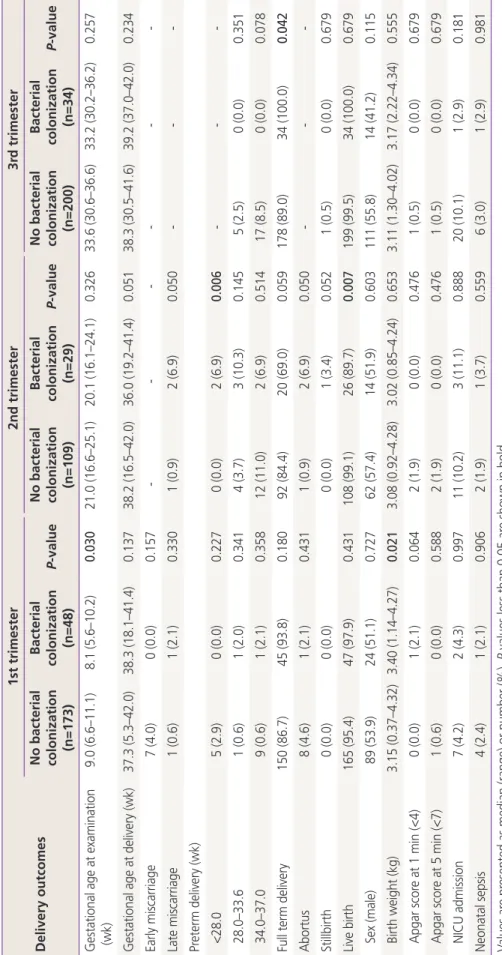
according to maternal vaginal microorganisms, we divided patients into a bacterial colonization group and a no bacterial colonization group in each trimester and compared delivery outcomes (Table 3). In the 1st and 3rd trimester, there was no difference in gestational age at delivery or in the rate of mis- carriage or preterm delivery between the bacterial coloniza- tion group and no bacterial colonization groups. However, of note, the presence of abnormal vaginal colonization detected in the 2nd trimester was significantly associated with adverse delivery outcome. The rate of preterm delivery before 28 weeks in the bacterial colonization group was significantly higher than the rate in the no bacteria colonization group (6.9% vs.

0%; P=0.006). Gestational age at delivery itself failed to reach statistical significance (P=0.051), late miscarriage rate in the bacterial colonization group tends to become higher than in the no bacterial colonization group (P=0.050). Consequently, abnormal vaginal colonization detected in the 2nd trimes- ter was associated with a lower rate of live births compared with the no bacterial colonization group (89.7% vs. 99.1%;

P=0.007). Birth weight, Apgar score, NICU admission, and neonatal sepsis rates were similar between the 2 groups.

Table 4 shows the delivery outcomes according to maternal vaginal bacterial colonization, focusing on bacterial species grouped by trimester. Overall, the presence of microorganisms including E. coli, Enterobacter, Klebsiella pneumonia, Pseu- domonas aeruginosa, Staphylococcus aureus, Streptococcus agalactiae, and Enterococcus faecalis in the 1st and 3rd trimes- ter was not associated with adverse delivery outcome, miscar- riage or preterm delivery. However, bacterial colonization by K. pneumonia in the 2nd trimester was associated with the increased risk of preterm delivery before 28 weeks of gesta- tion, compared to the no K. pneumonia group (50% vs. 0.7%, P=0.029). S. agalactiae colonization in the 2nd trimester demonstrated higher late miscarriage rate (28.6% vs. 0.8%, P=0.007) compared to no colonization group.

To examine whether antibiotics treatment affect delivery outcomes including preterm delivery, birth weight, NICU ad- mission, and neonatal sepsis, we grouped pregnant women ac- cording to antibiotics treatment in each trimester. As a result, antibiotics treatment was not related to improved delivery outcome, miscarriage or preterm delivery in bacterial coloniza- tion group at each trimester (Supplementary Table 1).

Discussion

Our data showed several important clinical findings regard- ing the vaginal microbiome in pregnant women. First, we found that the prevalence of abnormal vaginal colonization in pregnant women in each trimester was 21.7%, 21.0%, and 14.5% in the 1st, 2nd, and 3rd trimester, respectively.

Second, abnormal vaginal colonization in the 2nd trimester but not in 1st trimester was associated with late miscarriage or preterm delivery less than 28 weeks of gestation. Finally, among individual microbiome species in the 2nd trimester, S.

agalactiae was found to be related with late miscarriage and K. pneumonia isolated was associated with preterm delivery before 28 weeks of gestation.

The composition of the vaginal microbiome during normal pregnancy changes as pregnancy advances, vaginal microor- ganisms become progressively more benign, until term [10].

As pregnancy progresses, the increased estrogen level has a positive effect on lactobacillary activity and proliferation by increasing glycogen availability [5]. Increased Lactobacillus rates are thought to inhibit pathogen growth through secre- tion of antibacterial bacteriocins, as well as the production of metabolite, such as lactic acid which helps to maintain a low, hostile pH [11]. In our study, we also confirmed that abnormal bacterial colonization decreased significantly as the pregnancy progressed. It should be noted that our study population does not represent a longitudinal study, limiting information of the real change in vaginal microorganisms over gestation. How- ever, a longitudinal study by Romero et al. [12] already dem- onstrated that the incidence of anaerobe or strict-anaerobe microbial species were found to decrease with advancing ges- tational age, which is in line with our cross-sectional study de- rived from each trimester. Our study also demonstrated that a decreasing trend was observed in both Gram-negative and Gram-positive bacteria. Comparable results were reported in another study reporting that vaginal colonization changed from 24% in the 1st trimester to 17% in the 3rd trimester [13].

Although decreased lactobacilli characterizing bacterial vagi- nosis are associated with preterm delivery [14], particularly among high risk women, the impact of intermediate flora or aerobic vaginitis in pregnancy are not fully understood, with some studies suggesting that it may cause poor pregnancy out- comes, comparable to bacterial vaginosis [8].

The “intermediate flora” state means a transitional stage

between normal vaginal flora and bacterial vaginosis [5]. The

(5)

Table 3. Delivery outcomes according to maternal v aginal bacteria colonization Delivery outcomes 1st trimester 2nd trimester 3r d trimester No bacterial colonization (n=173)

Bacterial colonization (n=48) P-value No bacterial colonization (n=109) Bacterial colonization (n=29) P-value No bacterial colonization (n=200)

Bacterial colonization (n=34) P-value Gestational age at examination (wk) 9.0 (6.6–11.1) 8.1 (5.6–10.2) 0.030 21.0 (16.6–25.1) 20.1 (16.1–24.1) 0.326 33.6 (30.6–36.6) 33.2 (30.2–36.2) 0.257 Gestational age at delivery (wk) 37.3 (5.3–42.0) 38.3 (18.1–41.4) 0.137 38.2 (16.5–42.0) 36.0 (19.2–41.4) 0.051 38.3 (30.5–41.6) 39.2 (37.0–42.0) 0.234 Early miscarriage 7 (4.0) 0 (0.0) 0.157 - - - - - - Late miscarriage 1 (0.6) 1 (2.1) 0.330 1 (0.9) 2 (6.9) 0.050 - - - Pr eterm delivery (wk) <28.0 5 (2.9) 0 (0.0) 0.227 0 (0.0) 2 (6.9) 0.006 - - - 28.0–33.6 1 (0.6) 1 (2.0) 0.341 4 (3.7) 3 (10.3) 0.145 5 (2.5) 0 (0.0) 0.351 34.0–37.0 9 (0.6) 1 (2.1) 0.358 12 (11.0) 2 (6.9) 0.514 17 (8.5) 0 (0.0) 0.078 Full term delivery 150 (86.7) 45 (93.8) 0.180 92 (84.4) 20 (69.0) 0.059 178 (89.0) 34 (100.0) 0.042 Abortus 8 (4.6) 1 (2.1) 0.431 1 (0.9) 2 (6.9) 0.050 - - - Stillbirth 0 (0.0) 0 (0.0) 0 (0.0) 1 (3.4) 0.052 1 (0.5) 0 (0.0) 0.679 Live birth 165 (95.4) 47 (97.9) 0.431 108 (99.1) 26 (89.7) 0.007 199 (99.5) 34 (100.0) 0.679 Sex (male) 89 (53.9) 24 (51.1) 0.727 62 (57.4) 14 (51.9) 0.603 111 (55.8) 14 (41.2) 0.115 Birth weight (kg) 3.15 (0.37–4.32) 3.40 (1.14–4.27) 0.021 3.08 (0.92–4.28) 3.02 (0.85–4.24) 0.653 3.11 (1.30–4.02) 3.17 (2.22–4.34) 0.555 Apgar scor e at 1 min (<4) 0 (0.0) 1 (2.1) 0.064 2 (1.9) 0 (0.0) 0.476 1 (0.5) 0 (0.0) 0.679 Apgar scor e at 5 min (<7) 1 (0.6) 0 (0.0) 0.588 2 (1.9) 0 (0.0) 0.476 1 (0.5) 0 (0.0) 0.679 NICU admission 7 (4.2) 2 (4.3) 0.997 11 (10.2) 3 (11.1) 0.888 20 (10.1) 1 (2.9) 0.181 Neonatal sepsis 4 (2.4) 1 (2.1) 0.906 2 (1.9) 1 (3.7) 0.559 6 (3.0) 1 (2.9) 0.981 Values ar e pr esented as median (range) or number (%). P-values less than 0.05 ar e shown in bold. NICU, neonatal intensive car e unit.

(6)

Table 4. Delivery outcomes according to the presence of v aginal microorganisms in each trimester Trimesters/ delivery outcomes

Escherichia coli Enterobacter Klebsiella pneumonia Pseudomonas aeruginosa Staphylococcus aureus Streptococcus agalactiae Enterococcus faecalis (−) (+) P- value (−) (+) P- value (−) (+) P- value (−) (+) P- value (−) (+) P- value (−) (+) P- value (−) (+) P- value 1st trimester (n=2 07) (n=14) (n=220) (n=1) (n=219) (n=2) (n=220) (n=1) (n=217) (n=4) (n=211) (n=10) (n=220) (n=1) Early miscarriage 7 (3 .4) 0 (0.0) 0.628 7 (3.2) 0 (0.0) 0.968 7 (3.2) 0 (0.0) 0.938 7 (3.2) 0 (0.0) 0.968 7 (3.2) 0 (0.0) 0.878 7 (3.3) 0 (0.0) 0.720 7 (3.2) 0 (0.0) 0.968 Late miscarriage 2 (1 .0) 0 (0.0) 0.877 2 (0.9) 0 (0.0) 0.991 2 (0.9) 0 (0.0) 0.982 2 (0.9) 0 (0.0) 0.991 2 (0.9) 0 (0.0) 0.964 2 (0.9) 0 (0.0) 0.911 2 (0.9) 0 (0.0) 0.991 Pr eterm delivery (wk) <28.0 5 ( 2.4 ) 0 (0.0) 0.719 5 (2.3) 0 (0.0) 0.977 5 (2.3) 0 (0.0) 0.955 5 (2.3) 0 (0.0) 0.977 5 (2.3) 0 (0.0) 0.912 5 (2.4) 0 (0.0) 0.792 5 (2.3) 0 (0.0) 0.977 <34.0 2 (1 .0) 0 (0.0) 0.877 2 (0.9) 0 (0.0) 0.991 2 (0.9) 0 (0.0) 0.982 2 (0.9) 0 (0.0) 0.991 2 (0.9) 0 (0.0) 0.964 2 (0.9) 0 (0.0) 0.911 2 (0.9) 0 (0.0) 0.991 <37.0 10 (4 .8) 0 (0.0) 0.512 10 (4.5) 0 (0.0) 0.955 10 (4.6) 0 (0.0) 0.911 10 (4.5) 0 (0.0) 0.955 10 (4.6) 0 (0.0) 0.830 10 (4.7) 0 (0.0) 0.623 10 (4.5) 0 (0.0) 0.955 Full term delivery 18 1 (87. 4) 14 (100.0) 0.164 194 (88.2) 1 (100.0) 0.882 193 (88.1) 2 (100.0) 0.778 194 (88.2) 1 (100.0) 0.882 191 (88.0) 4 (100.0) 0.604 185 (87.7) 10 (100.0) 0.278 194 (88.2) 1 (100.0) 0.882 2nd trimester (n= 13 3) (n=5) (n=138) (n=0) (n=136) (n=2) (n=138) (n=0) (n=137) (n=1) (n=131) (n=7) (n=138) (n=0) Late miscarriage 3 ( 2.3 ) 0 (0.0) 0.894 3 (2.2) 0 (0.0) - 3 (2.2) 0 (0.0) 0.957 3 (2.2) 0 (0.0) - 3 (2.2) 0 (0.0) 0.957 1 (0.8) 2 (28.6) 0.010 3 (2.2) 0 (0.0) - Pr eterm delivery (wk) <28.0 1 ( 0.8 ) 1 (20.0) 0.071 2 (1.4) 0 (0.0) - 1 (0.7) 1 (50.0) 0.030 2 (1.4) 0 (0.0) - 2 (1.5) 0 (0.0) 0.971 1 (0.8) 1 (14.3) 0.099 2 (1.4) 0 (0.0) - <34.0 7 ( 5.3 ) 0 (0.0) 0.768 7 (5.1) 0 (0.0) - 7 (5.1) 0 (0.0) 0.901 7 (5.1) 0 (0.0) - 7 (5.1) 0 (0.0) 0.901 6 (4.6) 1 (14.3) 0.311 7 (5.1) 0 (0.0) - <37.0 14 (1 0.5 ) 0 (0.0) 0.581 14 (10.1) 0 (0.0) - 14 (10.3) 0 (0.0) 0.807 14 (10.1) 0 (0.0) - 13 (9.6) 0 (0.0) 0.193 14 (10.7) 0 (0.0) 0.465 14 (10.1) 0 (0.0) - Full term delivery 10 8 ( 81. 2) 4 (80.0) 0.654 112 (81.2) 0 (0.0) - 111 (81.6) 1 (50.0) 0.342 112 (81.2) 0 (0.0) - 111 (81.6) 1 (50.0) 0.342 109 (83.2) 3 (42.9) 0.020 112 (81.2) 0 (0.0) - 3r d trimester (n=2 30 ) (n=4) (n=234) (n=0) (n=233) (n=1) (n=234) (n=0) (n=232) (n=2) (n=227) (n=7) (n=234) (n=0) Gestational age at delivery <34.0 5 ( 2.2 ) 0 (0.0) 0.917 5 (2.1) 0 (0.0) - 5 (2.1) 0 (0.0) 0.979 5 (2.1) 0 (0.0) - 5 (2.2) 0 (0.0) 0.958 5 (2.2) 0 (0.0) 0.858 5 (2.1) 0 (0.0) - <37.0 17 (7 .4) 0 (0.0) 0.738 17 (7.3) 0 (0.0) - 17 (7.3) 0 (0.0) 0.927 17 (7.3) 0 (0.0) - 17 (7.3) 0 (0.0) 0.860 17 (7.5) 0 (0.0) 0.586 17 (7.3) 0 (0.0) - Full term delivery 20 8 ( 90. 4) 4 (100.0) 0.672 212 (90.6) 0 (0.0) - 211 (90.6) 1 (100.0) 0.906 212 (90.6) 0 (0.0) - 210 (90.5) 2 (100.0) 0.820 205 (90.3) 7 (100.0) 0.496 212 (90.6) 0 (0.0) - Values ar e pr esented as number (%). P-values less than 0.05 ar e shown in bold.

(7)

term aerobic vaginitis, as opposed to bacterial vaginosis, was coined by Donders et al. [15] and has recently received con- siderable attention. This condition is another type of disturbed vaginal microorganisms, in which the lactobacilli are replaced by aerobic facultative pathogens such as Klebsiella, E. coli, En- terococci, Staphylococcus spp., and group B streptococci and is characterized by vaginal leukocytosis and parabasal cells with an increased inflammatory reaction [15].

Recent evidence suggested that aerobic abnormal flora in early pregnancy confer a significant risk factor for preterm labor and is associated with inflammation of the placenta, including chorioamnionitis and funisitis [16]. We found that abnormal bacterial colonization by aerobic bacteria detected in the 2nd trimester was associated with a higher rate of deliv- ery before 28 weeks compared to the no bacterial coloniza- tion group. However, this association was not observed in cases of abnormal bacterial colonization isolated in the 1st trimester. Our finding is consistent with an earlier report by Honda et al. [17] who suggested that the mid to late second trimester period is the optimal screening period to identify abnormal vaginal flora, as there is a shift in vaginal flora from normal to intermediate. In this study, we could not elucidate the exact mechanism of trimester specific impacts on ab- normal pregnancy outcome. There are several reports which may be related to this phenomenon. In fact, it was previously indicated that immune modulation by the change of helper T cells subtype occurred during 2nd trimester [18]. Mid- pregnancy plasma cytokines including interleukin (IL)-2, IL-4, IL-6, interferon- γ, and transforming growth factor-β were also known to be associated with preterm delivery [19]. Similarly, high levels of immunoglobulin M, ferritin, and C-reactive protein measured in mid-pregnancy, have been linked to increased risk of spontaneous preterm delivery [20-22]. How- ever, the association between abnormal vaginal colonization and the change by immune modulation or cytokine needs to be studied further.

Brocklehurst et al. [23] demonstrated that treatment of bac- terial vaginosis before 20 weeks of gestation may be effective for the prevention of preterm birth and Lamont et al. [24] sug- gested that treatment with oral clindamycin administered to pregnant women with asymptomatic vaginal flora within 22 weeks of gestation reduced the preterm delivery rate.

Our study population was generated from consecutive single- ton pregnant women undergoing vaginal culture by a single physician. Due to limitation of retrospective reviews of the

medical records, the precise symptoms of vaginitis at the time of vaginal culture could not be retrieved. In fact, symptoms of vaginitis are often nonspecific and do not correlate with bacterial load, therefore differentiation between symptomatic and asymptomatic vaginal colonization is often difficult. This study only includes the Gram staining and culture results, therefore, it has a limited function in the evaluation of the vaginal environment, such as vaginal pH and microscopic di- agnosis. A further limitation to our study is the relative small number of cases with abnormal vaginal colonization when the participants were divided by trimester. However, our study could be a basis for further studies on abnormal vaginal colo- nization in association with preterm delivery by suggesting that the 2nd trimester may be the most critical time to per- form vaginal cultures.

It is noteworthy that in this study we focused on individual vaginal microorganisms and their association with adverse pregnancy outcome, including miscarriage and preterm de- livery. We found that the rate of preterm delivery before 28 weeks of gestation in K. pneumonia colonization group was higher than that in the no colonization group. Among aerobic microorganisms, Klebsiella spp. was known to be associated with an increased risk for preterm birth [25]. The association between Klebsiella spp. and preterm birth is stronger than the association between bacterial vaginosis and preterm birth.

Our data corroborates the findings of Carey and Klebanoff [26]

who demonstrated that Klebsiella spp. was linked to preterm birth. We also showed that the late miscarriage rate in S.

agalactiae colonization group in the 2nd trimester was higher than that in the no colonization group. Group B streptococ- cus is one of the main causes of infection in pregnant women with chorioamnionitis and is related to microbial invasion of the amniotic cavity [27,28]. Vaginal colonization with group B streptococcus is associated with preterm labor, as evidenced by our study [27,29].

The most frequently observed microorganisms in the female

genital tract are group B streptococcus, E. coli, and Ureaplasma

urealyticum. E. coli is one of the most frequent microorganisms

cultured in aerobic vaginitis [15]. In our study, the most com-

mon microbiome was group B streptococcus (4.0%) followed

by E. coli (3.8%). We recently demonstrated that E. coli was

the most frequent microorganism isolated from the vagina in

high risk pregnant women with preterm premature rupture of

membranes and preterm labor, and correlated with as caus-

ative microorganism of early neonatal sepsis [30]. Of note, E.

(8)

coli and group B streptococcus are cited as the most frequent bacteria isolated from neonates with sepsis and meningitis [31,32]. It has been shown that high density colonization with vaginal E. coli is more likely among women with a history of preterm birth [33].

At present, the performance of vaginal culture as a routine antenatal test is controversial and is not generally recom- mended [34]. A Cochrane review demonstrated that antibiot- ics administered to pregnant women reduced overgrowth of bacteria but did not reduce preterm birth [23]. However, a recent meta-analysis suggested that infection screening and treatment programs in pregnant women may reduce preterm birth and late miscarriage [24]. Interestingly, it has been previ- ously shown that macrolides and clindamycin administered during the 2nd trimester were associated with a lower rate of preterm birth, while metronidazole alone was associated with a greater risk of preterm delivery in a high-risk population [35].

It has also been suggested that clindamycin, unlike metronida- zole, has a broader spectrum and is effective against aerobic microorganisms [36]. Considering that metronidazole only has antibacterial effect on anaerobes, the superior efficacy of broad spectrum antibiotics, such as clindamycin, in reducing the risk of preterm birth may indirectly reflect the importance of aero- bic vaginitis. In our study, there were no differences in delivery outcomes between treatment group and no treatment group among the groups presenting with abnormal vaginal flora according to trimester of pregnancy. However, due to the small number of the pregnant women with abnormal vaginal flora and the diversity of antibiotics used, we could not show whether a specific antibiotic regimen could reduce the risk of preterm birth.

In conclusion, our study suggested that the association between abnormal vaginal flora and adverse pregnancy outcome may be related to culture time and to the specific microorganism. Colonization in the 2nd trimester colonization by K. pneumonia resulted in an increased risk of late miscar- riage and colonization by S. agalactiae was associated with an increased risk of preterm birth before 28 weeks. Understand- ing vaginal microbiome may be the first step to introduce a preventive strategy for preterm birth. Therefore, prospective studies on abnormal vaginal flora targeting the specific study population, such as a history of preterm delivery or short cervi- cal length, in relation to abnormal vaginal flora are required.

Conflict of interest

No potential conflict of interest relevant to this article was re- ported.

References

1. Aagaard K, Riehle K, Ma J, Segata N, Mistretta TA, Coarfa C, et al. A metagenomic approach to characterization of the vaginal microbiome signature in pregnancy. PLoS One 2012;7:e36466.

2. McLean NW, Rosenstein IJ. Characterisation and selection of a Lactobacillus species to re-colonise the vagina of women with recurrent bacterial vaginosis. J Med Micro- biol 2000;49:543-52.

3. Martin HL, Richardson BA, Nyange PM, Lavreys L, Hillier SL, Chohan B, et al. Vaginal lactobacilli, microbial flora, and risk of human immunodeficiency virus type 1 and sexually transmitted disease acquisition. J Infect Dis 1999;180:1863-8.

4. Hay PE, Lamont RF, Taylor-Robinson D, Morgan DJ, Ison C, Pearson J. Abnormal bacterial colonisation of the genital tract and subsequent preterm delivery and late miscar- riage. BMJ 1994;308:295-8.

5. Donati L, Di Vico A, Nucci M, Quagliozzi L, Spagnuolo T, Labianca A, et al. Vaginal microbial flora and outcome of pregnancy. Arch Gynecol Obstet 2010;281:589-600.

6. Donders GG, Vereecken A, Bosmans E, Dekeersmaecker A, Salembier G, Spitz B. Definition of a type of abnormal vaginal flora that is distinct from bacterial vaginosis: aero- bic vaginitis. BJOG 2002;109:34-43.

7. Romero R, Gómez R, Chaiworapongsa T, Conoscenti G, Kim JC, Kim YM. The role of infection in preterm labour and delivery. Paediatr Perinat Epidemiol 2001;15 Suppl 2:41-56.

8. Donders G, Odds A, Vereecken A, Van Bulck B, Cau- dron J, Londers L, et al. Abnormal vaginal flora in the first trimester, but not full-blown bacterial vaginosis, is associated with preterm birth. Prenat Neonatal Med 1998;3:588-93.

9. Donders GG, Van Calsteren K, Bellen G, Reybrouck R,

Van den Bosch T, Riphagen I, et al. Predictive value for

preterm birth of abnormal vaginal flora, bacterial vagi-

nosis and aerobic vaginitis during the first trimester of

(9)

pregnancy. BJOG 2009;116:1315-24.

10. Huang YE, Wang Y, He Y, Ji Y, Wang LP, Sheng HF, et al.

Homogeneity of the vaginal microbiome at the cervix, posterior fornix, and vaginal canal in pregnant Chinese women. Microb Ecol 2015;69:407-14.

11. Hawes SE, Hillier SL, Benedetti J, Stevens CE, Koutsky LA, Wølner-Hanssen P, et al. Hydrogen peroxide-producing lactobacilli and acquisition of vaginal infections. J Infect Dis 1996;174:1058-63.

12. Romero R, Hassan SS, Gajer P, Tarca AL, Fadrosh DW, Bie- da J, et al. The vaginal microbiota of pregnant women who subsequently have spontaneous preterm labor and delivery and those with a normal delivery at term. Micro- biome 2014;2:18.

13. Brzychczy-Włoch M, Pabian W, Majewska E, Zuk MG, Kielbik J, Gosiewski T, et al. Dynamics of colonization with group B streptococci in relation to normal flora in women during subsequent trimesters of pregnancy. New Microbiol 2014;37:307-19.

14. Waites KB, Katz B, Schelonka RL. Mycoplasmas and ureaplasmas as neonatal pathogens. Clin Microbiol Rev 2005;18:757-89.

15. Donders G, Bellen G, Rezeberga D. Aerobic vaginitis in pregnancy. BJOG 2011;118:1163-70.

16. Rezeberga D, Lazdane G, Kroica J, Sokolova L, Donders GG. Placental histological inflammation and reproduc- tive tract infections in a low risk pregnant population in Latvia. Acta Obstet Gynecol Scand 2008;87:360-5.

17. Honda H, Yokoyama T, Akimoto Y, Tanimoto H, Teramoto M, Teramoto H. The frequent shift to intermediate flora in preterm delivery cases after abnormal vaginal flora screening. Sci Rep 2014;4:4799.

18. Schminkey DL, Groer M. Imitating a stress response: a new hypothesis about the innate immune system’s role in pregnancy. Med Hypotheses 2014;82:721-9.

19. Gargano JW, Holzman C, Senagore P, Thorsen P, Skog- strand K, Hougaard DM, et al. Mid-pregnancy circulating cytokine levels, histologic chorioamnionitis and sponta- neous preterm birth. J Reprod Immunol 2008;79:100-10.

20. Catov JM, Bodnar LM, Ness RB, Barron SJ, Roberts JM.

Inflammation and dyslipidemia related to risk of sponta- neous preterm birth. Am J Epidemiol 2007;166:1312-9.

21. Goldenberg RL, Tamura T, DuBard M, Johnston KE, Cop- per RL, Neggers Y. Plasma ferritin and pregnancy out- come. Am J Obstet Gynecol 1996;175:1356-9.

22. Holzman C, Jetton J, Fisher R, Senagore P, Mohan M, Paneth N. Association of maternal IgM concentrations above the median at 15-19 weeks of gestation and early preterm delivery. Lancet 1999;354:1095-6.

23. Brocklehurst P, Gordon A, Heatley E, Milan SJ. Antibiotics for treating bacterial vaginosis in pregnancy. Cochrane Database Syst Rev 2013:CD000262.

24. Lamont RF, Nhan-Chang CL, Sobel JD, Workowski K, Conde-Agudelo A, Romero R. Treatment of abnormal vaginal flora in early pregnancy with clindamycin for the prevention of spontaneous preterm birth: a sys- tematic review and metaanalysis. Am J Obstet Gynecol 2011;205:177-90.

25. McDonald HM, O’Loughlin JA, Jolley PT, Vigneswaran R, McDonald PJ. Changes in vaginal flora during preg- nancy and association with preterm birth. J Infect Dis 1994;170:724-8.

26. Carey JC, Klebanoff MA. Is a change in the vaginal flora associated with an increased risk of preterm birth? Am J Obstet Gynecol 2005;192:1341-6.

27. Boldenow E, Gendrin C, Ngo L, Bierle C, Vornhagen J, Coleman M, et al. Group B streptococcus circumvents neutrophils and neutrophil extracellular traps during amniotic cavity invasion and preterm labor. Sci Immunol 2016;1:eaah4576.

28. Shirazi M, Abbariki E, Hafizi A, Shahbazi F, Bandari M, Dastgerdy E. The prevalence of group B streptococcus colonization in Iranian pregnant women and its subse- quent outcome. Int J Fertil Steril 2014;7:267-70.

29. Allen U, Nimrod C, Macdonald N, Toye B, Stephens D, Marchessault V. Relationship between antenatal group B streptococcal vaginal colonization and premature labour.

Paediatr Child Health 1999;4:465-9.

30. Jeong H, Han SJ, Yoo HN, Choi SJ, Oh SY, Kim YJ, et al. Comparison of changes in etiologic microorganisms causing early-onset neonatal sepsis between preterm labor and preterm premature rupture of membranes. J Matern Fetal Neonatal Med 2015;28:1923-8.

31. Sgro M, Shah PS, Campbell D, Tenuta A, Shivananda S, Lee SK, et al. Early-onset neonatal sepsis: rate and organism pattern between 2003 and 2008. J Perinatol 2011;31:794-8.

32. Kim JY, Sung JH, Chang KH, Choi SJ, Oh SY, Roh CR,

et al. Abnormal vaginal colonization by gram-negative

bacteria is significantly higher in pregnancy conceived

(10)

through infertility treatment compared to natural preg- nancy. J Matern Fetal Neonatal Med 2017;30:556-61.

33. Krohn MA, Thwin SS, Rabe LK, Brown Z, Hillier SL. Vagi- nal colonization by Escherichia coli as a risk factor for very low birth weight delivery and other perinatal com- plications. J Infect Dis 1997;175:606-10.

34. Committee on Practice Bulletins-Obstetrics, The Ameri- can College of Obstetricians and Gynecologists. Practice bulletin no. 130: prediction and prevention of preterm

birth. Obstet Gynecol 2012;120:964-73.

35. Morency AM, Bujold E. The effect of second-trimester antibiotic therapy on the rate of preterm birth. J Obstet Gynaecol Can 2007;29:35-44.

36. Lamont RF, Duncan SL, Mandal D, Bassett P. Intra-

vaginal clindamycin to reduce preterm birth in women

with abnormal genital tract flora. Obstet Gynecol

2003;101:516-22.

수치

Table 1. Clinical characteristics of pregnant women in each trimester
Table 3.Delivery outcomes according to maternal vaginal bacteria colonization Delivery outcomes 1st trimester2nd trimester3rd trimesterNo bacterial  colonization (n=173)
Table 4.Delivery outcomes according to the presence of vaginal microorganisms in each trimester Trimesters/  delivery  outcomes

참조

관련 문서

Objective: The purpose of this study is to investigate the relationship between depression and evening meals for adult women by using the National Health and Nutrition Survey

The purpose of this study was to investigate the change of body composition and physical fitness after 12 weeks of practice with middle-aged women centered

The purpose of this study was to investigate how the 8-week aerobic exercise program affects the physical strength and stress of obese women in the

Prevalence of Undiagnosed Diabetes and Related Factors in Korean Postmenopausal Women:.. The 2011-2012 Korean National Health and

The aim of this research was to investigate the differences of intentions and satisfactions to classes according to middle school students’ gender

The aim of this paper is to study the features of interactive art in the age of digital reproduction. In the age of mechanical reproduction, cameras and movies mediated by

최대정수함수가 극댓값을 갖는 점과 극솟값을 갖는 점을 모두 구하고, 그 점에서 극값을 구하 시오.. 함수가 미분 가능하면 극값을

그러므로 이러한 표현은 함수의 이름과 미분계수를 구하는 점이 명확하여 혼동할 염려가 없을