462
DOI 10.4070 / kcj.2009.39.11.462 Copyright ⓒ 2009 The Korean Society of Cardiology
Open Access
Comparison of Triple Anti-Platelet Therapy (Aspirin, Clopidogrel, and Cilostazol) and Double Anti-Platelet Therapy (Aspirin and Clopidogrel) on Platelet Aggregation in Type 2 Diabetic Patients Undergoing Drug-Eluting Stent Implantation
Tae-Hyun Yang, MD, Doo Il Kim, MD, Jong Yoon Kim, MD, Il Hwan Kim, MD, Ki-Hun Kim, MD, Yang Chun Han, MD, Woong Kim, MD, Sang Hoon Seol, MD, Seong Man Kim, MD, Dae Kyeong Kim, MD and Dong Soo Kim, MD
Division of Cardiology, Department of Internal Medicine, Inje University College of Medicine, Cardiovascular Research Institute, Busan Paik Hospital, Busan, Korea
ABSTRACT
Background and Objectives: Triple anti-platelet therapy may produce more potent inhibition of platelet aggre- gation in patients undergoing coronary stent implantation. We tested whether this effect could be maintained in diabetic patients, where platelet reactivity is increased and the risk of stent thrombosis is higher. Subjects and Methods: Fifty five type 2 diabetic patients who had undergone drug-eluting stent (DES) implantation and chronic anti-platelet therapy (>1 month) were stratified according to the status of anti-platelet therapy. Platelet aggregation after adenosine diphosphate (ADP; 10 μmol/L and 20 μmol/L) stimulation was compared using light transmittance aggregometry between dual (aspirin plus clopidogrel, n=34) and triple therapy (aspirin, clopidogrel plus cilostazol, n=21) groups. Results: The 2 groups had similar clinical and procedural characteristics. Maximal ADP-induced platelet aggregation was significantly lower in the triple therapy group than the dual therapy group (ADP 10 μmol/L, 37.1±15.4 vs. 28.3±11.8, p=0.03; ADP 20 μmol/L, 63.1±15.0 vs. 49.1±15.1, p=0.01), but there were no differences in diabetic treatment (oral hypoglycemic agent vs. insulin) or diabetic control {hemoglobin Alc (HbA1c)
≤7 vs. HbA1c >7}. Conclusion: Triple anti-platelet therapy showed more potent inhibition of maximal ADP in- duced platelet aggregation in type 2 diabetic patients receiving chronic anti-platelet therapy. This finding suggests that triple antiplatelet therapy may be more effective in preventing thrombotic complications after DES implanta- tion in type 2 diabetic patients. (Korean Circ J 2009;39:462-466)
KEY WORDS:Antiplatelet drugs; Diabetes mellitus; Platelet aggregation; Stents.
Introduction
Type 2 diabetic patients have approximately 2 to 4- fold higher incidence of coronary artery diseases than
non-diabetic patients, and restenosis commonly occurs after coronary stent implantation.1)2) Type 2 diabetes mellitus is also a risk factor for stent thrombosis after the implantation of drug-eluting stents (DES).3) Func- tional changes in platelets can increase cardiovascular complications in type 2 diabetic patients4-6) and decrease the response to aspirin,7)8) which increases the risk of de- veloping coronary artery disease.9-11) Platelet aggregation is higher in diabetic patients after a loading-dose of clo- pidogrel, and platelet aggregation and activity are also higher after the administration of aspirin and clopidogrel for more than 1 month.12) Thus, the anti-platelet effects of clopidogrel and aspirin are decreased in diabetic pa- tients. The triple anti-platelet therapy with aspirin, clo- pidogrel, and cilostazol is more effective in preventing stent thrombosis than dual anti-platelet therapy with aspirin, clopidogrel, or ticlopidine.13) Triple therapy also
Received: November 26, 2008 Revision Received: February 11, 2009 Accepted: February 25, 2009
Correspondence: Doo Il Kim, MD, Division of Cardiology, Department of Internal Medicine, Inje University College of Medicine, Cardiovascular Research Institute, Busan Paik Hospital, 633-165 Gaegeum-dong, Busanjin-gu, Busan 614-735, Korea
Tel: 82-51-890-6270, Fax: 82-51-892-0273 E-mail: [email protected]
○cc This is an Open Access article distributed under the terms of the Creative Commons Attribution Non-Commercial License (http://creativecommons.
org/licenses/by-nc/3.0) which permits unrestricted non-commercial use, distribution, and reproduction in any medium, provided the original work is properly cited.
inhibits platelet aggregation and activity more than dual therapy after the drug-induced stimulation of platelets.14)
To date, however, there is no data comparing dual and triple therapy in type 2 diabetic patients. Therefore, we tested platelet aggregation after double and triple therapy using optical aggregometry in type 2 diabetic patients that received anti-platelet drugs after DES implantation.
Subjects and Methods
Subjects
We recruited 55 patients with type 2 diabetes mellitus who had received a DES at least one month earlier that then visited the outpatient clinic between March and May, 2008. Patients were taking anti-platelet agents without any notable clinical events. Patients were divided into a dual therapy group, with aspirin and clopidogrel, or a triple therapy group, with aspirin, clopidogrel, and cilostazol. The selection of anti-platelet agents was whol- ly based on physician discretion. Exclusion criteria were:
patients with impaired glucose tolerance not taking oral hypoglycemic agents, patients taking oral anti-coagula- tion agents, patients taking non-steroidal anti-inflam- matory agents before the platelet aggregation test, pa- tients who abused other drugs or alcohol, patients whose platelet counts were less than 100,000/μL, patients whose hematocrit was less than 25%, patients whose se- rum creatinine was higher than 2.5 mg/dL, and patients whose serum liver enzymes were 2 times higher than normal. An institutional review committee approved this study and all subjects gave informed consent.
Platelet aggregation test
The brachial vein was directly punctured with a 22-
gauge needle and blood was drawn. The first 2- to 3 mL blood to avoid the spontaneous activation of platelets.
The remaining blood was placed in a test tube contain- ing 3.8% trisodium citrate. Within an hour following blood sampling, the degree of maximal platelet aggrega- tion was measured using optical aggregometry (Chro- nolog Aggregometer, Norbis, Stuttgart, Germany) after platelet stimulation with adenosine diphosphate (ADP), 10 μmol/L and 20 μmol/L. Centrifugation was per- formed at 800 r.p.m. for 10 minutes, and supernatant was harvested to prepare platelet-rich plasma. Using au- tologous plasma, platelet counts were set at 250,000/μL.
Platelet-poor plasma was generated by a secondary cen- trifugation at 2,500 r.p.m. for 10 minutes. The light trans- mittance of platelet-rich plasma was set at 0% and that of platelet-poor plasma was set at 100%. The curve of blood coagulation was recorded for six minutes at each measurement. The degree of platelet aggregation was ex- pressed as the percent changes in the light transmittance of platelet-rich plasma at 37℃ following ADP stimula- tion based on platelet-poor plasma (100%). At each meas- urement, the maximal platelet aggregation was measured.
Statistical analysis
Continuous variables were expressed as mean±stand- ard deviation and categorical variables are expressed as the frequency and its percentage. Continuous variables following a normal distribution were analyzed using Stu- dent’s t-test, non-normal data were analyzed using Mann- Whitney test. Categorical variables were analyzed using the Chi-square test or Fisher’s exact test. A value of p<
0.05 was considered statistically significant. All the statis- tical analyses were performed using Statistical Package for Social Science (SPSS) 15.0 (SPSS Inc. Chicago, IL, USA).
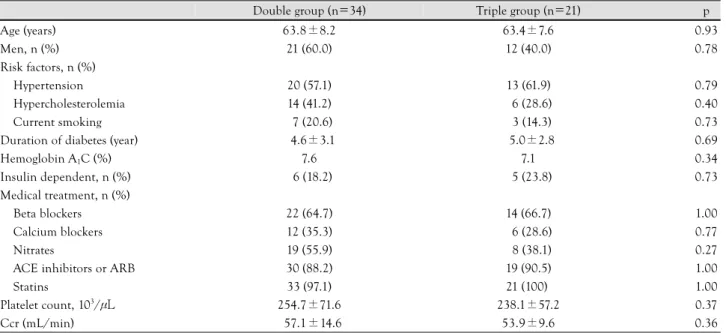
Table 1. Clinical characteristics of patients (n=55)
Double group (n=34) Triple group (n=21) p
Age (years) 63.8±8.2 63.4±7.6 0.93
Men, n (%) 21 (60.0) 12 (40.0) 0.78
Risk factors, n (%)
Hypertension 20 (57.1) 13 (61.9) 0.79
Hypercholesterolemia 14 (41.2) 06 (28.6) 0.40
Current smoking 07 (20.6) 03 (14.3) 0.73
Duration of diabetes (year) 04.6±3.1 05.0±2.8 0.69
Hemoglobin A1C (%) 7.6 7.1 0.34
Insulin dependent, n (%) 06 (18.2) 05 (23.8) 0.73
Medical treatment, n (%)
Beta blockers 22 (64.7) 14 (66.7) 1.00
Calcium blockers 12 (35.3) 06 (28.6) 0.77
Nitrates 19 (55.9) 08 (38.1) 0.27
ACE inhibitors or ARB 30 (88.2) 19 (90.5) 1.00
Statins 33 (97.1) 21 (100). 1.00
Platelet count, 103/μL 254.7±71.6 238.1±57.2 0.37
Ccr (mL/min) 057.1±14.6 53.9±9.6 0.36
ACE: angiotensin converting enzyme, ARB: angiotensin receptor blocker, Ccr: creatinine clearance calculated by Cockcroft and Gault method
Results
Clinical characteristics
We enrolled 34 patients receiving dual therapy and 21 patients receiving triple therapy. All patients were taking 100 mg aspirin and 75 mg clopidogrel a day. Pa- tients on triple therapy also took 200 mg cilostazol a day.
There were no differences in the duration of diabetes mellitus, cardiovascular risk factors, creatinine clearance as calculated using the methods of Cockcroft and Gault, treatment agents other than anti-platelet agents, or he- matologic tests (Table 1). In the dual therapy group, 30 patients were treated with 39 sirolimus-eluting stents (S- ES) and 4 patients were treated with 6 paclitaxel-eluting stents (PES). In the triple therapy group, 18 patients were treated with 22 SESs and 3 patients were treated with 4 PESs. Anti-platelet agents had been administered af- ter DES implantation for 224.2±93.2 days in the dual therapy group and 181.2±121.2 days in the triple ther- apy group (p=0.18).
Platelet aggregation test
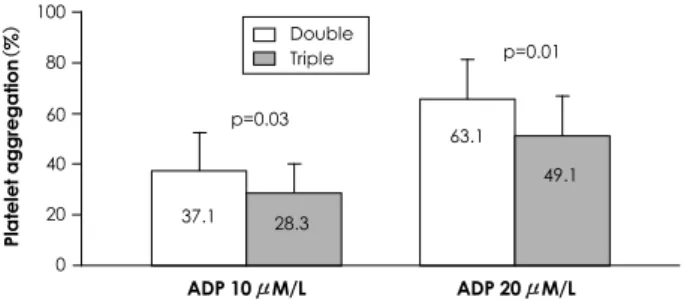
Platelet aggregation was lower in the triple therapy group than the dual therapy group after 10 μmol/L A- DP (28.3±11.8% vs. 37.1±15.4%, p=0.03) and 20
μmol/L ADP (49.1±15.1% vs. 63.1±15.0%, p=0.01) (Fig. 1). Maximum platelet aggregation was not different in the insulin or oral hypoglycemic groups (Table 2).
Maximum platelet aggregation was not different based on diabetic control status, as measured by hemoglobin levels of A1c 7.0 (Table 3).
Discussion
We found that triple therapy with aspirin, clopidogrel, and cilostazol inhibited ADP-induced platelet aggrega- tion better than dual therapy with aspirin and clopido- grel in type 2 diabetic patients after DES implantation.
Similarly, Lee et al.14) found that triple therapy inhibited platelet aggregation better than dual therapy after DES implantation, although that study included non-diabetic and diabetic patients.
Type 2 diabetes mellitus is equivalent to coronary ar- tery disease and presents higher thrombogenic potential that increases cardiovascular risk. Vascular endothelial dysfunction, abnormal fibrinolysis, increased levels of coagulation factors, alterations of platelet function, and the decreased response to anti-platelet agents are closely associated with the formation of blood clots.4-8) Platelet responses to aspirin can be decreased even though thromboxane A2 in diabetics, but clopidogrel can also help prevent cardiovascular diseases in type 2 diabetic patients.15) Dual therapy with aspirin and clopidogreal would be more effective than individual treatments, but is less effective in type 2 diabetic patients.12)
Cilostazol and clopidogrel suppress ADP-induced pla- telet aggregation, but they work differently. Clopidogrel blocks the ADP receptor to inhibit adenylate cyclase, whereas cilostazol suppresses phosphodiesterase III acti- vity. Both drugs therefore elevate the intracellular con- centration of cyclic adenosine monophosphate (cAM- P),16)17) which suppresses platelet aggregation better than either drug alone. Clinical studies have demonstrated that the triple therapy could lower the incidence of stent
Table 3. Maximal platelet aggregation following 20 μM/L ADP according to diabetic control
HbA1c ≤7 (n=30) HbA1c >7 (n=25) p
Platelet aggregation, n (%)
Double group* 17 (63.5±14.2) 17 (62.7±16.1) 0.90
Triple group† 13 (47.4±14.4) 08 (52.0±16.4) 0.16
All patients 56.5±16.3 59.3±16.7 0.42
*Double: aspirin plus clopidogrel, †Triple: aspirin, clopidogrel plus cilostazol. ADP: adenosine diphosphate, HbA1c: hemoglobin A1c Table 2. Maximal platelet aggregation following 20 μM/L ADP according to hypoglycemic therapy modalities
Insulin (n=11) OHA (n=44) p
Platelet aggregation, n (%)
Double group* 06 (65.0±11.7) 28 (62.7±15.8) 0.90
Triple group† 05 (57.2±6.9) 0 16 (46.6±16.2) 0.16
All patients 11 (61.5±10.2) 44 (56.9±17.6) 0.54
*Double: aspirin plus clopidogrel, †Triple: aspirin, clopidogrel plus cilostazol. ADP: adenosine diphosphate, OHA: oral hypoglycemic agents
100
80
60
40
20
0
Platelet aggregation(%)
ADP 10 μM/L p=0.03
p=0.01
37.1 28.3
63.1 49.1 Double
Triple
Fig. 1. Maximal platelet aggregation following ADP (10 and 20 μM) in type 2 diabetic patients according to anti-platelet drugs (Double, aspirin plus clopidogrel; Triple, aspirin, clopidogrel plus cilostazol).
Numbers in the box denote the mean value of platelet aggregation.
ADP: adenosine diphosphate.
ADP 20 μM/L
thrombosis more than dual therapy.13)18)
Enhanced platelet activation may be a consequence of more prevalent atherosclerotic lesions or reflect the influence of metabolic disturbances on platelet biochem- istry and function. Decreased responses to anti-platelet agents may result from increased ADP receptors on the platelet surface, oxidative stress resulting in aspirin- insensitive thromboxane biosynthesis, and altered struc- ture of the platelet membrane and enhanced protein glycation reducing interaction with drug target.19)20) Be- cause protein glycation can decrease the efficacy of anti- platelet agents, diabetic treatment modalities, either hy- poglycemic agents or insulin, or diabetic control, may influence anti-platelet activity. However, we did not find differences in treatment modalities or diabetic status in either therapy group. However, the small number of pa- tients on insulin and the large number of patients with good diabetic control limit the strength of this conclu- sion. The degree of platelet aggregation was somewhat higher in patients with insulin treatment or hemoglo- bin A1c (HbA1c) of >7.0, suggesting that triple therapy would be effective for these patients.
Greater suppression of platelet aggregation in triple therapy might increase the incidence of complications including hemorrhage, and could increase medication expenses. Large-scale clinical studies did not show dif- ferences for the two therapies in the incidence of com- plications such as bleeding or gastrointestinal complica- tions.13)21)22) The lack of established criteria for treatment periods for anti-platelet agents implies the need for indi- vidual treatment plans. The results of this study suggests that triple therapy may be useful in type 2 diabetic pa- tients with left main coronary artery lesion, bifurcation lesions, or long lesions with high risk of stent thrombosis.
DES can also produce later stent thrombosis than bare- metal stents, indicating that triple therapy may be indi- cated long after stent implantation. Cilostazol can also reduce restenosis,21) which has significant clinical benefit.
There are some limitations of the current study. First, we used a retrospective analysis of medical records based on a single-center experience in a small number of pa- tients, which could have selection bias. Second, we en- rolled patients in an outpatient clinic without major car- diac events after DES implantation. Third, there were some discrepancies in the period of the use of anti-pla- telet agents. These limitations prevent the results of the current study from being generalized. Further prospec- tive, randomized studies that are currently planned at our institution in patients with type 2 diabetes mellitus could overcome these limitations. Finally, we used opti- cal aggregometry and did not measure clinical outcomes of inhibiting platelet aggregation. Further large-scale cli- nical studies are warranted to clarify differences in dual and triple therapy in diabetic patients.
In conclusion, triple therapy inhibited platelet aggre-
gation more than dual therapy in type 2 diabetic patients taking anti-platelet agents. The current study provides an experimental basis for the selective use of triple therapy in patients with stents at high risk for thrombosis.
Acknowledgments
This work was supported by a Grant from Inje University, 2006.
REFERENCES
1) Beckman JA, Creager MA, Libby P. Diabetes and atherosclerosis:
epidemiology, pathophysiology, and management. JAMA 2002;
287:2570-81.
2) Kim W, Jeong MH, Kim KH, et al. Long-term clinical and angio- graphic results of coronary stenting in diabetic patients. Korean Circ J 2001;31:24-30.
3) Iakovou I, Schmidt T, Bozizzoni E, et al. Incidence, predictors, and outcome of thrombosis after successful implantation of drug- eluting stents. JAMA 2005;293:2126-30.
4) Colwell JA, Nesto RW. The platelet in diabetes: focus on preven- tion of ischemic events. Diabetes Care 2003;26:2181-8.
5) Vinik AI, Erbas T, Park TS, Nolan R, Pittenger GL. Platelet dys- function in type 2 diabetes. Diabetes Care 2001;24:1476-85.
6) Ferroni P, Basili S, Falco A, Davi G. Platelet activation in type 2 diabetes mellitus. J Thromb Haemost 2004;2:1282-91.
7) Watala C, Golanski J, Pluta J, et al. Reduced sensitivity of plate- lets from type 2 diabetic patients to acetylsalicylic acid (aspirin): its relation to metabolic control. Thromb Res 2004;113:101-13.
8) Mori TA, Vandongen R, Douglas AJ, McCulloch RK, Burke V.
Differential effect of aspirin on platelet aggregation in IDDM. Dia- betes 1992;41:261-6.
9) Gum PA, Jottke-Marchant K, Welsh PA, White J, Topol EJ. A pro- spective, blinded determination of the natural history of aspirin resistance among stable patients with cardiovascular disease. J Am Coll Cardiol 2003;41:961-5.
10) Eikelboom JW, Hirsh J, Weitz JI, Johnston M, Yi Q, Yusuf S. As- pirin-resistant thromboxane biosynthesis and the risk of myocar- dial infarction, stroke, or cardiovascular death in patients at high risk for cardiovascular events. Circulation 2002;105:1650-5.
11) Grotemeyer KH, Scharafinski HW, Husstedt IW. Two-year follow- up of aspirin responder and aspirin non responder: a pilot-study including 180 post-stroke patients. Thromb Res 1993;71:397-403.
12) Angiolillo DJ, Fernandez-Ortiz A, Bernardo E, et al. Platelet func- tion profiles in patients with type 2 diabetes and coronary artery disease on combined aspirin and clopidogrel treatment. Diabetes 2005;54:2430-5.
13) Lee SW, Park SW, Hong MK, et al. Triple versus dual antiplatelet therapy after coronary stenting: impact on stent thrombosis. J Am Coll Cardiol 2005;46:1833-7.
14) Lee BK, Lee SW, Park SW, et al. Effects of triple antiplatelet ther- apy (aspirin, clopidogrel, and cilostazol) on platelet aggregation and P-selectin expression in patients undergoing coronary artery stent implantation. Am J Cardiol 2007;100:610-4.
15) Bhatt DL, Marso SP, Hirsch AT, Ringleb PA, Hacke W, Topol EJ.
Amplified benefit of clopidogrel versus aspirin in patients with dia- betes mellitus. Am J Cardiol 2002;90:625-8.
16) Ryningen A, Olav Jensen B, Holmsen H. Elevation of cyclic AMP decreases phosphoinositide turnover and inhibits thrombin-induced secretion in human platelets. Biochim Biophys Acta 1998;1394:
235-48.
17) Defreyn G, Gachet C, Savi P, Driot F, Cazenave JP, Maffrand JP.
Ticlopidine and clopidogrel (SR 25990C) selectively neutralize ADP inhibition of PGE1-activated platelet adenylate cylcase in rats and rabbits. Thromb Haemost 1991;65:186-90.
18) Ahn JC, Song WH, Kwon JA, et al. Effects of cilostazol on platelet activation in coronary stenting patients who already treated with aspirin and clopidogrel. Korean J Intern Med 2004;19:230-6.
19) Cipollone F, Ciabattoni G, Patrignani P, et al. Oxidative stress and aspirin-insensitive thromboxane biosynthesis in severe unstable angina. Circulation 2000;102:1007-13.
20) Winocour PD, Watala C, Perry DW, Kinlough-Rathbone RL. De- creased platelet membrane fluidity due to glycation or acetylation
of membrane proteins. Thromb Haemost 1992;68:577-82.
21) Lee SW, Park SW, Kim YH, et al. Drug-eluting stenting followed by cilostazol treatment reduces late restenosis in patients with dia- betes mellitus the DECLARE-DIABETES Trial. J Am Coll Cariol 2008;51:1181-7.
22) Park JS, Kim YJ. The clinical effects of cilostazol on atherosclero- tic vascular disease. Korean Circ J 2008;38:441-5.