D I A B E T E S & M E T A B O L I S M J O U R N A L D I A B E T E S & M E T A B O L I S M J O U R N A L
This is an Open Access article distributed under the terms of the Creative Commons Attribution Non-Commercial License (http://creativecommons.org/licenses/by-nc/4.0/) which permits unrestricted non-commercial use, distribution, and reproduction in any medium, provided the original work is properly cited.
Asian Subpopulations May Exhibit Greater
Cardiovascular Benefit from Long-Acting Glucagon- Like Peptide 1 Receptor Agonists: A Meta-Analysis of Cardiovascular Outcome Trials
Yu Mi Kang1,*, Yun Kyung Cho2,*, Jiwoo Lee2, Seung Eun Lee2, Woo Je Lee2, Joong-Yeol Park2, Ye-Jee Kim3, Chang Hee Jung2, Michael A. Nauck4
1International Healthcare Center, Departments of 2Internal Medicine, 3Clinical Epidemiology and Biostatistics, Asan Medical Center, University of Ulsan College of Medicine, Seoul, Korea,
4Diabetes Center Bochum-Hattingen, St. Josef-Hospital, Ruhr-University Bochum, Bochum, Germany
Background: Based on reported results of three large cardiovascular outcome trials (CVOTs) of glucagon-like peptide 1 receptor agonists (GLP-1 RAs), we aimed to investigate the overall effect of GLP-1 RAs on major adverse cardiovascular events (MACEs) and to identify subpopulations exhibiting the greatest cardiovascular (CV) benefit.
Methods: Three CVOTs reporting effects of long-acting GLP-1 RAs were included: LEADER (liraglutide), SUSTAIN-6 (semaglu- tide), and EXSCEL (exenatide once weekly). In all studies, the primary endpoint was three-point MACE, comprising CV death, non-fatal myocardial infarction, and non-fatal stroke. Overall effect estimates were calculated as hazard ratios and 95% confi- dence intervals (CIs) using the random-effects model; subgroup analyses reported in the original studies were similarly analyzed.
Results: Overall, statistically significant risk reductions in MACE and CV death were observed. Subgroup analysis indicated a significant racial difference with respect to CV benefit (P for interaction <0.001), and more substantial risk reductions were ob- served in subjects of African origin (relative risk [RR], 0.78; 95% CI, 0.60 to 0.99) and in Asians (RR, 0.35; 95% CI, 0.09 to 1.32).
However, post hoc analysis (Bonferroni method) revealed that only Asians exhibited a significantly greater CV benefit from treat- ment, compared with white subjects (P<0.0001).
Conclusion: Long-acting GLP-1 RAs reduced risks of MACE and CV deaths in high-risk patients with type 2 diabetes mellitus.
Our findings of a particularly effective reduction in CV events with GLP-1 RA in Asian populations merits further exploration and dedicated trials in specific populations.
Keywords: Agonist; Cardiovascular disease; Diabetes mellitus, type 2; Glucagon-like peptide 1; Incretins; Meta-analysis; Safety;
Therapeutics
Corresponding authors: Chang Hee Jung https://orcid.org/0000-0003-4043-2396 Department of Internal Medicine, Asan Medical Center, University of Ulsan College of Medicine, 88 Olympic-ro 43-gil, Songpa-gu, Seoul 05505, Korea
E-mail: [email protected]
Michael A. Nauck https://orcid.org/0000-0002-5749-6954
Diabetes Center Bochum-Hattingen, Medical Department I, St. Josef-Hospital, Ruhr- University Bochum, Gudrunstraße 56, 44791 Bochum, Germany
E-mail: [email protected]
INTRODUCTION
To date, numerous preclinical and preliminary clinical evalua-
tions have consistently indicated the potential cardiovascular (CV) benefits of glucagon-like peptide 1 receptor agonists (GLP-1 RAs) [1,2]. In addition, the results of three cardiovas- https://doi.org/10.4093/dmj.2018.0070
pISSN 2233-6079 · eISSN 2233-6087
cular outcome trials (CVOTs) assessing the safety of long-act- ing GLP-1 RAs have been reported. The Liraglutide Effect and Action in Diabetes: Evaluation of Cardiovascular Outcome Results (LEADER) study [3], and the Trial to Evaluate Cardio- vascular and Other Long-term Outcomes With Semaglutide in Subjects With Type 2 Diabetes (SUSTAIN-6) study [4], not only demonstrated CV safety, but also demonstrated the supe- riority of liraglutide and semaglutide versus placebo in reduc- ing the risk of cardiovascular disease (CVD). On the contrary, the Exenatide Study of Cardiovascular Event Lowering Trial (EXSCEL) study [5] demonstrated the CV safety of weekly ex- enatide but no statistically significant additional CV benefit was seen compared with placebo treatment [5].
We have conducted a pooled analysis to assess the CV effects of long-acting GLP-1 RAs with a special emphasis on subpop- ulations in order to find hints as to subgroups experiencing greater of reduced benefits from treatment with long-acting GLP-1 RAs.
METHODS
Three multicenter, randomized, double-blind, placebo-con- trolled CVOTs designed to test the CV safety of a long-acting GLP-1 RA were included in the combined analysis: the LEAD- ER study of liraglutide [3], the SUSTAIN-6 study of semaglu- tide [4], and the EXSCEL study of weekly exenatide [5]. The details of their designs can be found in the corresponding re- ports [3-5]. This meta-analysis was judged exempt from ethics approval by the Institutional Review Board of Asan Medical Center.
Definition
In all three CVOTs, the primary outcome was three-point ma- jor adverse cardiovascular event (MACE), comprising CV death, non-fatal myocardial infarction (MI) and non-fatal stroke [3-5]. Overall effect estimates were calculated as hazard ratios and 95% confidence intervals (CIs) using the random- effects model. Statistical heterogeneity between the studies was evaluated by I2-statistics. Pre-defined subgroup analyses were performed to explore the effect of therapy on primary out- come. Common definitions for the subgroups were used across all the trials and the subgroups assessed included sex, age, geographic region, race, body mass index (BMI), baseline glycosylated hemoglobin (HbA1c), duration of diabetes and the risk of CVD, congestive heart failure, and renal function.
The consistency of treatment effects across subgroups was per- formed using tests of interaction. We ran post hoc analysis with Bonferroni method (adjusted P value) between every possible combination of two racial groups. Because no adjustments for multiple comparisons were made for secondary outcomes or for subgroups, these analyses should be regarded as explorato- ry. STATA version 11 (Stata Corp., College Station, TX, USA) software was used for all statistical analyses.
RESULTS
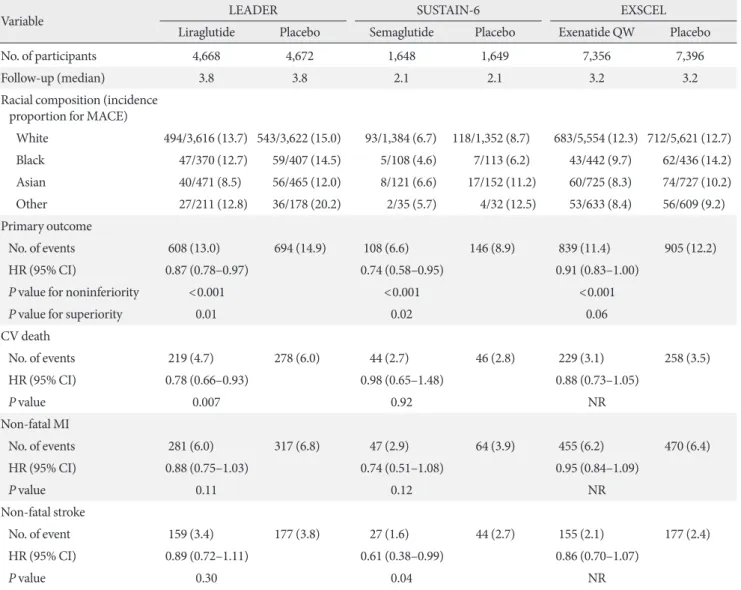
The main results of each CVOT are presented in Table 1 and the detailed study design, baseline clinical and biochemical characteristics are summarized in Supplementary Table 1. The EXSCEL study enrolled the largest number of subjects, where- as SUSTAIN-6 enrolled the smallest number of participants with the shortest median follow-up duration. Higher male-to- female participant ratios were observed in all three studies;
SUSTAIN-6 had the greatest proportion of female subjects.
Participants from various geographic regions were enrolled throughout all three studies, although most patients were from a white racial background.
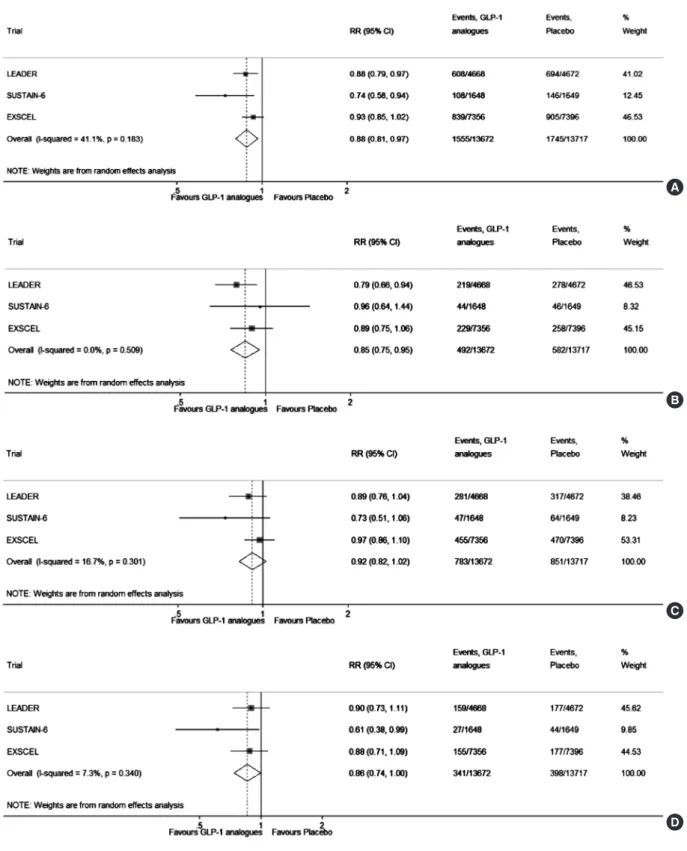
The composite analysis of risk of MACE is illustrated in Fig.
1. Moderate heterogeneity among the published trials was ob- served (I2=41.1%, P=0.183). Although the reduction in risk of MACE observed in the EXSCEL trial did not reach statistical significance as a single study, the combined analysis of all three CVOTs revealed statistically significant MACE risk reductions (relative risk [RR], 0.88; 95% CI, 0.81 to 0.97) (Fig. 1A). The combined reduction in RR for CV death was also statistically significant (RR, 0.85; 95% CI, 0.75 to 0.95) (Fig. 1B). However, the combined analysis of risk reduction in non-fatal MI and stroke did not reach statistical significance (Fig. 1C and D, re- spectively).
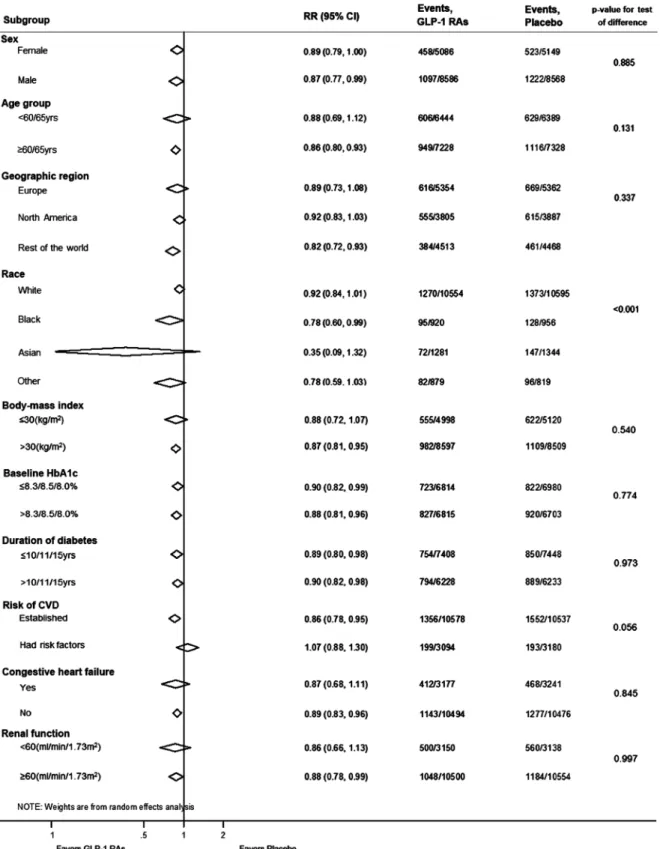
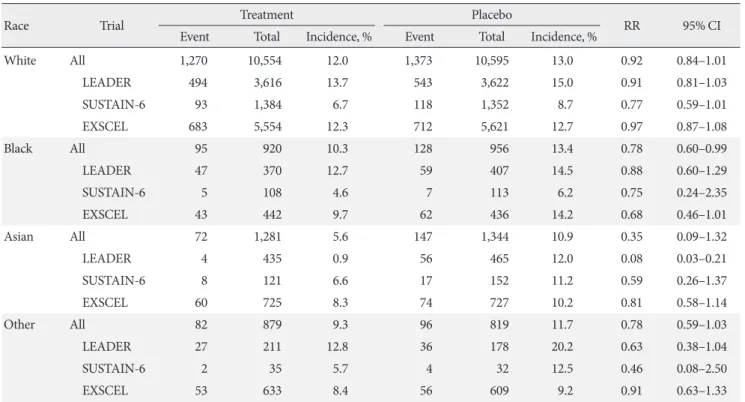
Fig. 2 presents the combined subgroup analysis of the three CVOTs. All subgroups, with the exception of race, showed no statistically significant difference compared with parameters within the same category (i.e., P<0.001 for the test of racial dif- ference). Evaluation of patients on the basis of race showed trends of MACE risk reductions in subjects of Black race (RR, 0.78; 95% CI, 0.60 to 0.99) and Asians (RR, 0.35; 95% CI, 0.09 to 1.32) (Table 2), but post hoc analysis using Bonferroni meth- od revealed that only Asians exhibited a significantly greater CV benefit from long-acting GLP-1 RAs, compared with white subjects (P<0.0001) (Supplementary Table 2). In addition,
subjects with established CVD showed a significant MACE risk reduction (RR, 0.86; 95% CI, 0.78 to 0.95), although those who had CV risks without established CVD did not show sig- nificant risk reductions (RR, 1.07; 95% CI, 0.88 to 1.30), albeit statistically nonsignificant P value for test of interaction (P=0.056).
To determine the contributing factors that might have led to a favorable CV outcome, CV risk factors from the three CV- OTs were analyzed (Supplementary Fig. 1). All three CVOTs demonstrated significant reductions in HbA1c, systolic blood
pressure (SBP), body weight, and heart rate. Combined analy- sis of these CV risk factors revealed that the overall mean dif- ference in HbA1c in all three CVOTs was –0.65% (95% CI, –0.83 to –0.47) (Supplementary Fig. 1A). The combined analy- sis also revealed overall SBP change of –1.5 mm Hg (95% CI, –1.83 to –1.23) (Supplementary Fig. 1B). The overall body weight change was –2.67 kg (95% CI, –3.74 to –1.59) (Supple- mentary Fig. 1C) and the overall change in heart rate was 2.60 bpm (95% CI, 2.26 to 2.94) (Supplementary Fig. 1D).
Table 1. CV outcomes
Variable LEADER SUSTAIN-6 EXSCEL
Liraglutide Placebo Semaglutide Placebo Exenatide QW Placebo
No. of participants 4,668 4,672 1,648 1,649 7,356 7,396
Follow-up (median) 3.8 3.8 2.1 2.1 3.2 3.2
Racial composition (incidence proportion for MACE)
White 494/3,616 (13.7) 543/3,622 (15.0) 93/1,384 (6.7) 118/1,352 (8.7) 683/5,554 (12.3) 712/5,621 (12.7) Black 47/370 (12.7) 59/407 (14.5) 5/108 (4.6) 7/113 (6.2) 43/442 (9.7) 62/436 (14.2) Asian 40/471 (8.5) 56/465 (12.0) 8/121 (6.6) 17/152 (11.2) 60/725 (8.3) 74/727 (10.2) Other 27/211 (12.8) 36/178 (20.2) 2/35 (5.7) 4/32 (12.5) 53/633 (8.4) 56/609 (9.2) Primary outcome
No. of events 608 (13.0) 694 (14.9) 108 (6.6) 146 (8.9) 839 (11.4) 905 (12.2)
HR (95% CI) 0.87 (0.78–0.97) 0.74 (0.58–0.95) 0.91 (0.83–1.00)
P value for noninferiority <0.001 <0.001 <0.001
P value for superiority 0.01 0.02 0.06
CV death
No. of events 219 (4.7) 278 (6.0) 44 (2.7) 46 (2.8) 229 (3.1) 258 (3.5)
HR (95% CI) 0.78 (0.66–0.93) 0.98 (0.65–1.48) 0.88 (0.73–1.05)
P value 0.007 0.92 NR
Non-fatal MI
No. of events 281 (6.0) 317 (6.8) 47 (2.9) 64 (3.9) 455 (6.2) 470 (6.4)
HR (95% CI) 0.88 (0.75–1.03) 0.74 (0.51–1.08) 0.95 (0.84–1.09)
P value 0.11 0.12 NR
Non-fatal stroke
No. of event 159 (3.4) 177 (3.8) 27 (1.6) 44 (2.7) 155 (2.1) 177 (2.4)
HR (95% CI) 0.89 (0.72–1.11) 0.61 (0.38–0.99) 0.86 (0.70–1.07)
P value 0.30 0.04 NR
Values are presented as number (%).
CV, cardiovascular; LEADER, Liraglutide Effect and Action in Diabetes: Evaluation of Cardiovascular Outcome Results; SUSTAIN-6, Trial to Evaluate Cardiovascular and Other Long-term Outcomes With Semaglutide in Subjects With Type 2 Diabetes; EXSCEL, Exenatide Study of Cardiovascular Event Lowering Trial; QW, weekly; MACE, major adverse cardiovascular event; HR, hazard ratio; CI, confidence interval; NR, not reported; MI, myocardial infarction.
Fig. 1. The composite analysis of the risk of major adverse cardiovascular events (MACEs) from three cardiovascular outcome trials, expressed as relative risk (RR): (A) three-point MACE, (B) cardiovascular death, (C) non-fatal myocardial infarction, and (D) non-fatal stroke. CI, confidence interval; GLP-1, glucagon-like peptide 1; LEADER, Liraglutide Effect and Action in Diabetes:
Evaluation of Cardiovascular Outcome Results; SUSTAIN-6, Trial to Evaluate Cardiovascular and Other Long-term Outcomes With Semaglutide in Subjects With Type 2 Diabetes; EXSCEL, Exenatide Study of Cardiovascular Event Lowering Trial.
A
B
C
D
Fig. 2. The combined subgroup analysis of the risk of major adverse cardiovascular events from three cardiovascular outcome tri- als. RR, relative risk; CI, confidence interval; GLP-1 RA, glucagon-like peptide 1 receptor agonist; HbA1c, glycosylated hemoglo- bin; CVD, cardiovascular disease.
Table 2. Subgroup analysis of MACE risks according to race
Race Trial Treatment Placebo
RR 95% CI
Event Total Incidence, % Event Total Incidence, %
White All 1,270 10,554 12.0 1,373 10,595 13.0 0.92 0.84–1.01
LEADER 494 3,616 13.7 543 3,622 15.0 0.91 0.81–1.03
SUSTAIN-6 93 1,384 6.7 118 1,352 8.7 0.77 0.59–1.01
EXSCEL 683 5,554 12.3 712 5,621 12.7 0.97 0.87–1.08
Black All 95 920 10.3 128 956 13.4 0.78 0.60–0.99
LEADER 47 370 12.7 59 407 14.5 0.88 0.60–1.29
SUSTAIN-6 5 108 4.6 7 113 6.2 0.75 0.24–2.35
EXSCEL 43 442 9.7 62 436 14.2 0.68 0.46–1.01
Asian All 72 1,281 5.6 147 1,344 10.9 0.35 0.09–1.32
LEADER 4 435 0.9 56 465 12.0 0.08 0.03–0.21
SUSTAIN-6 8 121 6.6 17 152 11.2 0.59 0.26–1.37
EXSCEL 60 725 8.3 74 727 10.2 0.81 0.58–1.14
Other All 82 879 9.3 96 819 11.7 0.78 0.59–1.03
LEADER 27 211 12.8 36 178 20.2 0.63 0.38–1.04
SUSTAIN-6 2 35 5.7 4 32 12.5 0.46 0.08–2.50
EXSCEL 53 633 8.4 56 609 9.2 0.91 0.63–1.33
Cumulative incidence (incidence proportion) was calculated by the number of events divided by the number of subjects in the each arm at the beginning of the trial. RR and 95% CIs were calculated assuming Poisson distribution. Overall effect estimates were calculated as hazard ratios and 95% CIs using the random-effects model.
MACE, major advance cardiovascular event; RR, relative risk; CI, confidence interval; LEADER, Liraglutide Effect and Action in Diabetes:
Evaluation of Cardiovascular Outcome Results; SUSTAIN-6, Trial to Evaluate Cardiovascular and Other Long-term Outcomes With Semaglu- tide in Subjects With Type 2 Diabetes; EXSCEL, Exenatide Study of Cardiovascular Event Lowering Trial.
DISCUSSION
In line with the recent meta-analysis that observed significant- ly reduced three-point MACE and mortality with the use of GLP-1 RAs (including the short-acting GLP-1 RA lixisenatide) [5], the overall results of our combined analysis that exclusively analyzed three CVOTs on long-acting GLP-1 RAs showed the reduced risk of three-point MACE and CV mortality. Of note, our subgroup analysis revealed a differential CV benefit of GLP-1 RAs across ethnic groups with a favorable trend to- wards Asians.
The mechanisms behind the cardioprotective effect of GLP- 1 RAs have been well established in preclinical and clinical studies [1,2]. Also as shown in Supplementary Fig. 1, GLP-1 RAs improve cardiometabolic factors such as HbA1c, SBP, and body weight [3-5], and this could have contributed to the over- all CV superiority observed in this combined analysis. In addi- tion, abundant GLP-1 receptor expression in cardiac and vas- cular tissues and the direct effect of GLP-1 to the CV system
such as the enhanced endothelial function, ventricular con- tractility, and myocardial glucose uptake could have contribut- ed simultaneously [1,2]. Taken together, the aforementioned direct and indirect effects of GLP-1 RAs might be responsible for the overall risk reduction for MACE [1].
To our knowledge, this is the first study that showed a statis- tically meaningful difference in the CV outcome among vari- ous racial groups. Although the RR for three-point MACE among Asians did not meet its statistical significance, its favor- able trend, as well as the significant post hoc analysis result, in- dicate a probably greater CV benefit from the long-acting GLP-1 RAs in Asian subpopulations with type 2 diabetes mel- litus, compared with other racial groups (Supplementary Table 2). Although mechanisms underlying the cardioprotective ef- fect of GLP-1 RAs is sufficiently established, those explaining the differential CV benefit according to race remains unclear.
However, there are several previous study findings which we can relate to this phenomenon.
First, Asians, especially East Asians, tend to exhibit lower in-
tact GLP-1 levels whether they are healthy or diabetic [6,7].
Impaired GLP-1 secretion, as well as accelerated degradation of endogenous GLP-1 by enhanced dipeptidyl peptidase-4 (DPP-4) among Asians have been proposed to explain the lower GLP-1 levels observed in Asian subjects [8]. Moreover, a Japanese study observed a blunted post-meal GLP-1 response in people with diabetes [7]. Therefore, potential metabolic consequences caused by considerably lower total GLP-1 levels and blunted GLP-1 responses might have been compensated for by the exogenous GLP-1 RA administration, exerting more profound GLP-1 effects in the whole body, including the CV system. Second, the preventive effect against CVD could be ex- plained by a greater improvement, by GLP-1 receptor stimula- tion, in the cardiometabolic risk factor profile in Asian sub- jects. For example, better glycemic control with incretin-based therapies in Asian type 2 diabetes mellitus patients than in other racial groups has been suggested [9-11]. Kim et al. [9,10]
ran a series of meta-analyses and observed that DPP-4 inhibi- tors [9] and GLP-1 analogues [10] lead to a significantly great- er HbA1c reduction in Asian-dominant studies (i.e., ≥50%
Asian participants) than in non-Asian dominant studies (i.e.,
<50% Asian participants). Suggested mechanisms underlying the greater glucose-lowering efficacy of GLP-1 RAs among Asians may include more profound β-cell dysfunction, genetic factors, a different nutritional composition that might lead to a different incretin response, and a lower BMI (i.e., BMI thresh- old hypothesis) [11]. Because Asians exhibit metabolic deterio- ration at a lower BMI compared to other racial counterparts, the net weight loss achieved by GLP-1 RAs administration could have a significantly greater metabolic impact on the Asian population. Also, with a lower body size and volume of distribution, Asians might be exposed to a higher level of GLP- 1 RAs. All of the aforementioned study findings could explain the additional CV benefit from GLP-1 RAs to some extent, however, their actual association with respect to ethnicity, as well as other possible mechanisms should still be investigated in the future comparative studies.
The main limitation of the current study is the possibility of a selection bias attributable to a highly selective study design that recruited several, currently available trial results with CV events as the primary endpoint. Moreover, subjects enrolled in these studies had diabetes and a high risk of CVD and there- fore are not representative of patients in ambulatory diabetes care. However, as a result of randomization, the background antidiabetic drugs might have balanced between the treatment
and placebo groups. Second, the CVOTs published to date mostly investigated the CV effect of long-acting GLP-1 as a secondary prevention of CVD for efficient study designs. Fu- ture studies should validate the effectiveness and utilization of GLP-1 RAs as a primary prevention of CVD. Lastly, because patient-level data were currently unavailable from the included studies, the statistical limitations owing to a small number of Asians enrolled in the CVOTs as well as the lack of other end- points besides the MACE (e.g., cholesterol levels) or the inci- dence of established CVDs were inevitable. However, we ran a post hoc analysis using Bonferroni method to delineate the dif- ference among all racial groups. The low proportion of Asian subjects in included studies might also be responsible for the lack of statistical power in our analysis. Therefore, the existence of a racial difference in the CV benefit, as well as potential mechanisms, should be investigated in future studies.
In conclusion, combining data from the major CVOTs of long-acting GLP-1 RAs (i.e., liraglutide, semaglutide, and weekly exenatide), we observed an overall CV superiority of these treatments over placebo, as well as the racial difference in the reduced risk for the three-point MACE. A favorable trend in CV outcomes towards Asians compared to other racial groups in our study should be furthermore validated by future studies with patient-level data to define these observations as a class effect, and evaluation of potential mechanisms underly- ing differential CV benefits across racial groups is also necessi- tated. If so, long-acting GLP-1 RAs might be a preferred choice for Asian type 2 diabetes mellitus patients, especially those with established CVDs.
SUPPLEMENTARY MATERIALS
Supplementary materials related to this article can be found online at https://doi.org/10.4093/dmj.2018.0070.
CONFLICTS OF INTEREST
Michael A. Nauck has been member on advisory boards or has consulted with AstraZeneca, Boehringer Ingelheim, Eli Lilly &
Co., Fractyl, GlaxoSmithKline, Menarini/Berlin Chemie, Mer- ck, Sharp & Dohme, and NovoNordisk. He has received grant support from AstraZeneca, Eli Lilly & Co., Menarini/Berlin- Chemie, Merck, Sharp & Dohme, Novartis Pharma, and No- voNordisk. He has also served on the speakers’ bureau of As- traZeneca, Boehringer Ingelheim, Eli Lilly & Co., Menarini/
Berlin Chemie, Merck, Sharp & Dohme, and NovoNordisk.
AUTHOR CONTRIBUTIONS
Conception or design: Y.M.K., C.H.J.
Acquisition and analysis of data: Y.K.C., Y.J.K.
Interpretation of data: S.E.L., W.J.L., J.Y.P., M.A.N.
Drafting the work or revising: Y.M.K., J.L., C.H.J., M.A.N.
Final approval of the manuscript: C.H.J., M.A.N.
ORCID
Yu Mi Kang https://orcid.org/0000-0002-6272-0666 Yun Kyung Cho https://orcid.org/0000-0002-4089-1376 Chang Hee Jung https://orcid.org/0000-0003-4043-2396 Michael A. Nauck https://orcid.org/0000-0002-5749-6954
ACKNOWLEDGMENTS
We thank Seon-Ok Kim from the Department of Clinical Epi- demiology and Biostatistics, Asan Medical Center & Universi- ty of Ulsan College of Medicine for her contribution in the post hoc analysis and data interpretations.
REFERENCES
1. Nauck MA, Meier JJ, Cavender MA, Abd El Aziz M, Drucker DJ. Cardiovascular actions and clinical outcomes with gluca- gon-like peptide-1 receptor agonists and dipeptidyl pepti- dase-4 inhibitors. Circulation 2017;136:849-70.
2. Kang YM, Jung CH. Cardiovascular effects of glucagon-like peptide-1 receptor agonists. Endocrinol Metab (Seoul) 2016;
31:258-74.
3. Alvarez-Villalobos NA, Trevino-Alvarez AM, Gonzalez-Gon- zalez JG. Liraglutide and cardiovascular outcomes in type 2 di-
abetes. N Engl J Med 2016;375:1797-8.
4. Marso SP, Bain SC, Consoli A, Eliaschewitz FG, Jodar E, Leiter LA, Lingvay I, Rosenstock J, Seufert J, Warren ML, Woo V, Hansen O, Holst AG, Pettersson J, Vilsboll T; SUSTAIN-6 In- vestigators. Semaglutide and cardiovascular outcomes in pa- tients with type 2 diabetes. N Engl J Med 2016;375:1834-44.
5. Bethel MA, Patel RA, Merrill P, Lokhnygina Y, Buse JB, Mentz RJ, Pagidipati NJ, Chan JC, Gustavson SM, Iqbal N, Maggioni AP, Ohman P, Poulter NR, Ramachandran A, Zinman B, Her- nandez AF, Holman RR; EXSCEL Study Group.. Cardiovascu- lar outcomes with glucagon-like peptide-1 receptor agonists in patients with type 2 diabetes: a meta-analysis. Lancet Diabetes Endocrinol 2018;6:105-13.
6. Zhang F, Tang X, Cao H, Lu Q, Li N, Liu Y, Zhang X, Zhang Y, Cao M, Wan J, An Z, Tong N. Impaired secretion of total glu- cagon-like peptide-1 in people with impaired fasting glucose combined impaired glucose tolerance. Int J Med Sci 2012;9:
574-81.
7. Yabe D, Kuroe A, Lee S, Watanabe K, Hyo T, Hishizawa M, Ku- rose T, Deacon CF, Holst JJ, Hirano T, Inagaki N, Seino Y. Little enhancement of meal-induced glucagon-like peptide 1 secre- tion in Japanese: comparison of type 2 diabetes patients and healthy controls. J Diabetes Investig 2010;1:56-9.
8. Singh AK. Incretin response in Asian type 2 diabetes: are Indi- ans different? Indian J Endocrinol Metab 2015;19:30-8.
9. Kim YG, Hahn S, Oh TJ, Kwak SH, Park KS, Cho YM. Differ- ences in the glucose-lowering efficacy of dipeptidyl peptidase-4 inhibitors between Asians and non-Asians: a systematic review and meta-analysis. Diabetologia 2013;56:696-708.
10. Kim YG, Hahn S, Oh TJ, Park KS, Cho YM. Differences in the HbA1c-lowering efficacy of glucagon-like peptide-1 analogues between Asians and non-Asians: a systematic review and me- ta-analysis. Diabetes Obes Metab 2014;16:900-9.
11. Cho YM. Incretin physiology and pathophysiology from an Asian perspective. J Diabetes Investig 2015;6:495-507.
Supplementary Table 1. Trial design and demographics of glucagon-like peptide 1 receptor agonist cardiovascular outcome trials
Variable LEADER SUSTAIN-6 EXSCEL
Trial characteristics
Year reported 2016 2016 2017
No. of participants 9,340 3,297 14,752
Median follow-up, yr 3.8 2.1 3.2
Eligibility criteria Patients with type 2 diabetes mellitus who had a glycated hemoglobin level of 7.0% or more, with an age of 50 years or more with at least one cardiovascular coexisting condition or an age of 60 years or more with at least one cardiovascular risk factor.
Patients with type 2 diabetes mellitus who had a glycated hemoglobin level of 7.0% or more, with an age of 50 years or more with established cardiovascular disease, chronic heart failure, or chronic kidney disease of stage 3 or higher or an age of 60 years or more with at least one cardiovascular risk factor.
Adults with type 2 diabetes mellitus with glycated hemoglobin level of 6.5 to 10.0%. The trial was designed such that approximately 70% of enrolled patients would have had previous cardiovascular events and 30% would not have previous cardiovascular events.
Demographics
Age, yr 64.3±7.20 64.6±7.4 62.0±8.89
Female sex 3,337 (35.7) 1,295 (39.3) 5,603 (38.0)
Duration of diabetes, yr 12.9±8.05 13.9±8.1 12.0±7.79
HbA1c, % 8.7±1.55 8.7±1.5 8.0±1.19
Body weight, kg 91.7±21.00 92.1±20.6 NR
BMI, kg/m2 32.5±6.30 32.8±6.2 31.8±5.89
Race
White 7,238 (77.5) 2,736 (83.0) 11,175 (75.8)
Black 777 (8.3) 221 (6.7) 878 (6.0)
Asian 936 (10.0) 273 (8.3) 1,452 (9.8)
Other 389 (4.2) 67 (2.0) 1,242 (8.4)
Geographic region
Europe 3,296 (35.3) 632 (19.2) 6,788 (46.0)
North America 2,847 (30.5) 1,137 (34.5) 3,708 (25.1)
Asia 711 (7.6)
1,528 (46.3)a 1,529 (10.4)
Rest of the world 2,486 (26.6) 2,727 (18.5)
Systolic BP, mm Hg 135.9±17.75 135.6±17.2 NR
Diastolic BP, mm Hg 77.1±10.20 77.0±10.0 NR
Pulse, beats/min NR 72.0±10.9 NR
LDL-C, mg/dL NR 82.3±45.6 NR
HDL-C, mg/dL NR 43.7±27.1 NR
Never smoked NR 1,493 (45.3) 7,233 (49.0)
Medical history
Established CVD 7,598 (81.3) 2,735 (83.0) 10,782 (73.1)
Risk factors for CVD 1,742 (18.7) 562 (17.0) 3,970 (26.9)
(Continued to the next page)
Supplementary Table 1. Continued
Variable LEADER SUSTAIN-6 EXSCEL
Renal function
eGFR ≥90 3,275 (35.1) 990 (30.0) 4,268 (28.9)
60–90 3,907 (41.8) 1368 (41.5) 7,246 (49.1)
30–59 1,934 (20.7) 832 (25.2) 3,177 (21.5)
<30 224 (2.4) 107 (3.3) 14 (0.1)
Medication history
Insulin user 4,169 (44.6) 1,913 (58.0) 6,836 (46.3)
Antihypertensives 8,632 (92.4) 3,082 (93.5) 13,323 (90.3)b
Lipid-lowering agents 7,079 (75.8) 2,521 (76.5) 11,370 (77.0)
Antithrombotic/anticoagulants 6,326 (67.7)c 2514 (76.3) 10,835 (73.4)
Values are presented as mean±standard deviation or number (%).
LEADER, Liraglutide Effect and Action in Diabetes: Evaluation of Cardiovascular Outcome Results; SUSTAIN-6, Trial to Evaluate Cardiovas- cular and Other Long-term Outcomes With Semaglutide in Subjects With Type 2 Diabetes; EXSCEL, Exenatide Study of Cardiovascular Event Lowering Trial; HbA1c, glycosylated hemoglobin; NR, not reported; BMI, body mass index; BP, blood pressure; LDL-C, low density lipoprotein cholesterol; HDL-C, high density lipoprotein cholesterol; CVD, cardiovascular disease; eGFR, estimated glomerular filtration rate.
aSUSTAIN-6 trial did not report Asian data as a single geographic region, bAntihypertensive, antianginal, and other cardiovascular medications,
cIncluding only platelet aggregation inhibitors.
Supplementary Table 2. Post hoc analysis for interactions be- tween different ethnic groups
Race P value for interaction
White Reference - -
Black 0.161 Reference -
Asian 0.000 0.031 Reference
Other 0.294 0.869 0.028
Supplementary Fig. 1. Cardiovascular risk factors from the three cardiovascular outcome trials: (A) glycosylated hemoglobin, (B) systolic blood pressure, (C) body weight, and (D) heart rate. CI, confidence interval; LEADER, Liraglutide Effect and Action in Diabetes: Evaluation of Cardiovascular Outcome Results; SUSTAIN-6, Trial to Evaluate Cardiovascular and Other Long-term Outcomes With Semaglutide in Subjects With Type 2 Diabetes; EXSCEL, Exenatide Study of Cardiovascular Event Lowering Tri- al; GLP-1, glucagon-like peptide 1.
A
B
C
D