The Journal of Advanced Prosthodontics 47
Effect of light-curing, pressure, oxygen
inhibition, and heat on shear bond strength between bis-acryl provisional restoration and bis-acryl repair materials
Ji-Suk Shim1, Jeong-Yol Lee2, Yeon-Jo Choi3, Sang-Wan Shin2, Jae-Jun Ryu3*
1Korea University Ansan Hospital, Prosthodontics, Ansan, Republic of Korea
2Korea University Guro Hospital, Prosthodontics, Seoul, Republic of Korea
3Korea University Anam Hospital, Prosthodontics, Seoul, Republic of Korea
PURPOSE. This study aimed to discover a way to increase the bond strength between bis-acryl resins, using a comparison of the shear bond strengths attained from bis-acryl resins treated with light curing, pressure, oxygen inhibition, and heat. MATERIALS AND METHODS. Self-cured bis-acryl resin was used as both a base material and as a repair material. Seventy specimens were distributed into seven groups according to treatment methods:
pressure - stored in a pressure cooker at 0.2 Mpa; oxygen inhibition- applied an oxygen inhibitor around the repaired material,; heat treatment - performed heat treatment in a dry oven at 60ºC, 100ºC, or 140ºC. The shear bond strength was measured with a universal testing machine, and the shear bond strength (MPa) was calculated from the peak load of failure. A comparison of the bond strength between the repaired specimens was conducted using one-way ANOVA and Tukey multiple comparison tests (α=.05). RESULTS. There were no statistically significant differences in the shear bond strength between the control group and the light curing, pressure, and oxygen inhibition groups. However, the heat treatment groups showed statistically higher bond strengths than the groups treated without heat, and the groups treated at a higher temperature resulted in higher bond strengths.
Statistically significant differences were seen between groups after different degrees of heat treatment, except in groups heated at 100ºC and 140ºC. CONCLUSION. Strong bonding can be achieved between a bis-acryl base and bis-acryl repair material after heat treatment. [J Adv Prosthodont 2015;7:47-50]
KEY WORDS: Bis-acryl; Repair; Relining; Heat; Shear bond strength
http://dx.doi.org/10.4047/jap.2015.7.1.47
http://jap.or.kr J Adv Prosthodont 2015;7:47-50
INTRODUCTION
Materials commonly used to fabricate provisional restora- tions include polyethyl methacrylate (PEMA), polymethyl methacrylate (PMMA), polyvinyl methacrylate, and bis-
acryl. Among these materials, bis-acryl resin has become popular as a material for provisional restorations because it is convenient to use, delivers a low exothermic reaction, and causes less polymerization shrinkage.1,2
In general, the chemical similarity between materials being bonded has a great effect on the bond strength between the polymers involved.3 Therefore, employing a repair resin that is chemically similar to the provisional base appears to deliver a higher bond strength than that of other materials that have a dissimilar composition.3 However, in contrast to this rationale the bond strength between bis- acryl and bis-acryl is considered weak,4 and the difficulty of using it in repair is therefore seen to be a critical shortcom- ing of bis-acryl resin. To overcome this limitation, some authors have suggested the use of light-cured flowable composites as a repair material for bis-acryl provisional res- toration. Hagge et al.4 showed that air abrasion, followed by
Corresponding author:
Jae-Jun Ryu
Department of Advanced Prosthodontics, Korea University Anam Hospital, 73, Inchon-ro, Seongbuk-gu, Seoul 136-705, Republic of Korea Tel. 82 2 920 5423: e-mail, [email protected]
Received June 10, 2014 / Last Revision August 20, 2014 / Accepted September 11, 2014
© 2015 The Korean Academy of Prosthodontics
This is an Open Access article distributed under the terms of the Creative Commons Attribution Non-Commercial License (http://creativecommons.
org/licenses/by-nc/3.0) which permits unrestricted non-commercial use, distribution, and reproduction in any medium, provided the original work is properly cited.
pISSN 2005-7806, eISSN 2005-7814
48
the application of a flowable composite, can be a successful method of repair for use with bis-acryl composite. Through case reports, Bohnekamp and Garcia,5 and Hammond et al.6 demonstrated efficacy of the use of flowable composite as a method of bis-acryl provisional restoration, although the resistance of the repaired composite to fracture using this method has still not yet been proven.3
Repairing a provisional bis-acryl restoration using bis- acryl would simplify the process of repair, and the bond strength of the repaired material would be expected to sur- pass that of bis-acryl and flowable composites. However, no reports have yet determined a method to achieve strong bond strength between bis-acryl resins. The purpose of this in vitro study is therefore to determine an appropriate way of increasing the bond strength between bis-acryl resins, by comparing the shear bond strength between bis-acryl resins obtained using different treatments involving light curing, pressure, oxygen inhibition, and heat.
MATERIALS AND METHODS
Self-curing bis-acryl resin (Luxatemp AM Plus, DMG, Hamburg, Germany; shade A2, Lot 698382) was used as the base material and repair material. The shear bond strength test required the use of a sample holder to fix the specimen in the universal testing machine, perpendicular to the orientation of the shear force, and transparent acrylic glass rods (Polymicar, Tae-guang, Korea) were fabricated for this purpose. The mixed self-curing bis-acryl resin was dispensed into a 12-mm-wide hole in the acrylic glass rod and was allowed to set for 10 minutes.
Prior to repair, the surfaces of the specimens were ground with silica carbide (SiC) paper (grit 180), rinsed with water for 10 seconds, and dried for 30 seconds using an air syringe. Hard transparent gelatin capsules (4.0 mm in diam- eter) were used as matrices for the production of columns of relining materials bonded to the bis-acrylic provisional resin surface. The capsule was partially filled with repair materials to limit the thickness of the bonded material to 2 mm (Fig. 1).
Immediately after specimen preparation, the specimens were treated in the following different ways for 20 minutes:
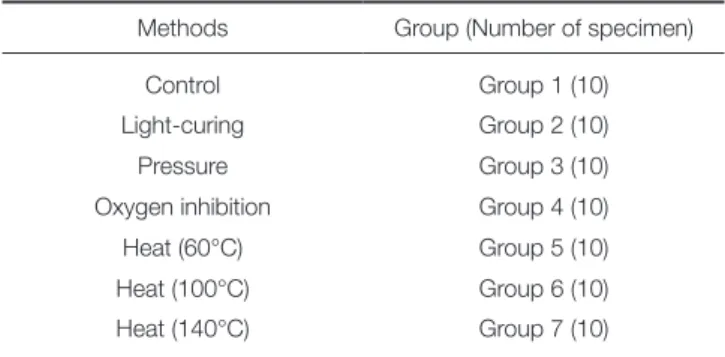
CONTROL - room temperature without any treatment, LIGHT CURING - exposed the top surface of the speci- men to a light curing unit (Drs light, Good Doctors Co., Jungcheon, Incheon, Korea), PRESSURE - stored in a pres- sure cooker (PSPC-24C, PN Poongnyun, Danwon, Ansan, Korea) without waater at 0.2 Mpa, OXYGEN INHIBITION - applied an oxygen inhibitor (Oxyguard II, Kuraray Noritake Dental Inc., Kurashiki, Okayama, Japan) around the repaired material, and HEAT - applied heat using a dry oven (WiseVen, Daihan Scientific Co., Yeong-deungpo, Seoul, Korea) at 60ºC, 100ºC, or 140ºC. Each group involved 10 specimens and Table 1 describes the groups tested.
After the treatments were applied, the shear bond strength was measured with a universal testing machine (AG-10KNX, Shimadzu Co., Kyoto, Japan). A knife-edge
shearing rod was used at a crosshead speed of 1 mm/min to place a load on the specimens until fracture occurred.
The shear bond strength (MPa) was calculated from the peak load of failure. The aspect of each bonding failure was determined and recorded using a video measuring sys- tem (Optical video measuring system, Seven Ocean, Seoul, Korea) at 10× magnification.
The mean and standard deviation of the shear bond strengths were calculated for each treatment group. The data was evaluated for homogeneity of the variance based on the Levene test (α=.05). A comparison of the bond strength between repaired specimens was conducted by one-way ANOVA and Tukey multiple comparison tests (α
<.05). All statistical analyses were carried out with SPSS for Windows (release 12.01; SPSS Inc., Chicago, IL, USA).
Table 1. Design of the experiments
Methods Group (Number of specimen)
Control Group 1 (10)
Light-curing Group 2 (10)
Pressure Group 3 (10)
Oxygen inhibition Group 4 (10)
Heat (60°C) Group 5 (10)
Heat (100°C) Group 6 (10)
Heat (140°C) Group 7 (10)
Fig. 1. Schematic figure of specimen; a- acrylic glass rod, b- bis-acryl base material, c- gelatin capsule, d- bis-acryl repair material.
J Adv Prosthodont 2015;7:47-50
The Journal of Advanced Prosthodontics 49 RESULTS
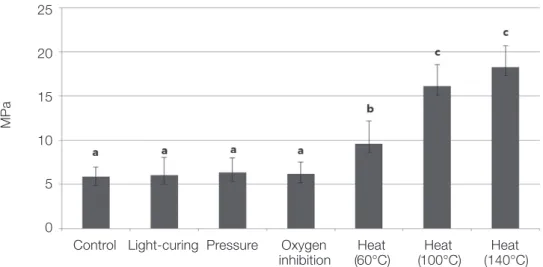
The results of the shear bond strength for each experimen- tal group are summarized in Fig. 2. The detachment results for the groups treated at room temperature indicates that group 3 (pressure) had the highest shear bond strength fol- lowed by group 4 (oxygen inhibition), group 2 (light cur- ing), and group 1 (control). However, there were no statisti- cally significant differences between the groups treated at room temperature.
The heat treatment groups (Groups 5-7) showed statis- tically higher bond strengths than the groups treated with- out heat (Groups 1-4), and the groups treated at a higher temperature resulted in higher bond strengths. There were also statistically significant differences between group 5 (heat/60ºC) and group 6 (heat/100ºC) (P<.05), but there were no statistically significant differences between group 6 (heat/100ºC) and group 7 (heat/140ºC). There was a burn odor recorded during heat treatment at 140ºC, but there was no trace of burn on the specimen. All of the groups treated at room temperature (Groups 1-4) showed adhesive failure and all of groups subjected to heat treatment (Groups 5-7) showed cohesive failure. Most cohesive fail- ures took place in the base material of the specimens, but four specimens of group 7 (heat/140ºC) showed cohesive failure of the repaired material.
DISCUSSION
There is little available information concerning methods to increase the bond strength of dental composites especially for bis-acryl resin, but light curing,7 pressure,8 oxygen inhi- bition,9 and heat10 have been proposed to fortify the mechanical properties of resin composites. Therefore, to achieve the purpose of this in vitro study, finding the way to
increase the bond strength between bis-acryl resins, light curing, pressure, oxygen inhibition and heat was selected as variables of the experiment.
The effects of light-curing, pressure, oxygen inhibition, and heat treatments on the shear bond strength between bis-acryl composites were evaluated. Among the above identified treatment methods, only the application of heat had an effect on the shear bond strength between bis-acryl resins and strong bond strength could be achieved using heat treatment after 20 minutes of bonding.
Although there are few available studies involving the heat treatment of bis-acryl, investigations of the heat treat- ment of other dental resins showed that increasing wear resistance,11 tensile strength,12,13 fracture toughness14 and hardness15 were obtained by applying heat treatment. These reports concluded that the increased mechanical properties resulting from heat treatment was related to an increase of the degree of cure. Therefore, the effect of heat treatment on dental resins prompts the degree of cure. The degree of cure of bis-acryl is lower than other provisional restoration materials16 and it can be improved more than other provi- sional restoration materials by heat treatment. In conclu- sion, the dramatic increase in bond strength between bis- acryl obtained by heat treatment in this study seems to be related to the low degree of cure of bis-acryl and the accel- erated cure of bis-acryl by heat treatment.
The optimal heat treatment for composite resin was 125ºC for a total of 7.5 minutes,17 but there is no available information about the proper heat temperature for the treatment of bis-acryl. In our study, there were no signifi- cant differences between the groups heat-treated at a tem- perature of 100ºC and groups treated at a temperature of 140ºC. During heat treatment at 140ºC, a burning odor was smelt and only specimens heat-treated at 140ºC showed cohesive failure of the repaired material. Therefore, it can
Fig. 2. The bond strengths of the each repaired materials, groups with the same letter did not show any statistically significant differences (α>.05).
MPa
25 20 15 10 5
0
Control Light-curing Pressure Oxygen Heat Heat Heat inhibition (60°C) (100°C) (140°C)
Effect of light-curing, pressure, oxygen inhibition, and heat on shear bond strength between bis-acryl provisional restoration and bis-acryl repair materials
50
be assumed that the strongest bonding between bis-aryl res- ins was achieved from heat treatment around a temperature of 100ºC for a time period of 20 minutes and the chemical deformation of bis-acryl occurred at a heat treatment tem- perature between 100ºC and 140ºC.
Ferracane and Condon18 showed that shorter heat treat- ment was sufficient to enhance the mechanical properties of a composite resin compared to heat treatment for differ- ent durations (3 hours and 10 minutes) at the same temper- ature (120ºC). The duration of heat treatment is also an important factor, although it was not considered in this study. Indeed, although a strong bond between bis-acryl resins was achieved through heat treatment of 20 minutes, there are concerns about shrinkage and deformation of bis- acryl resin due to the heat treatment. Therefore, in order to apply the results of this study to the clinical setting, more data regarding time factors of heat treatment and the other effects of heat on the mechanical properties of bis-acryl resin are required.
CONCLUSION
Light curing, pressure, and oxygen inhibition have no effect on the shear bond strength between bis-aryl resins. However, higher bond strength between bis-acryl resins can be achieved using the heat treatment of 100oC for 20 minutes.
REFERENCES
1. Young HM, Smith CT, Morton D. Comparative in vitro eval- uation of two provisional restorative materials. J Prosthet Dent 2001;85:129-32.
2. Tjan AH, Castelnuovo J, Shiotsu G. Marginal fidelity of crowns fabricated from six proprietary provisional materials.
J Prosthet Dent 1997;77:482-5.
3. Chen HL, Lai YL, Chou IC, Hu CJ, Lee SY. Shear bond strength of provisional restoration materials repaired with light-cured resins. Oper Dent 2008;33:508-15.
4. Hagge MS, Lindemuth JS, Jones AG. Shear bond strength of bis-acryl composite provisional material repaired with flow- able composite. J Esthet Restor Dent 2002;14:47-52.
5. Bohnenkamp DM, Garcia LT. Repair of bis-acryl provisional restorations using flowable composite resin. J Prosthet Dent 2004;92:500-2.
6. Hammond BD, Cooper JR 3rd, Lazarchik DA. Predictable repair of provisional restorations. J Esthet Restor Dent 2009;
21:19-24.
7. Tanoue N, Matsumura H, Atsuta M. Comparative evaluation of secondary heat treatment and a high intensity light source for the improvement of properties of prosthetic composites.
J Oral Rehabil 2000;27:288-93.
8. Murakami N, Wakabayashi N, Matsushima R, Kishida A, Igarashi Y. Effect of high-pressure polymerization on me- chanical properties of PMMA denture base resin. J Mech Behav Biomed Mater 2013;20:98-104.
9. Velazquez E, Vaidyanathan J, Vaidyanathan TK, Houpt M, Shey Z, Von Hagen S. Effect of primer solvent and curing
mode on dentin shear bond strength and interface morphol- ogy. Quintessence Int 2003;34:548-55.
10. Bausch JR, de Lange C, Davidson CL. The influence of tem- perature on some physical properties of dental composites. J Oral Rehabil 1981;8:309-17.
11. Lutz F, Phillips RW, Roulet JF, Setcos JC. In vivo and in vitro wear of potential posterior composites. J Dent Res 1984;63:
914-20.
12. Wendt SL Jr. The effect of heat used as secondary cure upon the physical properties of three composite resins. II. Wear, hardness, and color stability. Quintessence Int 1987;18:351-6.
13. Covey DA, Tahaney SR, Davenport JM. Mechanical proper- ties of heat-treated composite resin restorative materials. J Prosthet Dent 1992;68:458-61.
14. Cook WD, Johannson M. The influence of postcuring on the fracture properties of photo-cured dimethacrylate based den- tal composite resin. J Biomed Mater Res 1987;21:979-89.
15. Wendt SL Jr. The effect of heat used as a secondary cure up- on the physical properties of three composite resins. I.
Diametral tensile strength, compressive strength, and margin- al dimensional stability. Quintessence Int 1987;18:265-71.
16. Ha JY, Kim SH, Kim KH, Kwon TY. Influence of the vol- umes of bis-acryl and poly(methyl methacrylate) resins on their exothermic behavior during polymerization. Dent Mater J 2011;30:336-42.
17. Wendt SL Jr. Time as a factor in the heat curing of compos- ite resins. Quintessence Int 1989;20:259-63.
18. Ferracane JL, Condon JR. Post-cure heat treatments for com- posites: properties and fractography. Dent Mater 1992;8:290- 5.
J Adv Prosthodont 2015;7:47-50