PGHN
Original Article
The Rate of Conversion from Immune-tolerant Phase to Early Immune-clearance Phase in Children with Chronic Hepatitis B Virus Infection
Suk Jin Hong, Hyo Jung Park*, Mi Ae Chu*, Bong Seok Choi* and Byung-Ho Choe*
Department of Pediatrics, Catholic University of Daegu School of Medicine, *Department of Pediatrics, Kyungpook National University School of Medicine, Daegu, Korea
Purpose: The spontaneous seroconversion rate of hepatitis B e antigen (HBeAg)-positive chronic hepatitis B (CHB) virus infection in children is lower than that in adults. However, few studies have investigated the rate of transition from the immune-tolerant to the early immune-clearance phase in children.
Methods: From February 2000 to August 2011, we enrolled 133 children aged <18 years who had visited the Department of Pediatrics, Kyungpook National University Hospital. All subjects were in the immune-tolerant phase of HBeAg-positive CHB virus infection. The estimated transition rate into the early immune-clearance phase was calculated using the Kaplan-Meier method.
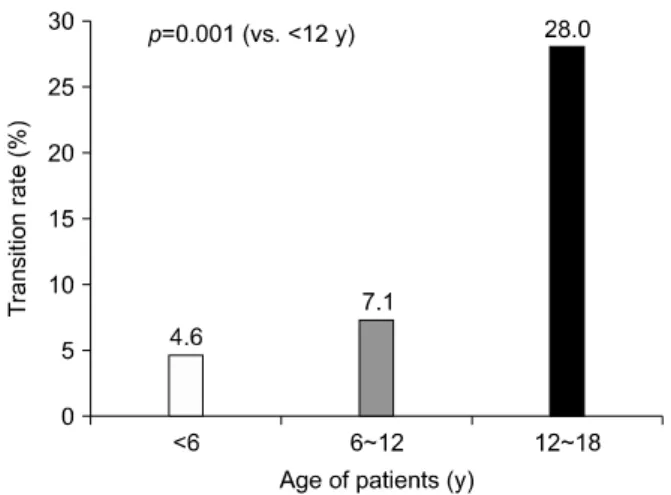
Results: Among the 133 enrolled pediatric CHB virus infection patients in the HBeAg-positive immune-tolerant phase, only 21 children (15.8%) had converted to the early immune-clearance phase. The average age at entry into active hepatitis was 10.6±4.8 years. The incidence of transition from the immune-tolerant to the early immune-clearance phase in these children was 1.7 episodes/100 patient-years. When analyzed by age, the estimated transition rate was 4.6%, 7.1%, and 28.0% for patients aged <6, 6-12, >12 years, respectively.
Conclusion: In children with CHB virus infection, the estimated rate of entry into the early immune-clearance phase was 28.0% for patients aged 12-18 years, which was significantly higher than that observed for children aged <12 years (11.7%; p=0.001).
Key Words: Child, Hepatitis B virus, Chronic hepatitis B, Phase transition, Natural history
Received:February 7, 2014, Revised:March 3, 2014, Accepted:March 10, 2014
Corresponding author: Byung-Ho Choe, Department of Pediatrics, Kyungpook National University Children's Hospital, Kyungpook National University School of Medicine, 130, Dongdeok-ro, Jung-gu, Daegu 700-721, Korea. Tel: +82-53-420-5704, Fax: +82-53-425-6683, E-mail:
Copyright ⓒ 2014 by The Korean Society of Pediatric Gastroenterology, Hepatology and Nutrition
This is an openaccess article distributed under the terms of the Creative Commons Attribution NonCommercial License (http://creativecommons.org/licenses/by-nc/3.0/) which permits unrestricted noncommercial use, distribution, and reproduction in any medium, provided the original work is properly cited.
INTRODUCTION
The natural history of chronic hepatitis B (CHB) vi-
rus infection in children is influenced by the age at in- fection, geographic region, ethnicity, mode of in- fection, host immunologic response, viral genotype,
and concurrent infection with other viruses [1]. Most hepatitis B virus (HBV) infections acquired during adulthood present as acute hepatitis and have low conversion rates (5-10%) to chronic hepatitis or be- coming a hepatitis carrier. However, HBV infection in the perinatal period or early childhood usually pro- gresses to chronic infection, with a significant pro- portion of chronically infected patients developing liver cirrhosis and hepatocellular carcinoma. In fact, it is reported that more than 90-95% of perinatal in- fections and 30% of infections in children aged <6 years result in chronic hepatitis [2].
According to studies of the natural history of CHB virus infection, the timing of hepatitis B e antigen (HBeAg) seroconversion varies from childhood to adulthood, and occurs markedly between the ages of 15 and 35 years [3]. In Asian countries, vertical trans- mission (from highly infectious mothers to their ba- bies) is an important route for HBV infection. Most carrier mothers experience delayed seroconversion in their 30s and 40s [4]. Many studies have reported on the natural history of CHB virus infection, including HBeAg seroconversion, but studies on the transition from the immune-tolerant phase to the early im- mune-clearance phase are rare. Therefore, in the present study, we aimed to elucidate the timing of the transition from the immune-tolerant phase to the early immune-clearance phase in children with CHB virus infection.
MATERIALS AND METHODS
Patient population
From February 2000 to August 2011, we enrolled a total of 133 children aged <18 years who had visited the Department of Pediatrics, Kyungpook National University Hospital (KNUH). All of the enrolled sub- jects were in the immune-tolerant phase of CHB virus infection. This cohort study was approved by the in- stitutional review board of KNUH (IRB No. KNUH 2013-04-057).
Inclusion criteria
Patients were considered to be in the immune-tol-
erant phase of CHB virus infection when they ex- hibited positive results for hepatitis B surface antigen (HBsAg) and HBeAg, negative results for hepatitis B surface antibody (anti-HBs) and hepatitis B e anti- body (anti-HBe), elevated HBV DNA titers for at least 6 months, and persistently normal serum aspartate transaminase (AST)/alanine aminotransferase (ALT) levels since birth.
Exclusion criteria
Patients were excluded from the study if they showed high levels of ALT at the time of the hospital visit, were transferred from another hospital during treatment, were co-infected with other viruses, for ex- ample hepatitis C virus, Epstein-Barr virus, Cytome- galovirus etc. were immune-compromised hosts, had other known metabolic or immune disorders, or had decompensated liver diseases, or other causes of liver disease such as steatohepatitis.
Patient follow-up
During follow-up periods, serum HBeAg (by using a commercially available electrochemiluminescence immunoassay (ECLIA) method; Roche Diagnostics, Indianapolis, IN, USA), HBV DNA (by real-time poly- merase chain reaction [PCR]; Roche COBAS AmpliPrep/Taq-Man96 real-time PCR assay; Roche Diagnostics, Mannheim, Germany; detection limit 12 IU·mL), and AST/ALT titers were monitored at inter- vals of 3-6 months until the occurrence of elevation of the AST/ALT levels. During follow-up period, children were regarded as being in the early immune-clear- ance phase if the elevation of the AST/ALT levels (>
1.5 times of the upper limits of normal value) per- sisted for more than 6 months without any evidence of systemic infection, because nonspecific reactive hepatitis is not uncommon in such young children.
No known specific evidence for systemic infection or other causes of liver disease were noted at the time of regarding immune-clearance phase.
Analysis plan
Patients were monitored at shorter intervals of 1-3 months if the AST/ALT titers were elevated. Entry into
Table 1.Baseline Demographic Data of Patients at Initial Visit
Total (n=133) Age (y)
p-value
<6 (n=64) 6-12 (n=41) ≥12 (n=28)
Age (y) Male : female ALT level (IU/L) HBV DNA level >108 IU/mL <108 IU/mL Mean±SD
6.9±4.9 78 : 55 27.6±10.7
123 10 (4.7±3.2)×106
2.4±1.7 27 : 37 29.3±11.1
61 3 (5.7±3.3)×106
8.7±1.8 25 : 16 23.5±10.4
31 10 (4.3±3.3)×106
13.5±1.0 26 : 2 28.3±10.9
23 5 (4.9±3.5)×106
NS
NS Values are presented as mean±standard deviation (SD) or number only.
NS: non-significant (p>0.05).
the early immune-clearance phase was considered when AST/ALT titers were elevated to at least 1.5 times over the upper limits of normal for a period of at least 3 months. The period to onset of active hepatitis was analyzed. If HBeAg seroconversion (HBeAg clearance plus undetectable HBV DNA by real time PCR) occurs during follow-up at the end of the immune-clearance phase, its implications were analyzed.
Statistical analysis
Statistical analysis was conducted using SPSS Statistics 17.0 (SPSS Inc., Chicago, IL, USA). All val- ues are expressed as the mean±standard deviation (SD). Between age groups, differences were analyzed using unpaired Student’s t-tests for the comparison of continuous variables, and p-values of <0.05 were considered statistically significant. The estimated transition rate from the immune-tolerant phase to the early immune-clearance phase was calculated us- ing the Kaplan-Meier method. The cumulative pro- portion of children transitioning to the early im- mune-clearance phase were evaluated with Wald statistics, which can correct wide confidence intervals.
RESULTS
Demographic data of enrolled patients A total of 133 children (78 male, 55 female; 1.4 : 1) were in the immune-tolerant phase were enrolled. At the time of their first visit, their mean age was 6.9±4.9 years (mean±SD; range, 0-14.5 years)
(Table 1). There were no significant demographic dif- ferences between patients aged ≥6 years and those aged <6 years. Most patients (98.5%) had a maternal history of CHB virus infection, suggesting that they were infected by vertical transmission. The mean du- ration of observation since birth was 9.5 years (range, 1.3-18.0 years), should it be tracked since birth.
Transition to the early immune-clearance phase Transition to the early immune-clearance phase was observed in 21 of the 133 children (15.8%), in- cluding 13 males and 8 females (M : F, 1.6 : 1); no no- table differences were observed between these male and female patients. The mean age at entry into the early immune-clearance phase was 10.6±4.8 years (range, 1.7-16.9 years). Among the 21 patients in the immune-clearance phase, spontaneous HBeAg sero- conversion occurred in 2 patients, whereas 17 pa- tients were treated with an antiviral agent such as lamivudine. The remaining 2 patients were lost to fol- low-up. During treatment, AST, ALT, HBeAg, an- ti-HBe, and HBV DNA titers were monitored every 3 months. Lamivudine treatment was continued for at least 1 additional year after the occurrence of HBeAg seroconversion.
Patients who entered the early immune-clearance phase were observed for 100 person-years during which they developed 1.7 events of active hepatitis.
The remaining 112 children persisted in the im- mune-tolerant phase during 1,036 person-years of observation. The maximum follow-up period was 12 years (range, 1.3-18.0 years), should it be tracked
Fig. 2. Transition rate from the immune-tolerant phase to the early immune-clearance phase according to the patient age.
Fig. 1. Cumulative proportion of children transitioning from the immune-tolerant phase to the early immune-clearance phase analyzed using the Kaplan-Meier method (n=133).
since birth. None of the children dropped out of the study within 6 months of enrollment.
The proportion of patients transitioning to the ear- ly immune-clearance phase, as calculated by the Kaplan-Meier method, was estimated at 4.6% in the group aged <6 years, 11.7% in the group aged <12 years, and 39.7% in the group aged <18 years (Fig.
1). The transition proportion in the children aged 12-18 years (28.0%) was significantly higher than the transition proportion among patients aged <12 years (11.7%; p=0.001) (Fig. 2).
Clinical course of phase-converted patients As of the time of writing, HBeAg seroconversion had occurred in 17 children among the 19 who entered the early immune-clearance phase, including the cases of spontaneous HBeAg seroconversion. In 13 of the 17 patients (76.5%), HBeAg seroconversion had occurred during a 4-year follow-up period. However, HBeAg se- roconversion has not yet occurred in 2 of the 19 who converted to early immune-clearance, and these pa- tients continue to receive treatment.
DISCUSSION
The rate of spontaneous HBeAg seroconversion has been reported to vary according to a patient’s geo- graphical region, age, and ethnicity. In Korea, Yoon et
al. [5] reported that spontaneous HBeAg seroconver- sion occurred in 16% of adult patients with CHB virus infection annually. The rate of seroconversion in older patients was higher than that in younger patients. In comparison with the seroconversion rate in Asia, where HBV is highly endemic, Evans et al. [6] found a higher spontaneous HBeAg seroconversion rate in 454 chronic Asian-American carriers of HBV. They also found higher seroconversion rates among individuals aged 18-34 years (23%) than among those aged <18 years (15%). The major mode of HBV transmission may explain the low spontaneous seroconversion rate in Asia [7]. In Asia, HBV infection is endemic and usually transmitted by perinatal vertical transmission from mothers in a prolonged immune-tolerant phase of CHB virus infection. In addition, higher HBeAg sero- conversion rates have been reported in horizontally in- fected children than in those infected perinatally [1].
The rate of spontaneous seroconversion is lower in children than in adults. In Taiwan, Chang et al. [8]
reported that the annual HBeAg clearance rate was low (<2%) during the first 3 years of life but in- creased with age (4-5% in children aged >3 years and 10-14% for children aged 10-14 years). In Korea, Kim et al. [9] followed 214 children with CHB virus infection for 20 years and reported cumulative spon- taneous HBeAg seroconversion rates of 8% for those aged <5 years, 11% for those aged <10 years, and
35% for those aged <19 years. Therefore, sponta- neous HBeAg seroconversion occurred in approx- imately one-third of HBV-infected children, which is higher than previously reported [4]. These data are similar to our findings regarding the transition rates from the immune-tolerant phase to the early im- mune-clearance phase in different pediatric age groups. We observed the transition to the early im- mune-clearance phase in 21 (15.8%) of 133 children in the present study. Among these 21 patients, spon- taneous HBeAg seroconversion occurred in 2 patients without treatment, and 17 patients were treated with an antiviral agent. The cumulative proportion of chil- dren transitioning to the early immune-clearance phase was estimated to be 11.7% in patients aged
<12 years and 39.7% in patients aged <18 years.
Ethnicity has not been found to affect the HBeAg seroconversion rates between children and adults.
Marx et al. [1] studied the long-term outcome of 174 HBeAg-positive children living in the United States who comprised a heterogeneous group with diverse ethnic origins. However, they reported a lower cumu- lative seroconversion rate in Asian-born children, pre- dominantly vertically infected, as compared to all the other ethnic groups (75% vs. 94% by Kaplan-Meier analysis, p<0.05) after 13 years of follow-up.
As stated above, there are many published studies on the seroconversion rates that have used HBeAg se- roconversion as the endpoint of the immune-clear- ance phase. From a clinical standpoint, it is more im- portant to elucidate the time of conversion to active hepatitis, which is the early stage of the im- mune-clearance phase, to determine the optimal time to start treatment. However, there is little research covering this clinically significant turning point.
Although most CHB virus infection patients are asymptomatic, a long-term immune-clearance phase influences the development of complications such as liver cirrhosis. Because early management to shorten the duration of the immune-clearance phase is im- portant for resolving hepatic inflammation, monitor- ing of liver function in immune-tolerant patients at regular intervals is necessary to detect the time of transition to the immune-clearance phase as early as
possible. Many guidelines recommend that adult pa- tients in the immune-tolerant phase should be moni- tored at intervals of 3 to 6 months [10-12]. In chil- dren, follow-up should be performed at least every 3 to 6 months, similarly to the follow-up guidelines for adults [13].
In the present study, we investigated the rate of transition to the immune-clearance phase according to age, in order to re-establish monitoring intervals.
However, this study has several limitations. It is a ret- rospective cohort study of Korean children, in whom vertical transmission and genotype C are predom- inant [14]. We regarded CHB virus infection children with normal AST/ALT titers for at least 6 months as carrier in immune-tolerant phase since birth. This contention is based on assumption that conversion to the immune-clearance phase could occur only once in early life. The cutoff point of AST/ALT titers at 1.5 times over the upper limits of normal for defining en- try to the early immune-clearance phase was de- termined arbitrarily. However, HBeAg sero- conversion occurred in most children who transi- tioned to the early-clearance phase either sponta- neously or with antiviral therapy [15-18].
Nevertheless, our report confirms that the tran- sition rate to the immune-clearance phase is very low in children aged <12 years. Therefore, it may be ad- visable to extend the follow-up interval from the cur- rently recommended 6-month follow-up interval for Korean children. Moreover, monitoring at 1-year in- tervals could be considered for children aged <6 years, in whom conducting short-term follow-up is not easy, since the transition rate in this age group was only 4.6%. However, further studies are needed to optimize follow-up intervals in children with CHB virus infection.
ACKNOWLEDGEMENTS
The authors thank the World Congress of Pediatric Gastroenterology, Hepatology and Nutrition (WCPG- HAN) for the 4th WCPGHAN Young Investigator Award and the European Society of Paediatric Gas- troenterology, Hepatology and Nutrition Internatio-
nal Award. This research was supported by Kyung- pook National University Research Fund, 2012.
REFERENCES
1. Marx G, Martin SR, Chicoine JF, Alvarez F. Long-term follow-up of chronic hepatitis B virus infection in chil- dren of different ethnic origins. J Infect Dis 2002;186:295-301.
2. McMahon BJ, Alward WL, Hall DB, Heyward WL, Bender TR, Francis DP, et al. Acute hepatitis B virus infection: relation of age to the clinical expression of dis- ease and subsequent development of the carrier state.
J Infect Dis 1985;151:599-603.
3. Chu CM. Natural history of chronic hepatitis B virus in- fection in adults with emphasis on the occurrence of cir- rhosis and hepatocellular carcinoma. J Gastroenterol Hepatol 2000;15(Suppl):E25-30.
4. Hsu YS, Chien RN, Yeh CT, Sheen IS, Chiou HY, Chu CM, et al. Long-term outcome after spontaneous HBeAg seroconversion in patients with chronic hep- atitis B. Hepatology 2002;35:1522-7.
5. Yoon JH, Rhee PL, Lee HS, Kim CY. Spontaneous HBeAg clearance rate and its affecting factors in- patients with chronic hepatitis B in Korea. Korean J Gastroenterol 1992;24:1313-9.
6. Evans AA, Fine M, London WT. Spontaneous sero- conversion in hepatitis B e antigen-positive chronic hepatitis B: implications for interferon therapy. J Infect Dis 1997;176:845-50.
7. Lok AS, Lai CL. A longitudinal follow-up of asympto- matic hepatitis B surface antigen-positive Chinese children. Hepatology 1988;8:1130-3.
8. Chang MH, Sung JL, Lee CY, Chen CJ, Chen JS, Hsu HY, et al. Factors affecting clearance of hepatitis B e an- tigen in hepatitis B surface antigen carrier children. J Pediatr 1989;115:385-90.
9. Kim Y, Baek SY, Eom JH, Chung KS. Natural history of chronic hepatitis b in children. Korean J Pediatr 2004;47:282-9.
10. European Association for the Study of the Liver. EASL clinical practice guidelines: Management of chronic hepatitis B virus infection. J Hepatol 2012;57:167-85.
11. Liaw YF, Kao JH, Piratvisuth T, Chan HLY, Chien RN, Liu CJ, et al. Asian-Pacific consensus statement on the management of chronic hepatitis B: a 2012 update.
Hepatol Int 2012;6:531-61.
12. Lok AS, McMahon BJ. Chronic hepatitis B: update 2009. Hepatology 2009;50:661-2.
13. Shah U, Kelly D, Chang MH, Fujisawa T, Heller S, González-Peralta RP, et al. Management of chronic hepatitis B in children. J Pediatr Gastroenterol Nutr 2009;48:399-404.
14. Choe BH, Lee JH, Jang YC, Jang CH, Oh KW, Kwon S, et al. Long-term therapeutic efficacy of lamivudine compared with interferon-alpha in children with chron- ic hepatitis B: the younger the better. J Pediatr Gastroenterol Nutr 2007;44:92-8.
15. Bortolotti F, Jara P, Barbera C, Gregorio GV, Vegnente A, Zancan L, et al. Long term effect of alpha interferon in children with chronic hepatitis B. Gut 2000;46:715-8.
16. Fujisawa T, Komatsu H, Inui A, Sogo T, Miyagawa Y, Fujitsuka S, et al. Long-term outcome of chronic hep- atitis B in adolescents or young adults in follow-up from childhood. J Pediatr Gastroenterol Nutr 2000;30:
201-6.
17. Bortolotti F, Guido M, Bartolacci S, Cadrobbi P, Crivellaro C, Noventa F, et al. Chronic hepatitis B in children after e antigen seroclearance: final report of a 29-year longitudinal study. Hepatology 2006;43:
556-62.
18. Iorio R, Giannattasio A, Cirillo F, D' Alessandro L, Vegnente A. Long-term outcome in children with chron- ic hepatitis B: a 24-year observation period. Clin Infect Dis 2007;45:943-9.