http://dx.doi.org/10.5534/wjmh.2013.31.1.58
Original Article
Received: Feb 6, 2013; Revised: Feb 22, 2013; Accepted: Feb 28, 2013 Correspondence to: Jun Ho Lee
Department of Urology, National Police Hospital, 123 Songi-ro, Songpa-gu, Seoul 138-708, Korea.
Tel: +82-2-3410-1266, Fax: +82-2-431-3192, E-mail: [email protected] Copyright © 2013 Korean Society for Sexual Medicine and Andrology
This is an Open Access article distributed under the terms of the Creative Commons Attribution Non-Commercial License (http://creativecommons.
org/licenses/by-nc/3.0) which permits unrestricted non-commercial use, distribution, and reproduction in any medium, provided the original work is properly cited.
Preoperative Predictors of Varicocelectomy Success in the Treatment of Testicular Pain
Yeon Won Park, Jun Ho Lee
Department of Urology, National Police Hospital, Seoul, Korea
Purpose: We performed the present study to evaluate the prognostic factors for the surgical outcome of varicocelectomy in the treatment of a painful varicocele.
Materials and Methods: A total of 77 patients undergoing varicocelectomy were enrolled. All the patients were examined for body mass index (BMI), varicocele grade, testosterone, follicle stimulating hormone (FSH), luteinizing hormone (LH), semen analysis, maximal vein diameter, and discrepancy of testicular volume. At a follow-up visit 3∼6 months after the surgery, the patient response was graded as a complete response, partial response, or no response. The resolution of pain was defined as a complete or partial response. We used logistic regression analyses to determine the preoperative factors for predicting a complete response and the resolution of pain.
Results: Ten subjects were lost to follow-up. The remaining 67 patients were included in this study. The pain was com- pletely resolved in 47.8% of patients, partial resolution was observed in 25.4% of patients, and failure was reported in 26.9% of patients. Among the parameters, only a longer duration of pain (≥3 months) was an independent factor related to the complete response of pain (odds ratio, 7.371; p=0.010) and the resolution of pain (odds ratio, 7.209; p=0.042).
The parameters of semen analysis results, testosterone, LH, FSH, BMI, grade, ultrasonography results, and the type of surgi- cal approach did not significantly predict the resolution of pain.
Conclusions: The duration of pain (≥3 months) was an independent prognostic factor for the complete response of pain and the resolution of pain.
Key Words: Varicocele; Pain; Laparoscopy; Microsurgery
INTRODUCTION
Varicocele is an abnormal tortuosity and enlargement of the veins of the pampiniform plexus in the spermatic cord. Varicocele has been known to be a cause of pain in 2% to 14% of men suffering chronic scrotal pain.1,2
Additionally, 2% to 10% of men with varicocele complain of scrotal pain.3
A varicocelectomy should be considered in patients with no alleviation of their pain after conservative man- agement, including resting, scrotal elevation, and non- steroidal anti-inflammatory analgesics. The success rate of
the surgical approach for the treatment of painful varico- cele has ranged from 53% to 92% for complete resolution, from 5% to 20% for partial resolution, and from 0% to 20% for failure.4
A longer duration of pain, body mass index (BMI), vari- cocele grade, and quantity and quality of preoperative pain have been reported as predictive factors for pain reso- lution after surgery.5-8 However, there are few data with re- spect to hormone levels, semen parameters, and ultra- sonographic features as prognostic factors. Therefore, we performed the present study to evaluate prognostic factors for surgical outcome, including follicle stimulating hor- mone (FSH), luteinizing hormone (LH), testosterone, the parameters of scrotal ultrasonography, semen analysis, age, duration of pain, BMI, and varicocele grade.
MATERIALS AND METHODS
1. Patients
The institutional review board of the National Police Hospital approved this study in December 2012. Data were collected retrospectively on 77 patients with left painful varicocele undergoing a varicocelectomy during a 5-year period beginning in January 2007. None of the pa- tients had responded to prior conservative management for 3∼4 weeks. Patients who had other causes of scrotal pain, such as testicular torsion, epididymitis, orchitis, in- guinal hernia, testicular tumor, or trauma were excluded from the study.
Varicocele was graded as follows9: grade I, palpable on- ly with the Valsalva maneuver; grade II, palpable without the Valsalva maneuver; and grade III, visible from a distance. All of the patients were evaluated for the serum levels of testosterone, FSH, and LH in the morning (between 8:00 and 11:00 AM). The semen analysis was performed after 3 days of abstinence from ejaculation. The maximal vein diameter was examined while the patient re- laxed using scrotal ultrasonography. The testicular vol- ume (bilateral) was measured by ultrasonography, and a discrepancy in the testicular volume was defined as a testis volume difference ≥3 ml.10
The surgical techniques included laparoscopic varico- celectomy and subinguinal varicocelectomy with a surgi- cal microscope (×10∼×25). In the laparoscopic varico-
celectomy, 3 ports (each 5 mm) were used. The spermatic veins were clipped at the site of the internal inguinal ring after incising the posterior peritoneum. An attempt was made to preserve the testicular artery. In all subinguinal varicocelectomy cases, the testis was delivered through the incision, and the gubernacular veins and external sper- matic perforating veins were divided. Additionally, an at- tempt was made to preserve the testicular artery and lymphatics.
All patients were asked to return for a follow-up visit 3
∼6 months after surgery. The patient response was graded as a complete response (pain was completely absent after the surgery), partial response (pain persisted but was re- duced after the surgery), or no response (pain remained unchanged after the surgery).11 The resolution of pain was defined as a complete or partial response.
2. Statistical analysis
Because of the markedly skewed distribution of the demographic characteristics, medians and interquartile ranges (IQR) were adopted.
To determine the preoperative factors for predicting a complete response and the resolution of pain after sur- gery, statistical analyses were performed with logistic re- gression analyses using the Statistical Package for the Social Sciences, version 11.0 (SPSS, Chicago, IL, USA). A p value of <0.05 was considered to be statistically significant.
RESULTS
A total of 77 patients with left painful varicocele under- went a varicocelectomy at our institution, and 10 (13%) subjects were lost to follow-up after the varicocelectomy.
The remaining 67 patients were included and the median follow up period was 6.0 months (IQR: 6.0∼9.0 months).
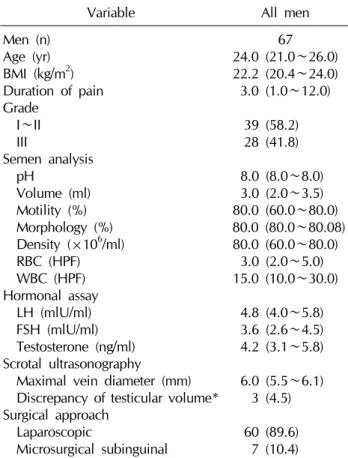
The baseline characteristics of the patients are shown in Table 1.
The pain was completely resolved in 47.8%, a partial resolution was observed in 25.4%, and failure was re- ported in 26.9% (Table 2).
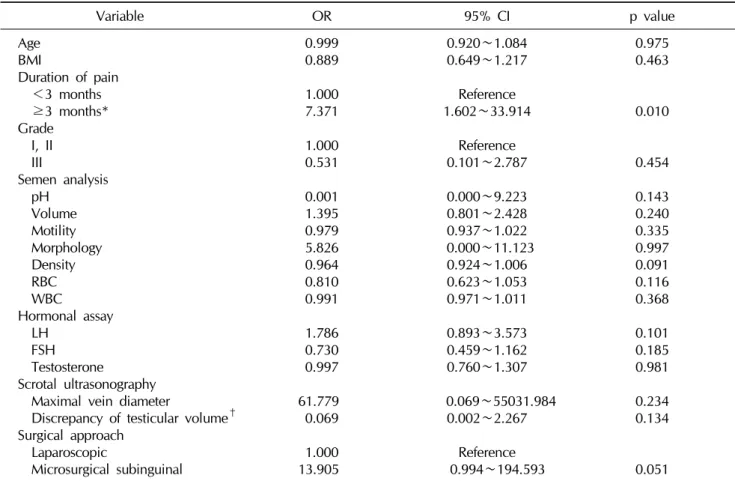
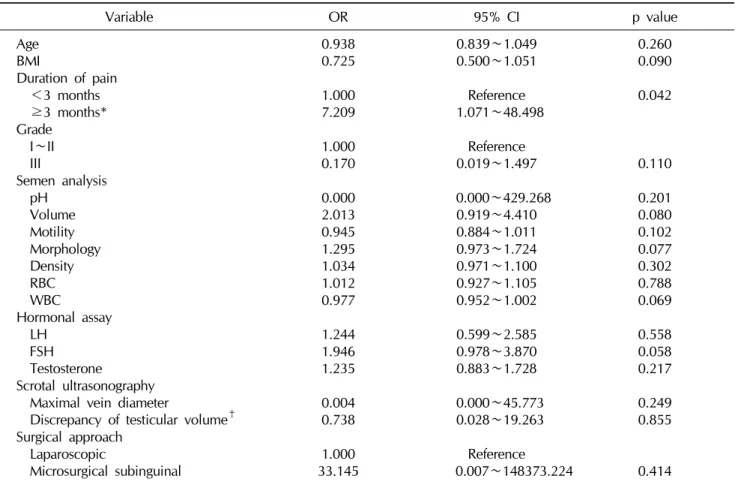
The results of the multivariate analysis of the predictors for the success of the varicocelectomy are presented in Tables 3 and 4. The semen parameters and levels of testos-
Table 1. Patient characteristics
Variable All men
Men (n) Age (yr) BMI (kg/m2) Duration of pain Grade
I∼II III
Semen analysis pH
Volume (ml) Motility (%) Morphology (%) Density (×106/ml) RBC (HPF) WBC (HPF) Hormonal assay LH (mlU/ml) FSH (mlU/ml) Testosterone (ng/ml) Scrotal ultrasonography Maximal vein diameter (mm) Discrepancy of testicular volume*
Surgical approach Laparoscopic
Microsurgical subinguinal
67 24.0 (21.0∼26.0) 22.2 (20.4∼24.0) 3.0 (1.0∼12.0)
39 (58.2) 28 (41.8) 8.0 (8.0∼8.0) 3.0 (2.0∼3.5) 80.0 (60.0∼80.0) 80.0 (80.0∼80.08) 80.0 (60.0∼80.0)
3.0 (2.0∼5.0) 15.0 (10.0∼30.0)
4.8 (4.0∼5.8) 3.6 (2.6∼4.5) 4.2 (3.1∼5.8) 6.0 (5.5∼6.1)
3 (4.5) 60 (89.6)
7 (10.4) Values are presented as number (%) or median (interquar- tile range).
BMI: body mass index, RBC: red blood cells, WBC: white blood cells, HPF: high power field, LH: luteinizing hormone, FSH: follicle stimulating hormone.
*Testis volume difference ≥3 ml.
Table 2. Outcome of varicocelectomy performed for pain
Variable Surgical approach
Overall (n=67) Microsurgical subinguinal (n=7) Laparoscopic (n=60)
Complete response*
Partial response† No response‡
5 (71.4) 1 (14.3) 1 (14.3)
27 (45.0) 16 (26.7) 17 (28.3)
32 (47.8) 17 (25.4) 18 (26.9) Values are presented as number (%).
*Pain was completely absent 3∼6 months after surgery. †Pain persisted but was reduced 3∼6 months after surgery. ‡Pain remained unchanged 3∼6 months after surgery.
terone, LH, and FSH were not related to the response after varicocelectomy. Additionally, the BMI, varicocele grade, scrotal ultrasonography parameters, and the type of surgi- cal approach did not significantly predict the resolution of pain. Only a longer duration of pain (≥3 months) was an
independent factor related to a complete response to sur- gery (odds ratio, 7.371; p=0.010) and the resolution of pain (odds ratio, 7.209; p=0.042).
DISCUSSION
Our results indicate that the duration of pain (≥3 months) is an independent prognostic factor for a com- plete response to surgery and the resolution of pain. The results of the present study correspond with the results of earlier studies, which reported that a longer duration of pain could predict a successful surgical outcome. In a large retrospective study that recruited 237 men who un- derwent a subinguinal varicocelectomy for scrotal pain, the patients who presented with long-term (>3 months) pain had a significantly higher chance of benefiting from the operation compared with the patients who presented with short-term pain (success rates: 98% in the >3 month group, 82.3% in the <3 month group; p<0.05).5 Another retrospective study including 53 cases who underwent subinguinal and inguinal varicocelectomy reported that the degree of improvement in the postoperative symptoms was relatively higher in patients who had a shorter dura- tion of pain (<6 months) than in those who had a longer duration of pain (≥6 months) (p=0.002).8 A recent retro- spective study including 76 patients also suggested that a longer duration of pain is associated with the resolution of pain (p=0.01).6 Although there are differences in the dura- tion of pain according to each study, a longer duration of pain appears to be associated with a successful surgical outcome.
No difference with regard to the semen parameters, hormone levels, or sonographic features between the res-
Table 3. Multivariate analysis of the predictive factors for the complete resolution of pain
Variable OR 95% CI p value
Age BMI
Duration of pain <3 months ≥3 months*
Grade I, II III
Semen analysis pH
Volume Motility Morphology Density RBC WBC Hormonal assay LH
FSH Testosterone Scrotal ultrasonography Maximal vein diameter
Discrepancy of testicular volume† Surgical approach
Laparoscopic
Microsurgical subinguinal
0.999 0.889 1.000 7.371 1.000 0.531 0.001 1.395 0.979 5.826 0.964 0.810 0.991 1.786 0.730 0.997 61.779 0.069 1.000 13.905
0.920∼1.084 0.649∼1.217 Reference 1.602∼33.914
Reference 0.101∼2.787 0.000∼9.223 0.801∼2.428 0.937∼1.022 0.000∼11.123 0.924∼1.006 0.623∼1.053 0.971∼1.011 0.893∼3.573 0.459∼1.162 0.760∼1.307 0.069∼55031.984 0.002∼2.267
Reference 0.994∼194.593
0.975 0.463
0.010
0.454 0.143 0.240 0.335 0.997 0.091 0.116 0.368 0.101 0.185 0.981 0.234 0.134
0.051
Statistical analysis performed using multiple logistic regression analysis differences between groups considered significant at p<0.05.
OR: odds ratio, CI: confidence interval, BMI: body mass index, RBC: red blood cells, WBC: white blood cells, LH: luteinizing hormone, FSH: follicle stimulating hormone.
*Statiscally significant. †Testis volume difference ≥3 ml.
ponders and non-responders was noted according to our results. To the best of our knowledge, there has only been one study utilizing data concerning the aforementioned parameters. In this retrospective study that included 76 pa- tients, semen parameters (sperm motility, sperm morphol- ogy, sperm density, and testicular volume), ultrasono- graphic features (discrepancy of testicular volume and maximal vein diameter), and hormone levels (FSH, LH, and testosterone) were not related to the success of varico- celectomy for pain.6 Our findings confirmed those results.
Preoperative BMI and varicocele grade have been sug- gested to be associated with the success rate.8,12
Our data also showed a negative trend for BMI (odds ra- tio, 0.725; p=0.090) and grade III (odds ratio, 0.170;
p=0.110). However, these differences were not signi- ficant. To better elucidate their relationship, follow-up
studies including a larger patient population are needed.
Additionally, dull pain has been reported to have a sig- nificant association with the successful resolution of pain compared with sharp pain.3,7,13 However, another study did not show a significant difference with respect to the type of pain.6,8 In this study, we could not evaluate this re- lationship due to the lack of data concerning the pain char- acteristics in the patient charts. Therefore, prospective da- ta collection for a large population is needed to define the relationship between the type of pain and the outcome of surgery.
The overall success rate for laparoscopic varicocelec- tomy was 71.7% (complete response 45.0%; partial re- sponse 26.7%) in this study. According to a recent review, the overall pain resolution rate (complete and partial re- sponses) of laparoscopic varicocelectomy for three differ-
Table 4. Multivariate analysis of the predictive factors for the resolution of pain
Variable OR 95% CI p value
Age BMI
Duration of pain <3 months ≥3 months*
Grade I∼II III
Semen analysis pH
Volume Motility Morphology Density RBC WBC Hormonal assay LH
FSH Testosterone Scrotal ultrasonography Maximal vein diameter
Discrepancy of testicular volume† Surgical approach
Laparoscopic
Microsurgical subinguinal
0.938 0.725 1.000 7.209 1.000 0.170 0.000 2.013 0.945 1.295 1.034 1.012 0.977 1.244 1.946 1.235 0.004 0.738 1.000 33.145
0.839∼1.049 0.500∼1.051 Reference 1.071∼48.498
Reference 0.019∼1.497 0.000∼429.268 0.919∼4.410 0.884∼1.011 0.973∼1.724 0.971∼1.100 0.927∼1.105 0.952∼1.002 0.599∼2.585 0.978∼3.870 0.883∼1.728 0.000∼45.773 0.028∼19.263
Reference 0.007∼148373.224
0.260 0.090 0.042
0.110 0.201 0.080 0.102 0.077 0.302 0.788 0.069 0.558 0.058 0.217 0.249 0.855
0.414
Resolution of pain: complete response and partial response. Statistical analysis performed using multiple logistic regression analysis differences between groups considered significant at p<0.05.
OR: odds ratio, CI: confidence interval, BMI: body mass index, RBC: red blood cells, WBC: white blood cells, LH: luteinizing hormone, FSH: follicle stimulating hormone.
*Statiscally significant. †Testis volume difference ≥3 ml.
ent reports was 86% (ranging from 76% to 95%).4 Further- more, data from Korea showed similar results.14,15 The success rate in our study was slightly lower than that in other studies. The reason for this difference might be due to the characteristics of the study populations. We col- lected data from policemen, who experience vigorous ac- tivity and standing or sitting positions for long periods compared with the general population. We speculate that the negative effect of the behavior of policemen could lower the success rate of a laparoscopic varicocelectomy.
Comparing success rates according to the surgical ap- proach was not possible due to the small number of micro- scopic varicocelectomies that were performed. The over- all pain resolution (complete and partial response) rate of microscopic varicocelectomy for seven different reports was 93% (ranging from 79.2 to 100%).4 To define which
method is superior for controlling the pain of varicocele, a prospective randomized control trial is needed.
Several limitations of the present study warrant mentio- ning. First, retrospective studies are less reliable than pro- spective studies. In addition, because this study consisted of a single institution and was conducted in a single occu- pational cluster, there might be a potential for selection bias.
CONCLUSIONS
The present results revealed that the duration of pain (≥
3 months) was an independent prognostic factor for a complete response and the resolution of pain after surgery to treat painful varicocele. Future investigations should ex- plore this relationship. The confirmation of these associa-
tions in a prospective, longitudinal data set would also be informative.
REFERENCES
1. Kass EJ, Marcol B. Results of varicocele surgery in adoles- cents: a comparison of techniques. J Urol 1992;148:694-6 2. Marmar JL, Kim Y. Subinguinal microsurgical varicocelec-
tomy: a technical critique and statistical analysis of semen and pregnancy data. J Urol 1994;152:1127-32
3. Peterson AC, Lance RS, Ruiz HE. Outcomes of varicocele li- gation done for pain. J Urol 1998;159:1565-7
4. Shridharani A, Lockwood G, Sandlow J. Varicocelectomy in the treatment of testicular pain: a review. Curr Opin Urol 2012;22:499-506
5. Altunoluk B, Soylemez H, Efe E, Malkoc O. Duration of preoperative scrotal pain may predict the success of micro- surgical varicocelectomy. Int Braz J Urol 2010;36:55-9 6. Chen SS. Factors predicting symptomatic relief by varicoce-
lectomy in patients with normospermia and painful varico- cele nonresponsive to conservative treatment. Urology 2012;80:585-9
7. Kim HT, Song PH, Moon KH. Microsurgical ligation for painful varicocele: effectiveness and predictors of pain resolution. Yonsei Med J 2012;53:145-50
8. Park HJ, Lee SS, Park NC. Predictors of pain resolution after varicocelectomy for painful varicocele. Asian J Androl 2011;13:754-8
9. Lyon RP, Marshall S, Scott MP. Varicocele in childhood and adolescence: implication in adulthood infertility? Urology 1982;19:641-4
10. Sigman M, Jarow JP. Ipsilateral testicular hypotrophy is as- sociated with decreased sperm counts in infertile men with varicoceles. J Urol 1997;158:605-7
11. Levine LA, Matkov TG, Lubenow TR. Microsurgical de- nervation of the spermatic cord: a surgical alternative in the treatment of chronic orchialgia. J Urol 1996;155:1005-7 12. Yaman O, Ozdiler E, Anafarta K, Göğüş O. Effect of micro-
surgical subinguinal varicocele ligation to treat pain.
Urology 2000;55:107-8
13. Al-Buheissi SZ, Patel HR, Wazait HD, Miller RA, Nathan S.
Predictors of success in surgical ligation of painful varicocele. Urol Int 2007;79:33-6
14. Yeo JK. A comparative study of varicocelectomy for painful varicocele: modified palomo, laparoscopic approach and microscopic subinguinal approach. Korean J Androl 2009;
27:201-5
15. Lee MJ, Cho SH, Choi JY, Kim SB, Lee ST, Min SK. Signifi- cance of laparoscopic varicocelectomy. Korean J Androl 2010;28:209-16