Emotional effect of the Covid-19 pandemic on oral surgery procedures: a social media analysis
Ahmet Altan
Department of Oral and Maxillofacial Surgery, Faculty of Dentistry, Tokat Gaziosmanpaşa University, Tokat, Turkey
Background: This study aimed to analyze Twitter users' emotional tendencies regarding oral surgery procedures before and after the coronavirus disease 2019 (COVID-19) pandemic worldwide.
Methods: Tweets posted in English before and after the COVID-19 pandemic were included in the study.
Popular tweets in 2019 were searched using the keywords "tooth removal", "tooth extraction", "dental pain",
"wisdom tooth", "wisdom teeth", "oral surgery", "oral surgeon", and "OMFS". In 2020, another search was conducted by adding the words "COVID" and "corona" to the abovementioned keywords. Emotions underlying the tweets were analyzed using CrystalFeel - Multidimensional Emotion Analysis. In this analysis, we focused on four emotions: fear, anger, sadness, and joy.
Results: A total of 1240 tweets, which were posted before and after the COVID-19 pandemic, were analyzed.
There was a statistically significant difference between the emotions' distribution before and after the pandemic (p < 0.001). While the sense of joy decreased after the pandemic, anger and fear increased. There was a statistically significant difference between the emotional valence distributions before and after the pandemic (p < 0.001).
While a negative emotion intensity was noted in 52.9% of the messages before the pandemic, it was observed in 74.3% of the messages after the pandemic. A positive emotional intensity was observed in 29.8% of the messages before the pandemic, but was seen in 10.7% of the messages after the pandemic.
Conclusion: Infectious diseases, such as COVID-19, may lead to mental, emotional, and behavioral changes in people. Unpredictability, uncertainty, disease severity, misinformation, and social isolation may further increase dental anxiety and fear among people.
Keywords: COVID-19; Oral Surgery; Pandemics; Social Media.
This is an Open Access article distributed under the terms of the Creative Commons Attribution Non-Commercial License (http://creativecommons.org/licenses/by-nc/4.0/) which permits unrestricted non-commercial use, distribution, and reproduction in any medium, provided the original work is properly cited.
Received: April 26, 2021•Revised: May 7, 2021•Accepted: May 17, 2021
Corresponding Author:Ahmet Altan, Gaziosmanpasa University, Ali Sevki Erek Yerleskesi, Tokat 60100, Turkey Tel: +90-356-212-4222 Fax: +90-356-212-4225 E-mail: [email protected]
Copyrightⓒ 2021 Journal of Dental Anesthesia and Pain Medicine
INTRODUCTION
A pandemic is defined as an epidemic that occurs worldwide or over an extensive area, crosses international boundaries, and usually affects many people [1]. Pan- demics in different periods throughout human history have led to social, political, and economic disruptions as well as sudden and wide-ranging morbidity and mortality.
During epidemics, changes in mental, emotional, and behavioral responses have been noted in society [2].
The novel coronavirus disease 2019 (COVID-19), caused by the severe acute respiratory syndrome coronavirus 2, was first detected in Wuhan, China, in December 2019 [3]. This disease, which has now spread worldwide, was declared a pandemic by the World Health Organization (WHO) on March 11, 2020 [4]. After the WHO's outbreak declaration, governments began taking precautions against the disease. Preventive measures affecting the daily routines of the populations were implemented to limit the COVID-19 infection. Signifi- cant changes occurred in daily life routines because of
school closures, changing working conditions, social activities restriction, and quarantine. As a result of the rapid increase in the number of confirmed cases and deaths, healthcare professionals, as well as the general population, experienced health-related problems and psychological pressure [5]. Oral and maxillofacial surgery was also one of the healthcare fields that had to change their working order. Maxillofacial surgery is an area of vulnerability, especially in an environment where a deadly virus is transmitted through the respiratory tract.
Because of the nature of a physician's job, each examination and procedure carries the risk of viral transmission [6]. Therefore, all non-emergency healthcare appointments and procedures were postponed or canceled.
Some patients who realized such a risk postponed their treatment themselves.
Social media is a platform where people share their thoughts with others on the internet. Social networks include applications that enable individuals to share content and information and express their feelings comfortably. In the past decade, social media has been used to monitor people's emotions and communication patterns during the Ebola and Zika outbreaks [7]. In this study, we assumed that different emotions that have appeared on social media recently and the narratives underlying them are related to the current COVID-19 crisis.
According to Plutchik's Wheel of Emotions [8], fear-anger and sadness-joy are opposite experiences or basic emotion pairs. In this study, we aimed to analyze the results of Twitter users' emotional responses to oral surgery procedures before and after the COVID-19 pandemic. We focused on the following four emotions:
fear, anger, sadness, and joy.
METHODS
1. Study Design
The tweets posted in English around the world were included in the study. Popular tweets were reached using the keywords "tooth removal," "tooth extraction," "dental
pain," "wisdom tooth," "wisdom teeth," "oral surgery,"
"oral surgeon," and "OMFS" in Twitter's search application between January 1, 2019, and December 31, 2019. These tweets represented the emotions related to oral surgery procedures before the COVID-19 pandemic.
Between January 1, 2020, and December 31, 2020, a search was performed by adding the words "COVID" and
"corona" to the abovementioned keywords. These popular tweets represented the emotions related to oral surgery procedures after the COVID-19 pandemic. The tweets sent from corporate accounts were not included in the study because they were sent for informative purposes and had no emotional meaning. The tweets, including different keywords, were used once. Furthermore, the tweets containing only emojis, icons, and videos were excluded. In this study, no ethics committee approval was required since public data were used, and the study did not include human subjects.
2. Analysis of Emotions
The emotions underlying the tweets were analyzed using CrystalFeel-Multidimensional Emotion Analysis, a proven sensitivity analytical technology. CrystalFeel collects machine learning-based emotion analysis algorithms to analyze emotional characteristics in the text in multiple output dimensions. When a text message is submitted, CrysalFeel analyzes the text's emotional characteristics by running five algorithms independently and simultaneously, providing five output dimensions, including intensity of joy, fear, anger, valence, and sadness. Continuous values are interpreted as follows: 0 - this text expresses emotional intensity at no or very low level; 1 - this text expresses extremely high emotional intensity (Table 1). Researchers can see the details and examples of the CrystalFeel algorithm in www.crystalfeel.socialanalyticsplus.net
Anger is an unpleasant emotional state that involves a strong, disturbing, and hostile response to hurt, threat, or a perceived provocation. Anger usually has many mental and physical consequences. In this study, anger includes several related emotions, such as annoyance,
Table 1. Examples of tweets with their emotion intensity scores
Emotions Tweets Scores
Anger “I hate COVID I literally was scheduled for a winsome tooth extraction on 3/20 and now I have to suffer for however long till my dentist opens back up”
[0.723]
Fear “Question for the Twitter... I have oral surgery scheduled for the 24th. Should I reschedule in re Corona? It’s an outpatient procedure, done by a dentist, it’s just at a hospital w/ their anesthesiologists. There are no cases in my area at this time.”
[0.528]
Sadness “With great sadness I must announce that I am once again in dental pain.” [0.676]
Joy “Yess, I'm finally getting my wisdom teeth out next week! Thank God, corona was playing and these teeth gotta
go!” [0.667]
Table 2. Interpretation of the five main emotional intensity scores
Anger intensity measures a range of anger-related negative feelings such as irritation, aggravation, annoyance, rage, and fury.
[0.0-0.4] (0.4-0.6] (0.6-0.8] (0.8, 1.0]
no or low-intensity anger moderate-intensity anger high-intensity anger extremely high-intensity anger Fear intensity measures a range of fear-related negative feelings such as concern, worry, anxiety, dread, scared, terror, and horror.
[0.0-0.4] (0.4-0.6] (0.6-0.8] (0.8, 1.0]
no or low-intensity fear moderate-intensity fear high-intensity fear extremely high-intensity fear Sadness intensity measures a range of sadness-related negative feelings such as disappointment, melancholy, helplessness, grief, and sorrow.
[0.0-0.4] (0.4-0.6] (0.6-0.8] (0.8, 1.0]
no or low-intensity sadness moderate-intensity sadness high-intensity sadness extremely high-intensity sadness Joy intensity measures an extensive range of positive emotions such as contentment, happiness, pleasure, ecstasy, excitement, and a more subtle
sense of hope, gratitude, pride, and compassion.
[0.0-0.4] (0.4-0.6] (0.6-0.8] (0.8, 1.0]
no or low-intensity joy moderate-intensity joy high-intensity joy extremely high-intensity joy Valence intensity measures a range of overall feelings from extremely unpleasant/ negative to extremely pleasant/positive.
[0-0.25] (0.25-0.48] (0.48-0.52] (0.52-0.75] (0.75, 1]
very negative negative neutral or mixed positive very positive
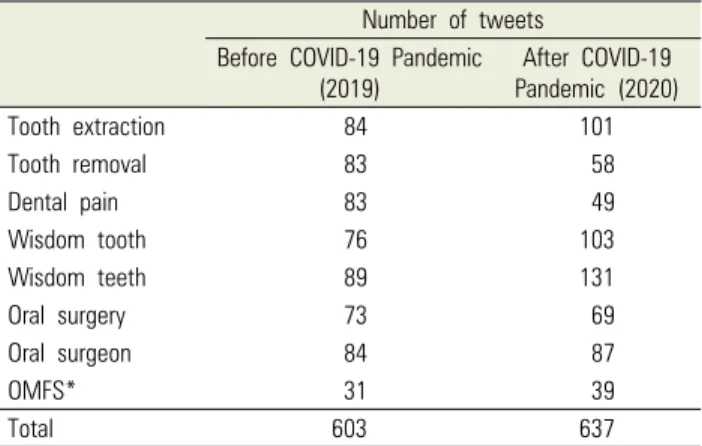
Table 3. Keywords searched on Twitter
Number of tweets Before COVID-19 Pandemic
(2019) After COVID-19 Pandemic (2020)
Tooth extraction 84 101
Tooth removal 83 58
Dental pain 83 49
Wisdom tooth 76 103
Wisdom teeth 89 131
Oral surgery 73 69
Oral surgeon 84 87
OMFS* 31 39
Total 603 637
*OMFS: Oral and Maxillofacial Surgery.
irritation, aggravation, fury, and rage.
Fear refers to an unpleasant emotion caused by danger, pain, damage, or a perceived threat. Fear usually leads to escaping, avoiding freezing, threat, or paralysis in extreme events. In this study, fear intensity measures several negative emotions related to fear, such as concern, anxiety, worry, scared, dread, horror, and terror.
Sadness refers to an unpleasant emotion characterized by disadvantages, helplessness, loss, sorrow, disappoint- ment, and helplessness. Sadness may usually lead to inactivity, silence, withdrawal from others, and depression in extreme cases. In this study, sadness intensity measures several negative emotions related to sadness, such as helplessness, disappointment, melancholy, sorrow, and grief.
Joy refers to a positive emotion, such as excessive happiness, pleasure, or enthusiasm of the soul caused by satisfaction or a sense of well-being. In English, joy may
refer to an extraordinary feeling of great happiness. In this study, joy intensity measures emotions, such as hope, pride, gratitude, compassion, and a wide range of positive emotions, such as pleasure, ecstasy, happiness, and excitement.
Valence or emotional valence refers to the overall
Table 4. Distribution of tweets by emotion scores
Before COVID-19 Pandemic
2019 After COVID-19 Pandemic
2020 P
No specific emotion 54 (8.9%) 52 (8.2%)
< 0.001*
Anger 90 (14.9%)a 137 (21.5%)b
Fear 215 (35.7%)a 330 (51.8%)b
Sadness 47 (7.8%) 47 (7.4%)
Joy 197 (32.7%)a 71 (11.1%)b
Total 603 (100%) 637 (100%)
*Significant at the p 0.05 level.
There is statistical significance between the columns with different superscripts.
Table 5. Distribution of tweets by emotional valence scores
Before COVID-19 Pandemic
2019 After COVID-19 Pandemic
2020 P
Very negative 15 (2.4%)a 43 (6.8%)b
< 0.001*
Negative 337 (52.9%)a 473 (74.3%)b
Neutral or mixed 54 (8.5%) 52 (8.2%)
Positive 190 (29.8%)a 68 (10.7%)b
Very positive 7 (1.1%)a 1 (0.2%)b
Total 603 (100%) 637 (100%)
*Significant at the p 0.05 level.
There is statistical significance between the columns with different superscripts.
degree of unpleasantness (negative emotions) or pleasantness (positive emotions) of an emotional experience or expression. In this program, valence intensity measures a range of general emotions, from extremely unpleasant/negative to extremely pleasant/
positive (Table 2).
3. Statistical Analysis
IBM SPSS V23 was used to analyze the data. A Chi-square test was used to compare the parameters before and after the pandemic. Analysis results were presented as frequency (percentage) for categorical data.
The level of significance was set at P < 0.05.
RESULTS
A total of 1240 tweets, 603 and 637 of which were posted before and after the COVID-19 pandemic, respectively, were analyzed (Table 3). There was a statistically significant difference between the distribution of emotions before and after the pandemic (P < 0.001)
(Table 4). While there was a feeling of joy in 32.7% of the messages before the pandemic, this ratio was 11.1%
after the pandemic. While there was a feeling of fear in 35.7% of the messages before the pandemic, this ratio was 51.8% after the pandemic. Furthermore, while 14.9%
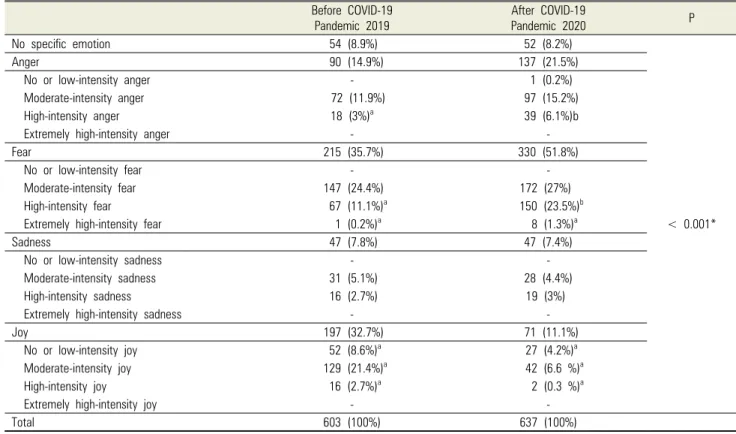
of the messages had a sense of anger before the pandemic, this ratio was 21.5% after the pandemic. There was a statistically significant difference between the distri- butions of emotional valence before and after the pandemic (P < 0.001) (Table 5). While a negative emotion intensity was noted in 52.9% of the messages before the pandemic, this ratio was 74.3% after the pandemic. A positive emotional intensity was observed in 29.8% of the messages before the pandemic; however, this ratio was 10.7% after the pandemic. There was a statistically significant difference between the distributions of pre-and post-pandemic thresholds of the intensity (P < 0.001) (Table 6). When the tweets' timing about oral surgery procedures was examined, a homogeneous distribution was observed before the COVID-19 pandemic; however, the tweets were concentrated around March and April 2020 (30.8%) after
Table 6. Distribution of tweets by thresholds of the intensity scores Before COVID-19
Pandemic 2019
After COVID-19
Pandemic 2020 P
No specific emotion 54 (8.9%) 52 (8.2%)
< 0.001*
Anger 90 (14.9%) 137 (21.5%)
No or low-intensity anger - 1 (0.2%)
Moderate-intensity anger 72 (11.9%) 97 (15.2%)
High-intensity anger 18 (3%)a 39 (6.1%)b
Extremely high-intensity anger - -
Fear 215 (35.7%) 330 (51.8%)
No or low-intensity fear - -
Moderate-intensity fear 147 (24.4%) 172 (27%)
High-intensity fear 67 (11.1%)a 150 (23.5%)b
Extremely high-intensity fear 1 (0.2%)a 8 (1.3%)a
Sadness 47 (7.8%) 47 (7.4%)
No or low-intensity sadness - -
Moderate-intensity sadness 31 (5.1%) 28 (4.4%)
High-intensity sadness 16 (2.7%) 19 (3%)
Extremely high-intensity sadness - -
Joy 197 (32.7%) 71 (11.1%)
No or low-intensity joy 52 (8.6%)a 27 (4.2%)a
Moderate-intensity joy 129 (21.4%)a 42 (6.6 %)a
High-intensity joy 16 (2.7%)a 2 (0.3 %)a
Extremely high-intensity joy - -
Total 603 (100%) 637 (100%)
*Significant at the p 0.05 level.
There is statistical significance between the columns with different superscripts.
the COVID-19 pandemic.
DISCUSSION
Social media enables people to convey their attitudes and emotions to a large population easily. Easy access to social networks, such as Twitter, allows researchers to use these tools as data sources on several issues, including attitudes towards health-related issues [9-11].
In this study, Twitter users' emotional responses to oral surgery procedures were analyzed. Many people have negative associations and emotions about dental treatment because of painful experiences in the past. Through this study, we determined that the COVID-19 pandemic made negative associations and emotions about oral surgery procedures even more negative.
Fear and anxiety about visiting the dentist is an important problem for many people. In their study on
Twitter, Johnsen et al. [12] reported that more negative words were used in the tweets about dentists than medical doctors and that the words related to pain were used at higher rates. Pain is an unpleasant sensory and emotional experience, and it has different personal effects on different people [13,14]. Gao et al. [15] reported that aversive dental treatment, indirect learning through parents and peers, and exposure to negative information affected dental anxiety and fear. This study observed that negative emotions, such as fear and anger, were dominant in the tweets posted before the COVID-19 pandemic in 2019. Procedures related to oral surgery, such as "wisdom tooth removal," "tooth extraction," and "dental pain" have negative effects on people. However, it was observed that the pandemic led to increased negative emotions and decreased positive emotions in the tweets about oral surgery procedures.
The COVID-19 pandemic is a highly devastating event that has significantly affected daily life in almost every
country. COVID-19 can spread rapidly by asymptomatic and symptomatic individuals. The clinicians who interact with more than one patient may serve as vectors for viral transmission between the patients [16]. Because of close physical contact with patients, dentists are at a high risk of contracting infections and transmitting COVID-19 to their patients [17]. The best protection for dentists and their patients is to raise awareness, avoid unnecessary contact with people who may have COVID-19, use appropriate personal protective equipment, and draw attention to personal hygiene behavior, especially handwashing [18]. Because of the high risk of COVID-19 contraction among dentists and their patients, on March 16, 2020, the American Dental Association [19]
recommended that dentists should delay elective procedures and only provide emergency dental care.
Furthermore, the Centers for Disease Control and Prevention [18] recommended that dental care providers should suspend routine dental visits and delay all elective procedure visits. When the tweets' timings about oral surgery procedures after the COVID-19 pandemic were examined, it was observed that the tweets were concentrated in March and April 2020. We observed that the closure of dental clinics led to the emergence of anger in people without treatment access. Furthermore, COVID-19 infection was a cause of fear among Twitter users who required emergency dental treatment during this period.
Except for a few studies conducted in China, there are limited studies on the psychological effects of the COVID-19 pandemic on society [20-22]. In a study conducted by Wang et al. [2] in 1210 participants from different cities in China at the beginning of the COVID-19 pandemic, psychological effects were observed, including stress, depression, and anxiety. The study results showed that 53.8% of these individuals experienced severe psychological effects of the pandemic.
Furthermore, 8.1%, 28.8%, and 16.5% of the participants reported stress, anxiety, and moderate to severe depression, respectively. It has been observed that the psychological trauma caused by the prevalence of
infectious diseases is quite common in societies.
Uncertainty, unpredictability, misinformation, social isolation, the severity of the disease, and overwhelming news may lead to anxiety and fear in society. The general public may also have boredom, frustration, and irritability under isolation [23]. Physical distancing because of social distancing measures can lead to high levels of anxiety and stress, which results in more exposure to social media. In this study conducted on Twitter users, it is possible to say that the above-mentioned negative emotions caused by the COVID-19 pandemic also affected the articles about oral surgery procedures.
During epidemics, the mental health of healthcare professionals can be adversely affected as they are frontline soldiers in these critical times. In their cross-sectional study on healthcare professionals in China, Lai et al. [20] reported anxiety, insomnia, and depressive symptoms in the participants. Du et al. [24]
investigated the effects of COVID-19 on different occupational groups and reported that doctors, nurses, and students were prone to anxiety and other healthcare staff, students, and economics staff were vulnerable to stress.
Physicians and healthcare professionals are constantly struggling and putting in all their efforts to control the pandemic and overcome this process while ensuring negligible impact and minimal loss of life. Unfortunately, worldwide, several healthcare professionals lost their lives in this struggle [25,26]. In this study, when we searched for "oral surgeon" or "oral surgery" on Twitter after the COVID-19 pandemic, we can say that one of the reasons for our feelings of fear and sadness was, unfortunately, our colleagues who died due to COVID-19.
This study has some limitations. Only Twitter was used in this social media analysis. Moreover, internet access rates may differ because of socioeconomic inequalities in the world. Furthermore, some age groups may not use Twitter. Therefore, more extensive studies involving other social media platforms, such as Facebook and Instagram may be needed.
Infectious diseases, such as COVID-19, may lead to mental, emotional, and behavioral changes in people.
Uncertainty, unpredictability, misinformation, social isolation, and the disease's severity may lead to anxiety and fear. COVID-19 may further increase dental anxiety and fear in the general population. The state and public health institutions play an important role in eliminating concerns regarding infectious diseases. Dentists and public health institutions should share the necessary information and maintain working conditions to develop trust among patients and ensuring their return to regular dental visits.
AUTHOR ORCIDs
Ahmet Altan: https://orcid.org/0000-0003-2041-6364
AUTHOR CONTRIBUTIONS
Ahmet Altan: Conceptualization, Data curation, Formal analysis, Methodology, Supervision, Validation, Writing – original draft, Writing – review & editing
CONFLICTS OF INTEREST: The author declares no conflicts of interest.
REFERENCES
1. Kelly H. The classical definition of a pandemic is not elusive. Bull World Health Organ 2011; 89: 540-1.
2. Wang C, Pan R, Wan X, Tan Y, Xu L, Ho CS, et al.
Immediate psychological responses and associated factors during the initial stage of the 2019 coronavirus disease (COVID-19) epidemic among the general population in China. Int J Environ Res Public Health 2020; 17: 1729.
3. Wang C, Horby PW, Hayden FG, Gao GF. A novel coronavirus outbreak of global health concern. Lancet 2020; 395: 470-3.
4. WHO Timeline – COVID-19. Available from
https://www.who.int/news-room/detail/27-04-2020-who -timeline---covid-19
5. Xiang YT, Yang Y, Li W, Zhang L, Zhang Q, Cheung T, et al. Timely mental health care for the 2019 novel coronavirus outbreak is urgently needed. Lancet Psychiatry
2020; 7: 228-9.
6. Kowalski LP, Sanabria A, Ridge JA, Ng WT, de Bree R, Rinaldo A, et al. COVID-19 pandemic: effects and evidence-based recommendations for otolaryngology and head and neck surgery practice. Head Neck 2020; 42:
1259-67.
7. Lwin MO, Lu J, Sheldenkar A, Schulz PJ, Shin W, Gupta R, et al. Global sentiments surrounding the COVID-19 pandemic on twitter: analysis of twitter trends. JMIR Public Health Surveill 2020; 6: e19447.
8. Plutchik R. A general psychoevolutionary theory of emotion. In: Emotion: Theory, Research, and Experience.
Edited by Plutchik R, Kellerman H. Cambridge, Massachusetts, Academic Press. 1980, pp 3-33.
9. Sinnenberg L, Buttenheim AM, Padrez K, Mancheno C, Ungar L, Merchant RM. Twitter as a tool for health research: a systematic review. Am J Public Health 2017;
107: e1-e8.
10. Prochaska JJ, Pechmann C, Kim R, Leonhardt JM.
Twitter=quitter? An analysis of twitter quit smoking social networks. Tob Control 2012; 21: 447-9.
11. Kendra RL, Karki S, Eickholt JL, Gandy L. Characterizing the discussion of antibiotics in the twittersphere: what is the bigger picture? J Med Internet Res 2015; 17: e154.
12. Johnsen JK, Eggesvik TB, Rørvik TH, Hanssen MW, Wynn R, Kummervold PE. Differences in emotional and pain-related language in tweets about dentists and medical doctors: text analysis of twitter content. JMIR Public Health Surveill 2019; 5: e10432.
13. Altan H, Çevik H, Doğru S, Coşgun A, Süren M, Okan İ. The pain colour of children with toothache in Turkish population. BMC Oral Health 2019; 19: 59.
14. Altan A, Akkoç S, Erdil A, Çolak S, Demir O, Altan H.
Effects of pain catastrophizing and anxiety on analgesic use after surgical removal of impacted mandibular third molars. J Dent Anesth Pain Med 2019; 19: 379-88.
15. Gao X, Hamzah SH, Yiu CK, McGrath C, King NM.
Dental fear and anxiety in children and adolescents:
qualitative study using YouTube. J Med Internet Res 2013;
15: e29.
16. Chen X, Shang Y, Yao S, Liu R, Liu H. Perioperative
care provider’s considerations in managing patients with the COVID- 19 infections. Transl Perioper Pain Med 2020;
7: 216-24.
17. Meng L, Hua F, Bian Z. Coronavirus disease 2019 (COVID-19): emerging and future challenges for dental and oral medicine. J Dent Res 2020; 99: 481-7.
18. Centers for Disease Control and Prevention. Information for healthcare professionals about coronavirus (COVID-19). Atlanta (GA): Centers for Disease Control and Prevention. Available from
https://www.cdc.gov/coronavirus/2019-ncov/hcp/index .html.
19. American Dental Association. ADA recommending dentists postpone elective procedures. Chicago (IL):
American Dental Association. Available from
https://www.ada.org/en/publications/ada-news/2020arc hive/march/adarecommending-dentists-postpone-elective procedures.
20. Lai J, Ma S, Wang Y, Cai Z, Hu J, Wei N, et al. Factors associated with mental health outcomes among health care workers exposed to coronavirus disease 2019. JAMA Netw Open 2020; 3: e203976.
21. Li W, Yang Y, Liu ZH, Zhao YJ, Zhang Q, Zhang L, et al. Progression of mental health services during the
COVID-19 outbreak in China. Int J Biol Sci 2020; 16:
1732-8.
22. Xu K, Cai H, Shen Y, Ni Q, Chen Y, Hu S, et al.
Management of coronavirus disease-19 (COVID-19): the Zhejiang experience. Zhejiang Da Xue Xue Bao Yi Xue Ban 2020; 49: 147-57.
23. Vahedian-Azimi A, Moayed MS, Rahimibashar F, Shojaei S, Ashtari S, Pourhoseingholi MA. Comparison of the severity of psychological distress among four groups of an Iranian population regarding COVID-19 pandemic.
BMC Psychiatry 2020; 20: 402.
24. Du J, Mayer G, Hummel S, Oetjen N, Gronewold N, Zafar A, et al. Mental health burden in different professions during the final stage of the COVID-19 lockdown in China:
cross-sectional survey study. J Med Internet Res 2020; 22:
e24240.
25. Ali P, Adam Z, West J, Pareek M, Raza M, Iqbal J.
Perceptions of COVID-19-related risk and mortality among ethnically diverse healthcare professionals in the UK. Ethn Health 2021; 26: 1-10.
26. Zhan M, Qin Y, Xue X, Zhu S. Death from Covid-19 of 23 health care workers in China. N Engl J Med 2020;
382: 2267-8.