ISSN 2234-3806 • eISSN 2234-3814
360 www.annlabmed.org http://dx.doi.org/10.3343/alm.2013.33.5.360 Ann Lab Med 2013;33:360-363
http://dx.doi.org/10.3343/alm.2013.33.5.360
Case Report
Diagnostic Genetics
Novel c.300_301delinsT Mutation in PITX2 in a Korean Family with Axenfeld-Rieger Syndrome
Jae Won Yun, M.D.1, Hyun-Kyung Cho, M.D.2, Soo-Young Oh, M.D.3, Chang-Seok Ki, M.D.1, and Changwon Kee, M.D.3
Departments of Laboratory Medicine and Genetics1, Ophthalmology2, and Obstetrics and Gynecology3, Samsung Medical Center, Sungkyunkwan University School of Medicine, Seoul, Korea
Axenfeld-Rieger syndrome (ARS) is characterized by anomalies of the anterior segment of the eye and systemic abnormalities. Mutations in the FOXC1 and PITX2 genes are under- lying causes of ARS, but there has been few reports on genetically confirmed ARS in Ko- rea. We identified a novel PITX2 mutation (c.300_301delinsT) in 2 Korean patients from a family with ARS. We expand the spectrum of PITX2 mutations and, to the best of our knowledge, this is the first confirmed family of PITX2-related ARS in Korea.
Key Words: Axenfeld-Rieger syndrome, Homeobox protein PITX2, FOXC1 protein
Received: April 9, 2013 Revision received: May 15, 2013 Accepted: July 9, 2013
Corresponding author: Chang-Seok Ki Department of Laboratory Medicine and Genetics, Samsung Medical Center, Sungkyunkwan University School of Medicine, 81 Irwon-ro, Gangnam-gu, Seoul 135-710, Korea
Tel: +82-2-3410-2709 Fax: +82-2-3410-2719 E-mail: [email protected]
Co-Corresponding author: Changwon Kee Department of Ophthalmology, Samsung Medical Center, Sungkyunkwan University School of Medicine, 81 Irwon-ro, Gangnam-gu, Seoul 135-710, Korea Tel: +82-2-3410-3569
Fax: +82-2-3410-0074 E-mail: [email protected]
© The Korean Society for Laboratory Medicine.
This is an Open Access article distributed under the terms of the Creative Commons Attribution Non-Commercial License (http://creativecom- mons.org/licenses/by-nc/3.0) which permits unrestricted non-commercial use, distribution, and reproduction in any medium, provided the original work is properly cited.
INTRODUCTION
Axenfeld-Rieger syndrome (ARS) is an autosomal dominant dis- ease that manifests as anomalies of the anterior segment of the eye and systemic abnormalities [1]. In the eye, this condition is characterized by varying degrees of anterior segment dysgene- sis and is associated with a high risk of glaucoma. Other associ- ated systemic issues include cardiovascular outflow tract mal- formations, craniofacial abnormalities, and pituitary abnormali- ties that can cause severe endocrinological sequelae [2].
Genetically, mutations in FOXC1 on chromosome 6p25 and
PITX2 on chromosome 4q25 have been identified in ARS pa- tients [3, 4]. The prevalence of FOXC1 or PITX2 mutations in the affected probands ranges from 40% to 70% [5-7]. FOXC1 muta- tions are associated with only eye involvement, while PITX2 mu- tations often result in systemic abnormalities in addition to eye issues. Although the causative mutations have yet to be identi- fied, 13q14 and 16q24 are known to contain loci of interest. A pediatric patient who was compound heterozygous for mutations in CYP1B1 showed characteristic anterior chamber anomalies and had an umbilical hernia [8-10].
PITX2, a member of the paired class of homeodomain tran-
Yun JW, et al.
PITX2 mutation in Axenfeld-Rieger syndrome
361
http://dx.doi.org/10.3343/alm.2013.33.5.360 www.annlabmed.org
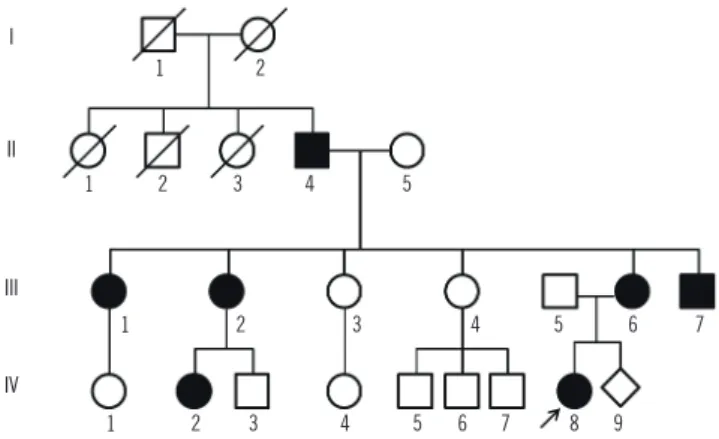
Fig. 1. Pedigree of the patient based on the clinical features (A).
Direct sequencing results of the PITX2 gene. III:5 is the father of the patient, III:6 is the mother, and V:8 is the patient (B).
G G G A G C G C A A C C A G C A G G C C T A G C A G G C C G
PITX2: c.300_301delinsT III:5
III:6
IV:8
Visual impairment, dental anomalies, redundant periumbilical skin
Glaucoma, cornea abnormalities, dental anomalies, redundant periumbilical skin Eye discomfort, dental anomalies, redundant periumbilical skin
Iris anomalies, dental anomalies, redundant periumbilical skin
Posterior embryotoxon, prominent Schwalbe’s line, focal iris atrophy, dental anomalies, redundant periumbilical skin
Glaucoma, posterior embryotoxon, prominent Schwalbe’s line, iridocorneal adhesion, dental anomalies
II:4 III:1 III:2 III:6 III:7 IV:8 I
II
1
1
1
1
2
2
2
2 3
3
3 4
4
4 5
5 6
6 8
7
7 9
5 III
IV
B A scription factors, is expressed in the corneal endothelium,
stroma, iris, ciliary body, and sclera, which all originate from the neural crest. This transcription factor is known to affect the de- velopment of the periocular mesenchyme [8, 11]. A coding re- gion frameshift as well as nonsense and missense mutations are thought to compromise the ability of PITX2 to bind to DNA. Copy number losses due to large chromosome rearrangements, small intragenic deletions, and a rare duplication have also been re- ported [12]. Here, we report a Korean family with clinical fea- tures of ARS carrying a novel c.300_301delinsT mutation in the PITX2 gene.
CASE REPORT
1. Case 1 (proband)A 4-yr-old girl was referred to our clinic because of uncontrolled intraocular pressure (IOP) under maximal tolerable medical therapy and corneal edema in both eyes. Her best-corrected vi- sual acuity was 20/800 in both eyes. IOP as measured by Gold- mann tonometry was 22 mm Hg (reference range: ≤21 mm Hg) in the right eye and 23 mm Hg (reference range: ≤21 mm Hg) in the left eye. The horizontal and vertical corneal diameter of both eyes was 9.5 mm and 10.0 mm, respectively. Posterior em- bryotoxon and a prominent Schwalbe’s line were observed in both eyes. Iridocorneal adhesion and corectopia were also seen, and anterior insertion of the iris into the trabecular meshwork with prominent iris processes was observed by gonioscopic ex- amination in both eyes. The optic disc was difficult to inspect because of corneal edema; the cup-to-disc (CD) ratio appeared to be 0.8 in both eyes. The patient had apparent microdontia.
2. Case 2 (mother)
The 35-yr-old mother of the patient had 20/20 best-corrected vi- sual acuity in both eyes. IOP as measured by Goldmann tonom- etry was 14 mm Hg (reference range: ≤21 mm Hg) in both eyes.
Her cornea was clear, but focal iris atrophy was observed in both eyes. A posterior embryotoxon, which is a prominent Schwalbe’s line, and anterior insertion of the iris into the trabec- ular meshwork with prominent iris processes were observed by gonioscopic examination in both eyes. Fundus examination re- vealed a normal appearing optic disc with a CD ratio of 0.3 in the right eye and 0.4 in the left eye. This patient also had redun- dant periumbilical skin and noticeable microdontia. She had dentures due to microdontia.
3. Molecular genetic analysis of PITX2
Sequencing analyses for FOXC1 and PITX2 in the proband and a family study for PITX2 mutations were performed. The pur- pose of the study and the procedures to be used were explained to all patients, and informed consent was obtained. Genomic DNA was isolated from peripheral blood leukocytes using the Wizard Genomic DNA Purification kit (Promega, Madison, WI, USA). All exons with flanking intronic regions were amplified us- ing the PCR with primers designed by the authors (available on request). Sequencing was performed with the ABI Prism 3100xl Genetic Analyzer (Applied Biosystems, Foster City, CA, USA) using the BigDye Terminator Cycle Sequencing-Ready Reaction Kit (Applied Biosystems). Sequences were analyzed using Se- quencher software (version 4.10.1, Gene Codes Corp., Ann Ar- bor, MI, USA) and compared with the reference sequence for
Yun JW, et al.
PITX2 mutation in Axenfeld-Rieger syndrome
362 www.annlabmed.org http://dx.doi.org/10.3343/alm.2013.33.5.360 PITX2 (NM_000325.5) and FOXC1 (NM_001453.2).
The patient was found to be heterozygous for a 2-bp deletion and an insertion of T in the PITX2 gene (c.300_301delinsT), a frameshift mutation predicted to result in premature termination at the 54th amino acid of the PITX2 protein (p.Gln101Serfs*54).
Analysis of the parents revealed that this variant was inherited from the mother: the father had a wild-type sequence, while the mother had the same variant as her daughter (Fig. 1). When we tested 104 unaffected ethnically matched controls, none had the mutation. In addition, no other mutations were found in the PITX2 gene of the patient or her parents. Neither mutation nor unknown variation was found in the FOXC1 analysis.
DISCUSSION
We found a novel PITX2 gene mutation (c.300_301delinsT) that appears to result in ARS through haploinsufficiency either due
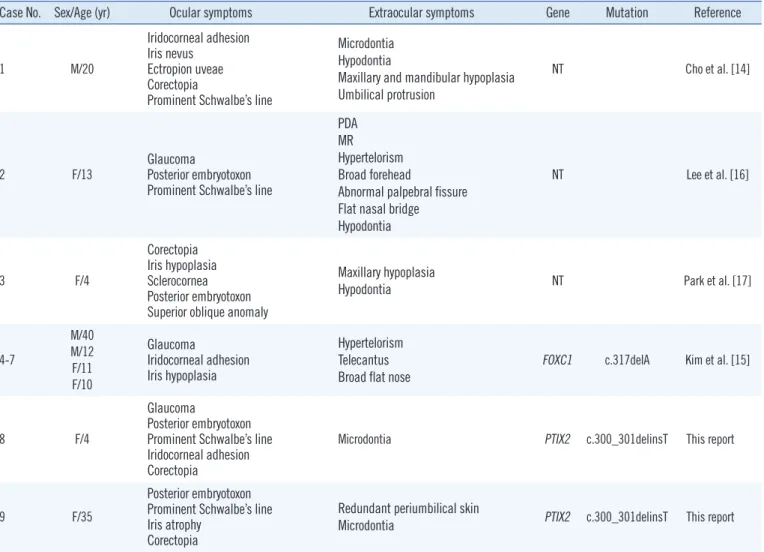
to a frameshift-mediated decay of mutant mRNA or production of mutant PITX2 protein, in a Korean family affected by autoso- mal dominant ARS. The spectrum of Axenfeld-Rieger malfor- mations demonstrates locus heterogeneity with the involvement of 2 major genes, PITX2 and FOXC1 [13]. This is the first report of a PITX2 gene mutation associated with ARS in a Korean indi- vidual. To our knowledge, 7 cases of ARS have been reported in Korea in addition to the present 2 cases. In one of those cases, the diagnosis of ARS was confirmed by a molecular method, which showed a novel FOXC1 mutation [14-17]. The clinical fea- tures, including ocular and extraocular symptoms and molecu- lar features, are described in Table 1.
The PITX2 gene is located on 4q25, and mutations have been identified in 10-60% of probands with ARS [8, 18]. Most com- monly, coding region frameshifts and nonsense and missense mutations are present, which are thought to affect DNA binding.
A small number of large chromosome rearrangements, small
Table 1. Clinical and molecular features of Axenfeld-Rieger syndrome patients in South Korea
Case No. Sex/Age (yr) Ocular symptoms Extraocular symptoms Gene Mutation Reference
1 M/20
Iridocorneal adhesion Iris nevus
Ectropion uveae Corectopia
Prominent Schwalbe’s line
Microdontia Hypodontia
Maxillary and mandibular hypoplasia Umbilical protrusion
NT Cho et al. [14]
2 F/13 Glaucoma
Posterior embryotoxon Prominent Schwalbe’s line
PDA MR Hypertelorism Broad forehead
Abnormal palpebral fissure Flat nasal bridge Hypodontia
NT Lee et al. [16]
3 F/4
Corectopia Iris hypoplasia Sclerocornea Posterior embryotoxon Superior oblique anomaly
Maxillary hypoplasia
Hypodontia NT Park et al. [17]
4-7
M/40 M/12 F/11 F/10
Glaucoma
Iridocorneal adhesion Iris hypoplasia
Hypertelorism Telecantus Broad flat nose
FOXC1 c.317delA Kim et al. [15]
8 F/4
Glaucoma
Posterior embryotoxon Prominent Schwalbe’s line Iridocorneal adhesion Corectopia
Microdontia PTIX2 c.300_301delinsT This report
9 F/35
Posterior embryotoxon Prominent Schwalbe’s line Iris atrophy
Corectopia
Redundant periumbilical skin
Microdontia PTIX2 c.300_301delinsT This report Abbreviations: NT, not tested; PDA, patent ductus ateriosus; MR, mitral regurgitation.
Yun JW, et al.
PITX2 mutation in Axenfeld-Rieger syndrome
363
http://dx.doi.org/10.3343/alm.2013.33.5.360 www.annlabmed.org
intragenic deletions, and a rare duplication resulting in copy number loss have also been described [12]. All individuals who inherit the ARS-associated PITX2 or FOXC1 alleles exhibit ocular symptoms, with full penetrance [2]. Compared to FOXC1 muta- tions, PITX2 mutations are more commonly associated with the extraocular systemic abnormalities of ARS. In our case, the pa- tient and her mother had extraocular abnormalities such as dental anomalies with or without redundant periumbilical skin.
On the basis of the systemic findings, we predicted a PITX2 mu- tation rather than a FOXC1 mutation, but sequenced both genes. Although gain-of-function mutations in PITX2 have been suggested to cause ARS, most intragenic PITX2 mutations are loss-of-function mutations that yield a protein defective in DNA binding or one that is unable to transactivate downstream genes, or both [12]. FOXC1 transcriptional activity is negatively regulated by PITX2, which explains how FOXC1 duplication and PITX2 de- letion result in similar phenotypes [19].
Phenotypes of the novel PITX2 mutation (c.300_301delinsT) in this family were variable. Although only the patient and her parents were fully genetically evaluated, ocular or extraocular manifestations of ARS were present in seven of the family mem- bers (Fig. 1). The patient showed severe glaucoma, Peters’
anomaly, and visual impairment and therefore, requires a trab- eculectomy and corneal transplantation. However, although her mother shared the PITX2 gene mutation, her ocular symptoms were mild and could be controlled with eye drops. In ARS, vary- ing degrees of anterior segment dysgenesis may be present, and careful examination of the features of the anterior segment is necessary to establish the diagnosis for each family member.
Other systemic symptoms including cardiovascular outflow tract malformations, craniofacial abnormalities, and pituitary abnor- malities were not typical in this family. However, dental anoma- lies and redundant periumbilical skin were observed.
In summary, we found a novel c.300_301delinsT mutation in PITX2 in a Korean family with ARS. We suggest that this PITX2 mutation causes typical ARS. Our results extend the spectrum of PITX2 mutations and highlight the role of PITX2 in the devel- opment and progression of ARS.
Authors’ Disclosures of Potential Conflicts of Interest
No potential conflicts of interest relevant to this article were re- ported.
REFERENCES
1. Fitch N and Kaback M. The Axenfeld syndrome and the Rieger syn- drome. J Med Genet 1978;15:30-4.
2. Chang TC, Summers CG, Schimmenti LA, Grajewski AL. Axenfeld-Rieg- er syndrome: new perspectives. Br J Ophthalmol 2012;96:318-22. 3. Semina EV, Reiter R, Leysens NJ, Alward WL, Small KW, Datson NA, et
al. Cloning and characterization of a novel bicoid-related homeobox transcription factor gene, RIEG, involved in Rieger syndrome. Nat Genet 1996;14:392-9.
4. Mirzayans F, Gould DB, Héon E, Billingsley GD, Cheung JC, Mears AJ, et al. Axenfeld-Rieger syndrome resulting from mutation of the FKHL7 gene on chromosome 6p25. Eur J Hum Genet 2000;8:71-4.
5. Strungaru MH, Dinu I, Walter MA. Genotype-phenotype correlations in Axenfeld-Rieger malformation and glaucoma patients with FOXC1 and PITX2 mutations. Invest Ophthalmol Vis Sci 2007;48:228-37.
6. Weisschuh N, Dressler P, Schuettauf F, Wolf C, Wissinger B, Gramer E.
Novel mutations of FOXC1 and PITX2 in patients with Axenfeld-Rieger malformations. Invest Ophthalmol Vis Sci 2006;47:3846-52.
7. Weisschuh N, De Baere E, Wissinger B, Tümer Z. Clinical utility gene card for: Axenfeld-Rieger syndrome. Eur J Hum Genet 2011;19. 8. Lines MA, Kozlowski K, Kulak SC, Allingham RR, Héon E, Ritch R, et al.
Characterization and prevalence of PITX2 microdeletions and mutations in Axenfeld-Rieger malformations. Invest Ophthalmol Vis Sci 2004;45: 828-33.
9. Phillips JC, del Bono EA, Haines JL, Pralea AM, Cohen JS, Greff LJ, et al. A second locus for Rieger syndrome maps to chromosome 13q14. Am J Hum Genet 1996;59:613-9.
10. Tanwar M, Dada T, Dada R. Axenfeld-Rieger syndrome associated with congenital glaucoma and cytochrome P4501B1 gene mutations. Case Rep Med 2010;2010. pii: 212656.doi: 10.1155/2010/212656.
11. Diehl AG, Zareparsi S, Qian M, Khanna R, Angeles R, Gage PJ. Extra- ocular muscle morphogenesis and gene expression are regulated by Pitx2 gene dose. Invest Ophthalmol Vis Sci 2006;47:1785-93.
12. Tümer Z and Bach-Holm D. Axenfeld-Rieger syndrome and spectrum of PITX2 and FOXC1 mutations. Eur J Hum Genet 2009;17:1527-39. 13. Gould DB, Mears AJ, Pearce WG, Walter MA. Autosomal dominant
Axenfeld-Rieger anomaly maps to 6p25. Am J Hum Genet 1997;61:765- 8.
14. Cho HJ and Cho YW. A case of Axenfeld-Rieger syndrome. J Korean Ophthalmol Soc 2000;41:258-63.
15. Kim GN, Ki CS, Seo SW, Yoo JM, Han YS, Chung IY, et al. A novel fork- head box C1 gene mutation in a Korean family with Axenfeld-Rieger syndrome. Mol Vis 2013;19:935-43.
16. Lee JH, Chae SH, Huh J, Kang IS, Lee HJ, Yang JH, et al. A case of Axenfeld-Rieger syndrome with severe mitral regurgitation. J Korean Pediatr Cardiol Soc 2006;10:216-9.
17. Park SW, Kim HG, Heo H, Park YG. Anomalous scleral insertion of su- perior oblique in Axenfeld-Rieger syndrome. Korean J Ophthalmol 2009; 23:62-4.
18. Borges AS, Susanna R Jr, Carani JC, Betinjane AJ, Alward WL, Stone EM, et al. Genetic analysis of PITX2 and FOXC1 in Rieger Syndrome patients from Brazil. J Glaucoma 2002;11:51-6.
19. Berry FB, Lines MA, Oas JM, Footz T, Underhill DA, Gage PJ, et al.
Functional interactions between FOXC1 and PITX2 underlie the sensi- tivity to FOXC1 gene dose in Axenfeld-Rieger syndrome and anterior segment dysgenesis. Hum Mol Genet 2006;15:905-19.