Journal of Information Science Theory and Practice
Non-Governmental Organization (NGO) Libraries for The
Visually Impaired in Nigeria: Alternative Format Use and
Perception of Information Services
’Niran Adetoro *
Department of Library and Information Science Tai Solarin University of Education, Ijagun, Ijebu-Ode E-mail: [email protected], [email protected]
Open Access
Accepted date: December 4, 2014 Received date: September 30, 2014 *Corresponding Author: ’Niran Adetoro
Associate Professor
Department of Library and Information Science Tai Solarin University of Education, Ijagun, Ijebu-Ode E-mail: [email protected],
All JISTaP content is Open Access, meaning it is accessible online to everyone, without fee and authors’ permission. All JISTaP content is published and distributed under the terms of the Creative Commons Attribution License (http:/ creativecommons. org/licenses/by/3.0/). Under this license, authors reserve the copyright for their content; however, they permit anyone to unrestrictedly use, distribute, and reproduce the content in any medium as far as the original authors and source are cited. For any reuse, redistribution, or reproduction of a work, users must clarify the license terms under which the work was produced.
http://dx.doi.org/10.1633/JISTaP.2015.3.1.3
ABSTRACT
Nigeria’s non-government organization (NGO) libraries for the visually impaired has over the years been at the forefront of information services provision to persons with visual impairment. This study adopted a survey re-search design to investigate use of alternative formats and perceptions of information services to the visually impaired, focusing on two purposively chosen NGO libraries for the visually impaired in Nigeria. Using a complete enumeration approach, data were gathered from 180 users of the libraries through the use of a structured ques-tionnaire with a reliability score (α = 0.74). Data from 112 (62.2%) of the 180 administered copies of a quesques-tionnaire that were retrieved were analysed. The study found that Braille materials had a high level of utilization ( -x = 4.46) and were the most frequently utilized (90.9%). Perception of information services by the visually impaired was positive while use of alternative formats was significantly and positively related to users’ perception of information services (r = .041; p < 0.05). The study recommends improved transcription and investment in alternative formats and in e-resources. It also recommends collaborations to widen access as well as constant evaluation of services.
1. INTRODUCTION
An aspiration for library and information services to the visually impaired is that they be equally hos-pitable to users of all kinds and categories. Such ser-vices must essentially disregard artificial boundaries in terms of information (Davies, 2007). The visually impaired just like the sighted need to use and acquire information, but such information would only be rel-evant when available in alternative formats, which in-cludes Braille, audio recordings/materials, large print, and electronic resources. The United Nations docu-ment on the equalization of opportunities for persons with disabilities (UN, 1993) and the UNESCO public library manifesto (1994) espouses that information is a primary and fundamental right for the disabled. With this, libraries have to play key roles in building an inclusive society.
It is crucial for the visually impaired, through the use of information, to become active participants in social life. Just like the sighted, information use will ensure that they partake in modern society’s process-es through the ability to identify, interpret, procprocess-ess, disseminate, use, and reuse information in order to make informed choices and reduce uncertainties (Singh & Mairangthem, 2010). The visually impaired will not achieve these ideals unless libraries provide services geared towards meeting their reading in-terests and information needs (Adetoro & Atinmo, 2012).
Library services for the visually impaired are known to vary from country to country. The services may not be part of the local or national library sys-tem but usually they run on low budgets, focusing on production of accessible formats with limited library services. A few of them have the capacity to leverage on new developments in digital library ser-vices. In many developing countries such as Nigeria, government investment in services to persons with disabilities has been minimal and therefore the space for information services to the visually impaired has been taken over by specialized libraries, especially a few non-governmental organization (NGO) libraries. The demand for information materials in alternative format in Nigeria by the visually impaired through libraries is high (Atinmo, 2007; Adetoro, 2010; Ade-toro, 2012) However, the visually impaired perceive
information services as weak with an inadequate resource base of limited and obsolete alternative in-formation materials for use (Adetoro, 2010).
These perceptions underscore the need for ser-vices to be based on the reading interests and needs of the visually impaired and that such services must provide opportunities and support that will enable them become independent, active, and self-sustain-ing members of their communities. In Nigeria, some NGOs providing information services to the visually impaired go beyond materials production by estab-lishing libraries specifically for the visually impaired. Notable among them are NigerWives, an association of foreign women married to Nigerian men, with the NigerWives library, the Anglo-Nigerian Welfare Association for the Blind (ANWAB) with ANWAB Library, and the Nigerian Society for the Blind with Inlaks Library for the Visually Handicapped. Niger-Wives and ANWAB have over the years been making available reading text for students. ANWAB have been making information available to tertiary level students and blind workers. ANWAB and Inlaks library for the visually handicapped both have an ex-tensive library of Braille and audio recordings. Both libraries have also in recent times trained users in the use of computers and the Internet; they have provid-ed Internet services to their users.
The libraries have a computerized Braille press for transcription of materials into alternative format. They also produce large print editions. Inlaks Library for the visually impaired have a well-equipped sound-proof studio for the production of audio recordings and carrels equipped with audio gadgets that facilitate individualized listening. This article further presents the statement of the problem, research questions and hypothesis raised to guide the study, a review of rele-vant literature, methods adopted, results, discussion of findings, and conclusions and recommendations.
2. STATEMENT OF THE PROBLEM
investment from the government. There is no data or government statistic indicating this neglect; however, a few public libraries located in some states make avail-able readavail-able materials for the visually impaired in secondary schools and from neighboring towns. These libraries do not produce materials; they are more distributors of information materials in alternative formats. They are poorly equipped, and their materi-als are obsolete and mainly Braille and a few talking books. Their effort is minimal relative to the needs of the visually impaired in Nigeria (Adetoro, 2009; Atin-mo, 2007).
The inadequacies of existing institutions has pro-pelled these NGOs through their libraries to dictate the direction of service provision to the visually im-paired in Nigeria. But how have these NGO libraries fared given the prevailing signs of weak capacity? The demand for information materials in alternative formats by the visually impaired is high in Nigeria (Adetoro, 2010). However, it is believed that the use of alternative formats for study and leisure purposes even in these libraries probably has its shortcomings especially in terms of level and frequency of use. The situation may explain the opinions or perceptions of many visually impaired persons that information ser-vices are generally weak and unable to adequately cater for their information needs for study and recreational purposes. These perceptions may have been shaped by factors relating to weak investment, lack of govern-ment support, and disjointed services, among others.
2.1. Research Questions and Hypothesis
The following research questions were investigated in this study:
ⅰ. What is the general level of use of alternative formats in NGO libraries for the visually im-paired?
ⅱ. How frequently do the visually impaired use the alternative formats in the NGO libraries? ⅲ. How do the visually impaired perceive the
infor-mation services provided by the NGO libraries?
2.2. The Research Hypothesis was Validated at 0.05 Level of Significance
There is no significant relationship between use of alternative formats and perception of information ser-vices in the NGO libraries by the visually impaired.
3. LITERATURE REVIEW
A study on the use of alternative formats by Canadi-an college students with print disabilities (Anne, 2000) found that 56% of the students use tape recordings frequently, 31% use large print, and 19% use Braille frequently. This is an indication of the popularity of audio recordings among the students. Davis, Wisdom, and Greaser (2001) revealed that about 83% of adults who are blind and partially sighted also use tape re-cordings. Other studies with evidence supporting the high level of audio material use include Goft, Cleary, Keil, Franklin, and Cole-Hamilton (2001), and Kennel, Yu, and Greaser (2000). The majority of the users of audio materials, according to Getz (2003), are visually impaired people who generally have no other way to read unless they use Braille. For instance, about 3% of Royal National Institute for the Blind (RNIB) users use Braille. In the USA, 4% of the National Library for the Blind (NLB) users read Braille (NLB, 2002). Only 3.9% use Braille in Israel (Getz, 2003).
Schols (1995) reported that in the Netherlands a high level of use of large print was due to an ageing population who prefer large print materials. In Nige-ria, a study of availability and use of alternative formats by secondary school students (Adetoro, 2011) revealed that 91.3% used Braille daily, 34.6% use audio books daily, and only 2% use large print weekly. Similar re-sults were reported by Atinmo (2007) and Adetoro and Atinmo (2012). According to Basharu (2000), it is amazing to observe the number of users who visit the ANWAB library to borrow alternative formats for use. Basharu adds that about 95% of the users either bor-row from the library or bring materials for transcrip-tion into Braille for their use.
less prepared to give personal attention to their visual-ly impaired users.
Bernardi (2004) identified two basic services that are most currently provided to the visually impaired through libraries as firstly, services based on traditional special formats; those dependent on adaptive technolo-gies, sometimes accompanied by training activities and target services such as access to catalogues, digital texts, and special formats and inter library loans. Karen (2004) reported that Gateshead libraries in the UK provided technology training and other services to the visually impaired with their Access to Reading and Information Services (AIRS) projects.
In the US emphases were on services geared to-wards improving access to library resources through adaptive technologies (Goddard, 2004; Pietrala, 2004). Norwegian libraries have deployed full time informa-tion officers who assist and guide users and essentially ensure that library services are accessible to all visually impaired users (Eymard, 2002).
Users’ favorable perceptions of DAISY (Digital Audio Based Information System) books as a very useful tool for information services provision, and the fact that a growing number of libraries are producing and provid-ing Daisy books, has been widely reported (Graddock, 2003; Tylor, 2004; Goddard, 2004).
Bernardi (2004) reported the introduction of a na-tional catalogue of electronic texts available through the Internet which allows users to search, order, and view electronic books in Braille or text format. Services of this nature are not only innovative but are well received and valued by the visually impaired. A similar initiative was carried out in the UK on an accessible catalogue for traditional and electronic texts for the visually impaired (Brophy & Craven, 1999).
Singh and Moirangthem (2010) found that Delhi libraries provided a wide range of information services to the visually impaired which includes library services, Braille production, audio book recordings, computer training, Internet service, and resource sharing. He adds that these services and other technology-based initia-tives bring smiles to the faces of the visually impaired.
An ideal library and information service according to Machell (1996) is one where individuals, regardless of the degree of their visual impairment, can access in-formation in a relevant and required format as well as in needed quantities where staff respect the needs of the
users.
The provision of web based information resources by libraries providing information services to the visually impaired has in recent times been advocated in order to further widen access to information resources. These resources have moved from a simple text interface to dynamic and interactive designs. There is a need for web accessibility to be designed for all users of the library. “Design for all” in the library environment means that library information technology systems and interfaces must be designed in a way that enable them to be read and interacted with easily by all users, whether visiting or remotely accessing the library, and regardless of any disability of access preference (Brophy & Craven, 2007).
The use of alternative formats in the NGO libraries selected is a critical aspect of this study. It is therefore necessary that the theoretical assumptions for this study must essentially emphasize utilization of information resources as a consequence of users’ perceptions of these services. This study was hinged on information utility theory which relates use of information with val-ue of use and user satisfaction. This theory stresses the dynamics of information consumer behavior, which is a product of how information is perceived by its users. This assumption should help contextualize the research questions raised for the study.
4. METHODS
The descriptive survey research design was adopted for the study. Two (2) NGO libraries were purposively selected for the study because they are the two known libraries for the visually impaired in Nigeria owned by NGOs. Other NGOs providing information services to the visually impaired produce and provide alternative formats but do not own libraries. The ANWAB library and the Inlaks Library for the Visually Handicapped, both located in Lagos, have a total population of 180 visually impaired users according to the library records provided by the two libraries.
administra-tion of the quesadministra-tionnaire. The quesadministra-tions were read out to respondents by the researcher and the library staff and their responses were recorded on the instrument. A total of 112 out of the 180 administered copies of the questionnaire (62.2%) were successfully completed and used for the study.
The study left out some active producers and distrib-utors of alternative formats in Nigeria because they are not libraries, though they partake in the provision of information services to the visually impaired. The study was unable to capture visually impaired persons who do not use libraries but visit transcription centers.
5. RESULTS
5.1. Respondents’ Characteristics
The sample data revealed that male respondents were 78(70%) while the female respondents were 34 (30.0%). The majority of them (84, 75.5%) are between 21 and 39 years of age; 86 (77.3%) are single while 26 (22.7%) are married. The data also showed that 36 (31.8%) are total-ly blind, 70 (62.7%) are partialtotal-ly sighted, and 6 (5.4%) are low visioned. It was also found that 25 (22%) had congenital conditions while 87 (78%) had acquired
vi-sual impairment, out of which 66 (60%) became vivi-sually impaired while in school (primary / secondary) and 44 (40%) as adults.
5.2. Use of Alternative Formats
The study found that the general level of utilization of alternative formats in the libraries was high for Braille materials (-x =4.46;SD=1.15) and for audio re-cordings/materials (-x =3.32;SD=1.58), and low for large print (-x =1.17;SD=0.68) and electronic resources (-x =0.56;SD=1.14). The data also revealed that Braille ma-terials were the most frequently used.
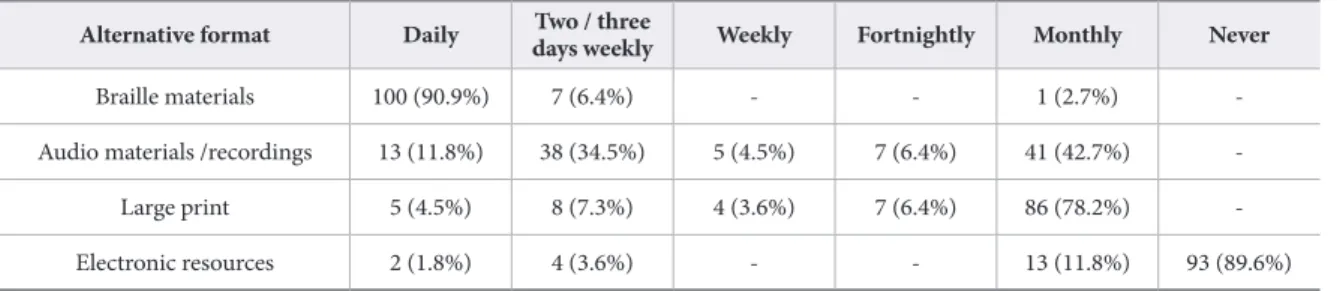
One hundred respondents (90%) used Braille daily. The frequency of use of audio materials in the libraries was less compared to Braille. A total of 51 respondents (46.3%) used audio materials either daily or two to three days a week. From this only 15 (11.8%) used audio ma-terials daily while 38 (34.5%) used audio mama-terials two or three days a week. However, 47 (42.7%) used audio materials once in a month. Large print editions were used daily by only 5 respondents (4.5%), and two or three days a week by 8 (7.3%). Electronic resources were used by 2 respondents daily (1.8%) and 4 (3.6%) twice or thrice weekly, while 93 (84.6) had never used elec-tronic resources.
Table 1. Level of Use of Alternative Formats
Alternative format Mean Standard Deviation
Braille materials 4.46 1.15
Audio materials/recordings 3.32 1.58
Large print 1.17 1.68
Electronic resources 0.56 1.14
Table 2. Frequency of Use of Alternative Formats
Alternative format Daily days weeklyTwo / three Weekly Fortnightly Monthly Never
Braille materials 100 (90.9%) 7 (6.4%) - - 1 (2.7%)
-Audio materials /recordings 13 (11.8%) 38 (34.5%) 5 (4.5%) 7 (6.4%) 41 (42.7%)
-Large print 5 (4.5%) 8 (7.3%) 4 (3.6%) 7 (6.4%) 86 (78.2%)
5.3. Visually Impaired Users’ Perceptions of Information Services Provided by the Libraries for Leisure and Academic Purposes
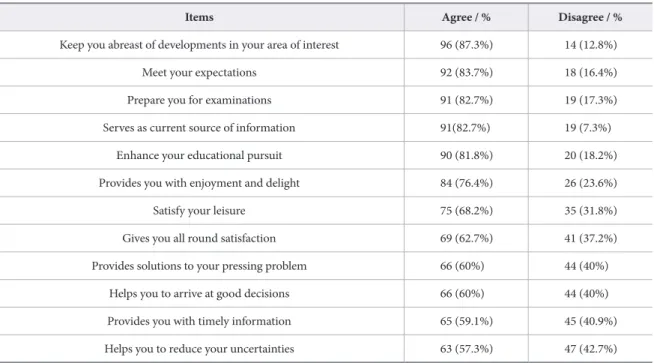
The respondents were asked to indicate whether they agree or disagree with the statements testing their perceptions of information services provided to them by the libraries for leisure and academic purposes. The results showed that the respondents had positive perceptions of the libraries’ information services. They were in agreement with all the items as significant percentage scores were recorded. Ninety-six (87.3%) agreed that services kept them abreast of development in their areas of interest, 92 (83.7%) viewed that the services prepared them for examinations and serve as current sources of information, respectively. Ninety (81.8%) are of the opinion that services enhance their educational pursuits, 84 (76.4%) agreed that the ser-vices provide them with enjoyment and delight, 75 (68.2%) opined that the services satisfied their leisure, 69 (62.7%) say they get satisfaction from the services provided by the libraries for leisure and academic pur-poses, while 66 (60%) viewed that the services provid-ed solutions to their pressing problems and also helpprovid-ed them to arrive at good decisions. Sixty-five (59.1%) say
they get timely information from the libraries while 45 (40.9%) disagree. Also 63 (57.3%) viewed that the services helped to reduce their uncertainties, though 47 (42.7%) had the opposite view.
5.4. Relationship between Use of Alternative Formats and Perceptions of Information Services
The hypothesis of the study is concerned with the possibility of a significant relationship between use of alternate formats and perceptions of information ser-vices by the visually impaired.
Hypothesis: There is no significant relationship
be-tween use of alternative formats and perceptions of in-formation service in the NGO libraries by the visually impaired.
Use of alternative formats was correlated with per-ceptions of information services. The result showed a Pearson correlation coefficient of 0.041 with a calculat-ed probability of 0.043, which is less than 0.05 signif-icance level. The null hypothesis was rejected, which means there is a significant relationship between use of alternative formats and the perceptions of information services in the libraries by the visually impaired.
Table 3. Perception of Information Services by the Visually Impaired
Items Agree / % Disagree / %
Keep you abreast of developments in your area of interest 96 (87.3%) 14 (12.8%)
Meet your expectations 92 (83.7%) 18 (16.4%)
Prepare you for examinations 91 (82.7%) 19 (17.3%)
Serves as current source of information 91(82.7%) 19 (7.3%)
Enhance your educational pursuit 90 (81.8%) 20 (18.2%)
Provides you with enjoyment and delight 84 (76.4%) 26 (23.6%)
Satisfy your leisure 75 (68.2%) 35 (31.8%)
Gives you all round satisfaction 69 (62.7%) 41 (37.2%)
Table 4. Correlation Between Use of Alternative Formats and Perceptions of Information Services
Variables Means -x Standard Deviation
Use of alternative formats 7.95 3.41
Perceptions of information services 27.09 11.41
• Pearson correlation result: r = .041; p = 0.043; N = 112 • Correlation is significant at 0.05 level (2-tailed)
6. DISCUSSION
There were more male visually impaired respondents than females. The data also showed that a significant majority of users of these libraries are partially sighted which suggests that the blind are lagging behind in terms of use of information materials in the libraries.
There is a connection between the general level of alternative format use and the frequency of use of alternative materials in the libraries. Braille materials enjoyed a significant and high level of utilization and are also the most frequently consulted by users. As for audio materials/recordings, though they saw a high level of use and an appreciable frequency of utilization, Braille materials recorded a higher level and frequency of use. Transcription activities in Nigeria have focused on the production of more Braille materials than other formats, and this perhaps explains why Braille is the most utilized. In other words Braille is the most uti-lized because it is the most available (Adetoro, 2010). This contrasted with the findings of Anne (2000) and Davis et al. (2001) who reported otherwise.
It is pertinent to note that electronic resources op-tions were seldom used by the visually impaired who visit these libraries despite the fact that the libraries indeed have Internet facilities for the visually impaired and a few other e-resources. Electronic resources pro-vide a viable alternative for visually impaired informa-tion users, as they widen access and possibly provide the same opportunities available to the sighted to the visually impaired. These resources are hardly used though the two libraries had put in place a continuous computer, software, and Internet use training pro-grams for their users. This perhaps is responsible for the poor utilization indices recorded for e-resources.
The users were satisfied with the services offered to
them in the libraries for academic and leisure purpos-es. Their perceptions of the information services were positive and revealing. The NGO libraries servicing the visually impaired in Nigeria have had a positive impact on their users judging from the finding of this study. This corroborates Schroeder (1996). Though with very few outlets, it is worthy of mentioning that NGO libraries in Nigeria are the only institutions with the capacity to intervene where the government through its public libraries had failed. The NGO librar-ies, according to the users, have kept them abreast of information in their interest areas, have provided ma-terials that prepared them for examinations, and have enhanced their educational pursuits. They also reveal that the libraries have not only met their expectations but they provided current information and satisfied their leisure needs, among other benefits. This is in agreement with Singh and Moirangthem (2010).
7. CONCLUSION AND RECOMMENDATIONS
The use of alternative formats in the NGO libraries studied was high for Braille and audio materials in terms of the level and frequency of use. Overall, the perceptions of the visually impaired with regard to information services were positive and encouraging while use of materials was related to users’ perceptions. These are positive points for the NGO libraries for the visually impaired in Nigeria and indeed for the efforts of the private institutions who are engaged in pro-viding information services to the visually impaired in one way or another. It is crucial to note that these libraries are better placed to adequately provide library and information services to the visually impaired positively if supported by government and other stake-holders. Though users were satisfied with the service provided by the libraries studied, the libraries need to improve service by widening their reach to a bigger community of visually impaired persons who are not library users. They need to intensify their efforts in reaching more users and pressuring the government to invest in services to persons with disabilities gener-ally. There is still much to be done in bringing about equal access to information for the visually impaired in Nigeria. The findings of this study suggest that the attention and policy of government urgently needs to be directed to helping NGO libraries widen their reach and further improve upon information services to the visually impaired. It is clear that available equipment for transcription of materials, Internet, and e-resources to widen access to information are inadequate. These resources and availability of funds are critical to im-proving information services provision to the visually impaired in the libraries and in Nigeria. It is suggested that further studies should examine the information use patterns of visually impaired persons who do not use libraries but patronize other information outlets or media, and to analyze how they perceive information services via such outlets.This study recommends that NGO libraries invest more in transcription of more materials into readable formats and in electronic resources for their users. This is because the materials available for the visual-ly impaired in the libraries are generalvisual-ly inadequate compared to what is desired. Braille materials have not covered the reading interests of the users. This is also
true for the other resources. They regularly bring in materials of interest in print to be transcribed for their use. The collection of the libraries in terms of subject coverage is not adequate. Audio recordings are much fewer in number than Braille, and the challenge of vol-unteer readers and studio equipment for transcription has kept the number of audio titles low. Large print and electronic resources are few owing to inadequate funds. NGO libraries for the visually impaired should collaborate first to widen resources and access to alter-native formats and lobby government towards building libraries for the visually impaired in Nigeria. Librari-ans and other stakeholders should engage in advocacy to create awareness and seek funds and assistance from corporate bodies and government. They should also look out for linkages with international bodies and funders so as to improve upon what is available. With these, utilization levels can be further improved. The NGO libraries should constantly investigate how well their services meet the expectations and satisfaction of users. This is crucial for sustainability and improved services.
REFERENCES
Adetoro, A. A. (2009). Relationship among reading interest, information materials availability and al-ternative format utilization by persons with visual impairment in selected libraries in southwestern, Ni-geria. Ph.D. Thesis, Department of Library, Archi-val and Information Studies, University of Ibadan, Nigeria.
Adetoro, N. (2010). Characteristics of visually impaired information users in Nigeria. African Research and Documentation, Journal of SCOLMA (UK Libraries and Archives Group on Africa), 114, 47-58.
Adetoro, N. (2011). Alternative format availability and its utilization by the visually impaired students in Nigerian secondary schools. Indian Journal of In-formation Science and Services, 5(2), 31-38.
Adetoro, N. (2012). Alternative format preferences among secondary school visually impaired stu-dents in Nigeria. Journal of Librarianship and Infor-mation Science, 44(2), 90-96.
visual impairment in Nigeria. African Journal of Li-braries Archives and Information Science, 22(2), 75-88.
Anne, M. (2000). Library services to Canadian stu-dents. Retrieved from
Atinmo, M. I. (2007). Setting up a computerized cat-alog and database of alternative format materials for blind and visually impaired persons in Nigeria. Library Trends, 55(4), 330-456.
Basharu, D. (2000). Equipping libraries for the blind with reading materials. Journal of Association of Libraries for the Visually Impaired, 1(1), 56-61. Bernardi, F. (2004). Library services for blind and
visually impaired people: Literature review. Retrieved from http://dspace-unipr.cilea.it/bit-stream/1889/1147
Berry, J. (1999). Apart or a part? Access to the Internet by visually impaired and blind people with par-ticular emphasis on assistive enabling technology and user perceptions. Information Technology and Disabilities, 6(3), 1-16.
Brophy P., & Craven, J. (1999). The integrated accessible library, a model of service development for the 21st
century: The final report of the REVIEL project. Manchester: CERLIM.
Brophy P., & Craven, J. (2007). Web Accessibility. Li-brary Trends, 55(4), 959-972.
Bundy, A. (2002). Inquiring into the roles of libraries in the online environment. Senate environment, communications, information technology and the Arts Reference Committee, Blackwood, South Australia. Retrieved from http://www.aph. gov.an/senate committee/ecta_ctte/completed_ inquires/2002-04/online_libraries/submissions/ sub03.doc .
Craddock, G. M. (2003). Assistive technology shaping the future. London: 105 Press.
Creaser, C., Davis, J. E., & Wisdom, S. (2002). Acces-sible, open and inclusive? How visually impaired people view library and information services and Agencies. Journal of Librarianship and Information Science, 34(4), 2012-214.
Croft, K., Cleary L, Keil, S., Franklin A., & Cole-Ham-ilton, I. (2001). The health and well being of blind and partially sighted children and young people aged 5-25. London: RNIB.
Davies, J. E. (2007). An overview of international
re-search into the library and information needs of vi-sually and information needs of vivi-sually impaired people. Library Trends, 55(4), 783-795.
Davis, J. Widom, S., & Creaser, C. (2001). Out of sight but not out of mind: visually impaired people’s per-spectives of library and information services. Lough-borough University library information statistics unit. Available at http://www.nib.uk.org/common/ research/202001/dochtml
Eymard, D. (2002). Bibliotheques at handicaps visuals. Libraries and the visually handicapped. Bulletin des bibliotheques de France, 47(20), 117-119.
Getz, I. (2003). What do blind people want from talking books? Published Proceedings of the 69th IFLA General Conference and Council, Berlin, August 1-9. Retrieved from http://www.archive.ifla.org/iv/ ifla69/papers/074e-Getz.pdf
Goddard, M. (2004). Access through technology. Li-brary Journal. Spring connected supplement, Apr. 2-6.
Harris, C., & Oppenheim, C. (2003). The provision of library for visually impaired students in UK fur-ther education libraries in response to the special educational needs and disability act (SENDA) Journal of Librarianship and Information Science, 35(4), 243-257.
IFLA/UNESCO (1994). UNESCO public library man-ifesto. The Hague: United Nations. Retrieved from www.unesco.org/webworld/librarias/manifestos/ librarian.html
Karen, H. (2004). AIRS: ICT and information for the visually impaired. Multimedia Information and Technology, 30(4), 113-115.
Kennell, M., Yu, M., & Creaser, C. (2000). Public library service for visually impaired people. Report to the li-brary and information commission. Loughborough university: Library and information unit. Retrieved from http://www.alb.uk.org/comm/research/ 212000dochtml
Machell, J. (1996). Library and information services for the visually impaired people: National guidelines. London: Library Association Publishing.
Pietrala, M. (2004). Serving the underserved: The vi-sion project. Interface, 26(3), 5-10.
Schols, M. (1995). Extra large: Large print on demand. Paper presented at the 61st IFLA General Confer-ence, Istanbul, Turkey, August 20-25. Retrieved from http://www.ifla.org/contact.html
Schroeder, F. K. (1996). Perception of Braille usage by legally blind adults. Journal of Visual Impairment and Blindness, 90(3). Retrieved from http://www. braille.org/papers/jvib0696/vb960310html Singh, K. P., & Moirangthem. E. (2010). Are Indian
libraries VIP-friendly? Information use and in-formation seeking behavior of visually impaired people in Delhi libraries. Library Philosophy and Practice. Retrieved from http://www.webpages. uidaho.edu/-mbolin/ipp.htm
Tylor, J. M. (2004). Serving blind readers in a digital age. American Libraries, 35(11), 49-51.
United Nations (1993). The standard rules for the equalization of opportunities for persons with disabilities. The Hague: United Nations General Assembly, 48th Session, December, 200, Resolution 48/96. Retrieved from http://www.un.org/esa/soc-dev/enable/dissre04.htm