Copyright ⓒ 2019 by Korean Society for Surgery of the Hand, Korean Society for Microsurgery, and Korean Society for Surgery of the Peripheral Nerve. All Rights reserved.
This is an Open Access article distributed under the terms of the Creative Commons Attribution Non-Commercial License (http://creativecommons.org/licenses/by-nc/4.0/) which permits unrestricted non-commercial use, distribution, and reproduction in any medium, provided the original work is properly cited.
INTRODUCTION
Fingers have dominant sensory sides and non-dominant sensory sides that should be considered during hand sur- gery, particularly when selecting a donor for heterodigital island flaps. One text proposes that the radial side of the index and middle finger and the ulnar side of the ring and little fingers are dominant sensory sides1. Other literature
suggests that each finger has its own unique sensibil- ity value. Specifically, the thumb, the radial sides of the index and middle fingers, and the ulnar side of the little finger are highly valuable due to their sensibility. Alter- natively, the ulnar sides of the middle and ring finger are less valuable and constitute donor areas2. Traditionally, the radial sides of fingers, opposite the thumb, are con- sidered dominant sensory sides3-5. This concept, however, Hand and
Microsurgery
형광물질을 이용한 사무직 근로자의 손가락 감각 우수부위 실험
김홍일
고신대학교 의과대학 성형외과학교실
Experiment of Radial and Ulnar Sides Sensory Dominance of the Digits in Office Workers by Fluorescent Material Painting
Hong Il Kim
Department of Plastic Surgery, Kosin University College of Medicine, Busan, Korea
Purpose: The radial side of fingers are thought to be the dominant sensory side. With the development of electronic de- vices and lifestyle changes, we think this should be re-evaluated.
Methods: We painted fluorescent material on both hands of 26 office workers. Each finger was divided into the ulnar and radial compartment. We analysed how much fluorescent material remained by comparing two pictures, before and after work.
Results: On the dominant hand, significantly more fluorescent material remained on the radial side of the ring and little finger compared with the other compartment. On the non-dominant hand, there was no statistical difference between compartments.
Conclusion: In this study, the radial sides of the ring and little finger on the dominant hand seem to be less useful in modern life and these compartments can be sensibly less important. This observation can be used as a basic data for re- evaluation of the sensory dominant sides of fingers and it may be helpful in various hand surgery.
Key Words: Fingers, Sensation, Tissue donors
Received February 16, 2019, Revised [1] March 18, 2019, [2] May 13, 2019, Accepted May 29, 2019 Corresponding author: Hong Il Kim
Department of Plastic Surgery, Kosin University College of Medicine, 262 Gamcheon-ro, Seo-gu, Busan 49267, Korea
TEL: +82-51-990-6131, FAX: +82-51-990-3005, E-mail: [email protected], ORCID: https://orcid.org/0000-0002-5505-9945
Original Article
es has made our lives convenient, while, at the same time, changing our patterns of finger use. These conveniences, however, have had unexpected consequences. One such consequence was that specific areas of the fingers became more important for electronic device use. Areas previ- ously thought to be non-dominant are now important for electronic device utilization. Therefore, the traditional concept of dominant sensory sides of the fingers, based on writing and use of other tools, may be outdated. To address this, we investigated finger areas that are more commonly used in office workers that utilize electronic devices.
MATERIALS AND METHODS
We selected 26 office workers mainly in computer work (11 male, 15 female; aged 26-54 years old; aver- age age: 33) for this study. The participants’ hand domi- nance was surveyed prior to the experiment. We painted fluorescent ink (highlighter ink; Pelikan Co., Hanover, Germany) on the volar sides of the participants’ fingers and palms. The fluorescent material was mixed with dis- tilled water prior to application. This material is colorless and harmless to the human body and therefore did not
hours of work and daily life as usual. All volunteers were told not to wash or wipe their hands until the end of the experiment to prevent the elimination of the fluorescent material. Photographs of the participants’ hands were taken after the work period ended and analysed to deter- mine the amount of fluorescent material remaining. To take photos under the same conditions, the camera (EOS 450D; Canon Co., Tokyo, Japan) was fixed in position with an ISO 400, the shutter speed was set at 1/30 sec- ond, and participants’ hands were positioned in the same location and manner as the first photograph and fixed with special lighting.
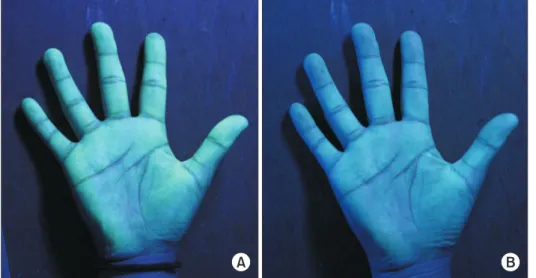
We used ‘ImageJ’ software, developed and provided for free by the National Institute of Health (Bethesda, MD, USA; http://rsbweb.nih.gov/ij/), to analyse the pho- tographs. Each finger was divided into an ulnar and radial side (Fig. 1), and the brightness of each side of the finger was compared with the baseline photograph (Fig. 2).
Data were analysed using the Kruskal–Wallis test and post-hoc according to Conover for comparing ten com- partments simultaneously in each hand. Mann–Whitney test was used to compare the ulnar and radial side domi- nance in each finger. MedCalc software (ver. 19.03, Os- tend, Belgium) was used. All statistical significance was
Fig. 1. (A) The baseline photo- graph shows each finger divided into the radial and ulnar side. (B) We analysed how much fluo- rescent material remained after a workday using ImageJ. ① Radial side of the thumb, ② ulnar side of the thumb, ③ radial side of the index finger, ④ ulnar side of the index finger, ⑤ radial side of the middle finger, ⑥ ulnar side of the middle finger, ⑦ radial side of the ring finger, ⑧ ulnar side of the ring finger, ⑨ radial side of the little finger, and ⑩ ulnar side of the little finger.
determined based on a significance level of 0.05.
RESULTS
Participants were all office workers. All of them were in charge of dealing with computers, receiving calls or working with documents. Smartphones and tablet PCs have also been used frequently. But most of the work was dealing with computers. The participants worked 6 to 8
hours (average 6.5 hours). Only one person was left hand dominant. On average, 74% of the fluorescence material remained after the work period, 73% remained on the dominant hand and 75% remained on the non-dominant hand. In the dominant hand, the residual fluorescence material was 73% on the thumb radial side, 73% on the thumb ulnar side, 72% on the index finger radial side, 71% on the index finger ulnar side, 73% on the middle finger radial side, 71% on the middle finger ulnar side, Fig. 2. (A) A baseline photograph is shown. (B) A photograph after 8 hours of work is shown.
Table 1. Results of the finger sensibility dominance of study subjects
Dominant hand Non-dominant hand
Remaining fluorescent
material (%) Statistical value of
sensibility dominance p-value* Remaining fluorescent
material (%) Statistical value of
sensibility dominance p-value*
Thumb 0.985 0.522
Radial 72.67±10.10 Dominant 74.17±11.28 None
Ulnar 72.61±9.31 Dominant 75.84±10.13 None
Index 0.756 0.264
Radial 72.40±8.70 Dominant 72.03±10.92 None
Ulnar 71.45±9.45 Dominant 75.81±10.24 None
Middle 0.400 0.360
Radial 72.95±9.87 Dominant 73.88±9.79 None
Ulnar 70.59±10.63 Dominant 75.71±9.02 None
Ring 0.002 0.431
Radial 77.97±9.30 Non-dominant 76.24±8.83 None
Ulnar 71.23±10.52 Dominant 75.04±9.69 None
Little <0.001 0.100
Radial 78.71±9.61 Non-dominant 77.46±8.54 None
Ulnar 70.45±9.71 Dominant 74.84±9.62 None
p-value† <0.001 0.434
Values are presented as mean±standard deviation.
*Mann–Whitney test. †Kruskal–Wallis test.
dex finger radial side, 76% on the index finger ulnar side, 74% on the middle finger radial side, 76% on the middle finger ulnar side, 76% on the ring finger radial side, 75%
on the ring finger ulnar side, 77% on the little finger ra- dial side, and 75% on the little finger ulnar side (Table 1).
In the dominant hand, the radial sides of ring and little finger retained significant more fluorescent material than other compartments (p<0.001). However, in the non- dominant hand, no compartments displayed a statistically significant difference (Table 1).
When ulnar and radial side of each finger were ana- lysed, there was a significant difference between ulnar side and radial side of ring and little finger of dominant hand. The other fingers were statistically not significant (Table 1).
DISCUSSION
The sensation is equally important to hand function.
Many neurovascular surgeries have been developed to restore finger sensation. To perform these surgeries, hand surgeons must be aware of dominant and non-dominant sensory sides of fingers. The dominant sensory sides of fingers in our concept are thought to be more used for touching, rubbing, pressing, holding and feeling. These sides should be used as a reference for selecting the por- tion to be reconstructed and the portion to be sacrificed through surgery. However, views differ regarding domi- nant versus non-dominant sensory areas of the fingers.
In 1961, Tubiana and Duparc2 suggest that the value of sensibility is high on the entire thumb, the radial sides of the index and middle fingers, and the ulnar side of the little finger. However, the values of the ulnar sides of the middle and ring fingers are lower than others2. It has also been suggested that the radial sides of the index and middle fingers, and the ulnar sides of the ring and little fingers are dominant sides, particularly to provide
thumb is dominant and that the ulnar sides of fingers are non-dominant. Finally, in 2013, Silva et al.5 suggested that the ulnar pulp of the thumb and the radial pulp of all other fingers are dominant while introducing the pulp switch flap. As shown, opinions regarding dominant sen- sory sides of fingers vary, likely due to a lack of accurate research into finger side sensory dominance. So, the au- thor designed a new experiment that can identify finger use area in modern life.
Daily activities related to finger use are numerous and include writing, turning a key, and opening a heavy door7. However, the development of machinery and electronic devices has altered and added to this list of the most com- mon activities. In the past, we commonly created docu- ments with pens. Now we use a keyboard and a mouse.
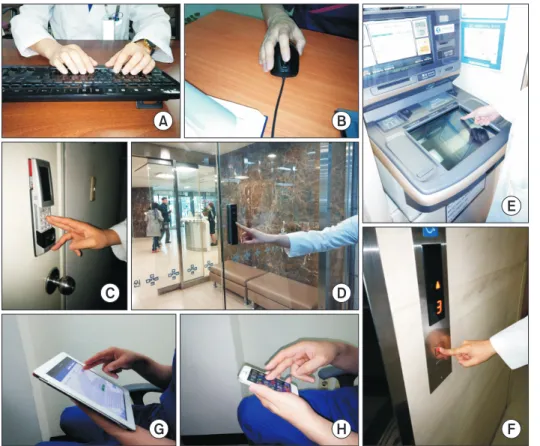
Turning a key is replaced by a button type lock. Starting an engine can be done by pressing a single button. In- stead of push open a heavy door, we open doors with a button. Development of electronic devices and machines such as the automated teller machine or elevator changed our lifestyle. We also use many haptic devices and smart- phones. All of these new activities require the use of the ulnar sides of fingers (Fig. 3).
This pattern of use is different from the traditional pattern for the dominant sensory zone. The results of this study show that the radial sides of the ring and little finger on dominant hand are used significantly less. But, the other compartments of the thumb and fingers showed similar use. According to these results, there are some differences from traditional sensory dominant sides of fingers. The ulnar sides of index and middle finger were not considered important in the past, but they are used with no significant difference from other compartments.
On the other hand, the radial sides of ring and little finger which were considered important in some of past stud- ies were not much used in this study. Further studies are needed but these findings may be used as basic data for
re-establishing the sensory dominant sides of fingers.
Furthermore, these findings may be helpful in better do- nor site selection for the neurovascular island flap and also be helpful to select the nerves to be reconstructed preferentially when reattaching the fingers.
But, in non-dominant hand, there was no statistically different compartment. We think it is because the tasks in office work are mostly single hand needed, except the keyboard job.
The standard deviation is large in our results because the data is non-parametric. The reason why our data is non-parametric is first, the business characteristics and the frequency of hand use of each person is different.
Second, it was not easy to do one’s work without wash- ing hands for a long time, and it made experimental time variation which is responsible for the large standard deviation. However, our results were statistically anal- ysed using the nonparametric Kruskal–Wallis tests and Mann–Whitney test. And highly significant results were obtained on dominant hand.
There are several limitations of this study. One is that it was only performed in office workers. Different results
may be observed in manual workers or in other groups of individuals. To address this issue, further study is needed.
However, many manual workers, due to injury, cannot perform their tasks and are apt to relocate to a simple of- fice job. The results presented for office workers are im- portant, particularly because office jobs are common and often a second career choice for manual workers. Second is that the experiment was not performed in the way that giving a task and then measure the elimination of fluorescent materials. It may have been lost by a simple touch, strong grasp or simply putting a hand on a desk.
However, the author tried to estimate the approximate use of finger compartments through the daily life of mod- ern office workers and it seems to have achieved those goals. In further clinical studies, task-based measurement research will be needed. Another limitation of this study is the lack of evidence in the experimental method. Many articles on finger sensory dominance have been reviewed, but there were no studies based on experiment for fin- ger sensory dominance. Therefore, this study is the first study to evaluate the finger sensory dominance and non- dominance by experiment.
Fig. 3. Activities require the use of the ulnar compartment more so than before. (A) Typing key- board needs sensation of ulnar compartment. (B) Also using a mouse needs sensation of ulnar compartment. (C) Button type lock, or (D) opening a door with a button also require ulnar compartment more than radial compartment.
Many electronic devices and ma- chines such as (E) automated teller ma chine or (F) elevator are controlled with fingers especially ulnar side of fingers. Recently, we use many (G) haptic devices and (H) smartphones which are mostly run by ulnar sides of fingers.
Kruskal–Wallis test, in which 10 compartments of the finger were simultaneously analyzed, and in the Mann–
Whitney test, which compared the radial side and ulnar side of each finger. Therefore, this experiment shows that the two compartments tend to be less used in contem- porary office workers, and the author believes that these compartments are less sensibly important. Alternatively, other compartments are found to be used with similar significance. Further evaluation and clinical trials are needed for the re-evaluation of sensory dominance of fin- gers. However, these results can be used as basic data for further study.
CONFLICTS OF INTEREST
The author has nothing to disclose.
ACKNOWLEDGEMENTS
This study was supported by a grant from Kosin Uni- versity College of Medicine.
Saunders; 2006. 207-52.
2. Tubiana R, Duparc J. Restoration of sensibility in the hand by neurovascular skin island transfer. J Bone Joint Surg Br. 1961;43:474-80.
3. Hashem MA. The heterodigital neurovascular island flap:
a sensible solution for difficult digital defects. Kasr El Aini J Surg. 2006;7:55-62.
4. Puckett CL, Howard B, Concannon MJ. Primary closure of the donor site for the Littler neurovascular island flap transfer. Plast Reconstr Surg. 1996;97:1062-4.
5. Silva JB, Pires FK, Teixeira LF. The pulp switch flap: an option for the treatment of loss of the dominant half of the digital pulp. J Hand Surg Eur Vol. 2013;38:948-51.
6. Ranney DA, Lennox WM. The protective value of a neu- rovascular island pedicle transfer in hands partially an- esthetic due to ulnar denervation in leprosy. J Bone Joint Surg Am. 1978;60:328-34.
7. Hayashi H, Shimizu H. Essential motion of metacarpo- phalangeal joints during activities of daily living. J Hand Ther. 2013;26:69-73; quiz 74.
형광물질을 이용한 사무직 근로자의 손가락 감각 우수부위 실험
김홍일
고신대학교 의과대학 성형외과학교실
목적: 전통적으로 손가락의 요측면이 감각 우수 부위로 여겨진다. 그러나 전자 장치 및 생활 방식의 변화에 따라 손 가락의 감각 우수 부위가 재평가되어야 한다고 생각한다.
방법: 26명의 사무직 근로자의 양손에 형광물질을 도포하여 각 손가락을 척측과 요측 구획으로 나누었다. 근무 전 후의 두 사진을 비교하여 얼마나 많은 형광물질이 남아 있는지 분석하였다.
결과: 우세수의 약지 요측 구획과 소지 요측 구획에서 다른 구획과 비교하여 현저하게 많은 형광물질이 남아 있었 다. 비우세수에서는 구획 간의 통계적으로 차이가 없었다.
결론: 이 연구를 통해 약지와 소지의 요측 구획이 다른 구획에 비하여 현대생활에서 덜 사용되며 감각적으로 덜 중 요한 구획일 수 있다는 것을 알 수 있었다. 이 결과는 현대사회에서 손가락의 감각 우수 부위에 대한 재평가의 기초 자료로 활용될 수 있으며 나아가 여러 가지 수부 수술에 있어서 도움이 될 것으로 생각된다.
색인단어: 손가락, 감각, 공여부 조직
접수일 2019년 2월 16일 수정일 1차: 2019년 3월 18일, 2차: 2019년 5월 13일 게재확정일 2019년 5월 29일 교신저자 김홍일
49267, 부산시 서구 감천로 262, 고신대학교 의과대학 성형외과학교실 TEL 051-990-6131 FAX 051-990-3005 E-mail [email protected] ORCID https://orcid.org/0000-0002-5505-9945