INTRODUCTION
Multiple births have become a focus of perinatal interest, especially because of the dramatic increase in frequency in recent years during the 1980s and 1990s (1), and the situa- tion is similar also in Korea (2). The increased rate of multi- ple births might be attributable to advancing maternal age at first birth and increased incidence of infertility, and there- fore, to the greater use of assisted reproductive technology including ovarian stimulation and in vitro fertilization (3).
Historically, multiples have been considered to be at in- creased risk for perinatal mortality and morbidity than sin- gletons, mainly because of higher rate of preterm birth and low birth weight (3). Some authors noted multiple very low birth weight infant (VLBWI) had higher mortality and mor- bidity than singleton (3-10), while others found no differences between two groups (11-15). So, it is not clear whether multi- ple VLBWI suffer higher mortality and morbidity than com- parable singletons. We, therefore, conducted this retrospective study to determine whether mortality and morbidity in mul- tiple VLBWI were higher than those in comparable singletons.
MATERIALS AND METHODS
In this retrospective study, we reviewed the medical records
of all live born preterm VLBWI with birth weight less than 1,500 g, who were admitted to the neonatal intensive care unit of Samsung Medical Center from October 1995 to December 2001. Live born singletons were included in singleton group, and live born twin, triplets, and survivors whose co-twins were stillborn were included in multiple births group. Four still- born multiple infants (one anencephaly, one acardia, two twin to twin transfusion), and one selective abortion due to alleged Down syndrome in triplets were excluded from analysis.
Neonatal medical records were reviewed to determine the birth weights, gestational age, mortality and morbidity of the infants. We compared the outcomes from the measurements of mortality and major morbidity, duration of mechanical ven- tilation, and length of hospitalization between the singletons and the multiples. We also compared perinatal mortality and major morbidity between the first born and the more than second born among multiples.
Gestational age in weeks was based on either the date of the last menstrual period, the known date of conception, fetal ultrasound, or the Ballard scoring system. Small for gestational age (SGA) was defined as a birth weight less than tenth per- centile for gestational age plotted on the Lubchenco intrauter- ine growth charts. Respiratory distress syndrome (RDS) was diagnosed based on the clinical symptoms of respiratory diffi- culty and compatible chest radiography findings of the diffuse reticulogranular pattern with air bronchograms and decreased
Kye Hyang Lee, Soo Jung Hwang, Sung Hye Kim, Soo Hyun Lee, Dong Kil Yu, Jong Hee Hwang, Chang Won Choi, Jae Won Shim*, Yun Sil Chang, Won Soon Park
Department of Pediatrics, Samsung Medical Center, Kangbuk Samsung Hospital*, Sungkyunkwan University School of Medicine, Seoul, Korea
Address for correspondence Won Soon Park, M.D.
Department of Pediatrics, Samsung Medical Center, 50 Ilwon-dong, Kangnam-gu, Seoul 135-710, Korea Tel : +82.2-3410-3523, Fax : +82.2-3410-0043 E-mail : [email protected]
779 J Korean Med Sci 2003; 18: 779-82
ISSN 1011-8934
Copyright � The Korean Academy of Medical Sciences
Comparison of Mortality and Morbidity in Multiple versus Singleton Very Low Birth Weight Infants in A Neonatal Intensive Care Unit
Multiple births in Korea have been increased recently as a consequence of incr- eased infertility due to advancing maternal age at first birth, and increased use of assisted reproductive technology. Multiples suffer higher mortality and morbidity than singletons. However, it is not clear whether preterm multiple very low birth weight infants (VLBWI) suffer higher mortality and morbidity than comparable sin- gletons. We evaluated 266 singleton and 113 multiple VLBWI to determine whether mortality and morbidity in multiple VLBWI were higher than those in comparable singletons. The rate of in vitro fertilization and cesarean section were significantly higher in multiples than singletons. The total and the adjusted mortality with ges- tational age and birth weight were not significantly different between the two groups.
Maternal age and the incidence of respiratory distress syndrome, patent ductus arteriosus, bronchopulmonary dysplasia, intracranial hemorrhage (grade≥3), cys- tic periventricular leukomalacia, and retinopathy of prematurity (stage≥3) were not significantly different between the two groups, and the incidence of abnormal brainstem auditory evoked potential was higher among the singletons. These results suggest that multiple VLBWI do not suffer higher mortality or morbidity than com- parable singletons.
Key Words : Multiple Birth Offspring; Infant; Very Low Birth Weight; Mortality; Morbidity
Received : 25 April 2003 Accepted : 18 August 2003
780 K.H. Lee, S.J. Hwang, S.H. Kim, et al.
lung volume. Patent ductus arteriosus (PDA) was confirmed in all infants by the echocardiograms demonstrating the left- to-right or the bi-directional blood flow through the ductus arteriosus. Bronchopulmonary dysplasia (BPD) was diagnosed by the presence of chronic respiratory distress, with oxygen required, beyond corrected gestational age of 36 weeks while accompanied by characteristic chest roentgenographic find- ings. Intraventricular hemorrhage (IVH) was diagnosed with cranial ultrasound examination, and the degree of hemorrhage was graded according to the classification of Papille et al. (16).
Cystic periventricular leukomalacia (PVL) was diagnosed by cranial ultrasonographic findings as cystic lesions in the periven- tricular white matter. The stage of retinopathy of prematurity (ROP) was defined by using the international classification of ROP as a spectrum of finding, including abnormal vasopro- liferation and tortuosity, retinal ridge formation, scarring, and retinal detachment. Abnormal brainstem auditory evoked potential (BAEP) was defined as hearing threshold over 45 dB done beyond corrected age of 40 weeks.
Statistical Analysis
Differences were examined for statistical significance with use of Wilcoxon rank sum test for continuous variables and of the chi-square for discrete variables, and through Fisher’s exact test when necessary. p value <0.05 were considered significant.
RESULTS Demographic Findings
Among the 379 VLBW preterm infants during the study period, 113 (30%) were multiples and 266 (70%) were sin- gletons. Among the multiples, 7 were triplets and 106 were twins.
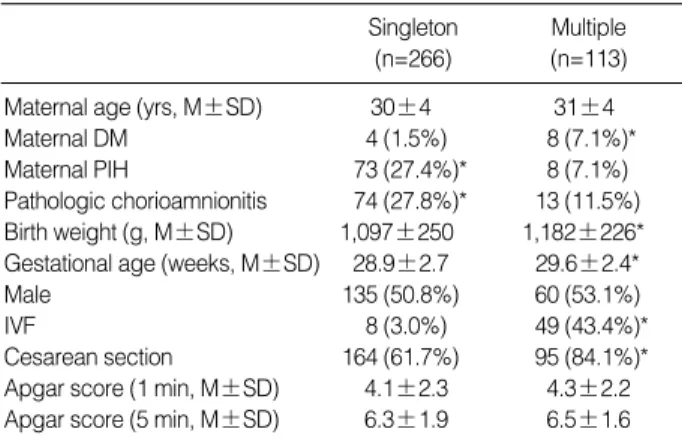
Birth weight and gestational age were significantly higher in multiples than in singletons (Table 1). When comparing mean values of birth weight and gestational age that exclude data for the gestation of VLBWI≤23 weeks, there were no differences in birth weight (1,106±244 g vs. 1,182±226 g, respectively) and gestational age (29.0±2.6 weeks vs. 29.4
±2.1 weeks, respectively) between singleton and multiple VLBWI. The birth weight adjusted with gestational age also was not significantly different between the two groups except in ≤23 weeks subgroups (Table 2). The rate of in vitro fertil- ization and cesarean section, and the incidence of maternal diabetes mellitus (DM) were significantly higher among the multiples (Table 1). The incidence of maternal pregnancy induced hypertension (PIH) and pathologic chorioamnionitis were significantly higher among the singletons. There were no significant differences in maternal age, antenatal use of steroid, antibiotics, and MgSO4, duration of premature rup- ture of membrane (PROM), and 1 and 5 min Apgar scores between the two groups.
Mortality in VLBW
The mortality in total and the mortality adjusted with the gestational age≥24 weeks were not significantly different between the two groups (Table 2).
Morbidity in VLBW
There were no significant differences in the incidence of major morbidities such as SGA, RDS, PDA, BPD, IVH, cystic PVL, and ROP, length of hospitalization, and days of ventila- tor and total parenteral nutrition (TPN) support between the two groups (Table 3). The rate of abnormal BAEP was signif- icantly higher among the singletons.
*p-value <0.05. DM, diabetes mellitus; PIH, pregnancy-induced hyper- tension; IVF, in vitro fertilization.
Singleton Multiple
(n=266) (n=113)
Maternal age (yrs, M±SD) 30±4 31±4
Maternal DM 4 (1.5%) 8 (7.1%)*
Maternal PIH 73 (27.4%)* 8 (7.1%)
Pathologic chorioamnionitis 74 (27.8%)* 13 (11.5%) Birth weight (g, M±SD) 1,097±250 1,182±226*
Gestational age (weeks, M±SD) 28.9±2.7 29.6±2.4*
Male 135 (50.8%) 60 (53.1%)
IVF 8 (3.0%) 49 (43.4%)*
Cesarean section 164 (61.7%) 95 (84.1%)*
Apgar score (1 min, M±SD) 4.1±2.3 4.3±2.2 Apgar score (5 min, M±SD) 6.3±1.9 6.5±1.6 Table 1.Demographic findings from the multiple and the single- ton very low birth weight infants (VLBWI)
Gestational age (wk) ≤23 24-25 26-27 28-29 ≥30 Total
Total (No.) S 5 (1.9%) 29 (10.9%) 68 (25.6%) 77 (28.9%) 87 (32.7%) 266 (100%)
M 0 (0.0%) 7 (6.2%) 20 (17.7%) 36 (31.9%) 50 (44.2%) 113 (100%)
Bwt (g, M±SD) S 650±90 779±156 985±163 1,132±222 1,286±166 1,097±250
M 840±125 957±137 1,170±200 1,329±138 1,182±226
Mortality (%) S 3 (60.0%) 12 (41.4%) 13 (19.1%) 9 (11.7%) 4 (4.6%) 41 (15.4%)
M 3 (42.9%) 4 (20.0%) 1 (2.8%) 2 (4.0%) 10 (8.8%)
Bwt, birth weight; S, singleton very low birth weight infants; M, multiple very low birth weight infants.
Table 2.Birth weights and mortality according to gestational age
Outcome of Multiple Vs Single VLBWI 781
Mortality and Morbidity according to Birth Order within the Multiples
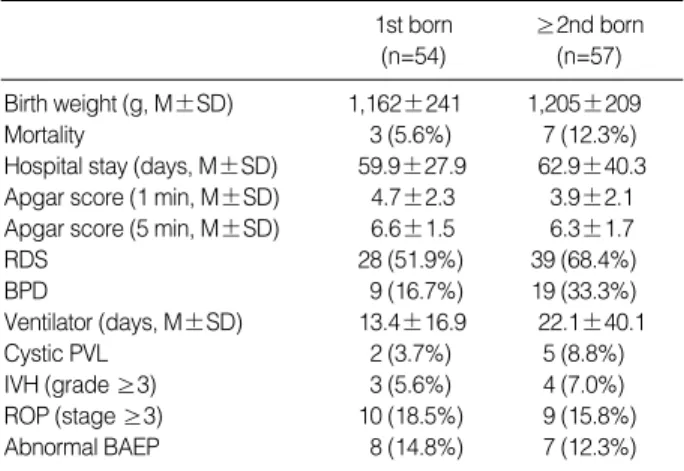
Of the 111 multiples, 54 were the first born and 57 were more than the second born. There were no significant differ- ences in mortality and other major morbidity between the first and more than the second born subgroups within the multi- ples (Table 4).
DISCUSSION
The incidence of multiple births has been increased dramat- ically and also consistently during last two decades from the 1970s to 1990s in all over the world. Twinning rate was in- creased by 35.8% in the United States, 58.3% in Israel, and 62.5% in Sweden between 1975 and 1995 (1). In Korea, Kang et al. also reported that twinning rate was increased by 36%
from 1989 to 1994 (2). The increased incidence of multiple births might occur as a consequence of advancing maternal age at first birth and increased primary infertility, and resul- tant increased use of assisted reproductive technology (1, 3, 17, 18). Our data of higher in vitro fertilization (IVF) rate in the multiple VLBWI and advancing maternal age comparing with previous study by Kang et al. (2) suggest that these trends are also applicable to the VLBWI groups.
Very high rate of multiples observed in this study suggests that multiple gestation itself might be an important risk fac- tor for preterm VLBW delivery. Although the incidence of maternal DM and the use of assisted reproductive technology were significantly higher in the multiples, the IVF rate bet- ween DM and non-DM group was not significantly different.
These findings do not support the assumption that higher rate of maternal DM in the multiples might be associated with
increased infertility with the resultant increased use of assist- ed reproductive technology in DM patients. Further studies will be necessary to delineate the reasons of higher incidence of maternal DM in the multiples. Higher rate of maternal pathologic chorioamnionitis and PIH among the singletons suggest that these factors could act as the important risk fac- tors for preterm VLBW delivery, especially among the single- tons. As multiple gestation is a well known major risk factor for maternal PIH, our data of significantly lower incidence of PIH observed in the multiples are difficult to explain. Further studies will be necessary to clarify this.
Although birth weights of the multiples at full term are smaller than those of the singletons, it is not clear when the divergence of growth in the multiple gestation starts in utero.
Some authors noted intrauterine growth for fetuses of the mul- tiple gestation follows that of singletons until 30-34 weeks of gestation when growth curves begin to diverge (4, 19-21).
In the study of Alexander et al. (22), divergence of growth for the multiples began much earlier at 22 weeks with marked divergence beginning at 28 weeks. Hoffman et al. (12) and Wolf et al. (13) reported no significant differences in birth weight between the singleton and the twin VLBWI. In this study, no significant differences in gestational age-specific birth weights were observed. These findings suggest that there is no significant divergence of growth of multiple gestation at least until 30-34 weeks of gestation.
The multiples are believed to have higher rate of perinatal mortality and major morbidity than the singletons, mainly because of higher rate of prematurity and VLBW (4-9). How- ever, it is not certain whether perinatal outcomes of the mul- tiples are also worse than the singletons in VLBWI subpop- ulation. Some authors reported multiple VLBWI had higher rate of mortality and neurodevelopmental morbidity than singleton VLBWI (10, 12). In other studies, no significant
SGA, small for gestational age; RDS, respiratory distress syndrome; PDA, patent ductus arteriosus; BPD, bronchopulmonary dysplasia; IVH, intra- ventricular hemorrhage; ROP, retinopathy of prematurity; PVL, periven- tricular leukomalacia; BAEP, brainstem auditory evoked potential.
1st born ≥2nd born
(n=54) (n=57)
Birth weight (g, M±SD) 1,162±241 1,205±209
Mortality 3 (5.6%) 7 (12.3%)
Hospital stay (days, M±SD) 59.9±27.9 62.9±40.3 Apgar score (1 min, M±SD) 4.7±2.3 3.9±2.1 Apgar score (5 min, M±SD) 6.6±1.5 6.3±1.7
RDS 28 (51.9%) 39 (68.4%)
BPD 9 (16.7%) 19 (33.3%)
Ventilator (days, M±SD) 13.4±16.9 22.1±40.1
Cystic PVL 2 (3.7%) 5 (8.8%)
IVH (grade ≥3) 3 (5.6%) 4 (7.0%)
ROP (stage ≥3) 10 (18.5%) 9 (15.8%)
Abnormal BAEP 8 (14.8%) 7 (12.3%)
Table 4.Mortality and morbidity according to birth order within the multiples
*p-value <0.05. SGA, small for gestational age; RDS, respiratory distress syndrome; PDA, patent ductus arteriosus; BPD, bronchopulmonary dys- plasia; TPN, total parenteral nutrition; IVH, intraventricular hemorrhage;
ROP, retinopathy of prematurity; PVL, periventricular leukomalacia; BAEP, brainstem auditory evoked potential.
Singleton Multiple
(n=266) (n=113)
SGA 48 (18.0%) 19 (16.8%)
RDS 148 (55.6%) 67 (59.3%)
PDA 159 (59.8%) 76 (67.3%)
BPD 81 (30.5%) 28 (24.8%)
Ventilator (days, M±SD) 23.8±33.6 17.9±30.9 TPN (days, M±SD) 21.0±23.9 16.9±15.9
IVH (grade ≥3) 17 (6.4%) 7 (6.2%)
ROP (stage ≥3) 36 (13.5%) 19 (16.8%)
Cystic PVL 13 (4.9%) 8 (7.1%)
Abnormal BAEP 51 (19.1%)* 15 (13.2%)
Hospital stay (days, M±SD) 63.6±40.0 61.1±34.6 Table 3.Morbidity among the multiple and the singleton very low birth weight infants (VLBWI)
782 K.H. Lee, S.J. Hwang, S.H. Kim, et al.
differences in perinatal mortality and major morbidity were observed (11, 13-15, 23). In this study, no significant differ- ences were observed in perinatal mortality and major morbid- ity between the multiple and the singleton VLBWI. As 5 patients with gestational age less than 23 weeks were includ- ed only in the singletons, the total mortality rate in the sin- gletons showed a tendency to be higher than in the multiples without statistical significance. The frequency of abnormal BAEP findings was even higher among the singletons. These findings support the assumption that the multiples is not a significant risk factor for increased perinatal mortality and morbidity in VLBWI.
Birth order of multiples has been considered as a prognostic factor because the second borns are at higher risk for malpre- sentation, hypoxia, and operative delivery (24-26). With the advent of modern perinatal care, however, most of the com- plications in the second born twins could be avoided. Ghai et al. (11) and Chen et al. (27) found no differences in perinatal mortality and morbidity between the first and second born twins. In this study, no significant differences in perinatal mor- tality and morbidity according to birth order were observed in the multiple VLBWI. These findings suggest that the birth order among the multiple VLBWI is not an important prog- nostic factor.
In summary, there were no significant differences in perina- tal mortality and morbidity between the singleton and the multiple VLBWI.
REFERENCES
1. Oleszczuk JJ, Keith DM, Keith LG, Rayburn WF. Projections of population-based twinning rates through the year 2100. J Reprod Med 1999; 44: 913-21.
2. Kang IS, Huh CY. Clinical study in twin pregnancy. J Kyung Hee Univ Med Center 1995; 11: 54-60.
3. Keith LG, Oleszczuk JJ, Keith DM. Multiple gestation: reflections on epidemiology, causes, and consequences. Int J Fertil Womens Med 2000; 45: 206-14.
4. Ho SK, Wu PY. Perinatal factors and neonatal morbidity in twin pregnancy. Am J Obstet Gynecol 1975; 122: 979-87.
5. Hartikainen-Sorri AL, Kauppila A, Tuimala R, Koivisto M. Factors related to improved outcome for twins. Acta Obstet Gynecol Scand 1983; 62: 23-5.
6. McCarthy BJ, Sachs BP, Layde PM, Burton A, Terry JS, Rochat R.
The epidemiology of neonatal death in twins. Am J Obstet Gynecol 1981; 141: 252-6.
7. Nylander PP. Perinatal mortality in twins. Acta Genet Med Gemellol 1979; 28: 363-8.
8. Zahalkova M. Perinatal and infant mortality in twins. Prog Clin Biol Res 1978; 24: 115-20.
9. Luke B, Keith LG. The contribution of singletons, twins, and triplets to low birth weight, infant mortality and handicap in the United States.
J Reprod Med 1992; 37: 661-6.
10. Yu VY, Loke HL, Bajuk B, Szymonowicz W, Orgill AA, Astbury J. Prognosis for infants born at 23 to 28 weeks’ gestation. Br Med J 1986; 293: 1200-3.
11. Ghai V, Vidyasagar D. Morbidity and mortality factors in twins: An epidemiologic approach. Clin Perinatol 1988; 15: 123-40.
12. Hoffman EL, Bennett FC. Birth weight less than 800 grams: Chang- ing outcomes and influences of gender and gestation number. Pedi- atrics 1990; 86: 27-34.
13. Wolf EJ, Vintzileos AM, Rosenkrantz TS, Rodis JF, Lettieri L, Mal- lozzi A. A comparison of pre-discharge survival and morbidity in singleton and twin very low birth weight infants. Obstet Gynaecol 1992;
80: 436-9.
14. Clarkson JE, Buckfield PM, Herbison GP. The outcome of twin preg- nancies in Dunedin, 1968-1978. Aust N Z J Obstet Gynaecol 1982;
22: 127-30.
15. Leonard C, Piecuch RE, Ballard RA, Cooper BA. Outcome of very low birth weight infants: multiple gestation versus singletons. Pedi- atrics 1994; 93: 611-5.
16. Papile LA, Burstein J, Burstein R, Koffler H. Incidence and evolution of subependymal and intraventricular hemorrhage: a study of infants with birth weights less than 1,500 gm. J Pediatr 1978; 92: 529-34.
17. Joseph KS, Allen AC, Dodds L, Vincer MJ, Armson BA. Causes and consequences of recent increases in preterm birth among twins.
Obstet Gynecol 2001; 98: 57-64.
18. Warner BB, Kiely JL, Donovan EF. Multiple births and outcome.
Clin Perinatol 2000; 27: 347-61, ix.
19. Fenner A, Malm T, Kusserow U. Intrauterine growth of twins: A retrospective analysis. Eur J Pediatr 1980; 133: 119-21.
20. Leroy B, Lefort F, Neveu P, Risse RJ, Trevise P, Jeny R. Intrauter- ine growth charts for twin fetuses. Acta genet med Gemellol Roma 1982; 31: 199-206.
21. Naeye RL, Benirschke K, Hagstrom JW, Marcus CC. Intrauterine growth of twins as estimated from liveborn birth weight data. Pedi- atrics 1966; 37: 409-16.
22. Alexander GR, Kogan M, Martin J, Papiernik E. What are the fetal growth patterns of singletons, twins, and triplets in the United States?
Clin Obstet Gynecol 1998; 41: 114-25.
23. Donovan EF, Ehrenkranz RA, Shankaran S, Stevenson DK, Wright LL, Younes N, Fanaroff AA, Korones SB, Stoll BJ, Tyson JE, Bauer CR, Lemons JA, Oh W, Papile LA. Outcomes of very low birth weight twins cared for in the National Institute of Child Health and Human Development Neonatal Research Network’s intensive care units. Am J Obstet Gynecol 1998; 179: 742-9.
24. Nakano R, Takemura H. Birth order in delivery of twins. Gynecol Obstet Invest 1988; 25: 217-22.
25. Young BK, Suidan J, Antoine C, Silverman F, Lustig I, Wasserman J. Differences in twins: the importance of birth order. Am J Obstet Gynecol 1985; 151: 915-21.
26. Eskes TK, Timmer H, Kollee LA, Jongsma HW. The second twin.
Eur J Obstet Gynecol Reprod Biol 1985; 19: 159-66.
27. Chen SJ, Vohr BR, Oh W. Effects of birth order, gender, and intrau- terine growth retardation on the outcome of very low birth weight in twins. J Pediatr 1993; 123: 132-6.