© 2012 The Korean Academy of Medical Sciences.
This is an Open Access article distributed under the terms of the Creative Commons Attribution Non-Commercial License (http://creativecommons.org/licenses/by-nc/3.0) which permits unrestricted non-commercial use, distribution, and reproduction in any medium, provided the original work is properly cited.
pISSN 1011-8934 eISSN 1598-6357
A Case of Elderly-Onset Crescentic Henoch-Schönlein Purpura Nephritis with Hypocomplementemia and Positive MPO-ANCA
Henoch-Schönlein purpura (HSP) is common in childhood and often self-limiting. There have been limited studies on elderly-onset HSP nephritis (HSPN). A 76-yr-old man was transferred to our hospital with a 1-month history of oliguria, abdominal pain, edema and palpable purpura in the legs. Three months ago, he was admitted to another hospital with jaundice, and consequently diagnosed with early common bile duct cancer. The patient underwent a Whipple’s operation. Antibiotics were administrated because of leakage in the suture from the surgery. However, he showed progressive renal failure with edema and purpura in the legs. Laboratory investigations showed serum creatinine 6.4 mg/dL, 24-hr urine protein 8,141 mg/day, myeloperoxidase anti-neutrophil cytoplasmic antibodies (MPO-ANCA) 1:40 and C3 below 64.89 mg/dL. Renal biopsy showed crescentic glomerulonephritis, as well as mesangial and extracapillary Ig A deposition. We started steroid therapy and hemodialysis, but he progressed to end-stage renal failure and he has been under maintenance hemodialysis. We describe elderly onset HSPN with MPO-ANCA can be crescentic glomerulonephritis rapidly progressed to end stage renal failure.
Key Words: Purpura, Schönlein-Henoch; Hypocomplementemic; Anti-Neutrophil Cytoplasmic Antibody
Jung-Hee Yu1, Kyu-Beck Lee1, Jae Eun Lee1, Hyang Kim1, Kyungeun Kim2, Ki-Seok Jang3, and Moon Hyang Park3
1Division of Nephrology, Department of Internal Medicine, 2Department of Pathology, Sungkyunkwan University School of Medicine, Seoul; 3Department of Pathology, Hanyang University College of Medicine, Seoul, Korea Received: 27 December 2011
Accepted: 20 May 2012 Address for Correspondence:
Kyu-Beck Lee, MD
Division of Nephrology, Department of Internal Medicine, Kangbuk Samsusng Hospital, Sungkyunkwan University School of Medicine, 78 Saemunan-gil, Jongno-gu, Seoul 110-746, Korea
Tel: +82.2-2001-2449, Fax: +82.2-2001-1596 E-mail: [email protected]
http://dx.doi.org/10.3346/jkms.2012.27.8.957 • J Korean Med Sci 2012; 27: 957-960
CASE REPORT
Nephrology
INTRODUCTION
Henoch-Schönlein purpura (HSP) is a common systemic vas- culitic disorder that occurs during hildhood and its course is often self-limiting (1, 2). Approximately 40% patients with HSP develop HSP nephritis (HSPN). Multiple studies have reported less frequent but poorer outcomes in adult HSPN (1, 2) and there have been a few data on elderly-onset patients (3). HSPN and Immunoglobulin A (IgA) nephropathy are considered to be re- lated diseases. IgA nephropathy is usually an indolent progres- sive adult disease, whereas HSPN is mainly seen during child- hood. HSPN presents extrarenal manifestations and has associ- ations with hypersensitivity. HSPN more often shows nephritic- nephrotic syndrome and chronic renal failure compared to IgA nephropathy (4).
Although the pathophysiologic mechanisms of HSPN are not completely understood, thecomplement activation, vascular damage and crescent formation in glomerular injury in severe HSPN appear to play an important role. However, the serum complement levels are usually normal (5) and anti-neutrophil cytoplasmic antibodies (ANCA) is negative in most patients with HSPN (2, 3, 6). We experienced a case of elderly-onset crescen- tic HSPN with nephritic-nephrotic syndrome associated with hypocomplementemia and positive myeloperoxidase ANCA
(MPO-ANCA) after a major operation and antibiotic use. Renal failure was not improved and the patient has been under main- tained HD.
CASE DESCRIPTION
A 76-yr-old man was transferred to our hospital at 7th July 2011 with 1-month history of oliguria, gross hematuria, abdominal pain, pitting edema and skin eruption (palpable purpura) in both legs. He had no previous medical history with normal re- nal function and urine analysis findings. His family history was also unremarkable. Three months ago, he was admitted to an- other hospital with jaundice, but then diagnosed with early com- mon bile duct cancer, and he underwent Whipple’s operation.
Antibiotics were used because of leakage in the suture from the surgery but there were no further surgical problems. The antibi- otics administered included ceftriaxone, amikacin, meropenem and piperacillin/tazobactam. However, serum creatinine in- creased from 1.0 to 6.3 mg/dL. A physical examination revealed multiple nontender purpura mixed with erythema ranging from 2 to 4 mm in diameter over his edematous lower legs and the dorsal side of his feet and toes (Fig. 1). Most of the skin lesions were non-indurated, although palpable or indurated purpura mixed with erythema could be identified in some areas. On ad-
Yu J-H, et al. • Elderly-Onset Crescentic HSPN with Hypocomplementemia and ANCA
958 http://jkms.org http://dx.doi.org/10.3346/jkms.2012.27.8.957
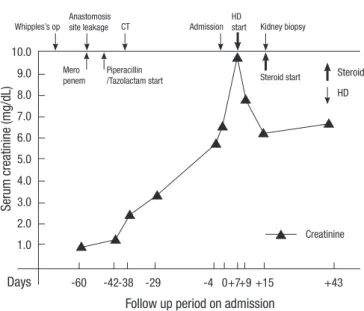
mission, laboratory investigations showed a reduced serum he- moglobin level of 10.5 g/dL and an elevated serum C-reactive protein level of 5.93 mg/dL. In addition to an elevated serum creatinine level of 6.4 mg/dL (Fig. 2), an increased blood urea nitrogen level of 45.7 mg/dL, urine RBC many/HPF and 24 hr urine protein showed 8,141 mg/day. Urine electrophoresis sug- gested nonselective glomerular proteinuria. C3 was low at 64.89 mg/dL, and ANCA was positive at MPO-ANCA 1:40 (by enzyme- linked immunosorbent assay [ELISA] and indirect inmunofluo-
rescence [IF]) and serum fluorescent antinuclear antibody test, cryoglobulin and other serology findings were within the nor- mal range. Ultrasonography showed diffuse parenchymal swell- ing, homogenous increase cortical echogenecity, ascites and bilateral pleural effusion. Renal biopsy showed crescentic glo- merulonephritis on light microscopy (LM), and mesangial and extracapillary Ig A deposition on IF. We examined eight glomer- uli, two of which were globally sclerotic. Circumferential fibro- cellular and cellular crescents were noted in 5 out of a total of 8 glomeruli. Most glomeruli were diffuse endocapillary prolif- eration in size and cellularity due to endocapillary proliferation with mild lymphocytic and neutrophilic infiltration. IF micros- copy revealed conspicuous staining for Ig A in the mesangium and segmentally subendothelial portion along the glomerular capillary walls (Fig. 3). On the 10th hospital day, the patient com- plained of abdomen discomfort and experienced pyrexia up to 38.5ºC. We started prednisolon 60 mg without using antibiotics, and after that the fever improved. Starting steroid therapy and HD, abdomen discomfort, purpura on legs, pretibial pitting edema and pleural effusion were improved. However, his renal function was not improved and he has been under maintenance HD.
DISCUSSION
HSP is a typical disease of childhood, and shows a near 20-fold disparity in incidence between adults and children (1.3 vs 22.1 per 100,000 population). Adult-onset HSP may involve more severe HSPN and organ injury, but there is limited data on el-
A B
Fig. 1. Skin rash and generalized edema were showed on lower extremities. Palpable purpuric rash mixed with erythema on both edematous legs (A) and feet (B).
Serum creatinine (mg/dL)
Follow up period on admission Hospital course
Creatinine Steroid HD
Whipples’s op CT Admission Kidney biopsy
Steroid start Anastomosis
site leakage
HD start
Mero penem
Piperacillin /Tazolactam start
Days -60 -42-38 -29 -4 0+7+9 +15 +43
10.0 9.0 8.0 7.0 6.0 5.0 4.0 3.0 2.0 1.0
Fig. 2. Changes in serum creatinine concentration in the patient during the hospital course. HD, hemodialysis; op, operation; CT, computerized tomography.
Yu J-H, et al. • Elderly-Onset Crescentic HSPN with Hypocomplementemia and ANCA
http://jkms.org 959
http://dx.doi.org/10.3346/jkms.2012.27.8.957
derly-onset HSP (3). The classic clinical symptoms include pur- puric rash, abdominal pain, arthralgias, and hematuria, but the spectrum of HSP may vary from only minimal petechial rash to severe gastrointestinal, neurologic, pulmonary, and renal dis- ease. Approximately 40% with HSP develop HSPN. HSPN is often triggered by antecedent infection, medication and other miscellaneous factors (8). HSPN and IgA nephropathy are cur- rently considered related diseases, as both are indistinguishable in the renal histologic and immunofluorescent findings, and both have been described in twins. HSPN more often shows ex- trarenal manifestation, nephritic-nephrotic syndrome and chron- ic renal failure compared to IgA nephropathy (4).
Pathogenesis of HSPN is not completely understood, but it has pathologically been regarded as a specific immune-medi- ated entity induced by environmental factors, particularly in- fections (9). The role of infection, particularly group A beta-he- molytic streptococcal, in the etiology of HSP has interested many investigators, but the role of bacterial antigens remains ques- tionable in a majority of cases. Other causes are hypersensitivity reactions induced by numerous drugs, but no common drug has yet been identified. In a previous case report, prodromal ill- ness and drug to HSP in three members of the same family were penicillin with sore throat and colon resection after diverticuli- tis with sulfonamide due to wound infection (10).
Pathophysiologic mechanisms of HSPN including comple-
ment activation, vascular damage and crescent formation in glomerular injury appear to play an important role. C3 deposits are seen in a vast majority of patients with HSPN. Hypocomple- mentemia generally has not been seen in HSPN, but excessive consumption and deposition of C3 in the kidneys may have been the cause of reduced C3 serum level in a severe HSPN case (5).
HSP is a systemic vasculitic disorder. ANCA with specificity for myeloperoxidase (MPO) was noted in primary small vessel vas- culitis (11). Although the prognosis of patients with overlapping HSPN with ANCA remains unclear, clinical correlations suggest that immune complex deposits in the kidney may potentiate the effect of ANCA in producing more severe glomerulonephritis than classic pauci-immune vasculitis or HSPN. As HSPN over- lapping syndrome characterized by the synergistic effect of MPO- ANCA and the IgA immune complex may result in a fatal out- come, aggressive immunosuppressive therapy should be initi- ated as early as possible (12). We examined MPO-ANCA twice using an enzyme immunoassay (ELISA) in our hospital and in- direct IF assay in another hospital. It was found that MPO-ANCA was positive and a titer of 1:40 was relatively weak. However, large multicenter studies combining indirect IF and ELISA have demonstrated a specificity approaching 99% for Wegener’s gran- ulomatosis, microscopic polyangitis, or their renal-limited vari- ant (13). The ANCA have an important role in pathogenicity of small vessel vasculitis, and intermittent ANCA positivity is an Fig. 3. Microscopic findings of needle biopsy specimen. (A) Eight glomeruli, 2 of which are globally sclerotic, whereas 5 showed segmental sclerosis. (B) Glomerulus shows fibrocellular crescent with focal capsular tear on PAS staining. (C) Masson’s trichrome stain shows golmerular sclerosis with fibrin deposition and interstitial fibrosis. (D) The silver staining shows some infiltrated neutrophils. The glomerular capillary basement membrane is not thickened. (E) The glomerulus demonstrates diffuse endocapillary prolif- eration with circumferential cellular crescent formation formation more than 50% glomeruli (Meadow classification Grade V, Jones silver stain, original magnification × 400). (F) Immunofluorescence demonstrates diffuse deposition of IgA in the mesangium and subendothelial portion of the glomerulus (anti-IgA immunofluorescence, original magnifica- tion × 400).
A B C
D E F
Yu J-H, et al. • Elderly-Onset Crescentic HSPN with Hypocomplementemia and ANCA
960 http://jkms.org http://dx.doi.org/10.3346/jkms.2012.27.8.957
independent risk factor for relapse (11-13). Therefore, MPO- ANCA may have some role in the pathogenesis of our crescen- tic HSPN case. In a retrospective study, 2 cases with ANCA out of a total of 42 HSP could not identify any clinical correlation between HSP and ANCA (6). Because the presence of crescents is a histologic feature of HSPN that represents a prognostic fac- tor and constitutes the basis for the International Study Group of Kidney Disease in Childhood (ISKDC) pathology classifica- tion, the study of crescent pathophysiology may provide useful information as a therapeutic strategy (14).
A cohort study (3) of 250 adults suffering from HSP was ret- rospectively analyzed for a median follow-up period of 14.8 yr.
The risk of progression to renal insufficiency, which ranges from 5% to 15% in children, seems to be much higher in adults, at ap- proximately 30%. They reported to define long-term prognosis and risk factors for severe renal failure in adults with HSPN. Re- nal function impairment and proteinuria level at presentation and, the degree of interstitial fibrosis, percentage of sclerotic glomeruli, and presence of glomeruli with fibrinoid necrosis on renal biopsy were associated with a poor renal prognosis.
Our elderly patient underwent a kidney biopsy-proven, sud- den developed HSPN associated with nephritic-nephrotic syn- drome with hypocomplementemia and p-ANCA after a major operation for the treatment of cancer. Renal biopsy showed cres- centic glomerulonephritis indicating a poor prognosis. After being initially treated with prednisolone, his purpura and ede- ma on the legs improved, but renal function did not improve.
This case implies that the prognosis of elderly-onset crescentic HSP nephritis with positive MPO-ANCA and hypocomplente- mia may be a poor outcome. Therefore, closed inspection would be helpful to monitor the progression of elderly-onset HSP, and the clinician should not delay renal biopsy to confirm the diag- nosis at the time of clinical suspicion of renal involvement. Ear- lier diagnosis and prompt treatment of elderly-onset HSPN will prevent the progress of end-stage renal failure. Only few cases with elderly onset HSPN have been reported, especially rare with MPO-ANCA. We describe elderly onset HSPN with MPO- ANCA can be crescentic glomerulonephritis rapidly progressed to end stage renal failure.
REFERENCES
1. Blanco R, Martínez-Taboada VM, Rodríguez-Valverde V, García-Fuentes
M, González-Gay MA. Henoch-Schönlein purpura in adulthood and childhood: two different expressions of the same syndrome. Arthritis Rheum 1997; 40: 859-64.
2. Pillebout E, Thervet E, Hill G, Alberti C, Vanhille P, Nochy D. Henoch- Schönlein purpura in adults: outcome and prognostic factors. J Am Soc Nephrol 2002; 13: 1271-8.
3. Diehl MP, Harrington T, Olenginski T. Elderly onset Henoch-Schönlein purpura: a case series and review of the literature. J Am Geriatr Soc 2008;
56: 2157-9.
4. Davin JC, Berge IJ, Weening JJ. What is the difference between IgA ne- phropathy and Henoch-Schönlein purpura nephritis. Kidney Int 2001;
59: 823-34.
5. Krause I, Garty BZ, Davidovits M, Cleper R, Tamary H, Rosenmann E, Eisenstein B. Low serum C3, leukopenia, and thrombocytopenia: un- usual features of Henoch-Schönlein purpura. Eur J Pediatr 1999; 158:
906-9.
6. Kim NH, Ham YR, Yoon JH, Jung JY, Kim ES, Chung S, Choi DE, Na KR, Lee KW, Shin YT. Henoch-Schönlein nephritis in adults: renal outcomes and prognostic factors. Korean J Nephrol 2009; 28: 570-8.
7. Shrestha S, Sumingan N, Tan J, Alhous H, McWilliam L, Ballardie F.
Henoch-Schönlein purpura with nephritis in adults: adverse prognostic indicators in a UK population. QJM 2006; 99: 253-65.
8. Rai A, Nast C, Adler S. Henoch-Schönlein purpura nephritis. J Am Soc Nephrol 1999; 10: 2637-44.
9. Yang YH, Chuang YH, Wang LC, Huang HY, Gershwin ME, Chiang BL.
The immunobiology of Henoch-Schönlein purpura. Autoimmun Rev 2008; 7: 179-84.
10. Lofters WS, Pineo GF, Luke KH, Yaworsky RG. Henoch-Schönlein pur- pura occurring in three members of a family. Can Med Assoc J 1973; 109:
46-8.
11. Bollée G, Noël LH, Suarez F, Royal V, Gilardin L, de Serre NP, El-Ghoul B, Lesavre P, Alyanakian MA, Fakhouri F. Pauci-immune crescentic glomer- ulonephritis associated with ANCA of IgA class. Am J Kidney Dis 2009;
53: 1063-7.
12. Nagasaka T, Miyamoto J, Ishibashi M, Chen KR. MPO-ANCA- and IgA- positive systemic vasculitis: a possibly overlapping syndrome of micro- scopic polyangiitis and Henoch-Schöenlein purpura. J Cutan Pathol 2009; 36: 871-7.
13. Bartůnková J, Tesar V, Sedivá A. Diagnostic and pathogenetic role of an- tineutrophil cytoplasmic autoantibodies. Clin Immunol 2003; 106: 73-82.
14. Davin JC. Henoch-Schönlein purpura nephritis: pathophysiology, treat- ment, and future strategy. Clin J Am Soc Nephrol 2011; 6: 679-89.
15. Hauer HA, Bajema IM, van Houwelingen HC, Ferrario F, Noël LH, Wald- herr R, Jayne DR, Rasmussen N, Bruijn JA, Hagen EC. Renal histology in ANCA-associated vasculitis: differences between diagnostic and sero- logic subgroups. Kidney Int 2002; 61: 80-9.