KOREAN J. FOOD SCI. TECHNOL. Vol. 51, No. 6, pp. 592~595 (2019) https://doi.org/10.9721/KJFST.2019.51.6.592
592
©The Korean Society of Food Science and Technology
Physicochemical characteristics and antioxidant potential
of paprika (Capsicum annuum L.) wine
Chan Yong Kim1, Oh Hun Kwon1, Won Jong Gun1, Yong-Sung Park2, Sanjeev Kumar Dhungana3, and Il-Doo Kim4,*
1Yeongyang Pepper Research Institute, Gyeongsangbuk-Do Agricultural Research & Extension Service 2School of Applied Biosciences, Kyungpook National University
3National Institute of Crop Science, Rural Development Administration 4International Institute of Research & Development, Kyungpook National University
Abstract Paprika (Capsicum annuum L.) contains various phytochemicals, including carotenoids, ascorbic acid, tocopherol, flavonoids, and phenolic compounds, as well as natural food colorants. Very little information is available regarding wine produced from different colored paprikas. The objectives of this study were to prepare wines from red, orange, and yellow paprika and evaluate their physicochemical characteristics. The alcohol concentration, pH, titratable acidity, and reducing sugar content were not significantly affected by the type of paprika. Hunter’s color values varied with the color of paprika. The total mineral content and 2,2-diphenyl-1-picrylhydrazyl radical scavenging potential of red paprika wine were significantly higher; however, the total polyphenol content of yellow paprika wine was significantly higher than that of the other wine samples. This study suggested that paprika could be used to prepare wine and red paprika might be appropriate for producing good-quality wine.
Keywords: antioxidant, mineral, paprika, physicochemical, wine
Introduction
Paprika (Capsicum annuum L.) is considered as a healthy food which contains different phytochemicals including carotenoids, ascorbic acid, tocopherol, flavonoids, and phenolic compounds, as well as natural food colorants (AlDuais et al., 2009; Jeong et al., 2006). There are several varieties and colors of paprika. Red paprika shows antitumor-promoting activity (Maoka et al., 2001; Maokaa et al., 2004) and reduction or prevention of cardiovascular diseases. Paprika is effective in the improvement of high density lipoprotein cholesterol and hepatic gene regulation (Aizawa and Inakuma, 2009) especially due to carotenoids. Capsanthin and capsorubin, which are found in red paprika, reveal antioxidative and antitumor activities (Kim et al., 2009). Paprika is a good source of natural colorants and vitamins like C and E, which are found effective on reducing the risk of cancer and cardiovascular disease (Gerster, 1991).
Capsaicinoids, especially capsaicin and dihydrocapsaicin which are the chief alkaloids for paprika’s pungency (Giuffrida et al., 2014), are reported to have health benefits like analgesic, anti-inflammatory, and antioxidant activities (Djamgoz and Isbilen, 2006). They have also shown anticarcinogenic properties by
inhibiting androgen-dependent growth of breast cancer, as well as colon, prostate, and gastric adenocarcinoma (Djamgoz and Isbilen, 2006). Carotenoids found in red paprika are reported to have a beneficial effect on human health such as cancer chemopreventive activity (Maoka et al., 2001). Paprika is also rich in phenolic compounds and flavonoids, which are well known for their significant antioxidant and anticancer activities (Lu et al., 2006; Tonin et al., 2005). Thus, the amalgamation of various phytochemicals contributing for the color, taste, and pungency of paprika is the reason for its global popularity.
Fruits and vegetables are highly perishable which are prone to rapid deterioration and are usually wasted if the surplus production is not properly stored or processed. Thus, it is important to develop new methodologies for processing them to minimize the production losses and to make more profits to the farmers. Winemaking is a potential technology from commercial point of view (Moreno-Arribas and Polo, 2005). Several fruits such as kiwi (Soufleros et al., 2001), banana (Akubor et al., 2003), mango (Reddy and Reddy, 2005), cocoa (Dias et al., 2007), orange (Selli et al., 2008), gabiroba (Duarte et al., 2009), and pineapple (Pino and Queris, 2010) have been used to brew wine.
Several studies on physicochemical and functional properties of paprika have been carried out. However, very little information is available regarding the production of wine from different colored paprika. Considering the nutritional values of paprika and possibility of brewing wine from it, this study intended to prepare and investigate the quality of wine produced from red, orange, and yellow colored paprika. This study could be useful to promote commercial production and develop high value product from paprika.
*Corresponding author: Il-Doo Kim, International Institute of Research & Development, Kyungpook National University, Daegu 41566, Korea
Tel: +82-53-950-5707 Fax: +82-53-958-6880 E-mail: [email protected]
Received September 8, 2019; revised November 17, 2019; accepted November 18, 2019
Quality of paprika wine 593
Materials and Methods
Chemicals and materials
Folin-Ciocalteu phenol reagent and 1,1-diphenyl-2-picrylhydrazyl (DPPH) were purchased from Sigma-Aldrich (St. Louis, MO, USA). All the chemical and reagents were of analytical grade. Red, orange, and yellow paprikas (Capsicum annuum L.) were purchased from local market in May of 2019. The paprikas were washed with tap water, kept under room conditions (25) for 2 h for surface drying, crushed with gentle pressure with the help of mortar and pestle, followed by homogenization in a mixer (HMF 3450-S; Hanil Co., seoul, Korea) without fluid addition.
Preparation of paprika wine samples
Each 3.5 kg of the homogenized red, orange, and yellow paprika was separately put into 27-L stainless steel fermenting vessels. Sulfur dioxide (100 ppm) was mixed in the vessels with subsequent stirring. Total volume of the mixture was made up to 23 L with water after mixing 0.54 g/L pectinase, 108.70 g/L sugar, 0.11 g/L yeast nutrients, 0.65 g/L acid blend, 0.07 g/L tannin, and 0.05 g/L potassium metabisulfite. The mixture was subjected to fermentation at room temperature using a rehydrated inoculum of Fermivin 7013 dry yeast (Saccharomyces cerevisiae) (Gist Brocades, Prouvy, France) at the rate of 2.5 g dry yeast per liter of fermenting material. The wine was racked after fermentation and aged in a glass bottle (23 L). Wine samples were stored at 18oC for 3 months. The finished wines were clarified with 250 mg/L of bentonite and filtered through 1.5 and 0.5µm of filter papers (Buon vino MGF, Inc, Ontario, Canada) and were stored in 750-mL glass bottles at 4oC until analysis.
Measurement of chemical characteristics
A pH Meter (Model 250, Beckman Coulter, Inc., Fullerton, CA, USA) was used to measure the pH values of wine samples. Titratable acidity (TA) was determined following the method described by Lee et al. (2017). The wine sample (5 mL) was mixed with deionized water (125 mL) and titrated using a 0.1 N sodium hydroxide solution to an endpoint pH 8.2. The alcohol concentration of wine samples was measured following the method described by Ough and Amerine (1988). The reducing sugar content of wine samples was determined following the method described by Nanos and Karayannis (1991).
Color measurement
The L*, a*, and b* values of the wine samples were measured using a Chroma Meter (CR-300, Minolta Corp., Tokyo, Japan). The ‘L*’ value is a measure of lightness, from completely opaque (0) to completely transparent (100). The ‘a*’ value is a measure of redness (‘−a’ greenness), and the ‘b*’ value measures yellowness (‘−b’ blueness). A calibration plate (Minolta Corp.; YCIE=94.5, XCIE=0.3160, YCIE=0.330) and a standard plate (Hunter Associates Laboratory Inc., Reston, VA, USA; L*=97.51, a*=−0.18, b*=+1.67) were used to standardize the instrument with D65 illuminant (Kim et al., 2014).
Determination of mineral content
An aliquot of wine sample (15 mL) and 1% (v/v) nitric acid (0.5 mL) was mixed. The mixture was diluted with distilled water (2 mL) and mixed thoroughly. The mineral composition of wine samples was determined using an inductively coupled plasma-atomic emission spectrophotometer (ICP-AES; Varian Vista Inc., Victoria, Australia) following the manufacturer’s protocol (Skujins, 1998).
DPPH radical scavenging activity
The DPPH radical scavenging activity was measured according to the method described by Cheung et al. (2003). A freshly prepared 0.1 mL of 0.1% (w/v) DPPH-methanol solution was mixed with 0.1 mL of wine sample in a 96-well microplate. The microplate was incubated for 30 min at room temperature in dark condition and then the absorbance value of the mixtures was measured at 517 nm using a spectrophotometer (Multiskan GO, Thermo Scientific, Vantaa, Finland). The radical scavenging activity (RSA) was calculated as a percentage inhibition using the following equation.
%RSA=(1–Sab/Cab)×100
where Sab is the absorbance of the mixture of sample and DPPH solution and Cab is absorbance of DPPH solution without sample. Total polyphenol content
The total polyphenol content of wine samples was determined according to the Folin-Ciocalteu method (Singleton et al., 1999). Wine sample (50µL) and 2% (w/v) aqueous sodium carbonate (1000µL) were mixed using a vortexer and allowed to react for 3 min at room temperature. After 3 min, 50µL of 1 N Folin-Ciocalteau reagent was added to the mixture, followed by an incubation for 30 min at room temperature in dark condition. The absorbance values of the reaction mixtures were measured at 750 nm using a microplate spectrophotometer (Multiskan GO, Thermo Scientific). Gallic acid was used as a standard to plot the calibration curve and the total polyphenols were determined as gallic acid equivalents (ìg GAE/mL wine).
Statistical analysis
Data were subjected to analysis of variance using SAS 9.3 (SAS Institute, Inc. Cary, NC, USA). The significant differences among the sample means were separated using Tukey test at 5% probability. The mean values of triplicate experiments were considered for statistical analysis unless otherwise mentioned.
Results and Discussion
Chemical characteristics
The alcohol content, pH, TA, and reducing sugar of wine samples were not significantly different (Table 1). The pH and TA values of paprika wine were within the range, however the alcohol concentration was more than the values found in a wine prepared from rice by mixing blueberry and black rice powders (Kim et al.,
594 한국식품과학회지 제 51 권 제 6 호 (2019)
2015), which might be due to the difference in the raw material (Saranraj et al., 2017).
Color values
Hunter’s color values of paprika wine samples were significantly different (Table 2). The lightness value of Y-W (64.91) was significantly high followed by O-W (63.54) and R-W (60.22). The redness (1.71) and yellowness (15.50) values of R-W were significantly high among three wine samples.
Variations in lightness, redness, and yellowness values among the paprika wine samples might have been due to addition of different proportions of colorants (AlDuais et al., 2009; Jeong et al., 2006), including carotenoids found in the different varieties of paprika (Kim et al., 2016).
Mineral content
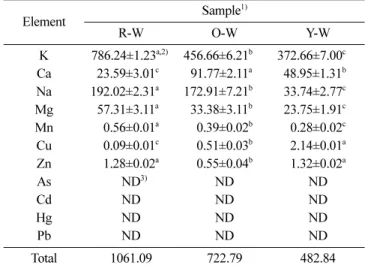
The amounts of mineral elements in different paprika wine samples were significantly different (Table 3). K was the most abundant mineral found in all paprika wine. R-W (786.24 mg/kg) showed the highest amount of K followed by O-W (456.66 mg/kg). The lowest amounts of K, Na, Mg, and Mn were found in Y-W, whereas R-W contained the lowest amounts of Ca and Cu. The total mineral contents of R-W (1061.09 mg/kg) was more than double than that of Y-W (482.84 mg/kg).
The variation in mineral contents of different wine samples might be due the genotypic differences of paprika. Different minerals have various physiological functions in human body. Consumption of high Na and low K is associated with potential risk of hypertension and cardiovascular diseases (Luta et al., 2018). Zn plays roles in growth, development, differentiation, DNA synthesis, RNA transcription, and cellular apoptosis (MacDiarmid et al., 2000).
Antioxidant potential
Antioxidant potential of paprika wine was assessed based on the DPPH free radical scavenging activities and total polyphenol contents. The DPPH radical scavenging activities of R-W (81.23%) was significantly high, whereas the total polyphenol content of Y-W was significantly high among the samples. Kim et al. (2011) reported that different colored and varieties of paprika have significantly different antioxidant potential. This might be the reason for the variations in DPPH radical scavenging activities and total polyphenol content of paprika wine samples.
Table 1. Chemical characteristics of paprika wine prepared with different-colored paprikas
Sample1) Alcohol (%, v/v) pH Titratable acidity2) (g/100 mL) Reducing sugar (mg/L)
R-W 0,11.50±0.10a,3) 3.67±0.10a 0.52±0.03a 0188.5±10.2a
O-W 12.01±0.08a 3.65±0.11a 0.51±0.02a 191.4±9.2a
Y-W 11.80±0.07a 3.71±0.12a 0.54±0.02a 180.3±8.7a
1)R-W: Red paprika wine, O-W: Orange paprika wine, Y-W: Yellow paprika wine
2)As lactic acid
3)Data are means±SD of triplicate experiments. Values followed by different superscripts in the same column are significant different (p<0.05).
Table 2. Hunter’s color values of paprika wine prepared with different-colored paprikas
Sample1) Color value
2)
L (Lightness) a (Redness) B (Yellowness) R-W 0,60.22±0.33c, 3) 1.71±0.01a 15.50±0.16a O-W 63.54±0.07b -0.05±0.01c- 03.47±0.09b Y-W 64.91±0.03a 0.13±0.03b 00.77±0.03c
1)R-W: Red paprika wine, O-W: Orange paprika wine, Y-W: Yellow
paprika wine
2)L: Lightness (100, white; 0, black), a: Redness (-, green; +, red), b:
Yellowness (-, blue; +, yellow)
3)Data are means±SD of triplicate experiments. The values followed
by the different letters in the same column are significantly different (p<0.05).
Table 3. Mineral content (mg/kg) of paprika wine prepared with different-colored paprikas Element Sample 1) R-W O-W Y-W K 786.24±1.23a,2), 456.66±6.21b00 372.66±7.00c00 Ca 23.59±3.01c0 91.77±2.11a0 48.95±1.31b0 Na 192.02±2.31a00 172.91±7.21b00 33.74±2.77c0 Mg 57.31±3.11a0 33.38±3.11b0 23.75±1.91c0 Mn 0.56±0.01a 0.39±0.02b 0.28±0.02c Cu 0.09±0.01c 0.51±0.03b 2.14±0.01a Zn 1.28±0.02a 0.55±0.04b 1.32±0.02a As 0ND3) ND ND Cd ND ND ND Hg ND ND ND Pb ND ND ND Total 1061.09 722.79 482.84
1)R-W: Red paprika wine, O-W: Orange paprika wine, Y-W: Yellow
paprika wine
2)Data are means±SD of duplicate experiments. The values followed
by the different letters in the same row are significantly different (p<0.05).
3)ND: non-detected. Detection limit; Pb; <5 mg/kg, As; <10 mg/kg,
Cd; <5 mg/kg, Hs; <10 mg/kg
Table 4. DPPH radical scavenging activities and total polyphenolic content of paprika wine prepared with different-colored paprikas
Sample1) DPPH (%) Total polyphenol content (GAE2) µg/mL of wine) R-W 081.23±0.12a,3) 69.90±0.12c
O-W 76.57±0.11b 77.91±0.14b
Y-W 76.95±0.11b 93.53±0.10a
1)R-W: Red paprika wine, O-W: Orange paprika wine, Y-W: Yellow
paprika wine
2)Gallic acid equivalents
3)Data are means±SD of triplicate experiments. Values followed by
different superscripts in the same column are significant different (p<0.05).
Quality of paprika wine 595
Conclusion
Paprika wine samples were prepared by fermenting red, orange, and yellow paprikas. The general chemical characteristics of the wine samples were not significantly affected by the type of paprika. Hunter’s color values of wine samples were differed with the color of paprika. Total mineral content and DPPH radical scavenging potential of R-W were significantly high, however, total polyphenol content of Y-W was significantly high among the wine samples. Further studies may be necessary for commercial production of paprika wine.
Conflict of interest
The authors declare no conflict of interest.
References
Aizawa K, Inakuma T. Dietary capsanthin, the main carotenoid in paprika (Capsicum annuum), alters plasma highdensity lipopro-teincholesterol levels and hepatic gene expression in rats. Brit. J. Nutr. 102: 1760-1766 (2009)
Akubor PI, Obio SO, Nwadomere KA, Obiomah E. Production and quality evaluation of banana wine. Plant Food Hum. Nutr. 58: 1-6 (2003)
AlDuais M, Hohbein J, Werner S, Bohm V, Jetschke G. Contents of vitamin c, carotenoids, tocopherols, and tocotrienols in the sub-tropical plant species Cyphostemma digitatum as affected by pro-cessing. J. Agr. Food Chem. 57: 5420-5427 (2009)
Cheung LM, Cheung PCK, Ooi VEC. Antioxidant activity and total polyphenolics of edible mushroom extracts. Food Chem. 81: 249-255 (2003).
Dias DR, Schwan RF, Freire ES, Serôdio RD. Elaboration of a fruit wine from cocoa (Theobroma cacao L.) pulp. Int. J. Food Sci. Tech. 42: 319-329 (2007)
Djamgoz MBA, Isbilen B. Dietary compounds as anti-cancer agents: A preliminary evaluation of ion channels and membrane excit-ability as possible target mechanisms. Turk. J. Biochem. 31: 57-68 (2006)
Duarte WF, Dias DR, Gilberto Pereira VM, Gervásio IM, Schwan RF. Indigenous and inoculated yeast fermentation of gabiroba (Campomanesia pubescens) pulp for fruit wine production. J. Ind. Microbiol. Biotechnol. 36:557-569 (2009)
Gerster, H. Potential role of â-carotene in the prevention of cardio-vascular disease. Int. J. Vitam. Nutr. Res. 61: 277-291 (1991) Giuffrida D, Dugo P, Torre G, Bignardid C, Cavazzad A, Corradinid
C, Dugoa G. Evaluation of carotenoids and capsaicinoids content in powder of red chilli peppers during one year of storage. Food Res. Int. 65: 163-170 (2014)
Jeong CH, Ko WH, Cho JR, Ahn CG, Shim KH. Chemical compo-nents of Korean paprika according to cultivars. Korean J. Food Preserv. 13: 43-49 (2006)
Kim JS, Ahn JY, Ha TY, Rhee HC, Kim SA. Comparison of phy-tochemical and antioxidant activities in different color stages and varieties of paprika harvested in Korea. Korean J. Food Sci. Technol. 43: 564-569 (2011)
Kim JS, An CG, Park JS, Lim YP, Kim S. Carotenoid profiling from 27 types of paprika (Capsicum annuum L.) with different colors, shapes, and cultivation methods. Food Chem. 201: 64-71 (2016) Kim S, Ha T, Hwang IK. Analysis, bioavailability, and potential
healthy effects of capsanthin, natural red pigment from Capsicum spp. Food Rev. Int. 25: 198-213 (2009)
Kim M-O, Kim I-D, Dhungana SK, Lee J-W, Shin D-H. Influence of blueberry and black rice powders on quality characteristics of the Korean traditional rice wine Takju. Food Sci. Biotechnol. 24: 439-444 (2015)
Kim I-D, Lee J-W, Kim S-J, Cho J-W, Dhungana SK, Lim Y-S, Shin D-H. Exogenous application of natural extracts of persimmon (Diospyros kaki Thunb.) can help in maintaining nutritional and mineral composition of dried persimmon. Afr. J. Biotechnol. 13: 2231-2239 (2014)
Lee S, Lee JA, Park GG, Jang JK, Park YS. Semi-continuous fer-mentation of onion vinegar and its functional properties. Mole-cules 22: 1313 (2017)
Lu J, Papp LV, Fang J, Rodriguez-Nieto S, Zhivotovsky B, Holmgren A. Inhibition of mammalian thioredoxin reductase by some flavonoids: Implications for myricetin and quercetin anti-cancer activity. Cancer Res. 66: 4410-4418 (2006)
Luta X, Hayoz S, Krause CG, Sommerhalder K, Roos E, Strazzullo P, Beer-Borst S. The relationship of health/food literacy and salt awareness to daily sodium and potassium intake among a work-place population in Switzerland. Nutr. Metab. Cardiovas. 28: 270-277 (2018)
MacDiarmid CW, Gaither LA, Eide D. Zinc transporters that regulate vacuolar zinc storage in Saccharomyces cerevisiae. EMBO J. 19: 2845-2855 (2000)
Maokaa T, Enjob F, Tokuda H, Nishino H. Biological function and cancer prevention by paprika carotenoids. Food Food ingredients J. Jpn 209: 203-210 (2004)
Maoka T, Mochida K, Kozuka M, Ito Y, Fujiwara Y, Hashimoto K, Enjo F, Ogata M, Nobukuni Y, Tokuda H. Cancer chemopreven-tive activity of carotenoids in the fruits of red paprika (Capsicum annuum L.). Cancer Lett. 172: 103-109 (2001)
Moreno-Arribas MV, Polo MC. Winemaking biochemistry and micro-biology: current knowledge and future trends. Crit. Rev. Food Sci. 45: 265-286 (2005)
Nanos CG, Karayannis MI. Assay of reducing sugars in beverages, wines, honey and marmalades using potentiometric stripping anal-ysis (PSA). Fresen. J. Anal. Chem. 340: 253-257 (1991)
Ough CS, Amerine MA. Methods for Analysis of Musts and Wines. 2nd ed. John Wiley and Sons, New York, NY, USA (1988)
Pino JA, Queris O. Analysis of volatile compounds of pineapple wine using solid-phase microextraction techniques. Food Chem. 122: 1241-1246 (2010)
Reddy LV, Reddy OV. Production and characterization of wine from mango fruit (Mangifera indica L). World J. Microb. Biot. 21: 1345-1350 (2005)
Saranraj P, Sivasakthivelan P, Naveen M. Fermentation of fruit wine and its quality analysis: A review. Aust J. Sci. Technol. 1: 85-97 (2017)
Selli S, Canbas A, Varlet V, Kelebek H, Prost C, Serot T. Character-ization of the most odor-active volatiles of orange wine made from a Turkish cv. Kozan (Citrus sinensis L. Osbeck). J. Agr. Food Chem. 56: 227-234 (2008)
Singleton VL, Orthofer R, Lamuela-Raventos RM. Analysis of total phenols and other oxidation substrates and antioxidants by means of folin-ciocalteu reagent. Methods Enzymol. 299: 152-178 (1999)
Skujins S. Handbook for ICP-AES (Varian-Vista). A Short Guide to Vista Series. ICP-AES Operation. Varian Int. AG, Zug, Switzer-land (1998)
Soufleros EH, Pissa I, Petridis D, Lygerakis M, Mermelas K, Bouk-ouvalas G, Tsimitakis E. Instrumental analysis of volatile and other compounds of Greek kiwi wine; sensory evaluation and optimisation of its composition. Food Chem. 75: 487-500 (2001) Tonin FG, Jager AV, Micke GA, Farah JPS, Tavares MFM.
Optimi-zation of the separation of flavonoids using solvent-modified micellar electrokinetic chromatography. Electrophoresis 26: 3387-3396 (2005)